


The survey, released last week by the Milwaukee Jewish Federation, found that 43% of Jewish adults said they identified as Zionist, while 42% said they did not. A much higher share, 69%, said they feel somewhat or very “emotionally attached to Israel.” At the same time, 52% of respondents agreed that “Israel regularly violates the human rights of the Palestinian people.”
Milwaukee, WI
South side residents urge railroad company to clean up illegal dumping


As garbage continues to pile up on the train tracks behind their homes, neighbors on South 15th Place are urging the city and railroad company, Union Pacific, to address the illegal dumping.

See neighbor describe piles of trash near Union Pacific train tracks
Anna Zarnowski and her neighbors hope the city and Union Pacific will collaborate to clean up a mess left by illegal dumpers in her neighborhood.
Rats, cockroaches and piles of trash are frequent sights for some neighbors living near Pulaski Park on South 15th Place on Milwaukee’s south side.
The alley behind their homes and the train tracks beside the alley have become an illegal dumping ground for unwanted furniture, car tires, shopping carts, gallons of motor oil and large bags of trash.
Anna Zarnowski, who has been living on the street for 10 years, said this has been an issue since she moved in, but it’s ramped up in recent years.
She said she filed more than 10 complaints through the City of Milwaukee’s Click4Action app and said she’s called the office of her local alderman, 12th District Ald. Jose Perez, about the issue, on several occasions.
“I love the south side. You want to see it succeed and be great, and at least just be comfortable and clean,” Zarnowski said.
“It’s not too much to ask for.”
Each time she calls or files a complaint, the garbage in the alley behind her home is removed. However, the train tracks are on private property owned by the railroad company, Union Pacific.
“The city says it’s not their responsibility — then it just sits,” Zarnowski said.
In several of Zarnowski’s complaints, she’s included photos of garbage piling up on the ground by the train tracks. Some of the garbage has been on the ground near the tracks for at least four years, she said.
“It’s a concern. You don’t want to have vermin around,” Zarnowski said.
Illegal dumping is impacting several neighbors
Christina Ornelas, 41, has owned a home on South 15th Place for 10 years.
When she moved in, she noticed garbage piling up on the street and along the train tracks.
“It’s like they clean, and then the next day there’s already a lot of garbage,” Ornelas said, in Spanish, adding that the waste on the train tracks remains even if the waste on the streets is removed, leading to pest issues.
Ornelas has not yet called the city about the illegal dumping near her home, but said she wishes the city and the owners of the train tracks could come together to find a solution to prevent illegal dumping, for example, by adding cameras to the road to discourage the activity.
The city’s Department of Neighborhood Services processes some illegal dumping complaints, but most dumping complaints are addressed through a collaboration of other departments, including the Department of Public Works, according to Jeremy McGovern, the Neighborhood Services’ marketing and communications officer.
Neighborhood Services can help mitigate the problem by implementing some preventative measures to reduce illegal dumping, like installing cameras and traffic control measures to prevent access to the area, sending violation orders, or teaching neighbors how to report the issue to the city, McGovern said.
While Neighborhood Services is willing to provide this support, the illegal dumping taking place on the tracks behind Ornelas and Zarnowski’s homes is primarily the responsibility of Union Pacific.
Steps taken so far by Neighborhood Services
On Nov. 24, the department sent Union Pacific a violation order to remove the waste from its property behind Zarnowski’s home on South 15th Place by Dec. 3, 2025.
The railroad company can still file an appeal, which must be filed within 20 days, according to the violation order obtained by the Journal Sentinel.
Failure to comply with the order or file an appeal could result in prosecution or fines ranging from $150 to $10,000, according to the violation order report.
A representative from Union Pacific said the company plans to remove the waste on the train tracks following the new violation order sent by Neighborhood Services.
“Despite several clean-ups over the years, and another scheduled soon, illegal dumping at this site is a challenging issue that often returns just as quickly as we address it,” Union Pacific communications manager Robynn Tysver said in an emailed statement to the Journal Sentinel.
The last violation order sent to Union Pacific for the train tracks behind Zarnowski’s home was sent in April 2021.
This resulted in Neighborhood Services hiring its own contractor to clean the train tracks and billing the private company $835.66 for the clean-up, which it paid in full, according to McGovern.
A year later, on April 24, 2022, the train tracks were once again filled with garbage, and Zarnowski said she filed a new complaint.
Union Pacific declined to comment on why the previous violation order placed on the company to remove waste on the tracks resulted in an invoice from Neighborhood Services for the waste removal.
Elected officials respond to illegal dumping on railroad
Ald. Perez said Union Pacific is “historically difficult to work with … they are not the most responsive to any concerns.”
Perez said while his office has no record of Zarnowski’s calls, if the dumping on the train tracks near South 15th Place continues to be a nuisance for neighbors, his office is willing to collaborate with Neighborhood Services on a proactive solution to prevent the illegal dumping.
He also said his office would work with the City Attorney’s office to hold Union Pacific legally accountable to address the issue, if needed.
According to McGovern, Neighborhood Services is also willing to work with private property owners, like Union Pacific, regardless of the type of property, to discuss solutions for abatement and compliance.
However, Perez said he believes these kinds of issues would be better addressed if city departments worked more collaboratively on lasting solutions.
If one department arrives to conduct an illegal dumping clean-up, they could sweep the area to look for other possible concerns to refer to other departments, which would help address issues before they become a nuisance to neighbors, Perez said. This would ensure neighbors don’t need to file several complaints before an issue is escalated.
“These systems aren’t talking to one another … the accountability even between interdepartmental referrals is loose,” Perez said. “They’ve got to fix the system beyond the moment and the complaint in real time.”
Zarnowski said she hopes the waste is removed before heavy snow falls and freezes the garbage to the ground for another season.
“They [Union Pacific] should take some kind of action on it,” Zarnowski said. “If it’s their property, they should have some responsibility in keeping things tidy or at least trying to prevent it from happening.”
How to file a complaint for illegal dumping on private property
Neighbors impacted by illegal dumping on private property near their home can submit a complaint through the Click4Action App or by calling Neighborhood Services at 414-286-2268. For non-English speakers, bilingual staff members are available to assist, McGovern said.
If the dumping is on private property, they should make a note on the app or inform the operator, McGovern said. If a neighbor is unsure of whether the waste is located on private or city-owned property, Neighborhood Services can help verify the property owner and file the complaint appropriately.
Once the complaint is submitted, the city can schedule an inspection to verify it and then issue a violation order to the owner of the private property to remove the waste if needed, McGovern said.
If the waste is not removed after a given period, Neighborhood Services can hire a contractor to remove the waste and send a bill to the property owner, McGovern said.
If a resident files a complaint about illegal dumping and it’s on public or city-owned property, Neighborhood Services can escalate the complaint to another department, such as the Department of Public Works, McGovern said.
Alyssa N. Salcedo covers Layton Boulevard West for the Journal Sentinel’s Neighborhood Dispatch. Reach her at asalcedo@gannett.com. As part of the newsroom, all Alyssa’s work and coverage decisions are overseen solely by Journal Sentinel editors.
Support for this effort comes from the Zilber Family Foundation, Journal Foundation, Bader Philanthropies, Northwestern Mutual Foundation, Greater Milwaukee Foundation and individual contributions to the Journal Sentinel Community-Funded Journalism Project. The project is administered by Local Media Foundation, tax ID #36‐4427750, a Section 501(c)(3) charitable trust affiliated with Local Media Association.
Learn more about our community-funded journalism and how to make a tax-deductible gift at jsonline.com/support. Checks can be addressed to Local Media Foundation with “JS Community Journalism” in the memo, then mailed to: Local Media Foundation, P.O. Box 85015, Chicago, IL 60689.


Milwaukee has officially joined the Global Swimmable Cities Alliance, aligning with other Great Lakes communities like Sheboygan and Ottawa in a growing movement to make urban waterways safer for recreation.
Milwaukee Riverkeeper Cheryl Nenn joined WTMJ’s Jeff Sherman on The Upswing to discuss what that means for the city. With a background in environmental science and experience working with both the City of New York and the U.S. Forest Service, Nenn says joining the alliance builds on years of water quality progress – while also creating accountability through a clear action plan.
Efforts are already underway to improve both safety and accessibility. Nenn says Milwaukee Riverkeeper is pursuing grants to install more safety ladders along lower piers throughout the river system, ensuring that anyone who ends up in the water has a way to get out. At the same time, the organization is working with the city and local businesses to green riverfront areas, creating healthier habitats for wildlife and improving the overall ecosystem.
Nenn emphasized that becoming a swimmable city is a community effort. Residents can play a role by picking up trash along beaches and rivers, keeping streets and storm drains clean, and reducing plastic use.
The Upswing is presented by Horicon Bank.
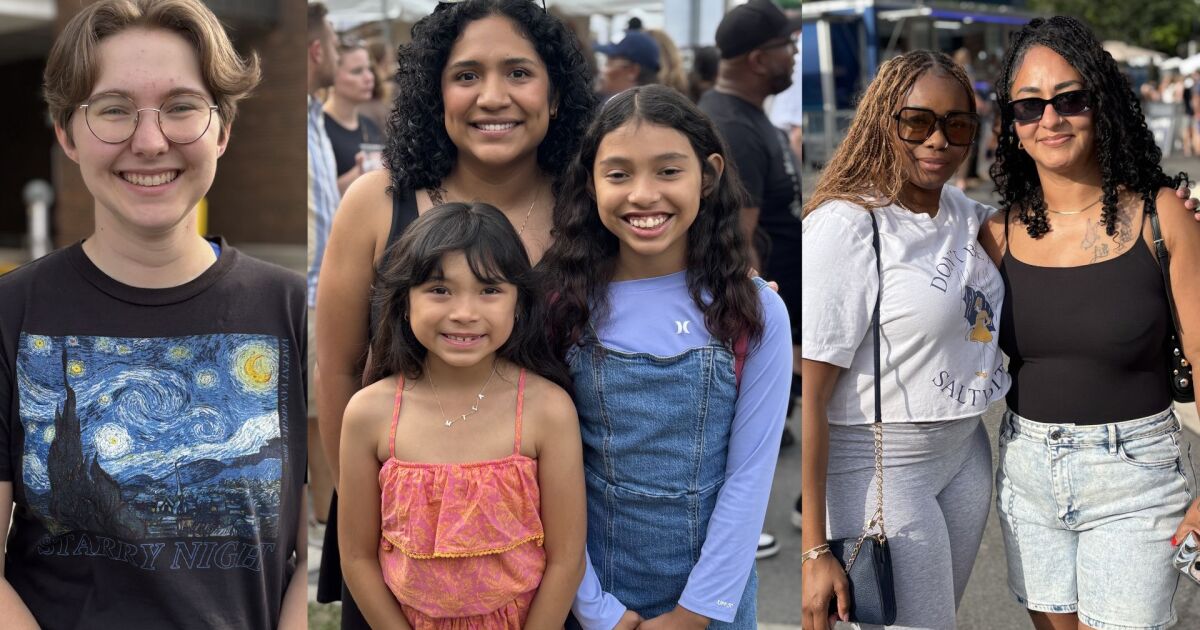
MILWAUKEE — Bastille Days and Festa Italiana are filling downtown Milwaukee with live music, food and large crowds this weekend.
For many, events like these are a summer tradition.
“The festivals for the summertime-they’re something to do like almost every single day and almost most definitely every single week,” Natara Riley said.
But some festivalgoers say outside of these big events, downtown’s entertainment scene isn’t what it used to be.
“I grew up partying on Water Street. I won’t go there no more at all,” Leandra Wohner said.
“I think it’s the city is not upkeeping the entertainment that people need to have fun. So when something does happen, like Bastille Days or other festivals, a lot of people tend to go to it because there’s not a lot of room for like activities for people,” Riley said.
Watch: Festivalgoers say Milwaukee’s summer events fill a gap in downtown entertainment
It’s a weekend of festivals in downtown Milwaukee
Festivalgoers say events like these give people a chance to enjoy live music, support local vendors, and try new foods — all in an environment they feel is well organized.
“I feel like it’s safe. They block off the roads, especially where there’s a lot of people walking around, and you know, parking wasn’t hard to find either. So it’s very-I want to say-I feel like it’s very well put together,” Dana Garcia said.
For those who may be hesitant about coming downtown, Emma Maertz offered this encouragement.
“If you never give it a chance, you never discover all the wonderful little vibrant things out here on the streets, and so I’d say give it a chance. You know, come down, see what it’s like, walk around, try out a street festival, park a few blocks away, and explore a new area,” Maertz said.
Let’s talk:
Hey there! At TMJ4 News, we’re all about listening to our audience and tackling the stuff that really matters to you. Got a story idea, tip, or just want to chat about this piece? Hit us up using the form below. For more ways to get in touch, head over to tmj4.com/tips.
It’s about time to watch on your time. Stream local news and weather 24/7 by searching for “TMJ4” on your device.
Available for download on Roku, Apple TV, Amazon Fire TV, and more.
Report a typo or error // Submit a news tip
Milwaukee, WI
Survey finds less than half of Jews in Milwaukee identify as Zionists | The Jerusalem Post

Yet another survey has found that fewer than half of Jews in an American city identify as Zionists, this time in Milwaukee, the childhood home of Golda Meir, the Zionist icon and former Israeli prime minister.
The results join a growing number of similar data points generated by Jewish groups that point to evolving, and at times seemingly contradictory, views about Israel among American Jews. A survey released in February by Jewish Federations of North America, an umbrella group, found that 37% of Jews identified as Zionist even as 88% believed that “Israel has the right to exist as a Jewish, Democratic state.”
The findings cut across North American Jewish communities of different regions and sizes and are prompting Jewish leaders to reexamine their assumptions at a time when Israel is shedding support among Americans of all backgrounds.
“A year ago I really would have had a knee-jerk reaction where I was stuck on the word, because I am a Zionist,” Miryam Rosenzweig, the Milwaukee federation’s president and CEO, told the Jewish Telegraphic Agency about her views on the survey. “What I needed to overcome and understand is that, as a brand, it’s tarnished.” The word, she said, “is tainted.”
‘The values are still there’
Yet, Rosenzweig insisted, for her Jewish community, “the values are still there.”
The Milwaukee area is home to an estimated 27,500 Jews who attend more than a dozen synagogues and six Jewish schools. The local federation operates a number of programs directly and supports a wide range of education, cultural, religious and security initiatives meant to strengthen the Jewish community. (It also gives to a number of national Jewish organizations, including a small grant to 70 Faces Media, JTA’s parent company.)
The local survey, completed by 980 families, was conducted between December 2024 and March 2025, at a time when criticism over Israel’s handling of the war in Gaza was sharply mounting. More than 100 hostages taken when Hamas attacked Israel on Oct. 7, 2023, triggering the war, were still in captivity at the survey’s start, while dozens were released during a temporary ceasefire midway through the survey period.
Conducted by researchers at Brandeis University and the University of Chicago’s NORC social research firm, the survey is the federation’s first deep dive into its Jewish population since 2011. It was conducted by email, mail and phone, with options to complete the survey online or over the phone, and has an overall margin of error of 6.5%.
The survey asked about a wide range of topics and, Rosenzweig said, has illuminated unique challenges for the federation, including the region’s aging Jewish population and its relatively lower average household income when compared to similarly sized Jewish communities.
High levels of Jewish ‘participation’
The data also offered unique bright spots, such as high levels of what Rosenzweig classified as Jewish “participation.”
Three-quarters of Jewish children in the area’s interfaith households are being raised Jewish, for example, and nearly one in four of all Jewish children in Milwaukee are enrolled in a Jewish day school or yeshiva, higher than the national average.
But it is the Zionism question that has seized public interest, in part because it was asked at all.
For decades, according to Matthew Boxer, a researcher at Brandeis’s Cohen Center for Jewish Studies who led the Milwaukee study and has worked on many others, local federations conducting population studies would ask about topics such as emotional attachment to Israel, but largely refrained from directly asking their communities whether they identified as Zionists.
That changed with the 2020 Chicago federation survey, also led by Boxer’s team, which found that 40% of the region’s Jewish adults self-identified as Zionist while 80% agreed with the statement “It’s important for Israel to be a Jewish state.”
Since then, Boxer said, around a dozen federations have opted to ask some version of the Zionism question on their surveys. Recently released findings from the federations in Boston and St. Louis found similar results to Chicago’s and Milwaukee’s; new survey results in Austin, Texas, and Orange County, California, are expected later this year. (Some have decided against including the question, too.)
The findings have functioned as something of a Rorschach test for American Jews. Those who are deeply critical of Israel say the fact that a minority of American Jews identify as Zionists prove that American Jewish groups should roll back their support for and engagement with Israel. Those who want to preserve the historic relationship urge looking beyond the label and focusing on the fact that a significant majority of Jews are aligned in their support for traditional tenets of Zionism.
In an essay for JTA published after the national federations group released its survey, Mimi Kravetz, JFNA’s chief impact officer, concluded that most Jews still believe in the “historic definition” of Zionism, while conceding that the term has gone through “definition creep.” She urged federations to “open pathways for learning and belonging,” and avoid “responding with anger when the moment calls for steady leadership.”
For Rosenzweig, who came to Milwaukee in 2019 after years working with Jewish young professionals at Detroit’s federation, polling her community about Zionism was a no-brainer even when they were first conceiving the survey before Oct. 7. “We have to ask the question,” she said.
“The demographic study is not meant to answer what we want to hear,” she said. “We need to know where they stand, where do people agree and disagree?”
While the survey found a split on Zionist identification, it found broad consensus on other issues, sometimes ones that are in tension with each other. For example, 84% of Milwaukee Jews somewhat or strongly agreed with the statement, “I consider it important for Israel to be a Jewish state.” At the same time, 88% agreed that “Israel should be a democratic state for all of its citizens, regardless of religious identity.”
Two ideas could coexist
Rosenzweig said she believes the two ideas could coexist. “Our community can support Israel and support Israel’s right to exist and be a Jewish state, and they’re concerned for the human dignity of Palestinians. It’s not binary,” she said. “And I think that’s really an important message about who American Jews are.”
Rabbi Noah Chertkoff, who leads the Reform Congregation Shalom in the suburb of Fox Point, said he wasn’t surprised by the survey results on Zionism but cautioned against drawing too many conclusions from them.
“I proudly identify as a Zionist, but I also recognize that the word itself has been badly distorted and, at times, deliberately defamed by people more interested in vilifying Jews than engaging seriously with Jewish history, Jewish belief and the Jewish people’s own understanding of our story,” he wrote in an email to JTA.
Chertkoff added that his own congregants have expressed both “real anguish” over Oct. 7, as well as concerns for democracy in Israel and “the suffering of civilians on all sides of the conflict.” He added that the survey should be read as a “mandate”: “If we want the next generation to inherit a durable connection to Israel and Zionism, we cannot rely only on inherited labels.”
Rabbi Lex Rofeberg, a Milwaukee native who runs the alternative Jewish engagement network Judaism Unbound from his current home in Rhode Island, said he believed the survey is surfacing more than mere confusion over the word Zionism.
“As a person who would self-identify as ‘not a Zionist,’ I hope that Jewish organizations in Milwaukee, and beyond, would respond to this finding not by trying to shift my beliefs, or by insisting that I don’t really know what I’m opposing,” he wrote in an email. “I’d hope instead they’d recognize the reality that ‘I’m not a Zionist’ is a sincere, deeply-held belief for a lot of Jews all around the world, and that includes just over 40% of Jews in the greater Milwaukee area.”
Jewish institutions, he suggested, “should respond to lower support for Zionism not with ‘how do we re-brand Zionism’ but rather ‘how can we create meaningful Jewish experiences for folks who are actively not Zionists?’”
Jewish Milwaukee, which Rofeberg calls “awesome” and credits with having “shaped me as a person and a Jew,” could achieve this, he insists.
What the federation does with this new information is still to be determined. Rosenzweig is currently drafting “a very extensive strategic plan,” she told JTA, but said it was too early for specifics. She does hope to focus on points of commonality, rather than trying to convince half of the local Jews they are, or should be, Zionists.
For inspiration, Rosenzweig has been dusting off Milwaukee’s community survey from exactly a century ago. (Meir had already moved to Palestine by way of Denver at the time.) Back then, she said, the community was roughly the same size it is now, and its Jewish funding arms were raising roughly the same amount of money, adjusted for inflation.
“It was talking about the ‘Campaign for Palestine,’ in 1926, because the Jews of Eastern Europe had nowhere to go,” Rosenzweig said. “They were worried about it then. And so today, we’re responding to the moment. And yes, it looks dark. There were dark days, and we survived because we came together. We know how to do this.”
-

 Los Angeles, Ca45 minutes ago
New details emerge in fatal stabbing of boy in El Monte
-

 Detroit, MI1 hour ago
1 dead, 1 injured after two-vehicle crash at Collingwood and Belleterre in Detroit
-

 San Francisco, CA1 hour ago
4 arrested, 3 cited after brawl following Giants vs. Rockies game at Oracle Park
-

 Dallas, TX1 hour ago
Mark Cuban takes legal action against Dallas Mavericks ownership over potential new arena deal
-

 Miami, FL1 hour ago
South Florida Dirt: A timeline of the Vacchi vs. Stern legal battle
-

 Boston, MA2 hours ago
Tall Ships begin historic Boston parade of sails
-

 Denver, CO2 hours ago
Lakers Proposed to Land Peyton Watson in Massive 9-Player Blockbuster Trade
-

 Seattle, WA2 hours ago
Cyclists fill backroads for annual summer Seattle-to-Portland ride

