Midwest
Meet the American who created highway rest areas, Allan Williams, small-town engineer

The Motor City ignited the roar of the 1920s.
Chrysler, Ford and General Motors, each in Detroit, Michigan, emerged as the world’s three biggest automakers early in the Roaring ’20s. Customers needed somewhere to go to make their engines purr – and a safe, convenient way to get there.
The job fell upon the shoulders of small-town Michigan visionaries who paved the way for the automobile to leave the city and become synonymous with the open American highway.
Allan Williams, the first-ever highway engineer in rural Ionia County, proved perhaps the most influential among them.
MEET THE AMERICAN WHO STITCHED TOGETHER THE STARS & STRIPES, BETSY ROSS, REPUTED WARTIME SEDUCTRESS
He conceived and created America’s first roadside rest area in 1929. The idea took off faster than a big-block Motown muscle car 40 years later.
The highway rest stop, however, was only the most visible of the many contributions Williams made to the speed, safety and convenience of the American highway system we all benefit from today.
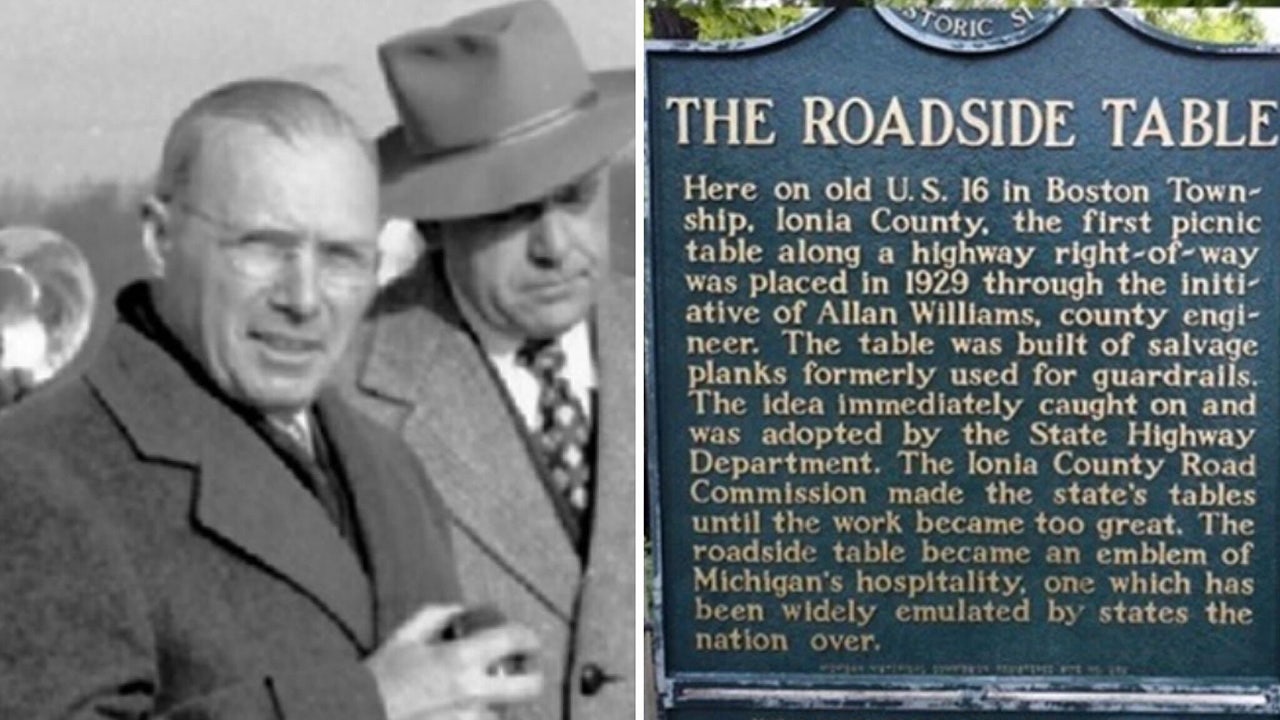
Allan Williams, standing, of the Ionia County Road Commission speaking at a City of Ionia, Michigan, bridge dedication luncheon. (Michigan Department of Transportation)
“He was living at a time when he had the ability to really do some big things and make some big changes in Michigan, but also actually in our nationwide history,” Sigrid Bergland, a historian with the Michigan Department of Transportation, told Fox News Digital.
Highway road maps, road signs and even snow plows were all influenced by his curiosity, intellect, varied skills and vision.
“He really was a Renaissance man.”
Williams also proved a civic leader in both peacetime and wartime.
He helped improve the roads less traveled in his small-town life.
“He was really an interesting Michelangelo-type of all-around interesting guy who did a lot of different things over his lifetime and who just happened to be a transportation engineer,” said Bergland. “He really was a Renaissance man.”
Fun, freedom and ‘automobiling’
Allan Mackenzie Williams was born on Jan. 26, 1892 in Ludington, Michigan, to Joseph and Isabelle (Cogswell) Williams.
The future American roadmaster apparently inherited his varied interests and natural gifts for fixing things from his father.
Roadside picnic on the way to Wisconsin, 1917. Mary E. Smith is seated with a friend on a white blanket with thermoses and a picnic basket. Their automobile is parked on the side of the road next to a fence. (Historical Society/Getty Images)
The elder Williams jumped from a career as a camp cook to one as an electrical engineer, according to the Michigan DOT.
“He opened and ran an electrical shop,” the state agency notes, “and went on to wire the first home in Ludington with electricity.”
MEET THE AMERICAN WHO INVENTED THE GAS-POWERED TRACTOR, ENTREPRENEUR JOHN FROELICH, HELPED FEED THE WORLD
The younger Williams studied engineering at the University of Michigan in Ann Arbor before transferring to Kalamazoo College, in Kalamazoo.
He found his life’s calling in 1919, still only in his 20s, when he was hired as county engineer for the Ionia County Road Commission.
Few roads were even paved at that point, notes Bergland of Michigan DOT.
Chuck “The Viking” Hayden, publisher of the travel blog restles-viking.com, at the first American highway rest stop: Route 16, Ionia County, Michigan. (Martha and Chuck Hayden/restless-viking.com)
But automobiles built 130 miles east in Detroit were getting more affordable, growing in popularity and spilling out across the American countryside.
“The elite chauffeur-driven crowd was about to be surpassed by a general public that wanted the fun and freedom that came with ‘automobiling,’” auto journalist Nick Kurczewski wrote in 2016.
The “public … wanted the fun and freedom that came with ‘automobiling.’”
Michigan highway engineers were the first people in a position to witness, then shape the future of automobile travel. Convenience was an early need.
Williams, apparently before the winter of 1928, “saw a family trying to eat a picnic lunch from a big tree stump alongside their parked automobile on one of the roads under county jurisdiction,” American Road Builder magazine reported in 1957.
Detroit, Michigan: Ford family and friends out for a drive on Detroit street in the 1906 Model K-6 cylinder auto. Left to right: Henry Ford, Leroy Pelletier, Clara Ford, Edsel Ford, and a telephone operator. (Getty Images)
“[They] had an appetizing snack spread out on a white cloth on the stump, but they couldn’t really enjoy the food because they couldn’t sit around their makeshift table, and had to content themselves with standing around or sitting on rocks or bare ground to eat their food.”
MEET THE AMERICAN WHO MAPPED THE US-MEXICO BORDER, GEN. WILLIAM EMORY, SHAPED NATION IN WAR AND IN PEACE
Williams had some extra wood lying around the Ionia Country Road Commission garage – and a vision.
‘Thought he was going to get a bawlin’’
The automobile first became a major part of the American landscape in the 1920s.
The number of cars registered in Michigan alone more than quadrupled during the decade, from 326,000 in 1919 to 1.4 million in 1919.
Williams witnessed similar scenes of travelers eating on the side of the road with increasing frequency.
A General Motors assembly line showing an early engine drop, circa 1920. (Fotosearch/Getty Images)
“An outdoorsman himself, he decided that people should have better facilities for resting and refreshing themselves along the highways,” according to the American Road Builder account.
“During the winter months, when some of his snowplowing crews were standing by at the county garage waiting for an expected storm, he put them to work knocking together picnic tables from odd lengths of 2×4 scrap lumber.”
For more Lifestyle articles, visit www.foxnews.com/lifestyle
He used “leftover guardrail wood or other surplus timber” according to Michigan DOT, while the tables “probably had plenty of splinters sticking out,” notes Bergland.
Allan Williams, the county engineer for the Ionia County (Michigan) Road Commission, created the first highway rest area in the U.S. on Route 16 in Michigan in 1929. (Michigan Department of Transportation)
The tables were painted green and placed on Route 16, three miles south of the Village of Saranac.
“My dad thought he was going to get a bawlin’ out for using that planking,” the engineer’s son, Colin Williams, then 84, said in a 2011 interview with MLive.com.
William’s roadside rest area, in today’s terms, went viral.
The “bawlin’” never came.
Instead, acclaim came from far and wide. Williams’ roadside rest area, in today’s terms, went viral.
MEET THE AMERICAN WHO PAVED THE WAY FOR THE INTERSTATE, GEN. LUCIUS CLAY, MASTER PLANNER, HERE OF TWO NATIONS
“The state highway department received more than 500 pieces of written feedback at table locations, from motorists as far away as Washington, Florida and Texas,” according to the MLive.com account.
Williams’s vision for highway respite spread about as fast as construction crews could pour the concrete for new roads.
A sign on Route 16 in Ionia County, Michigan, marks the site of the first highway rest stop in the United States. (Martha and Chuck Hayden/restless-viking.com)
Nearly 1,500 picnic tables had been placed around Michigan by 1937, many of the earliest built by Williams’ staff in Ionia County.
The state eventually took over the responsibility. The roadside picnic table total in Michigan reached 2,500 by 1947.
There are 1,400 full-service highway rest areas just along U.S. Interstate highways today, according to InsterstateRestAreas.com.
They offer countless picnic tables and seats among them.
‘Just some guy in small-town Michigan!’
Allan Williams passed away on June 3, 1979.
He was 87 years old and is buried in Lakeview Cemetery in his hometown of Ludington.
Allan Williams, far left, at M-66 bridge dedication ribbon cutting ceremonies in Ionia, Michigan. (Michigan Department of Transportation)
“Michigan was definitely the location of many ‘firsts’ in transportation — and especially highway — history,” Chris Bessert, the publisher of MichiganHighways.org, wrote in an email to Fox News Digital.
Williams, he writes, was at the center of it all.
“He designed and issued the first state highway road map … He championed the construction of highways on rights-of-way wider than the standard 66-foot space used to that point, he designed Michigan’s state highway route marker and widened its use, and a variety of other firsts.”
“The state highway department received more than 500 pieces of written feedback at table locations.”
William’s impact was also felt close to home.
“He left a legacy in Ionia County,” traveler bloggers Martha and Chuck “The Viking” Hayden write on restless-viking.com.
He served for many years as president of the Ionia County Free Fair, still one of the largest in the state, helped engineer Ionia County Airport, and was chairman of the county hospital board.
The first highway rest stop in 1929 consisted of a few roadside picnic tables on Route 16 in Michigan. They quickly became an American phenomenon. South of the Border in Dillon, South Carolina, is one of the nation’s gaudiest roadside attractions. John Margolies Roadside America Photograph Archive, 1986. (Universal History Archive/Universal Images Group via Getty Images)
When the United States entered World War II, Williams oversaw Ionia County’s efforts to turn scrap metal into munitions.
“He was very civically minded, very interested in helping people and finding different ways to give back to people and to contribute to his community,” said Bergland of Michigan DOT. “He was a big-picture guy.”
Gov. William Milliken honored Williams with a Michigan Tourism Award in 1976, recognizing the contributions the engineer’s work made to encouraging visitors to the state.
There is some dispute, however, over the Williams rest-area origin story.
“Some documentation indicates that Connecticut established its first site in 1928,” reports RestAreaHistory.org. “More solid evidence, however, points to Michigan and a site created in 1929.”
Other evidence suggests that Herbert Larson, a road commissioner in Iron County, on Michigan’s Upper Peninsula, erected roadside picnic tables as early as 1919.
Allan Williams, far left, was the first engineer for the Ionia County (Michigan) Road Commission when he conceived the first U.S. highway rest area in 1929. A sign marks the American roadside landmark today on Route 16 in Michigan. (Michigan Department of Transportation; Martha and Chuck Hayden/restless-viking.com)
But Larson’s was a standalone occurrence, according to Bessert, while Williams created what became a state and then national phenomenon.
“Williams’ role in the early development of Michigan’s highway system was copied and duplicated around the world,” writes Bessert.
“It’s something that shouldn’t be minimized. And this was just some guy in small-town Michigan!”
To read more stories in this unique “Meet the American Who…” series from Fox News Digital, click here.
Read the full article from Here


Michigan basketball entered Friday having lost nine straight games to Illinois. With the sole regular-season matchup coming in Champaign against the KenPom No. 4 Illini, it was going to be a tall task for the Wolverines to end that streak.
The game matched up the nation’s No. 2 defense against the No. 1 offense, and in front of a raucous Orange Krush, the maize and blue took a little while to get into an offensive rhythm. Because the No. 5 offense is no slouch, especially against the No. 31 defense. What’s more, Morez Johnson Jr. returned to Champaign after spending his first year with Illinois.
However, the Illini certainly showed how much Michigan appears to be their rival, and really played a physical brand of basketball. After Illinois got a five-point lead, the Wolverines bounced back and got a six-point lead. Illinois had a slight advantage in the first half on the boards, but the Wolverines had a field goal advantage. Both teams were relatively even on turnovers.
Ultimately, Michigan ended up taking a seven-point lead into the locker room at halftime, but backup point guard LJ Cason appeared to have hurt his knee on the final score of the half.
The second half started with a Michigan layup and an Illinois 3. The next round of scoring went exactly the same way. But then Yaxel Lendeborg hit a 3 to stop the asymmetry. They traded baskets, but then after a few Illinois turnovers, the Wolverines pushed the lead to 10.
Cason returned to the game after the under-16 media timeout, providing (temporary) good news for the maize and blue (he would leave the game again shortly). But the Wolverines missed a few shots, and Illinois took advantage, getting a shot from the field by Mirkovic before Wagler hit a 3 to cut the lead to five, prompting a Michigan timeout with 13:09 remaining.
Illinois cut Michigan’s lead back down to six, but Yaxel Lendeborg stretched it back to nine with a layup-and-one. Then Aday Mara started taking over.
Mara was unguardable, scoring floaters, dunks, and putbacks. His quick 7 points put the Wolverines up to a game-high of 14 with 9:13 remaining. The Illini answered to end the nearly three-minute field goal drought, ending Michigan’s 7-0 scoring run. But the Wolverine defense held, and Trey McKenney finally hit his first (of three) 3-point attempts to push the lead to 15, and he hit again on the next trip, pushing the lead to 18 with 7:34 left in the game. It was a 13-2 scoring run for the maize and blue.
After an Illinois timeout, they missed again, and Will Tschetter got in on the contagious, 3-pointer action, pushing the lead to 21. Cadeau finally broke the makes from deep, and Wagler hit to cut the lead back to 18 with 5:41 remaining.
Illinois couldn’t mount a comeback, and Michigan won, 84-70. Here are our five takeaways.
Homecoming for Morez Johnson Jr.
An Illinois native who spent his first year with the Illini, the Orange Krush did as much as it could to make it uncomfortable for the outgoing transfer. However, it wasn’t the case, as Johnson was often the best player on the floor.
He was the only Michigan basketball player in double digits at halftime, with 13 points, five rebounds, and a steal, and he was something of an energizer bunny out on the floor for the Wolverines. There were no qualms for Johnson returning to his old stomping ground, as he played one of his best games in a maize and blue uniform.
Johnson was quiet in the second half, but the damage was done, and it makes his former teammate’s pregame comments more prescient:
What could have been.
Johnson finished with a double-double, scoring 19 points and netting 11 rebounds.
Michigan’s offense outplays Illinois’ offense
As noted, the Illini entered the game with the No. 1 overall offense, while the Wolverines were No. 5. Yet, when the rubber hit the road, it was the maize and blue who had the superior offensive attack, managing to shoot 52.5% overall and 60% in the second half. Illinois managed 41.3% and 43.3% respectively.
The Michigan defense forced Illinois to go through a series of uncomfortable stretches in the second half, with multiple three-minute droughts from the floor. And Illinois, which is accustomed to getting to the foul line, couldn’t seem to draw many fouls until relatively late in the game. Even when the Illini forced three Wolverine turnovers late, they couldn’t seem to take advantage.
Ultimately, Michigan was dominant on both ends of the floor.
Bench, fastbreak, and points in the paint
The Wolverines dominated all three categories, finishing the game with 20 bench points, 10 fastbreak points, and 42 points in the paint. We already discussed Johnson and his homecoming, but we cannot leave out Aday Mara, who was just such a mismatch for Michigan vs. the Illini. As noted, Mara really flexed late in the game, taking it over. He was the catalyst for most of these stats.
Meanwhile, Illinois only had 7 bench points, 1 fastbreak point, and was just behind Michigan with 32 points in the paint.
The streak was emphatically broken
As we said in the open, the Illini had beaten the Wolverines nine straight times. Even the Fab Five couldn’t beat Illinois in Champaign, as the maize and blue have historically struggled at State Farm Arena. Though it took some time for the Wolverines to flex, flex they did, and this was as emphatic of a win as Michigan had all season.
The final score may have been just a 14-point gulf, but honestly, the game wasn’t really that close (and it hadn’t been for most of the final 10 minutes). This was a huge win for the Wolverines, one that’s been years in the making. If not decades.
With the win over Illinois, Michigan has won the outright Big Ten regular-season title.
No. 1 overall seed back in the realm of possibility
It may come down to the Big Ten Tournament now that Michigan has lost the head-to-head with Duke. And the Blue Devils’ 54-point win over Notre Dame pushed them into the No. 1 NET ranking, stealing it away from the maize and blue. But with a win over the No. 4 NET-ranked Illini, the Wolverines have the second-best win in college basketball (behind Duke, of course). They also have wins over No. 5 Gonzaga, No. 7 Purdue, No. 11 MSU, No. 12 Nebraska, and will face No. 26 Iowa on the road next week.
There’s a strong case for the maize and blue to have the No. 1 overall seed given the levels of domination over most all of the aforementioned teams.

WHITELAND, Ind. (WISH) — “The Zone” featured highlights from eight high school boys basketball games from across central Indiana on Friday.
Watch highlights of Beech Grove at Whiteland above.
Final Score: Whiteland 89 Beech Grove 61
“The Zone” airs each Friday at 11:08 p.m. Click here to watch ‘The Zone’ for basketball highlights on February 27, 2026.

The fourth and final bunch of Iowa high school boys basketball substate championship games are now set after the second round of Class 4A games were completed on Friday, February 27.
Substate championships in Iowa’s largest classification will take place on Tuesday, March 3, with the higher seed serving as host in all eight games. Winners advance to Des Moines, Iowa and the Casey’s Center to compete in the Iowa High School Athletic Association Boys State Tournament beginning March 9.
Three-time defending 4A state champion Valley was eliminated by Ankeny, 72-36. The Tigers, who lost all five starters from a year ago, won just one game prior to earning a victory in the opening round of postseason play.
Cedar Falls, who has held the No. 1 spot in 4A throughout the season, scored a dominating 78-45 decision vs. Iowa City High to move on.
Colin Rice, a Nebraska commit for Fred Hoiberg, scored a single-game school-record 50 points as Waukee Northwest topped Iowa City Liberty, 101-58.
Council Bluffs Lincoln, Ames, North Scott, Dowling Catholic, Dubuque Senior, Johnston, Linn-Mar, Muscatine, Norwalk, Cedar Rapids Prairie, Des Moines Roosevelt, Urbandale and Waukee all joined them in the next round after winning games at home.
The 1A and 2A substate finals will take place on Saturday, February 28 while the 3A games go down on Monday, March 2.
Here are the Iowa boys high school basketball Class 4A substate finals for Wednesday, March 3.
Wednesday, March 3
Class 4A

Town Hall to address future of Medicaid expansion in Idaho – Local News 8

Takeaways: Michigan basketball ends Illinois streak, wins Big Ten

Highlights: Beech Grove at Whiteland; February 27, 2026

Iowa Boys High School Basketball Substate Finals Locked In For 4A

Kansas Jayhawks vs. Arizona Wildcats: live game updates, stats, play-by-play

Florida High School Football Rankings: Top 25 teams – Oct. 21

Cleary's 21 help Le Moyne down Central Connecticut State 69-64 in OT

How old is Bo Nix? What to know about Oregon quarterback ahead of 2024 NFL Draft

99th annual Pony Swim held in Virginia

Indiana Members Credit Union announced as new anchor tenant at Bottleworks District

ICE blasts Washington mayor over directive restricting immigration enforcement

Did the EU bypass Hungary’s veto on Ukraine’s €90 billion loan?

How the federal government is painting immigrants as criminals on social media

Where Iran’s ballistic missiles can reach — and how close they are to the US

Has India’s influence in Afghanistan grown under the Taliban?
-

 World2 days ago
Exclusive: DeepSeek withholds latest AI model from US chipmakers including Nvidia, sources say
-

 Massachusetts3 days ago
Mother and daughter injured in Taunton house explosion
-

 Montana1 week ago
2026 MHSA Montana Wrestling State Championship Brackets And Results – FloWrestling
-

 Louisiana5 days ago
Wildfire near Gum Swamp Road in Livingston Parish now under control; more than 200 acres burned
-

 Denver, CO2 days ago
10 acres charred, 5 injured in Thornton grass fire, evacuation orders lifted
-

 Technology7 days ago
YouTube TV billing scam emails are hitting inboxes
-

 Technology7 days ago
Stellantis is in a crisis of its own making
-

 Politics7 days ago
OpenAI didn’t contact police despite employees flagging mass shooter’s concerning chatbot interactions: REPORT