Iowa
HEAT team brings added manpower to law enforcement agencies in NW Iowa, SW Minnesota


IOWA GREAT LAKES (KTIV) – Much of Northwest Iowa is made up of smaller, rural communities. Many of those came together to create a SWAT unit, in a partnership that’s lasted decades.
The High-Risk Entry and Arrest Team, or HEAT, is made up of law enforcement officers from 28 agencies, including 11 sheriff’s offices and 17 police departments. The team covers nearly 6,500 square miles across 12 counties in northwest Iowa and southwest Minnesota, serving nearly 132,000 people. Averaging between 6 and 12 calls per year, the team is called in whenever necessary.
It’s a partnership that was created in the 90s to ensure no matter the incident, trained and skilled officers would be ready to serve at a moments notice.
“The chiefs and sheriffs of the region got together and knew that they couldn’t support a tactical team on their own,” said HEAT Commander Todd Schillinger, also an officer with the Arnolds Park Police Department. “So they pooled their resources, which was a great idea. And that just happened to happen in northwest Iowa, Southwest Minnesota. You get across that state lines, but all those things were taken care of back in the late 90s. The team went operational in 1999. And we’ve been going and growing since then.”
Schillinger helps coordinate coverage when a department needs the assistance on a call.
“They can range from high-risk arrest warrants to barricaded suspects, high-risk drug warrants, anything that the agencies aren’t either equipped or have the manpower or the training for, we act as that support unit,” he explained. “Without that, without that support team, I don’t know. You just couldn’t pull that many trained people in with specialty equipment with the smaller departments.”
Schillinger says having a close relationship with so many different agencies in the region has been a big benefit for not only the fellow officers, but their communities as well.
Copyright 2024 KTIV. All rights reserved.



High School On SI Iowa recently published polls for the midseason high school softball player of the year in each of the five classifications. Now, it is time to vote for the baseball midseason player of the year in Iowa.
The Iowa High School Athletic Association State Baseball Tournament begins July 20 in both Cedar Rapids for Class 4A and Class 3A and in Carroll for Class 2A and Class 1A. Many of the players you will see listed below are part of teams currently ranked in the High School On SI Iowa Top 25 State Baseball Rankings.
Below are the nominees for the High School On SI Iowa Class 1A Baseball Midseason Player of the Year. Stats listed with the players are from Bound and accurate as of June 28, 2026.
Feel free to vote as many times as you like, with voting set to close on Monday, July 6 at 11:59 p.m. CT.
High School On SI Iowa Class 1A Baseball Midseason Player Of The Year Nominees
Ty Heydon, Coon Rapids-Bayard, Junior
Heydon is hitting .623 with a .710 on-base, blasting six homers with 12 doubles, five triples, 53 RBI and 42 runs scored. He has stolen 24 bases and is 4-0 with a save and 61 strikeouts in just under 33 innings pitched.
Colton Wight, Martensdale-St. Marys, Senior
Wight, a leader for the Blue Devils, has 44 RBI with 18 doubles, nine homers and three triples. He is batting .581 with 56 runs scored. He has stolen 19 bases and struck out 18 in just under 11 innings.
Connor Mullenbach, Saint Ansgar, Senior
Over seven starts and nine games, Mullenbach has yet to allow an earned run, going 8-0 with 41 strikeouts. He has surrendered just three runs total and 23 hits. At the plate, Mullenbach is batting .403 with 33 runs scored and 22 steals.
Colton Moffitt, Baxter, Senior
The Class 1A leader with 109 strikeouts, Moffitt is 9-1 with one save over 53-plus innings. Opponents have just 19 hits and two earned runs off him, as he owns a .106 batting average against and a 0.26 earned run average.
Macklin Loftus, Logan-Magnolia, Sophomore
Just a 10th-grader, Loftus has taken the state by storm, allowing four total hits and one earned run in 32-plus innings, striking out 81 batters. He is a perfect 5-0 on the mound.
About Our Midseason Baseball Player Of The Year Voting
High School on SI voting polls are meant to be a fun, lighthearted way for fans to show support for their favorite athletes and teams. Our goal is to celebrate all of the players featured, regardless of the vote totals. Sometimes one athlete will receive a very large number of votes — even thousands — and that’s okay! The polls are open to everyone and are simply a way to build excitement and community around high school sports. Unless we specifically announce otherwise, there are no prizes or official awards for winning. The real purpose is to highlight the great performances of every athlete included in the poll.
Follow

The Iowa State Cyclones are going to be preparing soon for the 2026-27 campaign, and they will be relying on some returning players to take a step forward.
It was a fantastic season for the most part for the Cyclones last year. This was a team that was one of the best in the country and was ranked as the number two overall team in the nation at one point.
The Big 12 was one of the most challenging conferences in the country, and even though Iowa State had some bumps along the way, they were still a real threat heading into March Madness.
There was plenty to like about the team, with this being a group under T.J. Otzelberger that was really good not only defensively, but on the offensive end of the court as well. Unfortunately, the team was eliminated in the Sweet 16 with the absence of their star Joshua Jefferson being too much for the team to overcome.
Now, as they get ready to head into next season, the roster is going to look a lot different, but they do have one returning player who did show some signs of improvement at the end of the year.
Killyan Toure Has Star Potential
Coming off such an impressive NCAA tournament, it could end up being Toure who will be the next star of the Cyclones. This was a team that lost a lot of talent both in the transfer portal with Milan Momcilovic leaving, but also due to graduation.
As they prepare for next season, there are going to be a lot of new faces on the roster. Otzelberger was active in the transfer portal, bringing in talent, and it will be needed to fill some holes. However, they do have a returning starter who could be a player to watch.
After being a starter as a freshman, Toure is very experienced and now knows what it takes to be successful. Right off the bat, the young guard proved as a freshman that he was one of the best defenders in the conference. With speed and length at the position, he was able to guard most players and was a real problem when it came to opposing guards.
However, if he is going to take the leap toward stardom, it will be the offensive end of the court that will be key. Hopefully, the end of the season was something that Toure can build upon heading into year two. If he improves offensively to go along with his already elite defensive skills, he will be one of the best guards in the Big 12.
 Add us as a preferred source on Google
Follow

Football season continues to grow closer, and a clear sign of that is the preseason recognition for top talents coming to life.
The Iowa Hawkeyes once again have a roster featuring future NFL talent that can compete at the highest level in the collegiate ranks.
Entering 2026, the Hawkeyes feature five stars making an appearance on the preseason All-American and All-Big Ten teams from Phil Steele, one of the nation’s top college football analysts.
Phil Steele Preseason All-America/All-Big Ten
First-Team All-America Third-Team All-America First-Team All-B1G Second-Team All-B1G Third-Team All-B1G Fourth-Team All-B1G — HawkeyeFBNotes (@HawkeyeFBNotes) June 15, 2026
▪️Kade Pieper
▪️Zach Lutmer
▪️Kade Pieper
▪️Trevor Lauck
▪️Zach Lutmer
▪️Eli Ozick
▪️DJ Vonnahme
Phil Steele Preseason All-American selections
Receiving the highest honors of the bunch is Iowa offensive lineman Kade Pieper, a Phil Steele Preseason First-Team All-American.
Pieper, who snubbed the NFL draft this past year, which would have seen him drafted, elected to come back to the Hawkeyes for another season. His talent is through the roof, and he is garnering first-round NFL buzz as well.
Getting a nod as a Preseason Third-Team All-American is the versatile Zach Lutmer, who will do a little bit of everything for Iowa, from playing cornerback to safety to even a linebacker-esque role at times.
Phil Steele Preseason All-Big Ten selections
Phil Steele’s Preseason All-Big Ten honors, of course, include Kade Pieper and Zach Lutmer, First-Team and Second-Team All-Big Ten selections, respectively.
Also appearing as a Preseason Second-Team All-American is another Iowa offensive lineman, Trevor Lauck. Returning, just like Pieper, Lauck enters 2026 with expectations higher than before to be a steadying presence up front.
Eli Ozick, Iowa’s kicker who transferred in from North Dakota State, earned Third-Team All-Big Ten recognition, while tight end DJ Vonnahme received a nod as a member of the Fourth-Team All-Big Ten team.
Did Phil Steele get it right?
Yes and no.
Kade Pieper belongs in the All-American conversation. He is that good and should be dominant for Iowa on the offensive line. This is the good.
Putting Zach Lutmer as a Third-Team All-American is understandable, but a Second-Team All-Big Ten selection feels like we are underselling just how good Lutmer can be for Iowa this year.
The one that stands out the most is where DJ Vonnahme is slotted in. Leading Iowa in receiving yards last year with limited action, he proved he can be the go-to target in the passing game.
With an offseason under his belt and more time in Tim Lester’s offense, Vonnahme looks to be a featured weapon for the Hawkeyes’ offensive attack.
I am not sold the Big Ten has four tight ends that will be better or featured more than DJ Vonnahme will be for the Iowa Hawkeyes.
Add us as a preferred source on GoogleFollow
-
 Entertainment1 minute ago
Movies, books, art and music to explore as America turns 250
-
 Lifestyle7 minutes ago
Mystery artist steps forward as future of iconic bird atop L.A. eyesore in doubt
-
Politics14 minutes ago
Gun owners may carry a weapon into stores, Supreme Court rules, rejecting a California law
-
 Sports29 minutes ago
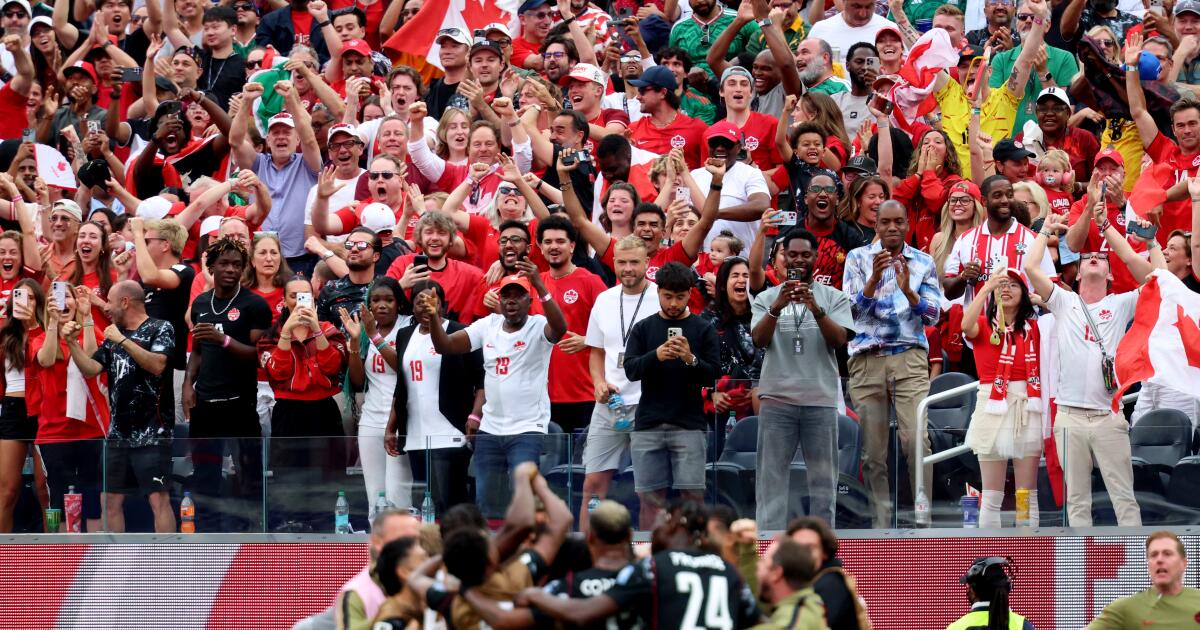
Commentary: World Cup shows MLS still needs to achieve major goals to grow the game
-

 World37 minutes ago
‘A concession to Zelenskyy’s ultimatum’: Ukraine’s triumph over Belarus
-
 News59 minutes ago
Native Americans celebrate victory at the Battle of Little Bighorn, 150 years later
-

 New York2 hours ago
How a Global Researcher Lives on $110,000 in Long Island City
-

 Los Angeles, Ca2 hours ago
Mass shooting at L.A. street takeover leaves 1 dead, 6 injured


