Politics
Iran and Israel trade fire then halt after Trump intervenes


BEIRUT — Israel and Iran suspended military attacks on each other on Monday, heeding President Trump’s call to end a flare-up that threatened derail a brittle two-month ceasefire and engulf the Middle East in all-out conflict once again.
Iran’s military said in a statement on Iranian state media that it had “delivered a painful response” to Israel’s attacks on Lebanon.
“Accordingly, the operations of the armed forces are hereby halted,” the statement said. But it added that “if the aggressions and evils continue, including in southern Lebanon, much more severe and crushing measures will be on the way.”
Israel too signaled it would cease attacks on Iran, according to an unnamed Israeli official quoted in Israeli media, who said the decision came at the behest of Trump. Still, the official said Israel would continue fighting in south Lebanon.
The tit-for-tat attacks, which involved at least 30 ballistic missiles launched on Israel and dozens of Israeli airstrikes on Iran, threatened to widen the scope of a conflict that has already killed and wounded thousands, displaced more than a million people and rattled economies across the globe.
“Israel and Iran must immediately stop ‘shooting.’ ” wrote Trump early Monday on his social media platform, Truth Social.
Later, he wrote, “Both sides, Israel and Iran, are looking to do an immediate CEASEFIRE!”
“Final negotiations on ‘Peace’ are proceeding, subject to ignorance or stupidity getting in its way. The Blockade will remain in place, and in full force and effect, until a ‘Final Deal’ is reached. Things should move quickly.”
Yet it appears likely Iran and Israel will again be on a collision course over Lebanon.
Later on Monday, Israeli Defense Minister Israel Katz said in a statement the Israeli military will continue attacking in Lebanon, including Beirut, if Hezbollah, an Iran-supported paramilitary faction and political party, attacked northern Israel.
Over the last two months of the ceasefire, Trump repeatedly claimed he was on the verge of signing a deal with Iran, despite repeated confrontations that underscored the fragility of the truce.
The latest escalation came after Israel attacked the suburbs of Lebanon’s capital Beirut on Sunday in what it said was a targeted strike against Hezbollah.
In recent days, Iran conditioned a ceasefire agreement with Israel and the U.S. on a cessation of hostilities across all fronts, including Lebanon, threatening it would respond to any Israeli action on the Lebanese capital. Israel rejects linking both battlefields, and insists on having a free hand to attack Hezbollah.
A number of U.S.-brokered ceasefires between the Lebanese and Israeli governments — but without Hezbollah involvement — failed to stop most of the fighting, with Israeli warplanes pounding wide swaths of Lebanon’s south while Hezbollah launched drones and missiles on northern Israel. Nevertheless, the Lebanese government has rejected being included in Iran’s negotiations with the U.S.
By Sunday night, Iran’s threats came to pass with several waves of Iranian ballistic missiles, which caused no injuries and were the first Tehran had fired at Israel since a ceasefire took hold in April. Iran’s military said the fusillade was a warning. But Israel said it would retaliate.
Trump initially downplayed the Iranian attack on Sunday, saying in an interview with the Financial Times that Iran’s barrage was “not going to have any impact on the deal” and telling the Axios news site that he would talk to Israeli Prime Minister Benjamin Netanyahu to halt any Israeli response.
“He won’t have any choice,” Trump said in a phone interview with the Financial Times, referring to Netanyahu having to accept any deal the U.S. negotiates with Iran.
“I call the shots. I call all the shots. He doesn’t call the shots,” Trump said.
Yet by the early morning on Monday, dozens of Israeli warplanes were striking western and central Iran. They hit a petrochemical complex in Mahshahr in southwestern Iran, and waged extensive strikes on “strategic defense systems,” according to Israeli military statements, in what observers said was a prelude to a wider offensive. Residents in Tehran, Isfahan, Tabriz and Shiraz reported powerful explosions.
The Israeli military said in a statement it expected several days of fighting with Iran but was prepared for a prolonged campaign. It said the strikes on Iran were conducted by Israel on its own, but that they had been done in “full coordination” with U.S. Central Command, which also helped in intercepting Iranian missiles launched at Israel.
But that distinction appeared to matter little to Iran’s foreign ministry spokesperson, Esmail Baghaei, who said in a press conference on Monday that the U.S held direct responsibility for recent ceasefire violations and Israel’s action “cannot be looked at in isolation from the U.S.”
“No one believes the Israeli regime would take any action without coordination with the United States,” he said.
“The U.S. bears responsibility for the Israeli regime’s aggression, and it will also be responsible for the consequences of any escalation in tensions.”
Iran launched additional barrages throughout Monday, targeting Israeli airbases in Nevatim and Tel Nof and a petrochemical plant in Haifa, according to a statement from Iran’s Revolutionary Guard Corps. It added Israel was engaging in “a dangerous game by targeting civilian and oil infrastructure — a game that will now encompass all regional energy targets, with global economic consequences resting on America.”
The renewed hostilities also saw Yemen’s Houthis — who receive support from Iran and Hezbollah, and are part of a regional network of Iran-backed factions called the “Axis of Resistance” — enter the fray with a pair of ballistic missiles lobbed at Israel. The Israeli military said one of the missiles was intercepted; the second fell short of Israel.
Houthi spokesman Brig. Gen. Yahya Sarea confirmed the attack in a televised statement on Monday, and said Israeli maritime navigation in the Red Sea would be targeted.
During the Gaza war, the Houthis attacked commercial shipping in the Red Sea — including ships with no link to Israel — to pressure Israel into lifting its blockade on the enclave.
But, unlike Hezbollah, which attacked Israel on March 2, three days after the U.S. and Israeli campaign on Iran, the Houthis had refrained from helping their ally, until Monday.
Their involvement now raises the specter of another squeeze on energy markets already beleaguered by closures on the Strait of Hormuz and which have relied on the Red Sea as an alternative passageway for energy supplies, especially for those from Saudi Arabia.
If the Houthis closed the Bab Al-Mandab Strait, it would all but paralyze commercial flows.
Oil prices spiked in the wake of the exchanges, with Brent Crude rising 5% to hit $98 a barrel, before deflating once more.
Monday’s strikes are the most serious breakdown in a ceasefire marred by repeated fighting between Israel and Hezbollah, and clashes between the U.S. and Iran. But up until Sunday there was no direct confrontations between Israel and Iran since the ceasefire took hold.
In recent weeks, Lebanon proved to be a particularly sensitive flashpoint, with Israel continuing attacks in southern Lebanon and its ground troops systematically razing towns and villages. At Trump’s urging, Beirut remained out of bounds, but Israeli military leaders said they would hit the capital if Hezbollah attacked northern Israel.
But that equation proved untenable for Iran.
“Iran’s attack in defense of Lebanon was not merely a military response; rather, it was the formal declaration of a strategic doctrine,” said Sadegh Larijani, who chairs Iran’s Expediency Council, an advisory body to the Iranian Supreme Leader.
Referring to attack Iran launched Sunday, he said, “This action sent a clear message that if one of the sides of the axis of resistance is attacked, it will result in a response beyond geographical borders and will change the equations of the region.”
In Israel, the drawdown of hostilities places additional pressure on Netanyahu, whose political base has repeatedly excoriated him as not doing enough to combat Hezbollah while being too weak to stand up to Trump. Many in Israel view a peace deal without regime change in Iran as a strategic failure; one that is likely to restrain Israel’s ability to attack Hezbollah.
That he launched strikes on Iran in defiance of Trump may win him points ahead of an uphill election fight. Yet it is unlikely to endear him to Trump, who recently scolded Netanyahu during a phone call last week and called him “crazy.”


NEWYou can now listen to Fox News articles!
President Donald Trump said Tuesday he plans to lift U.S. sanctions on Turkey and signaled he is prepared to move forward with the long-stalled sale of F-35 stealth fighter jets, marking a dramatic reversal in U.S. policy toward the NATO ally years after Ankara was expelled from the program for its purchase of a Russian missile defense system.
Speaking alongside Turkish President Recep Tayyip Erdoğan during a bilateral meeting at the NATO summit in Ankara, Turkey, Tuesday, Trump said his administration would remove sanctions imposed on Turkey’s defense sector.
“I can tell you we’re going to be taking the sanctions off, OK?” Trump said. “I don’t want him to waste his time answering that question. It’s time. We don’t sanction friends.”
TRUMP BETS ON FORMER NATO TROUBLEMAKER AS TURKEY’S STRATEGIC VALUE SURGES
Turkish President Recep Tayyip Erdogan welcomes US President Donald Trump at Ankara Airport, who is paying an official visit to Turkey ahead of the 36th NATO Heads of State and Government Summit in Ankara, Turkey, on July 07, 2026. (Dogukan Keskinkilic/Pool via REUTERS)
Asked whether he would sell F-35 fighter jets to Turkey despite existing legal restrictions tied to Ankara’s purchase of the Russian-made S-400 air defense system, Trump indicated he was open to doing so.
“Many people, including the people sitting right here thinks why wouldn’t we do that?” Trump said. “Turkey has been in many ways much more loyal than other countries that we think would be loyal.”
Pressed on concerns about Turkey’s continued possession of the S-400, Trump dismissed them.
“I have no concerns about anything.”
The remarks represent Trump’s clearest indication yet that he intends to restore defense ties with Turkey, building on months of efforts to revive military cooperation with one of NATO’s largest armed forces after years of strained relations.
Turkey was removed from the multinational F-35 program in 2019 after taking delivery of the Russian-made S-400 air defense system, prompting Washington to argue that operating the Kremlin-built system alongside America’s most advanced stealth fighter could expose sensitive U.S. technology. Congress subsequently imposed sanctions under the Countering America’s Adversaries Through Sanctions Act, or CAATSA.
‘WRITTEN IN OUR DNA’: POLISH PILOTS WHO REMEMBER SOVIET RULE PREPARE FOR AMERICA’S MOST LETHAL FIGHTER JET
Congress long has been one of the biggest obstacles to restoring Turkey’s access to the F-35, with bipartisan lawmakers arguing that Ankara should not receive America’s most advanced fighter aircraft while it continues to possess the Russian-made S-400 air defense system and pursues policies they say run counter to U.S. interests.
A U.S. airmen watches an Air Force F-35 Lightning II joint strike fighter aircraft approach for the first time on July 14, 2011 at Eglin Air Force Base in Florida. (Samuel King Jr./U.S. Air Force)
Beyond political opposition, the Trump administration also faces legal hurdles.
While the president has authority over sanctions policy, Congress enacted additional restrictions after Turkey’s purchase of the S-400. Section 1245 of the fiscal year 2020 National Defense Authorization Act bars the transfer of F-35 aircraft to Turkey unless the executive branch certifies that Ankara has met statutory requirements related to the Russian missile system.
In recent days, a bipartisan group of House lawmakers urged Trump not to move forward with an F-35 sale, arguing that doing so without satisfying those legal requirements would violate U.S. law and undermine national security.
Lawmakers also have warned that Turkey’s continued possession of the S-400, support for Hamas and tensions with fellow NATO allies Greece and Cyprus raise broader concerns about restoring Ankara’s access to the stealth fighter.
Russian S-400 missile air defence systems are seen before the military parade to commemorate the 75th anniversary of the battle of Stalingrad in World War Two, in the city of Volgograd, Russia February 2, 2018. REUTERS/Tatyana Maleyeva – UP1EE220T3A2B
CLICK HERE TO DOWNLOAD THE FOX NEWS APP
The Pentagon has maintained that the S-400’s sophisticated radar could collect data on the F-35’s radar signature and electronic profile during routine operations, potentially allowing Russia to better detect and defeat the aircraft in a future conflict if that information were shared with Moscow.
When the Trump administration removed Turkey from the F-35 program in 2019, the White House said “the F-35 cannot coexist with a Russian intelligence collection platform that will be used to learn about its advanced capabilities.”
Pentagon acquisition chief Ellen Lord similarly warned at the time that allowing Turkey to operate both systems would jeopardize the long-term security of the F-35 program because “much of the F-35’s strength lies in its stealth capabilities.”
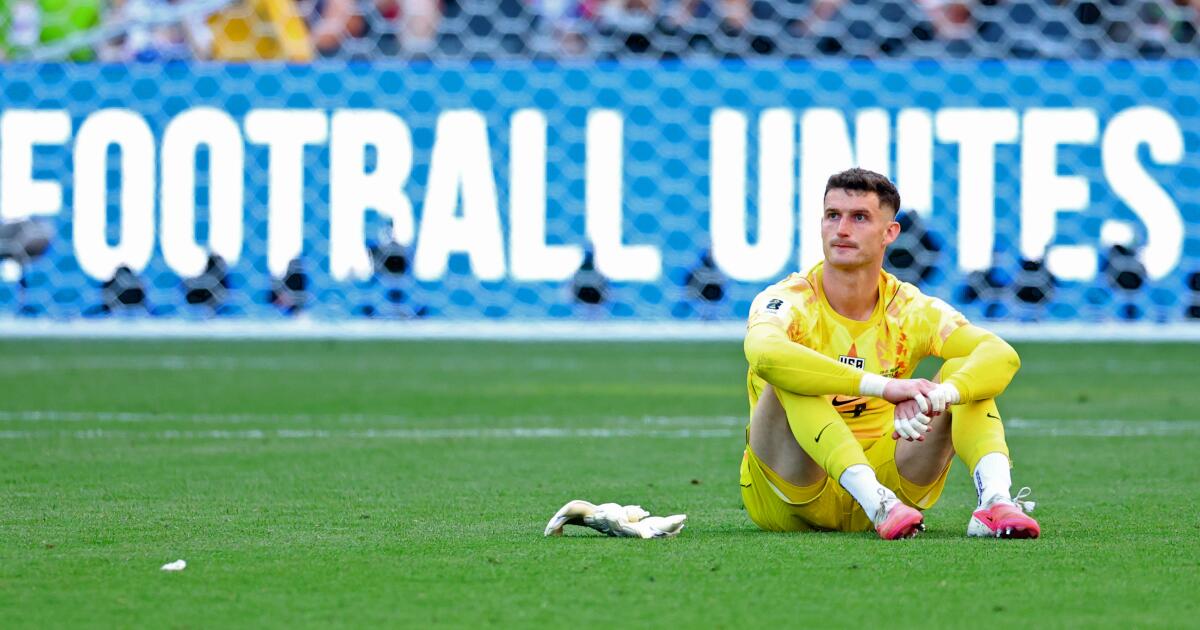
SEATTLE — Is everybody happy now? You good, Mr. President?
Put our boys in a blender, President Trump did, with those phone calls to FIFA President Gianni Infantino. Messed with their mojo by politicking to get American striker Folarin Balogun’s red card rescinded.
We’ll have to check VAR, but it might be the first time Trump succeeded at having a decision overturned.
Probably because this time what he sought to overturn — discipline stemming from Balogun’s accidental contact in the United States’ victory over Bosnia and Herzegovina — actually was unjust. Balogun should not have received a red card.
The problem is, having our President butt in here was a joke. Unfunny and out of bounds, offsides, an own goal — all of the things.
It put the U.S. team at the center of a geopolitical maelstrom, which is exactly what they did not need in the hours before the biggest match of their lives and the biggest match in the history of the U.S. men’s soccer program.
Some 40 or 50 million viewers were expected to tune in; how many of them watched for the first time? And what sort of impression did Monday’s 4-1 blunder-filled meltdown against Belgium make? That we stink at soccer — still?
If you were one of them, please, believe your soccer-fan friends when they tell you the Americans played much better in previous matches.
But so much for a magical run. On their home turf, the Americans pulled up lame before the finish line (aka, for the U.S. team’s purposes, its first quarterfinals since 2002).
To their credit, after the debacle, members of the U.S. team didn’t complain about anything being rigged. They didn’t use the distraction as an excuse. And they didn’t point fingers at anyone — anyone at all.
U.S. striker Folarin Balogun (20) walks to the locker room at halftime against Belgium in the World Cup on Monday at Lumen Field in Seattle.
(Allen J. Schaben / Los Angeles Times)
“We’re playing on home soil,” defender Chris Richards said. “So the only pressure we put on ourselves is to perform for our country, and ultimately didn’t feel the way we wanted to today. But I don’t think the antics of the last 24 hours had anything to do with it.”
No, they said the “debate,” or “outside noise” or “political manipulation” — as Tim Ream, Alex Freeman and coach Mauricio Pochettino described what others are calling “Balogate” — were not to blame for the gut-punch that answered the question: Why not us?
Because the U.S. is not yet good enough to beat the world’s great teams. Especially not when their pregame preparation includes having to try to block out an international uproar.
To have any hope against the Belgians in the round of 16 — a matchup between FIFA’s Nos. 9- and 17-ranked sides — the Americans needed to be going full-tilt, to be focused and ferocious and probably also a little bit lucky.
Instead, they looked shook, rattled. And they got rolled.
They were the worst version of themselves at the worst time, which was so weird from a team that had been on its front foot from the first whistle against Paraguay.
Not Monday. Against Belgium, they were on their heels from the outset. Heavy touches, slow afoot, playing like they had the weight of the World Cup on their shoulders.
And all that White House maddening meddling — for what?
Balogun started and played most of the match, but it could just as well have been reserve striker Ricardo Pepi. Or you or me, Balogun was that ineffective.
His play of the day came postmatch, when he approached Belgian coach Rudi Garcia and the two had a respectful exchange. A real diplomat, that Brooklyn-born, Britain-raised American by birthright.

This loss was a real team effort, of course. Christian Pulisic came off in the 59th minute after twisting his right ankle — leaving this World Cup without a goal in the four matches he appeared.
Matt Freese, the Harvard-educated starting goalkeeper, had a brain cramp of epic proportions when he stepped outside of the box and failed to corral a ball. Belgium’s Charles De Ketelaere kicked it loose and set up Hans Vanaken, whose shot traveled behind Ream for an easy score that made it 3-1 in the 57th minute.
There was a lot of poor decision-making with this match, on and off the pitch.
In the end, Trump’s appeal to Infantino did more harm than good. But what if some good could come from it?
Hey, FIFA, what about giving teams a process to appeal cards, like our American athletes in the NBA, NFL and MLB have?
Offering a suggestion box wouldn’t be opening Pandora’s box, not if it were a transparent and regular part of the game that would, hopefully, offer increasingly fair outcomes in a tournament where every match is so monumental — as our President recognized, much too enthusiastically.

U.S. coach Mauricio Pochettino waves to the crown after a 4-1 loss to Belgium at the World Cup on Monday.
(Allen J. Schaben / Los Angeles Times)
Prosecutors on Monday began laying out their case against the man accused of murdering Charlie Kirk. It was the first day of a weeklong preliminary hearing that will determine whether or not there is enough evidence against the accused killer to stand trial.
-

 Alaska5 minutes ago
Alaska, Trump Administration Settle Biden-Era Oil, Gas Plan Case
-

 Arizona8 minutes ago
Man, woman found dead near Arizona-Utah border; suspect arrested
-

 Arkansas13 minutes ago
Sanders Appoints Steve Kueter to the Arkansas Game and Fish Commission • Arkansas Game & Fish Commission
-

 California20 minutes ago
California Film Tax Credits For ‘Shrek’, Disney & Ben Affleck Movies
-

 Colorado21 minutes ago
Colorado Peak Claims Another Life
-

 Connecticut28 minutes ago
Here’s How Much Rain Fell in Your Town
-

 Delaware35 minutes ago
Coastal Delaware Restaurant Week raises funds for local first responders – Milford LIVE! – Local Delaware News, Kent and Sussex Counties
-

 Florida38 minutes ago
US appeals court strikes down key part of Florida law restricting campus race and gender discussions

