Indiana
Outgoing Indiana Gov. Eric Holcomb looks back on eight years in office — and at what's next • Indiana Capital Chronicle


Looking back on two terms in office, outgoing Indiana Gov. Eric Holcomb doesn’t have regrets — or at least not many.
The Republican statesman is just days away from bringing his eight years as governor to a close. He’ll officially hand the reins to Gov.-elect Mike Braun on January 13.
In a sit-down interview with the Indiana Capital Chronicle in December, Holcomb pointed to economic gains — like job and wage growth, and an influx of new business developments in the state — among his biggest wins.
His tenure as Indiana’s 51st head of state was most notably defined by the COVID-19 pandemic, however. Even so, Holcomb said he hopes to be revered as “more than just a COVID governor.”
“I hope people say that we were served at a point in time that — while the economy grew — we were able to invest and reinvest and modernize things that had been on the shelf … gathering dust, understandably, because we didn’t have the money … and we upgraded so many different facilities that will have a positive impact on people’s lives and give them more opportunities,” he said. “And then maybe even most importantly, that I was a person that respected everyone, whether I agreed with them or not, or they with me. And that I was kind, even during the most challenging times. That’s enough for me.”
Holcomb’s COVID-19 response
The Holcomb administration’s response to the global pandemic likely earned the governor the most criticism, much of which from conservatives who disapproved of Indiana’s statewide mask mandate and other COVID-19 restrictions that Holcomb imposed by executive order.
“You’re never going to please everyone, and you might not even please half of them. But what gave me confidence, actually strength, during it all, was that we were looking at all the information that we could get our hands on and were connected with communities in all 92 counties. We were connected to trade associations, to schools, to hospitals, to local health departments, to all kinds of entities that had an opinion,” Holcomb recalled.
“There was some disinformation and misinformation. And information was changing daily … and we were trying,” he continued. “What gave me strength and confidence is the administration was trying to do the right thing, regardless of the hit that I might take politically. … No matter how hard it is or unpopular it is, I have to do the right thing. I’ll defend it to the end.”
But if there is “one regret” Holcomb has, it came in May 2020, after a photo was posted on Facebook showing the governor posing at the Hobnob Corner Restaurant in Nashville, Indiana, with two other people — none of whom were wearing masks.
The photo was posted amid rising statewide tensions over Holcomb’s stay-at-home orders that caused many businesses to shut down.
“(The woman who wanted a photo) asked, ‘Could I get a picture with our faces?’ And it was so innocently asked, and I didn’t get COVID after it. So, it was almost like, ‘Well, why are you telling us to wear it?’ I get it,” Holcomb said. “I wish I wouldn’t have done that.”
Ire was also high among state legislators, some from within Holcomb’s own party.
Throughout the dog days of the pandemic, Holcomb said he “was in constant communication” with legislative leadership. Although the governor “was always asking” if lawmakers wanted to come back in session, “they never did.”
In 2021, lawmakers approved a measure that sought to give the Republican-dominated legislature the power to call themselves into special session after the governor has declared an emergency. Holcomb vetoed, claiming it went against the Indiana Constitution, but the General Assembly overrode his veto.
Ultimately, Holcomb prevailed before the Indiana Supreme Court. He called the debacle “an honest disagreement … that I didn’t lose any friendships over.”
“There were some disagreements among us. You had to make calls like, where does one’s individual liberty infringe on another person’s individual? Do you believe it’s airborne-transmitted? Some didn’t, I do. … And people were also angry that I was promoting getting vaccinated,” Holcomb said.
“With an issue like a global pandemic that was unlike in 1918, where information traveled faster than light and sound, and there were different motivations — you just had to try to do the right thing,” he added. “I know that sounds so cliche, but we tried to balance lives and livelihoods every single opportunity that confronted us.”

Still, Holcomb emphasized that there’s another, far more supportive “side of the conversation” surrounding his response pandemic.
“To this day, if we were to go to … an MCL or to Hardee’s or wherever, if you and I went in and we were standing there, inevitably, someone comes up to me and says, ‘Thanks for the way you handled COVID,’” the governor said.
“I’m almost amazed by — I shouldn’t be — but the lingering positive effect of how we got through it all. The attention has been on the loud, angry disagreers, on the people that protested with guns on their backs and dressed me up as Hitler out here. They wanted attention. They had their own motivation, and some of it was probably pure, and they were afraid of the government taking over their lives,” he continued. “I know this sounds thin-skinned of me, but we had a (gubernatorial) election after it (in 2020), and the one thing that kind of stifled some of the noise was the people spoke, and it riled up this silent majority that said, ‘Those people are being unfair, and I’m going to vote, and I’m going to cross over, and I’m going to express my support.’ And then they said, in a record number, ‘keep going.’”
Holcomb said he also wishes he could have done more to improve Indiana’s infant and maternal mortality rates. Despite significant focus, the state still ranks among the worst in the country for both metrics. The governor said the lack of progress is one of few shortfalls “that will haunt me.”
“We’re nowhere where I thought we could be after years. Not close. It’s not because we’re not trying. There’s a shortcoming somewhere, because other states are doing a better job than we are, and I don’t want to just blame the state — it takes two to tango,” Holcomb said. “We’ve got really good corporate partners, great stakeholders who are helping us, trying to provide the education to expecting or new mothers. But we just cannot figure it out.”
Holcomb cited resistance from the General Assembly as a major “inhibitor” to achieving better maternal health.
Lawmakers, he said, “just flat out thought” pregnancy accommodations for mothers, for example, amounted to “government intervention in the business workplace that was unnecessary.”
“I always thought it was a pro-growth culture that wasn’t anti-business, for sure,” Holcomb said. “It was the opposite to me.”
Trials — and triumphs
Holcomb had a breadth of political experience — but not governing experience — when he assumed office in January 2017.
Before he was governor, Holcomb was an advisor to both then-Gov. Mitch Daniels and former U.S. Sen. Dan Coats. He additionally worked for Congressman John Hostettler and as a state chairman of the Indiana Republican Party.
Holcomb’s gubernatorial campaign lasted just 106 days, after former Gov. Mike Pence was tapped as would-be President Donald Trump’s vice president in 2016.
Indiana Gov. Eric Holcomb’s portrait tells his story from inside — and outside — his office
His biggest surprise over the last eight years has been “the amount of turnover” in government, media, the judiciary, and other public sectors.
Holcomb said the lack of “consistency and continuity” causes Hoosiers — “real people” — to be less connected to elected officials and others whose decisions have “impact.”
“It’s the amount of change, not just technology, and how it’s impacting and forcing change on how to govern, or how to cover those governing. The turnover … and how that translates to the average citizen who doesn’t read (the news), or see every press release I put out, or is just earning a living and trying to get by, or recover from an addiction, or fill in the blank,” he said. “There is a need for all of us, including me, to be a better storyteller about why we do what we do, and not just assume.”
The governor said his greatest accomplishment — aside from economic development wins — was “not taking the bait” and “staying focused on the job” despite “a lot of upheaval, and a lot of transition, and a lot of new faces, and new motivations, and new competition.”
“People want you to think about running for this. Say you ought to do that. You ought to come out and address the protesters — whatever it is to get my attention diverted from the job that I have,” Holcomb said. “I’m not trying to pat myself on the back, but that takes discipline, and a really good team that also stays focused on the job that they have.”
Looking ahead
As the transition of power nears, Holcomb said he has a list of recommendations to hand off to his successor. Included are “a number of” capital investment deals he’ll advise Braun to chase, along with possible actions for improving maternal and infant health.
Above anything else, Holcomb said Indiana’s next governor should expect “to be learning — and learning a lot every day.”
Need to get in touch?
Have a news tip?
“It’s one thing to be convicted, and to have your opinions, and have a good plan, and execute and implement and tweak it, and pivot and scramble, or whatever. It’s another thing to just understand that this is the first time any of us ever had the job. It’s different from every other job. And I’m not saying it’s harder. I’m just saying it’s a different job, and you have to be aware that you’re going to be learning,” Holcomb said. “And I would say to remain humble, in the sense that you’re going to be learning every day about things, and it’s necessary then to stay in contact with people … in every county, okay, and different associations, and all these tentacles that you have.”
What comes next for the departing state leader is still to be decided, but he and First Lady Janet Holcomb — who will move just northwest of Indianapolis after leaving the governor’s residence — plan to lay low and “travel a little less,” for now.
“We’ve had a busy few months, and just kind of want to exhale, and spend some time with family, initially, and friends that just always seem to kind of take the hit,” he said. “But I won’t go stir crazy. I mean, I’ll get busy after a few months, doing something.”
It’s also the more mundane aspects of day-to-day lift that Holcomb said he’s looking forward to most, like “mowing the lawn with my headphones.”
“I would love to be able to go to CVS or Walgreens and buy Q-tips without having to be followed … or without addressing the decision that I just made the other day,” Holcomb said, chuckling. “Or maybe when I go out to eat — and I’m sure my mouth is open when I’m chewing — and I can see (someone coming up to me) out of the corner out of my eye. It’s just the anonymity that you had prior will be nice, or not having law enforcement so close every minute of the day.”
And as for another go at elected office?
“Not right now,” Holcomb said of any possible future political aspirations. “I’ve not devoted one second to that, and in fact, I need a break.”
GET THE MORNING HEADLINES.



INDIANAPOLIS (WISH) – The 2026 NCAA Division I Men’s Basketball Tournament’s Final Four is set.
Four teams have advanced to the Final Four and will compete for the national championship this upcoming weekend in Indianapolis.
The two national semifinal matchups will take place on Saturday. Tip times for the two games have been announced:
- 6:09 p.m. EDT – No. 3 seed Illinois vs. No. 2 seed UConn
- 8:49 p.m. EDT – No. 1 seed Michigan vs. No. 1 seed Arizona
The winners of Saturday’s games will then play in the National Championship Game on Monday, April 6.
Each game will take place inside Lucas Oil Stadium.

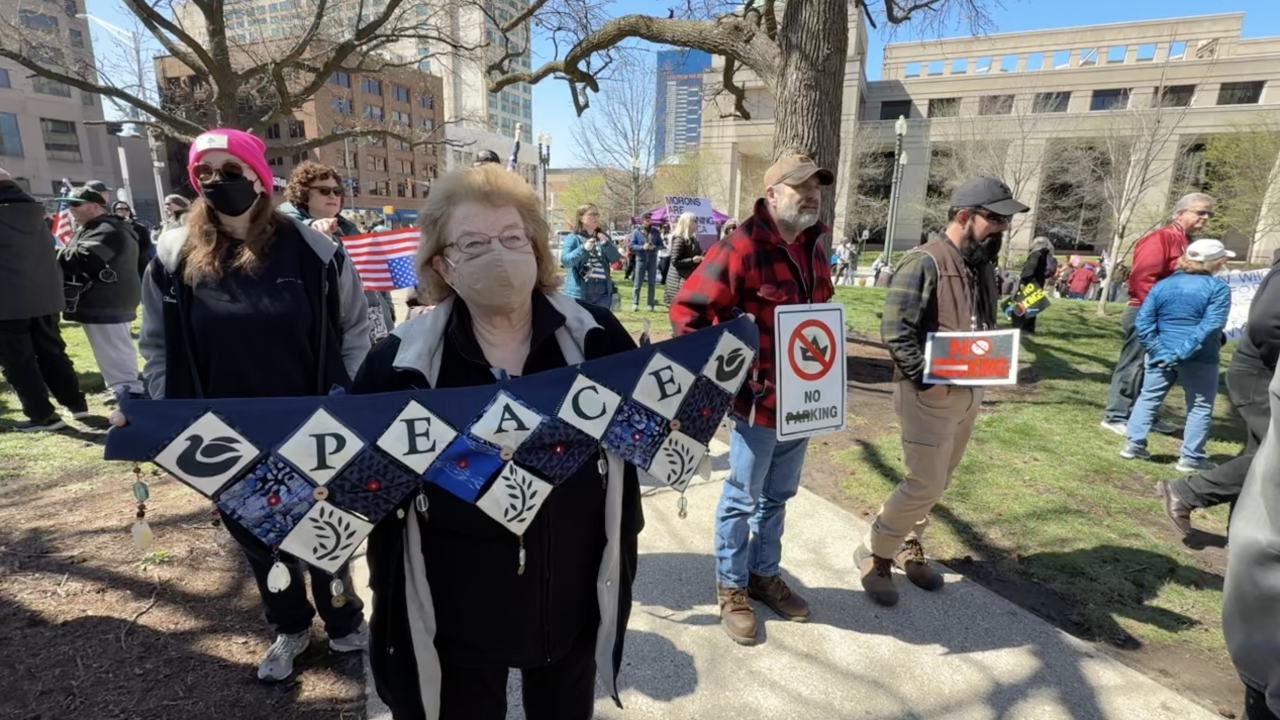
INDIANAPOLIS — Hundreds of Hoosiers gathered at the Indiana Statehouse Saturday morning as part of nationwide ‘No Kings’ events to voice their concerns about the current administration.
WATCH FULL STORY BELOW
Hundreds gather at Indiana State Capitol for ‘No Kings’ protest
“I’m out here today because what’s happening in our government is completely trash,” Donna Sipes told WRTV. “It’s wrong. We need to do something about it.”
“I’m tired of every single day when the TV comes on to see what stupid thing he’s done next,” Lindi Marti said.
WRTV
Attendees noted the growing popularity of the demonstrations.
“This is my fourth one to come to. I didn’t come to all of them when it was really cold, but I’m glad to see that they are getting a lot more people out here every time,” Marti added. “It seems like there’s more and more coming.”
Demonstrators highlighted specific foreign policy concerns, including the administration’s handling of the war in Iran.
“We’re bombing the heck out of them. We’re killing civilians,” Marti’s husband said. “We’re getting ready to send our Marines.”
WRTV
Others focused on the administration’s handling of immigration.
“That’s what I’m concerned about,” Reverend Kenny Little told WRTV. “Little kids, they’re taking them away from their family. And I’m just one of those people, I think everyone got rights.”
Indiana medical students also attended the rally to speak out against changes to the healthcare system.
“We’re really worried about the attacks on the health care system in general, but with Medicaid… current estimates range from anywhere from 325,000 to 450,000 Hoosiers will lose coverage by 2032,” Wade Catt said with concern.
WRTV
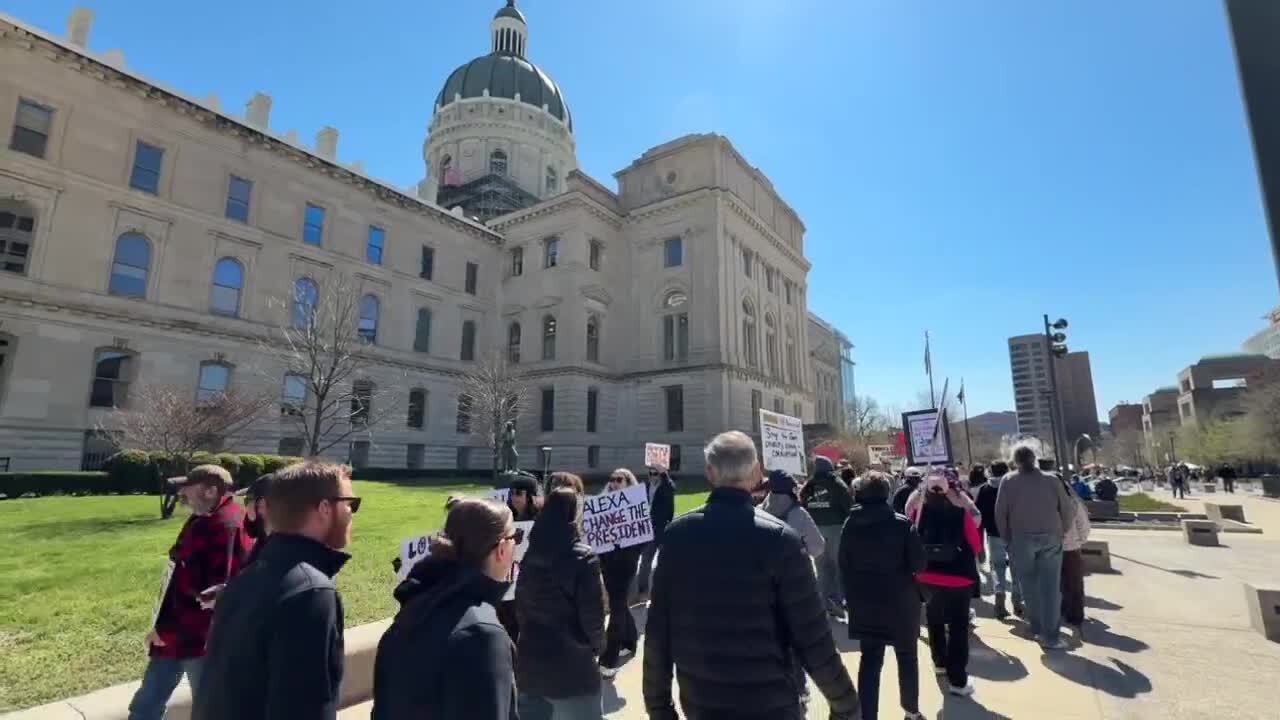
With midterm elections approaching later this year, attendees emphasized the importance of now taking action at the ballot box.
“If we don’t vote, then things are gonna not, they’re gonna stay the same,” a protester said.
Meanwhile, Indiana Lieutenant Governor Micah Beckwith says he’s happy to see Hoosiers exercise their First Amendment right to protest.
However, he takes issue with the idea that President Trump is acting like a king. Beckwith says the fact that people have the freedom to protest is proof that the president is not acting like a tyrant.
He acknowledges that bridging the gap between the sides is probably an uphill battle, but believes communication is key.
“I think when you sit down with people face to face, you’re confronted with humanity. There’s another human sitting across that table from you and talking to you. And so, all I have to say, I think that’s probably the thing I would encourage all Hoosiers to do is say, ‘Hey, if you don’t agree with somebody or if you don’t like somebody, why don’t you try grabbing coffee with them? And give it 30 minutes, and just see what happens.’ I bet most of the time people will walk away with a much softer heart and spirit towards that person before they came in,” Beckwith said.
Beckwith is currently on a 92-county tour of the state. He says all sides are welcome to attend his events.
__

INDIANAPOLIS (WISH) — Police say one “young man” is dead after a shooting at the 1200 block of Rue Rabelais at about 7:19 p.m. according to the Indianapolis Metropolitan Police Department.
That is near the intersection of 56th Street and Binford Boulevard.
Police say the victim was taken to Riley Hospital where he later died. Investigators say they are still working to identify the victim.
There was no known information about a suspect. Police did say that they believe this is a targeted incident.
There was no other information immediately available.
This story has been updated with information from the Indianapolis Metropolitan Police Department.
Oregon Lottery Pick 4 results for March 29

What you can do to lower your electric bill in Pennsylvania

This RI Garden Transforms Into a Fairy Wonderland

How to watch TCU vs. South Carolina women’s basketball Elite Eight: TV, streaming

Argus Leader First/Second Five: South Dakota’s best girls high school basketball players

Florida High School Football Rankings: Top 25 teams – Oct. 21

How old is Bo Nix? What to know about Oregon quarterback ahead of 2024 NFL Draft

Cleary's 21 help Le Moyne down Central Connecticut State 69-64 in OT

99th annual Pony Swim held in Virginia

Indiana Members Credit Union announced as new anchor tenant at Bottleworks District

Video: Iran to Allow More Oil Ships Through Strait of Hormuz, Trump Says

Dem senator warns deportation could let Virginia woman’s illegal immigrant killer ‘escape accountability’

Newsletter: G7 ministers to hold talks on war’s economic fallout
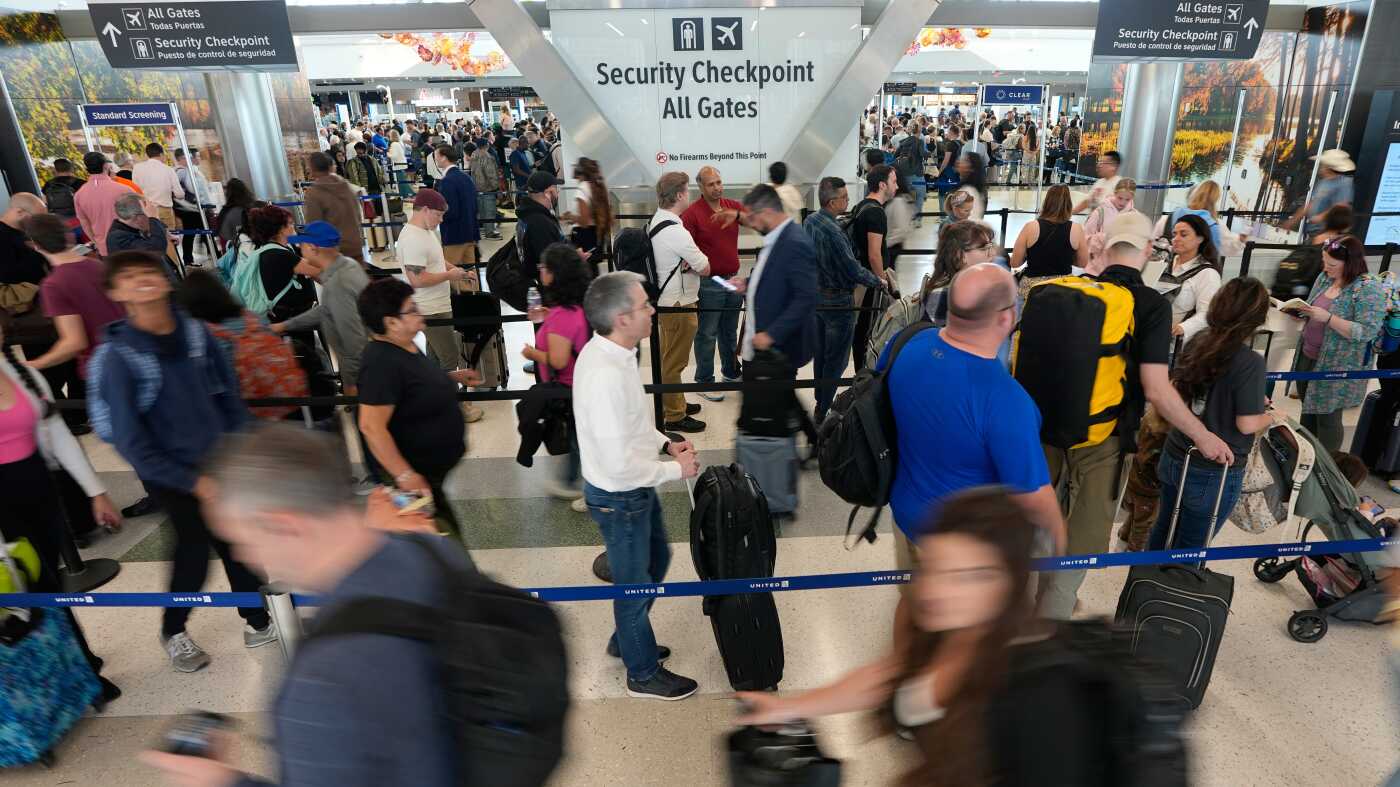
ICE officers could remain at airports after TSA workers are paid

Scathing report claims nation’s oldest labor union ‘betrayed’ MAGA members through ‘shocking’ spending
-

 Sports1 week ago
IOC addresses execution of 19-year-old Iranian wrestler Saleh Mohammadi
-

 Miami, FL4 days ago
Jannik Sinner’s Girlfriend Laila Hasanovic Stuns in Ab-Revealing Post Amid Miami Open
-

 New Mexico1 week ago
Clovis shooting leaves one dead, four injured
-

 Politics1 week ago
Schumer gambit fails as DHS shutdown hits 36 days and airport lines grow
-

 Tennessee7 days ago
Tennessee Police Investigating Alleged Assault Involving ‘Reacher’ Star Alan Ritchson
-

 Minneapolis, MN4 days ago
Boy who shielded classmate during school shooting receives Medal of Honor
-

 Science1 week ago
Record Heat Meets a Major Snow Drought Across the West
-

 Technology1 week ago
YouTube job scam text: How to spot it fast