Indiana
Knicks-Pacers: 5 takeaways from Indiana’s staunch Game 6 stand


In an emphatic Game 6 win, Pascal Siakam showed exactly why Indiana traded for him.
• Download the NBA App
We haven’t had a Game 7 at Madison Square Garden since 1995.
The winner of that game was the Indiana Pacers, with Patrick Ewing missing a game-tying finger roll at the buzzer. And it was the Pacers who forced another Game 7 at MSG with a 116-103 victory over the New York Knicks in Game 6 of the Eastern Conference semifinals on Friday.
Indiana took control with a 17-2 run late in the second quarter, dominated the paint, and rebounded well enough to improve to 6-0 at home in these playoffs. They were the more desperate team and they played like it, continuing to play fast on offense and showing a lot more toughness on defense than they displayed in Game 5.
Here are some notes, quotes, numbers and film as the Pacers improved to 6-0 at home in the playoffs and booked another trip back to New York for Game 7 on Sunday afternoon (3:30 p.m. ET, ABC) …
1. Pacers dominate the paint and the glass
The Pacers had outscored the Knicks by 40 points in the paint over the first four games of this series, but the Game 5 score in the paint was 62-36 in favor of the Knicks, with New York also obtaining an incredible 50% of available offensive rebounds.
The script was flipped in Game 6, when the Pacers were a plus-24 (62-38) in the paint, the Knicks’ worst differential of the season (94 total games). Some of that was the Pacers pushing in transition, moving the ball and consistently looking to attack.
Some of it was their defense. The Knicks’ 18-for-41 (43.9%) shooting in the paint was their fourth-worst mark of the season (94 total games). Indiana blocked eight of those shots, with Isaiah Jackson recording three blocks in less than 12 minutes off the bench.
Of course, defensive possessions, especially when you’re playing the Knicks, aren’t done until a rebound has been secured. The Pacers were much better on the defensive glass, with New York’s offensive rebounding percentage of 32.0% being its third-lowest mark of the postseason. (The Knicks are 6-0 when they’ve grabbed more than 34% of available offensive boards.)
The Pacers, meanwhile, had more offensive rebounds (14) than the Knicks (13). Jackson had just one of those 14, but drew two loose-ball fouls on the offensive glass on a single possession early in the fourth quarter.
“It was just activity,” Pacers coach Rick Carlisle said of his team’s interior success on Friday. “We played harder tonight, which was a must.”
2. Knicks play small, Siakam plays big
The Knicks changed their starting lineup in Game 5, replacing Precious Achiuwa with Miles McBride. It gave New York more spacing around Jalen Brunson.
But it also made the Knicks smaller up front. Pascal Siakam took advantage of that change, playing big and scoring a team-high 25 points, with 17 of those coming in the paint (14) or at the free throw line.
Early in the first quarter, Siakam got a layup after a Knicks bucket on the other end of the floor. Tyrese Haliburton got the ball up the floor quickly and Siakam got behind Josh Hart, who had his eyes on the ball …

Later in the first, Siakam established early post position against McBride and drew a foul. A few possessions later, he drew another by taking Donte DiVincenzo under the basket.
In the second quarter, Siakam really went to work against Hart by posting him up …
He got two more post-up scores against Hart after that. Then he had another matchup against McBride and, when the Knicks brought two extra defenders, Siakam found Myles Turner for a dunk …
The Knicks didn’t go back to their big lineup for the second half, but they put Isaiah Hartenstein (or Achiuwa) on Siakam, with Hart guarding Turner (or Jackson). But in the fourth quarter, with the Knicks’ bigs focused on rim protection, Siakam was twice able to find space to shoot in-rhythm jumpers after setting a ball screen.
3. Hart gets hurt
Prior to Game 6, Hart had averaged an incredible 43.7 minutes, what would be the highest mark for any player who played at least 10 games in the last 11 postseasons. And he had played all 48 (or all 53) minutes in four of the 11 games.
But on Friday, Hart asked to be subbed out midway through both the first and third quarters. He seemingly suffered an abdominal injury early on and was clearly in discomfort the rest of the night. He still played almost 31 minutes, but shot just 2-for-8 and (as noted above) had a tough time defending Siakam.
The Knicks are already without Julius Randle, Mitchell Robinson, Bojan Bogdanovic and OG Anunoby. And with Hart now dealing with something, they have the shortest of turnarounds between Games 6 and 7. The last time they played in the afternoon less than 48 hours after a night game was Game 4, which they lost by 32.
Knicks coach Tom Thibodeau didn’t have an update on Hart after Game 6. Nor did he have much of an answer when asked about the possibility of Anunoby (hamstring strain) returning from a four-game absence to play in Game 7.
The Knicks are now 14-17 without Anunoby since his acquisition. In this series, they’ve been outscored by 28 points (19 per 100 possessions) in 79 total minutes with their other four starters on the floor without him, allowing the Pacers to score an uber-efficient 131.3 points per 100 possessions.
4. Tale of two halves for Brunson
There was some hope for the Knicks at halftime despite being down 10. First of all, they had trailed in eight of their previous 11 playoff games by double-digits and won five of those eight.
Secondly, they were down only 10 even though Brunson had shot 2-for-13 from the field and 1-for-4 from the free throw line. If he got going in the second half, they certainly had a shot.
And Brunson did get going in the second half, scoring 26 points (on 9-for-13 shooting) in less than 19 minutes. But it wasn’t enough.
Overall, the Pacers defended the Knicks’ star better than they did in Game 5. Aaron Nesmith was the primary defender again and did a good job of navigating screens. Haliburton was stronger with his hedges when his man set those screens. And the Pacers also had a couple of timely double-teams after Brunson burrowed his way into the paint …
But in the second half, Brunson was also able to take advantage of the Pacers’ pressure, both in the backcourt (breaking the press and driving for a layup) and in the frontcourt (cutting back door for another layup). He found a rhythm and then he started cooking.
Ultimately, Brunson’s second-half scoring didn’t mean much. And there hasn’t been much carry-over from game to game in this series. But he has shot much better in the three games at home (54%) than he has in Indiana (39%).
5. The difference is inside the Knicks’ offense
Brunson’s second-half scoring didn’t mean much because the Pacers scored 52 points on 34 second-half possessions (1.53 per) before Thibodeau initiated garbage time (by taking Brunson out) with a little less than four minutes left in the fourth quarter.
Game 5, when they held the postseason’s No. 1 offense under a point per possessions, was the Knicks’ best defensive game of the playoffs. But their defense didn’t travel and Game 6 was one of their worst.
Still, the bigger difference between New York wins and Indiana wins in this series has been on the the Knicks’ end of the floor …
Knicks and Pacers’ efficiency, conf. semis
| Games | NYK OffRtg | IND OffRtg |
|---|---|---|
| New York wins | 131.0 | 116.7 |
| Indiana wins | 107.6 | 125.2 |
| Diff. | 23.4 | -8.5 |
OffRtg = Points scored per 100 possessions
That’s more about their shooting in the paint (60.3% vs. 46.5%) than their shooting from the outside (effective field goal percentage of 56.9% vs. 50.0%). The Pacers were tougher defensively in Game 6 and may need to be even better at Madison Square Garden on Sunday afternoon.
* * *
John Schuhmann is a senior stats analyst for NBA.com. You can e-mail him here, find his archive here and follow him on X.
The views on this page do not necessarily reflect the views of the NBA, its clubs or Warner Bros. Discovery.


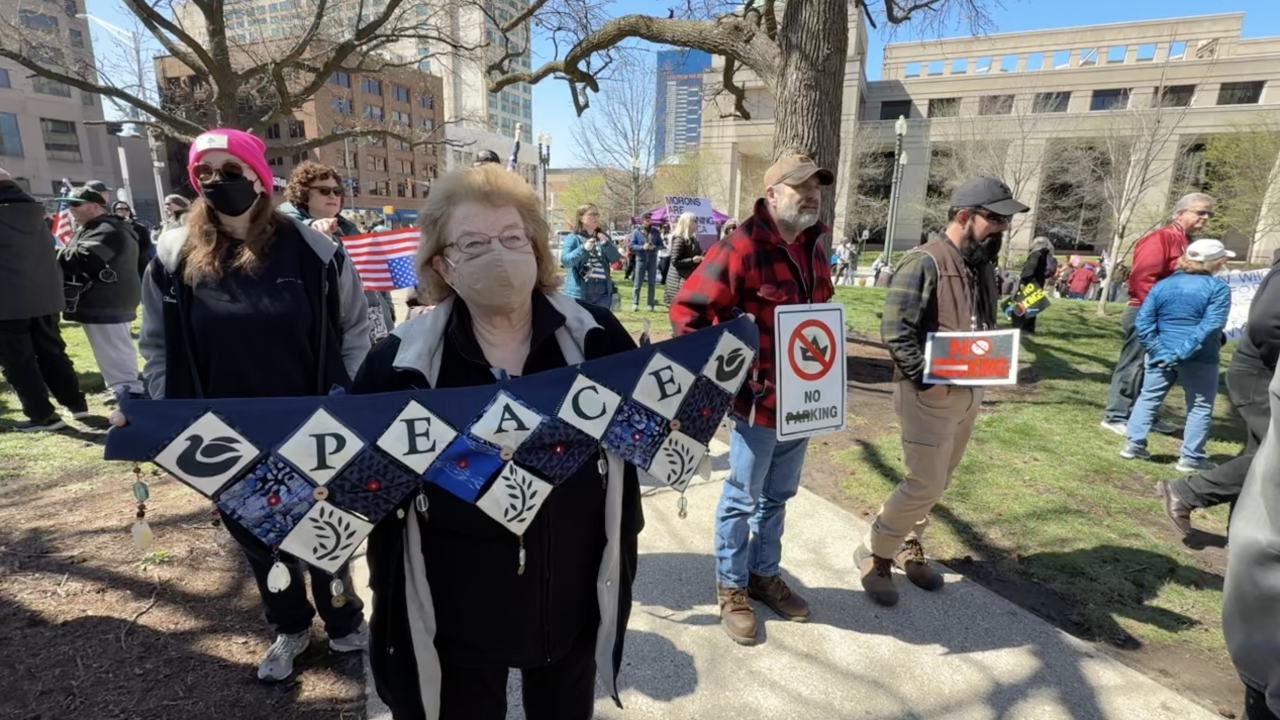
INDIANAPOLIS — Hundreds of Hoosiers gathered at the Indiana Statehouse Saturday morning as part of nationwide ‘No Kings’ events to voice their concerns about the current administration.
WATCH FULL STORY BELOW
Hundreds gather at Indiana State Capitol for ‘No Kings’ protest
“I’m out here today because what’s happening in our government is completely trash,” Donna Sipes told WRTV. “It’s wrong. We need to do something about it.”
“I’m tired of every single day when the TV comes on to see what stupid thing he’s done next,” Lindi Marti said.
WRTV
Attendees noted the growing popularity of the demonstrations.
“This is my fourth one to come to. I didn’t come to all of them when it was really cold, but I’m glad to see that they are getting a lot more people out here every time,” Marti added. “It seems like there’s more and more coming.”
Demonstrators highlighted specific foreign policy concerns, including the administration’s handling of the war in Iran.
“We’re bombing the heck out of them. We’re killing civilians,” Marti’s husband said. “We’re getting ready to send our Marines.”
WRTV
Others focused on the administration’s handling of immigration.
“That’s what I’m concerned about,” Reverend Kenny Little told WRTV. “Little kids, they’re taking them away from their family. And I’m just one of those people, I think everyone got rights.”
Indiana medical students also attended the rally to speak out against changes to the healthcare system.
“We’re really worried about the attacks on the health care system in general, but with Medicaid… current estimates range from anywhere from 325,000 to 450,000 Hoosiers will lose coverage by 2032,” Wade Catt said with concern.
WRTV

With midterm elections approaching later this year, attendees emphasized the importance of now taking action at the ballot box.
“If we don’t vote, then things are gonna not, they’re gonna stay the same,” a protester said.
Meanwhile, Indiana Lieutenant Governor Micah Beckwith says he’s happy to see Hoosiers exercise their First Amendment right to protest.
However, he takes issue with the idea that President Trump is acting like a king. Beckwith says the fact that people have the freedom to protest is proof that the president is not acting like a tyrant.
He acknowledges that bridging the gap between the sides is probably an uphill battle, but believes communication is key.
“I think when you sit down with people face to face, you’re confronted with humanity. There’s another human sitting across that table from you and talking to you. And so, all I have to say, I think that’s probably the thing I would encourage all Hoosiers to do is say, ‘Hey, if you don’t agree with somebody or if you don’t like somebody, why don’t you try grabbing coffee with them? And give it 30 minutes, and just see what happens.’ I bet most of the time people will walk away with a much softer heart and spirit towards that person before they came in,” Beckwith said.
Beckwith is currently on a 92-county tour of the state. He says all sides are welcome to attend his events.
__

INDIANAPOLIS (WISH) — Police say one “young man” is dead after a shooting at the 1200 block of Rue Rabelais at about 7:19 p.m. according to the Indianapolis Metropolitan Police Department.
That is near the intersection of 56th Street and Binford Boulevard.
Police say the victim was taken to Riley Hospital where he later died. Investigators say they are still working to identify the victim.
There was no known information about a suspect. Police did say that they believe this is a targeted incident.
There was no other information immediately available.
This story has been updated with information from the Indianapolis Metropolitan Police Department.

This story contains descriptions of distressing circumstances involving children.
INDIANAPOLIS (WISH) – A mother and her boyfriend were accused of causing the death of a 4-year-old-boy found dead in a basement closet on Monday.
Indianapolis Metropolitan Police Department arrested Angel Lovely, 37, and Nicholas Bergdoll, 36, on preliminary charges of neglect of a dependent causing death. The Marion County Prosecutor’s Office by Friday had not filed formal charges.
A sibling found the 4-year-old dead on Monday, according to investigators. Lovely and Bergdoll were in the home at the time but told police they were asleep when he died.
Born premature with cerebral palsy, the 4-year old couldn’t walk, was nonverbal, and ate through a feeding tube. Lovely claimed she would rarely put the child in the closet, only “when he won’t stop screaming” or when she “needed a break.”
But when investigators interviewed Lovely’s three other children, they said that the boy “stays in the closet all day,” and that “mom locks him in the closet” and “does not pay attention to him.”
An exact cause of death hasn’t been determined, but the child was found with blood in his mouth. Lovely said he’d been aspirating.
One of Lovely’s children told investigators they heard the 4-year-old gagging but didn’t say anything because it wasn’t unusual.
A neighbor living on Monticello Drive, Michelle Johnson, told News 8, “It’s horrible. It breaks my heart.”
Johnson had seen the other children outside the home but never knew there was a boy in a wheelchair living there. She said if she suspected they were being neglected, she would have called police or the Indiana Department of Child Services.
“We’re supposed to be a village and raise kids together,” Johnson said. “That’s really heartbreaking.”
Bergdoll told police, according to the investigators’ report, that he didn’t agree with putting the child in the closet: “I am not going to tell her how to f****** raise her kids.”
“I’m sickened,” IMPD Public Information Officer Tommy Thompson told News 8 in an interview.
“Think about putting yourself in that situation. Every day, do you want to be in a closet? Locked up, no light?”
Court records show the Department of Child Services had removed the boy from Lovely’s care because of medical neglect, but she regained custody last year against DCS recommendations.
Thompson, the neighbor, hopes the tragedy can be an opportunity for others to speak up when they see a child who can’t speak up for themselves. “Maybe you’ve got to make that tough phone call. Reach out. The city has resources.”
Johnson wishes she would have known what was happening so she could have said something. “Children don’t have a voice and we’re supposed to be their voice.”
Help is available for victims of domestic violence, child abuse, and sexual assault. Below is a list of suggested resources, both national and local:

Inside the Dallas furry convention drawing thousands and sparking culture battles

Jannik Sinner’s Girlfriend Laila Hasanovic Stuns in Skirt Before Miami Open Final
![!$+∇√$[+[!LIVESTREAMs!]+] Minnesota Wild vs Boston Bruins Live Free Streams On Tv Channel 2026-03-29](https://i3.wp.com/encrypted-tbn0.gstatic.com/images?q=tbn:ANd9GcReQZPBURuIIuh0fPF6YTAqOY-y1_BeWJWzPA&s&w=80&resize=80,80&ssl=1 "!$+∇√$[+[!LIVESTREAMs!]+] Minnesota Wild vs Boston Bruins Live Free Streams On Tv Channel 2026-03-29")
!$+∇√$[+[!LIVESTREAMs!]+] Minnesota Wild vs Boston Bruins Live Free Streams On Tv Channel 2026-03-29

Colorado No Kings protests draw crowds across Denver, state

Where to watch Cleveland Guardians vs. Seattle Mariners: Live stream, start time, TV channel, odds for Sunday, March 29

Florida High School Football Rankings: Top 25 teams – Oct. 21

How old is Bo Nix? What to know about Oregon quarterback ahead of 2024 NFL Draft

Cleary's 21 help Le Moyne down Central Connecticut State 69-64 in OT

99th annual Pony Swim held in Virginia

Indiana Members Credit Union announced as new anchor tenant at Bottleworks District

JD Vance says he was ‘obsessed’ with UFOs, believes aliens are actually ‘demons’
The EU's recipe for trade deals : easy on beef, tough on wine

Photos: ‘No Kings’ protests across the country

Jeffries declines to break with indicted Democrat after ethics panel’s guilty verdict

Hundreds of thousands march through London in stand against the far right
-

 Sports1 week ago
IOC addresses execution of 19-year-old Iranian wrestler Saleh Mohammadi
-

 New Mexico7 days ago
Clovis shooting leaves one dead, four injured
-

 Tennessee6 days ago
Tennessee Police Investigating Alleged Assault Involving ‘Reacher’ Star Alan Ritchson
-

 Minneapolis, MN3 days ago
Boy who shielded classmate during school shooting receives Medal of Honor
-

 Technology7 days ago
YouTube job scam text: How to spot it fast
-

 Miami, FL3 days ago
Jannik Sinner’s Girlfriend Laila Hasanovic Stuns in Ab-Revealing Post Amid Miami Open
-

 Science1 week ago
Record Heat Meets a Major Snow Drought Across the West
-

 Politics1 week ago
Schumer gambit fails as DHS shutdown hits 36 days and airport lines grow