Indiana
Celtics-Pacers: 4 things to look for in Game 4 of East Finals


Pascal Siakam’s playoff-friendly midrange game has added an expected source of offense for the Pacers.
• Download the NBA App
INDIANAPOLIS — No team in NBA history has come back from a 3-0 deficit to win a best-of-seven playoff series. But four have come back to force a Game 7, with the last being the Boston Celtics, who did it a year ago in the Eastern Conference Finals.
In these Eastern Conference Finals, the Celtics are the team with the 3-0 lead, and they know the job is not done.
“It’s a way different feeling, obviously,” Derrick White said on Sunday about being up 3-0. “But you just understand that anything can change after one game. So you can’t relax.”
Here are some things to keep an eye out for as the Celtics try to close out the Indiana Pacers in Game 4 on Monday (8 p.m. ET, ESPN).
1. How Haliburton’s absence changes the Pacers … defensively
Game 2 of this series was the one that wasn’t close. And it wasn’t close because the Celtics had their most efficient offensive performance (126 points on 94 possessions) of the playoffs.
It was as purposeful of an offensive performance as we’ve seen from the Celtics, who relentlessly attacked the weaknesses in the Indiana defense. Those weaknesses began with Tyrese Haliburton, who was consistently put into screening action involving Jayson Tatum or Jaylen Brown.
With Haliburton out in Game 3, the Pacers switched more screens, and the Celtics had to find other ways to gain advantages and create good shots. They certainly attacked other weaknesses, namely Doug McDermott and Ben Sheppard. Boston also made Myles Turner work a little more, with Al Horford setting 23 ball screens, the most he’s set in the playoffs and tied for the second most he’s set all season in 78 total games.
“Everything depends on the coverage and the matchup,” Celtics coach Joe Mazzulla said Sunday. “The way you attack and the type of spacing that you have and the reads you have are going to be different because the coverage is different.
“It’s more about that, finding the advantage and making sure we can exploit it as a team.”
Haliburton was listed as questionable on the initial injury report for Game 4. If he plays, it’s unlikely he’ll be at 100 percent, making him more of a target for the Celtics’ defense than he was in Game 2. If he doesn’t play, the Celtics also know what to do.
2. Do the Pacers have any more midrange magic?
Midrange shots (those that come between the paint and the 3-point line) accounted for just 11% of total field goal attempts this season. That’s half the midrange rate from just seven years ago (22% in 2016-17) and one third the rate from 16 years ago (33% in 2007-08).
But the midrange shot is not dead. It’s a key reason why the Pacers are still playing, and why two of the three games in this series have been close.
Over their 16 playoff games, the Pacers have taken 15% of their shots from midrange, the highest rate (by a healthy margin) among the four teams still playing and up from 10% (21st) in the regular season.
While the Pacers didn’t shoot a lot from midrange in the regular season, they were the first team in the last 27 years to make more than half (50.5%) of their shots from between the paint and the 3-point line. And they’ve been even better (52.4%) in the playoffs.
That includes a four-game stretch — Game 6 of the conference semis through Game 2 of this series — in which the Pacers shot an incredible 50-for-81 (61.7%), with those 81 attempts accounting for 23% of their total shots from the field.
The were still better than average (7-for-15) in Game 3, but that wasn’t enough. One possession before he had the ball stolen by Jrue Holiday, Andrew Nembhard missed a 13-foot pullup that would have given the Pacers back the lead with a little more than 30 seconds left.
If they’re going to take this series back to Boston for a Game 5, the Pacers may need a little more midrange magic on Monday.
3. Celtics’ small ball hasn’t worked
Game 4 will be the 10th straight game that Kristaps Porzingis has missed with the calf strain he suffered in Game 4 of the first round. That injury has pushed Al Horford into the starting lineup, and that lineup has been much better in the playoffs (plus-18.1 per 100 possessions in 195 minutes) than it was in the regular season (plus-2.7 in 311 minutes).
With Horford in the starting lineup, Luke Kornet was the backup center until he sprained his wrist in the first half of Game 2.
With Kornet out, the Celtics initially went to small lineups — with Tatum or Oshae Brissett at center — when Horford sat down. But those lineups haven’t been good:
Celtics in conference finals
| Bigs on floor | MIN | OffRtg | DefRtg | NetRtg | +/- |
|---|---|---|---|---|---|
| Two | 6 | 133.3 | 108.3 | +25.0 | +3 |
| One | 121 | 122.1 | 112.2 | +9.9 | +28 |
| Zero | 21 | 129.7 | 147.4 | -17.6 | -8 |
OffRtg = Points scored per 100 possessions
DefRtg = Points allowed per 100 possessions
NetRtg = Point differential per 100 possessions
Doesn’t include a couple of minutes of Game 2 garbage time
So Xavier Tillman has been getting some minutes as the backup center, including more than six minutes alongside Horford in Game 3 (all of the two-big minutes in the table above).
In the second half on Saturday, the only time there were zero bigs on the floor was the last seven seconds of the third quarter). The bigs were missed in those seven seconds, because the quarter ended with McDermott getting a tip-in over Payton Pritchard to put the Pacers up nine.
Horford and Porzingis (when he returns) allow the Celtics to play big without sacrificing spacing on offense. Kornet (who’s listed as questionable for Game 4) and Tillman, not so much. But the latter’s minutes were critical in Game 3, and we may not see much more small ball going forward.
4. More numbers to know
Some other notes regarding the Celtics and Pacers:
- This series is a huge contrast in ball movement, with the Pacers having averaged 400 passes per 24 minutes of possession and the Celtics having averaged just 276 per 24.
- Celtics opponents have made just 19 corner 3-pointers over their 13 playoff games. That’s as many as the Wolves made in their four-game sweep of the Suns in the first round.
- Though Boston is a plus-51 from 3-point range in this series, the Pacers have outscored them by three total points from the field. But Boston is a plus-27 at the free throw line.
- After committing just 11.6 turnovers per 100 possessions through the first two rounds (lowest among teams that won a series), the Pacers have committed 16.4 per 100 in this series. Boston has won the possession battle, committing 14 fewer turnovers over the three games.
- The Celtics’ Sam Hauser and the Pacers’ Ben Sheppard were a combined 33-for-72 (45.8%) from 3-point range through the first two rounds of the playoffs. They’re a combined 0-for-18 in the conference finals.
* * *
John Schuhmann is a senior stats analyst for NBA.com. You can e-mail him here, find his archive here and follow him on X.
The views on this page do not necessarily reflect the views of the NBA, its clubs or Warner Bros. Discovery.


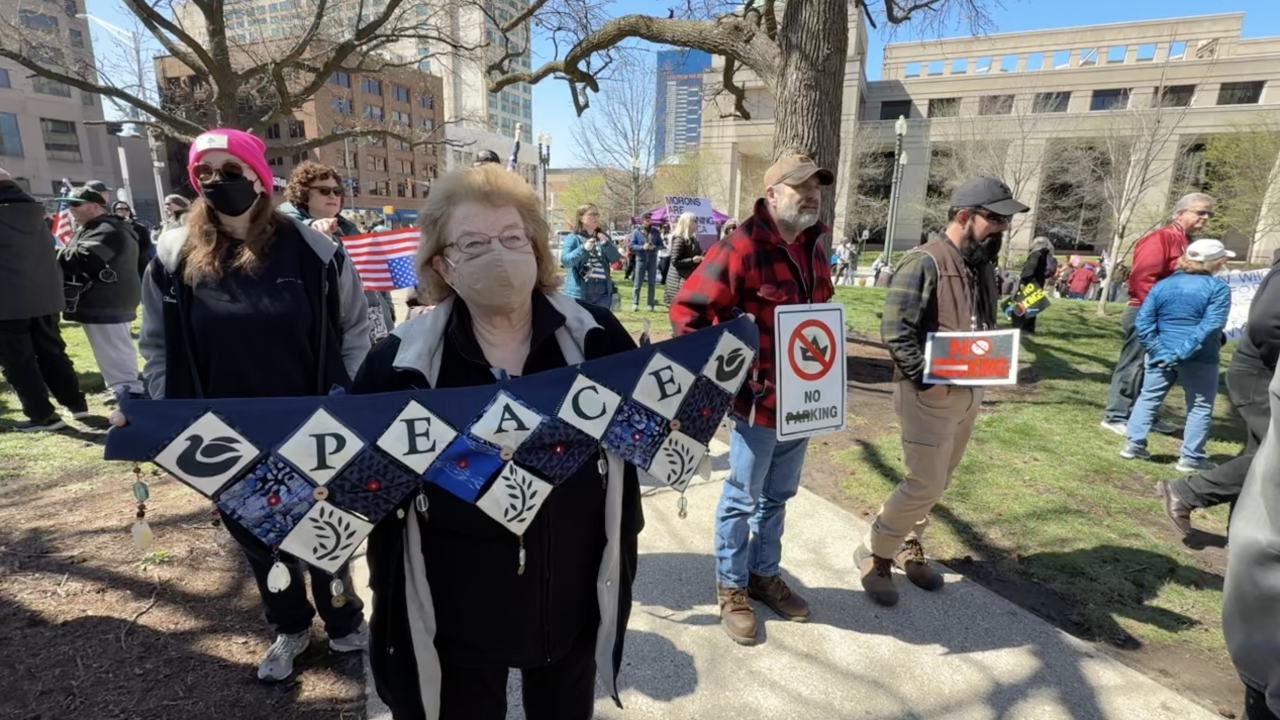
INDIANAPOLIS — Hundreds of Hoosiers gathered at the Indiana Statehouse Saturday morning as part of nationwide ‘No Kings’ events to voice their concerns about the current administration.
WATCH FULL STORY BELOW
Hundreds gather at Indiana State Capitol for ‘No Kings’ protest
“I’m out here today because what’s happening in our government is completely trash,” Donna Sipes told WRTV. “It’s wrong. We need to do something about it.”
“I’m tired of every single day when the TV comes on to see what stupid thing he’s done next,” Lindi Marti said.
WRTV
Attendees noted the growing popularity of the demonstrations.
“This is my fourth one to come to. I didn’t come to all of them when it was really cold, but I’m glad to see that they are getting a lot more people out here every time,” Marti added. “It seems like there’s more and more coming.”
Demonstrators highlighted specific foreign policy concerns, including the administration’s handling of the war in Iran.
“We’re bombing the heck out of them. We’re killing civilians,” Marti’s husband said. “We’re getting ready to send our Marines.”
WRTV
Others focused on the administration’s handling of immigration.
“That’s what I’m concerned about,” Reverend Kenny Little told WRTV. “Little kids, they’re taking them away from their family. And I’m just one of those people, I think everyone got rights.”
Indiana medical students also attended the rally to speak out against changes to the healthcare system.
“We’re really worried about the attacks on the health care system in general, but with Medicaid… current estimates range from anywhere from 325,000 to 450,000 Hoosiers will lose coverage by 2032,” Wade Catt said with concern.
WRTV

With midterm elections approaching later this year, attendees emphasized the importance of now taking action at the ballot box.
“If we don’t vote, then things are gonna not, they’re gonna stay the same,” a protester said.
Meanwhile, Indiana Lieutenant Governor Micah Beckwith says he’s happy to see Hoosiers exercise their First Amendment right to protest.
However, he takes issue with the idea that President Trump is acting like a king. Beckwith says the fact that people have the freedom to protest is proof that the president is not acting like a tyrant.
He acknowledges that bridging the gap between the sides is probably an uphill battle, but believes communication is key.
“I think when you sit down with people face to face, you’re confronted with humanity. There’s another human sitting across that table from you and talking to you. And so, all I have to say, I think that’s probably the thing I would encourage all Hoosiers to do is say, ‘Hey, if you don’t agree with somebody or if you don’t like somebody, why don’t you try grabbing coffee with them? And give it 30 minutes, and just see what happens.’ I bet most of the time people will walk away with a much softer heart and spirit towards that person before they came in,” Beckwith said.
Beckwith is currently on a 92-county tour of the state. He says all sides are welcome to attend his events.
__

INDIANAPOLIS (WISH) — Police say one “young man” is dead after a shooting at the 1200 block of Rue Rabelais at about 7:19 p.m. according to the Indianapolis Metropolitan Police Department.
That is near the intersection of 56th Street and Binford Boulevard.
Police say the victim was taken to Riley Hospital where he later died. Investigators say they are still working to identify the victim.
There was no known information about a suspect. Police did say that they believe this is a targeted incident.
There was no other information immediately available.
This story has been updated with information from the Indianapolis Metropolitan Police Department.

This story contains descriptions of distressing circumstances involving children.
INDIANAPOLIS (WISH) – A mother and her boyfriend were accused of causing the death of a 4-year-old-boy found dead in a basement closet on Monday.
Indianapolis Metropolitan Police Department arrested Angel Lovely, 37, and Nicholas Bergdoll, 36, on preliminary charges of neglect of a dependent causing death. The Marion County Prosecutor’s Office by Friday had not filed formal charges.
A sibling found the 4-year-old dead on Monday, according to investigators. Lovely and Bergdoll were in the home at the time but told police they were asleep when he died.
Born premature with cerebral palsy, the 4-year old couldn’t walk, was nonverbal, and ate through a feeding tube. Lovely claimed she would rarely put the child in the closet, only “when he won’t stop screaming” or when she “needed a break.”
But when investigators interviewed Lovely’s three other children, they said that the boy “stays in the closet all day,” and that “mom locks him in the closet” and “does not pay attention to him.”
An exact cause of death hasn’t been determined, but the child was found with blood in his mouth. Lovely said he’d been aspirating.
One of Lovely’s children told investigators they heard the 4-year-old gagging but didn’t say anything because it wasn’t unusual.
A neighbor living on Monticello Drive, Michelle Johnson, told News 8, “It’s horrible. It breaks my heart.”
Johnson had seen the other children outside the home but never knew there was a boy in a wheelchair living there. She said if she suspected they were being neglected, she would have called police or the Indiana Department of Child Services.
“We’re supposed to be a village and raise kids together,” Johnson said. “That’s really heartbreaking.”
Bergdoll told police, according to the investigators’ report, that he didn’t agree with putting the child in the closet: “I am not going to tell her how to f****** raise her kids.”
“I’m sickened,” IMPD Public Information Officer Tommy Thompson told News 8 in an interview.
“Think about putting yourself in that situation. Every day, do you want to be in a closet? Locked up, no light?”
Court records show the Department of Child Services had removed the boy from Lovely’s care because of medical neglect, but she regained custody last year against DCS recommendations.
Thompson, the neighbor, hopes the tragedy can be an opportunity for others to speak up when they see a child who can’t speak up for themselves. “Maybe you’ve got to make that tough phone call. Reach out. The city has resources.”
Johnson wishes she would have known what was happening so she could have said something. “Children don’t have a voice and we’re supposed to be their voice.”
Help is available for victims of domestic violence, child abuse, and sexual assault. Below is a list of suggested resources, both national and local:

L.A. summons the spirit of glam-surrealist artist Steven Arnold

Trump’s approval ratings just hit a new low. A Latino voter shift could reshape the midterms

Monroe High ace Miguel Gonzalez preparing for future as a father

Republican US lawmaker demands Congress vote on any Iran troop deployment

So you went to a No Kings protest. Now what?

Florida High School Football Rankings: Top 25 teams – Oct. 21

How old is Bo Nix? What to know about Oregon quarterback ahead of 2024 NFL Draft

Cleary's 21 help Le Moyne down Central Connecticut State 69-64 in OT

99th annual Pony Swim held in Virginia

Indiana Members Credit Union announced as new anchor tenant at Bottleworks District
Republican US lawmaker demands Congress vote on any Iran troop deployment
So you went to a No Kings protest. Now what?

JD Vance says he was ‘obsessed’ with UFOs, believes aliens are actually ‘demons’
The EU's recipe for trade deals : easy on beef, tough on wine

Photos: ‘No Kings’ protests across the country
-

 Sports1 week ago
IOC addresses execution of 19-year-old Iranian wrestler Saleh Mohammadi
-

 New Mexico7 days ago
Clovis shooting leaves one dead, four injured
-

 Miami, FL3 days ago
Jannik Sinner’s Girlfriend Laila Hasanovic Stuns in Ab-Revealing Post Amid Miami Open
-

 Tennessee6 days ago
Tennessee Police Investigating Alleged Assault Involving ‘Reacher’ Star Alan Ritchson
-

 Minneapolis, MN3 days ago
Boy who shielded classmate during school shooting receives Medal of Honor
-

 Technology1 week ago
YouTube job scam text: How to spot it fast
-

 Politics1 week ago
Schumer gambit fails as DHS shutdown hits 36 days and airport lines grow
-

 Science1 week ago
Record Heat Meets a Major Snow Drought Across the West