Illinois
Buckeyes Wilt Down The Stretch, Fall to Illinois – Press Pros Magazine


Bruce Thornton scored 20 points and dished out 10 assists, but the Buckeyes fell to Illinois 77-74 in the Big Ten Tournament. (Press Pros File Photos)
Hamstrung by foul problems and unable to get the one last break needed for yet another star on its NCAA Tournament resume, Ohio State came up just short against second-seeded Illinois in the Big Ten Tournament.
 Minneapolis, MN – A quick glance suggests Ohio State came up an agonizing three points short of the upset win over second-seeded Illinois that it needed Friday at the Big Ten Tournament.
But, really, the Buckeyes’ came even closer than their 77-74 loss that, had it ended differently, just might have landed OSU (20-13) in the NCAA Tournament.

Veteran columnist Bruce Hooley writes Ohio State basketball and sports at large for Press Pros Magazine.com.
In reality, Ohio State was as close as one additional rebound in the waning seconds…one who-knows-what-he-was-thinking mistake at the wrong time by an OSU senior…or one official’s call that should have fouled out Illinois’ best player with six minutes to play.
Any of those – and Ohio State likely needed only one of them – could have been enough to avert the Illini’s escape in a game the Buckeyes led by 10 points with 11 minutes left and three points with 1:41 remaining.
Instead, OSU went scoreless thereafter and Illinois made all six of its free throw attempts to end the Buckeyes’ fairy-tale rally in the aftermath of former head coach Chris Holtmann’s firing on Valentine’s Day.
 Why was Ohio State fouling at the finish, when leading, 74-71, via Jamison Battle’s shot in the lane at 1:41?
Well, after Terrence Shannon’s two free throws at 1:28 cut that margin to one, Battle tried again with a hard drive to the hoop that drew contact, but no foul, resulting in a jump ball to Illinois.
Coleman Hawkins then put the Illini in front for the first time since late in the first half with another pair from the line, where Illinois would finish 21-of-32 to OSU’s 10-of-13.
Now down, 75-74, OSU crossed midcourt and, before it could set up much of anything, watched backup center Zed Key to set quite possibly the worst excuse for a screen in the history of college basketball.
Key positioned himself to impede Hawkins covering Battle three feet behind the three-point line. But, for some inexplicable reason, Key then just fell into Hawkins like an oak tree on the wrong end of a sharpened chainsaw.
In a game where officials let Illinois hammer Ohio State mercilessly in the post for offensive rebounds – a sickening 19, to be exact – Key’s nonsense couldn’t be ignored when committed it in full view of everyone in the Target Center.
Leading by one and seeking further separation from the Buckeyes, Illinois’ Marcus Domask missed yet another jumper on a night the first-team All-Big Ten wing went an abysmal 3-of-16 from the field.
But Ohio State let Hawkins grab the rebound with 32 seconds left.
 No worries, right?
Just play great defense, regain possession after the Illini consumed however much of the 18 seconds they had left to shoot, then either preserve the win at the free throw line or hold for a final, game-winning attempt.
Instead, Shannon did Ohio State a big favor.
Not as big a favor, mind you, as officials did Shannon when they ignored his bull-in-a-china-shop steamrolling of OSU’s Bruce Thornton with six minutes left.
Thornton was in defensive position and backpedaling only slightly when Shannon, who has no gear below overdrive, flattened him driving to the rim just 29 seconds after checking back into the game.
Officials pretended their whistles were a delectable dessert, swallowing them obligingly and sending Shannon to the line for a pair of free throws that he drained.
More importantly, the call spared Shannon banishment to the court-side seat he should have occupied the remainder of the night…kinda like the temporary restraining order that’s allowed Shannon to play since January despite facing up to 54 years in prison on a rape charge that will go to trial in May.
Don’t you just love college sports?
Fast forward to the final 32 seconds, with Shannon at the top of the key, where he let fly a hoped-for clinching triple that instead came up well short.
 Ohio State, though, whiffed again on the rebound and Hawkins, again, grabbed it.
Forced to foul on the inbounds, OSU put Shannon on the line at 11.3 and he hit both, leaving the Buckeyes down, 77-74.
The anticipated Illinois foul on the Buckeyes’ ensuing possession never happened, with Battle getting off a contested triple under heavy duress that could have tied it.
Instead, it came up just short, as did his heave from midcourt after stealing an Illini inbounds pass in the final second.
“I’m just glad everyone got to see what’s in this locker room,” interim coach Jake Diebler said of the team that lost nine of Holtmann’s final 11 games, but went 6-2 thereafter. “My belief in them has never waivered.

Koverman,Staley, Dickerson proudly supports your favorite high school sports on Press Pros Magazine.
“We understand that things didn’t go as any of us anticipated for a certain stretch of the season, but we have great players in here who care so much about this program.”
Illinois coach Brad Underwood, who stomped and spat and sputtered throughout timeouts in an attempt to awaken his team to shake an opponent it beat by 12 points in Columbus, was not happy with what he saw on OSU’s final possession or all night.
“We were supposed to foul when they came across half-court,” Underwood said. “That was a mess. We got lucky.”
Shannon’s 28 points and 18 off the bench from backup bouncer – er, center – Dain Dainja delivered the Illini (24-8) from an OSU upset bid built on Battle’s 21 and Thornton’s 20.
The Buckeyes bench, which contributed a collective 37 in a Thursday win over Iowa, managed just 20 this time around with Devin Royal (6 points, 2 rebounds) limited to just 19 minutes because of foul trouble.
OSU center Felix Okpara had 10 rebounds and four blocks, but scored just four points in 24 minutes, fouling out with 2:27 to go to invite Illinois’ crippling dominance of the offensive glass down the stretch.
Officials called Ohio State for 27 fouls to Illinois’ 13, including seven on the Buckeyes in the last 5:44, at which point OSU held a 65-61 lead. The Illini were not whistled for a single foul over that span.
“We talked about the most important real estate being what was in the paint,” Diebler said. “We just couldn’t get the rebound we needed when we needed it there af the end, but that doesn’t change anything I feel about this team and how they responded.”

Wilson Health proudly sponsors the best in area sports coverage on Press Pros Magazine.com.



The Illinois Polymer Maker Lab, Beckman’s newest core facility, will open soon in the institute’s basement. The lab will be the first-of-its-kind facility for the automated formulation and testing of polymer-based materials and will soon be open to researchers across campus and across the nation.
The lab will help researchers accelerate the development of materials and products related to paints and coatings, adhesives, personal care items, composites, and materials for 3D printing. It could also help researchers design resins for energy-efficient manufacturing and products in the food science industry. It’s funded by a Major Research Instrumentation grant from the National Science Foundation.
“The core capabilities will be pretty unique,” said Dan Krogstad, the lab’s manager and a research professor in the Department of Materials Science and Engineering. “The IPML facility at Beckman provides researchers with an incredible opportunity to accelerate the development of polymer-based formulations through the creation of rich, digital datasets using automated equipment and workflows.”
The lab joins four other Beckman core research facilities: the Biomedical Imaging Center, Microscopy Suite, Molecular Imaging Lab and Visualization Lab.
“The Illinois Polymer Maker Lab is another example of how Beckman provides cutting-edge facilities that you can’t find anywhere else,” said Beckman Director Steve Maren. “This facility will fuel materials discovery for our researchers and especially allow them to push the boundaries of knowledge through AI.”
The Anton Paar high-throughput rheometer, an HTR 7000, was the first instrument to be installed in IPML earlier this spring. It’s a robotic instrument capable of dispensing polymers and measuring their flow behavior automatically.
For example, the rheological properties tell us whether a paint will drip after being applied to a surface, how easy it is to squeeze toothpaste out of a tube or how well the materials will flow through pipes in a factory.
However, while the rheological properties are important in the development of new materials, collecting related data can require a lot of time. High-throughput systems, like IMPL’s Anton Paar HTR 7000, help overcome this limitation.
Sam Tawfick, a co-leader of the Autonomous Materials Systems group, said his Beckman research colleagues are researching how to better manufacture advanced materials through 3D printing or resins for polymers reinforced with carbon fibers
“The flow behavior of polymers is critical to assess their manufacturability,” said Tawfick, the Anderson Family Scholar and professor of mechanical science and engineering, adding that the IPML rheometer’s usefulness is in how it dispenses polymers and automatically measures their flow.
“This changes the students’ workflow in the lab by minimizing sample preparation steps and enabling the equipment to run and take measurements 24 hours a day, seven days a week. For the students, this means higher productivity and the ability to focus on interpretation of the results.”
Beyond reducing the time required, automating rheological measurements promotes machine learning by making procedures more uniform, creating organized digital datasets and increasing the amount of data that can be collected.
Tawfick believes access to the lab will have incredible implications for both expanding knowledge and offering new materials to the public.
“I personally think students will achieve more during the same timeline of a Ph.D. or postdoctoral training, connecting more dots around their discovery and tightening both the scientific understanding and the reliability of their discoveries,” he said.
In the past, it’s taken up to 20 years for a new polymer, like a high temperature resistant silicone or high strength composite, to be ready for commercial use. Material readiness is ranked on a scale (called the Technology Readiness Level, or TRL) between 0 and 9, the latter which describes a material that’s commercially established.
“It takes about 10 years to move the concept of a material from TRL 0 to TRL 3 in a lab,” Tawfick said. “IPML is targeting this stage, with the aim of shortening it from a decade to potentially weeks.”
And because the lab will be a Beckman core facility, knowledge can transfer among users thanks to the help of expert staff members and the creation of institutional knowledge, Tawfick said.
“Groups from campus and external users from the private sector will benefit from and contribute to this institutional knowledge,” he said. “This will be accomplished by gradually optimizing the workflows and the AI models used in the facility.”

The LA Clippers selected Illinois guard Keaton Wagler with the No. 5 overall pick in the 2026 NBA draft on Tuesday at the Barclays Center in Brooklyn, New York.
Wagler became the first Illini freshman to be named a consensus All-American after averaging 17.9 points, 5.1 rebounds and 4.2 assists while shooting 39.7% from 3-point range. He set numerous freshman program records, including points (663), field goals (202) and 3s (87).
The 6-foot-6 Wagler is the first player in franchise history to be taken with the fifth pick and the highest player drafted since Blake Griffin went No. 1 in 2009. He is Illinois’ third top-10 pick in the draft era (1966), joining Kendall Gill (1990, No. 5) and Deron Williams (2005, No. 3).
Wagler is highly touted because of his shooting, feel and ability to convert difficult finishes at the rim. He had a monumental rise up draft boards throughout the year after leading Illinois to its first Final Four appearance since 2005.
The 19-year-old was heavily linked to the Clippers throughout the predraft process after visiting only with them and the Chicago Bulls (No. 4). He eventually canceled his remaining workouts after those meetings, an indication that he felt he wouldn’t fall below the Clippers.
Wagler was the fifth straight freshman to hear his name called on Tuesday, following AJ Dybantsa (Washington), Darryn Peterson (Utah), Cameron Boozer (Memphis) and Caleb Wilson (Chicago).
Illinois
Ex-Illinois teacher awaiting deportation linked to Tren de Aragua mass shooting in Chicago: DHS

CHICAGO – A former Illinois teacher living in the United States illegally, who was allegedly involved in a 2024 Tren de Aragua mass shooting that killed three people at a Chicago house party, was arrested by federal authorities, officials said Monday.
Giovanna Mercedes Moreno Occhipinti, 32, an illegal immigrant from Venezuela with dual citizenship in Italy, was taken into custody by U.S. Immigration and Customs Enforcement (ICE) agents on May 13, the Department of Homeland Security (DHS) said.
Occhipinti entered the U.S. in October 2021 under the Visa Waiver Program and was supposed to leave by Jan. 2, 2022. She overstayed her visa, DHS said.
On the night of the Dec. 2, 2024, shooting, she allegedly drove the two gunmen—Ricardo Granadillo Padilla and Edward Martinez Cermeno—to the scene of the crime, where five people were injured in addition to the three fatalities, authorities said.
“Although Chicago police arrested this illegal alien shortly after the shooting, sanctuary politicians released her from jail without notifying ICE,” DHS Acting Assistant Secretary Lauren Bis said in a statement. “Under President Trump and Secretary Mullin, DHS is doing the job that sanctuary politicians in Illinois refuse to do: putting the American people first and removing these dangerous criminals from our communities.”
Martinez Cermeno was released from ICE custody in January 2025 after a federal judge determined that federal prosecutors failed to meet their burden of proof to keep him incarcerated while awaiting trial.
Immediately after the shooting, authorities found multiple weapons in Occhipinti’s vehicle, DHS said. Authorities believe she helped Granadillo Padilla and Martinez Cermeno evade law enforcement after the attack.
The Chicago Police Department arrested Occhipinti on Dec. 5, 2024, on charges of unlawful use of weapons and other weapons offenses. However, she was released without ICE ever being notified under Chicago’s sanctuary policies, which protect illegal immigrants from federal immigration authorities.
The Cook County State’s Attorney’s office decided not to prosecute the suspects, DHS said, and Granadillo Padilla and Martinez Cermeno were eventually deported.
“Giovanna Mercedes Moreno Occhipinti’s actions were calculated and deliberate, leading to the loss of three lives,” said HSI Chicago Special Agent in Charge Matthew Scarpino. “I’m proud of our agents for pursuing this case to the end, ensuring that everyone who helped facilitate this mass homicide is brought to justice.”
Fox News was told by DHS that Occhipinti was a teacher at an unspecified school in the Chicago suburb of Elgin. Illinois officials have refused to cooperate with federal authorities and will not tell DHS the name of the school, Fox News has learned.
Occhipinti is being held at the Grayson County Detention Center in Leitchfield, Kentucky.
Read more at FoxNews.com
-
 Sports11 minutes ago
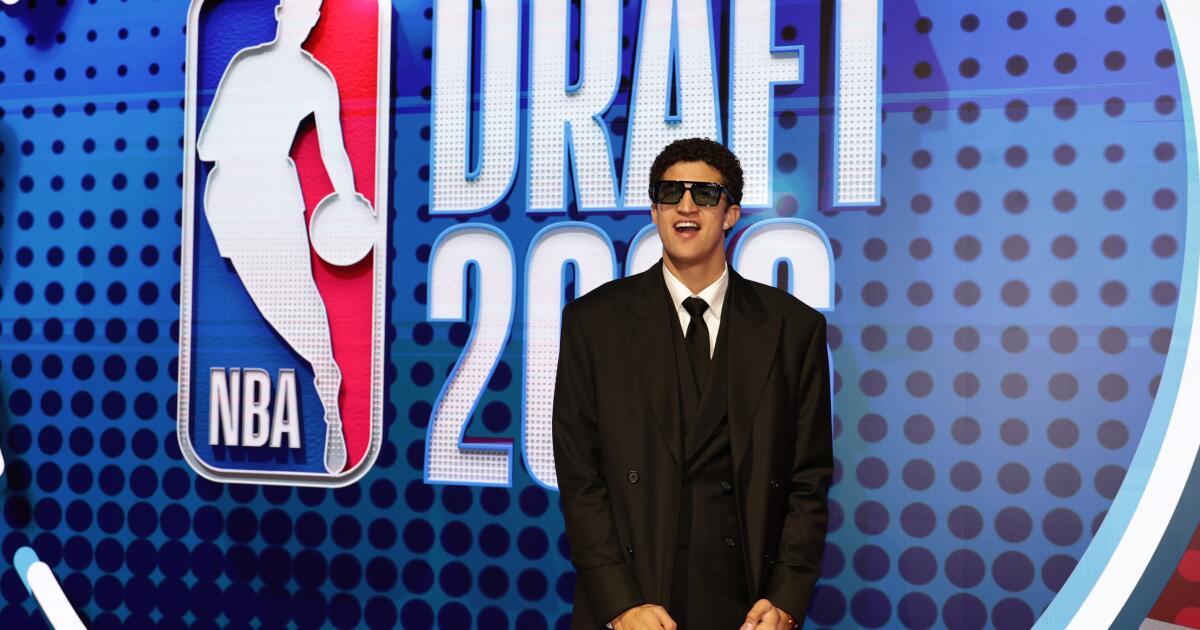
‘Super blessed’: Karim López makes NBA history as first Mexican-born first-round draft pick
-

 World20 minutes ago
Will the UK rejoin the European Union? MEPs debate Brexit on The Ring
-
News44 minutes ago
Federal judge bars Trump from implementing proof of citizenship requirement to vote
-

 Los Angeles, Ca2 hours ago
Clue may identify SUV in Long Beach hit-and-run that left woman injured
-

 Detroit, MI2 hours ago
Ilitch Companies creates gaming platform, expands beyond Detroit
-

 San Francisco, CA3 hours ago
First of its kind queer museum in San Francisco Chinatown amplifies Chinese LGBTQ artists
-

 Dallas, TX3 hours ago
These children were sold for sex. Then the system failed them again
-

 Miami, FL3 hours ago
Hard Rock Cafe lets Downtown Miami lease lapse after 30-plus years

