Midwest
He's not running again in 2028, but Trump's returning to this crucial presidential nominating state

NEWYou can now listen to Fox News articles!
President Donald Trump returns to Iowa Thursday evening.
But his stop in the state that for half a century has held the lead-off contest in the race for the Republican presidential nomination is about 2026 rather than 2028.
Trump will headline a Fourth of July eve event at the Iowa State Fairgrounds in Des Moines to kick off America250, a series of yearlong celebrations surrounding the 250th anniversary of the signing of the Declaration of Independence.
Longtime Iowa GOP chair Jeff Kaufmann told Fox News it’s no surprise that the president picked Iowa to kick off celebrations of America’s independence.
TRUMP ANNOUNCES HE’LL KICK OFF INDEPENDENCE DAY WEEKEND WITH ‘VERY SPECIAL’ PATRIOTIC EVENT
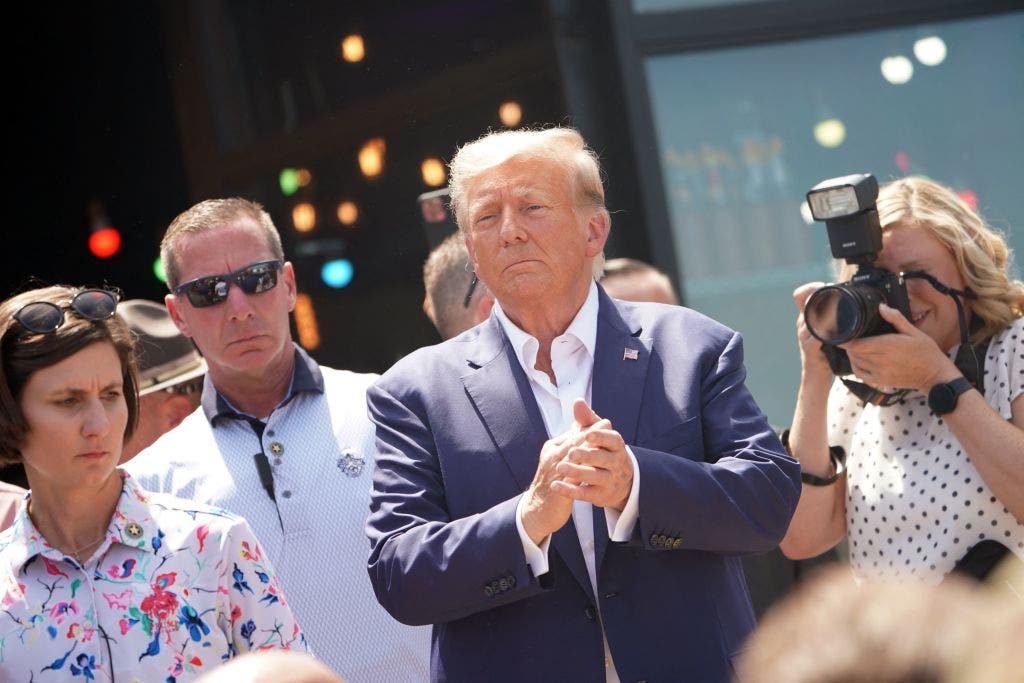
Then-former President Donald Trump waves to supporters at the Iowa Pork Producers tent during a visit to the Iowa State Fair, Aug. 12, 2023, in Des Moines. (Charlie Neibergall/The Associated Press)
“We’ve always had a special relationship with the president,” Kaufmann told Fox News Digital, as he noted that Trump carried the one-time general election battleground turned red state in the 2016, 2020 and 2024 presidential elections.
Kaurfmann said Trump’s stop in Iowa “is very symbolic, but it’s also very telling of what is important to him and I really believe he’s starting here because not only does he love Iowa, but he believes in the heartland. I think this is a huge message that he’s sending to everyone that he hasn’t forgotten who brought him to the dance.”
TRUMP WHITE HOUSE RELEASES VIDEO SERIES LEADING UP TO AMERICA’S 250TH BIRTHDAY: ‘ROAD TO INDEPENDENCE’
Veteran Iowa-based Republican consultant Nicole Schlinger said “it’s no surprise” that the president has “chosen to kick off America 250 at the best state fairgrounds in the country.”
“From the day his helicopter first landed here in 2015, Trump has had a special connection with Iowa. He’s straight-talking, hardworking and unapologetically proud of our country – just like Iowans,” Schlinger added. “Starting America’s 250th in Iowa is a reminder that the road to our future runs through the heartland.”
Former President Donald Trump greets supporters as he arrives at the Iowa State Fair, on Aug. 12, 2023, in Des Moines. (Paul Steinhauser – Fox News )
Trump is no stranger to the fairgrounds.
Presidential candidate Trump walked through the crowds at the famed state fair in 2015 and 2023, and he held large rallies at the fairgrounds just ahead of the 2016 Iowa caucuses and again in October 2021.
Trump’s trip will also spark speculation about 2028.
“Trump 2028” hats are available for $50 and T-shirts that read “Trump 2028 (Re-write the Rules),” sell for $36 on the Trump Organization’s website.
But the rules are quite clear: The 22nd Amendment to the U.S. Constitution restricts presidents to two terms in office.
KEEP YOUR EYES ON THESE SIX REPUBLICANS AS 2028 TALK STARTS TO HEAT UP
And after months of flirting with running for a third term in the White House, Trump appears to be ruling out another campaign.
Despite touting strong support in the MAGA world for a 2028 run for re-election, the president in a May interview on NBC News’ “Meet the Press” said, “I’m not looking at that.”
“I’ll be an eight-year president,” Trump added. “I’ll be a two-term president. I always thought that was very important.”
“I’ll be an eight-year president,” President Donald Trump said. “I’ll be a two-term president. I always thought that was very important.” (Stefani Reynolds/AFP via Getty Images)
But Trump’s 2028 flirtations, which he said weren’t a joke, and his sweeping moves since the start of his second tour of duty in the White House are keeping the spotlight firmly on him, averting any lame-duck talk and putting a damper on any early moves by those in the Republican Party hoping to succeed the president.
The race for the next GOP presidential nomination won’t get underway until Trump’s ready to share the spotlight, and he recently said it’s “far too early” to begin holding those discussions.
But Trump also added, “I’m looking to have four great years and turn it over to somebody, ideally a great Republican, a great Republican, to carry it forward.”
Vice President JD Vance is presumed to be the extremely early frontrunner in the race to be the next GOP standard-bearer.
Former President Trump addresses a large crowd of supporters at the Iowa State Fairgrounds, Oct. 9, 2021. (Paul Steinhauser – Fox News )
But other Republican politicians, with a likely eye to 2028, already have made stops in Iowa.
Sen. Rand Paul of Kentucky, who ran unsuccessfully for the 2016 GOP nomination, and Sen. Rick Scott of Florida, already have visited Iowa in 2025.
And Govs. Glenn Youngkin of Virginia and Sarah Huckabee Sanders of Arkansas stopped in the Hawkeye State in July.
Kaufmann, pointing to Vance, noted, “I’ve said on multiple occasions that the vice president certainly has a standing invitation.”
And Kaufmann, addressing the early 2028 trips to Iowa, highlighted that “it’s 24-7 here, 365 days a year. It’s exactly how we want it and I think our folks are ready for the challenge yet again.”
Read the full article from Here



Fans pack Campus Martius for USA-Belgium World Cup match
USA fans pack Campus Martius in downtown Detroit for the World Cup Round of 16 match vs Belgium watch party hosted by Detroit City FC on July 6, 2026.
Another Team USA match in the World Cup means another party in downtown Detroit.
Hundreds of fans filled out Campus Martius Park ahead of Team USA’s Round of 16 match against Belgium. If USA wins at Lumen Field in Seattle, it’ll be its first time the Americans made the World Cup quarterfinals in more than 20 years.
This is the fifth Team USA watch party held by Detroit City Football Club for the World Cup.
One US soccer fan, Ankur Gupta, came with a red, white, and blue Einstein wig. Gupta said he hopes the fanfare at Campus Martius matches the in-person experience for Team USA matches.
“I went to the US-Seattle, US-Paraguay games, and they have this complete (expletive) show,” he said. “And it’s awesome.”
The conversation around tonight’s match has been dominated by FIFA’s last-minute decision to allow Folarin Balogun to play, nullifying a one-game suspension from his red card against Bosnia and Herzegovina.
With Balogun available, the USMNT has an improved shot to reach the quarterfinals for the first time since 2002, and only the second time ever.
Detroit watch party erups after USA goal vs. Belgium in World Cup
The downtown Detroit crowd reacts as USA’s Malik Tillman scores against Belgium in the World Cup Round of 16 match on July 6, 2026.
This story will be updated.
USA TODAY contributed.

MILWAUKEE – On Tuesday, July 7, Milwaukee officials are set to release new quarterly crime numbers, following two separate incidents over the holiday weekend in two of the city’s popular entertainment districts that injured two police officers.
Holiday weekend violence
What we know:
Shortly after midnight Sunday, Milwaukee police said officers were chasing after people setting off fireworks in the Brady Street area when a firework injured an officer, a 33-year-old woman, near Cambridge and Brady Streets.
Viewer video of the fireworks
About two hours later, police said officers were running to the sound of gunshots near Water and Knapp Streets, when a car fleeing the scene hit an officer.
FREE DOWNLOAD: Get breaking news alerts in the FOX LOCAL Mobile app for iOS or Android
In that incident, Milwaukee Police Chief Jeffrey Norman said the injured officer, as well as other officers, shot at the vehicle – which sped off. Norman said the car was found about 12 blocks away, near 12th and Fond du Lac, as well as the injured 18-year-old driver. He was taken to the hospital for treatment of gunshot wounds, and is expected to survive. Police said a gun was found in the suspect vehicle, as well as in the area where the man was arrested.
Milwaukee police said both officers are recovering.
Officials respond
What they’re saying:
On Monday, Milwaukee Mayor Cavalier Johnson noted the hundreds – if not thousands of people – who celebrated the holiday weekend responsibly, while calling out the upbringing of people who cause chaos in the city.
“This is beyond a policing thing,” said Johnson, following a press conference in the city’s Uptown neighborhood at 55th and Wright. “I don’t want to put this at the feet of the police department. Those folks who go down there and cause problems, they make a decision to do that,” Johnson said.
The events are just the latest incidents to happen in the city’s entertainment districts. Brady Street recently implemented its pilot safety plan.
“Is there a concern these have an impact on business and drawing more people that want to be there, to enjoy a safe environment?” asked FOX6’s Bill Miston.
“I’m always taking a look, and trying to be cognizant of what these sort of events mean for businesses, for public safety, and for the city as a whole,” Johnson said.
SIGN UP TODAY: Get daily headlines, breaking news emails from FOX6 News
Milwaukee Downtown said it was disheartened by the incidents on Water and nearby Brady Streets, and wished the officers a quick and full recovery. In a statement, Milwaukee Downtown thanked police for their dedication to keeping the entertainment districts safe.
“Downtown Milwaukee welcomed tens of thousands of guests over the milestone holiday weekend. It is unfortunate that these actions overshadow the many positive experiences shared by residents and visitors,” said CEO Matt Dorner.
Portions of this article were formatted using A.I. FOX6’s Bill Miston and an editor reviewed it for accuracy and tone prior to publishing.
The Source: Information in this story was gathered from the Milwaukee police, Milwaukee Police Chief Jeffrey Norman, Milwaukee Mayor Cavalier Johnson, and Milwaukee Downtown.
Minneapolis, MN
Overnight shooting outside Minneapolis recording studio leaves teen injured, 3 men hurt

Minneapolis police are investigating a shooting that injured a 17-year-old boy and three men overnight on Monday.
Law enforcement was called to the 1300 block of Water Street around 2:35 a.m. on a report of a shooting. Officers found a 17-year-old boy with an apparent non-life-threatening gunshot wound; he was brought to Children’s Hospital for treatment, Minneapolis police said.
About 20 minutes later, three men, whose ages were not specified, showed up at the hospital with apparent non-life-threatening gunshot wounds, police confirmed.
Law enforcement says the four men were leaving a building when gunfire broke out. During a live broadcast on Monday, Ramsey County Sheriff Bob Fletcher confirmed the men were walking out of a recording studio.
No arrests have been made at this time.
-
Politics22 seconds ago
Preliminary Hearing for Man Accused of Killing Charlie Kirk Starts in Utah
-
 Lifestyle30 minutes ago
What a divorce coach wishes couples knew before ending a marriage
-

 Technology38 minutes ago
Hoto’s PixelDrive screwdriver is down to $60, matching its best price
-

 World45 minutes ago
Cuba plunges into third major blackout this year as power crisis worsens
-

 Politics48 minutes ago
Top Platner ally turns on him after bombshell rape allegation rocks campaign: ‘Red line’
-

 Health53 minutes ago
Experimental vaccine shows promise against dangerous intestinal illness
-

 Sports1 hour ago
England’s Jordan Henderson officially ruled out after freak fall causes fracture, opts for surgery
-

 Technology1 hour ago
Starship delivery robots leave campuses for cities

