Midwest
Gasoline with higher blends of ethanol to be sold in 8 Midwestern states year-round

- The Environmental Protection Agency has announced a final rule permitting drivers in eight Midwestern states to use a higher blend of ethanol year-round.
- The fuel additive consumes roughly 40% of the nation’s corn crop, and higher sales of ethanol could mean greater profits for farmers.
- The rule, which takes effect in April 2025, will apply in Illinois, Iowa, Minnesota, Missouri, Nebraska, Ohio, South Dakota and Wisconsin.
Drivers in eight Midwestern states will be able to fuel up with a higher blend of ethanol throughout the year under a final rule announced Thursday by the Environmental Protection Agency.
The biofuels industry and farming groups, with support of Midwest governors, sought the end of a summertime ban on sales of gasoline blended with 15% ethanol for years. The higher blend has been prohibited because of concerns it could worsen smog during warm weather.
The move reflects the importance of ethanol to agriculture. The fuel additive consumes roughly 40% of the nation’s corn crop, so higher sales of ethanol could mean greater profits for corn farmers.
AUTO-MOO-BILES? ETHANOL MADE FROM MILK COMING SOON TO MICHIGAN
The rule, which takes effect in April 2025, will apply in Illinois, Iowa, Minnesota, Missouri, Nebraska, Ohio, South Dakota and Wisconsin. Those states grow the bulk of the U.S. corn crop and are home to much of the nation’s ethanol production.
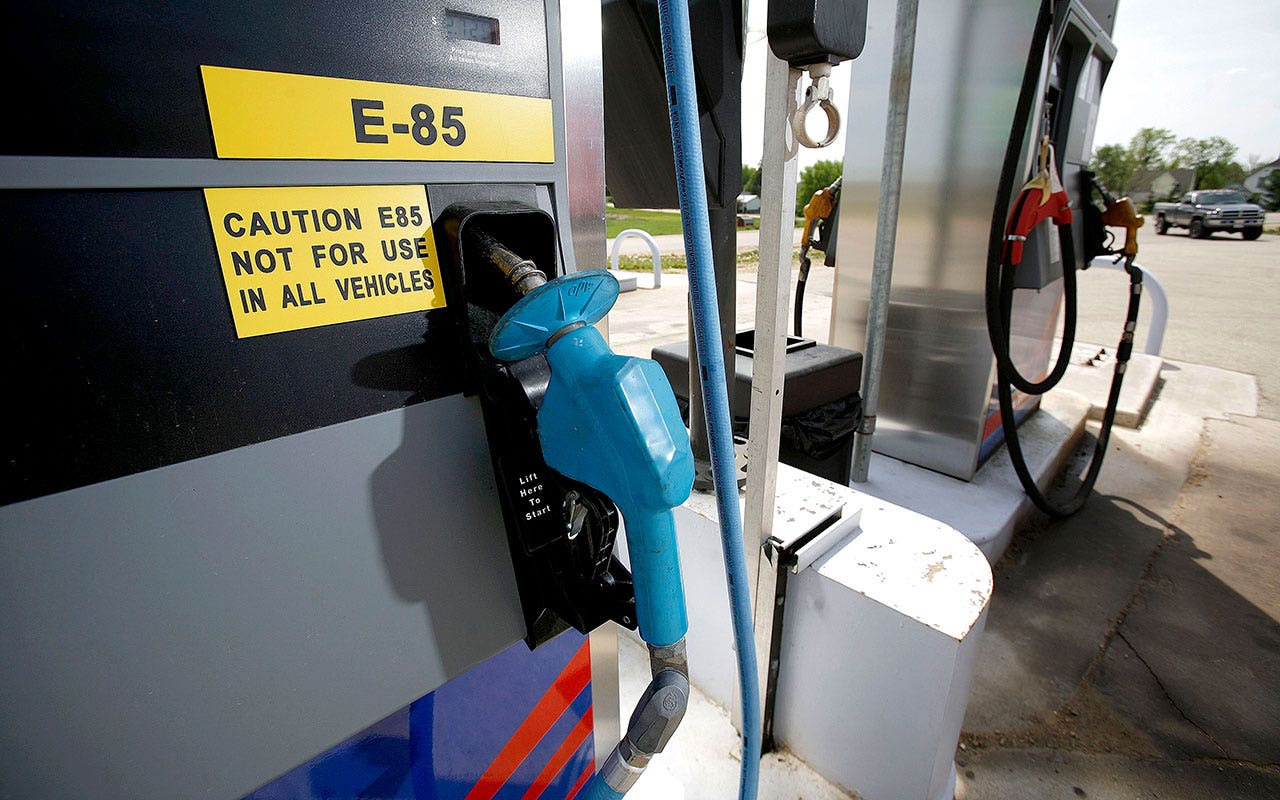
A sign about ethanol hangs on a fuel pump at Capital Mini Mart in Belmont, Wisconsin. Drivers in eight Midwestern states will be able to fuel up with a higher blend of ethanol throughout the year under a final rule announced on Thursday by the Environmental Protection Agency. (Mark Hirsch/Getty Images)
The EPA said it delayed implementation of the new rule because of concerns there wasn’t enough supply to meet demand this summer. Ethanol producers welcomed the change but criticized the EPA for that delay.
GUTFELD DIGS INTO CORNY POLITICAL CONCERNS ABOUT ETHANOL
“While we are pleased to see EPA has finally approved year-round E15 in these eight states, we are extremely disappointed by the agency’s needless decision to delay implementation until 2025,” the Renewable Fuels Association, a trade group, said in a statement. “It’s helpful to finally have some certainty about 2025 and beyond, but what happens this summer?”
Most gasoline sold across the country is blended with 10% ethanol, though 15% blends are becoming increasingly common, especially in the Midwest. E15 summer sales still will not be allowed in most of the country during summer, though agricultural groups are pushing for a nationwide policy change.
The biofuels industry and politicians of both parties have portrayed ethanol as a product that helps farmers, reduces prices at the pump and lessens greenhouse gas releases because the fuel burns more cleanly than straight gasoline. However, environmentalists and others have said increased ethanol production can increase carbon releases because it results in more corn production, leading to increased use of fertilizer and greater releases of nitrate. Synthetic and natural fertilizers also are a leading source of water pollution.
BIDEN DISMISSED IDEA ETHANOL COULD HELP SLASH GAS PRICES AS ADMIN STRUGGLES TO RESPOND TO RISING COSTS: REPORT
The EPA has approved sales of E15 for cars and trucks manufactured after 2000. Growth Energy, another bioenergy trade association, estimates the higher blend will cost consumers 15 cents a gallon less than 10% ethanol.
Petroleum refiners have opposed the Midwest-specific rules, saying a special blend in one region would increase costs and could lead to tighter fuel supplies.
The American Petroleum Institute, a trade group, said a national standard was needed.
“We are concerned this piecemeal approach could weaken the resiliency of the region’s fuel supply chain,” Will Hupman, a vice president at the group said in a statement. “We continue to call on Congress to pass the bipartisan Nationwide Consumer and Fuel Retailer Choice Act, which would bring much needed consistency to the marketplace by allowing for the year-round sale of E15 nationwide, preserving access to E10 and eliminating the need for regional or state-specific waiver petitions.”
Read the full article from Here


Some communities saw their bills rise 75% or more.
The median property tax bill for Chicago homeowners rose by a record last year, and some parts of the city saw much steeper increases than others.
The citywide median rise was 16.7%, according to a report from the Cook County Treasurer’s office on bills for tax year 2024.
Many poor communities in Chicago saw the largest increases. In 15 areas on the South and West sides, property taxes shot up 30% because of rising home values. In West Garfield Park, North Lawndale, Englewood, West Pullman and West Englewood, property tax bills rose 75% or more.
Chicago homeowners have suffered in recent years. While property taxes did increase in some Cook County suburbs in 2024, city homeowners felt the bulk of the pain. That’s because assessed values on downtown commercial buildings fell 7.2%, reducing taxes on those properties.
Lower commercial assessments don’t reduce what the city expects to collect in property taxes — it just means homeowners pay a larger share.
Other reasons for Chicago homeowners’ high bills this year included a 6.3% increase in the levy, or what taxing bodies request. That rise was driven by a larger request from Chicago Public Schools and a higher amount earmarked for Tax Increment Financing districts. TIF districts collected 10.4% more year over year in 2024, totaling over $1.3 billion.
For 2024 the total Cook County levy was $19.2 billion, up about 4.8% from the previous year. The Chicago-area inflation rate was closer to 3.5%.
Cook County property taxes have outpaced inflation for a long time. Since 1995, they’ve gone up 181%, from $6.8 billion in 1995 to $19.2 billion in 2024, according to the county treasurer. Adjusted for inflation, that’s a 48% increase. If property taxes had risen on pace with inflation, the 2024 levy would have been $13 billion rather than $19.2 billion.
This rising burden can’t continue. Since 2019, more than 1,000 Cook County homeowners — including 125 senior citizens — have lost their homes and all their equity over a property tax debt smaller than the price of a 10-year-old Chevy Impala.
The U.S. Supreme Court has found the practice of taking more than the tax owed to be unconstitutional, but the Illinois General Assembly has yet to change the law to stop it. Cook County Treasurer Maria Pappas delayed the property tax lien sale scheduled for last August, but it’s now set for March.
Of the Illinois residents who moved out in 2024, 95% went to lower-tax states. Lawmakers must reduce the property tax burden. They should cap how long TIFs can last and limit how many times they can be extended. Returning that money to general use would bring much-needed transparency and real property tax relief for Illinois residents.
Also, legislators are allowed to work as property tax appeal lawyers, enabling them to profit from ever-growing tax hikes. Imprisoned former Illinois House Speaker Mike Madigan did that, as did former Chicago Ald. Ed Burke. This practice should not be prohibited.
The best way to reduce the property tax burden is to reform its largest driver: public-sector pensions. In Chicago, 80% of property taxes go toward its growing pension debt. Rather than seeking to control spending, Gov. J.B. Pritzker recently signed a “pension sweetener” for Chicago police and firefighters that will increase liabilities by $11.1 billion.
Reforming the state constitution would allow for moderate pension changes, increasing the fiscal health of those systems and reducing the property tax burden on Chicago homeowners.
Until changes are made, Cook County homeowners will continue to see their property tax bills climb.

Central Indiana has seen a very wet start to March, with several rounds of rain and storms moving through the region over the past few days. In fact, the city of Indianapolis has already received more rain in the first four days of the month than it typically gets during the entire month of March.
So far this month, Indianapolis has recorded 3.90 inches of rainfall, which already exceeds the normal March monthly average of 3.79 inches. Much of that rain came during a widespread soaking on Tuesday, when a strong system pushed steady showers and thunderstorms across the state.
Some of the highest totals over the past three days have been recorded across central Indiana. Rain gauges show 5.86 inches in Marion County, 5.02 inches in Morgan County, 4.97 inches in Hancock County, 4.95 inches in Shelby County, 4.57 inches in Johnson County, and 4.26 inches in Hendricks County. These totals represent a significant amount of rainfall in a short period of time and have left many areas with saturated ground and standing water in low spots.

Despite the widespread rainfall, the impact on drought conditions has been somewhat uneven across the state. According to the latest drought monitor, the areas that received the heaviest rain over the past few days are largely the same areas that were already in relatively good shape in terms of moisture levels. Meanwhile, parts of northern Indiana that have been dealing with more persistent dryness have seen much lighter totals.
Cities such as Kokomo, Lafayette, and Muncie have generally picked up less rain compared to areas farther south. Forecast models suggest that pattern may continue over the next several days.
Additional rainfall is expected through Thursday, with another round possible around midday Saturday. Current projections show the best chance for another inch or more of rain focusing once again across the southern half of the state, while northern Indiana may see lower totals.
That means while the recent rain has certainly helped improve soil moisture in many areas, it may not fully address the lingering dryness farther north. For now, the pattern remains active, and Hoosiers should expect more wet weather before the system finally begins to move out later this weekend.

Wrestling-Women
March 5, 2026
Iowa women’s wrestling star Kylie Welker on competing for official NCAA championship
March 5, 2026
Kylie Welker chats with NCAA Digital’s Sophie Starkey about the success of Iowa women’s wrestling and the possibility of winning the inaugural NCAA sanctioned championship.

Amid tariff and trade confusion, Georgia posted record exports in 2025

Kay’s Crackseed: The Manoa shop preserving Hawaii’s favorite childhood snack

Idaho lawmakers introduce bill to phase out state funding for Hispanic Affairs commission

Chicago property taxes jump — but unevenly

Heavy rain soaks central Indiana, but drought relief uneven across the state

Florida High School Football Rankings: Top 25 teams – Oct. 21

Cleary's 21 help Le Moyne down Central Connecticut State 69-64 in OT

How old is Bo Nix? What to know about Oregon quarterback ahead of 2024 NFL Draft

99th annual Pony Swim held in Virginia

Indiana Members Credit Union announced as new anchor tenant at Bottleworks District

Map: 4.9-Magnitude Earthquake Shakes Louisiana

Paxton vows he’s ‘staying in this race’ even if Trump backs Cornyn in Texas GOP clash

Which Kurdish groups is the US rallying to fight Iran?

Man accused of plot to assassinate Trump testifies Iran pressured him, says Biden and Haley were other possible targets

DHS defends McLaughlin against allegations husband’s company profited millions from ad contracts: ‘Baseless’
-

 World1 week ago
Exclusive: DeepSeek withholds latest AI model from US chipmakers including Nvidia, sources say
-

 Massachusetts1 week ago
Mother and daughter injured in Taunton house explosion
-

 Wisconsin4 days ago
Setting sail on iceboats across a frozen lake in Wisconsin
-

 Maryland5 days ago
AM showers Sunday in Maryland
-

 Florida5 days ago
Florida man rescued after being stuck in shoulder-deep mud for days
-

 Denver, CO1 week ago
10 acres charred, 5 injured in Thornton grass fire, evacuation orders lifted
-

 Massachusetts3 days ago
Massachusetts man awaits word from family in Iran after attacks
-

 Oregon6 days ago
2026 OSAA Oregon Wrestling State Championship Results And Brackets – FloWrestling