Midwest
Bureaucrats hide true price of Obama Presidential Center as taxpayers hit with infrastructure bill

NEWYou can now listen to Fox News articles!
FIRST ON FOX: Former President Barack Obama once declared that his presidential center would be a “gift” to Chicago, but taxpayers are on the hook for hundreds of millions of dollars in hidden costs related to the beleaguered project.
A Fox News Digital investigation shows taxpayers are now stuck footing the bill for surging public infrastructure costs required to support the project — and no government agency can provide an accounting of the total public cost, despite months of queries and FOIA requests.
“Illinois Republicans saw this coming a mile away. Now, right on cue, Illinois Democrats are leaving taxpayers high and dry and putting them on the hook for hundreds of millions of dollars to support the ugliest building in Chicago,” Illinois GOP Chair Kathy Salvi told Fox News Digital. “Illinois’ culture of corruption is humming along with pay-to-play deals to their allies and friends while lying to Illinois voters.”
When the project was approved in 2018, Obama pledged to privately fund construction of the expansive 19.3-acre campus in historic Jackson Park through donations to the Obama Foundation – a commitment that remains in place as the center’s construction continues to be privately financed.
But the extensive infrastructure required to make the campus operationally viable — including redesigned roads, stormwater systems, and relocated utilities — is publicly financed, and without those changes, the center could not function.
At the time, projections placed public infrastructure costs at roughly $350 million, split between the state of Illinois and the city of Chicago.
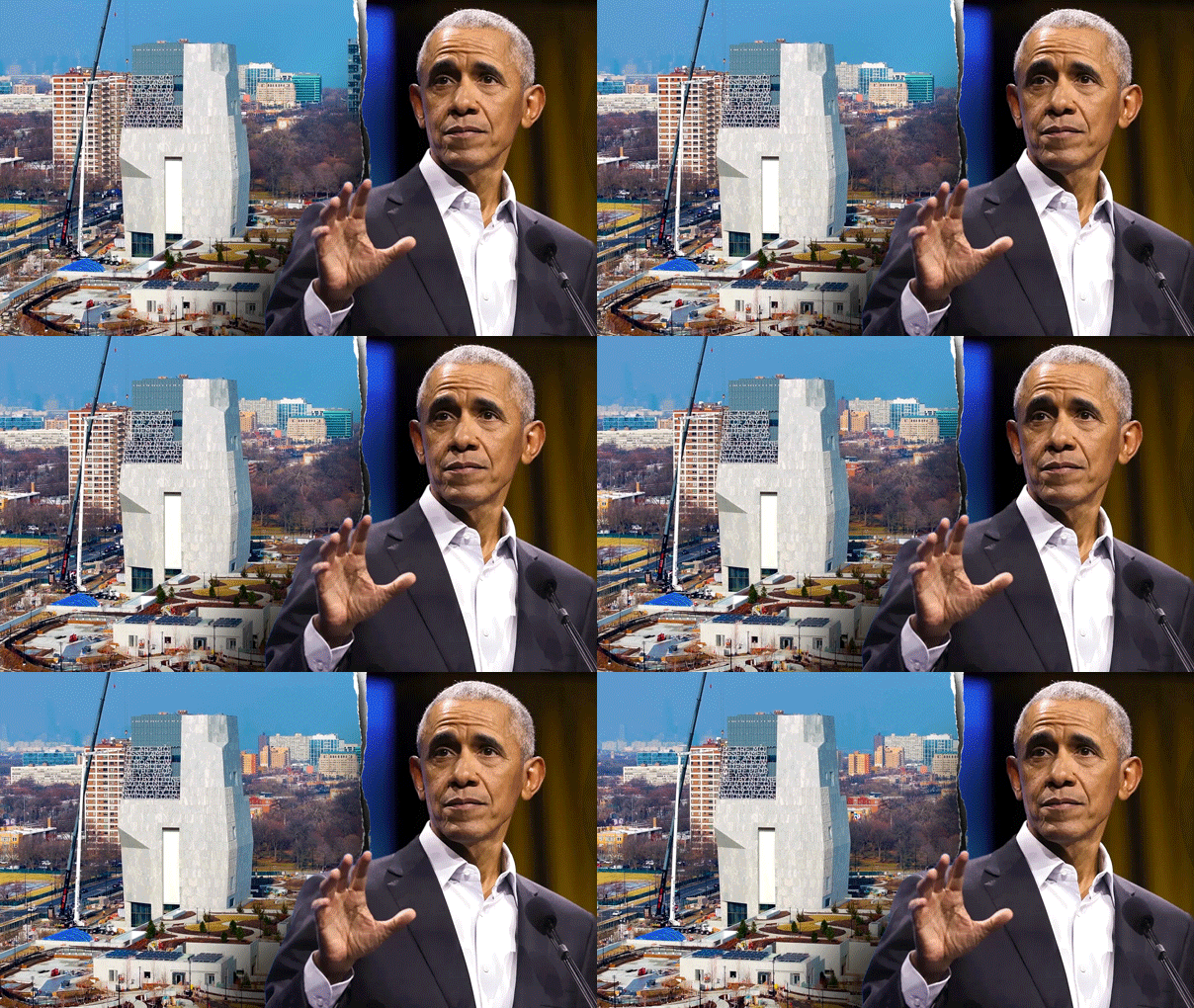
Former President Barack Obama once professed that his presidential center would be a “gift” to Chicago. Animated GIF showing the Obama Presidential Center under construction alongside a static image of former President Barack Obama. (Fox Flight Team; Getty)
Eight years later, the Illinois Department of Transportation (IDOT) told Fox News Digital that approximately $229 million in infrastructure spending was tied to the site, up from its earlier estimate of roughly $174 million.
The $229 million figure reflects state-managed spending, which may include federal transportation funds routed through IDOT.
Meanwhile, Chicago officials have failed to produce a reconciled total showing how much city taxpayers have committed or how current spending compares to the roughly $175 million discussed when the project was approved.
A paper trail without a total
Fox News Digital submitted records requests and press inquiries to every agency involved in the infrastructure work, including the Illinois Department of Transportation (IDOT), Chicago’s Department of Transportation (CDOT), the Office of Budget and Management (OBM), the Mayor’s Office and Gov. J.B. Pritzker’s administration.
Not a single office provided a unified, up-to-date accounting of total public infrastructure spending tied to the project. The investigation involved months of FOIA requests, partial disclosures and repeated follow-ups.
No single agency appears to oversee the full scope of the infrastructure work, and neither the state nor the city has assembled a reconciled accounting — a fragmentation that has made the overall public cost difficult to determine.
Instead, agencies provided partial figures, declined to clarify whether city and state totals overlap or insisted that no consolidated total exists.
The Illinois Attorney General’s Public Access Counselor (PAC) is reviewing whether multiple agencies complied with state transparency laws following Fox News Digital FOIA requests.
Exterior view of the Obama Presidential Center tower under construction in Chicago. (Fox 32 Chicago)
Construction costs soar
The center sits on 19 acres of historic public parkland carved out in a controversial transfer for just $10 under a 99-year agreement, making the question of public infrastructure spending particularly sensitive. Legal challenges to the land transfer, including lawsuits arguing the arrangement was not in the public interest, were ultimately dismissed, although the merits of the arguments were not adjudicated on.
The center — though commonly referred to as a presidential “library” — will not function as a traditional facility operated by the National Archives and Records Administration (NARA), and former President Obama’s official records will be maintained by NARA at a federal site in Maryland.
While the Obama Presidential Center in Chicago is expected to provide digital access to archival materials, it will not serve as a federally operated records repository.
Instead, the Chicago complex will be operated privately, without rent payments, by the Obama Foundation, the former president’s nonprofit organization, which oversees leadership programs and civic initiatives aligned with his values and policy priorities.
Construction costs for the facility itself have ballooned from early estimates of roughly $330 million to at least $850 million, according to the foundation’s 2024 tax filings, although these expenses are being borne by private donors.
Meanwhile, a $470 million reserve fund — known as an endowment — that the foundation promised to fill to protect taxpayers should the project go belly-up, has received only $1 million in deposits, Fox News Digital previously reported.
OBAMA LIBRARY, BEGUN WITH LOFTY DEI GOALS, NOW PLAGUED BY $40M RACIALLY CHARGED SUIT, BALLOONING COSTS
A before-and-after aerial graphic shows the footprint of the Obama Presidential Center in Jackson Park, including the removal of Cornell Drive and construction along Stony Island Avenue. (Fox News)
Roads removed, routes rebuilt
Taxpayers often fund routine improvements near major civic projects — such as turn lanes, utility hookups or upgraded traffic signals — but the scale of the work surrounding the Obama Presidential Center is far more extensive.
By comparison, other modern presidential libraries required only limited public infrastructure upgrades and did not involve the removal of a major roadway or the wholesale redesign of a historic park’s traffic pattern.
Much of the publicly financed work reshaped the roads and utilities that once ran through Jackson Park.
Cornell Drive — a four-lane roadway that bordered the center’s east side by the park’s lagoon — was permanently removed under the center’s site plan and enveloped by the campus. Traffic that once ran alongside the lagoon has been rerouted farther west, reducing the number of public roads directly adjacent to the complex and creating a more unified campus footprint around the center.
Crews also tore down trees, relocated water mains, sewer lines, and electrical infrastructure and installed new drainage systems tied to the facility’s structural needs as part of the public infrastructure project.
City and state officials say the changes were necessary to manage traffic and visitor demand. Critics argued the redesign altered long-standing park infrastructure to accommodate the foundation’s preferred layout.
What’s clear is that without those road closures, reroutes and utility relocations, the project would not function as designed.
The Obama Foundation, which is funding the center’s construction, defended the project in a statement to Fox News Digital.
“The Obama Foundation is investing $850 million in private funding to build the Obama Presidential Center and give back to the community that made the Obamas’ story possible,” said Emily Bittner, a spokesperson for the foundation.
“After decades of underinvestment on the South Side of Chicago, the OPC is catalyzing investment, from both public and private sources, to build economic opportunity for residents through jobs, housing, and public spaces and amenities.”
A map graphic shows the footprint of the Obama Presidential Center inside Jackson Park on Chicago’s South Side along Lake Michigan. (Fox News)
The number no one will state
IDOT, which controls the state’s funding for the corridor and signs off on major transportation contracts tied to the project, acknowledged approximately $229 million in state-managed infrastructure spending but did not produce a consolidated accounting reconciling that total across all project phases.
“With all the main parts of this aspect of the overall project awarded, to date the state via IDOT has contributed approximately $229 million,” an IDOT spokesperson told Fox News Digital in July in its latest release. “Approximate breakdown of these funds: $19 million in preliminary engineering; $24 million for construction engineering and $186 million for construction activities.”
The spokesperson said that the initial $174 million figure was from a “2017 was a preliminary cost estimate.”
CDOT, which carried out the roadway closures, traffic rerouting and utility relocation work inside Jackson Park, acknowledged Fox News Digital’s Oct. 7, 2025, FOIA request and took a statutory extension but never issued a final determination or produced the requested records. The department also did not provide a unified city total or clarify how Chicago’s capital allocations overlap with the state’s spending.
OBM, which oversees the city’s capital allocations, did not say whether the city’s $175 million estimate remains current and directed Fox News Digital to the Capital Improvement Plan. Chicago’s most recent 2024–2028 Capital Improvement Plan — the city’s multi-year infrastructure budget — lists more than $206 million allocated to roadway and utility work surrounding the project. However, much of that funding is labeled “state,” and neither state nor city officials could clarify how those allocations overlap with IDOT’s reported total.
In a FOIA response, OBM said it “does not have responsive records” showing any cost overruns, reallocations or a breakdown of spending across major components of the Obama Center infrastructure work.
The agency also could not explain how Chicago’s $206 million budget line relates to IDOT’s $229 million figure or how much of the city’s amount is actually paid by Chicago rather than the state.
Chicago’s 2024–2028 Capital Improvement Program lists $206,078,058 for “Obama Presidential Center & Jackson Park – Infrastructure Improvements,” with most funding labeled as state sources. (City of Chicago Capital Improvement Program)
Pritzker’s office gave conflicting responses and ultimately produced no records showing the state’s total infrastructure spending.
Meanwhile, Mayor Brandon Johnson’s office did not respond to repeated requests for the city’s total infrastructure spending tied to the project or for how much more Chicago expects to commit.
Without updated reconciliations from both levels of government, taxpayers still have no clear accounting of the financial obligations associated with the center.
What is clear is that Obama’s “gift” to Chicago comes with a hefty public price tag that has grown more complex — and without updated cost projections, the true total cost remains unknown.
Related Article

Read the full article from Here



Click the + Icon To See Additional Sharing Options
The Missouri State Highway Patrol reported 10 arrests across north Missouri between June 19, 2026, and June 21, 2026. The arrests involved allegations including driving while intoxicated, kidnapping, unlawful possession of drug paraphernalia, failure to maintain a single lane, and outstanding warrants.
It is important to note that, while all the individuals listed below have been reported as arrested, they may not have been physically transported to a detention center. Depending on the circumstances, an individual may be issued a summons, which includes a court date. When the Missouri State Highway Patrol issues a summons with a court date, it is considered an arrest, even if the individual is not physically transported to a detention center.
Noah T. Nims, 35, of St. Joseph, Missouri, was arrested in Buchanan County on June 19, 2026, at 6:14 p.m. He was accused of driving while intoxicated, first offense, and failure to maintain a single lane. Nims was held at the Buchanan County Law Enforcement Center on a 24-hour hold.
Jaedyn C. Bacerra, 22, of Kansas City, Missouri, was arrested in Livingston County on June 19, 2026, at 9:47 p.m. Authorities alleged he was driving while intoxicated. Additional allegations included failure to have two lighted headlamps and failure to equip a vehicle with two approved red taillights. Bacerra was held at the Livingston County Sheriff’s Office and later released.
Justin F. Myers, 35, of St. Joseph, Missouri, was arrested in Andrew County on June 20, 2026, at 2:11 a.m. He was accused of driving while intoxicated as a prior offender and operating a motor vehicle in a careless and imprudent manner involving an accident. Myers was released to Mosaic and was listed as released.
Edgar Y. Martinez Ramirez, 36, of Olathe, Kansas, was arrested in Harrison County on June 20, 2026, at 8:46 a.m. He was accused of child kidnapping, a Class A felony; first-degree kidnapping, a Class A felony; and first-degree tampering with a motor vehicle, a Class D felony. Martinez Ramirez was held at the Harrison County Sheriff’s Department on a 24-hour hold.
Albin B. Kos, 42, of Kansas City, Missouri, was arrested in Daviess County on June 20, 2026, at 2:23 p.m. Authorities alleged he unlawfully possessed drug paraphernalia as a prior offender, operated a vehicle without a valid driver’s license, and failed to maintain insurance. He was also wanted on misdemeanor Jackson County warrants for failure to appear on charges related to speeding and driving without a valid license. Kos was held at the Daviess-DeKalb Regional Jail and was listed as bondable.
Andres A. Reed, 43, of Omaha, Nebraska, was arrested in Holt County on June 21, 2026, at 1:40 a.m. He was accused of misdemeanor driving while intoxicated. Reed was held by the Holt County Sheriff’s Office on a 12-hour hold.
Timothy R. Nelson Ptomey, 32, of St. Joseph, Missouri, was arrested in Buchanan County on June 21, 2026, at 10:11 p.m. He was accused of driving while intoxicated, failing to display valid license plates on a motor vehicle or trailer, and driving the wrong direction on a divided highway in a manner that created an immediate threat of an accident. Nelson Ptomey was held at the Buchanan County Law Enforcement Center on a 24-hour hold.
Trace A. Wheeler, 23, of Edina, Missouri, was arrested in Lewis County on June 19, 2026, at 5:39 a.m. He was accused of driving while intoxicated and failing to drive on the right half of the roadway in an incident involving an accident. Wheeler was held at the Lewis County Jail and later released.
Shane D. Kurk, 29, of Canton, Missouri, was arrested in Lewis County on June 21, 2026, at 1:31 a.m. He was accused of driving while intoxicated. Kurk was held at the Lewis County Sheriff’s Department and later released.
Travis J. Miles, 41, of Shawnee, Kansas, was arrested in Ralls County on June 21, 2026, at 11:28 p.m. He was accused of driving while intoxicated and failing to wear a seat belt. Miles was released following his arrest.
Post Views: 1
Related
Click the + Icon To See Additional Sharing Options

Nebraska extended an offer to one of the top receivers in the class of 2028. Four-star receiver Malachi Lee earned the offer while competing on campus in the Battle of the Boneyard 7-on-7 Tournament, which the Huskers hosted this weekend.
Lee is the 50th overall player in the 2028 class, the eighth overall wide receiver in the class, and the top player in his class from the state of Virginia, according to the Rivals Industry Rankings. The wide receiver has an extensive offer sheet that includes Maryland, Penn State, Wisconsin, and Syracuse.
The 2028 recruiting class currently has no commitments. This is no reason for alarm, as the coaching staff is just putting the finishing touches on the 2027 class as we speak.
Nevertheless, it’s good for the Huskers to get a head start on the 2028 group, as talent is evident in the class.
Contact/Follow us @CornhuskersWire (https://twitter.com/CornhuskersWire) on X (formerly Twitter) and like our page onFacebook (https://www.facebook.com/CornhuskersWire) to follow ongoing coverage of Nebraska news, notes and opinions.

BISMARCK — The public is invited to the opening of the State Historical Society of North Dakota’s new exhibit, “North Dakota 250 Road Trip: Our American Story,” with a ribbon-cutting ceremony at 9 a.m. on Wednesday, July 1, at the North Dakota Heritage Center & State Museum in Bismarck.
Following the ribbon-cutting ceremony, visitors can enjoy light refreshments, live music by Mythtickle, face painting, Scouting America Pinewood Derby races and opportunities to visit with agency curators, archivists and community partners until 1 p.m.
Developed as part of the America250 commemoration, the free exhibit explores North Dakota’s significant role in the American story through themes of travel, migration, innovation, and community. Visitors can explore highlights of how North Dakota has influenced the nation and how the nation has shaped us, beginning with stories dating back to the 1770s from tribal nations.
“We designed this exhibit as a road trip through North Dakota’s past, present, and future,” Exhibitions Manager David Newell said. “We are encouraging people to discover new stories and explore places they haven’t visited yet.”
Visitors can plan their own road trips, contribute to the state’s story on a kiosk, research longtime owners of Centennial Farms and learn how to explore your roots.
“This exhibit is an American story, a North Dakota story, and a personal story,” Audience Engagement & Museums Director Kimberly Jondahl said. “We invite people to dive into their own family histories using State Archives resources in the genealogy area. Do you know where your own people were in 1776?”
These programs are part of the ND250 commemoration celebrating our country’s 250th birthday.
The North Dakota Heritage Center & State Museum, located at 612 E. Boulevard Ave. in Bismarck, is open Monday-Friday, 8 a.m.-5 p.m., and Saturday-Sunday, 10 a.m.-5 p.m. Admission is free.
-

 Missouri4 minutes ago
Patrol reports 10 arrests in north Missouri from June 19-21, 2026
-
Montana6 minutes ago
Montana Lottery Big Sky Bonus, Millionaire for Life results for June 21, 2026
-

 Nebraska11 minutes ago
Four-star wide receiver picks up offer from Nebraska
-

 Nevada19 minutes ago
Arizona wildfires burn thousands of acres as Nevada smoke reaches Kanab
-

 New Hampshire21 minutes ago
Officials respond to 'unknown substance' spill at Sunapee Harbor
-

 New Jersey26 minutes ago
World Cup match to impact NJ Transit service during rush hour
-

 New Mexico28 minutes ago
Stables at Tamaya kick-off annual rodeo season featuring rescue horses
-

 North Dakota36 minutes ago
‘North Dakota 250 Road Trip’ exhibit opens July 1

