Lifestyle
Why I rejected the “neutral” aesthetics of therapy rooms

You’ve (finally) made an appointment with a therapist. Just getting the appointment took some legwork. This is an in-person appointment, so you walk from the nearest metro station, or step out of the ride share, or park your car. If you’re really fortunate, you were able to walk there. You arrive to the therapist’s office, perhaps anxious, flustered, maybe numb.
What do you see when you walk in?
You might enter a lobby. It might be windowless. Neutral carpeting, overhead lighting. There might be a bank of small buttons on the wall, and with one press, the button signals to the therapist in the room that you’ve arrived. That’s old school, though. You might enter an old apartment building that’s been rezoned for offices with no waiting room to speak of. Or you might enter directly from the street into an office, without the pacifying liminal space of a waiting room.
As a client of therapists in Los Angeles (one Jungian analyst in a big Westside office building, another in a home office in my neighborhood — and yes, I got to walk there), and as a therapist myself, I’m often thinking about The Room. The fantasy of the contemporary therapy room is often based on images planted by pop culture: The dark wood paneling and furniture of Dr. Melfi’s office in “The Sopranos” comes to mind, or the most recent season of the L.A.-based home office of “In Treatment,” with its distinctive view of the city and its well-appointed and colorful interior. Between just these two shows, one can see how the therapy space and how we perceive it is subtly changing.

I am not a “neutral” therapist, and so my self-designed therapy room is not a neutral, or beige, space.
The first office where I sought therapy was in a small town in the Pacific Northwest. I took an elevator and approached a door with frosted glass. The building was historical and aptly named the Security Building. I was in my early 20s. It was in that office where I began untangling some of my own history, much of which would later appear in my first book. My weekly processing of the past eventually migrated to another building when my therapist moved her practice to a house rezoned for offices in a residential neighborhood. Both locations served as a particular kind of refuge, places where I came to new understandings and occasional epiphanies. In each office, I sat across from my counselor on a couch, held in a space that she created.
“If the unconscious is structured like a language, the design of a therapist’s consulting room is also a language,” Deborah Levy writes in a recent Granta essay. As a writer/therapist, I can appreciate this — including when Levy later notes that therapy rooms are “often beige” and that even if the “room’s mood attempts to be entirely neutral, someone has art-directed its blandness.” When I think of the various therapy rooms I worked in as an associate therapist in a busy community clinic, I recall the attention to having a somewhat blank canvas across many rooms, that each could be outfitted with donated furniture, random books and an occasional piece of art. If you’ve been in therapy for as many years as I have, you probably recognize this blandness.
Up until the 1980s, there was not as much attention given to the decor of the room where patients/clients met. In the U.S. in the early ’90s, elements such as windows, plants and even aquariums were considered choices that might serve as symbolic material for the client. And with the easing of the concept of the therapist as “a blank slate,” shifts have continued to occur in therapy room decor. Where there was once an insistence on an impersonal space, there is now an acknowledgment that the therapist does not have to cloak their identity in a benign anonymity.
I am not a “neutral” therapist, and so my self-designed therapy room is not a neutral, or beige, space. In 2021, more than a year after I had stopped seeing clients in person in rented offices due to the pandemic, I had the opportunity to furnish and decorate my own home office. I thought about how best to create a container — a place where someone would cross the threshold and feel. Therapy can obviously generate loads of feelings, but the best container allows the client to feel it all, in a safe, comfortable environment.

In an episode of “Conan O’Brien Must Go,” O’Brien, dressed as Freud in a wig, fake beard and suit, visits the Freud Museum in Austria. O’Brien, gamely holding a cigar, introduces the museum director, who begins by noting that Freud’s office couch is actually housed in London. Upon hearing this, O’Brien abruptly leaves the room. Since The Couch is not in the Freud Museum, O’Brien returns to the room and does a whole bit using a blow-up mattress.
When I was buying a couch for my own therapy office, I did not think of The Couch. I did, however, think about the various therapy offices I’ve sat or reclined in. There was crying, complaining, dissociating and even laughing on those couches. No particular couch sticks in my memory, so perhaps these were neutral couches awaiting my emotions to spill out over them. When I try to remember sitting across from my therapists in their respective offices, I do remember whether there was carpet or wood floor under my feet, what the bookshelves in the room offered, and whether or not the lighting was natural, lamps or overhead.
Before I designed my own office space, I met my most recent therapist in a room of her home. The bookshelves in the room were a rich mix of cookbooks and psychology books. Occasionally my therapist would have a delicious-smelling soup on simmer in another part of the house — not a design choice, but a pleasant sensory experience in the background. When the pandemic forced us to meet outdoors, her back patio, with its tiled floor, pergola and garden became the room (albeit one with occasional mosquitoes).
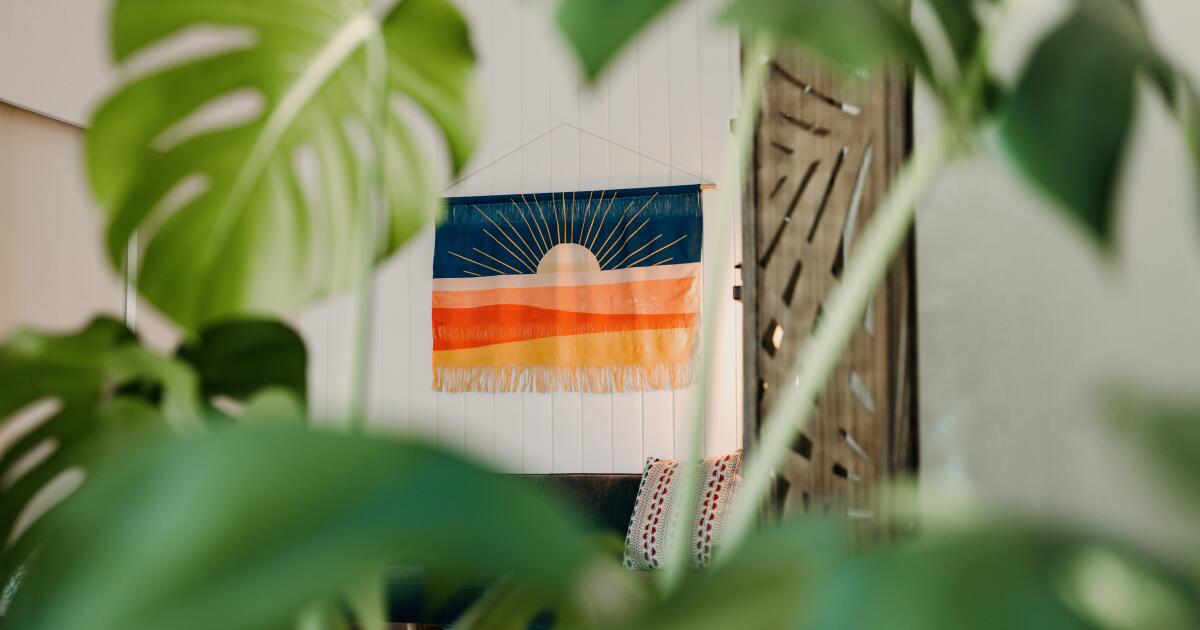
My therapy office is a 350-square-foot ADU behind my home. When a client enters, the first thing they see is a glass door with a bright yellow frame and behind it, a large monstera plant, which has grown along with them session by session. On the wall behind the couch where clients sit, I hung a tapestry that features a sun rising over an abstract landscape of pinks and yellows. Since the tapestry is in my eye line as I face clients, I think of it as a constant reminder that each person sitting in front of me has the potential to feel renewal and the possibility of change on a continual basis. The blinds on the east-facing window filter in natural light. From where my client sits on a slate blue couch, their eye might fall on the hanging bookshelves, where I’ve placed a few select volumes, such as the therapy-favorite “Waking the Tiger” by Peter Levine, as well as a few unexpected titles, like “Love in a F—Up World” by Dean Spade, and “Grapefruit” by Yoko Ono.


My therapy room is, quite literally, an extension of my home. Far from an institutional feel, the room’s colors, lighting and furnishings are meant to elicit a sense of warmth, connection and solace.
Above the book shelf is another shelf with more whimsical items: a container of various sea animal toys, for an imagined future where I offer clients sand play, as well as two varieties of cat tarot card decks. My desk, where I perch my phone atop a stack of old and new psychology tomes to see remote clients via Zoom, is its own sacred space: orange and blue dishes of honey and orange calcite, abalone shells, a stub of palo santo, and a deer figurine that reminds me of the animal images I conjured as a client doing the work of EMDR. A Himalayan salt lamp emits a soft orange light.
My therapy room is, quite literally, an extension of my home. Far from an institutional feel, the room’s colors, lighting and furnishings are meant to elicit a sense of warmth, connection and solace. And like my home, the language of this room wants to invite and beckon. It can hold the spectrum of emotions evoked in therapy, as well as the silences.
A common refrain we return to in therapy is that “everything is temporary.” Change is constant. In my ideal therapy room, plants live in the room when no one else is in it. Seasonal flowers are brought in, and when they die, composted. The scent of coffee or chai might linger. A client’s fingers might clutch a smooth black onyx, or a jagged rose quartz, or tissues. We are changed, both client and therapist, in the process. As my clients embark on the private journey that is therapy, in a room thoughtfully arranged to contain everything, the room itself is the reliable axis around which meaningful and deep changes can occur.

Wendy C. Ortiz is the author of three books and is a therapist in private practice in Los Angeles.


Artist Lex Marie taken by Stephen L.A Miller
hide caption
toggle caption
Multidisciplinary artist Lex Marie has gone viral on TikTok and Instagram for her artwork confronting discipline within Black households.
At Lex Marie’s art studio, a belt is no longer just a belt.
I met the multidisciplinary artist in Washington, D.C., at the American University’s Katzen Arts Center.
She led me to her studio, where some belts are stretched across a canvas in meticulously organized rows and columns.
Others are used as a tool. Marie dips them in paint and swings them like a brush, leaving thick, violent marks across a white canvas.
Marie says each piece of work carries a story about childhood, discipline, survival and the complicated ways love can be expressed.
She is building a body of work that confronts a topic many families know well but rarely discuss openly: corporal punishment in Black households.
“I’m critiquing discipline in Black households specifically,” Marie says. “But I’m trying to tackle the history behind discipline in black households, behind spankings and whippings, and speak to the difference in how millennials are raising their children as well.”
The work is personal for her. Marie is 33 and the mother of an eight-year-old boy. As her son continues to grow, she says the questions that shape her art often come directly from her parenting.
“Through motherhood, I’m starting to think about my own childhood, and I’m comparing and contrasting it. So some of these works are just speaking from my experiences with spankings, and they’re also going from the perspective of how I feel.”
One of the larger works in the series is called “Watch Your Tone.” The six-by-six-foot piece is composed entirely of belts — dozens of them — arranged carefully across the canvas. They are an assortment of different shades of brown, black and pink to represent the color of flesh.
The title of the piece echoes a phrase many children hear growing up: “Watch your tone when talking to me.”
But Marie says the belts also represent something deeper.
She explains that she created this piece to convey multiple meanings. The different skin tones help her explain the different ways punishment is tied to American history.
For some historians and scholars, the conversation around corporal punishment in Black American households cannot be separated from the legacy of slavery. During enslavement, physical violence, such as being beaten with whips, was used to control Black bodies. Over generations, those discipline practices have evolved into modern parenting practices.
Yohuru Williams, founding director of the Racial Justice Initiative at the University of St. Thomas, believes that the link between corporal punishment and African Americans is rooted in slavery.
“This idea of whipping, this idea that black bodies require extreme punishment — that there’s something about the constitution of blackness that requires excessiveness in terms of discipline — has deep roots. Roots that extend beyond slavery. But it [was] really reinforced by the enslavement of Africans. And then once they come to the United States, you have this adoption of punishment systems within slavery that continue after slavery; that continue that process with that practice of brutalization of … black and brown bodies,” he said.
“Because I Love You, another piece in Marie’s series, highlights the physical act of enforcing punishment.
Marie painted a wooden panel white, dipped a belt in acrylic paint and struck the surface again and again, leaving marks scattered across the piece like scars and welts.
“I spent hours just kind of beating the same thing over and over,” she said.
The process left her physically sore the next day.
The piece’s title comes from a phrase many children hear after a whipping: “This hurts me more than it hurts you” or “I’m doing this because I love you.”
Marie explains how making this work has been cathartic and difficult. When the videos of her art began circulating online, the reactions were immediate.
Thousands of people commented on her post, sharing their own childhood stories. Some were painful and defensive, while others were grateful the topic was being discussed.
But Marie stands firm that the goal of this work isn’t to accuse or shame. It creates space for a conversation that is often buried.
Williams says that in order to have these discussions, Black families have to reimagine how they think about discipline.
“I think a lot of parents — black parents — struggle with this because there is this inherent knowledge that this is the way that we came up. And there is this belief that, well, you know, … maybe we’re more stable, maybe we’re more durable, maybe we’ve been able to endure more. We’ve developed a particular type of grip because of this experience,” Williams said.
Williams says it’s time to have an “honest” conversation about the historical legacy of corporal punishment within the Black community. “That would be far more communal and affirmative of human dignity and the dignity of black life,” he said. “Coming out of the Black Lives Matter movement, you kind of look back at this, and you go, ‘We understand it from a historical standpoint.’ But from a humanistic and community-centered, restorative justice practices standpoint, there’s something that just doesn’t sit right with me about this practice. And I think we owe it to ourselves as a community to revisit that.”
Marie sees her art as a pathway to discuss extremely difficult and triggering conversations about childhood trauma, especially for people who might struggle to find the words themselves — just like her.
The project will continue to grow over the next year as Marie develops more pieces for a planned exhibition this fall. The series has nearly 20 pieces, and she has even sold two to filmmaker Spike Lee, who is known for his films Do the Right Thing and Malcolm
X
Lex Marie has a solo show at The Bishop gallery in Brooklyn, New York this fall which will feature this series.
For Marie, the most important outcome isn’t agreement. It’s recognition.
This story was edited by Olivia Hampton and produced by Nia Dumas. The digital story was written by Nia Dumas.

U.S. Sen. Raphael Warnock, D-Ga., attends a rally opposing the SAVE America Act outside the U.S. Capitol on March 18 in Washington.
Heather Diehl/Getty Images
hide caption
toggle caption
Heather Diehl/Getty Images
Sen. Raphael Warnock, a Georgia Democrat, became the state’s junior U.S. senator over a decade after he was selected to serve as senior pastor of Ebenezer Baptist Church in Atlanta, Georgia, a church that was once led by the Rev. Martin Luther King Jr. His role as a senator brought him to Washington National Cathedral in 2023, where he marked Juneteenth that year with a sermon framed around the life of the prophet Isaiah.
“Every valley shall be exalted, every mountain and hill shall be made low, the crooked places shall be made straight, the rough places smooth, and the glory of the Lord shall be revealed, and all flesh shall see it together,” Warnock said during the sermon.
Warnock expands on that message in his new book, The Crooked Places Made Straight: Reflections on the Moral Meaning of America, where he argues that democracy is “the political enactment of a spiritual idea.”
In an interview with Morning Edition host Michel Martin, Warnock said the country’s divisions are less political than moral. “What we’re dealing with right now is not the difference between right and left, it’s really the difference between right and wrong,” Warnock said. He added that “it’s really too bad when my party cedes so much of the faith and values space … to those on the right.”
In his conversation with Martin, he explains why he believes faith should confront systemic injustice, not just personal behavior, and calls for a broader moral imagination in American politics.
Listen to the interview by clicking on the blue play button above.

To understand the gravitational pull toward golf, consider the sport as a sequence of problems. Aaron Singleton, a skilled player in the Dads Link Golf Club, is playing particularly well today at Palos Verdes Golf Course, having just hit two back-to-back birdies. But even on the shots that fly into a grassy oblivion, he smiles.
-
Share via
“Golf is 18 different holes. 18 different chances to solve a problem,” he says. “Each hole presents a different problem. Each shot is a different problem.” According to Singleton, this wisdom that players inherit on the golf course — especially resilience and patience — translates to fatherhood.
Singleton, who has a 3-year-old son, is part of a growing group of fathers who participate in the Dads Link Golf Club. The club is part of the region’s golf boom; Southern California Golf Assn. is estimated to have one of the largest memberships in the country, with over 200,000 golfers.

Ian Davis, the founder of Dads Link and Golf Club, watches his drive.
Ian Davis is the founder of Los Angeles’ Dads Link Golf Club. Each month, he invites fathers to enjoy golf together to focus on fellowship, fatherhood and their well-being.
“This has grown in a way that I couldn’t have imagined,” says Davis, who works as a wellness coach with an emphasis in mindfulness and meditation. He started the club in 2023 on the East Coast before relocating it to Los Angeles in January 2024, where the club hosts an annual Father’s Day tournament and various golf clinics.
At the driving range, Davis leads the group through “a grounding practice” that involves stretching and deep breathing. Member Ose Akhile, a personal trainer, follows up with stretching and other warm-up exercises. For many of the men, golf has become a rediscovered hobby. Singleton returned to the sport after playing it as a teenager. “I’m looking forward to getting better,” he says.
Club member Darius Ingram, father of 3-year-old daughter, says that reconnecting with the game has allowed him to prioritize his own well-being.
“I used to play golf recreationally. Now, I do it for mental stability,” he says.

Ian Davis greets Ose Akhile as Darius Ingram stands nearby.
Ian Monteilh, who is new to the group and has two daughters ages 11 and 15, says the outing provides camaraderie that was missing from his life.
“It’s a community that I didn’t have. I’m blessed to be around like-minded men with no pressure,” he says. “Even if we’re having a rough day on a golf course, there’s camaraderie.”
Once considered a predominantly white sport, golf is now being reshaped by a new generation of Black players and other players of color, including many of the fathers in Dads Link Golf Club. In 2024, 25% of golfers across courses nationally were Black, Asian and Latino, marking the most diverse era in the sport’s history, according to the National Golf Foundation.
“It’s a lot less pretentious — more diverse, more access for all different types of people,” says Ingram, who noticed a shift in golfing culture in recent years. Despite Tiger Woods’ storied career as one of the sport’s most impactful athletes, Black men remain underrepresented in top tournaments.

Darius Ingram reacts to barely missing a putt on the 18th green as Ian Davis watches.
Ingram partly attributes Black men’s interest in golf to renewed interest from other professional athletes. Star athletes like Michael Jordan and Steph Curry — who also happen to be dads — are skilled golfers.
“There are a lot of people who play their main sport, and they play golf when they retire,” says Ingram.

Ose Akhile smiles before teeing off.
Rappers like Schoolboy Q and DJ Khalid have also become interested in the sport, adding to its cachet.
The benefits of the groups are apparent, explains Akhile, who has three daughters, ages 6, 7 and 9.
“I’m outside — fresh air, sunshine, a break for my family. I get to decompress,” he says. Describing himself as a “Caribbean baby,” he explains that the ocean waves have a hypnotic effect on him. As the golfers move along the Palos Verdes course, the ocean stretches beyond them.
“Nature helps a lot with stress relief. There’s a lot of green grass and quiet out here. I love my child, but it’s hard to hear her yell, ‘Dad!’ every three seconds,” says Singleton. During the game, he stays calm while a squirrel approaches him. “Me and nature are one with each other,” he says. Behind him, a baby coyote prances into the fog.
Singleton adds that in the chaos of fatherhood, friendships occasionally fall to the wayside.
“There’s so much to do. Everyone separated. It’s beneficial to have a group text, a fellowship like this, where you can hear someone going through the same thing as you,” Singleton says.
Akhile agrees. “These are probably the only guys that understand the day-to-day stressors and pressures of my life,” he says.

Ose Akhile, Darius Ingram, Ian Monteilh, Ian Davis, Aaron Singleton and other Dads Link and Golf members have breakfast together.
After finishing nine holes, the men enjoy breakfast burritos. They joke that they will begin ranking the golf courses in the L.A. area by the quality of their breakfast burritos. Meanwhile, Davis leads the group through a conversation about fatherhood. Each month he chooses one dad to be the focus. This morning that’s Ingram. He speaks on being a father and how it relates to golf.
“I’m not as good as I want to be, so there’s frustration there,” Ingram says, referring to the challenges of parenting. He adds that to “right things” he doesn’t like about himself, he focuses on how his efforts could result in his daughter becoming a better version of him. The men offer encouragement as birds circle above. The sun pierces through the fog.
Monteilh looks up and jokes: “The only birdies I saw today were in the sky.”
-

 Los Angeles, Ca1 hour ago
Neighbors say Encino mansion brings rowdy parties, scantily clad women to quiet street
-

 Detroit, MI2 hours ago
What’s New at Newlab Detroit?
-

 San Francisco, CA2 hours ago
Austrian World Cup fans take over San Francisco restaurant
-

 Dallas, TX2 hours ago
Cowboys news: George Pickens is back with the team
-

 Miami, FL2 hours ago
A community of creatives — inside Miami Acting Studio
-

 Boston, MA2 hours ago
SEE THE GOOD: Boston middle schooler selected for NBA math championship – Boston News, Weather, Sports | WHDH 7News
-

 Denver, CO2 hours ago
Attorney for Denver Broncos defender Jonathon Cooper plays race card in domestic abuse case
-

 Seattle, WA2 hours ago
Cal Raleigh two-run single lifts Seattle Mariners to 3-1 win over Orioles in return from injured list

