Lifestyle
Who are America's first drag laureates? Californians ready to fight the war on drag

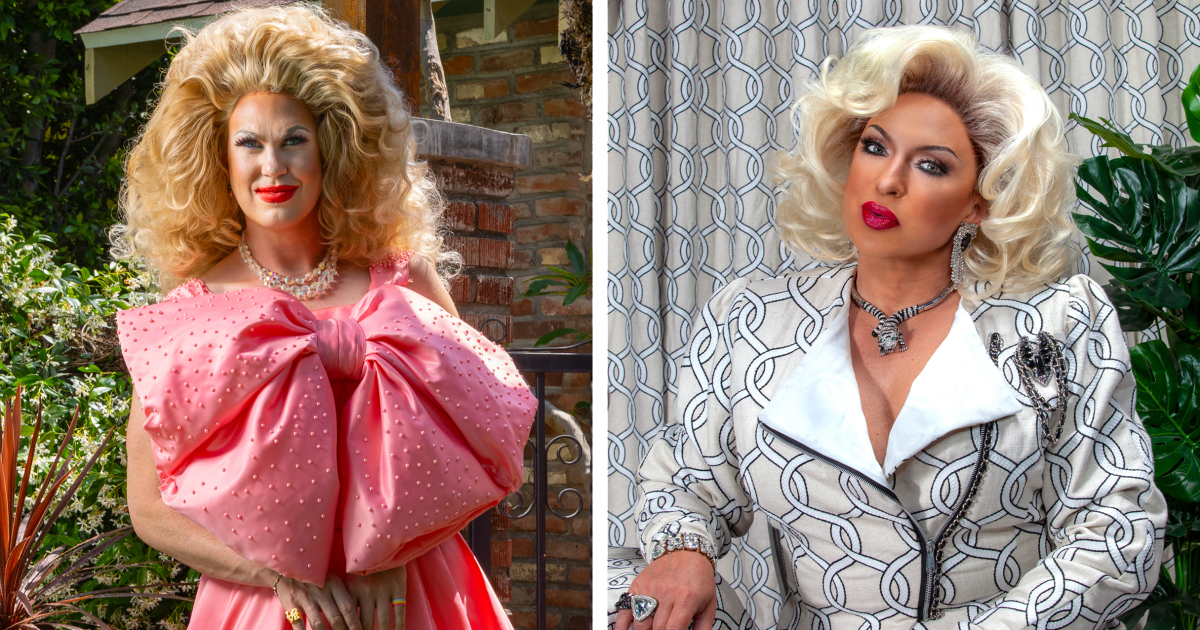
It’s June and Pride Month is in full swing as LGBTQ+ communities around the world celebrate together as well as commemorate the Stonewall Uprising in New York City in 1969. Two prominent voices — the drag laureates of West Hollywood and San Francisco — are booked and busy. There are wigs to coif, dresses to steam and parties to attend.
On their busy schedules this month are a host of events: Pride kickoff parties and official parade appearances in SoCal and NorCal, a panel about drag and cinema at the Academy Museum of Motion Pictures in Los Angeles, and the raising of the Pride flag at City Hall in San Francisco, among many others.
The laureates — drag queen D’Arcy Drollinger from San Francisco and L.A. native Pickle, the one-name drag queen representing West Hollywood — sat down late last month to chat about their tenures, Drollinger on a video chat and Pickle in person over lunch in Hollywood.
D’Arcy Drollinger.
(Rachel Z Photography)
So what is a laureate? And what is a drag laureate specifically?
A laureate is a recipient of an honor or recognition for achievement in an art or science. The most widely known laureate program in the United States is in the field of poetry. The National Youth Poet Laureate Amanda Gorman rose to acclaim when she read her poem “The Hill We Climb” at President Biden’s inauguration in 2021.
So then, what exactly is a drag laureate? The answer for Pickle and Drollinger — they are the first two queens in the nation to hold this title — is that it’s a role that is still being defined. Their individual roles receive an annual stipend funded through West Hollywood Arts Council for Pickle and through the San Francisco Public Library for Drollinger. The role is meant for them to act as a spokesperson for local businesses and be an ambassador for their city. Also, during their tenure, they’re meant to highlight the LGBTQ+ community and elevate the art of drag.
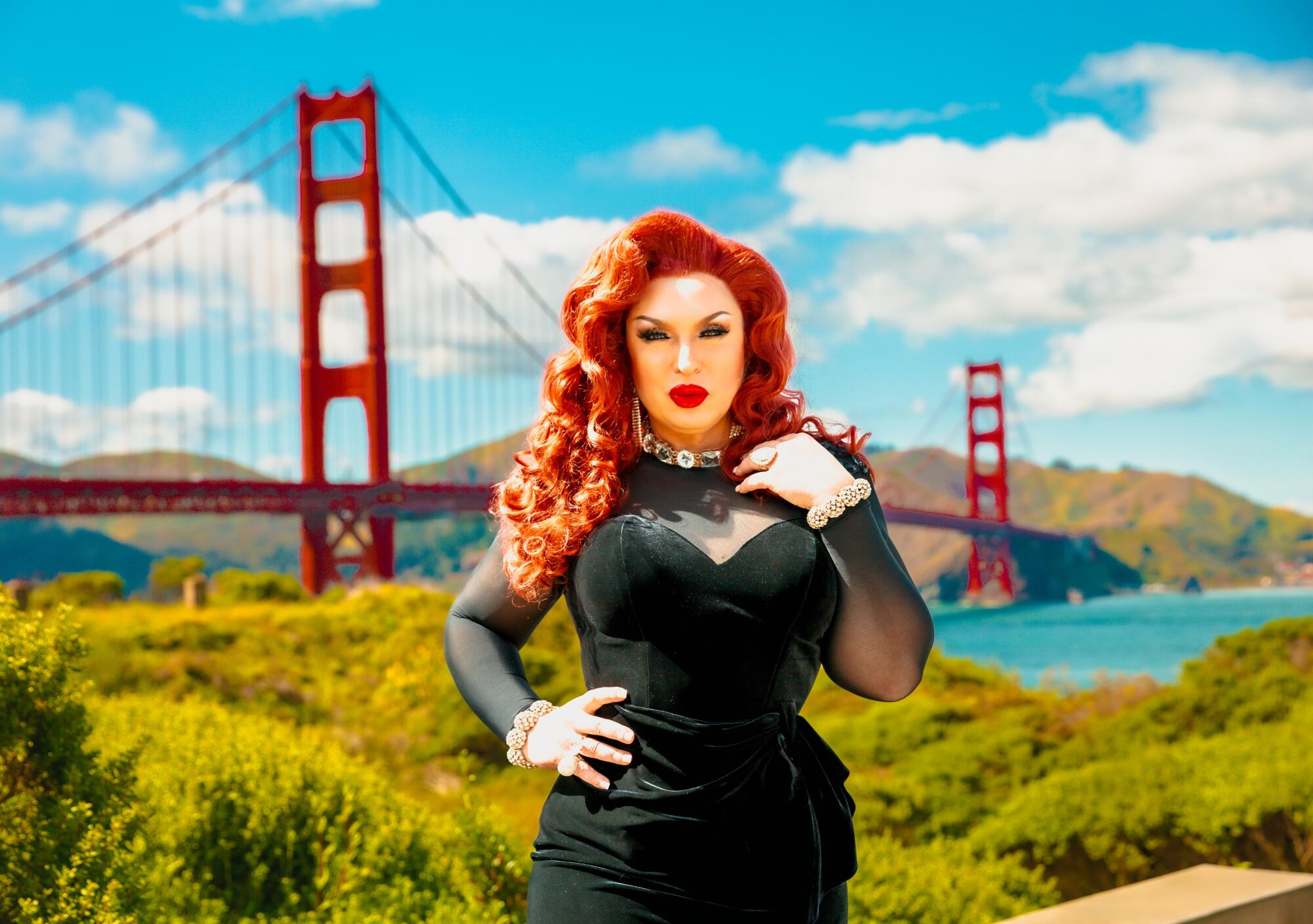
D’Arcy Drollinger.
(Rachel Z Photography)
Why does having these roles in cities with large LGBTQ+ populations matter?
“The queer community continues to be the heartbeat of [this city],” says Drollinger, who thinks a position like hers shows a great commitment by San Francisco leaders to a group that has deep roots in the city and helped shape its identity. The queer communities in San Francisco and L.A. have been at the forefront of progressive change, with monumental protests at Compton’s Cafeteria in 1966 in San Francisco, Cooper Do-Nuts in downtown L.A. in 1959 and the Black Cat in Silver Lake in 1967.
Both laureate programs were spawned from COVID-era worries about the declining state of small business and ravaged city cores, as is playing out in San Francisco. All across the country, downtowns have largely sat empty, a product of people conditioned to staying home during the pandemic shutdown. Turning to drag queens and kings, talented performers who are good at drawing a crowd and creating a festive environment, seemed like an obvious way to get the LGBTQ community and its allies back out.
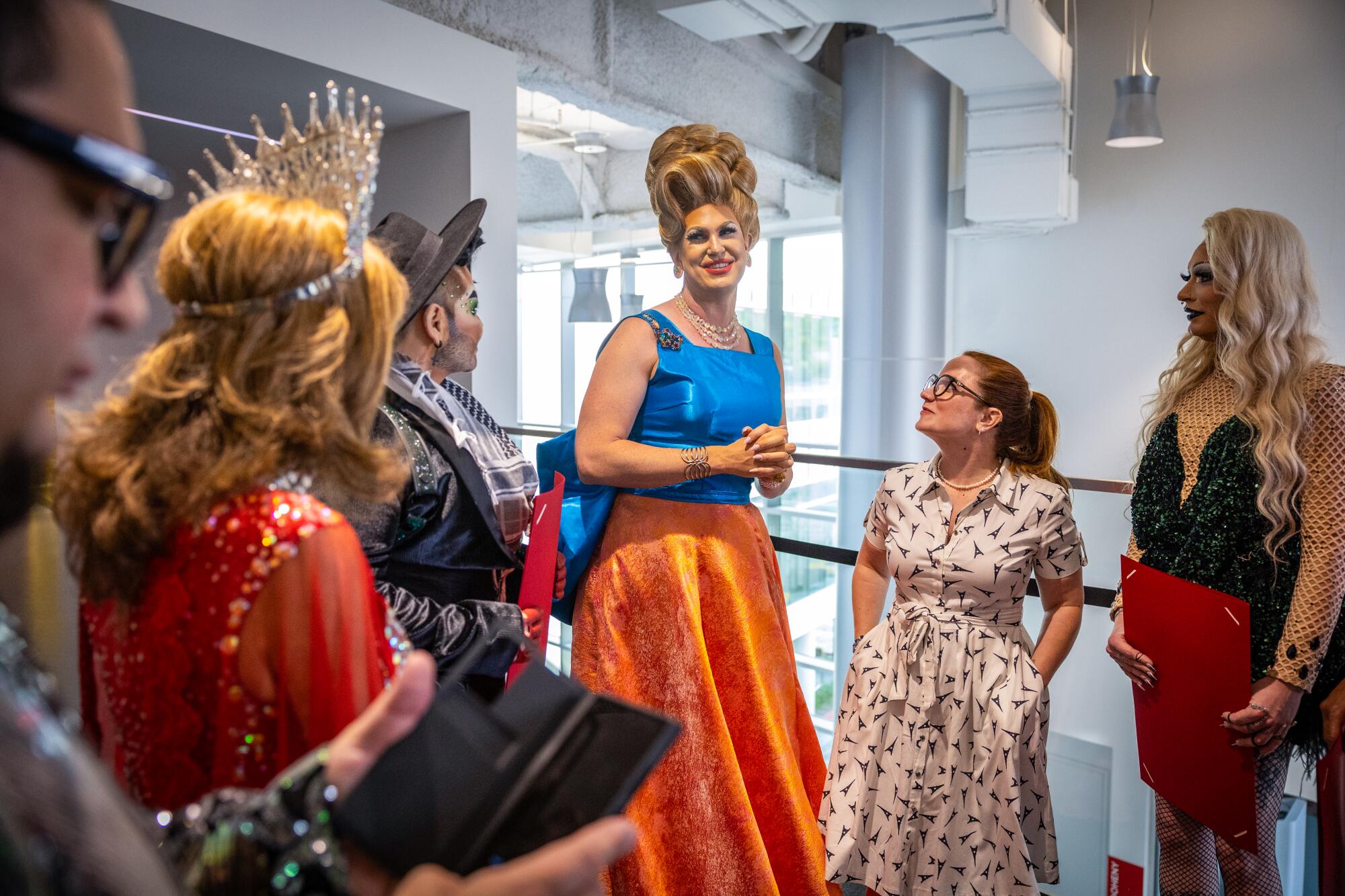
West Hollywood Drag Laureate Pickle, center, is thanked by Los Angeles County Supervisor Lindsey P. Horvath before hosting the José Sarria Drag Pageant, celebrating Harvey Milk Day in West Hollywood.
(Jason Armond / Los Angeles Times)
“The LGBTQ community has such a history with the city,” says West Hollywood Councilmember Lauren Meister, who helped draft the initial proposal for the Drag Laureate program in WeHo. “We wanted the drag laureate to be an ambassador to West Hollywood businesses but also promote art and culture. We wanted to do something that could bring some levity back to our city and keep things edgy.”
Positions like this, in two of America’s most liberal cities, in a time when drag queens are everywhere from TV to local bars, might not seem revolutionary. But around the country, the landscape can look a little different. This year alone, the American Civil Liberties Union is tracking 25 bills in state legislatures that are aiming to block children from drag performances, force venues that promote performances to register as adult businesses or ban drag altogether. And in California, drag performers are not immune from harassment by conservative groups.
Pickle, who leads the Los Angeles chapter of Drag Story Hour that hosts story-time readings for children at local libraries, was met with angry protests at a story hour in the city of San Fernando last fall. Although it was a distressing experience, she tries not to let it rattle her too much. She continues to host story hours around L.A. County and is working with San Fernando city officials to investigate the incident.
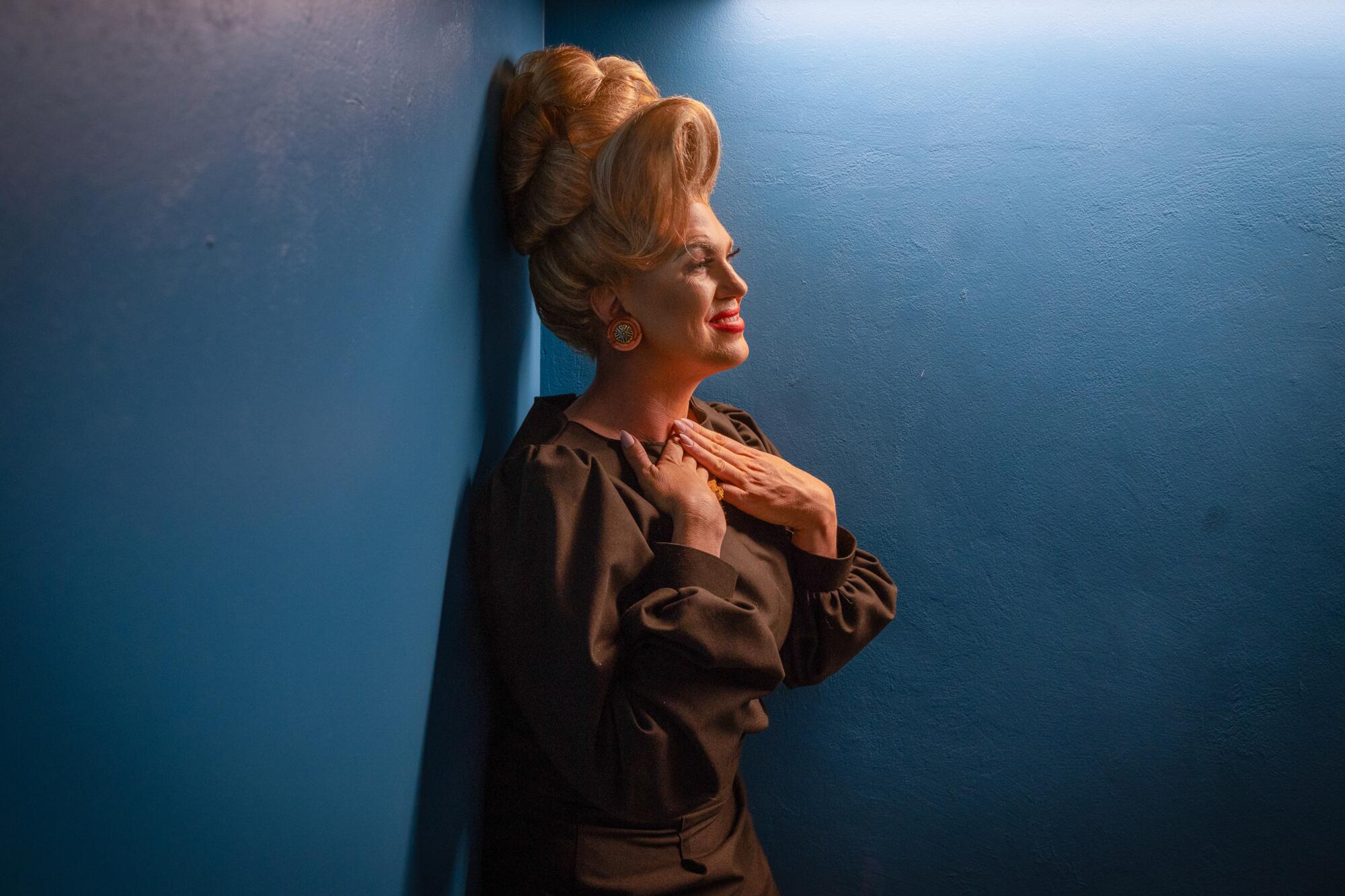
Pickle poses for a portrait after hosting the José Sarria Drag Pageant.
(Jason Armond / Los Angeles Times)
Who are these queens?
In July 2023, Pickle was selected by the West Hollywood Arts Council from a pool of applicants to be the city’s first drag laureate. In her official capacity so far, she has MC’d a Halloween Spectacular in support of the Bob Baker Marionette Theater, played host for an event celebrating the 39th anniversary of the city of West Hollywood, and just recently put together a drag pageant in honor of LGBTQ activist José Julio Sarria for Harvey Milk Day.
Pickle, whose name was inspired by drag icon Hedda Lettuce and her favorite In-N-Out order (cheeseburger, extra onions, no pickle), is excited about uplifting other drag performers and showcasing the talent that’s bubbling up all around Southern California. “Drag is so much more than the bars and clubs people are used to seeing it in,” says Pickle, who has been performing for about a decade. “It’s a legitimate art form that deserves its spotlight.”
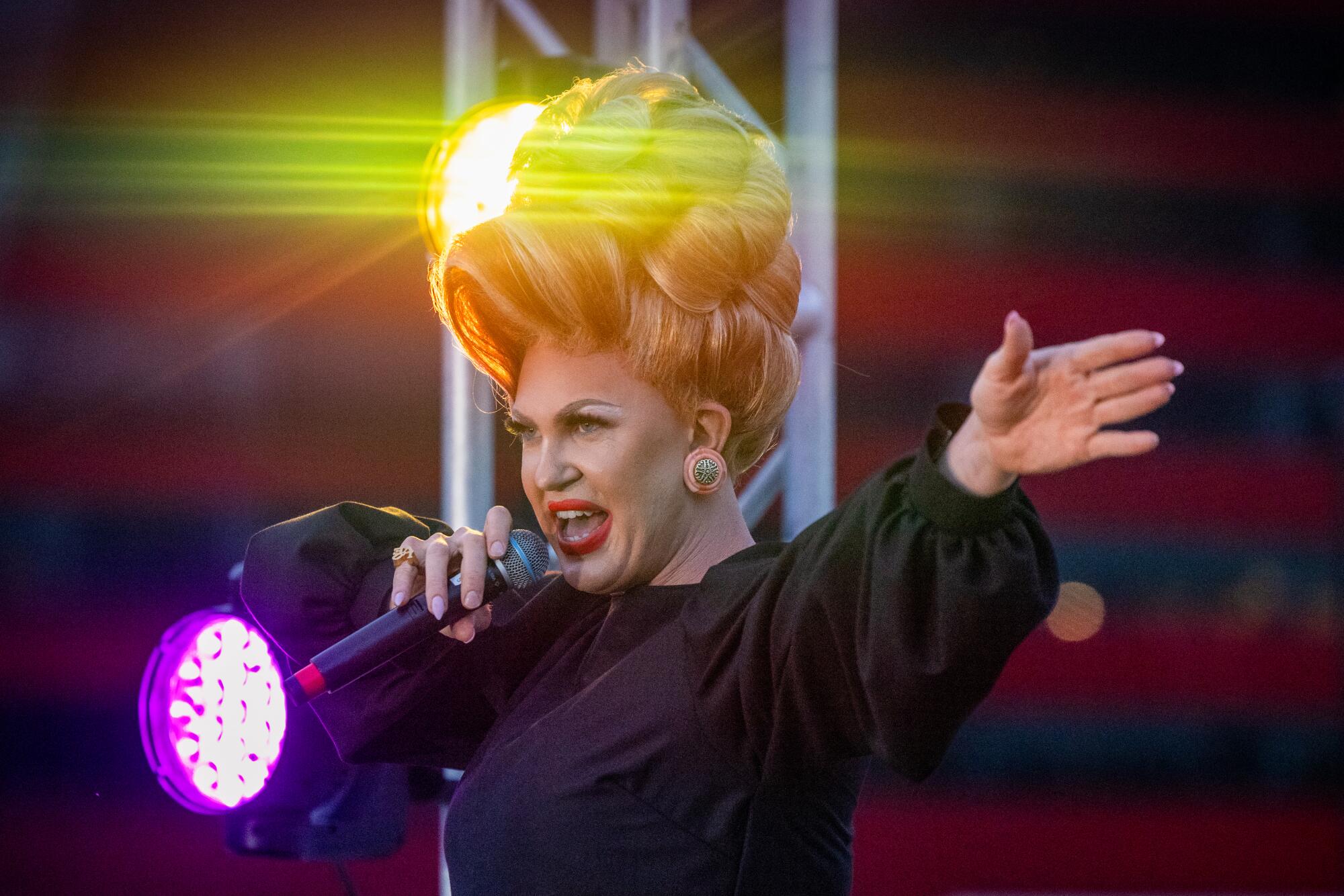
Pickle at the José Sarria Drag Pageant.
(Jason Armond / Los Angeles Times)
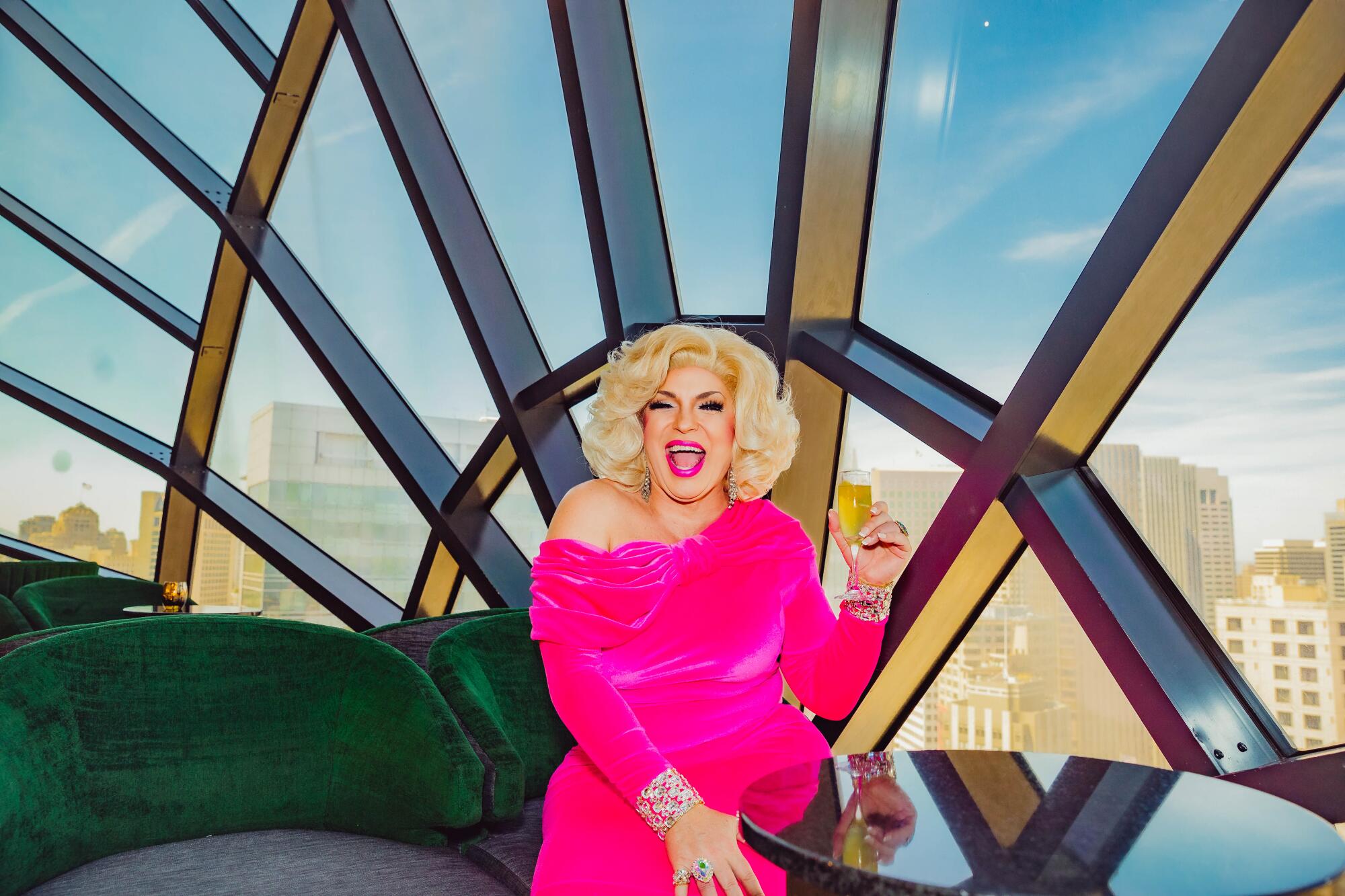
D’Arcy Drollinger.
(Rachel Z Photography)
Drollinger, who was appointed in May 2023, dons a big blond bouffant wig, expressive eyes and pouty lips. The San Francisco native is a veteran drag performer, writer and actor who’s been performing since the ’90s. She’s also the owner of Oasis, one of the country’s largest drag cabarets. In her role as laureate, she has curated drag stages for the San Francisco Museum of Modern Art and the music festival Outside Lands, and has helped develop drag performances in conjunction with First Thursdays, an effort to promote the businesses in downtown San Francisco.
Drollinger has always tried to support other queer artists, mainly through her nonprofit Oasis Arts that provides mentorship, performance space and small stipends to queer artists of all genres. With the laureate role, she is excited to be able to spotlight her community even further.
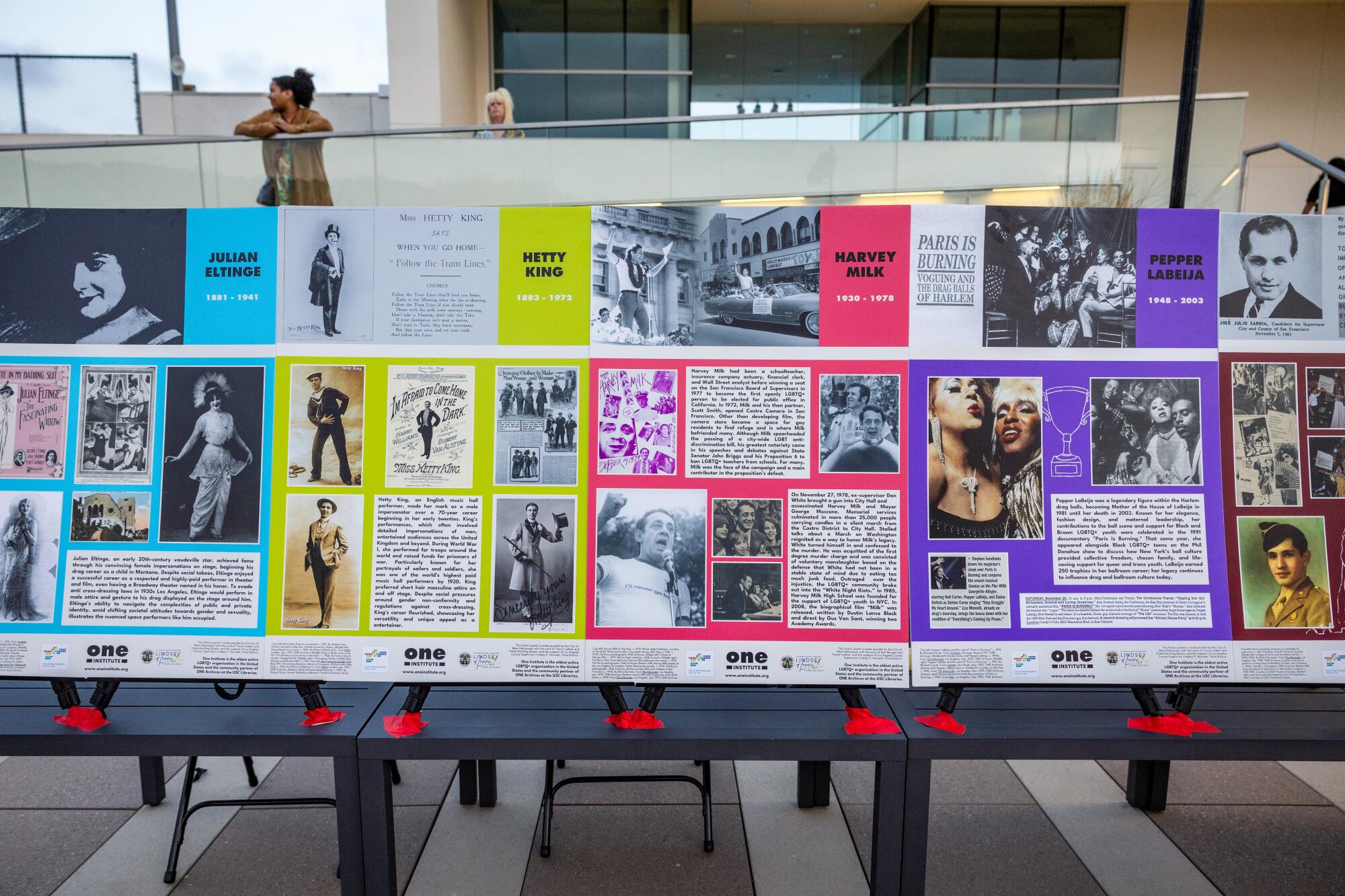
LGBTQ+ history on display at the José Sarria Drag Pageant.
(Jason Armond / Los Angeles Times)
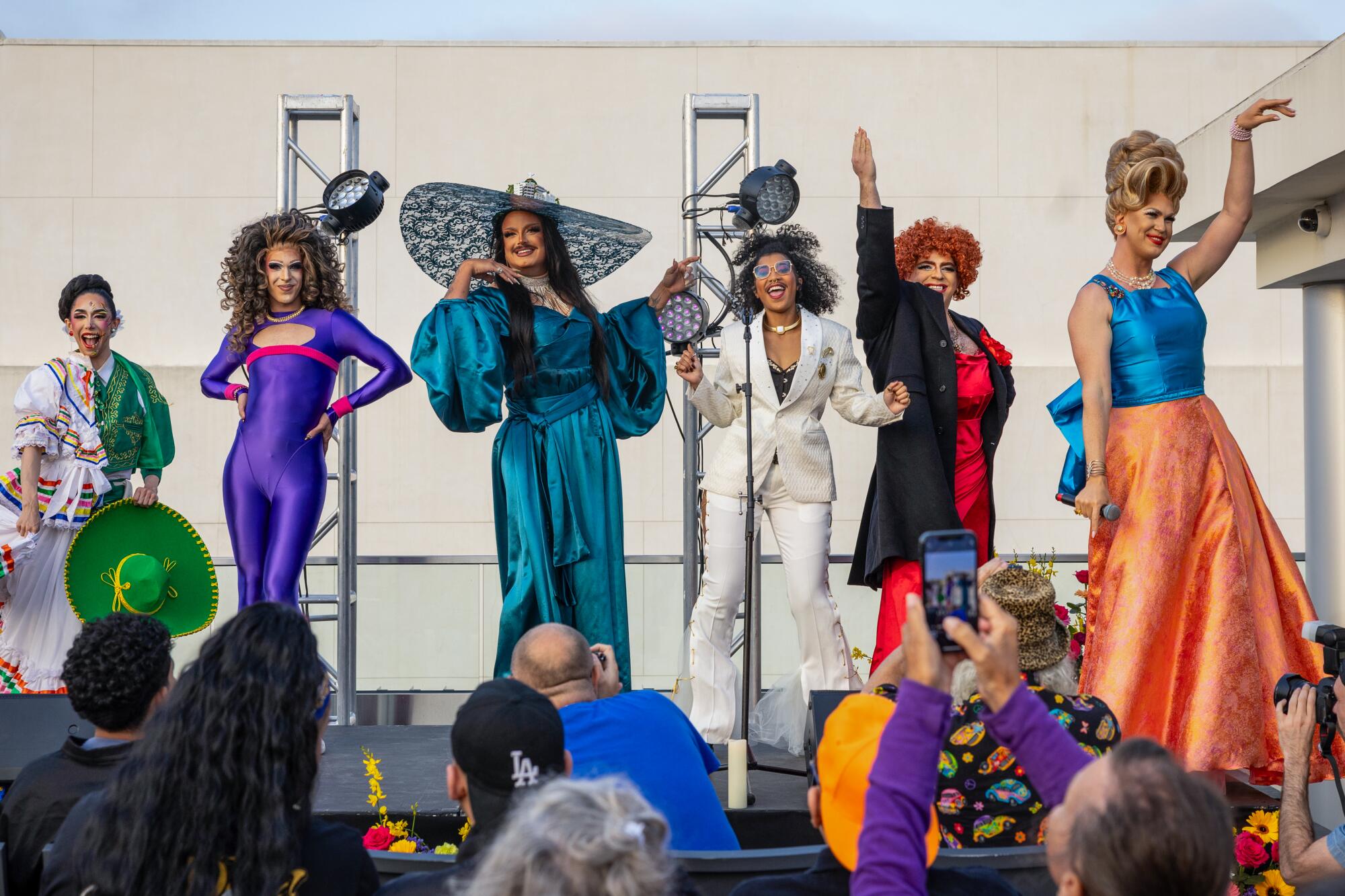
West Hollywood Drag Laureate Pickle, right, hosts the José Sarria Drag Pageant, celebrating Harvey Milk Day in West Hollywood.
(Jason Armond / Los Angeles Times)
Is diversity and inclusion helping to shape the future of the drag community?
As with anyone who steps into the role of “first,” the question of who’s next as a laureate comes up regularly. Both drag queens say they are aware of the diversity of their communities and the need to bring representation to this new elevated position. But they are cognizant of the fact that while they were chosen by a selection committee from a diverse pool of individuals, they are white performers. Pickle and Drollinger say they are confident that diversity will be better reflected in the laureate appointments moving forward.
“I’m just one flavor,” says Pickle of the breadth of talent in the drag community. “I’m spending a lot of my time connecting other drag artists to resources.” One of her initiatives as a drag laureate has been to set up quarterly drag roundtables at Plummer Park Community Center to bring together drag performers of all backgrounds with resources that can help elevate their art.
According to Pickle, there are local arts grants of up to $6,500 specifically earmarked for trans and gender-diverse artists that most performers aren’t aware of. She feels artists and performers in the drag community would be strong candidates because they’re making art nobody else is making.
She also has witnessed remarkable change. “We recently got a lot of the descriptions for these arts grants rewritten to specifically include drag performers,” she says. “It’s incredibly important to be able to see yourself mentioned in these grants to think, ‘Oh yeah, this is something I can utilize.’”
In the Bay Area, Drollinger says creating space for trans and BIPOC communities is paramount. She often hears that there should be more trans and BIPOC nights at certain clubs in NorCal. “And that is important,” she says. “But why not include everyone in everything? … Once we have a shift in consciousness, those who are considered outsiders become the insiders.”
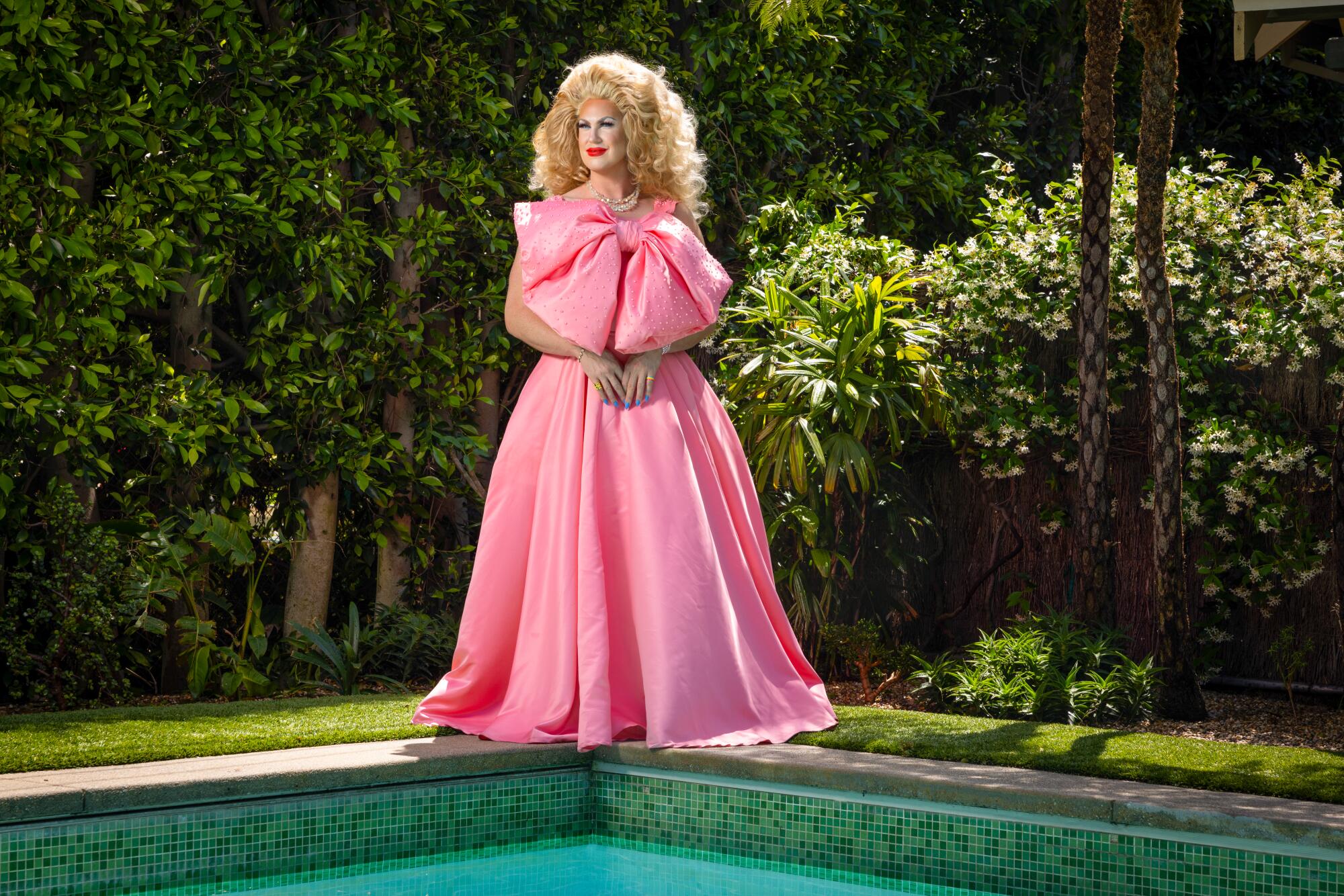
West Hollywood Drag Laureate Pickle, one of the first drag laureates in the country, at her childhood home in Koreatown.
(Jason Armond / Los Angeles Times)
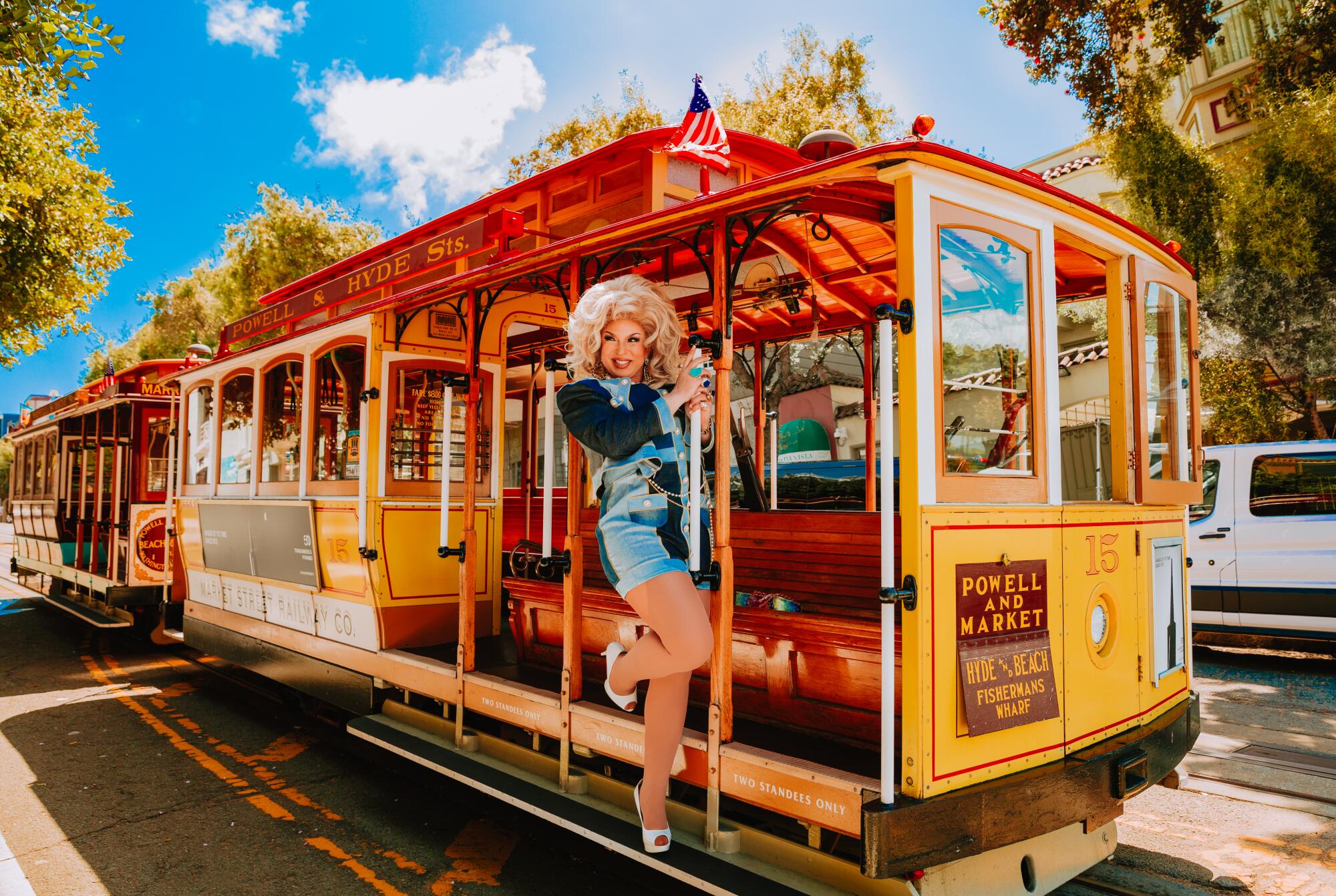
D’Arcy Drollinger on a San Francisco trolley.
(Rachel Z Photography)
Who comes next?
The laureates still have time on their tenures: Pickle will end hers next summer; Drollinger’s tenure ends in November, but she’s discussing a six-month extension. However, they are starting to see the finish line and are thinking about what, or more important, who comes next. “The true measure of success for my time as laureate will be in the pool of applicants for the next round,” says Pickle. If she’s done her job well, she says the next laureate will be selected from a much larger number of applicants from all sections of the drag community.
For Drollinger, she hopes to leave behind an event or two that can be replicated by her successors if they choose to. “On my way out, I want to put in writing what I think this program is, to give it a little more shape,” she says. “But ultimately, I hope the drag laureate role can be whatever that individual laureate wants to make of it.”


San Francisco Ballet artistic director Tamara Rojo is known for taking risks. She says that, with the exception of Nutcracker, “every time you bring back the same work, less people will come. You are cannibalizing yourself. So that’s not really a long-term strategy that you can rely on.”
Karolina Kuras
hide caption
toggle caption
Karolina Kuras
One of the first things Tamara Rojo did when she became artistic director of the San Francisco Ballet in 2022 was to commission a major new work on a very hot, very San Francisco topic: AI.
“I wanted to be somewhere where the answer is, ‘Let’s try,’ rather than, ‘We’ve never done it this way,’” Rojo told NPR about her decision to move to a city known globally for innovation. Rojo had spent decades working in the United Kingdom, first as a principal dancer with the Royal Ballet and English National Ballet and then as artistic director and lead principal dancer with the English National Ballet.
The ballet she commissioned for San Francisco, Mere Mortals, was boundary-pushing on a number of fronts.
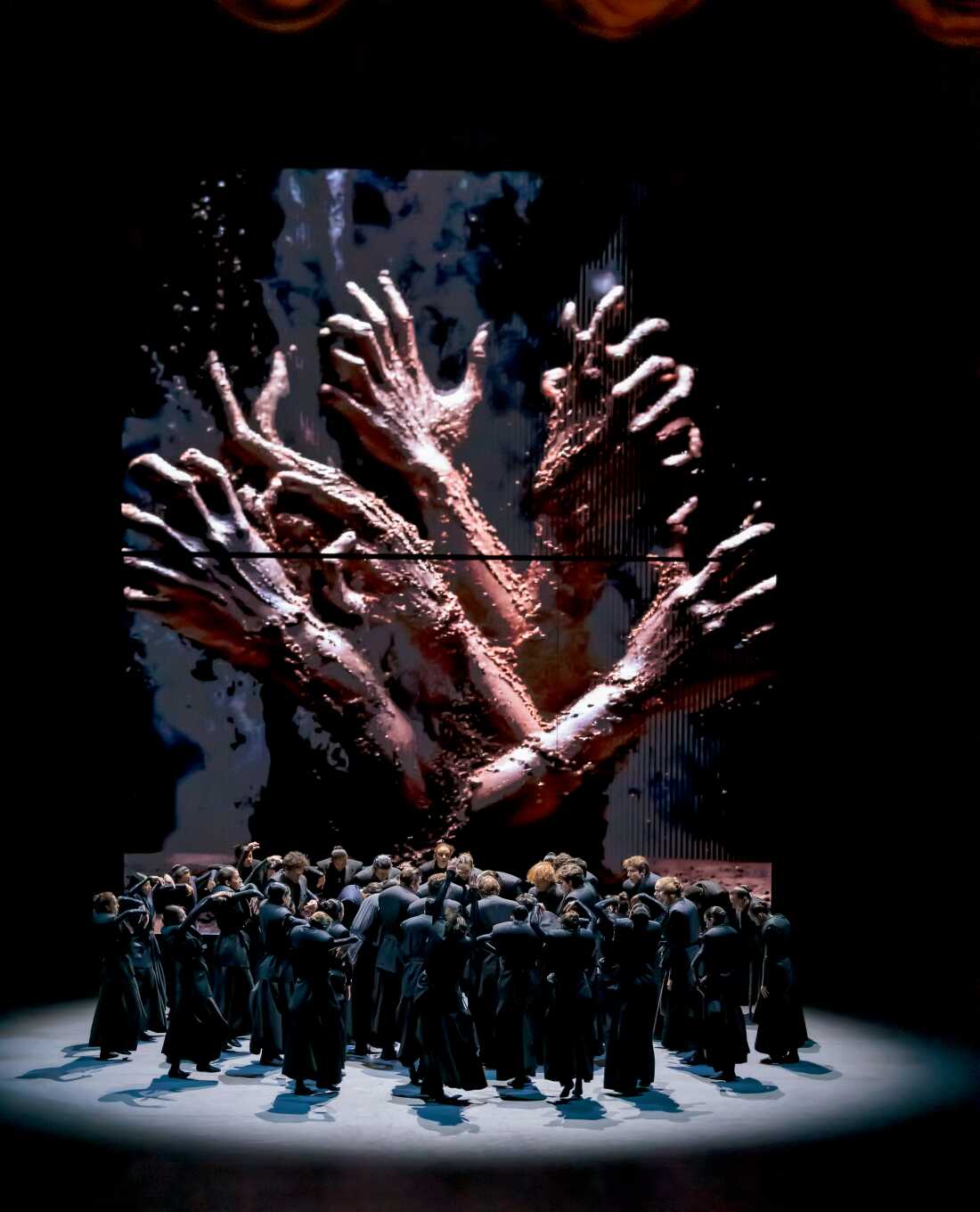
San Francisco Ballet’s new work about AI, Mere Mortals, presents a departure for the nearly 100-year-old dance institution.
Chris Hardy/San Francisco Ballet
hide caption
toggle caption
Chris Hardy/San Francisco Ballet
The jagged, earthbound movement, grainy electronic-driven soundtrack and pulsating AI-generated visuals of the hour-long ballet, presented a departure for the company programmatically. Also, Rojo’s choreographer pick, Aszure Barton, was the first woman ever commissioned to create a full-length work in the San Francisco Ballet’s nearly 100-year history – in an industry where most new dances are still created by men.
“What I love about Tamara is that she is defiant in what she believes in,” Barton said at the San Francisco Ballet’s headquarters during a break from rehearsing Mere Mortals. “This was a huge risk for her. It could have failed.”
Ballet can be a pretty conservative artform, with many companies trundling out Swan Lakes, Nutcrackers, and Cinderellas year after year. Every now and again, though, someone like Rojo comes along and truly shakes things up – even if that has meant ruffling tutus in the process.
Moving beyond limits
Rojo’s desire to move beyond accepted limits is a hallmark of her career. “She has extraordinary ambition,” dance writer Rachel Howard said.
Rojo was only 19 when she volunteered to represent her small, Madrid-based dance school and company at the prestigious Paris International Dance competition in 1994.

During her years as a principal dancer with the Royal Ballet, Tamara Rojo danced many famous roles including Princess Aurora in The Sleeping Beauty. In this 2006 dress rehearsal at The Royal Opera House, the Cuban ballet star Carlos Acosta partnered Rojo as Prince Florimund.
John D. McHugh/AFP/Getty Images
hide caption
toggle caption
John D. McHugh/AFP/Getty Images
“I don’t know what happened, but my hand went up,” Rojo said. “I didn’t think about it. I just went ‘me!’”
She won gold, and soon went on to dance for the Scottish National Ballet, the English National Ballet, and, starting in 2000, the Royal Ballet.
The ballerina became known for her consummate technique as well as her ability to bring emotional depth to roles like Odette/Odile in Swan Lake, Aurora in The Sleeping Beauty, and Giselle.
“Tragically sensual as one could want,” wrote New York Times critic John Rockwell in a review of Rojo’s performance of a duet from Ondine at the Lincoln Center Festival in 2004.
She also somehow found the time to earn a Ph.D. in the psychology of elite dancers from the Universidad Rey Juan Carlos in Madrid.
“She was truly one of the great international ballet stars of the last 40 years, at least,” said Howard.
Daring and success
Rojo has taken that same boundless ambition from the stage to the artistic director’s chair — making moves that match daring with success.
As the English National Ballet’s artistic director and lead principal dancer from 2012 to 2022, she helped transform the company into an international dance powerhouse, in large part through her radical approach to programming. Rojo’s efforts included bringing ballet to the Glastonbury Festival for the first time in the event’s history, and commissioning an Indian Kathak dance-infused reimagining of the beloved classic Giselle from choreographer Akram Kahn.
She also managed to keep the company financially afloat by offering up crowd-pleasing fare like The Nutcracker and a “swashbuckling romp” of a production of Le Corsaire, and oversaw its move from a cramped building in the “old money” South Kensington neighborhood of London to sprawling new studios in hip Canning Town.

Akram Khan and Tamara Rojo, pictured in London in 2013, have become frequent collaborators.
Tim P. Whitby/Getty Images
hide caption
toggle caption
Tim P. Whitby/Getty Images
“Rojo was hugely resourceful and creative about how she revitalized that company,” Howard said.
Sitting in her office at the San Francisco Ballet in dressy white sweatpants and an extravagantly ruffled blue blouse, the Spanish native, who turns 52 on Sunday, said the survival of her artform depends, at least in part, on risk-taking.

“Other than Nutcracker — which is this fabulous thing that keeps us all alive — every time you bring back the same work, less people will come,” Rojo said. “You are cannibalizing yourself. So that’s not really a long-term strategy that you can rely on.”
A risk pays off
The risks Rojo has taken with Mere Mortals seem to be paying off.
The production was recently remounted in San Francisco (it premiered in 2024), and will also be seen by audiences at the Edinburgh International Festival and Sadler’s Wells in London this summer. According to the company, it has brought in millions of dollars in ticket sales and drawn crowds of first-time ticket-buyers to the San Francisco Ballet.

A scene featuring dancer Wei Wang in San Francisco Ballet’s Mere Mortals.
Chris Hardy/San Francisco Ballet
hide caption
toggle caption
Chris Hardy/San Francisco Ballet
Many of them have stuck around for the post-performance DJ parties. These are part of Rojo’s ongoing desire to open things up by turning the company’s lobby into a friendlier space involving collaborations with local cultural groups and artists.
“We have this platform. We don’t have to be a gatekeeper. That’s actually bad for the arts,” Rojo said. “And so who else can we invite to be part of our actions?”
Perhaps most importantly for the company, Mere Mortals inspired a whopping, $60 million gift from an anonymous donor — one of the largest ever given to an American ballet company. This windfall is mainly earmarked to fund new work. Barton, the choreographer, said she remembers when Rojo invited the donor into the rehearsal room.
“She’s very convincing when she believes in something,” Barton said. “If I had the means, I would give it to her too.”
A difference of vision?
But not everyone is on board with the changes she’s made and her leadership style.
In 2018, during her time leading the English National Ballet, the U.K. publication The Times quoted a group of unnamed dancers who it said had accused Rojo of perpetuating a culture of intimidation and downplaying injury. Those dancers also objected to her romantic relationship with one of her company’s lead dancers, Isaac Hernandez, who moved with her to the San Francisco Ballet. They have a son together, but have since separated. NPR has not independently confirmed the allegations.

Tamara Rojo and associate artistic director Antonio Castilla observing rehearsal for the San Francisco Ballet’s recent production of Don Quixote.
Lindsey Rallo/San Francisco Ballet
hide caption
toggle caption
Lindsey Rallo/San Francisco Ballet
In a 2018 statement, English National Ballet said the company had worked with Rojo “from the start to implement improvements across the company,” including better access to medical care, more training for managers and a new building. Arts Council England, which funds and supports the arts across that country, said at the time it was satisfied with the new policies and processes put into place; English National Ballet said it worked with “unions and staff to ensure that feedback was heard and concerns were addressed. Asked about the allegations this week, the ballet told NPR that “No formal grievances were substantiated.”
Looking back, Rojo says that it was challenging to learn how to be a manager while still dancing, and to make changes in an industry where management is so male-dominated. A 2025 report from the Dance Data Project revealed of the 217 artistic directors leading classically based dance companies in the U.S. and internationally, 30% are women, while 70% are men.
“I came in very strong and very fast,” Rojo said. “And that, combined with ‘Women that succeed need to be put in their place,’ was very difficult.”

Tamara Rojo and Isaac Hernandez in London, 2016.
Chris Jackson/Getty Images
hide caption
toggle caption
Chris Jackson/Getty Images
It’s hard to say if similar disagreements over leadership happened when she took over San Francisco Ballet. A handful of high-profile company members have left, including Hernandez. The dancers declined to comment. San Francisco Ballet said the number of roster changes is similar to the number before her tenure.
“Not everybody’s going to agree with my vision,” Rojo said.
Some San Francisco Ballet dancers concur.
“Like any leadership change, sometimes people feel aligned with it and sometimes not,” said principal dancer Sasha De Sola. “The role of an artistic director is to bring their creative vision and continue to build.”
Cultivating dance leaders of the future
Part of Rojo’s creative vision is an unusual, new two-year program aimed at identifying and training the next generation of dance leaders while they continue to perform on stage. De Sola is a participant.
“Many times you’re required to almost wait until the end of your [ballet] career to be able to pursue these things,” De Sola said. “And I feel grateful that I’ve been able to do these in tandem.”
Rojo said she believes ballet dancers are capable of being great leaders if they’re taught how to do it. “You just need to have a vision that is specific and relevant to the institution that you want to direct and that is financially sustainable,” she said. “And you also need to make great art.”
Jennifer Vanasco edited this story for broadcast and web.
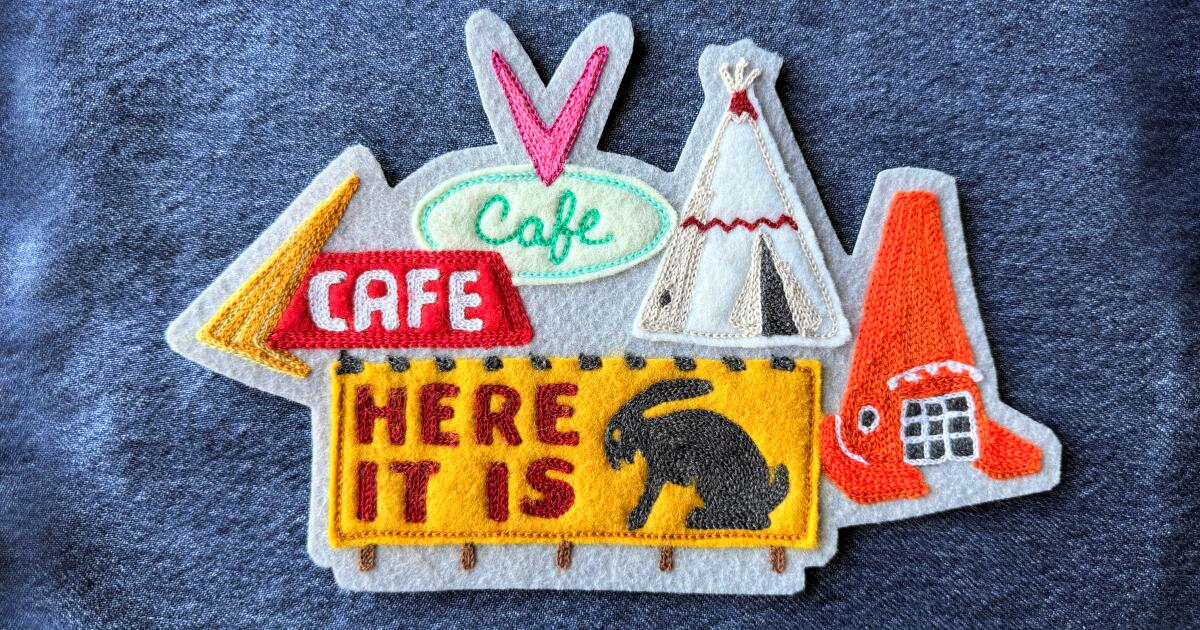
Route 66 has its tendrils throughout SoCal, and especially in the L.A. area, winding through Pasadena, West Hollywood and culminating in Santa Monica. But the most loving ode to Route 66 may in fact be at the Disneyland Resort, specifically at Disney California Adventure.

Stories, photos and travel recommendations from America’s Mother Road
Cars Land opened in 2012 as part of a reworking of the theme park and at long last gave it a striking land that could rival — and in many cases surpass — those of its next-door neighbor, Disneyland. Flanked by sun-scarred, reddish rocks that look lifted from Arizona, Cars Land is a marvel of a theme park land, with its backdrop mountain range ever so slightly nodding to the fins of classic Cadillacs from 1957 to 1962. That design element is a salute to the Cadillac Ranch in Amarillo, Texas, where 10 vintage Cadillacs are buried nose-first in the ground that to many resembles a 20th century Stonehenge.
Yet before the area was attached to the 2006 film, it was envisioned as a theme park destination dedicated to roadside attractions and trips along the so-called Mother Road. Cars Land is a make-believe area based on a fictional town from an animated film, but its roots are decidedly real.
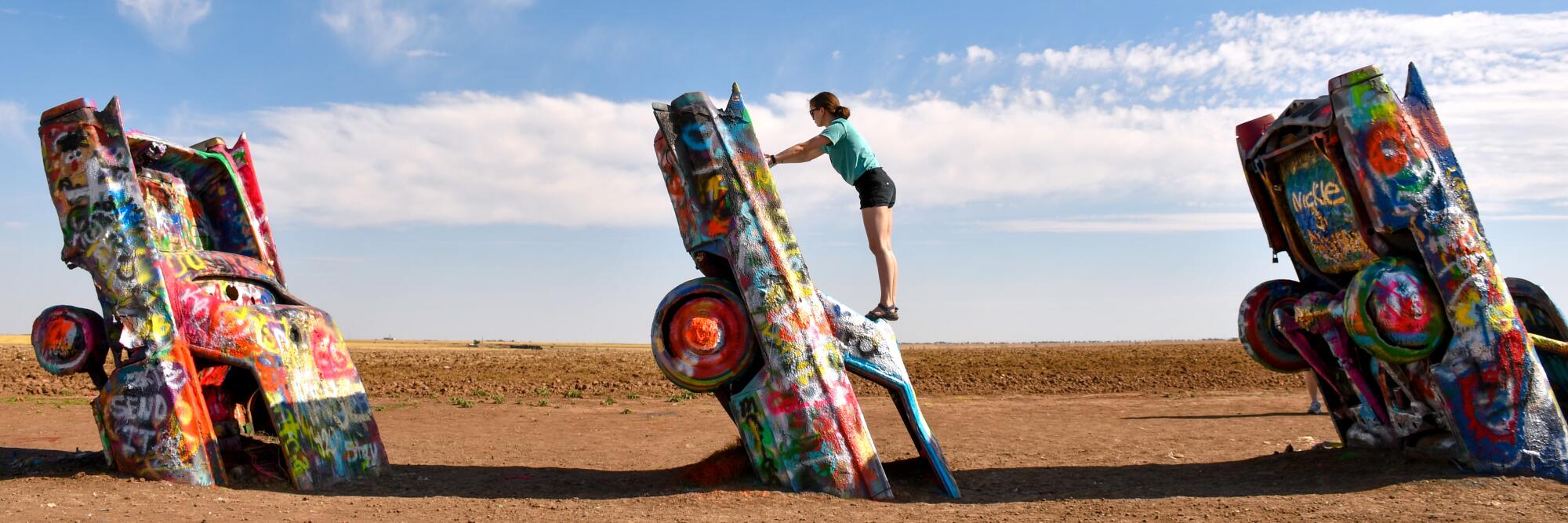
Cadillac Ranch, an artwork made from 10 old cars by the Ant Farm artists’ collective in the 1970s, has become one of Amarillo’s top attractions. Visitors are invited to add their own spray-painted touches.
(Christopher Reynolds / Los Angeles Times)

The backdrop mountain range of Radiator Springs Racers is a nod to Cadillac Ranch. The peaks are designed to look like the tail fins of classic cars.
(Mark Boster / Los Angeles Times)
“We very much acknowledge that up front, that you’re walking down Route 66,” says Kathy Mangum, the retired Walt Disney Imagineer who served as the executive producer of Cars Land.
“But you’re also not walking down a part of Route 66 that exists anywhere,” Mangum continues. “There’s no part of Route 66 where you’re looking up at a Cadillac range surrounded by red rocks. It’s the spirit of Route 66. I wouldn’t even call it a ‘best-of.’ It’s just a little bit of this, a little bit of that, and combined it feels real.”
Before those at Walt Disney Imagineering, the secretive arm of the company devoted to theme park experiences, were even aware that Pixar Animation Studios was working on the “Cars” film, an automotive-focused land was in the planning stages for Disney California Adventure. The park had opened in 2001 and had struggled in its early years to pull in crowds, with audiences zeroing in on a lack of Disneyland-style attractions and an absence of grandly designed vistas.
In an effort to rejuvenate the park, then-Imagineer Kevin Rafferty envisioned an area to be called Car Land — without the “s” — pulling heavily from his family’s road trips and Route 66-like roadside attractions and oddities. Among its standout attractions was to be one initially named Scoot 66, later changed to Road Trip, USA, a slow-moving ride that took guests on a cross-country journey through nature and roadside quirkiness, although its showcase scene would have been a trip trough a miniaturized Carlsbad Caverns, a bit of a detour from Route 66.
“It was kind of tongue-in-cheek,” says Rafferty, now retired, of the never-built ride. “You were going to be seeing all these roadside attractions that would draw you in, like giant bunnies.”

Mater’s Junkyard Jamboree brings the rusty, old tow truck character from the “Cars” movie to life in Cars Land at Disney California Adventure. (Mark Boster / Los Angeles Times)

An artwork in Seligman, Ariz., pays homage to the Disney-Pixar “Cars” movie, which was heavily inspired by the town. (Mark Lipczynski / For The Times)
Rafferty believed a place such as Car Land would be ripe for exploration in a Disney park, as it was to be set from the late 1950s to the early 1960s and tap into a collective nostalgia for a time when a vehicle meant the freedom to explore the open road. Cars Land today still has some of that ageless energy, boasting a vintage rock ’n’ roll soundtrack and a strip of a street filled with colorful neon, its lights, especially at night, beckoning guests to come closer.
“The reason why I thought it would fit into a Disney park, especially Disney California Adventure, is because cars are so much a part of the California story,” Rafferty says. “Cars are designed in California, even though they’re built elsewhere. There’s more custom shops in California. There’s more design studios in California. There’s more car clubs. And all the cars songs. ‘She’s so fine, my 409.’ It was all the Beach Boys and Jan and Dean.”

The neon signs of Radiator Springs. Flo’s V8 Cafe isn’t a direct match for any Route 66 diner, but it was inspired in spirit by the Midpoint Cafe in Adrian, Texas.
(Paul Hiffmeyer / Disneyland Resort)
Development on Rafferty’s Car Land idea would change course when Imagineering and Pixar eventually aligned. But it was also a shift that would more formally ground the area in the culture of Route 66, which heavily influenced the film. Both the filmmakers and, later, those with Imagineering, embarked on 10-day research trips along the road led by historian Michael Wallis, author of “Route 66: The Mother Road.” Those at Pixar, in fact, were so charmed by Wallis’ tours that the author was asked to voice the role of the film’s sheriff.
Wallis says he took the teams out in rented Cadillacs. “I like to stop every 300 yards,” Wallis says. “If I’m doing a road trip, I get into it. So we stopped to move box turtles off the road. I waded them into winter wheat to dance, to pick wild grapes. I introduced them to people that I guaran-damn-tee that they never would have met, the great characters of the road, and I showed them the man-made and natural sites of the road.”

Though the fictional “Cars” and Cars Land community of Radiator Springs has no single inspiration, it echoes the scenery and history of several small towns between Tulsa, Okla., and Kingman, Ariz., including Tucumcari, N.M., Seligman, Ariz., and Oatman, Ariz. And the single, graceful bridge that is centered upon the land’s backdrop mountain range closely resembles Pasadena’s own Colorado Street Bridge, although there’s no roaring waterfall next to the original.

Scenes from Route 66 in Seligman, Ariz. The town was one of the inspirations for the fictional “Cars” and Cars Land town of Radiator Springs.
(Mark Lipczynski / For The Times)

The centerpiece bridge of the Cars Land mountain range was modeled after a local landmark. (Paul Hiffmeyer / Disneyland Resort)

The Colorado Street Bridge in Pasadena, an inspiration for the Cars Land structure. (Adam Markovitz)
Elsewhere, Ramone’s House of Body Art connects with the U-Drop Inn, a 1936 Art Deco gas station in Shamrock, Texas, that now serves as a visitor center and cafe. The Cozy Cone Motel nods to the Wigwam motel chain, which once included seven locations from Kentucky to California. Two remain in business along Route 66: the Wigwam in San Bernardino and another in Holbrook, Ariz.
While Imagineers had visual references from the animated film, Mangum says the research trip was invaluable in lending authenticity to the park.
“We could walk into a building in Shamrock, Texas, that looks so much like what Ramone’s House of Body Art looks like and see that those tiles are made of raised terra-cotta,” Mangum says. “So we could get the actual texture. It’s a movie world, but it’s also a real world.”
Flo’s V8 Cafe isn’t a direct match with any Route 66 eatery, the Imagineers say, but was certainly influenced in spirit by the Midpoint Cafe in Adrian, Texas.

The Midpoint Cafe in Adrian, Texas, celebrates the halfway point on Route 66 between Chicago and Los Angeles.
(Christopher Reynolds / Los Angeles Times)
“We sampled all their pies and food and made copious notes on this stuff,” Rafferty says. “The two women who owned the Midpoint Cafe had what they said was their mother’s recipe for ‘ugly crust pies.’ We fell in love with ugly crust pies. I met with the head chef of Disneyland, who was a Frenchman at the time, and I said we wanted to serve ugly crust pies at Flo’s V8 Cafe. And he said, ‘No, no, no, nothing at Disneyland will be ugly.’”
No, but it may be influenced by abandoned buildings. Mangum says a key locale for the land was the deserted structures of Two Guns, Ariz. Gas station remains led to sketches that would inspire parts of the “Stanley’s Oasis” area of the Radiator Springs Racers queue, which Rafferty and company filled out with an oil service station and then a building composed of empty oil bottles. The story goes that Stanley’s Oasis is a roadside attraction settlement that led to the development of the town of Radiator Springs.

At the Cozy Cone Motel, a string of cone-shaped food stalls sell quick bites such as swirled soft-serve cones. (Stephanie Breijo / Los Angeles Times)

The Cozy Cone is based on the real-life Wigwam Motels. (Christopher Reynolds / Los Angeles Times)
“That kind of Route 66-inspired story was all made up,” Rafferty says. “It wasn’t in the film.” That backstory, however, would inform the 2012 short “Time Travel Mater.”
The enduring strength of the land, however, isn’t just due to the popularity of the animated properties that led to it. While Route 66 wasn’t magic for everyone — the history of the road is dotted with tales of extreme poverty and horrific racism — it’s become romanticized as a slice of Americana and stands as a jumping-off point to further delve into our past.
The land is, in a word, timeless. It’s also representative of the ideal of a working small town, the sort of place we forever long for. “It may not be the America of today,” Mangum says, “but in a way it is.”
Times staff writer Christopher Reynolds contributed to this report.

Sunday Puzzle
NPR
hide caption
toggle caption
NPR

On-air challenge
The on-air challenge goes here.
Last week’s challenge
Last week’s challenge comes from Joshua Green, of Columbia, Md. Think of a popular film franchise with many sequels. Hidden in consecutive letters inside its name is a place mentioned multiple times in the Bible. Replace that place with a single letter and you’ll name a Major League Baseball team. What franchise and team are these?
Answer: “The Avengers” –> (Detroit) Tigers
Winner
Erin Kealiher of Silver Spring, Maryland.
This week’s challenge
This week’s challenge comes from Joseph Young, of St. Cloud, Minn. Name a famous actor of the past, seven letter first name and seven letter last name. Remove three consecutive letters from him last name and the remaining letters in order will be the well known lead character from a long running series of films. What actor and character are these?
If you know the answer to the challenge, submit it here by Thursday, May 21 at 3 p.m. ET. Listeners whose answers are selected win a chance to play the on-air puzzle. Important: include a phone number where we can reach you.
-
 News12 minutes ago
The Supreme Court avoids taking up a fight over Voting Rights Act enforcement for now
-

 New York2 hours ago
How a Web Developer Lives on $45,000 in Far Rockaway
-

 Los Angeles, Ca2 hours ago
Santa Monica kidnapping suspect in custody after early-morning pursuit, officer-involved shooting
-

 Detroit, MI2 hours ago
5 players who could help Detroit Lions in NFL free agency
-

 San Francisco, CA2 hours ago
San Francisco forward David Fuchs commits to Clemson out of NCAA transfer portal
-

 Dallas, TX3 hours ago
Whataburger revives iconic A-frame design at new Texas restaurants
-

 Miami, FL3 hours ago
Ai’King Hall’s Recruiting Flip to Miami Signals Concerning Oregon Trend
-

 Boston, MA3 hours ago
Sexual assault trial of Alvin Campbell, Massachusetts attorney general’s brother, begins today

