Lifestyle
When did food become such a luxury?


The industrial food supply will be the last bastion of the luxury economy, and we might mirror the cannibals in doomsday movies before we cede our idiosyncratic eating habits to austerity.
Capitalism is amazing because it inspires unrelenting competition between brands and the branding of items that should be generic — organized and categorized by which boasts the best flavor, the most sustainably sourced ingredients, or fastest-ripening produce whose side effects might include the leaching of toxic chemicals into municipal food and water supplies. Then, these same brands dutifully patent an expensive snake oil antidote for poisoning you. The side effects of the contaminants might reveal themselves in the body as mineral depletion, heavy metal overload or lethargy (chronic fatigue, leaky gut, hyperactivity, dissociation, anhedonia). Luckily, the same system that instigated mass disease and physical and psychic atrophy can invent a market for “clean eating,” the branded backlash against factory farming’s poisoning and genetic modification of your food and soil and water and air.
What makes late capitalism even more special is that it can short-circuit just well enough that the so-called clean or whole foods deter most of society from examining where their food comes from and how it reaches them. What is a farm? What is a supply chain? Who are the farmers harvesting your food and the truckers driving it on interstates to you? Do they earn a living wage? Do you? What is topsoil? What is a supermarket? A muse for Allen Ginsberg, whose ecstatic litany of a poem “A Supermarket in California” captures the orgy of too many and just enough options, the numbness of excess. We forget that litany of questions under the fluorescent beams. Such are our funeral parlors for food, where mechanical reproduction haunts nourishment and we eat from the giant slot machines of industry. What is a supermarket?
In Memphis, Tenn., circa 1916, Piggly Wiggly opened its doors, offering the first self-service grocery vendor. Customers used carts and handheld baskets and ambled the aisles with their lists and often those lists expanded because there were so many products. Branding became essential to the differentiation that would earn the easy recognition and loyalty of customers, though labels about the purity of contents or lack thereof didn’t matter in this former landscape. What is called “Big Food” was born in the same region of the consumer temperament that brought us Elvis. By the 1950s and ’60s, middle-class and bourgeoisie America had a casual sense of access to meals and snacks and radio hits as if all were ready-mades built into their cities and suburbs like parts of a set. Personal fridges were stocked as well as the early markets but now there were more “processed foods” — frozen meals for lunch or dinner, an infinite variety of chips and dips for grazing. And the American teenager had enough disposable income to spend on frivolous quick food to accompany lighthearted music and lifestyles. The result is that we now have as many supermarket chains as we have categories of food product in those hallowed minor warehouses.

Before the self-service grocery, outlets required patrons to show up with detailed lists of items they needed and hand those lists to a clerk who would gather the items, which were either loose in bins or in flimsy generic packaging with no ingredients or labels. Today, this feels a step above state-sanctioned rations. At the same time, there’s a new niche market for containerless, “zero-waste,” grocery stores such as Re_Grocery in Los Angeles. And what these elite, boutique shops don’t necessarily realize is that they’re turning wellness into a luxury for the elite and those who replicate elitism for clout. It’s a sinister mode of decadence — decadent minimalism, where overt virtue signaling meets seemingly neurotic purity fantasies, where customers dance in the glow of the glare on bulk bins.
I remember supermarket parking lots from my childhood most vividly. There were times when my mom, my dad and I would make a trip for a jug of milk and my mom would go inside while we waited in the car. One such night my dad asked if we should leave her and drive away, as if to suggest before she owned us forever like the market. I returned a monotone no. The supermarket gave him a premonition of something sinister to come. In suburban San Diego, an area called Carlsbad, we’d call him from supermarket payphones as he sat in jail. His paranoia had been confirmed. And after he died and we moved to L.A., my mother went on her inevitable health kick-slash-healing journey. She hired a meditation coach who introduced her to Enya and a ’90s health-food chain called Mrs. Gooch’s. This store boasted muted neutral bins and amber-toned aisles, a drastic contrast from the buzzing neons of the popular chains. Instead of brand names like Fruit Roll-Ups, Mrs. Gooch’s carried fruit leather, made with real fruit, and it was tofu or other soy stuffed into the inner filet of the hot dogs instead of insinuations of pork. You could buy freshly pressed juices in glass bottles. On the way home, we’d stop for shots of wheatgrass. During her bouts of depression, she’d leave money on her nightstand and we’d walk ourselves to Vons or Ralphs and buy anything we wanted. At home, we had books on raw veganism by Dick Gregory and grape cures and detox methods and healing music. We had stakes in every market. We’d turned grocery shopping into a therapeutic symbol of semi-functional American family life, and of agency over our own lives. We were part of the group unknowingly beta testing the conflation of health, vitality and luxury shopping.
Whole Foods replaced Mrs. Gooch’s, but after being deracinated by Amazon, it became passé, less and less a signifier of status. Around the same time, terms like food desert went mainstream, defining the regions within cities where the only available food was the kind that is addictive and might kill you a little quicker. The newfound concern wasn’t accompanied by any remedy. The ability to articulate the struggle for decent food became another vain virtue signal.
And then came the rise of Erewhon, an upscale health food market that derives its name from the anagramic spelling of the word nowhere. It takes its name from a novel by Samuel Butler, in which ill health is a crime and citizens have to stay vital or risk incarceration — dark, with a little radiant grain of truth in depicting the persistent crisis of faith in the food supply. The market first opened in Boston in 1966, then reemerged in 2011 after a couple bought it from its original owner. Today a private equity firm — the Stripes Group — owns a minority stake, and the chain is expanding to every upscale neighborhood in Los Angeles. Thanks to the internet, its reputation transcends L.A. and has come to signify luxury eating nationwide. Tourists make pilgrimages to try its Hailey Bieber smoothie, replete with obscure superfoods and priced around $22. This is a typical price of an Erewhon smoothie. Everything in the store is organic, and local produce is prioritized. The aisles are sepia-toned and filled with everything from bone broth to raw fermented crackers to dried fruits (unadulterated by sulfur dioxide) to organic hygiene products to every brand of specialty water that exists in the world.

The prominence of Erewhon is the temporary response to the deterioration of Whole Foods, but its increasing popularity is also a reaction to the food scarcity trauma that 2020 instigated and the way we self-soothed with bougier tastes in food and wellness. It is no longer enough to wear designer- or even label-free “quiet luxury” clothing; the new way to indicate class is to shop Erewhon with no regard for cost and bypass the genetically modified, aggressively low-quality gut-busting food the U.S. is now renowned for. Celebrities shop at Erewhon and call paparazzi to photograph them there. Kim Kardashian collaborated with Balenciaga and carried a brown paper Erewhon shopping bag designed by the questionable brand to an outdoor L.A. fashion show. It was tacky. Influencers make TikToks and YouTubes taste-testing Erewhon smoothies and prepared foods mukbang-style. The satiety can be felt through the camera, its satisfaction with luxuriating in something so pure, so clean. And many of us have had slow evenings where we head there with a friend just to feel something. Erewhon is expanding to so many locations that the chain is bound to suffer the fate of Whole Foods and be replaced by a new, more conscientious iteration of the clean-eating superfood movement.
In the meantime, this aggressively revisionist supermarket, as indicated in Butler’s novel, has become part pharmacy, part a site of repentance for past consumption. We can’t see the farm from Nowhere. We are running on the energy of farmers’ labor and transmuting it into fetish object, and it feels almost beautiful on set in Los Angeles.
We’re in a game of survival of the fittest, where surviving itself feels akin to luxuriating in what should be hostile territory, mastering an environment we have come together to ravage. The next phase, of course, is making everything we consume from scratch like the tradwives and supermodels-turned-influencers. But you can’t buy their affect from Nowhere. It’s part Nara Smith, the German and South African supermodel who is now TikTok-famous for her gorgeous, tedious recipes for everything from gum to chips to real meals, and part Gwyneth Paltrow, who preaches her style of eating and sells it in batches that can be shipped direct to your doorstep, as if by a deity of celebrity fitness.
Smith began making her food from scratch after being diagnosed with lupus and eczema. As a model and mother of three married to model Lucky Blue Smith, she has become the embodiment of luxury fashion meeting its lifestyle counterpart, with only a glint of moralizing. This family is almost perfect in its All American-meets-New American mode, like they were dreamed up in the Erewhon origin novel, with beauty as their alias, so you’d never know there are underlying health issues inspiring their commitment to clean living. Nara Smith is idolized and also ridiculed, but the unbothered serenity she channels in every video is eerily effective. She manages to be vulnerable, venerable, semi-transparent and entirely opaque, like any of the great gurus. “Do as I do, but you can’t because you’re you and I am the embodiment of pure luxury” could be her slogan. You just wanna try the lifestyle out, slow down, buy a mortar and pestle, marry a devout model, and see if living that way is akin to falling in love, becoming a teenager again, sharing a sugarless homemade soda over whitewashed doo-wop while the wars cold and hot proliferate abroad.
There is rampant spiritual sickness pervading the West, and what is called luxury, in every area of life, seems to soothe its symptoms. When it comes to food — shopping for food like our lives depend on it, but casually, in refined and enchanting micro-climates — the spirit seems to swell with optimism at the thrill we feel when we pay more for the false security of organic, non-GMO, seed oil-free, Nara Smith-approved groceries. My mother, widowed but loyal to the lifestyle market as if it would protect her from the alienation of child rearing, was onto something. This is where the elite go to abandon and redeem themselves, where the almost elite go to feel like what they may never be and claim a lifestyle just beyond their reach, for now. Who could blame them?



new video loaded: Prada Peels Back the Layers at Milan Fashion Week
By Chevaz Clarke and Daniel Fetherston
February 27, 2026

Bill Cosby
Rape Accuser Says Cosby Won’t Take Stand At Trial
Published
Bill Cosby‘s rape accuser Donna Motsinger says the TV star can’t be bothered to show up to court for a trial in a lawsuit she filed against him.
According to new legal docs, obtained by TMZ. Motsinger says Bill will not testify in court … she claims it’s “because he does not care to appear.”

Motsinger says Bill won’t show his face at the trial either … and the only time the jury will hear from him will be a previously taped deposition.
As we previously reported, Motsinger claims Bill drugged and raped her in 1972. In the case, Bill admitted during a deposition that he obtained a recreational prescription for Quaaludes that he secured from a gynecologist at a poker game.
TMZ.com
Bill also said he planned to use the pills to give to women in the hopes of having sex with them.
Motsinger alleged Bill gave her a pill that she thought was aspirin. She claimed she felt off after taking it and said she woke up the next day in her bed with only her underwear on.
Here, it sounds like Motsinger wants to play the deposition for the jury.
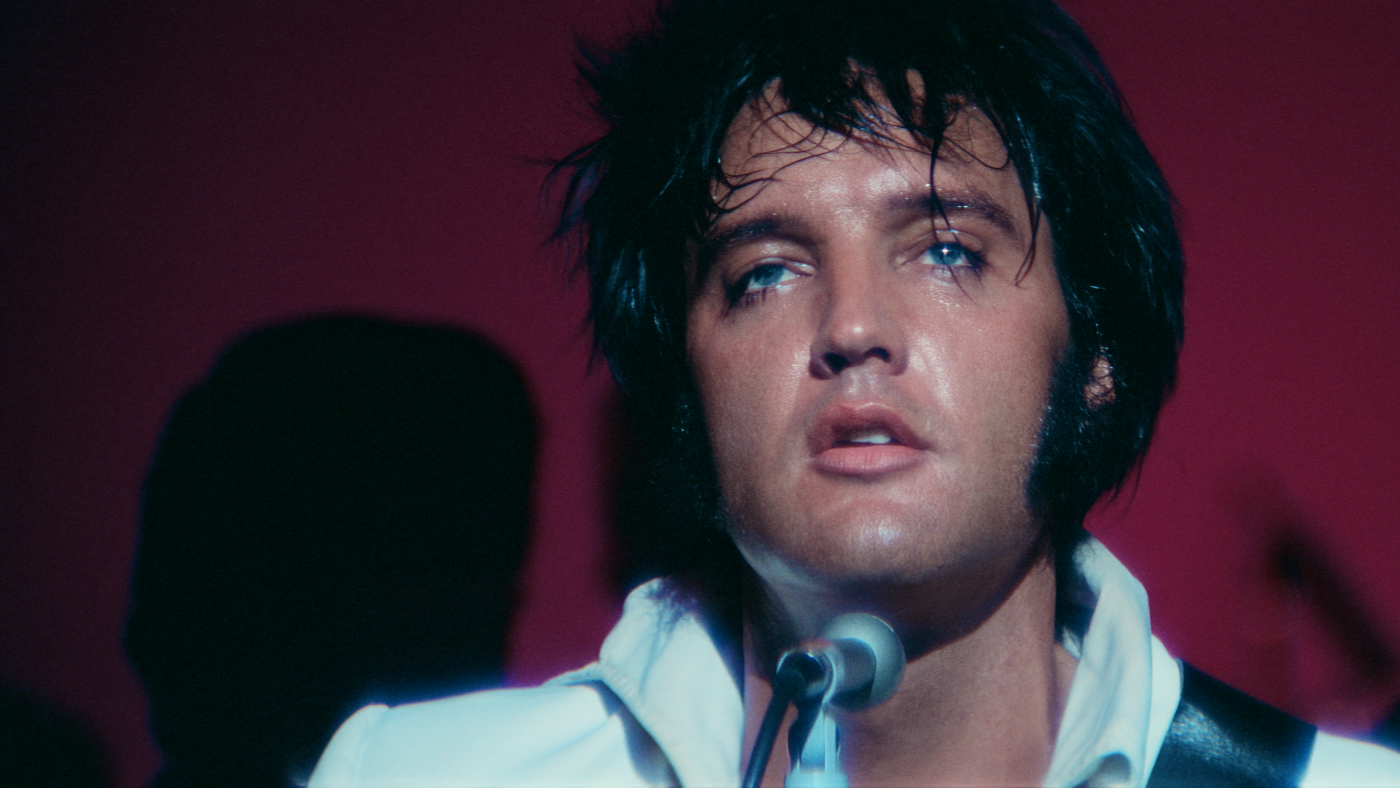
Elvis Presley in Las Vegas in Aug. 1970.
NEON
hide caption
toggle caption
NEON
“You are my favorite customer,” Baz Luhrmann tells me on a recent Zoom call from the sunny Chateau Marmont in Hollywood. The director is on a worldwide blitz to promote his new film, EPiC: Elvis Presley in Concert — which opens wide this week — and he says this, not to flatter me, but because I’ve just called his film a miracle.
See, I’ve never cared a lick about Elvis Presley, who would have turned 91 in January, had he not died in 1977 at the age of 42. Never had an inkling to listen to his music, never seen any of his films, never been interested in researching his life or work. For this millennial, Presley was a fossilized, mummified relic from prehistory — like a woolly mammoth stuck in the La Brea Tar Pits — and I was mostly indifferent about seeing 1970s concert footage when I sat down for an early IMAX screening of EPiC.
By the end of its rollicking, exhilarating 90 minutes, I turned to my wife and said, “I think I’m in love with Elvis Presley.”
“I’m not trying to sell Elvis,” Luhrmann clarifies. “But I do think that the most gratifying thing is when someone like you has the experience you’ve had.”
Elvis made much more of an imprint on a young Luhrmann; he watched the King’s movies while growing up in New South Wales, Australia in the 1960s, and he stepped to 1972’s “Burning Love” as a young ballroom dancer. But then, like so many others, he left Elvis behind. As a teenager, “I was more Bowie and, you know, new wave and Elton and all those kinds of musical icons,” he says. “I became a big opera buff.”
Luhrmann only returned to the King when he decided to make a movie that would take a sweeping look at America in the 1950s, ’60s, and ’70s — which became his 2022 dramatized feature, Elvis, starring Austin Butler. That film, told in the bedazzled, kaleidoscopic style that Luhrmann is famous for, cast Presley as a tragic figure; it was framed and narrated by Presley’s notorious manager, Colonel Tom Parker, portrayed by a conniving and heavily made-up Tom Hanks. The dark clouds of business exploitation, the perils of fame, and an early demise hang over the singer’s heady rise and fall.
It was a divisive movie. Some praised Butler’s transformative performance and the director’s ravishing style; others experienced it as a nauseating 2.5-hour trailer. Reviewing it for Fresh Air, Justin Chang said that “Luhrmann’s flair for spectacle tends to overwhelm his basic story sense,” and found the framing device around Col. Parker (and Hanks’ “uncharacteristically grating” acting) to be a fatal flaw.
Personally, I thought it was the greatest thing Luhrmann had ever made, a perfect match between subject and filmmaker. It reminded me of Oliver Stone’s breathless, Shakespearean tragedy about Richard Nixon (1995’s Nixon), itself an underrated masterpiece. Yet somehow, even for me, it failed to light a fire of interest in Presley himself — and by design, I now realize after seeing EPiC, it omitted at least one major aspect of Elvis’ appeal: the man was charmingly, endearingly funny.
As seen in Luhrmann’s new documentary, on stage, in the midst of a serious song, Elvis will pull a face, or ad lib a line about his suit being too tight to get on his knees, or sing for a while with a bra (which has been flung from the audience) draped over his head. He’s constantly laughing and ribbing and keeping his musicians, and himself, entertained. If Elvis was a tragedy, EPiC is a romantic comedy — and Presley’s seduction of us, the audience, is utterly irresistible.
Unearthing old concert footage
It was in the process of making Elvis that Luhrmann discovered dozens of long-rumored concert footage tapes in a Kansas salt mine, where Warner Bros. stores some of their film archives. Working with Peter Jackson’s team at the post-production facility Park Road Post, who did the miraculous restoration of Beatles rehearsal footage for Jackson’s 2021 Disney+ series, Get Back, they burnished 50-plus hours of 55-year-old celluloid into an eye-popping sheen with enough visual fidelity to fill an IMAX screen. In doing so, they resurrected a woolly mammoth. The film — which is a creative amalgamation of takes from rehearsals and concerts that span from 1970 to 1972 — places the viewer so close to the action that we can viscerally feel the thumping of the bass and almost sense that we’ll get flecked with the sweat dripping off Presley’s face.
This footage was originally shot for the 1970 concert film Elvis: That’s The Way It Is, and its 1972 sequel, Elvis on Tour, which explains why these concerts were shot like a Hollywood feature: wide shots on anamorphic 35mm and with giant, ultra-bright Klieg lights — which, Luhrmann explains, “are really disturbing. So [Elvis] was very apologetic to the audience, because the audience felt a bit more self conscious than they would have been at a normal show. They were actually making a movie, they weren’t just shooting a concert.”
Luhrmann chose to leave in many shots where camera operators can be seen running around with their 16mm cameras for close-ups, “like they’re in the Vietnam War trying to get the best angles,” because we live in an era where we’re used to seeing cameras everywhere and Luhrmann felt none of the original directors’ concern about breaking the illusion. Those extreme close-ups, which were achieved by operators doing math and manually pulling focus, allow us to see even the pores on Presley’s skin — now projected onto a screen the size of two buildings.
The sweat that comes out of those pores is practically a character in the film. Luhrmann marvels at how much Presley gave in every single rehearsal and every single concert performance. Beyond the fact that “he must have superhuman strength,” Luhrmann says, “He becomes the music. He doesn’t mark stuff. He just becomes the music, and then no one knows what he’s going to do. The band do not know what he’s going to do, so they have to keep their eyes on him all the time. They don’t know how many rounds he’s going to do in ‘Suspicious Minds.’ You know, he conducts them with his entire being — and that’s what makes him unique.”

Elvis Presley in Las Vegas in Aug. 1970.
NEON
hide caption
toggle caption
NEON
It’s not the only thing. The revivified concerts in EPiC are a potent argument that Elvis wasn’t just a superior live performer to the Beatles (who supplanted him as the kings of pop culture in the 1960s), but possibly the greatest live performer of all time. His sensual, magmatic charisma on stage, the way he conducts the large band and choir, the control he has over that godlike gospel voice, and the sorcerer’s power he has to hold an entire audience in the palm of his hands (and often to kiss many of its women on the lips) all come across with stunning, electrifying urgency.
Shaking off the rust and building a “dreamscape”
The fact that, on top of it all, he is effortlessly funny and goofy is, in Luhrmann’s mind, essential to the magic of Elvis. While researching for Elvis, he came to appreciate how insecure Presley was as a kid — growing up as the only white boy in a poor Black neighborhood, and seeing his father thrown into jail for passing a bad check. “Inside, he felt very less-than,” says Luhrmann, “but he grows up into a physical Greek god. I mean, we’ve forgotten how beautiful he was. You see it in the movie; he is a beautiful looking human being. And then he moves. And he doesn’t learn dance steps — he just manifests that movement. And then he’s got the voice of Orpheus, and he can take a song like ‘Bridge Over Troubled Water’ and make it into a gospel power ballad.
“So he’s like a spiritual being. And I think he’s imposing. So the goofiness, the humor is about disarming people, making them get past the image — like he says — and see the man. That’s my own theory.”
Elvis has often been second-classed in the annals of American music because he didn’t write his own songs, but Luhrmann insists that interpretation is its own invaluable art form. “Orpheus interpreted the music as well,” the director says.
In this way — as in their shared maximalist, cape-and-rhinestones style — Luhrmann and Elvis are a match made in Graceland. Whether he’s remixing Shakespeare as a ’90s punk music video in Romeo + Juliet or adding hip-hop beats to The Great Gatsby, Luhrmann is an artist who loves to take what was vibrantly, shockingly new in another century and make it so again.

Elvis Presley in Las Vegas in Aug. 1970.
NEON
hide caption
toggle caption
NEON
Luhrmann says he likes to take classic work and “shake off the rust and go, Well, when it was written, it wasn’t classical. When it was created, it was pop, it was modern, it was in the moment. That’s what I try and do.”
To that end, he conceived EPiC as “an imagined concert,” liberally building sequences from various nights, sometimes inserting rehearsal takes into a stage performance (ecstatically so in the song “Polk Salad Annie”), and adding new musical layers to some of the songs. Working with his music producer, Jamieson Shaw, he backed the King’s vocals on “Oh Happy Day” with a new recording of a Black gospel choir in Nashville. “So that’s an imaginative leap,” says Luhrmann. “It’s kind of a dreamscape.”
On some tracks, like “Burning Love,” new string arrangements give the live performances extra verve and cinematic depth. Luhrmann and his music team also radically remixed multiple Elvis songs into a new number, “A Change of Reality,” which has the King repeatedly asking “Do you miss me?” over a buzzing bass line and a syncopated beat.
I didn’t miss Elvis before I saw EPiC — but after seeing the film twice now, I truly do.

As the NFL combine winds down, all eyes shift to Pittsburgh for the league’s next showcase event

Augusta 911 call center earns statewide honor

DC Public Health to begin daily testing of Potomac, Anacostia rivers for E. coli

If You Could Put Any Cleveland Baseball Player from the Past on the 2026 Team, Who Would it Be?

Vibe Coding the Vote: Austin Founder Launches AI Election Tool

Florida High School Football Rankings: Top 25 teams – Oct. 21

Cleary's 21 help Le Moyne down Central Connecticut State 69-64 in OT

How old is Bo Nix? What to know about Oregon quarterback ahead of 2024 NFL Draft

99th annual Pony Swim held in Virginia

Indiana Members Credit Union announced as new anchor tenant at Bottleworks District

ICE blasts Washington mayor over directive restricting immigration enforcement

Did the EU bypass Hungary’s veto on Ukraine’s €90 billion loan?

How the federal government is painting immigrants as criminals on social media

Where Iran’s ballistic missiles can reach — and how close they are to the US

Has India’s influence in Afghanistan grown under the Taliban?
-

 World2 days ago
Exclusive: DeepSeek withholds latest AI model from US chipmakers including Nvidia, sources say
-

 Massachusetts3 days ago
Mother and daughter injured in Taunton house explosion
-

 Montana1 week ago
2026 MHSA Montana Wrestling State Championship Brackets And Results – FloWrestling
-

 Louisiana5 days ago
Wildfire near Gum Swamp Road in Livingston Parish now under control; more than 200 acres burned
-

 Denver, CO2 days ago
10 acres charred, 5 injured in Thornton grass fire, evacuation orders lifted
-

 Technology7 days ago
YouTube TV billing scam emails are hitting inboxes
-

 Technology7 days ago
Stellantis is in a crisis of its own making
-

 Politics7 days ago
OpenAI didn’t contact police despite employees flagging mass shooter’s concerning chatbot interactions: REPORT