Lifestyle
What was the greatest Disneyland era? We look back on 70 years at the happiest place on Earth

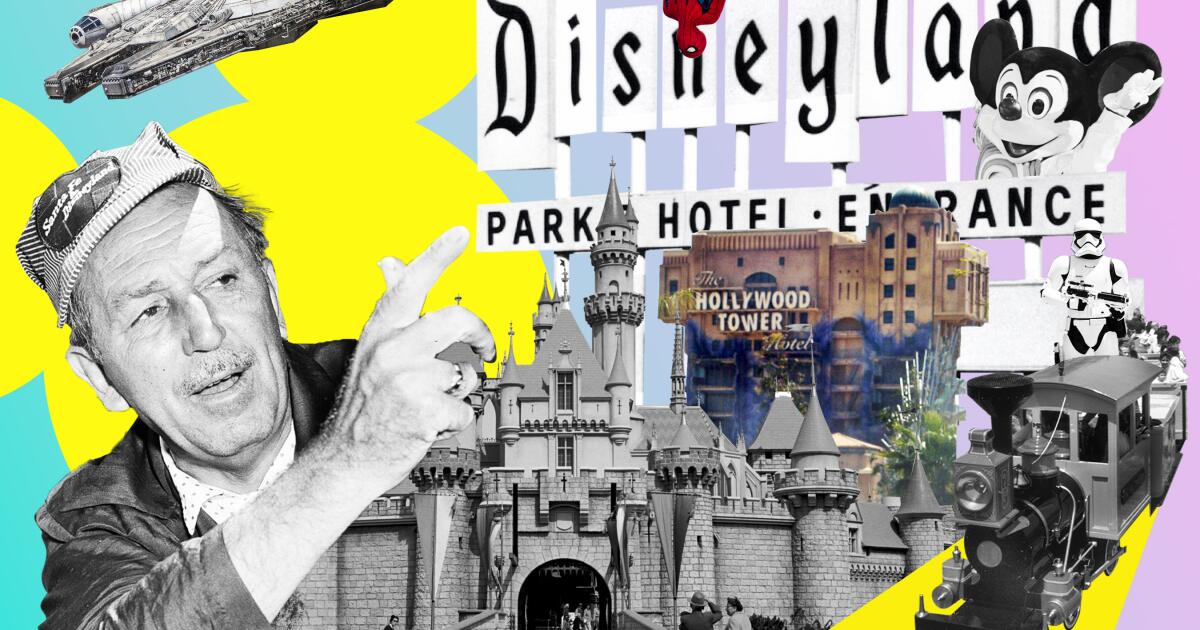
It’s all about a California (and high-growth) state of mind.
A park photographer, Kristin Wagner, photographs visitors as they enter Disney’s California Adventure, just below a recreation of the Golden Gate Bridge.
(Don Kelsen/Los Angeles Times)
In a period of grand expansion, Disneyland would start to become a proper resort — a metamorphosis that, while it didn’t work immediately, would be course-corrected and set up Disneyland for a new generation of growth. This era added Disney California Adventure, turning the destination into one that the Walt Disney Co. hoped would command multiday stays.
What was new
A former parking lot across from Disneyland was remade into Disney California Adventure, which would open in February 2001. The long in-development project was designed to honor California culture, but was pitched initially as a West Coast answer to Walt Disney World’s Epcot. The Times was kind in its opening coverage, praising the park’s change of pace from Disneyland and admiring how its architecture blurred fiction and reality.
The hang-gliding simulation Soarin’ Over California was an instant hit, and “Eureka! A California Parade” was Disney theatricality at its weirdest, with floats that depicted Old Town San Diego, Watts and more. But California Adventure’s prevalence of amusement park-like rides failed to command the crowds of its next door neighbor. Disney’s own documentary “The Imagineering Story” took a tough-love approach to the park’s early days, comparing some of its initial designs to those of a local mall. In time, however — with multiple makeovers and additions — California Adventure would become a beloved, world-class theme park, though it would stray from its initial California-centric conceit.
During this era, Disneyland also added the Grand Californian Hotel and its Downtown Disney District. A luxurious take on California’s Arts and Crafts movement, the Grand Californian remains the resort’s signature hotel and home to its finest dining establishment, Napa Rose, under renovations at the time of writing. Disney would also add a second haunted attraction with the Twilight Zone Tower of Terror in 2004. Over at Disneyland, Tomorrowland in 1998 would receive a transformation, one it has yet to fully recover from. The beloved People Mover would be no more, a Jules Verne-inspired art style would come and gradually go, and Buzz Lightyear Astro Blasters would arrive in 2005.
The Many Adventures of Winnie the Pooh would in 2003 evict the Country Bears from their music hall.
Did you know?
This era is home to two of Disneyland’s shortest-lived major attractions. Superstar Limo at California Adventure was conceived as a ride in which paparazzi would chase celebs, a concept deemed in poor taste in the wake of the death of Princess Diana. It was refashioned as a sort of tour of Hollywood with heavily caricatured figurines of the likes of Whoopi Goldberg, Regis Philbin, Drew Carey, Cher and more, but would close within a year. At Disneyland, People Mover‘s replacement Rocket Rods could never consistently operate, and the ride would last just about two years. The tracks remain.


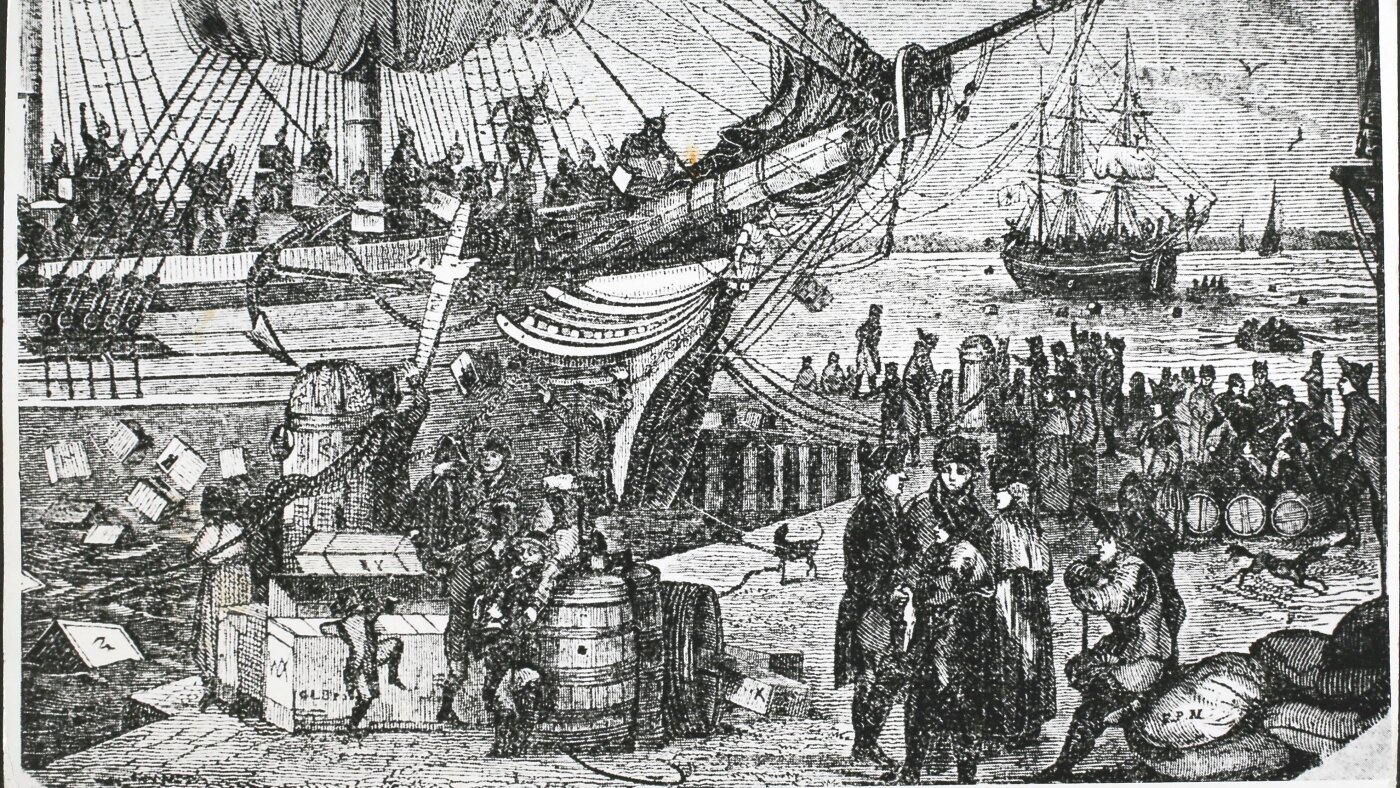
An illustration of the Boston Tea Party, when colonists dumped British East India Company tea into the harbor on Dec. 16, 1773. Some accounts say this marked a pivotal moment when Americans started loving coffee. But one historian says Americans were drinking lots of coffee before then.
Hulton Archive/Getty Images
hide caption
toggle caption
Hulton Archive/Getty Images
A consequential act of defiance secured tea’s place as perhaps the most iconic beverage of America’s colonial era.
The Boston Tea Party became an essential ingredient in the recipe for revolution in the following years.
But tea wasn’t the only hot beverage with a prominent role in America’s fight for independence.
Coffee was an important part of American culture from the start. And coffeehouses were essential, too — serving as hubs for brewing ideas of independence.
As the United States celebrates 250 years, here’s what to know about America’s early history of coffee.

Colonists were drinking coffee long before the United States existed
Europeans brought coffee with them when they came to America.
“The first documented example of a mortar and pestle used to grind coffee beans was on the Mayflower” in 1620, says historian Michelle Craig McDonald, the author of Coffee Nation: How One Commodity Transformed the Early United States.
“The fact that coffee was present so early is not surprising if you think about it,” McDonald says. “A number of those who were on the Mayflower came to North America from Amsterdam, which was a major coffee trading center in Western Europe by the 17th century.”

The first coffeehouse in the colonies opened in 1676 in Boston, a century before the U.S. declared independence, she says. Some taverns sold coffee even earlier.
The Boston Tea Party probably wasn’t the dramatic turning point toward coffee that some claim
On the night of Dec. 16, 1773, disgruntled colonists boarded three ships moored in Boston Harbor and threw overboard more than 92,000 pounds of tea owned by the British East India Company.
Tensions had been building between the Crown and the colonies over the previous decade, as Britain tried to levy taxes on its colonies to recoup war debts.
The Boston Tea Party protest was targeted at the British government’s passing of the Tea Act in 1773, which granted the East India Company a monopoly over tea sales in the colonies. While the British had removed some unpopular taxes in the preceding years, they left tea taxes in place. Colonial merchants were especially upset that the act allowed the East India Company to undercut their tea business.
To build solidarity for their cause of sovereignty, some patriots called on colonialists to swear off tea in favor of coffee. It’s why many histories point to the Boston Tea Party as a turning point when Americans switched from mostly drinking tea to mostly coffee. The anti-tea sentiment was immortalized in a founding father’s now-famous letter.
In July 1774, John Adams (before he became the second U.S. president) wrote to his wife Abigail, recounting an incident during his travels. After a long day, he asked the proprietor of the house where he was lodging for a cup of tea, provided it was smuggled and free of British taxes.
” ‘No sir, said she, we have renounced all Tea in this Place. I cant make Tea, but I’le make you Coffee.’ Accordingly I have drank Coffee every Afternoon since, and have borne it very well. Tea must be universally renounced. I must be weaned, and the sooner, the better,” Adams wrote.
Despite John Adams claiming a newfound patriotic duty to appreciate coffee, McDonald says colonists had been drinking lots of coffee all along.
She studied advertisements from the 1760s and ’70s to estimate how many shops sold coffee versus tea. Even before the Boston Tea Party, she says, “coffee is definitely more broadly available than tea is.”
A big reason? It was cheaper. “Its price again per pound is significantly less, which tells you about its availability, its accessibility to drinkers.”
Historians say it’s hard to definitively compare tea with coffee consumption, though, as official records from before America gained independence were inconsistent.
And smuggling was rampant, making official records even less reliable.
“There is a vast amount of smuggling,” says Joyce Chaplin, a professor of early American history at Harvard University. “So they’re not paying formal duties on tea that they get from the Dutch. They’re probably not paying formal duties on coffee from the French Caribbean.”
And Chaplin notes that people who loudly proclaimed a new appreciation for coffee over tea weren’t always doing what they said. It could have been political pandering. “I do not drink tea that comes via the East India Company,” she posits someone of the era saying. “But, you know, other sources are fine. Ditto for the coffee.”
Coffeehouses were a hub for revolutionary ideas
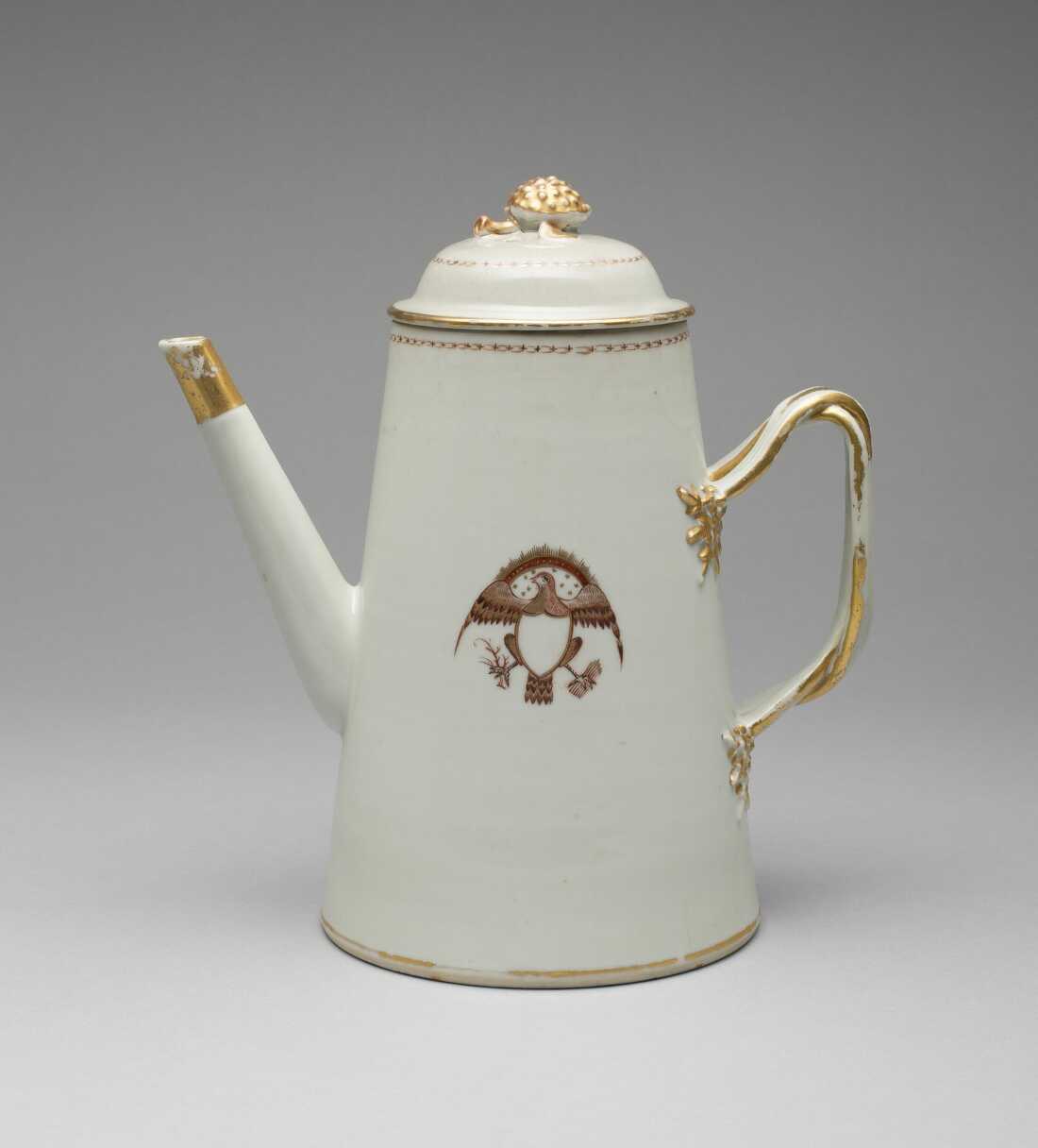
A coffeepot with cover, circa 1795. It has an American eagle motif, made in China for the American market. Coffee was part of a growing trend of globalization in the colonial era.
Heritage Art/Heritage Images via Getty Images
hide caption
toggle caption
Heritage Art/Heritage Images via Getty Images
In the colonial era, coffeehouses were hotbeds for seditious thought — where people planned acts of revolution.
“Coffeehouses are kind of famous for being places where people think and plot things,” says Mark Pendergrast, author of Uncommon Grounds: The History of Coffee and How It Transformed Our World.
A coffeehouse called the Green Dragon served as one of the locations for planning the Boston Tea Party. Years earlier, the Old London Coffeehouse in Philadelphia was a meeting place for strategizing responses to another British tax, the Stamp Act of 1765.
In Britain, coffeehouses were nicknamed “penny universities,” Pendergrast says: “because for a penny you could go and learn a whole lot by sitting around in a coffeehouse and discussing everything.” The same attitude traveled across the Atlantic.
Early American coffeehouses would commonly have city business directories, libraries of newspapers and currency exchange information. People could get maritime insurance there or buy things at auction.

“There’s a reason why coffeehouses become places of colonial protest … in the 1760s, in the 1770s, and it’s because it is the place where traders and merchants tended to gather,” historian McDonald says. “That’s where they heard about the economics of the day.”
Taverns were more likely than coffeehouses to have rooms for rent and stables for travelers’ horses. They were also more likely to have food.
Interestingly enough, coffeehouses could serve alcohol and taverns could serve coffee.
But the vibes at each were different. While women and men could “riotously drink together” in taverns, coffeehouses often didn’t allow women, according to Chaplin of Harvard.
“The sense was the coffeehouse was the place where you had a clear head — to argue about politics, to find out what was going on in the business world, to cut a business deal,” she says. “Whereas taverns were places where, in a sense, you refueled.”
Still, she says, the lines between the two “weren’t completely clear.”
The cost of America’s revolutionary drink
Coffee (and tea for that matter) was part of a growing globalization of trade around this time.
Much of the coffee in the colonies was grown in the Caribbean, while tea came from China.

Supply was up and coffee was easier than ever to drink. “Trade and frankly, imperialism, are making it possible for … colonial products to be produced and transferred to other parts of the world in greater and greater quantities,” says Chaplin.
As a result, by the time of the American Revolution, both coffee and tea were in reach for many common people. “They’re both becoming affordable luxuries,” Chaplin says.
Fancy coffee and tea paraphernalia were also part of this increasingly global market. Middle and upper-class people would have wanted special implements for drinking these beverages and a place to drink it. That meant they needed wood for coffee tables, silver for coffeepots, and porcelain for teapots.
“These two beverages are encouraging people to consume all kinds of new stuff,” says Chaplin. “The mahogany that comes out of the Caribbean, the china coming out of China, silver that is mined principally in South and Central America and processed in a lot of the parts of the world.”
There’s a dark side to coffee’s history, too. The plantations that supplied the crop ran on the labor of enslaved people. By 1790, half of the world’s coffee was being grown in the French colony of Saint-Domingue, in what is today Haiti, Pendergrast says, where slaves were routinely mistreated, raped and murdered.

The Declaration of Independence, signed in 1776, is infamous for a contradiction. It proclaimed that “all men are created equal,” but failed to acknowledge the hundreds of thousands of enslaved people living in America at the time.
Coffee carried a similar contradiction. The beverage that fueled conversations that inspired America’s fight for independence — centered on the ideals of life, liberty and the pursuit of happiness — depended on enslavement.
“Coffee had this paradoxical effect, that it did promote revolutionary thought,” Pendergrast says. “But it was also grown by slaves.”
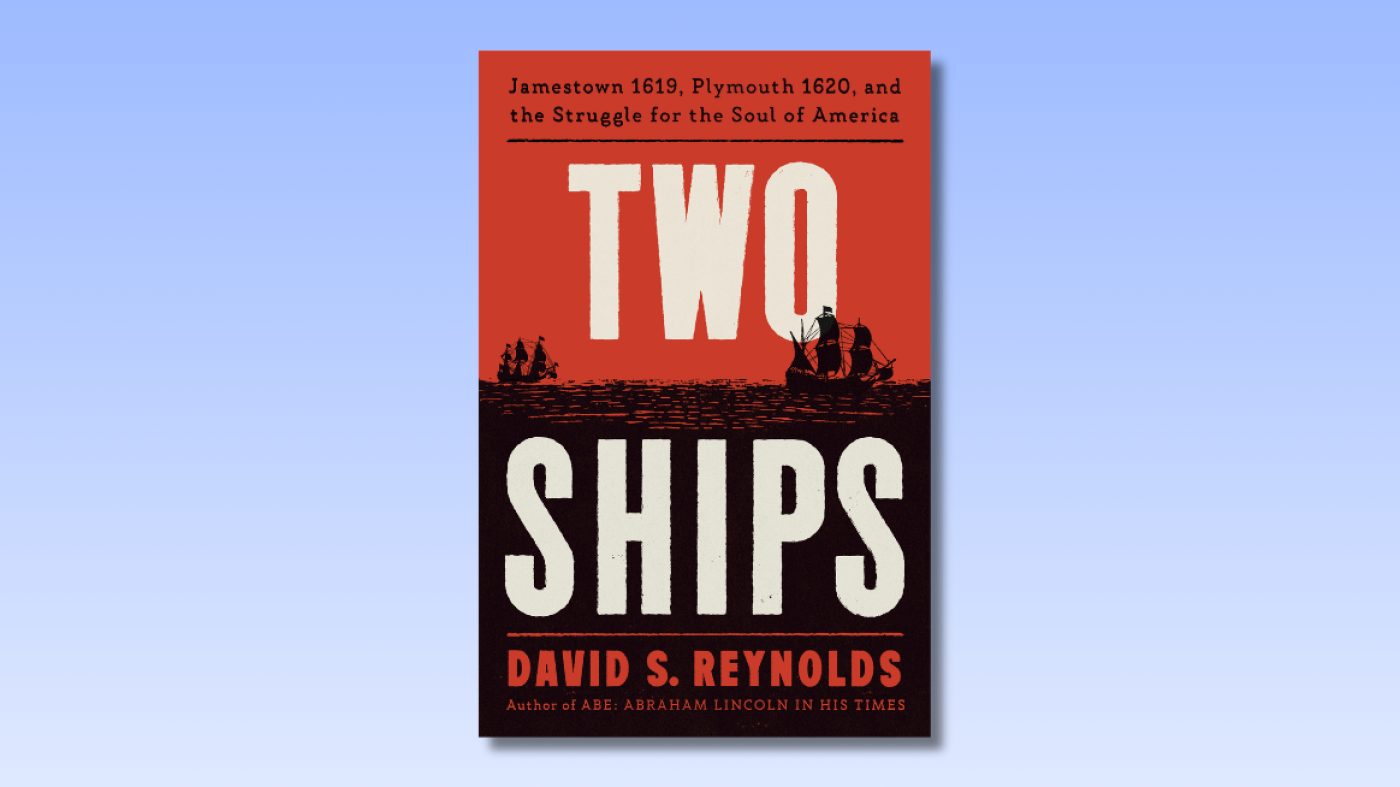
Just in time for a contentious 250th anniversary of the United States of America, historian David S. Reynolds’ latest book, Two Ships, helps us realize that any country that couldn’t agree on its own origin story is destined for divisive times.
Two Ships is about the complicated, conjoined legacy of the landings of the Mayflower, which carried the Pilgrims to Plymouth, Mass., in 1620, and the White Lion, which arrived in Jamestown a year earlier, bringing the first enslaved Africans to Virginia.
As Reynolds demonstrates, it’s not so much the facts of these two voyages, as it is the meanings ascribed to them, that made them such a powerful metaphor for two conflicting visions of American identity.
To simplify, the Mayflower’s passengers were separatist Puritans, dissenters to the reign of the English king, James I. As the United States developed, the Mayflower was credited with carrying the seeds of a radical democracy to the New World, one in which all men (in theory, at least) were equal before God.
In contrast, the European settlers of Jamestown were Royalists, also known as Cavaliers. Loyal to the monarchy, they believed in a strict hierarchy.
But the meaning of the images of the two ships shifted depended on who was invoking them and when. Not surprisingly, the metaphor was deployed most vigorously during the Civil War. In abolitionist speeches and writings, the White Lion or the “Slave-Ship,” as it was commonly called, was condemned for infecting America with the “plague-spot” of slavery.
Reynolds says that Frederick Douglass resorted to the “two ships” metaphor frequently, while Lincoln avoided it, hoping to preserve a unified ship of state. Meanwhile, Southern descendants of Cavaliers invoked the Mayflower to emphasize the intolerance and “cruel, persecuting” character of the Puritans. In a comment that resonates for our own times, Reynolds says:
It didn’t matter to the South that … by the mid-nineteenth century, the North had become a kaleidoscope of religious denominations, …, few of which resembled the faith of the Plymouth colonists. Distortion is intrinsic to cultural memory, especially when amplified by sectional or political bias. For Southerners, the Mayflower had brought Puritanism, which had yielded fanatical movements like abolitionism, now a dire threat to the Union.
In a brief-but-fascinating digression into the unpredictable power of literary fiction, Reynolds observes that the South’s fondness for Nathaniel Hawthorne’s anti-Puritan novel, The Scarlet Letter, and, even more, for the medieval historical romances of Sir Walter Scott, bolstered its nostalgia for a largely-imagined feudal society.

Reynolds quotes the always-quotable Mark Twain, no fan of Scott’s, as saying that Scott “did measureless harm; more real and lasting harm, perhaps, than any other individual that ever wrote …”
Two Ships is a dazzling survey of some three centuries of American history through a close reading of a metaphor. By the 1890s, Reynolds says, the interpretive tide had turned again: “Southern and Northern whites, feeling threatened by people of color and by an array of European immigrants, were retreating to a cocoon of racial solidarity that Mayflower celebrations helped reinforce.”
By the later-20th century, the image of the Mayflower was depoliticized and commercialized into Pilgrim hats and Black Friday sales. The powerful metaphor of the two ships receded into the mist.
Seven years ago, however, the 1619 Project piloted the White Lion — “The Slave-Ship” — back into view and anchored it at the center of debates about slavery’s place in the national story. The 1619 Project has been faulted for its historiography, and it does lie outside of the chronological boundaries of Reynolds’ book; still, it seems too momentous a reappearance of the White Lion not to at least acknowledge in this book.
That criticism noted, I think reading Two Ships would be an excellent way to observe this particular Fourth of July. It’s wise for all of us to have a more informed awareness of how Americans have understood, misunderstood and, often, flattened each other into stereotypes. Or, as Ernest Hemingway, one of the Mayflower Pilgrims’ more cynical descendants, might say in response to that sentiment: “Isn’t it pretty to think so?”



I took a kid’s camera to Paris Fashion Week, because was it ever really that serious? Yes and no. This men’s season happened during one of the hottest weeks in France’s recorded history, which inspired that specific brand of collective hysteria brought on by living through yet another unprecedented moment together — taking over our brains and ruining our plans to wear boots — and a grander reflection on what we were doing there and why. The throngs of teenagers doing back flips into the Canal Saint-Martin and playing soccer in the street set the mood for the week. If the world is ending, you might as well swim in dirty water and have fun doing it, no?
As far as the shows went, there was the coastal stoner energy of Tokyo-based Auralee — brightly colored leathers and furry flip-flops — that reminded me of the low-key elegance of hanging out in Southern California. At the Rick Owens show, Rick-heads made minimal weather-restrictive tweaks to their usual uniforms — platforms, leather, ground-grazing garments — making you appreciate the beauty in that level of ascetic dedication. Louis Vuitton built a literal beach as its runway, complete with sand and a giant wave that felt like a mirage: Is this a heat-induced hallucination or yet another buzzed-about set design under men’s creative director Pharrell Williams? At the Dries Van Noten show, there was an ice-cold beer fridge and popsicles, a chic and inspired detail only rivaled by a collection that was a breath of fresh air during a week where I Googled the symptoms of heat stroke more than once. The Willy Chavarria show was air-conditioned, pumped with Xinú perfume and felt expensive. Sven Marquardt, a Berlin photographer and Berghain’s most famous bouncer, was sitting in front of me, which I took as an incredibly good omen. The painted blue feet and Oakley collab sunglasses at the Kiko Kostadinov show felt auspicious as well.

A look from the Auralee show.
There were conversations floating around about how apocalyptic it felt sitting at a fashion show in over 100-degree Fahrenheit weather, our backs soaked, our minds dizzied, when the industry is responsible for something like 10% of global greenhouse gas emissions. The cognitive dissonance contributed to the thickness in the air that week.
At the Comme des Garçons show, called “If the War Were to End..,” models danced and ran and skipped out onto the runway for the finale, soundtracked by the joyous sound of children singing “You’re So Good to Me” by the Langley Schools Music Project. In that moment, we were happy, we were clapping, we might have even been hopeful. Humans have the capacity to hold a lot — a fan in one hand while attempting not to completely melt in the front row, and a fantasy that there might still be a future where we get to wear those leopard-print Dries shoes we fell in love with on the runway.

The moments before the Comme des Garçons show.

Comme des Garçons show attendees.

Comme des Garçons, head-to-toe.

The Comme des Garçons show.

The Dries Van Noten show.

A chic and inspired detail at the Dries Van Noten show: ice-cold beer.


Scenes from the ERL presentation.


The Kiko Kostadinov show.


Tapping in from Louis Vuitton beach.

Quavo at the Louis Vuitton show.

Scenes from after the Louis Vuitton show.

Scenes from the Louis Vuitton show.

Scenes from the Nahmias x Puma dinner at Gigi Paris.

Scenes from the On X Online Ceramics rave.


At Silencio to see Venezuelan DJ and producer Safety Trance.

The Willy Chavarria show.

Scenes from Willy Chavarria.

The throngs of teenagers doing back flips into the Canal Saint-Martin and playing soccer in the street set the mood for the week.
-

 Atlanta, GA2 minutes ago
Atlanta United 2 Earns 1-0 Win Against Toronto FC II | Atlanta United 2
-

 Minneapolis, MN5 minutes ago
Teen in critical condition after being pulled from Minnehaha Falls
-

 Indianapolis, IN10 minutes ago
Peace on the Plaza: Community building through basketball
-

 Pittsburg, PA17 minutes ago
Pittsburgh's Paul Skenes Named To National League All-Star Team
-

 Augusta, GA19 minutes ago
BREAKING: Parents of missing 4-year-old arrested, child believed to be deceased
-

 Washington, D.C24 minutes ago
US at 250: How celebrations unfolded in Washington DC
-

 Cleveland, OH32 minutes ago
Cleveland marks America’s 250th birthday with lakefront fireworks show
-

 Austin, TX34 minutes ago
Iranian-Americans rally at Texas Capitol for “Free Iran” on Fourth of July

