Lifestyle
Want to engage your dreams? Start with mugwort and a full bladder

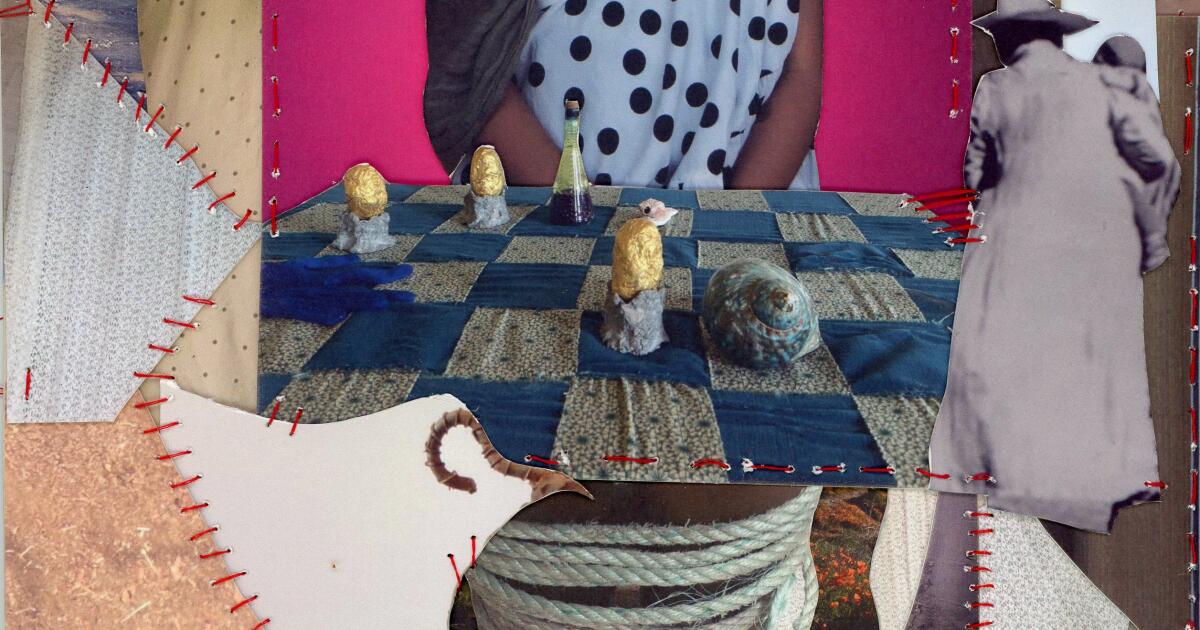
“Visitation,” 2024, photo-collage and thread
(dama / For The Times)
This story is part of Image’s April issue, “Reverie” — an invitation to lean into the spaces of dreams and fantasy. Enjoy the journey.
The first Visitation occurs in a dream on the wings of an aircraft transporting me and my mother to San Antonio, because my sister has died. My sister materializes through golden-hued cumulus clouds, beckons with her hand for me to come to her, and so I do. In my palms, she drops an orb of pure golden light before retreating back into cloud.
Visitations, in addition to meaning a gathering of friends and family for the recently deceased, can also be defined as a visit from the deceased. In my Dreaming Life, my sister returns, randomly yet always intensely, to travel here to me within my perceptible life, to tell me things. It is not always so clear what it is that she has traveled so far to tell me.
Instead of holding a visitation, my family chooses to offer two funeral services. A whole grocery store cannot be shut down, so we opt to hold the service over two nights, to allow my deceased sister’s coworkers to come by between their shifts.
Every person — customers, old school friends, neighbors, children of exes — holds on to me to say how my sister had been their angel and inspiration and life’s guiding light. My sister, who died at age 48 of breast cancer, had become an angel through the workings of Death, but she had — as reaffirmed again and again through the tears and sorrows of the receiving line — also been an angel in her Waking Life.
Visitations occur because those who mourn occupy an unreal space; loss transcends reality or else collapses that once-stable sense of self, space and time.
Visitations occur because those who mourn occupy an unreal space; loss transcends reality or else collapses that once-stable sense of self, space and time. As any of us who have lost know, such deep losses fracture the self. Loss upends our notions of space: The space is now dominated by an insurmountable absence. This absence distorts time or those edges of days or weeks or months that were once so clearly demarcated.
In mourning and grief, it is this very haze of the fracturing of self, space and time that can find, in the practice of Visitation, some temporary bearings within a world upended. To see the familiar faces, to hear the old story, to think about the old song — such remembrances tether us, however frayed and fragile the gossamer of grief, to a world transformed. The world is now distorted: it is a world where someone’s gone missing.
In the world now absent my sister, I cling to each and every Visitation from her as she comes in dreams. I have always had a peculiar interest in the Dreaming Life, and after my sister died, I found that if I wanted to continue some form of communication with her, I would have to be the astronomer and detailed data collector in the observatory of sleep. Only I could keep the lookout; only I could transcribe the fates.
So I began to entangle my Waking Life within the Dreaming Life.
Everyone suddenly, it seems, wants to lucid dream. I say: First dream, but dream actively. Here are some practices I take to ensure an engagement in my Dream Life:
- Keep a notebook bedside. Reach for this notebook first thing upon waking, whatever the hour. Even if you can’t recall any dreams, this practice, which can be difficult to establish, will develop into a habit. If you cannot recall the dream fully formed, then record dreamlets — the fragments of dreams.
- Drink water. The body, of course, is optimal when hydrated, but falling asleep with a full bladder will help you to wake in the middle of the night with a glimmer of a dream. Be sure to discipline yourself to write your dreamlets down before you go to the bathroom and forget. Keep a notebook by the toilet to help you remember.
- Rest your mind before sleep. Tell yourself that you are going to dream and that you will remember your dreams and that you will write them down. It’s OK if you’re stressing or thinking troubled thoughts before bed. Think what you will, but always firmly believe that you will dream. I recommend reading before bed, as it is an activity that stimulates the mind, imagination, openness to surprise, close attention and interpretation: These are the stuffs of reading your own dreams.
- Sleep in. We have more opportunities to dream when we are able to sleep in. Give yourself the gift of this at least once a week.
- Try mugwort in your bedtime tea. After a few weeks of active dreaming, try mugwort tea on the nights when you can sleep and dream more freely. Mugwort is an herb that is easily foraged and induces more vivid dreams. A teaspoon will suffice.
- Ask yourself what is troubling you. Can you reframe this worry through what your dreams have been showing you?
By paying attention to your dreams and collecting your dreamlets, you will begin to see a way out. You can face the situation, in however a veiled or coded way, in your dreams. You can practice your way out or through or in.
In a dream, I was once an unexpected visitor. I came upon a corridor, white and filled with light, through which my sister glided. I ran after her, but I was stopped by an attendant, in white, who told me that I couldn’t go through the doors but that my sister was there, on the other side, making it beautiful for me.
And so who’s to say that in this life, we are not merely visiting? If the dreams of unborn babes are the dreams of practicing at living, for what then is this Waking Life preparing us?
In one dream, my sister wants to go to Brazil. We’re on a highway in San Antonio. We’re going fast around all the cloverleafs and overpasses. We take curves dangerously fast. I tell her that I’m happy to go with her, but does she know the way? Yes, she replies. She says she goes all the time. She knows the way. In the dream, we never get there, but we’re so happy to be free, to just do it, to go wherever, whenever with a sister.
In dreaming, it’s not so easy as paying attention to merely one dream. One dream taken out of your map of dreaming is merely a piece, a clue, a hint toward a totality. One dream is one spot of paint viewed up close on an otherwise vast masterpiece — you won’t know what it is you’re seeing until you’ve amassed enough, connected the dots, done the good work of a detective.
I am a writer who gains through fragments, rarely composing a full essay in one go. I prefer instead to accumulate the bits and pieces, stitch them up, allow happenstance and discovery to arrange the pieces, determine the binding. I like to begin in chaos and have that chaos propel its own focus or refractured brilliance.
My Dreaming Life is no different: I see dreams as fragments of a greater masterpiece. So I jot down my dreams.
My Dreaming Life is no different: I see dreams as fragments of a greater masterpiece. So I jot down my dreams. These dreamlets, these glimmers of a seemingly real and lived experience, eventually pull toward their narratives, eventually show me my struggles and push me on toward a way out in such a way that I can solve the problem in the Dream World while simultaneously tackling a very real-world problem. The two are not inseparable.
I collect the glimmers and connect the dots. My sleuth side sees dreams as not a mere escape from the logic or hardships or realities of the day but rather a world in the making. The dreams enable me to prepare for the next life as it navigates me, night after night, from one realm to the next and back again.
My sister and I entered the scary exhibit at a wax museum on one of the outings we last took together. She was afraid of what might appear. I held her hand and led the way. I knew it would be one of the last times I would hold her hand. My sister, who had always gone first in my fear of dark hallways, was now being led by my hand.
Except, in Waking Life, that is in reality, my sister is the one who goes first into the fear of the dark, into the dream of Death, of which I have always held a tight fear.
If I am to see what there is to see in the ongoing series of Visitation dreams from my deceased sister, then I would have to conclude that she is truly there, on the other side, making it beautiful for me.
Jenny Boully is a Guggenheim Fellow whose books, including “Betwixt-and-Between,” employ dreams alongside real-life entanglements. She has two books forthcoming from Graywolf Press. In addition to teaching at Bennington College, she offers private dream writing guidance.



new video loaded: Prada Peels Back the Layers at Milan Fashion Week
By Chevaz Clarke and Daniel Fetherston
February 27, 2026

Bill Cosby
Rape Accuser Says Cosby Won’t Take Stand At Trial
Published
Bill Cosby‘s rape accuser Donna Motsinger says the TV star can’t be bothered to show up to court for a trial in a lawsuit she filed against him.
According to new legal docs, obtained by TMZ. Motsinger says Bill will not testify in court … she claims it’s “because he does not care to appear.”

Motsinger says Bill won’t show his face at the trial either … and the only time the jury will hear from him will be a previously taped deposition.
As we previously reported, Motsinger claims Bill drugged and raped her in 1972. In the case, Bill admitted during a deposition that he obtained a recreational prescription for Quaaludes that he secured from a gynecologist at a poker game.
TMZ.com
Bill also said he planned to use the pills to give to women in the hopes of having sex with them.
Motsinger alleged Bill gave her a pill that she thought was aspirin. She claimed she felt off after taking it and said she woke up the next day in her bed with only her underwear on.
Here, it sounds like Motsinger wants to play the deposition for the jury.
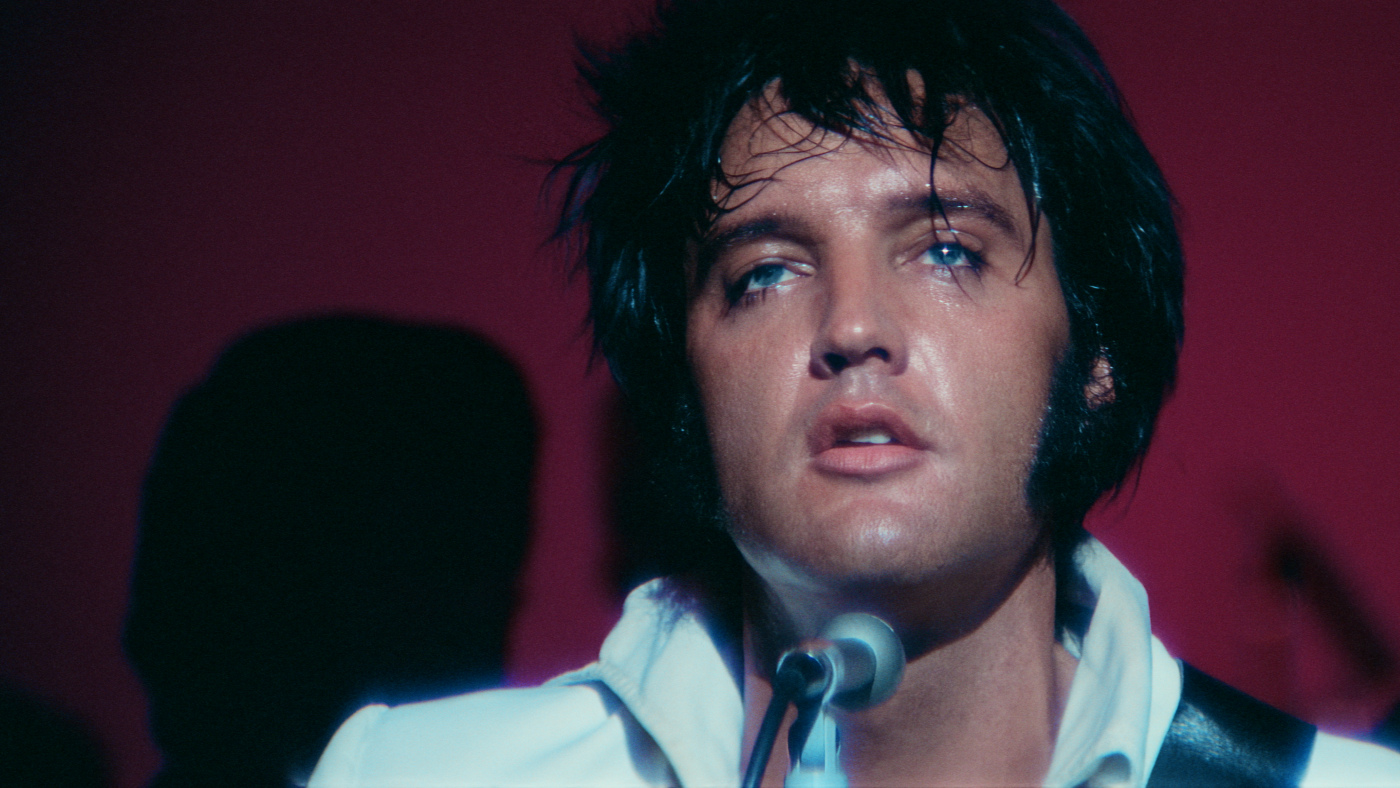
Elvis Presley in Las Vegas in Aug. 1970.
NEON
hide caption
toggle caption
NEON
“You are my favorite customer,” Baz Luhrmann tells me on a recent Zoom call from the sunny Chateau Marmont in Hollywood. The director is on a worldwide blitz to promote his new film, EPiC: Elvis Presley in Concert — which opens wide this week — and he says this, not to flatter me, but because I’ve just called his film a miracle.
See, I’ve never cared a lick about Elvis Presley, who would have turned 91 in January, had he not died in 1977 at the age of 42. Never had an inkling to listen to his music, never seen any of his films, never been interested in researching his life or work. For this millennial, Presley was a fossilized, mummified relic from prehistory — like a woolly mammoth stuck in the La Brea Tar Pits — and I was mostly indifferent about seeing 1970s concert footage when I sat down for an early IMAX screening of EPiC.
By the end of its rollicking, exhilarating 90 minutes, I turned to my wife and said, “I think I’m in love with Elvis Presley.”
“I’m not trying to sell Elvis,” Luhrmann clarifies. “But I do think that the most gratifying thing is when someone like you has the experience you’ve had.”
Elvis made much more of an imprint on a young Luhrmann; he watched the King’s movies while growing up in New South Wales, Australia in the 1960s, and he stepped to 1972’s “Burning Love” as a young ballroom dancer. But then, like so many others, he left Elvis behind. As a teenager, “I was more Bowie and, you know, new wave and Elton and all those kinds of musical icons,” he says. “I became a big opera buff.”
Luhrmann only returned to the King when he decided to make a movie that would take a sweeping look at America in the 1950s, ’60s, and ’70s — which became his 2022 dramatized feature, Elvis, starring Austin Butler. That film, told in the bedazzled, kaleidoscopic style that Luhrmann is famous for, cast Presley as a tragic figure; it was framed and narrated by Presley’s notorious manager, Colonel Tom Parker, portrayed by a conniving and heavily made-up Tom Hanks. The dark clouds of business exploitation, the perils of fame, and an early demise hang over the singer’s heady rise and fall.
It was a divisive movie. Some praised Butler’s transformative performance and the director’s ravishing style; others experienced it as a nauseating 2.5-hour trailer. Reviewing it for Fresh Air, Justin Chang said that “Luhrmann’s flair for spectacle tends to overwhelm his basic story sense,” and found the framing device around Col. Parker (and Hanks’ “uncharacteristically grating” acting) to be a fatal flaw.
Personally, I thought it was the greatest thing Luhrmann had ever made, a perfect match between subject and filmmaker. It reminded me of Oliver Stone’s breathless, Shakespearean tragedy about Richard Nixon (1995’s Nixon), itself an underrated masterpiece. Yet somehow, even for me, it failed to light a fire of interest in Presley himself — and by design, I now realize after seeing EPiC, it omitted at least one major aspect of Elvis’ appeal: the man was charmingly, endearingly funny.
As seen in Luhrmann’s new documentary, on stage, in the midst of a serious song, Elvis will pull a face, or ad lib a line about his suit being too tight to get on his knees, or sing for a while with a bra (which has been flung from the audience) draped over his head. He’s constantly laughing and ribbing and keeping his musicians, and himself, entertained. If Elvis was a tragedy, EPiC is a romantic comedy — and Presley’s seduction of us, the audience, is utterly irresistible.
Unearthing old concert footage
It was in the process of making Elvis that Luhrmann discovered dozens of long-rumored concert footage tapes in a Kansas salt mine, where Warner Bros. stores some of their film archives. Working with Peter Jackson’s team at the post-production facility Park Road Post, who did the miraculous restoration of Beatles rehearsal footage for Jackson’s 2021 Disney+ series, Get Back, they burnished 50-plus hours of 55-year-old celluloid into an eye-popping sheen with enough visual fidelity to fill an IMAX screen. In doing so, they resurrected a woolly mammoth. The film — which is a creative amalgamation of takes from rehearsals and concerts that span from 1970 to 1972 — places the viewer so close to the action that we can viscerally feel the thumping of the bass and almost sense that we’ll get flecked with the sweat dripping off Presley’s face.
This footage was originally shot for the 1970 concert film Elvis: That’s The Way It Is, and its 1972 sequel, Elvis on Tour, which explains why these concerts were shot like a Hollywood feature: wide shots on anamorphic 35mm and with giant, ultra-bright Klieg lights — which, Luhrmann explains, “are really disturbing. So [Elvis] was very apologetic to the audience, because the audience felt a bit more self conscious than they would have been at a normal show. They were actually making a movie, they weren’t just shooting a concert.”
Luhrmann chose to leave in many shots where camera operators can be seen running around with their 16mm cameras for close-ups, “like they’re in the Vietnam War trying to get the best angles,” because we live in an era where we’re used to seeing cameras everywhere and Luhrmann felt none of the original directors’ concern about breaking the illusion. Those extreme close-ups, which were achieved by operators doing math and manually pulling focus, allow us to see even the pores on Presley’s skin — now projected onto a screen the size of two buildings.
The sweat that comes out of those pores is practically a character in the film. Luhrmann marvels at how much Presley gave in every single rehearsal and every single concert performance. Beyond the fact that “he must have superhuman strength,” Luhrmann says, “He becomes the music. He doesn’t mark stuff. He just becomes the music, and then no one knows what he’s going to do. The band do not know what he’s going to do, so they have to keep their eyes on him all the time. They don’t know how many rounds he’s going to do in ‘Suspicious Minds.’ You know, he conducts them with his entire being — and that’s what makes him unique.”

Elvis Presley in Las Vegas in Aug. 1970.
NEON
hide caption
toggle caption
NEON
It’s not the only thing. The revivified concerts in EPiC are a potent argument that Elvis wasn’t just a superior live performer to the Beatles (who supplanted him as the kings of pop culture in the 1960s), but possibly the greatest live performer of all time. His sensual, magmatic charisma on stage, the way he conducts the large band and choir, the control he has over that godlike gospel voice, and the sorcerer’s power he has to hold an entire audience in the palm of his hands (and often to kiss many of its women on the lips) all come across with stunning, electrifying urgency.
Shaking off the rust and building a “dreamscape”
The fact that, on top of it all, he is effortlessly funny and goofy is, in Luhrmann’s mind, essential to the magic of Elvis. While researching for Elvis, he came to appreciate how insecure Presley was as a kid — growing up as the only white boy in a poor Black neighborhood, and seeing his father thrown into jail for passing a bad check. “Inside, he felt very less-than,” says Luhrmann, “but he grows up into a physical Greek god. I mean, we’ve forgotten how beautiful he was. You see it in the movie; he is a beautiful looking human being. And then he moves. And he doesn’t learn dance steps — he just manifests that movement. And then he’s got the voice of Orpheus, and he can take a song like ‘Bridge Over Troubled Water’ and make it into a gospel power ballad.
“So he’s like a spiritual being. And I think he’s imposing. So the goofiness, the humor is about disarming people, making them get past the image — like he says — and see the man. That’s my own theory.”
Elvis has often been second-classed in the annals of American music because he didn’t write his own songs, but Luhrmann insists that interpretation is its own invaluable art form. “Orpheus interpreted the music as well,” the director says.
In this way — as in their shared maximalist, cape-and-rhinestones style — Luhrmann and Elvis are a match made in Graceland. Whether he’s remixing Shakespeare as a ’90s punk music video in Romeo + Juliet or adding hip-hop beats to The Great Gatsby, Luhrmann is an artist who loves to take what was vibrantly, shockingly new in another century and make it so again.

Elvis Presley in Las Vegas in Aug. 1970.
NEON
hide caption
toggle caption
NEON
Luhrmann says he likes to take classic work and “shake off the rust and go, Well, when it was written, it wasn’t classical. When it was created, it was pop, it was modern, it was in the moment. That’s what I try and do.”
To that end, he conceived EPiC as “an imagined concert,” liberally building sequences from various nights, sometimes inserting rehearsal takes into a stage performance (ecstatically so in the song “Polk Salad Annie”), and adding new musical layers to some of the songs. Working with his music producer, Jamieson Shaw, he backed the King’s vocals on “Oh Happy Day” with a new recording of a Black gospel choir in Nashville. “So that’s an imaginative leap,” says Luhrmann. “It’s kind of a dreamscape.”
On some tracks, like “Burning Love,” new string arrangements give the live performances extra verve and cinematic depth. Luhrmann and his music team also radically remixed multiple Elvis songs into a new number, “A Change of Reality,” which has the King repeatedly asking “Do you miss me?” over a buzzing bass line and a syncopated beat.
I didn’t miss Elvis before I saw EPiC — but after seeing the film twice now, I truly do.

Montana cowboys help build trauma ranch for Israeli soldiers

How to Watch No. 12 Nebraska Basketball at USC with Preview, Breakdown, TV Channel

Nye County Sheriff urges caution after deadly month on rural Nevada roads

Sen. Denise Ricciardi & Jeff Rogers: Stopping super speeders can save lives in New Hampshire

N.J. group demands review of Trenton immigration arrest operation at auto shop

Florida High School Football Rankings: Top 25 teams – Oct. 21

Cleary's 21 help Le Moyne down Central Connecticut State 69-64 in OT

How old is Bo Nix? What to know about Oregon quarterback ahead of 2024 NFL Draft

99th annual Pony Swim held in Virginia

Indiana Members Credit Union announced as new anchor tenant at Bottleworks District

ICE blasts Washington mayor over directive restricting immigration enforcement

Did the EU bypass Hungary’s veto on Ukraine’s €90 billion loan?

How the federal government is painting immigrants as criminals on social media

Where Iran’s ballistic missiles can reach — and how close they are to the US

Has India’s influence in Afghanistan grown under the Taliban?
-

 World2 days ago
Exclusive: DeepSeek withholds latest AI model from US chipmakers including Nvidia, sources say
-

 Massachusetts3 days ago
Mother and daughter injured in Taunton house explosion
-

 Montana1 week ago
2026 MHSA Montana Wrestling State Championship Brackets And Results – FloWrestling
-

 Louisiana5 days ago
Wildfire near Gum Swamp Road in Livingston Parish now under control; more than 200 acres burned
-

 Denver, CO2 days ago
10 acres charred, 5 injured in Thornton grass fire, evacuation orders lifted
-

 Technology7 days ago
YouTube TV billing scam emails are hitting inboxes
-

 Technology7 days ago
Stellantis is in a crisis of its own making
-

 Politics7 days ago
OpenAI didn’t contact police despite employees flagging mass shooter’s concerning chatbot interactions: REPORT