Lifestyle
Veteran news editor expects Trump 'to go after the press in every conceivable way'


Then-President Donald Trump holds up The Wall Street Journal as he speaks at the White House on April 19, 2020.
Tasos Katopodis/Getty Images
hide caption
toggle caption
Tasos Katopodis/Getty Images
Heading into a second term, New Yorker editor David Remnick says Donald Trump’s anger “has been never so intense as it’s been against the press.” The president-elect has referred to the news media as the “Enemy of the American people,” has threatened retribution against outlets that have covered him negatively and has suggested that that NBC, CBS and ABC should have their licenses revoked.
Marty Baron, the former executive editor of the Washington Post, says he expects the incoming administration “to go after the press in every conceivable way … [using] every tool in the toolbox — and there are a lot of tools.”
“I think [Trump’s] salivating for the opportunity to prosecute and imprison journalists for leaks of national security information — or what they would call national security information,” Baron says. “I would expect that he would deny funding to public radio … and TV. And that he will seek to exercise control over the Voice of America and its parent company, the U.S. Agency for Global Media, as he did in his previous administration, trying to turn it into a propaganda outlet.”

Remnick sees parallels between Trump’s approach to the media and that of Russian President Vladimir Putin. Both men, he says, challenge traditional notions of the truth. “The Putin regime shows us when there is no truth, everything is possible,” Remnick says. “Lying has come from White Houses for decades and decades. But Donald Trump has changed the game.”
Baron adds that Trump’s target goes beyond the press: “The objective here is to suppress free expression by anyone. … So this is just the first step. And I think people should keep that in mind.”
Interview highlights
On the Washington Post‘s announcement in the weeks before the 2024 election that it would not be endorsing either presidential candidate
Baron: I don’t think there’s any great explanation for this decision 11 days before the election [other] than that [Post owner Jeff Bezos] was yielding to pressure from Donald Trump on his other interests, which are substantially larger than The Post, particularly Amazon, which has many contracts with the federal government, particularly in terms of cloud computing, and Blue Origin, a commercial space enterprise that is essentially wholly dependent upon the federal government for its contracts. …

If this had been a decision that was made three years ago, two years ago, a year ago, maybe even six months ago, I would say fine. It’s not that important to me whether news organizations like The Post make a presidential endorsement. Of course, people can make up their own minds. They don’t need The Post to help them. But I don’t think there’s any logical explanation for this decision other than “Don’t poke the bear.” And I think this was an effort to not poke the bear. And I think it was notably unsuccessful, because nobody can reasonably argue that trust in the Washington Post today is higher than it was prior to this decision. It is substantially lower. I’ve never seen a reputation for a company so severely damaged in such a short period of time. And I think it was a regrettable and deeply wrong decision on [Bezo’s] part.
On the pressure media outlets are facing
Remnick: If you look at the waning influence of what’s called the mainstream press, and if you look at statistics about trust in the press and the ecology of the press, the combination of economic pressures combined with Trump’s pressures has been of immense concern to all of us who were involved in this activity. … These pressures are immense. And Trump knows it. And he knows how it’s affected his political fortunes in the most positive way.

Baron: When [Trump] talks about his triumphs during his first term, he’s cited the undermining confidence in the mainstream press — he’s called it one of his greatest successes. … It’s not the only reason the confidence in the press has declined. There are a variety of reasons. … But the big factors have been market fragmentation and the fact that people can find any site that affirms their preexisting point of view and any conspiracy theory, no matter how crazy it is, they can find somebody who says that’s true.
On the media’s responsibility in losing the trust of the people
Baron: I don’t think that we’ve accurately and adequately reflected the concerns of a lot of Americans in this country. I’ve often been asked whether we had failures in our coverage of Donald Trump in 2015 and 2016. And I say that the greatest failure came well before that in that we did not anticipate that this country could produce a candidate like Donald Trump. We did not understand the level of grievance and anger toward the so-called elites, including and maybe especially the press — although if you look at the salaries of most journalists, they don’t qualify as elite. And so I think we didn’t really do a good enough job of getting out in the country and really understanding the concerns of ordinary Americans. …
I’m concerned that a portion of the journalistic community, if you can call it that, have engaged in what I would consider to be advocacy and activism of a sort. That’s not true of everybody by any means, not even true of the majority of the journalists. But there’s a segment out there that believes in that. And I think that that has hurt us. And we should aim to be an independent arbiter of the facts, try to put them in context in an effort to get at the truth over time. And we should be more focused on the kinds of questions we want to ask and trying to get answers to those questions than thinking that we have the answers to those questions before we embark on reporting. Otherwise, the so-called reporting is merely an exercise in confirmation bias.
On how the collapse of local news contributed to polarized media
Remnick: There are all kinds of news deserts all over the country that have been created by this new news ecology, so that small newspapers and medium-sized newspapers have either shriveled to the point of disappearance or they’ve closed their doors completely. Newsrooms across the river here in New Jersey, for example, that used to have a couple hundred people in them have a couple dozen, at best. They’re hanging on by their fingernails. If that had been replaced by websites with equally aggressive, or even better, news gatherers, of reporters and editors, that would be one thing, but they haven’t.
Baron: Many people in communities, they’ve never even seen a reporter. They’ve never met a reporter. Their impressions of what journalists are is formed by arguments that they see on cable news, partisan arguments, what they see on cable news. And that is really unfortunate, because that is not the way that most journalists carry themselves.
On the American public not being able to agree on facts
Baron: The sad reality today is that we as a society do not share a common set of facts. But it’s actually a lot worse than that. We cannot even agree on what a fact is on how to determine a fact, because all of the elements that we have used in the past to determine what a fact is have been devalued, dismissed, denigrated, denied. All of that things like education, expertise, actual experience, and above all, evidence. …
So the idea here is to obliterate the idea that there is some truth, independent truth that can be determined by independent arbiters of truth, whether it be not just journalists, but the courts as well, or anybody else, and that the only truth, at least in Trump’s mind, is the one that comes out of his own mouth.
On what traditional media can learn from social media influencers
Baron: We have to be better communicators. We have to recognize that the way that people are receiving information today is radically different from the way that we received information when we were growing up and the way we maybe prefer to receive information today. So we have a lot to learn from influencers, actually, in terms of how to do that. Our authority is not just being questioned today, but our authenticity is being questioned today. And these influencers are coming across as much more authentic and therefore people think they’re more authoritative.
Monique Nazareth and Thea Chaloner produced and edited this interview for broadcast. Bridget Bentz, Molly Seavy-Nesper and Meghan Sullivan adapted it for the web.





Rob Reiner at the Cannes film festival in 2022.
Andreas Rentz/Getty Images
hide caption
toggle caption
Andreas Rentz/Getty Images
When Rob Reiner spoke with Fresh Air in September to promote Spinal Tap II: The End Continues, Terry Gross asked him about Being Charlie, a 2015 film he collaborated on with his son Nick Reiner. The film was a semiautobiographical story of addiction and homelessness, based on Nick’s own experiences.
Nick Reiner was arrested Sunday evening after Rob and Michele Reiner were found dead inside their California home.


The father character in Being Charlie feels a lot of tension between his own career aspirations and his son’s addiction — but Reiner said that wasn’t how it was for him and Nick.
“I was never, ever too busy,” Reiner told Fresh Air. “I mean, if anything, I was the other way, you know, I was more hands-on and trying to do whatever I thought I could do to help. I’m sure I made mistakes and, you know, I’ve talked about that with him since.”
At the time, Reiner said he believed Nick was doing well. “He’s been great … hasn’t been doing drugs for over six years,” Reiner said. “He’s in a really good place.”

Reiner starred in the 1970s sitcom, All in the Family and directed Stand By Me, The Princess Bride, When Harry Met Sally and A Few Good Men. Spinal Tap II: The End Continues is a sequel to his groundbreaking 1984 mockumentary This Is Spinal Tap.
“After 15 years of not working together, we came back and started looking at this and seeing if we could come up with an idea, and we started schnadling right away,” Reiner recalled. “It was like falling right back in with friends that you hadn’t talked to in a long time. It’s like jazz musicians, you just fall in and do what you do.”
Below are some more highlights from that interview.
Interview Highlights

Carl Reiner (left) and Rob Reiner together in 2017.
Matt Winkelmeyer/Getty Images for TCM
hide caption
toggle caption
Matt Winkelmeyer/Getty Images for TCM
On looking up to his dad, director Carl Reiner, and growing up surrounded by comedy legends
When I was a little boy, my parents said that I came up to them and I said, “I want to change my name.” I was about 8 years old … They were all, “My god, this poor kid. He’s worried about being in the shadow of this famous guy and living up to all this.” And they say, “Well, what do you want to change your name to?” And I said, “Carl.” I loved him so much, I just wanted to be like him and I wanted to do what he did and I just looked up to him so much. …
[When] I was 19 … I was sitting with him in the backyard and he said to me, “I’m not worried about you. You’re gonna be great at whatever you do.” He lives in my head all the time. I had two great guides in my life. I had my dad, and then Norman Lear was like a second father. They’re both gone, but they’re with me always. …

There’s a picture in my office of all the writers who wrote for Sid Caesar and [Your] Show of Shows over the nine years, I guess, that they were on. And, when you look at that picture, you’re basically looking at everything you ever laughed at in the first half of the 20th century. I mean there’s Mel Brooks, there’s my dad, there is Neil Simon, there is Woody Allen, there is Larry Gelbart, Joe Stein who wrote Fiddler on the Roof, Aaron Ruben who created The Andy Griffith Show. Anything you ever laughed at is represented by those people. So these are the people I look up to, and these are people that were around me as a kid growing up.
YouTube
On directing the famous diner scene in When Harry Met Sally
We knew we were gonna do a scene where Meg [Ryan] was gonna fake an orgasm in an incongruous place like a deli, and Billy [Crystal] came up with the line, “I’ll have what she’s having.” … I said, we need to find somebody, an older Jewish woman, who could deliver that line, which would seem incongruous. I thought of my mother because my mother had done a couple of little [movie] things … So I asked her if she wanted to do it and she said sure. I said, “Now listen mom, hopefully that’ll be the topper of the scene. It’ll get the big laugh, and if it doesn’t, I may have to cut it out.” … She said, “That’s fine. I just want to spend the day with you. I’ll go to Katz’s. I’ll get a hot dog.” …
When we did the scene the first couple of times through Meg was kind of tepid about it. She didn’t give it her all. … She was nervous. She’s in front of the crew and there’s extras and people. … And at one point, I get in there and I said, “Meg, let me show you what I meant.” And I sat opposite Billy, and I’m acting it out, and I’m pounding the table and I’m going, “Yes, yes, yes!” … I turned to Billy and I say, “This is embarrassing … I just had an orgasm in front of my mother.” But then Meg came in and she did it obviously way better than I could do it.
On differentiating himself from his father with Stand By Me (1986)
I never said specifically I want to be a film director. I never said that. And I never really thought that way. I just knew I wanted to act, direct, and do things, be in the world that he was in. And it wasn’t until I did Stand By Me that I really started to feel very separate and apart from my father. Because the first film I did was, This Is Spinal Tap, which is a satire. And my father had trafficked in satire with Sid Caesar for many years. And then the second film I did was a film called The Sure Thing, which was a romantic comedy for young people, and my father had done romantic comedy. The [Dick] Van Dyke Show is a romantic comedy, a series.
But when I did Stand By Me, it was the one that was closest to me because … I felt that my father didn’t love me or understand me, and it was the character of Gordie that expressed those things. And the film was a combination of nostalgia, emotion and a lot of humor. And it was a real reflection of my personality. It was an extension, really, of my sensibility. And when it became successful, I said, oh, OK. I can go in the direction that I want to go in and not feel like I have to mirror everything my father’s done up till then.
On starting his own production company (Castle Rock) and how the business has changed
We started it so I could have some kind of autonomy because I knew that the kinds of films I wanted to make people didn’t wanna make. I mean, I very famously went and talked to Dawn Steel, who was the head of Paramount at the time. … And she says to me, “What do you wanna make? What’s your next film?” And I said, “Well, you know, I got a film, but I don’t think you’re going to want to do it.” … I’m going to make a movie out of The Princess Bride. And she said, “Anything but that.” So I knew that I needed to have some way of financing my own films, which I did for the longest time. …
It’s tough now. And it’s beyond corporate. I mean, it used to be there was “show” and “business.” They were equal — the size of the word “show” and “business.” Now, you can barely see the word “show,” and it’s all “business.” And the only things that they look at [are] how many followers, how many likes, what the algorithms are. They’re not thinking about telling a story. … I still wanna tell stories. And I’m sure there’s a lot of young filmmakers — even Scorsese is still doing it, older ones too — that wanna tell a story. And I think people still wanna hear stories and they wanna see stories.


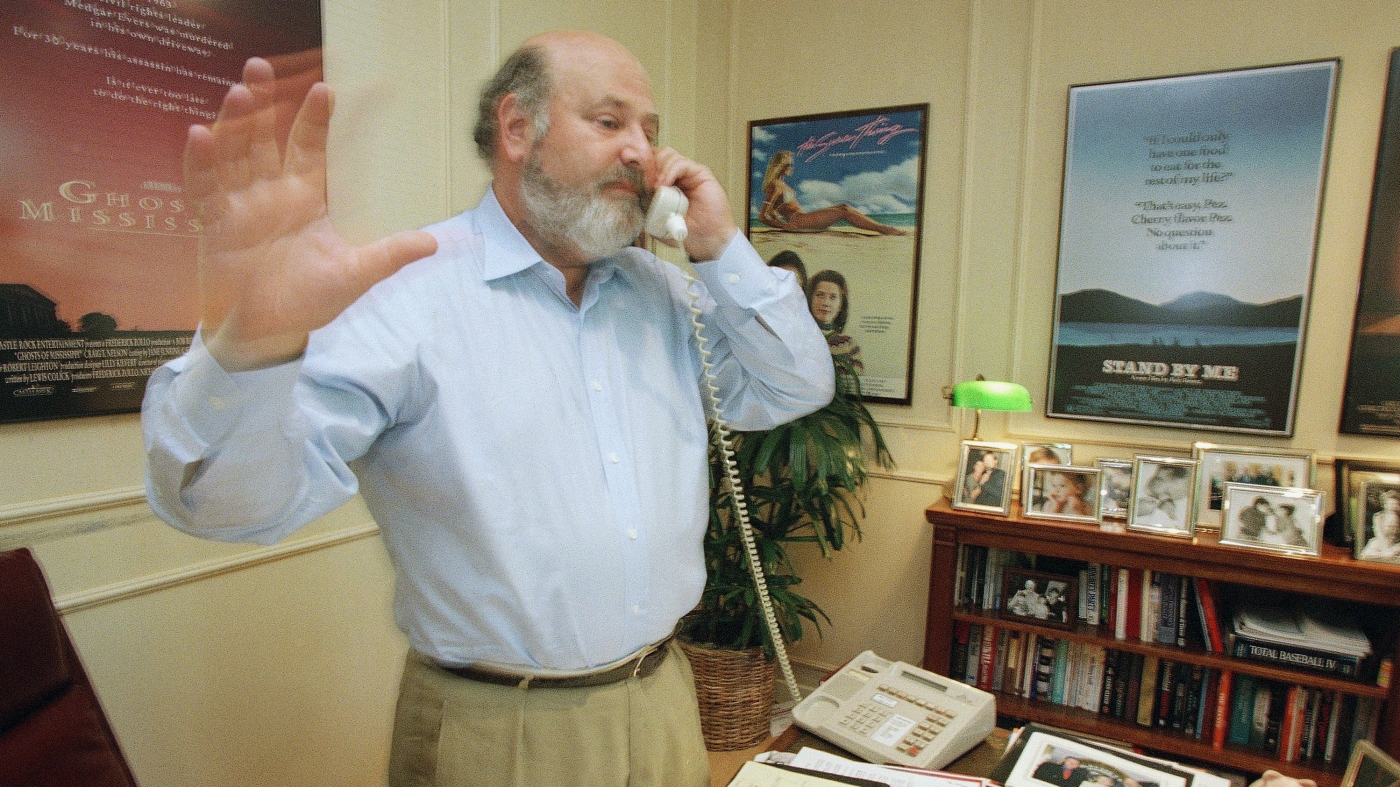
Rob Reiner at his office in Beverly Hills, Calif., in July 1998.
Reed Saxon/AP
hide caption
toggle caption
Reed Saxon/AP
Maybe an appreciation of Rob Reiner as a director should start with When Harry Met Sally…, which helped lay the foundation for a romantic comedy boom that lasted for at least 15 years. Wait — no, it should start with Stand By Me, a coming-of-age story that captured a painfully brief moment in the lives of kids. It could start with This Is Spinal Tap, one of the first popular mockumentaries, which has influenced film and television ever since. Or, since awards are important, maybe it should start with Misery, which made Kathy Bates famous and won her an Oscar. How about The American President, which was the proto-West Wing, very much the source material for a TV show that later won 26 Emmys?

On the other hand, maybe in the end, it’s all about catchphrases, so maybe it should be A Few Good Men because of “You can’t handle the truth!” or The Princess Bride because of “My name is Inigo Montoya, you killed my father, prepare to die.” Maybe it’s as simple as that: What, of the words you helped bring them, will people pass back and forth to each other like they’re showing off trading cards when they hear you’re gone?
There is plenty to praise about Reiner’s work within the four corners of the screen. He had a tremendous touch with comic timing, so that every punchline got maximum punch. He had a splendid sense of atmosphere, as with the cozy, autumnal New York of When Harry Met Sally…, and the fairytale castles of The Princess Bride. He could direct what was absurdist and silly, like Spinal Tap. He could direct what was grand and thundering, like A Few Good Men. He could direct what was chatty and genial, like Michael Douglas’ staff in The American President discussing whether or not he could get out of the presidential limo to spontaneously buy a woman flowers.
But to fully appreciate what Rob Reiner made in his career, you have to look outside the films themselves and respect the attachments so many people have to them. These were not just popular movies and they weren’t just good movies; these were an awful lot of people’s favorite movies. They were movies people attached to their personalities like patches on a jacket, giving them something to talk about with strangers and something to obsess over with friends. And he didn’t just do this once; he did it repeatedly.
Quotability is often treated as separate from artfulness, but creating an indelible scene people attach themselves to instantly is just another way the filmmakers’ humanity resonates with the audience’s. Mike Schur said something once about running Parks and Recreation that I think about a lot. Talking about one particularly silly scene, he said it didn’t really justify its place in the final version, except that everybody loved it: And if everybody loves it, you leave it in. I would suspect that Rob Reiner was also a fan of leaving something in if everybody loved it. That kind of respect for what people like and what they laugh at is how you get to be that kind of director.
The relationships people have with scenes from Rob Reiner movies are not easy to create. You can market the heck out of a movie, you can pull all the levers you have, and you can capitalize on every advantage you can come up with. But you can’t make anybody absorb “baby fishmouth” or “as you wish”; you can’t make anybody say “these go to 11” every time they see the number 11 anywhere. You can’t buy that for any amount of money. It’s magical how much you can’t; it’s kind of beautiful how much you can’t. Box office and streaming numbers might be phony or manipulated or fleeting, but when the thing hits, people attach to it or they don’t.
My own example is The Sure Thing, Reiner’s goodhearted 1985 road trip romantic comedy, essentially an updated It Happened One Night starring John Cusack and Daphne Zuniga. It follows a mismatched pair of college students headed for California: She wants to reunite with her dullard boyfriend, while he wants to hook up with a blonde he has been assured by his dirtbag friend (played by a young, very much hair-having Anthony Edwards!) is a “sure thing.” But of course, the two of them are forced to spend all this time together, and … well, you can imagine.
This movie knocked me over when I was 14, because I hadn’t spent much time with romantic comedies yet, and it was like finding precisely the kind of song you will want to listen to forever, and so it became special to me. I studied it, really, I got to know what I liked about it, and I looked for that particular hit of sharp sweetness again and again. In fact, if forced to identify a single legacy for Rob Reiner, I might argue that he’s one of the great American directors of romance, and his films call to the genre’s long history in so many ways, often outside the story and the dialogue. (One of the best subtle jokes in all of romantic comedy is in The American President, when President Andrew Shepherd, played by Michael Douglas, dances with Sydney Wade, played by Annette Bening, to “I Have Dreamed,” a very pretty song from the musical … The King and I. That’s what you get for knowing your famous love stories.)
Rob Reiner’s work as a director, especially in those early films, wasn’t just good to watch. It was good to love, and to talk about and remember. Good to quote from and good to put on your lists of desert island movies and comfort watches. And it will continue to be those things.

Nick Reiner will be charged with first degree murder in his parents’ killing

‘View’ host rejects Halle Berry’s attacks on Newsom, says he’s ‘done a lot for women’

Dem-appointed education officials face new scrutiny as Feeding Our Future scandal widens, Trump targets fraud

James Carville blasts Crockett for breaking ‘first rule of politics,’ focusing on herself more than voters

Murdaugh trial court clerk pleads guilty to showing sealed crime scene photos to photographer

Florida High School Football Rankings: Top 25 teams – Oct. 21

Cleary's 21 help Le Moyne down Central Connecticut State 69-64 in OT

How old is Bo Nix? What to know about Oregon quarterback ahead of 2024 NFL Draft

99th annual Pony Swim held in Virginia

Video: ‘It Didn’t Have to Happen This Way:’ U.Va. Faculty Call for Review of Police Response to Protests
Nick Reiner will be charged with first degree murder in his parents’ killing

DA: Nick Reiner will be charged with first-degree murder in deaths of Rob & Michele Reiner

Video: Nick Reiner Talked Openly About His Addiction Struggles

Trump admin defends White House ballroom as national security matter

Venezuelan opposition leader Machado injured on covert Nobel Prize trip
-

 Washington1 week ago
LIVE UPDATES: Mudslide, road closures across Western Washington
-

 Iowa2 days ago
Addy Brown motivated to step up in Audi Crooks’ absence vs. UNI
-

 Iowa1 week ago
Matt Campbell reportedly bringing longtime Iowa State staffer to Penn State as 1st hire
-

 Iowa3 days ago
How much snow did Iowa get? See Iowa’s latest snowfall totals
-

 Miami, FL1 week ago
Urban Meyer, Brady Quinn get in heated exchange during Alabama, Notre Dame, Miami CFP discussion
-

 Cleveland, OH1 week ago
Man shot, killed at downtown Cleveland nightclub: EMS
-
World1 week ago
Chiefs’ offensive line woes deepen as Wanya Morris exits with knee injury against Texans
-

 Minnesota1 week ago
Two Minnesota carriers shut down, idling 200 drivers

