Lifestyle
This Storybook cottage's native plant wonderland shows how gorgeous no grass can be

Water-hungry lawns are symbols of Los Angeles’ past. In this series, we spotlight yards with alternative, low-water landscaping built for the future.
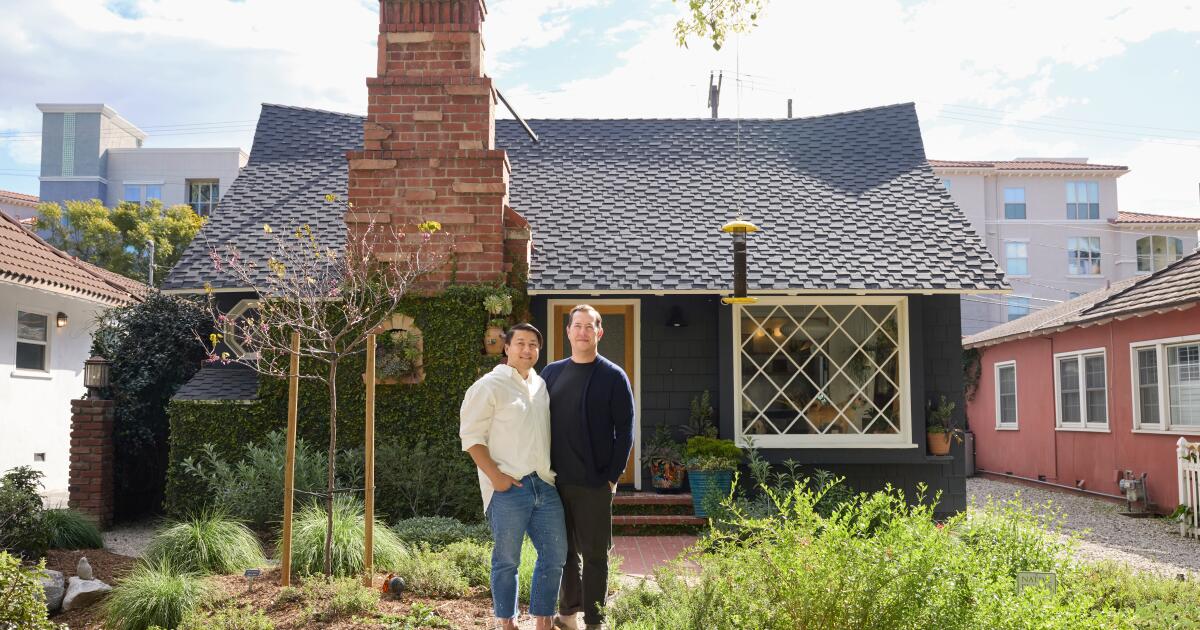
Once upon a time, under Universal Studios’ watchful Minion eye, there was a Storybook house in Studio City with a steep, sagging roof, a towering, tottering chimney and a yard so boring and prone to flooding that its charm was pretty much negated.
The front yard was mostly dead grass; the driveway was cracked and broken from runoff whenever it rained; and the funnel-shaped backyard was overwhelmed by a rotting wood pergola.
Succulents in the front yard grow in an alcove built into the chimney.
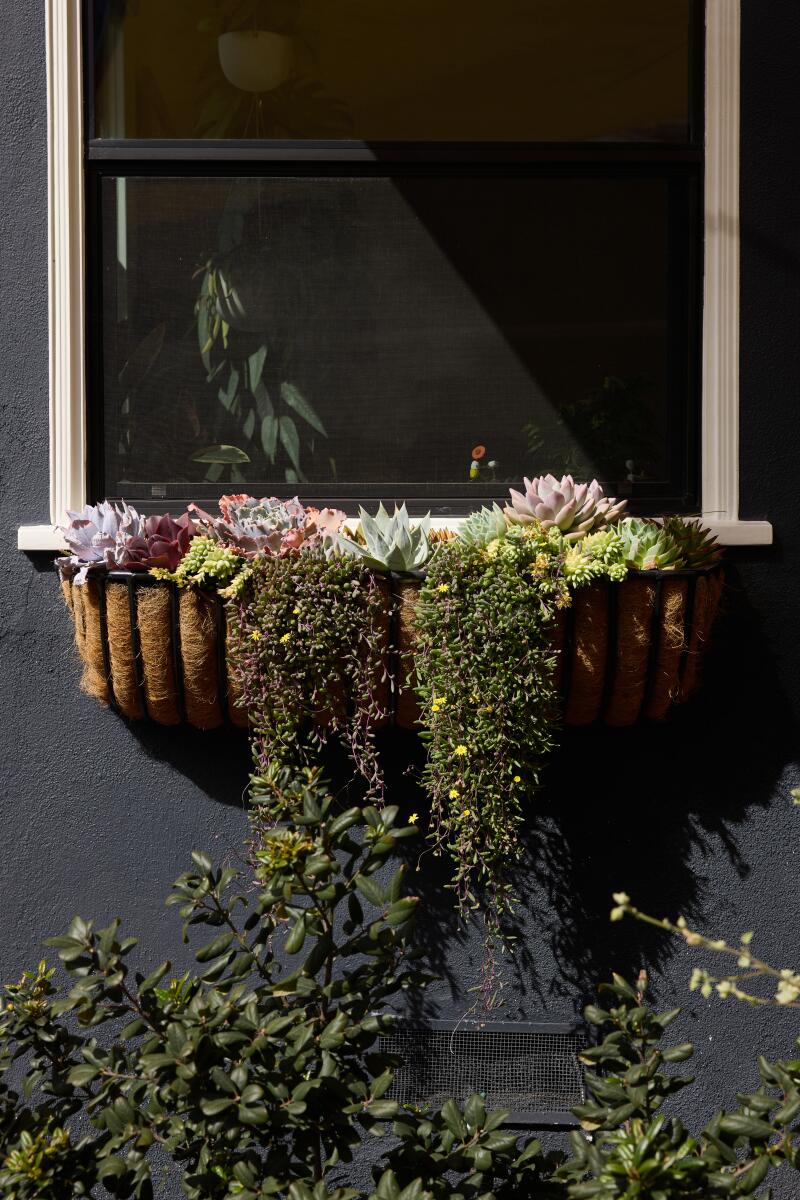
A planter spills over with succulents in Michael Solberg and Khoi Pham’s home garden.
No longer. Today, the yard of Khoi Pham and his fiancé, Michael Solberg, is a wonderland of native plants, water-conserving bioswales, a patio mosaic made from recycled concrete and permeable gravel paths with a delightful crunch. And throughout the garden are little riots of succulents spilling from pots, baskets and even the fanciful nook built into their chimney, dotting the garden with jolts of color like fancy embellishments on a cake.
There are lots of little signs identifying the plants too, to feed Solberg’s vision of educating passersby about the beauty, practicality and sustainability of native plant landscapes. The signs “make you feel like you should stop and pay attention,” said Solberg.
But they’re also helpful because this yard, designed and built by landscape designer Isara Ongwiseth of FormLA Landscaping, is one of three featured gardens during the Garden Conservancy’s San Fernando Valley Open Days Garden Tour on April 28, and the only one featuring a landscape devoted to California native plants. (Tickets are $10 per garden.)
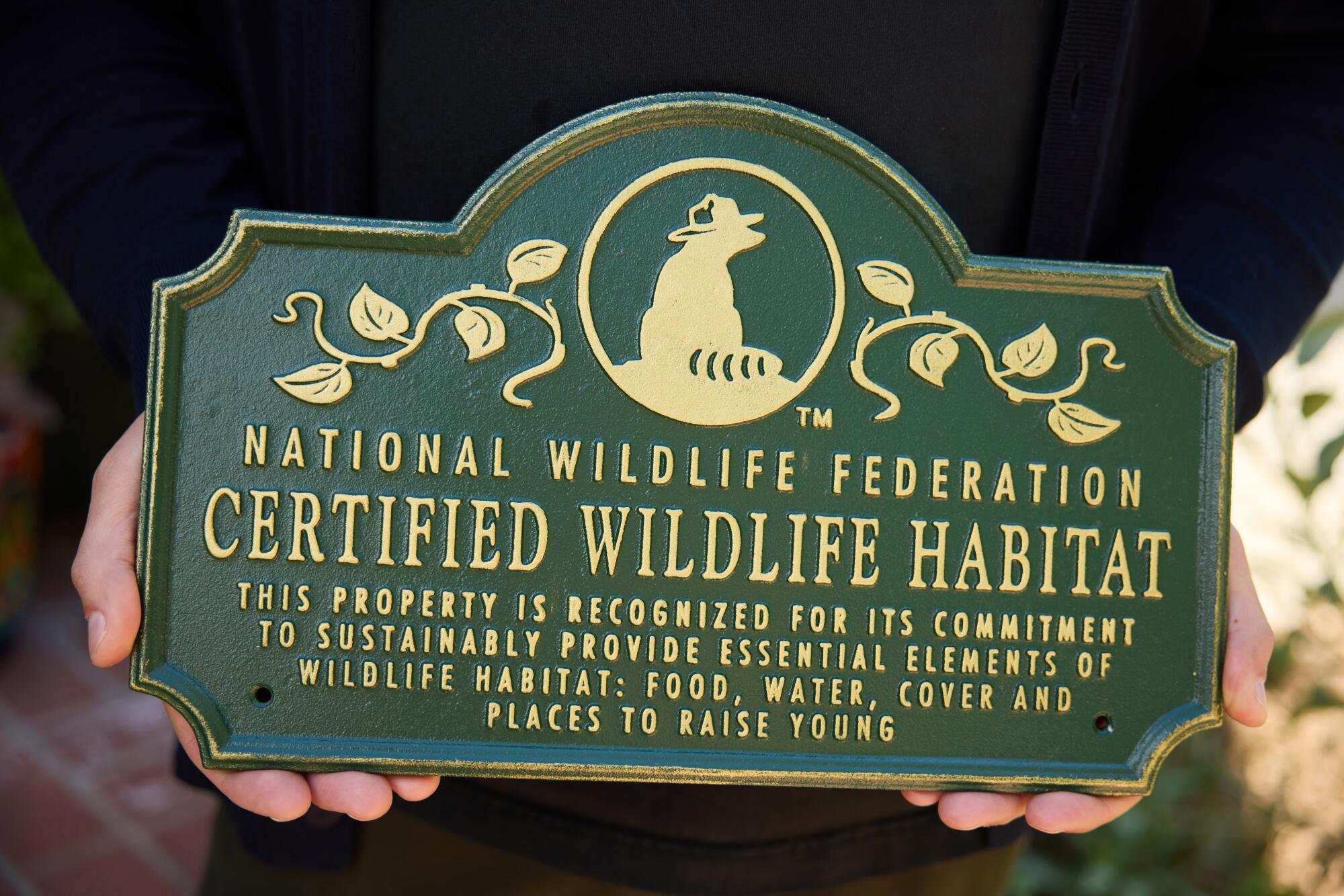
FormLA Landscaping provided this plaque for Michael Solberg and Khoi Pham’s native plant landscape.
(Yuri Hasegawa / For The Times)
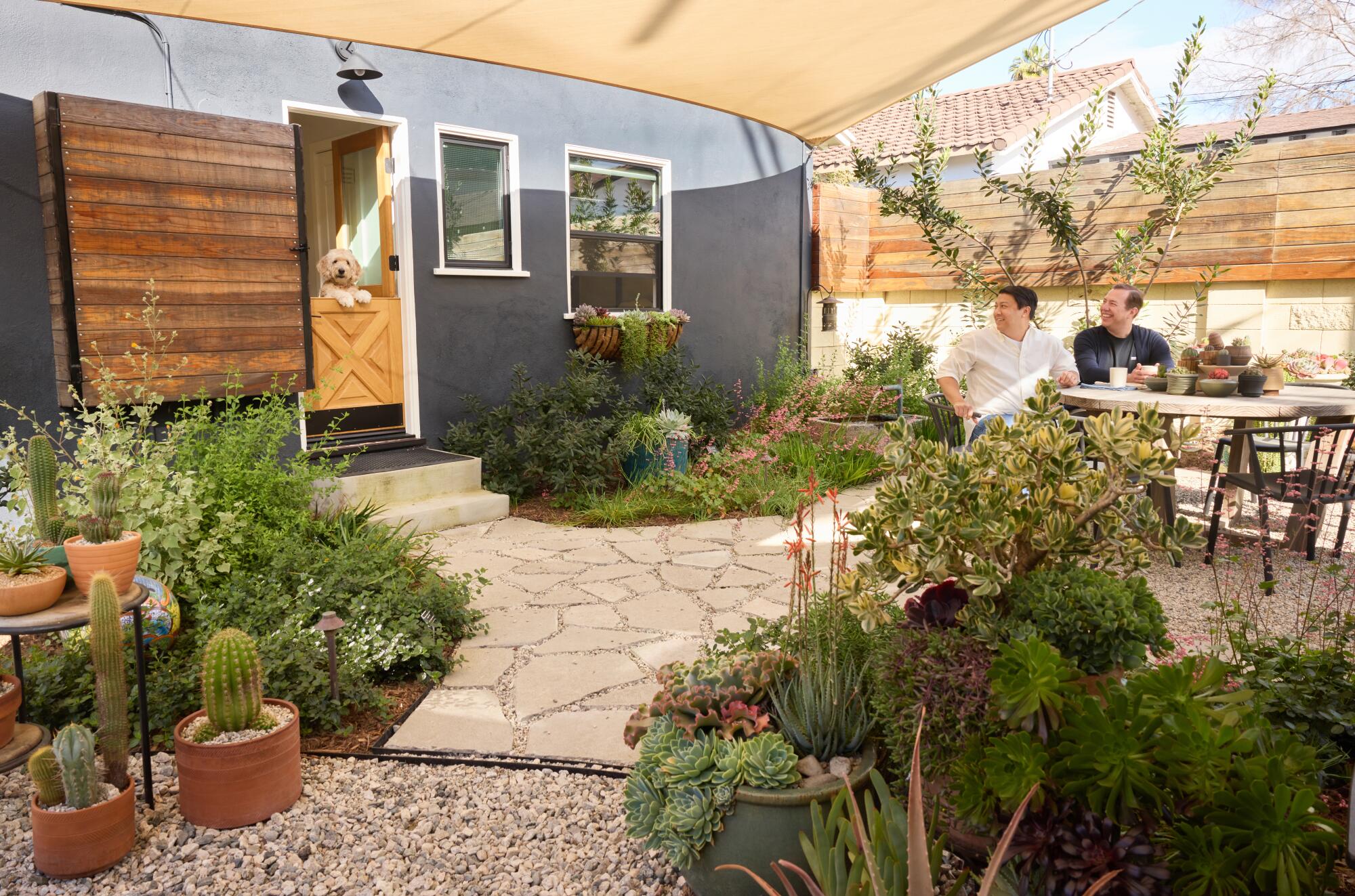
Native shrubs and flowers fill the shaded backyard’s planting areas, which are edged by pots and baskets brimming over with succulents and cactus, but all Lucy the goldendoodle wants is to join her owners outside.
(Yuri Hasegawa / For The Times)
The landscape is lush for one so young — it was installed in February 2022 — and features multiple plantings of a few varieties of native plants, such as the red-berried toyon, which Solberg is trying to espalier along one wall of his garage, dark-green ceanothus shrubs mingling with the silvery leaves of white sage (Salvia apiana), rings of Douglas iris (Iris douglasiana), earth-bound wisps of blushing coral bells, a.k.a. Wendy alumroot (Heuchera ‘Wendy’) and two Western redbud trees (Cercis occidentalis) — one in front, one in back — that bloom in deep violet clouds each spring.
For the record:
9:24 a.m. April 15, 2024An earlier version of this article incorrectly stated that the landscape was installed in February 2021. It was installed in February 2022. A photo caption incorrectly said the house is in North Hollywood. It is located in Studio City.
Out front are islands of fragrance that bloom in varying shades of purple — coyote mint (Monardella villosa), Cleveland sage (Salvia clevelandii) and bee’s bliss sage (Salvia ‘Bee’s Bliss’), along with clumps of deer grass (Muhlenbergia rigens), Oregon grape (Mahonia aquifolium) and the deep-throated flowers of Margarita BOP penstemon (Penstemon heterophyllus ‘Margarita BOP’).
Basically, Solberg said, except for the creeping fig lacing the chimney and the giant camphor tree on the parkway in front, any plants in the ground of their new landscape are California native plants; others, like his succulents and dwarf lemon, are planted in pots. And he hopes their plantings encourage more of the same.
I wanted to get the word out that native plants are a great way to have a sustainable garden that doesn’t require too much water, is good for wildlife and insects, is easy to care for and looks great too.
— Michael Solberg
“You just don’t see a bunch of California native gardens in our neighborhoods. What you see is lawn and standard shrubs, or fake turf or people who just paved everything over,” Solberg said. “I wanted something unique and different for our landscape, but also responsible with water and nature, and education was a really big part of that. I wanted to get the word out that native plants are a great way to have a sustainable garden that doesn’t require too much water, is good for wildlife and insects, is easy to care for and looks great too.”
This was Solberg and Pham’s second foray into creating a native plant landscape. Before they bought their Storybook home in late 2019, they’d taken out the lawn in front of their former home in Sherman Oaks and, inspired by gardens they’d seen on the Theodore Payne Foundation’s Native Plant Garden Tours, decided on a water-conscious landscape that relied on native plants instead of cactus and drought-tolerant plants from other countries with Mediterranean climates.
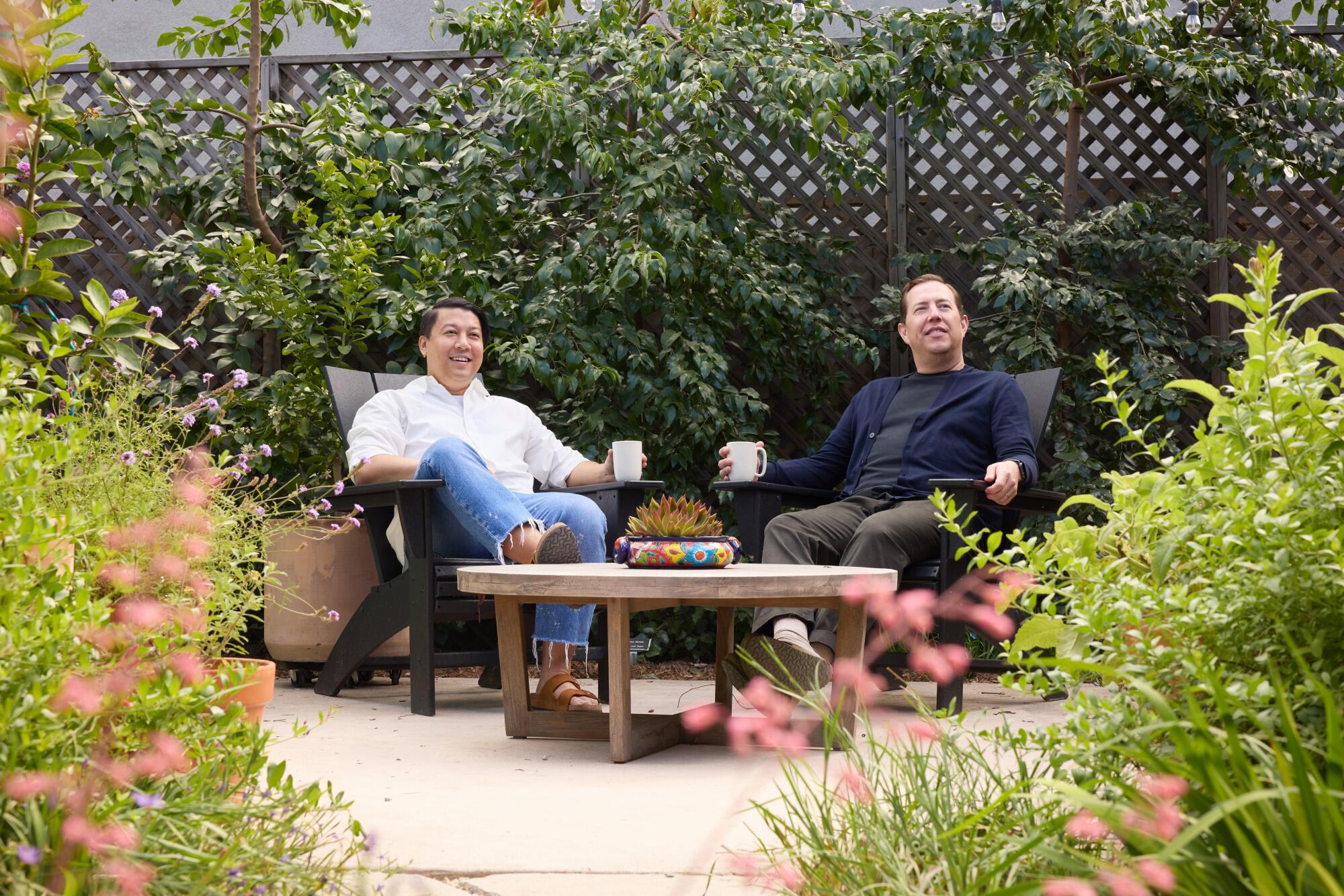
Khoi Pham, left and Michael Solberg enjoy sitting in their backyard garden most mornings, sipping coffee and admiring the leafy view.
Solberg — the gardener of the family — said he learned a lot in that DIY project: what native plants grow quickly and slowly, which he liked the best and which ones he should have placed somewhere else (such as a Matilija poppy that rapidly outgrew its location).
When it came time to finally landscape their new home in Studio City, Solberg said he wanted to continue the same theme, but he was concerned about dealing with the property’s special problems — a small, weirdly shaped backyard dominated by an aging pergola and water that ran off their Hansel-and-Gretel roof in sheets, creating runoff and flooding.
So in addition to an all-native-plant landscape, Solberg wanted permeable surfaces that would trap water in the soil instead of sending it out into the street — but he didn’t want any gutters to ruin their roof’s unusual lines. He wanted gravel walkways and drives that wouldn’t require constant maintenance. He wanted year-round color and interest, shade and privacy from the tall apartment building behind their house and plants that would attract birds and other pollinators.
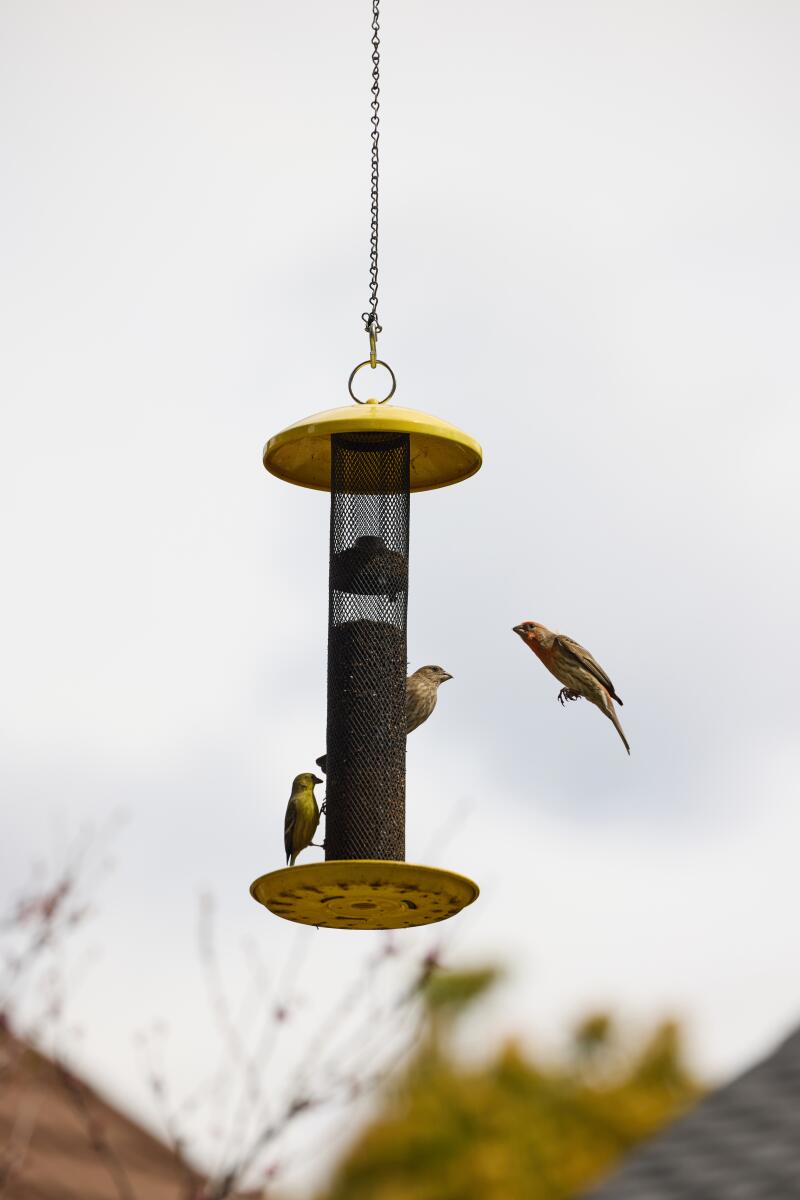
Birds fly around a feeder in Michael Solberg and Khoi Pham’s front yard.
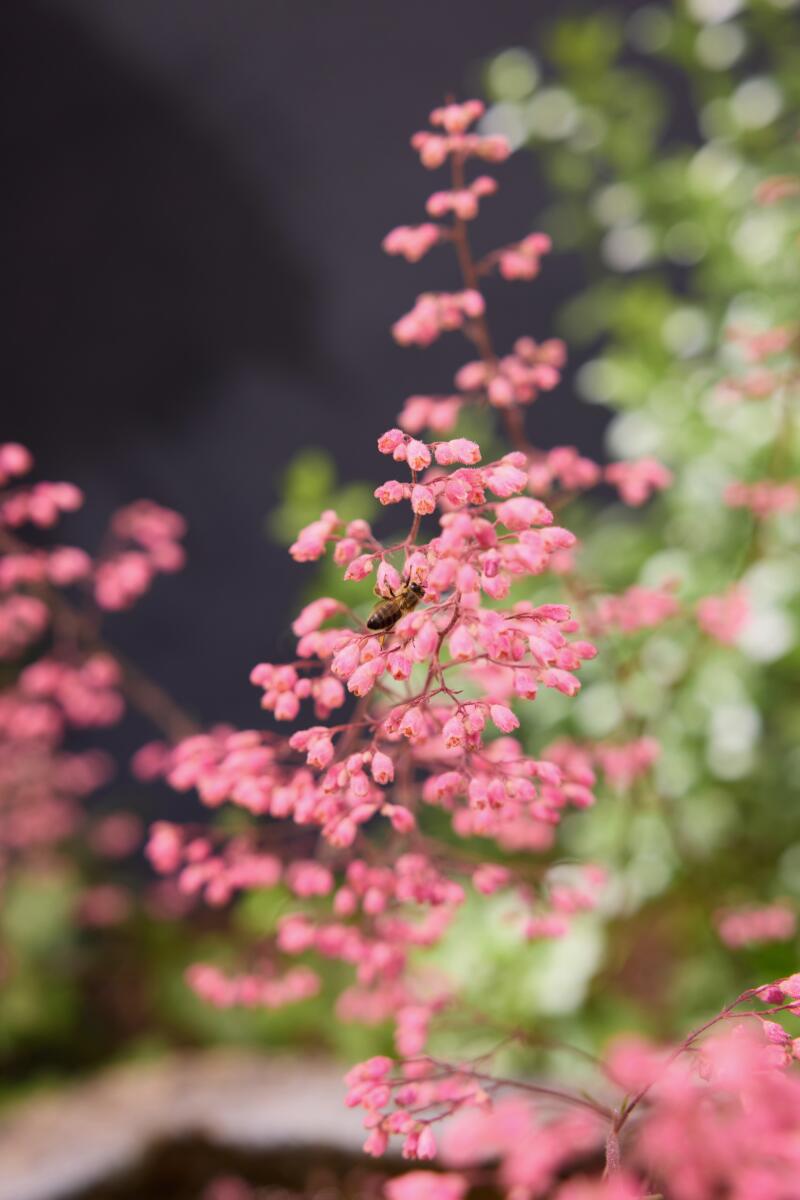
A bee noses among the pink blooms of a spray of coral bells.
They also had lifestyle considerations: Both men work from home — Solberg full-time overseeing corporate retail operations for a chain of tool stores and Pham at least two days a week as a research and development scientist for medical devices such as hospital sterilization equipment — so creating a serene and cheerful work environment was crucial inside and out.
And then there were Pham’s concerns. He was happy to leave the plant decisions to Solberg, the green thumb of the family. “I do the budget, but when it comes to gardening, I’m more of a cheerleader,” Pham said. “I was thinking more about the parties I’m going to throw in the backyard, and how they have to flow a certain way.”
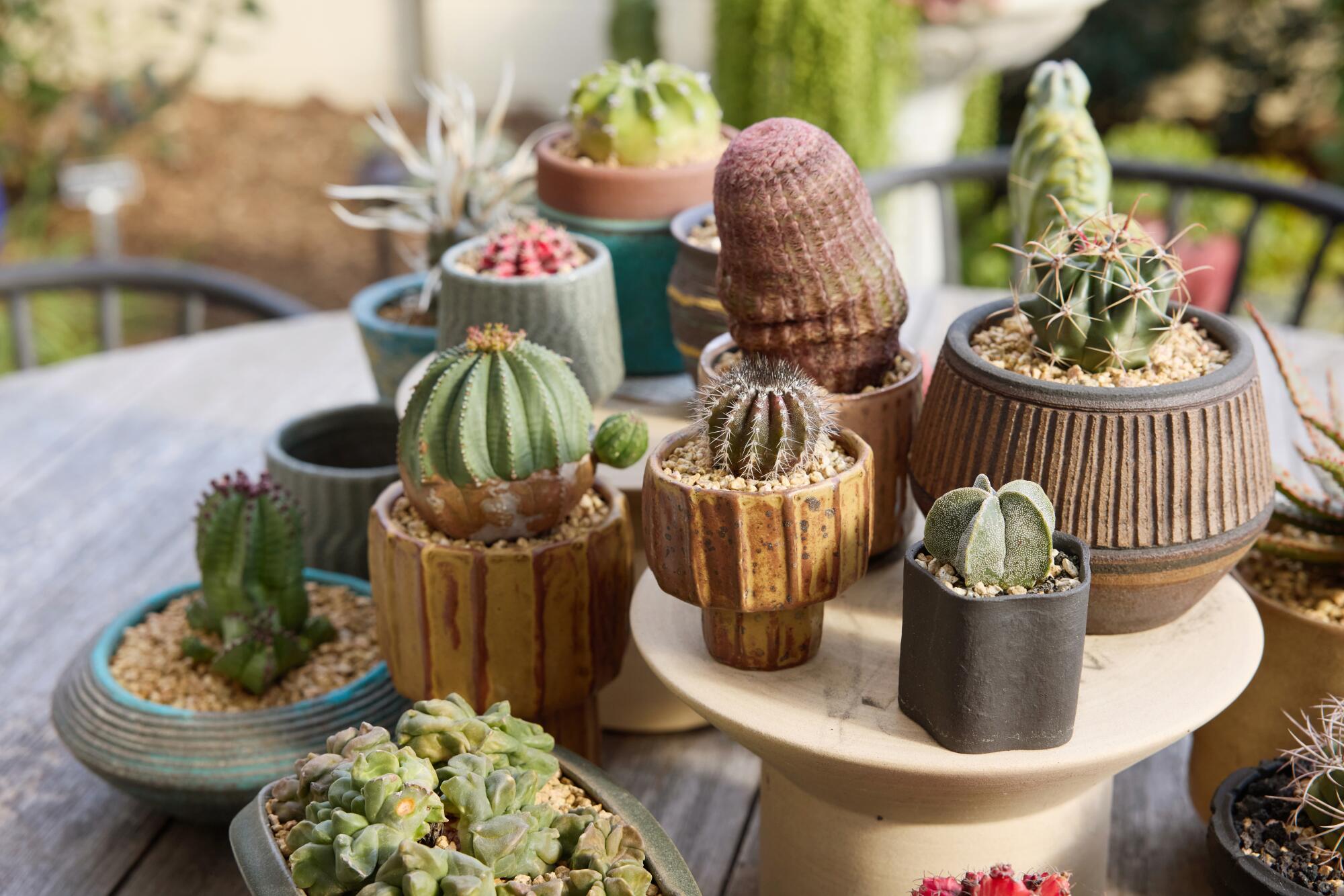
Part of Michael Solberg’s artful cactus collection sits clustered on a circular table in the home garden.
Solberg grew up around plants and gardening, but Pham said they were never a part of his life until the two met in San Diego in 2011. “When we first met, he had a beautiful succulent garden on his tiny patio that was really impressive — I had plastic succulents I bought from Crate & Barrel,” Pham said, laughing. “I just dusted them every once in a while.”
So there were lots of things to consider in creating their new landscape, Solberg said, plus he already knew how much work it was to take out a lawn and create a new landscape. So in the end, they called FormLA Landscaping, because they had admired the firm’s native landscapes in the past, and began laying out their wish list to Ongwiseth, the lead designer.
It took a few tweaks and persuasion — and $60,000 — but in the end, Solberg and Pham said Ongwiseth made their vision better than they had dreamed.
But there were a few bumps along the way.
One of the first decisions was removing the raised wooden deck in the backyard, Ongwiseth said. Pham and Solberg were reluctant not to rebuild, until they saw how much space the removal created. “It put everything at ground level, so you feel like you’re part of the garden instead of above it,” Solberg said.
Solberg was adamant about not wanting gutters to clutter up the roof line. Ongwiseth used French drains around the house perimeter — basically a trench filled with gravel and a perforated pipe to capture the runoff and direct it to the bioswales in the front yard. Ongwiseth finally convinced Solberg to add a small section of gutters on the south side of the house, along the driveway, where they were nearly invisible.
The two bioswales in the front are like planted indentations in the ground that fill with water after a heavy rain and hold it long enough that it sinks in. The gutters help direct rainfall into pipes that drain into the swales. Once they removed the broken concrete driveway and replaced it with ¾-inch crushed angular gravel, they found the rocks helped trap water coming off the roof as well, so that it sunk into the ground instead of pooling and flooding in spots like the old driveway. They also installed a subterranean drip irrigation system, which automatically waters two days a week for 10 minutes. The system uses sensors to skip watering days if it’s raining.
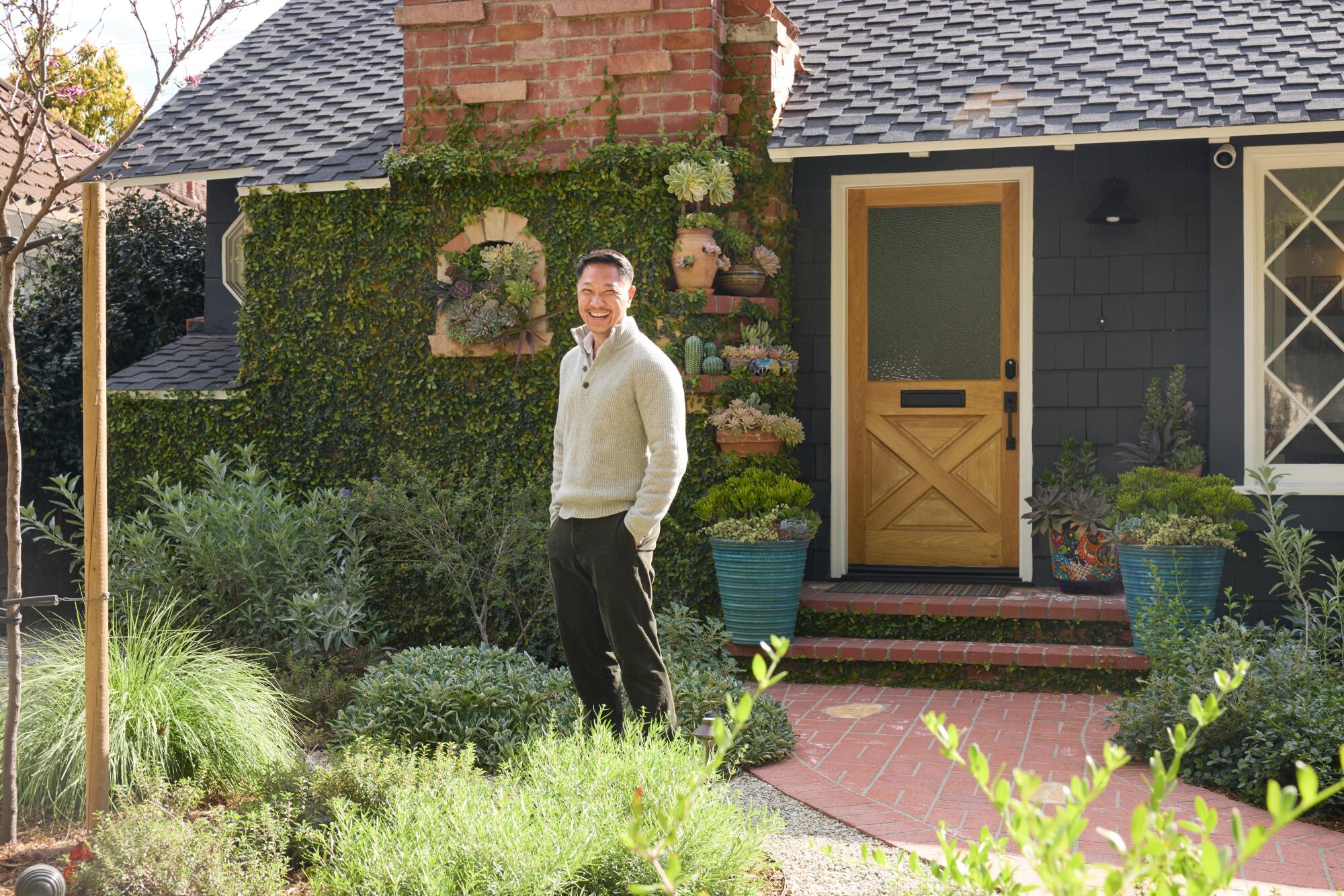
FormLA Landscaping lead designer Isara Ongwiseth in the front yard he designed.
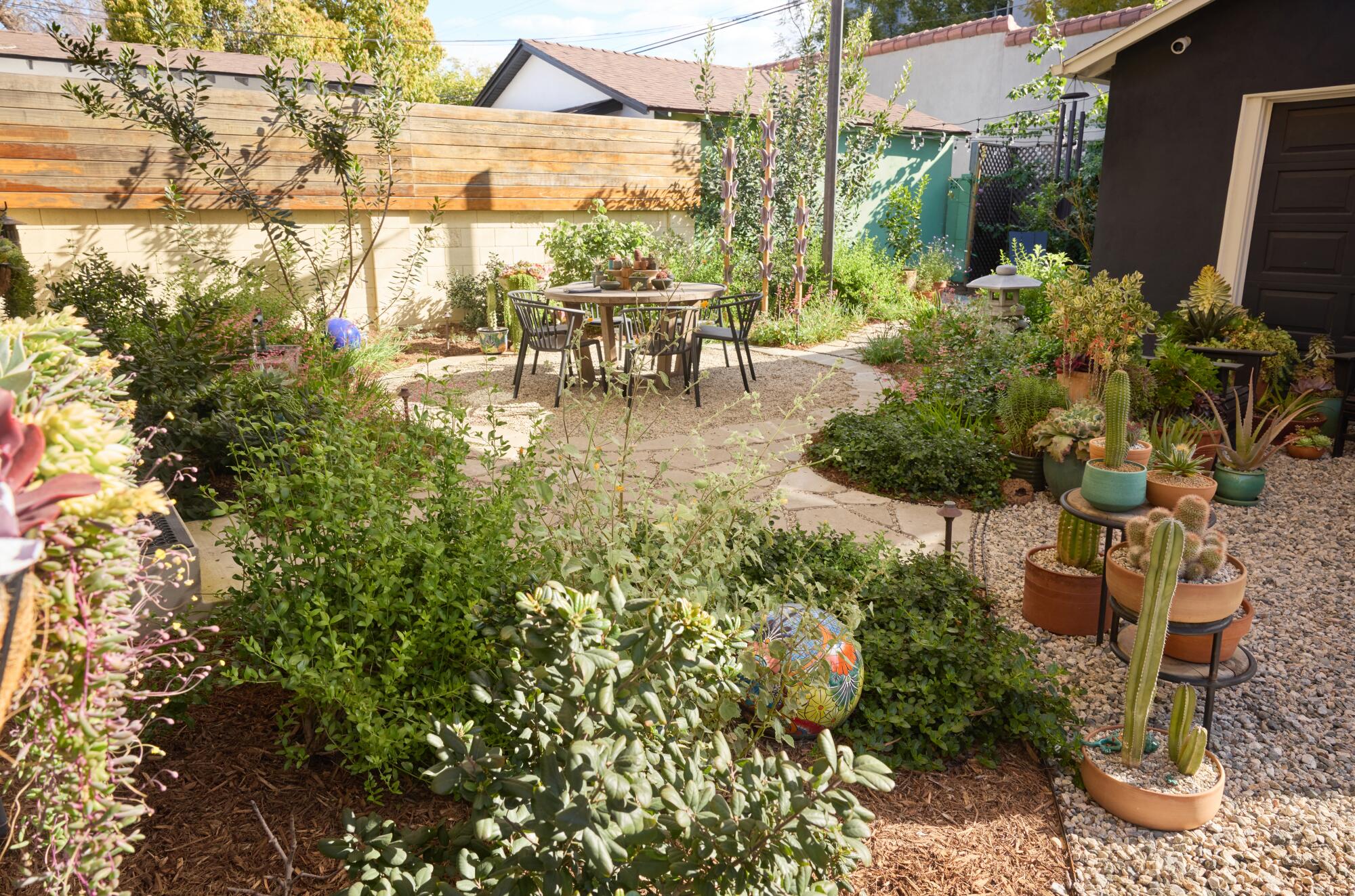
The backyard includes a circular gravel patio and meandering paths, edged in broken concrete.
The swales are edged with meandering paths of smaller, 3/8-inch angular gravel, and mostly hidden by the plants. Gravel was high on Solberg’s wish list, partly for sentimental reasons. His grandmother had gravel paths, he said, and he always loved the way they crunched when he walked on them. There’s a security aspect too, Ongwiseth said: “You’ll always know if somebody has wandered into your garden.”
But creating permeable paths and drives is more challenging than you’d think, Ongwiseth said. “Gravel and decomposed granite sounds good, but then you start tracking granite into the house and scratch the floor, so what do you do with that?” And round smooth gravel may look nice from afar, but your feet sink into those rocks when you walk on them, and they tend to scatter everywhere when children or dogs scramble by. (Pham and Solberg have two rambunctious dogs — Lucy, a goldendoodle, and Teddy, a terrier mix.) Because the kind of gravel Ongwiseth chose locks together, the small rocks stay in place when you walk on them, and your feet feel supported instead of sinking.
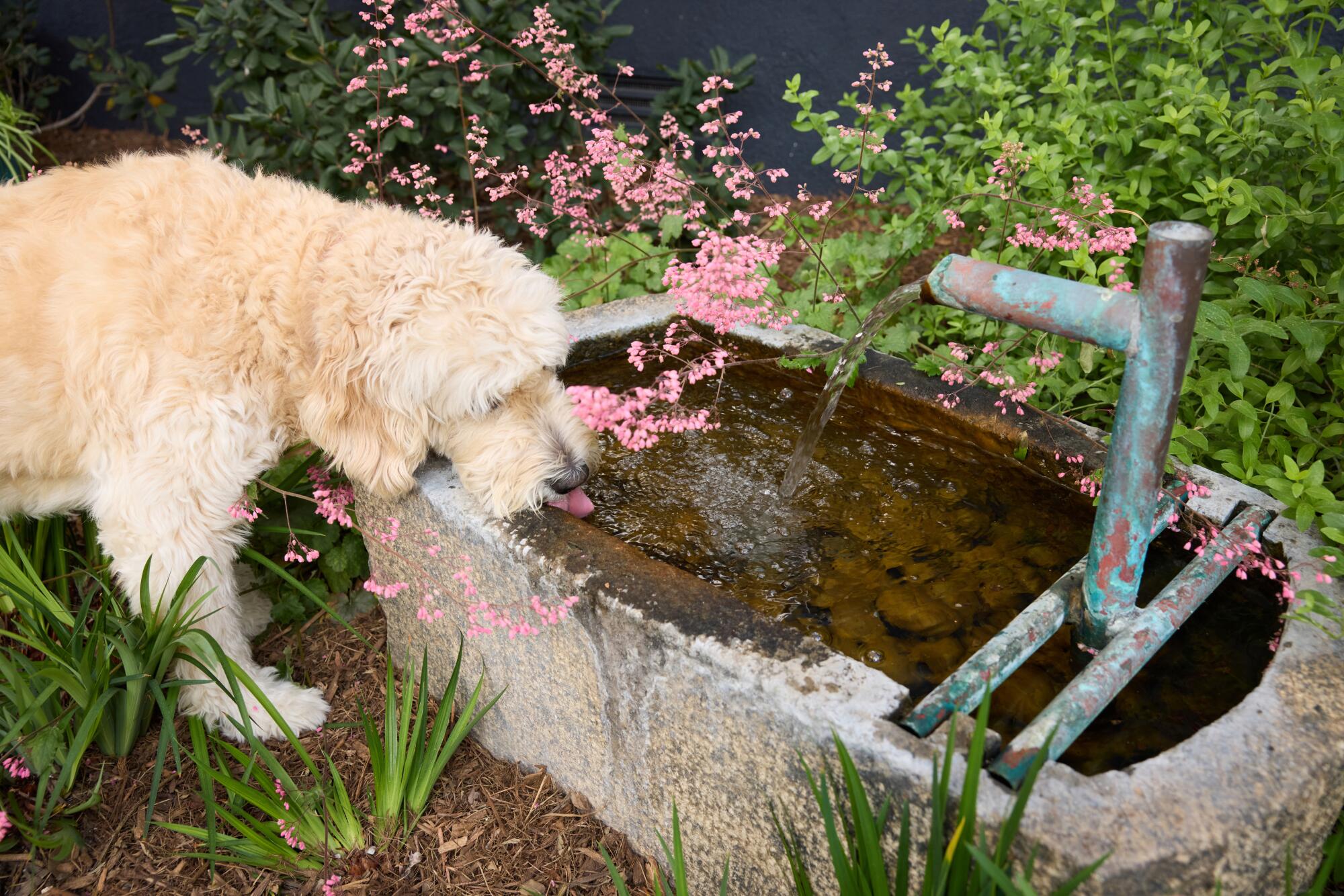
Lucy, Michael Solberg and Khoi Pham’s goldendoodle, laps at a rustic fountain next to a pink spray of coral bells.
Preparation was important too. After they tore out the old driveway and created the paths, they removed any weeds, added another drain at the end of the driveway and laid down a geo-textile fabric that suppresses weed growth while allowing water to soak through, before topping off the areas with two inches of gravel.
“Choosing the right type of weed barrier is very important, because so many will start to degrade over time,” Ongwiseth said. “The geo-textile fabrics don’t do that. I have many gardens I’ve installed in the last 15 years where the weed barrier is still holding up.”
Another point of concern was Ongwiseth’s plan to frame the gravel seating area outside the back door with a mosaic of broken concrete. “Broken concrete doesn’t sound very nice,” Pham said, “It felt a little too DIY, but once it was installed, I was like, ‘Oh, where else can we install it?’”
In fact, Pham said, you can still see a portion of rebar in one of his favorite pieces of concrete, “because it shows that it was reused. It truly is an art; they had to chip away at pieces of concrete to put the puzzle together to make it fit into the space.”
The finished design does look artistic, but it was all part of Ongwiseth’s practical considerations about transitioning between yard and home. He wanted a design that basically cleans your shoes of any dust or debris before you step inside. He grew up in a traditional Asian family where everyone takes off their shoes before they enter a home, “but not everyone practices that, so creating a landing or space even with concrete provides that transition.”
He also wanted to honor Solberg’s vision of having permeable surfaces throughout the garden, so instead of big concrete slabs there are spaces between all the small pieces of concrete to allow water to sink into the ground. Those spaces can create uneven places for chairs and tables, he said, so he made the main seating areas all gravel rimmed by the decorative pieces of concrete.
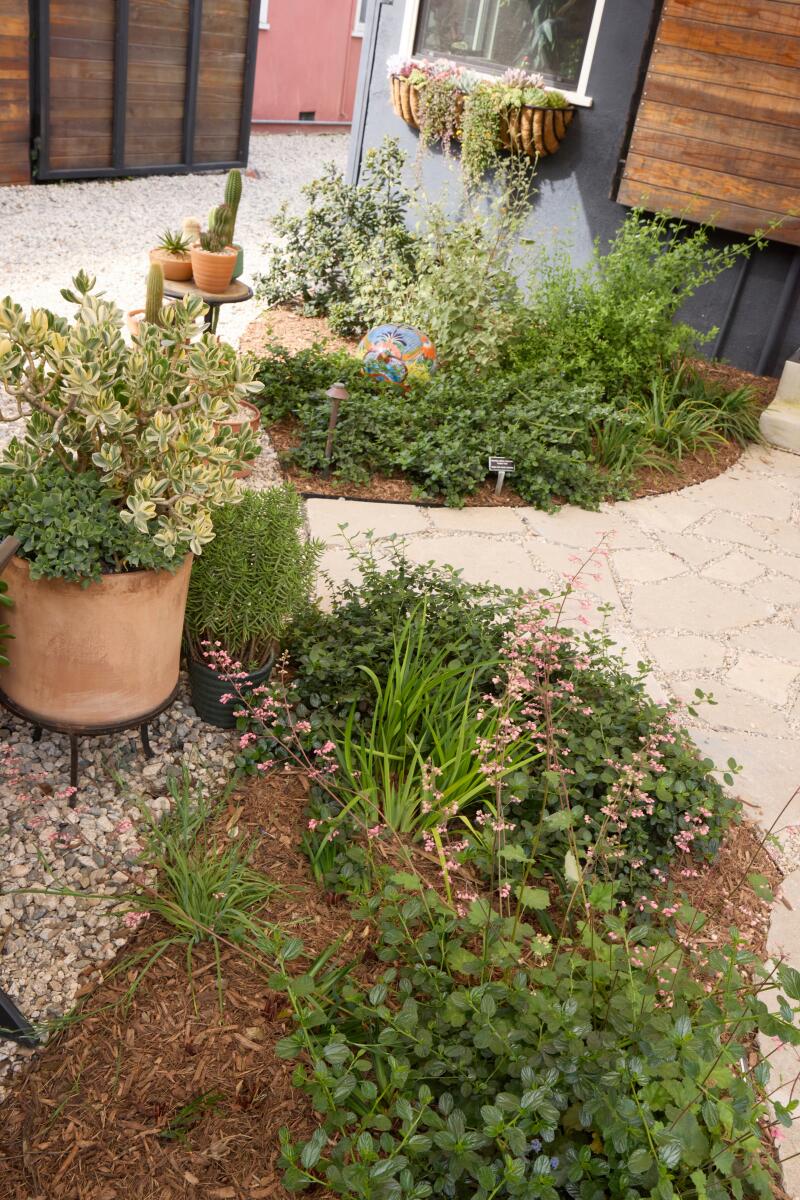
Broken concrete and gravel creates a walkway between planting areas and pots of succulents.
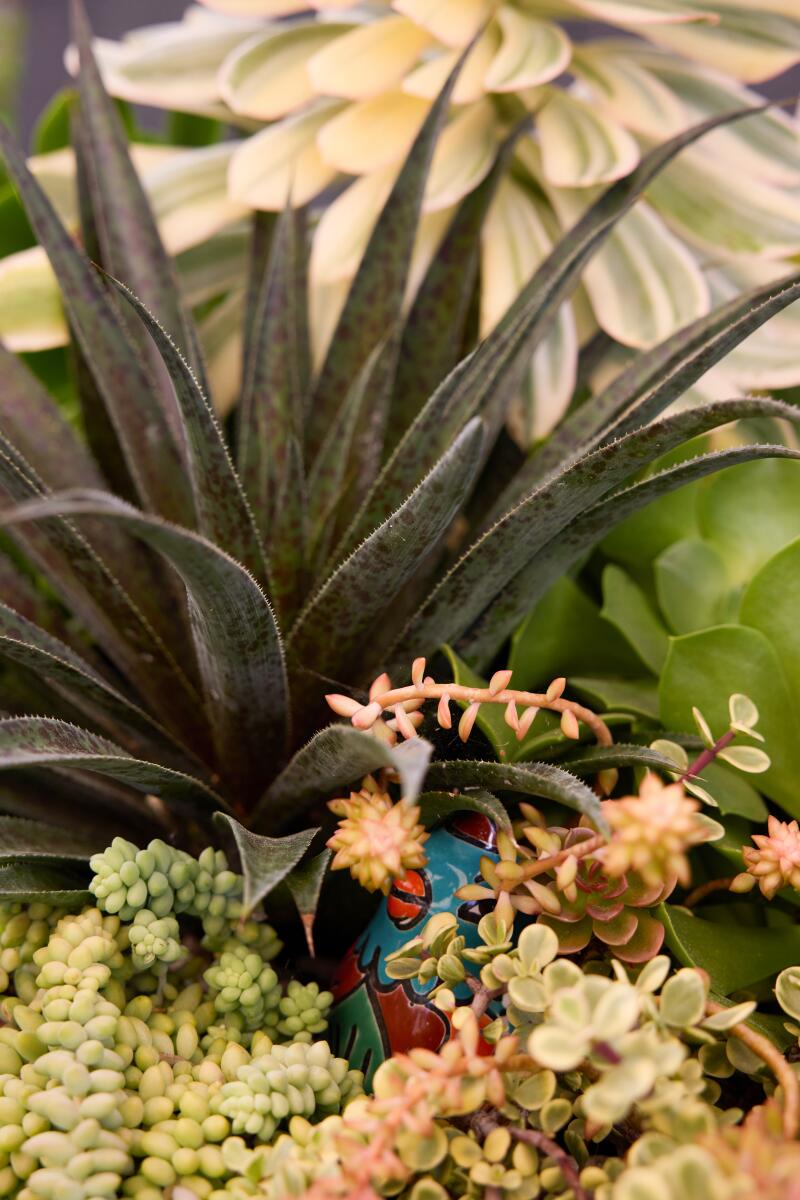
Michael Solberg’s pots of succulents add jolts of color around the home’s native plant landscape.
Ongwiseth also considered the fantastic Storybook design of the house in creating his design. As visitors will see, there is a sense of mystery and exploration as you walk from the front to the back.
“I wanted to create a meandering garden experience, where the whole garden is not revealed right away,” he said. “When we first arrived, we noticed the awkwardness of the shape of the backyard, and that old shade structure [the pergola] just emphasized that awkwardness. Once we removed all that we came up with a design that was more fluid, something that makes you want to explore the richness of the foliage, and the sense of many destinations throughout.”
There was a final and unexpected challenge, when Pham and Solberg were forced to remove a large camphor tree that provided privacy and filtered shade in their backyard. The tree had grown into their neighbor’s garage so it had to be removed, exposing their yard to the multistory apartment building behind them.
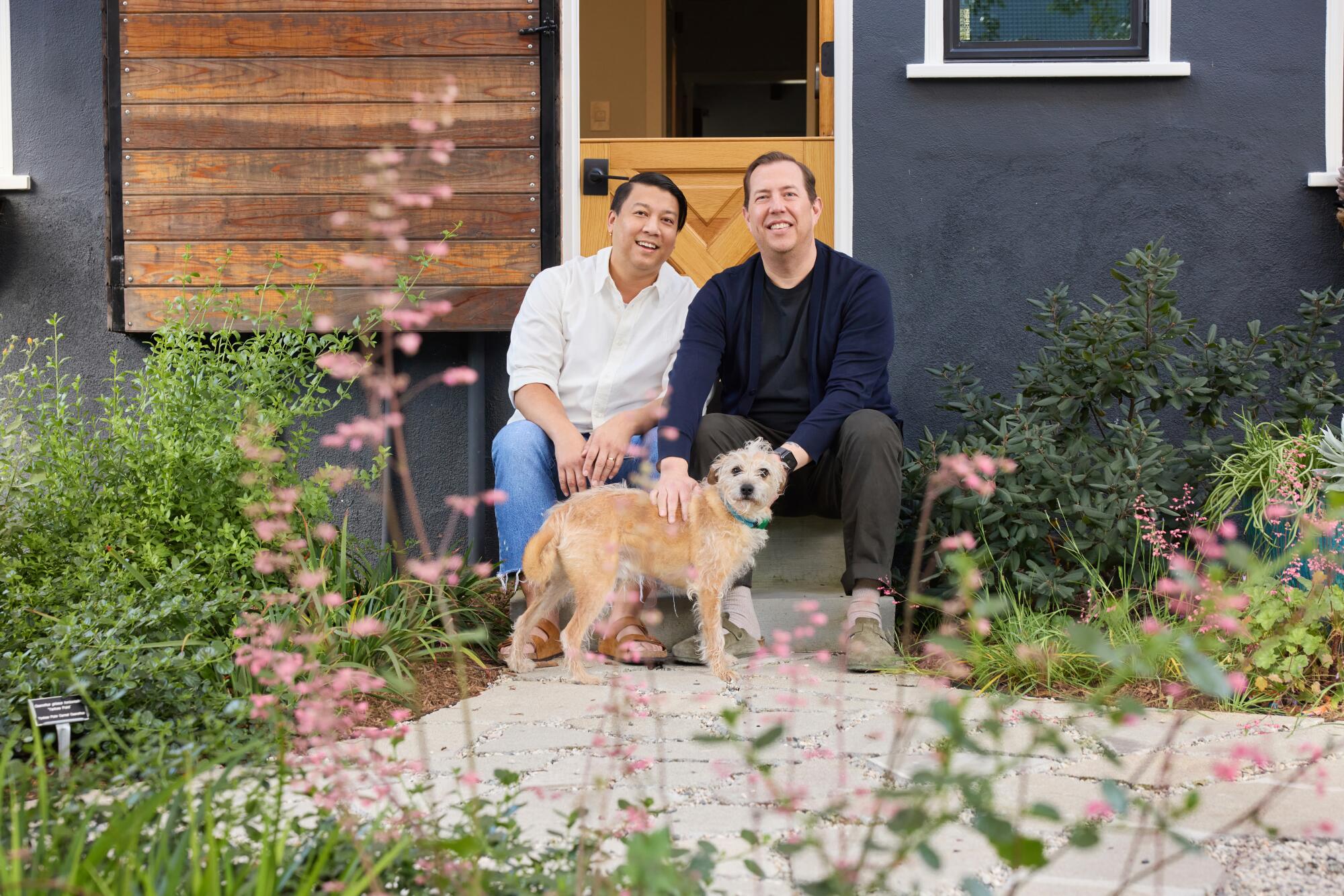
Khoi Pham, left, and Michael Solberg with their terrier mix, Teddy, one of their two dogs.
Ongwiseth softened the privacy issue by installing a large sail-shaped cover stretching from the house to the detached garage, which provides welcome shade during the summer but allows enough sunlight to filter through to keep the plants happy. They planted another redbud tree in the space where the camphor once stood — freeing up some additional space for their barbecue as well — and a bank of hollyleaf cherry (Prunus ilicifolia) at the very back that are already tall enough to block out a large swath of the apartments.
All in all, Pham and Solberg are still pinching themselves about how well it all came together. “There’s a healthy water table under our house now,” Solberg said, laughing. “And maintenance-wise, there’s not a lot we have to do. I have a blower to get rid of excess leaves once in a while, and sometimes, when it gets a little overgrown, I have to get out my clippers, but for the most part it tends to itself.”
These days, they can work outside at a large round table, with its small pots of colorful succulents, or drink coffee in the seating area nearby. Those places are separated by only a few steps, but they feel like a journey, admiring the tall abstract Dustin Gimbel sculptures of salvia whirls, next to real salvias blooming nearby, or the pots of blooming De La Mina verbena (Verbena lilacina ‘De La Mina’) and fragrant pitcher sage (Lepechinia fragrans).
This lovely space is where they’ll host their wedding reception in July, for about 50 people, the wide driveway functioning as a seating area as well as a way to drive in and out of their garage. Pham has his party flow, and Solberg has his vision of a landscape both beautiful and sustainable, visited by pollinators and birds.
“My advice is, just trust the process,” Solberg said. “Normally I would want more control, but I gave up creative license and learned a lot, like the Palmer’s Indian mallow (Abutilon palmeri) — I never would have chosen that for our garden because I didn’t know about it. So I learned, if you trust in the process, you can end up with something incredible, better than if you had done it on your own.”



Britney Spears
Open to Treatment Plan After DUI Arrest, Source Says
Published
Britney Spears‘ team is hoping the judge mandates treatment for the pop star over jail time following her Wednesday DUI arrest … and Britney isn’t fighting them on that, TMZ has learned.
Sources familiar with the situation tell TMZ … Britney is willing to comply with a treatment and support plan.
We’re told her team is in the early stages of developing a plan and they’re exploring multiple options, including mental health services, detox, and dual-diagnosis programs.
It’s unclear whether she would do inpatient or outpatient treatment, and it’s also unclear whether she would enter treatment before her May 4 court date.
Broadcastify.com

We broke the story … Britney was pulled over by California Highway Patrol officers around 9:30 PM Wednesday in Westlake Village, CA, not far from her home. She was later taken to a hospital — not for any injuries, because we’re told she didn’t sustain any — but to draw her blood to determine her blood alcohol content.
According to CHP, she was arrested for “driving under the influence of a combination of drugs and alcohol.”
Sources familiar with the investigation told us an unknown substance was found in Britney’s car, which was sent to be tested.
Britney’s manager, Cade Hudson, previously told TMZ … “This was an unfortunate and inexcusable incident. Britney will take the right steps, comply with the law, and we hope this marks the start of long-overdue change in her life. She needs help and support during this difficult time. Her boys will be spending time with her, and her loved ones are putting a plan in place to set her up for success and well-being.”

Michael B. Jordan plays twin brothers Smoke and Stack in Sinners.
Warner Bros. Pictures
hide caption
toggle caption
Warner Bros. Pictures
Ryan Coogler’s supernatural horror stars Michael B. Jordan playing twin brothers who open a 1930s juke joint in Mississippi. Opening night does not go as planned when vampires appear outside. “In a straightforward metaphor for all the ways Black culture has been co-opted by whiteness, the raucous pleasures and sonic beauty of the juke joint attract the interest of a trio of demons … they wish to literally leech off of the talents and energy of Black folks,” writes critic Aisha Harris. The film made history with a record 16 Academy Award nominations.


We asked our NPR audience: What movie would you recommend to someone who loved Sinners? Here’s what you told us:
Near Dark (1987)
Directed by Kathryn Bigelow; starring Adrian Pasdar, Jenny Wright, Lance Henriksen
If you want another cool vampire movie with Western kind of vibes, check out Kathryn Bigelow’s Near Dark — super underseen and kind of hard to find, but really gritty and sexy and another very different take on what you might think is a genre that had been wrung dry. – Maggie Grossman, Chicago, Ill.
30 Days of Night (2007)
Directed by David Slade; starring Josh Hartnett, Melissa George, Danny Huston
It follows a group of people in a small Alaskan town as they struggle to survive an invasion of vampires who have taken advantage of the month-long absence of the sun. Both this and Sinners revolve around a vampire takeover and the people’s fight to outlast the “night.” – Nathan Strzelewicz, DeWitt, Mich.
The Wailing (2016)
Directed by Na Hong-jin; starring Kwak Do-won, Hwang Jung-min, Chun Woo-hee, Jun Kunimura
In this South Korean supernatural horror film, a mysterious illness causes people in a quiet rural village to become violent and murderous. A local police officer investigates while trying to save his daughter, who begins showing the same disturbing symptoms. The film blends folk horror, religion, and psychological dread, exploring themes of faith, evil, and moral weakness. Like Sinners, it centers on a supernatural force corrupting a close-knit community, builds slow-burning tension, and examines spiritual conflict and human frailty. – Amy Merke, Bronx, N.Y.
Fréwaka (2024)
Directed by Aislinn Clarke; starring Bríd Ní Neachtain, Clare Monnelly, Aleksandra Bystrzhitskaya
In this Irish folk horror film, a home care worker, Shoo, is assigned to stay with an elderly woman who’s convinced she’s under siege by malevolent fairies. Like Sinners, Fréwaka blends folk traditions and social commentary with horror. The social failures Shoo copes with (untreated mental health issues, religious abuse) are just as frightening as the supernatural forces. – Kerrin Smith, Baltimore, Md.
And a bonus pick from our critic:
Ma Rainey’s Black Bottom (2020)
Directed by George C. Wolfe; starring Viola Davis, Chadwick Boseman, Glynn Turman
This is an adaptation of August Wilson’s play about a legendary blues singer (Viola Davis) muscling through a recording session with white producers who want to control her music. Chadwick Boseman’s blistering in his final role. – Bob Mondello, NPR movie critic
Carly Rubin and Ivy Buck contributed to this project. It was edited by Clare Lombardo.

The tiny town of West Goshen, Calif., was exactly the kind of place that community solar was designed for.
Near Visalia, most of its 500 residents live in mobile homes, where companies won’t install rooftop panels without a solid foundation. And until recently, they used propane for heating and cooking, with price fluctuations in the winter posing hardships for low-income families.
Community solar, in which residents get a discount on their bills for subscribing as a group to small solar arrays nearby, was designed to help low-income residents, apartment dwellers, renters and others who can’t put panels on their own roofs.
Over the last 11 years, New York, Maine, Minnesota, Massachusetts and other states have built thriving community solar programs. But California has built, at most, only 34 projects since 2015, and experts say that’s a generous accounting.
“We’ve had community solar for a dozen years, and it simply has not produced anything of scale and anything of note,” said Derek Chernow, director of Californians for Local, Affordable Solar and Storage, a developer trade group that’s pushing to get a more robust program off the ground. “Projects don’t pencil out.”
The West Goshen residents were among the lucky few, becoming part of a community solar project in 2024.
“It has kind of allowed us to kind of breathe a little bit,” said resident and community organizer Melinda Metheney. Her bill has dropped by about $300 in the summer months, thanks to the 20% community solar discount, stacked with other low-income discounts and clean energy incentives, she said.
West Goshen’s panels sit about 10 miles out of town, in a field surrounded by farms. Energy and climate experts agree California must add much more clean energy to its grid, some 6 gigawatts by 2032, the California Public Utilities Commission said in a new plan last week.
Assemblymember Christopher M. Ward (D-San Diego), who in 2022 authored a bill to create a more effective community solar program, said the state needs to double its annual solar installation rate to reach that goal and is not on track to do that using only large utility-scale solar farms and individual rooftop arrays.
“We need mid-scale community solar,” he said.

Energy and climate experts agree California must add much more clean energy to its grid, some 6 gigawatts by 2032, the California Public Utilities Commission said in a new plan last week. Above, solar panels at Extra Space Storage in Pico Rivera.
(Kayla Bartkowski / Los Angeles Times)
He and a coalition of environmental groups, solar developers and the Utility Reform Network, a ratepayer advocacy group, worked to put his 2022 law into effect. They coalesced around requiring utilities to pay community solar developers and customers for the electricity they feed to the grid using the same formula they use for people who install rooftop solar.
But in May 2024, the California Public Utilities Commission decided to go with a late-in-the-game proposal backed by the state’s investor-owned utilities to pay community solar at a lower rate.
The agency, along with its public advocate’s office, argued that crediting solar developers at the higher rate would raise bills for customers who don’t have solar, who would still have to shoulder the cost of grid maintenance. It’s similar to the argument they’ve made to cut incentives for rooftop solar.
The new program relied on federal money, including the Biden administration’s Solar for All, to sweeten the deal for developers. But the utilities commission spent very little of the $250 million available under that grant before the Trump administration tried to claw it back last summer, and now it is held up in litigation.
At a legislative oversight hearing last week, Kerry Fleisher, the commission’s director of distributed energy resources, blamed the loss for the new program’s failure to launch.
“There’s been a tremendous amount of uncertainty in terms of the Solar for All funding that was intended to supplement this program,” Fleisher said. “That’s part of the reason why this has taken longer than normal.” She said the commission still plans to release a program in the next several months.
Ward, the San Diego lawmaker who wrote the community solar bill, called the program “fatally flawed” in an interview.
He’s now considering a bill to bring the community solar program more in line with what he initially envisioned — higher incentives, requirements for battery storage, and compliance with state law that mandates new houses be built with solar.
A study last year funded by a solar trade group found that could save California’s electric system $6.5 billion over 20 years. But Ward’s effort to revive his program last year failed to pass the Assembly appropriations committee.
“All the other states in our country that have adopted similar community solar program models, they are working,” said Ward, adding that 22 states have programs comparable to the one solar advocates want in California. “The writing on the wall suggests that, exactly as we feared years ago, this was not the way to go.”
California Public Utilities Commission spokesperson Terrie Prosper called California “a leader in cost-effective, least-cost solar deployment overall compared to any other state,” in an emailed statement.
Under the commission’s definition, the state has brought on 34 projects, representing 235 megawatts of community solar. But studies from groups such as the Institute for Local Self-Reliance and Wood Mackenzie use different definitions for community solar, and they show California far behind at least 10 other states.
Meanwhile, advocates and developers involved in successful community solar projects in California say they were difficult to get off the ground.

Homes in the Avocado Heights area of Los Angeles County are part of a community solar project.
(Kayla Bartkowski / Los Angeles Times)
One that came online in May in the unincorporated communities of Bassett and Avocado Heights in the San Gabriel Valley provides solar electricity to about 400 low-income residents. They get 20% discounts on their electric bills for subscribing to panels installed on two Extra Space Storage building rooftops in Pico Rivera.
Organizers said it took nearly five years to find the right location and comply with utility requirements. They also got a grant in addition to funding provided by the state utilities commission’s solar program.
It “would not have happened if it hadn’t been for the grant,” said Genaro Bugarin, a director at the Energy Coalition nonprofit that proposed and coordinated the project.
Brandon Smithwood, vice president of policy at Dimension Energy, the developer for the project in West Goshen, said he still hopes to see a community solar program in California that compensates projects for the way they help out the grid.
“We’ve seen it can work, and we know what we have won’t work,” Smithwood said at the hearing.

Britney Spears Open to Treatment Plan as Team Weighs Options

Anxiety grows among California Democrats as gubernatorial candidates rebuff calls to drop out

Owners of fire-destroyed Palisades mobile home park seek to displace residents for development deal

Fatigue a factor as early matches begin at Indian Wells
Fact check: Did French border guards mock influencers returning from Dubai amid Iran war?

Florida High School Football Rankings: Top 25 teams – Oct. 21

Cleary's 21 help Le Moyne down Central Connecticut State 69-64 in OT

How old is Bo Nix? What to know about Oregon quarterback ahead of 2024 NFL Draft

99th annual Pony Swim held in Virginia

Indiana Members Credit Union announced as new anchor tenant at Bottleworks District
Fact check: Did French border guards mock influencers returning from Dubai amid Iran war?

Iran’s fight for survival / The widening war / Trump’s nebulous goals : Sources & Methods

Map: 4.9-Magnitude Earthquake Shakes Louisiana

Paxton vows he’s ‘staying in this race’ even if Trump backs Cornyn in Texas GOP clash

Which Kurdish groups is the US rallying to fight Iran?
-

 World1 week ago
Exclusive: DeepSeek withholds latest AI model from US chipmakers including Nvidia, sources say
-

 Wisconsin4 days ago
Setting sail on iceboats across a frozen lake in Wisconsin
-

 Massachusetts1 week ago
Mother and daughter injured in Taunton house explosion
-

 Maryland5 days ago
AM showers Sunday in Maryland
-

 Massachusetts3 days ago
Massachusetts man awaits word from family in Iran after attacks
-

 Florida5 days ago
Florida man rescued after being stuck in shoulder-deep mud for days
-

 Denver, CO1 week ago
10 acres charred, 5 injured in Thornton grass fire, evacuation orders lifted
-

 Oregon6 days ago
2026 OSAA Oregon Wrestling State Championship Results And Brackets – FloWrestling