Lifestyle
They transformed a sad, junk-filled yard into a DIY native plant wonderland

Water-hungry lawns are symbols of Los Angeles’ past. In this series, we spotlight yards with alternative, low-water landscaping built for the future.
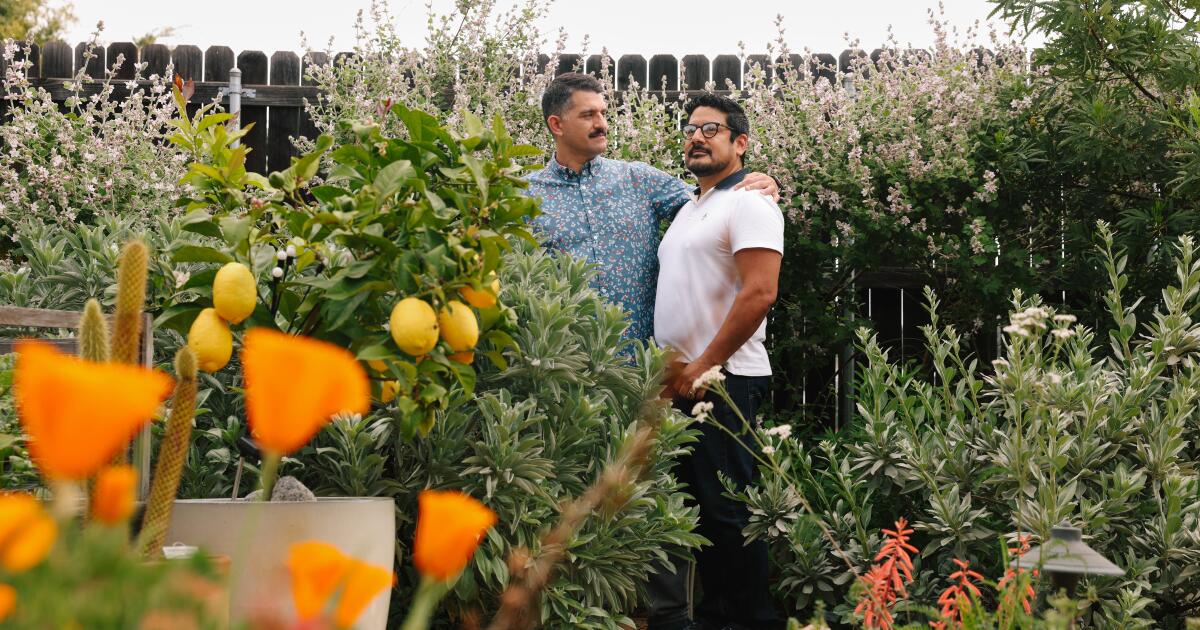
At the top of a roller-coaster hill in Highland Park, Thomas Zamora and his husband, Raul Rojas, enjoy two spectacular views — of the Pasadena hills to the east and of the meandering expanse of native plants, succulents and vegetables in a backyard that once was nothing but dirt and junk cars.
It’s been an evolution of nearly a decade, say Zamora and Rojas, but today, their backyard boasts a deck rimmed with pots of colorful succulents and wide water-permeable paths of flagstone and river pebbles, lined with fragrant plantings of California native trees and flowering shrubs. There’s a raised bed full of vegetables, a potted lemon tree and a few red-blooming Australian grevilleas and South African leucadendron left over from the early days of their landscaping journey “because the hummingbirds love them so much,” Zamora said. “They fight over the flowers, so we couldn’t stand to take them out.”
But almost everything else in the backyard, along with the terraced planters out front and the parkway, is devoted to California native plants, a passion inspired by the Theodore Payne Foundation’s Native Plant Garden Tour in 2015, when the couple saw what beautiful gardens others had created from native perennials, shrubs and wildflowers.
An oasis of welcoming serenity in the backyard of Raul Rojas and Thomas Zamora’s Highland Park home.
“That started us on our journey of ‘Frankensteining’ our landscape,” Zamora said, laughing. “The tours helped us get ideas for what elements we thought would look great in our yard. It wasn’t a formal process, because we did things ourselves. We found things we wanted, and places to fit them in, and just sort of winged it.”
They winged it so well that their home is now a regular part of Theodore Payne’s Native Plant Garden Tour, being held on April 13 and 14 this year. (Tickets are sold out online, but at publication time were still available for purchase in person at the foundation’s office in Sun Valley, Tuesdays through Saturdays from 8:30 a.m. to 4:30 p.m. for $55 (children under 16 are free).
The couple’s garden is alive with bees, hummingbirds and other pollinators, and there are chairs and even a flower-shaded bench for visitors to sit and admire the view. The space exudes serenity and invites wanderers —and is clearly a labor of love for both Zamora and Rojas. “Every Sunday is garden day and we enjoy the process,” Rojas said. “It’s a place for exercise and meditation … our happy place. And who does the weeding? Us!”
On their tidy potting bench, a butter knife rests in a pot, at the ready to tackle any unwanted sprouts. “The best weeding tool is a butter knife,” Rojas says confidentially. “My grandma taught me that; you just jab the knife in at the base of the root and pull the weed up by pinching it between two fingers.”
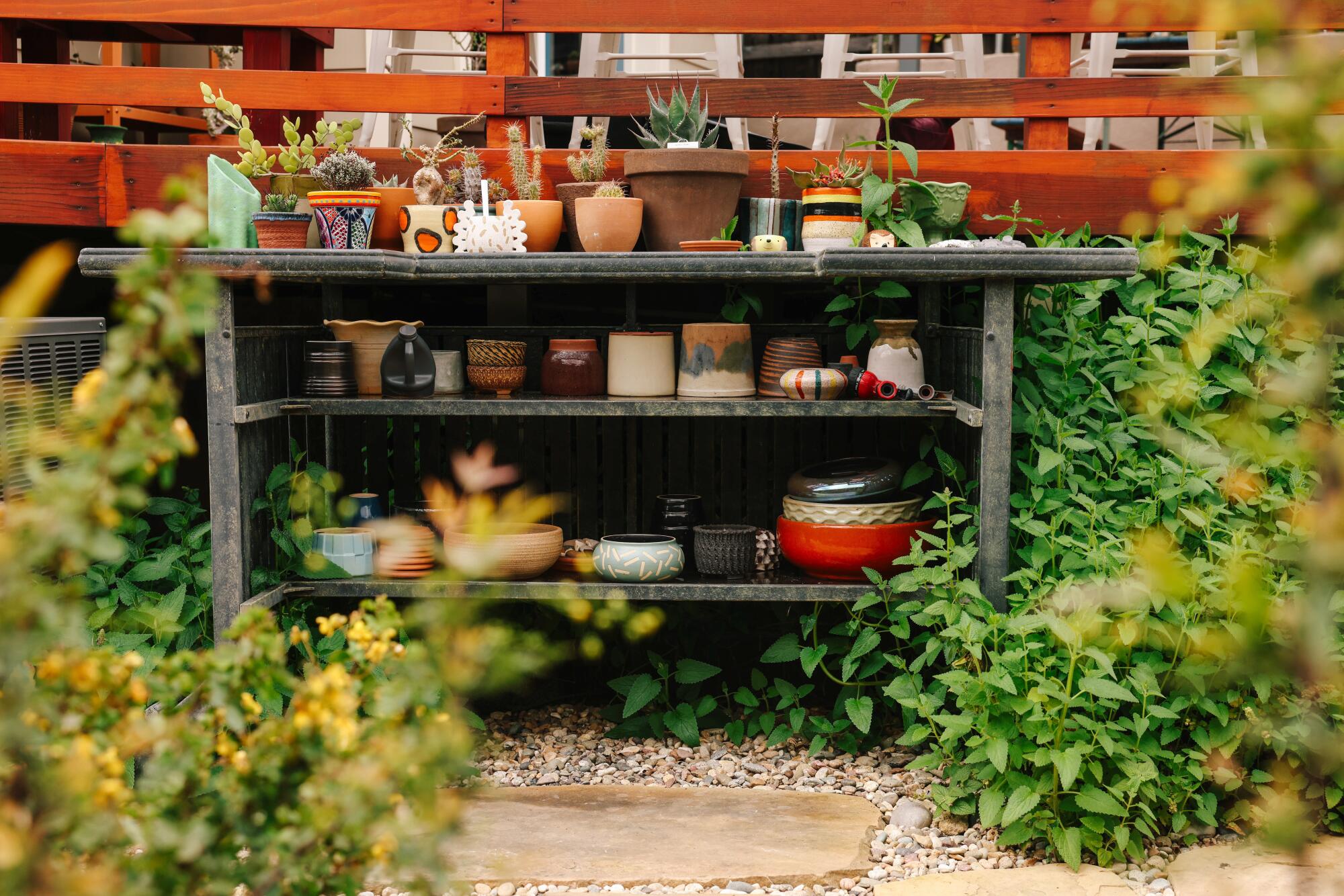
A relative’s discarded outdoor bar became the perfect potting bench for the couple’s backyard.
Clearly the technique works, because weeds — the bane of most gardens, including native plant landscapes — are visible nowhere in this yard. The plantings are jumbled but meticulous — almost Disney-esque — with brimming pots of succulents on the front porch and overflowing terraces of blue-blooming rosemary, a Mediterranean plant, along with native plants like evergreen currant (Ribes viburnifolium), island alum root (Heuchera maxima), fragrant blue pitcher sage (Lepechinia fragrans), bush sunflowers (Encelia californica) and island buckwheat hybrid (Eriogonum x blissianum)
It all looks perfect, down to the beautiful tangle of poppies and other native wildflowers in the narrow strip of parkway. But the process offered plenty of challenges, Zamora and Rojas said. “We’ve learned a lot along the way,” Rojas said.
Both men are California natives whose families enjoyed gardening and being outdoors, but they grew up around more traditional plants like roses, fruit trees and succulents. Plus, Rojas laughed, his parents kept him busy pulling weeds as a child.
When Zamora, an art department coordinator for TV shows like “No Good Deed,” bought the 1923 bungalow in 2009, the smallish backyard was filled with hard dirt and three junk cars, which thankfully were removed before he moved in in 2010. In the beginning, before he met Rojas, he focused more on the interior of the house and dabbled at planting just a few flower beds outside. He said his focus then was on showy drought-tolerant plants like statice and Pride of Madeira, a fast-growing perennial with giant purple blooms native to the Portuguese island of Madeira.
1
2
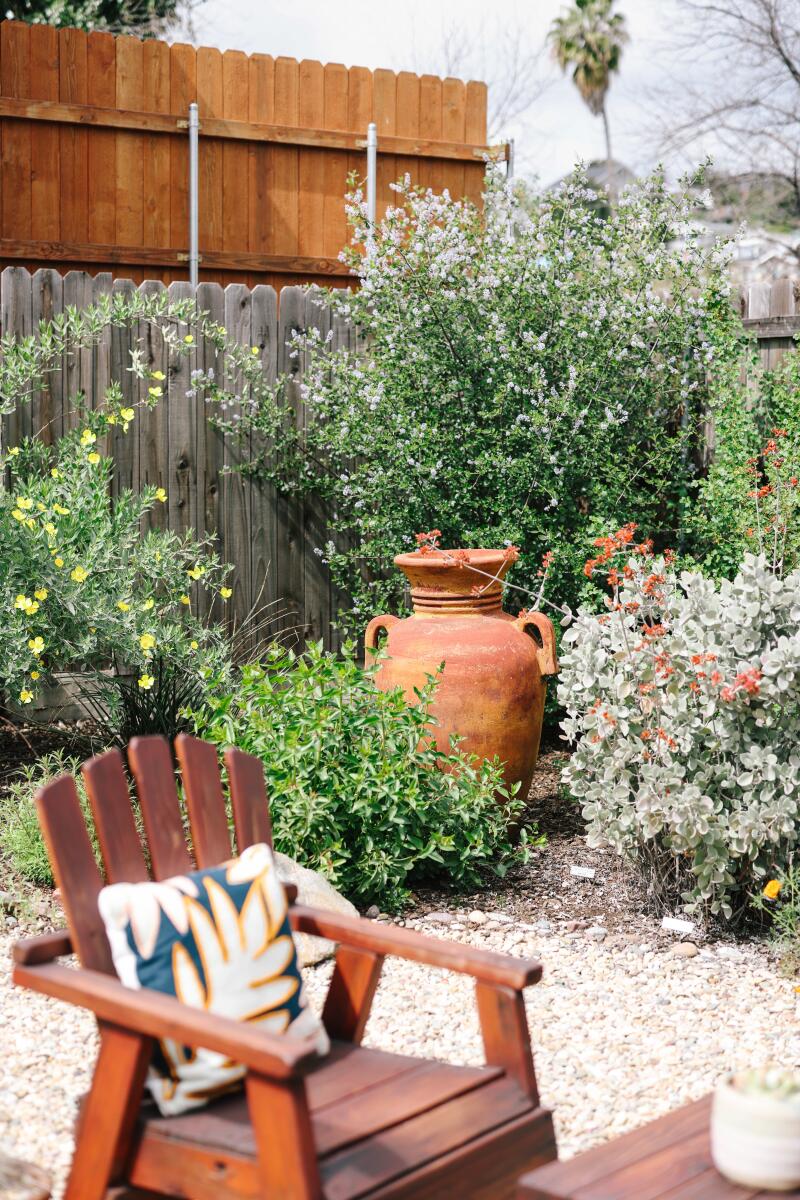
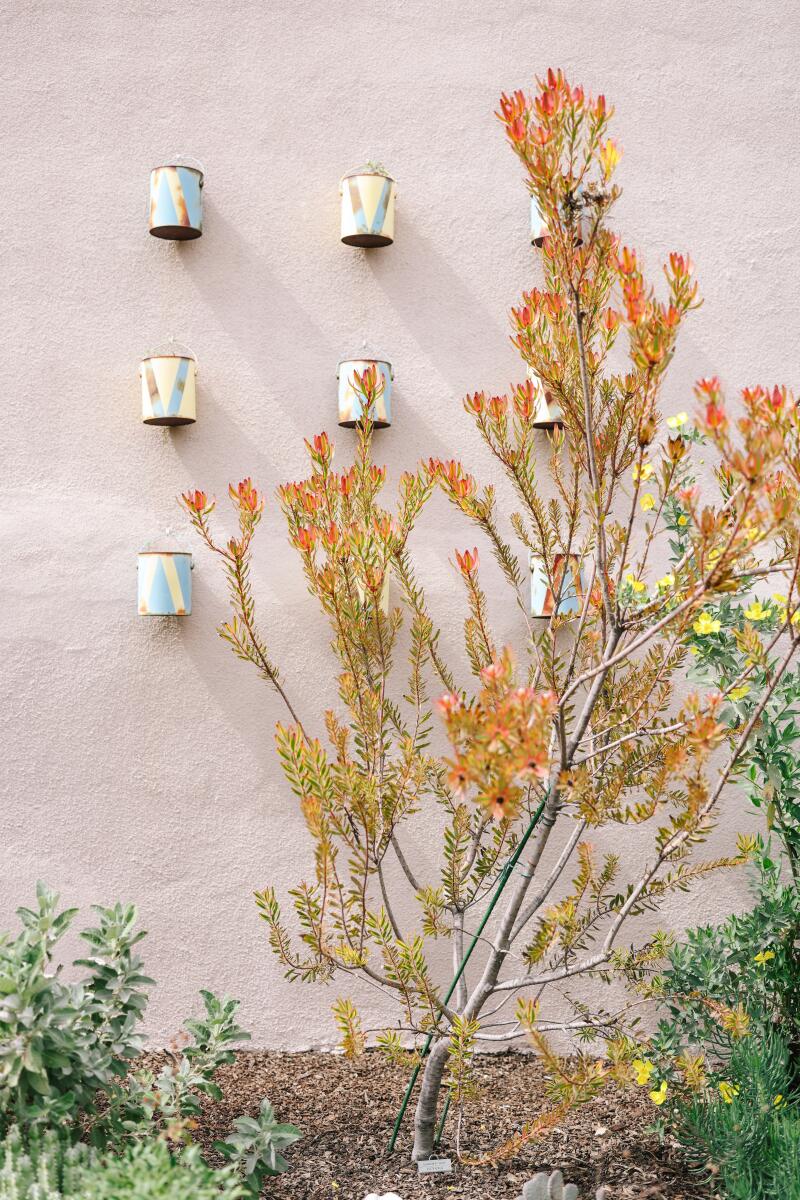
1. A leucadendron “Jester” from South Africa grows against a neighbor’s garage wall, against an artistic display of paint cans. The leucadendron is a holdover from Zamora’s earliest landscaping attempts, kept because it’s so popular with the hummingbirds. 2. (Dania Maxwell/Los Angeles Times)
“I didn’t realize these plants are invasive along the central coast,” he said. “I was just planting things because they looked pretty, and I knew they would grow because I’d seen them in other places.”
He added the leucadendron and grevillea for their showstopping, drought-tolerant blooms. But he also planted a white sage (Salvia apiana) because he admired the silvery green foliage of one of Southern California’s most famous indigenous plants during a local hike.
After Rojas moved in in 2012, the couple got more serious about the yard, visiting plant stores and nurseries to get ideas. In 2015, during a visit to Potted in Atwater Village, they saw a flier for the Theodore Payne tour and decided to give it try. It was easy to buy tickets for the tour in those days, Rojas said — “They didn’t sell out like they do today” — and the gardens they saw finally gave their landscaping a sharp focus: native plants.
“It was one of the best decisions we ever made,” Zamora said.
But once they started adding native plants in earnest, the challenges started. They amended their heavy clay soil with compost and other additives, something you would normally do to plant traditional landscape ornamentals and food. But after many of the new plants died, they learned their yard had mostly heavy, slow-draining clay soil, and that native plants prefer well-draining native soils over enriched garden plots.
“I learned that from one of Theodore Payne’s ‘Right Plant, Right Place’ classes that teaches you what plants do best in your situation,” Zamora said. “And I also used Calscape to find out if the plants I’m interested in will tolerate clay soils. That’s how we figured out a plan for adding plants we would love to have but don’t have a place where they will work.”
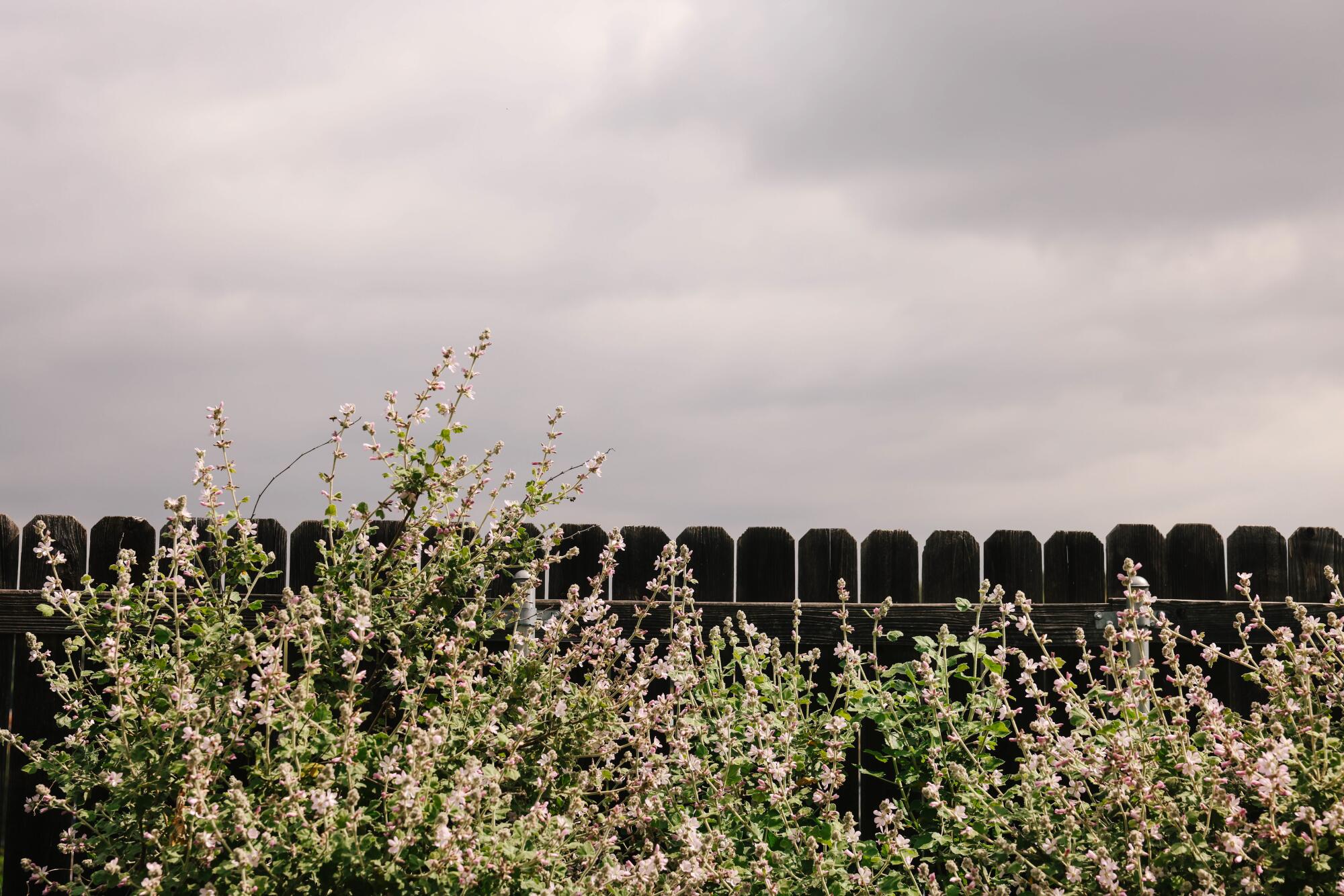
A San Clemente Island bushmallow loaded with pink blooms was planted from a one-gallon container and now grows exuberantly along the east fence of Raul Rojas and Thomas Zamora’s backyard.
They grow plants that don’t like clay in pots, such as the super-sweet smelling woolly bluecurls (Trichostema lanatum) near their side door; once established, it’s easily killed by too much water. The white sage has thrived, along with a very happy San Clemente Island bushmallow (Malacothamnus clementinus) that has grown from a one-gallon container to a massive shrub covered with blooms along their east fence.
They never really had a formal design, Zamora said. They tried things, and if it didn’t work, they tried something else. Initially they added two raised beds for vegetables but eventually removed one to create more space for paths and native plantings.
Adding pebble walkways helped solve problems with runoff and standing water in the backyard. “We do not have a bioswale [to capture rainwater until it drains into the soil] — I wish I had known about those when I was doing the walks,” Zamora said. “But I leveled the area so the water doesn’t pool now, and the rocks seem to help hold water so it doesn’t run off; it just seeps into the ground through the pavers.”
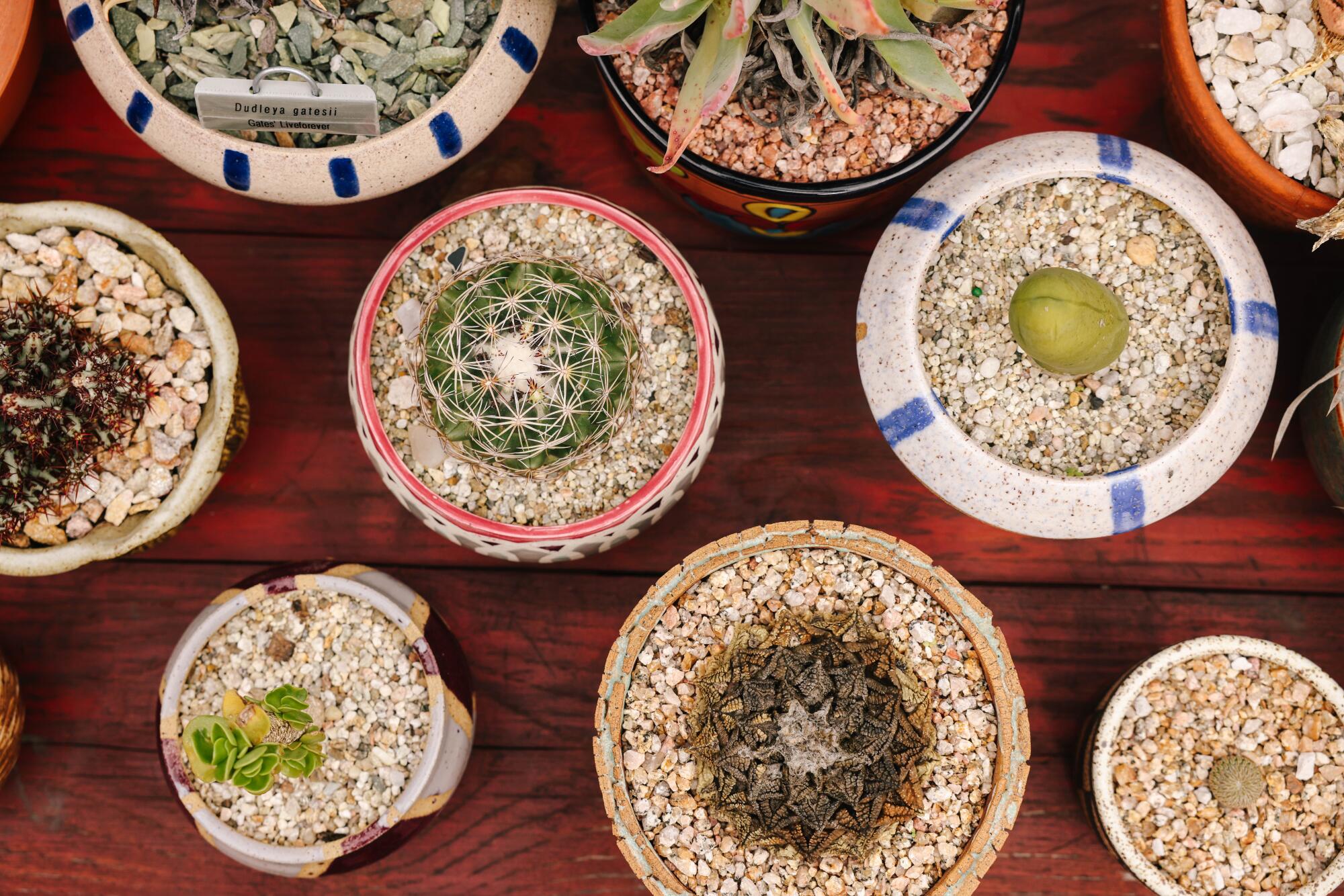
Succulents in colorful pots line the deck, front porch and potting bench at the home of Raul Rojas and Thomas Zamora.
Another helpful resource has been regular visits to the California Botanic Garden in Claremont, the state’s largest botanic garden devoted entirely to native plants. “It’s a peaceful place and very inspiring to see plants in their habitat,” Zamora said. “We went there lots during the pandemic because it was such a great place to walk around.”
They’re also regular customers of Hardy Californians, a pop-up native plant nursery in Sierra Madre. Rojas, an entertainment publicist, even volunteered there during the Hollywood actors’ strike in 2023, and came away an even bigger convert to the versatility and beauty of native plants.
“Our neighbors have been very positive,” Rojas said. “We got little signs for all the plants because people on neighborhood walks always ask us what we’ve planted, and what we recommend for a specific situation.”
A large ficus tree in the parkway outside their front door has died, probably because of damage when the street was dug up for water-pipe repairs. It’s a city-owned tree, Zamora said, so a city crew will have to remove it, “but we’re definitely going to talk to them about replacing it with something native.”
Over the years, they’ve gotten much more sanguine about the circle of life in their garden. “We’ve learned that gardening is a process and some plants do better than others,” Rojas said. “We used to get so upset — ‘OMG, this died!’ — but at this point, it’s more like, ‘Oh, this didn’t like that location.’ Now we see it as just a new planting opportunity.”
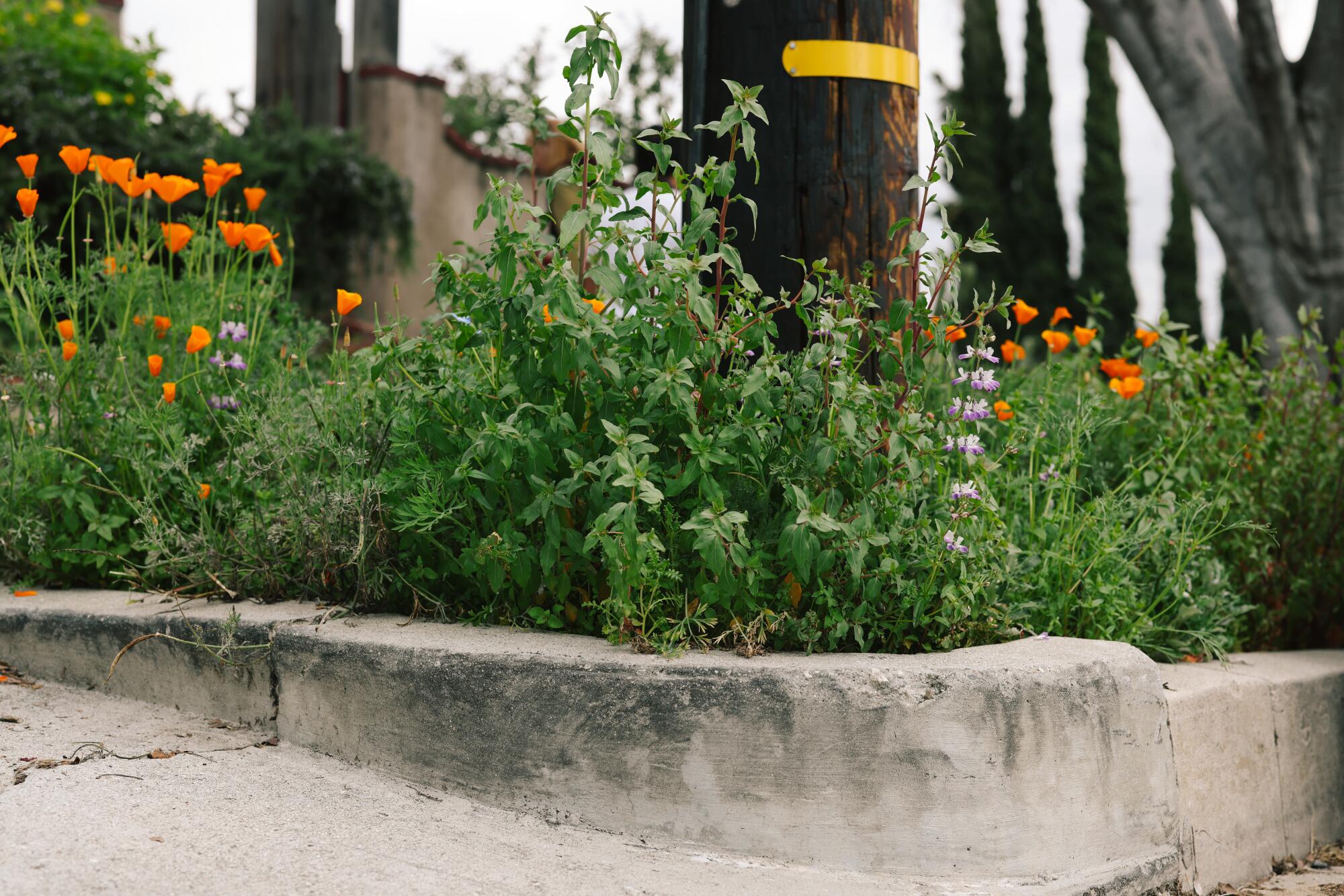
California poppies (Eschscholzia californica), purple Chinese houses (Collinsia heterophylla), baby blue eyes
(Nemophila menziesii) and other wildflowers grow thickly in the narrow parkway outside their home.



Tracy Morgan, left, and Daniel Radcliffe star in The Fall and Rise of Reggie Dinkins.
Scott Gries/NBC
hide caption
toggle caption
Scott Gries/NBC
Tracy Morgan, as a presence, as a persona, bends the rules of comedy spacetime around him.
Consider: He’s constitutionally incapable of tossing off a joke or an aside, because he never simply delivers a line when he can declaim it instead. He can’t help but occupy the center of any given scene he’s in — his abiding, essential weirdness inevitably pulls focus. Perhaps most mystifying to comedy nerds is the way he can take a breath in the middle of a punchline and still, somehow, land it.
That? Should be impossible. Comedy depends on, is entirely a function of, timing; jokes are delicate constructs of rhythms that take time and practice to beat into shape for maximum efficiency. But never mind that. Give this guy a non-sequitur, the nonner the better, and he’ll shout that sucker at the top of his fool lungs, and absolutely kill, every time.
Well. Not every time, and not everywhere. Because Tracy Morgan is a puzzle piece so oddly shaped he won’t fit into just any world. In fact, the only way he works is if you take the time and effort to assiduously build the entire puzzle around him.
Thankfully, the makers of his new series, The Fall and Rise of Reggie Dinkins, understand that very specific assignment. They’ve built the show around Morgan’s signature profile and paired him with an hugely unlikely comedy partner (Daniel Radcliffe).
The co-creators/co-showrunners are Robert Carlock, who was one of the showrunners on 30 Rock and co-created The Unbreakable Kimmy Schmidt, and Sam Means, who also worked on Girls5eva with Carlock and has written for 30 Rock and Kimmy Schmidt.
These guys know exactly what Morgan can do, even if 30 Rock relegated him to function as a kind of comedy bomb-thrower. He’d enter a scene, lob a few loud, puzzling, hilarious references that would blow up the situation onscreen, and promptly peace out through the smoke and ash left in his wake.
That can’t happen on Reggie Dinkins, as Tracy is the center of both the show, and the show-within-the-show. He plays a former NFL star disgraced by a gambling scandal who’s determined to redeem himself in the public eye. He brings in an Oscar-winning documentarian Arthur Tobin (Radcliffe) to make a movie about him and his current life.
Tobin, however, is determined to create an authentic portrait of a fallen hero, and keeps goading Dinkins to express remorse — or anything at all besides canned, feel-good platitudes. He embeds himself in Dinkins’ palatial New Jersey mansion, alongside Dinkins’ fiancée Brina (Precious Way), teenage son Carmelo (Jalyn Hall) and his former teammate Rusty (Bobby Moynihan), who lives in the basement.
If you’re thinking this means Reggie Dinkins is a show satirizing the recent rise of toothless, self-flattering documentaries about athletes and performers produced in collaboration with their subjects, you’re half-right. The show feints at that tension with some clever bits over the course of the season, but it’s never allowed to develop into a central, overarching conflict, because the show’s more interested in the affinity between Dinkins and Tobin.
Tobin, it turns out, is dealing with his own public disgrace — his emotional breakdown on the set of a blockbuster movie he was directing has gone viral — and the show becomes about exploring what these two damaged men can learn from each other.

On paper, sure: It’s an oil-and-water mixture: Dinkins (loud, rich, American, Black) and Tobin (uptight, pretentious, British, practically translucent). Morgan’s in his element, and if you’re not already aware of what a funny performer Radcliffe can be, check him out on the late lamented Miracle Workers.
Whenever these two characters are firing fusillades of jokes at each other, the series sings. But, especially in the early going, the showrunners seem determined to put Morgan and Radcliffe together in quieter, more heartfelt scenes that don’t quite work. It’s too reductive to presume this is because Morgan is a comedian and Radcliffe is an actor, but it’s hard to deny that they’re coming at those moments from radically different places, and seem to be directing their energies past each other in ways that never quite manage to connect.

Precious Way as Brina.
Scott Gries/NBC
hide caption
toggle caption
Scott Gries/NBC
It’s one reason the show flounders out of the gate, as typical pilot problems pile up — every secondary character gets introduced in a hurry and assigned a defining characteristic: Brina (the influencer), Rusty (the loser), Carmelo (the TV teen). It takes a bit too long for even the great Erika Alexander, who plays Dinkins’ ex-wife and current manager Monica, to get something to play besides the uber-competent, work-addicted businesswoman.
But then, there are the jokes. My god, these jokes.
Reggie Dinkins, like 30 Rock and Kimmy Schmidt before it, is a joke machine, firing off bit after bit after bit. But where those shows were only too happy to exist as high-key joke-engines first, and character comedies second, Dinkins is operating in a slightly lower register. It’s deliberately pitched to feel a bit more grounded, a bit less frenetic. (To be fair: Every show in the history of the medium can be categorized as more grounded and less frenetic than 30 Rock and Kimmy Schmidt — but Reggie Dinkins expressly shares those series’ comedic approach, if not their specific joke density.)
While the hit rate of Reggie Dinkins‘ jokes never achieves 30 Rock status, rest assured that in episodes coming later in the season it comfortably hovers at Kimmy Schmidt level. Which is to say: Two or three times an episode, you will encounter a joke that is so perfect, so pure, so diamond-hard that you will wonder how it has taken human civilization until 2026 Common Era to discover it.
And that’s the key — they feel discovered. The jokes I’m talking about don’t seem painstakingly wrought, though of course they were. No, they feel like they have always been there, beneath the earth, biding their time, just waiting to be found. (Here, you no doubt will be expecting me to provide some examples. Well, I’m not gonna. It’s not a critic’s job to spoil jokes this good by busting them out in some lousy review. Just watch the damn show to experience them as you’re meant to; you’ll know which ones I’m talking about.)
Now, let’s you and I talk about Bobby Moynihan.
As Rusty, Dinkins’ devoted ex-teammate who lives in the basement, Moynihan could have easily contented himself to play Pathetic Guy™ and leave it at that. Instead, he invests Rusty with such depths of earnest, deeply felt, improbably sunny emotions that he solidifies his position as show MVP with every word, every gesture, every expression. The guy can shuffle into the far background of a shot eating cereal and get a laugh, which is to say: He can be literally out-of-focus and still steal focus.
Which is why it doesn’t matter, in the end, that the locus of Reggie Dinkins‘ comedic energy isn’t found precisely where the show’s premise (Tracy Morgan! Daniel Radcliffe! Imagine the chemistry!) would have you believe it to be. This is a very, very funny — frequently hilarious — series that prizes well-written, well-timed, well-delivered jokes, and that knows how to use its actors to serve them up in the best way possible. And once it shakes off a few early stumbles and gets out of its own way, it does that better than any show on television.
This piece also appeared in NPR’s Pop Culture Happy Hour newsletter. Sign up for the newsletter so you don’t miss the next one, plus get weekly recommendations about what’s making us happy.
Listen to Pop Culture Happy Hour on Apple Podcasts and Spotify.

Andy Richter has found his place.
The Chicago area native previously lived in New York — where he first found fame as Conan O’Brien’s sidekick on “Late Night” — before moving to Los Angeles in 2001. Three years ago, he moved to Pasadena. “Now that I live here, I would not live anywhere else,” he says.
There are some practical benefits to the city. “I am such a crabby old man now, but it’s like, there’s parking, you can park when we have to go out,” Richter says. “The notion of going to dinner in Santa Monica just feels like having nails shoved into my feet.”

In Sunday Funday, L.A. people give us a play-by-play of their ideal Sunday around town. Find ideas and inspiration on where to go, what to eat and how to enjoy life on the weekends.
But he mostly appreciates that Pasadena is “a very diverse town and just a beautiful town,” he says.
For Richter, most Sundays revolve around his family. In 2023, the comedian and actor married creative executive Jennifer Herrera and adopted her young daughter, Cornelia. (He also has two children in their 20s, William and Mercy, from his previous marriage.)
Additionally, he’s been giving his body time to recover. Richter spent last fall training and competing on the 34th season of “Dancing With the Stars.” And though he had no prior dancing experience, he won over the show’s fan base with his kindness and dedication, making it to the competition’s ninth week.
He hosts the weekly show “The Three Questions” on O’Brien’s Team Coco podcast network and still appears in films and TV shows. “I’m just taking meetings and auditioning like every other late 50s white comedy guy in L.A., sitting around waiting for the phone to ring.”
This interview has been lightly edited and condensed for length and clarity.

7:30 a.m.: Early rising
It’s hard for me at this advanced age to sleep much past 7:30. I have a 5 1/2-year-old, and hopefully she’ll sleep in a little bit longer so my wife and I can talk and snuggle and look at our phones at opposite ends of the bed, like everybody.
Then the dogs need to be walked. I have two dogs: a 120-pound Great Pyrenees-Border Collie-German Shepherd mix, and then at the other end of the spectrum, a seven-pound poodle mix. We were a blended dog family. When my wife and I met, I had the big dog and she had a little dog. Her first dog actually has passed, but we like that dynamic. You get kind of the best of both worlds.

8 a.m.: Breakfast at a classic diner
Then it would probably be breakfast at Shakers, which is in South Pasadena. It’s one of our favorite places. We’re kind of regulars there, and my daughter loves it. It’s easy with a 5-year-old, you’ve got to do what they want. They’re terrorists that way, especially when it comes to cuisine.
I’ve lived in Pasadena for about three years now, but I have been going to Shakers for a long time because I have a database of all the best diners in the Los Angeles metropolitan area committed to memory. There’s just something about the continuity of them that makes me feel like the world isn’t on fire. And because of L.A.’s moderate climate, the ones here stay the way they are; whereas if you get 18 feet of winter snow, you tend to wear down the diner floor, seats, everything.
So there’s a lot of really great old places that stay the same. And then there are tragic losses. There’s been some noise that Shakers is going to turn into some kind of condo development. I think that people would probably riot. They would be elderly people rioting, but they would still riot.
11 a.m.: Sandy paws
My in-laws live down in Long Beach, so after breakfast we might take the dogs down to Long Beach. There’s this dog beach there, Rosie’s Beach. I have never seen a fight there between dogs. They’re all just so happy to be out and off-leash, with an ocean and sand right there. You get a contact high from the canine joy.

1 p.m.: Lunch in Belmont Shore
That would take us to lunchtime and we’ll go somewhere down there. There’s this place, L’Antica Pizzeria Da Michele, in Belmont Shore. It’s fantastic for some pizza with grandma and grandpa. It’s originally from Naples. There’s also one in Hollywood where Cafe Des Artistes used to be on that weird little side street.

4 p.m.: Sunset at the gardens
We’d take grandma and grandpa home, drop the dogs off. We’d go to the Huntington and stay a couple of hours until sunset. The Japanese garden is pretty mind-blowing. You feel like you’re on the set of “Shogun.”
The main thing that I love about it is the changing of ecospheres as you walk through it. Living in the area, I drive by it a thousand times and then I remember, “Oh yeah, there’s a rainforest in here. There’s thick stands of bamboo forest that look like Vietnam.” It’s beautiful. With all three of my kids, I have spent a lot of time there.

6:30 p.m.: Mall of America
After sundown, we will go to what seems to be the only thriving mall in America — [the Shops at] Santa Anita. We are suckers for Din Tai Fung. My 24-year-old son, who’s kind of a food snob, is like, “There’s a hundred places that are better and cheaper within five minutes of there in the San Gabriel Valley.” And we’re like, “Yeah, but this is at the mall.” It’s really easy. Also, my wife is a vegetarian, and a lot of the more authentic places, there’s pork in the air. It’s really hard to find vegetarian stuff.
We have a whole system with Din Tai Fung now, which is logging in on the wait list while we’re still on the highway, or ordering takeout. There’s plenty of places in the mall with tables, you can just sit down and have your own little feast there.
There’s also a Dave & Buster’s. If you want sensory overload, you can go in there and get a big, big booze drink while you’re playing Skee-Ball with your kid.
9 p.m.: Head to bed ASAP
I am very lucky in that I’m a very good sleeper and the few times in my life when I do experience insomnia, it’s infuriating to me because I am spoiled, basically. When you’ve got a 5 1/2-year-old, there’s no real wind down. It’s just negotiations to get her into bed and to sleep as quickly as possible, so we can all pass out.

new video loaded: Prada Peels Back the Layers at Milan Fashion Week
By Chevaz Clarke and Daniel Fetherston
February 27, 2026

Movie review: Ballet-themed erotic drama ‘Dreams’ dissipates in finale

Takeaways from AP’s report on the ICE detention center holding children and parents

2 Survivors Describe the Terror and Tragedy of the Tahoe Avalanche
‘The Fall and Rise of Reggie Dinkins’ falls before it rises — but then it soars

Xiaomi 17 is a small(ish) phone with a big(ish) battery

Florida High School Football Rankings: Top 25 teams – Oct. 21

Cleary's 21 help Le Moyne down Central Connecticut State 69-64 in OT

How old is Bo Nix? What to know about Oregon quarterback ahead of 2024 NFL Draft

99th annual Pony Swim held in Virginia

Indiana Members Credit Union announced as new anchor tenant at Bottleworks District
2 Survivors Describe the Terror and Tragedy of the Tahoe Avalanche

Iran fires missiles at US bases across Middle East after American strikes on nuclear, IRGC sites

Israel strikes two schools in Iran, killing more than 50 people

Anthropic CEO says he’s sticking to AI “red lines” despite clash with Pentagon

ICE blasts Washington mayor over directive restricting immigration enforcement
-

 World3 days ago
Exclusive: DeepSeek withholds latest AI model from US chipmakers including Nvidia, sources say
-

 Massachusetts3 days ago
Mother and daughter injured in Taunton house explosion
-

 Montana1 week ago
2026 MHSA Montana Wrestling State Championship Brackets And Results – FloWrestling
-

 Louisiana5 days ago
Wildfire near Gum Swamp Road in Livingston Parish now under control; more than 200 acres burned
-

 Denver, CO3 days ago
10 acres charred, 5 injured in Thornton grass fire, evacuation orders lifted
-

 Technology1 week ago
YouTube TV billing scam emails are hitting inboxes
-

 Technology1 week ago
Stellantis is in a crisis of its own making
-

 Politics1 week ago
OpenAI didn’t contact police despite employees flagging mass shooter’s concerning chatbot interactions: REPORT