Lifestyle
They lost their homes to fire. Now they’re rebuilding with all-electric.
No one is forcing fire survivors in Altadena and Pacific Palisades to rebuild their new homes all-electric. But many of them want to, for health reasons, cost savings, or because they’re worried about climate change.
Burning gas and propane for cooking, water heating and space heating in California homes and businesses creates 10% of the state’s greenhouse gas emissions. It also releases pollutants indoors.
That’s why, in recent years, state policy has pushed toward electrification, and about 39% of new homes in California in 2024 went in without gas lines. Only 8% of all homes were all-electric in 2020.
Yet after last year’s fires, Gov. Gavin Newsom waived a 2025 building code that strongly encouraged electric heat pumps in new construction, allowing residents in the burn zones to build back to older, less efficient standards.
The city of L.A. also waived a requirement that new homes be all-electric.
Climate experts called these rollbacks a missed opportunity. Early figures show 1,300 residents have already have applied for reconnections through SoCalGas, which serves most of Los Angeles.
Yet some determined groups of neighbors are building all-electric anyway, even without the requirements. Here are some of their reasons:
Neighbors building passive homes in Altadena
Leo Cheng is part of a group of about 10 Eaton fire survivors working together to build passive homes in Altadena.
Felipe Jimenez, a construction foreman, reads plans for a new home on East Mariposa Street in Altadena on Friday.
(Gary Coronado / For The Times)
A passive house is airtight and highly insulated, designed to reduce the need for air conditioning and heating to the highest extent possible.
Cheng, who previously lived in a home with a gas stove, furnace and water heater, became interested in the concept when he learned that it could keep out more smoke and toxic ash during a fire.
He sees passive homes as going hand in hand with all-electric appliances, because “with airtight construction, having a gas stove in the house especially doesn’t make sense” for indoor air quality.
Cheng was one of the western Altadena residents who received evacuation orders late on Jan. 7, 2025. He remembers rushing out of his house in the middle of the night without time to turn off the gas, so he also likes the idea of reducing fire risk by eliminating it all together.
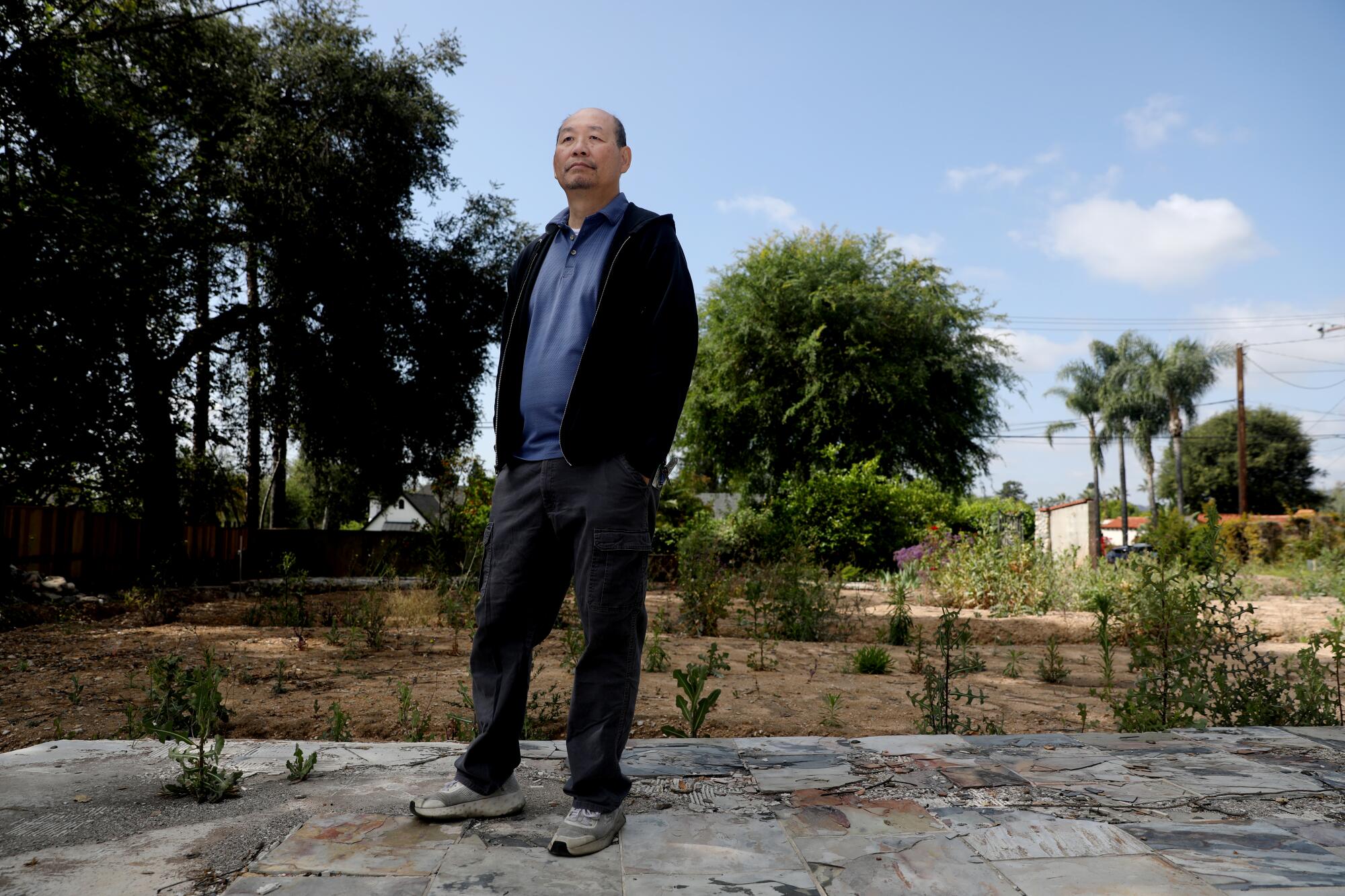
Leo Cheng, 60, on the site where he lived with his wife in a 1960s California ranch home on East Calaveras Street in Altadena.
(Gary Coronado / For The Times)
After going on a passive house tour led by his neighbor Jaime Rodriguez, whom he credits with sparking the passive house movement in Altadena, Cheng became part of a small but growing group that meets once a week to support one another with rebuilding energy-efficient, all-electric homes. A former NASA Jet Propulsion Laboratory engineer, he has decided to become a passive house consultant.
Besides indoor air quality, climate change is a big concern.
“I’m a firm believer that climate change played a big role in how intense and how widespread these fires were,” Cheng said. “Using fossil fuel in this day and age is not a good idea.”
Companies building all-electric catalog homes
Building a custom-designed home can bring an array of hurdles. For those looking for a simpler and more affordable approach, the Foothill Catalog Foundation offers pre-approved, all-electric home designs in styles that honor the architectural legacy of Altadena.
Local architects Cynthia Sigler and Alex Athenson took inspiration from early 20th century Sears catalogs that sold homes as kits when they founded the nonprofit last year.
They’re already working with 11 families with homes under construction, and have 50 more signed on to build their catalog homes.
Athenson said they didn’t set out to design their models all-electric but decided to go that route for health and safety reasons. Another factor was the money and time they could save clients by cutting out the need for two utility hookups.
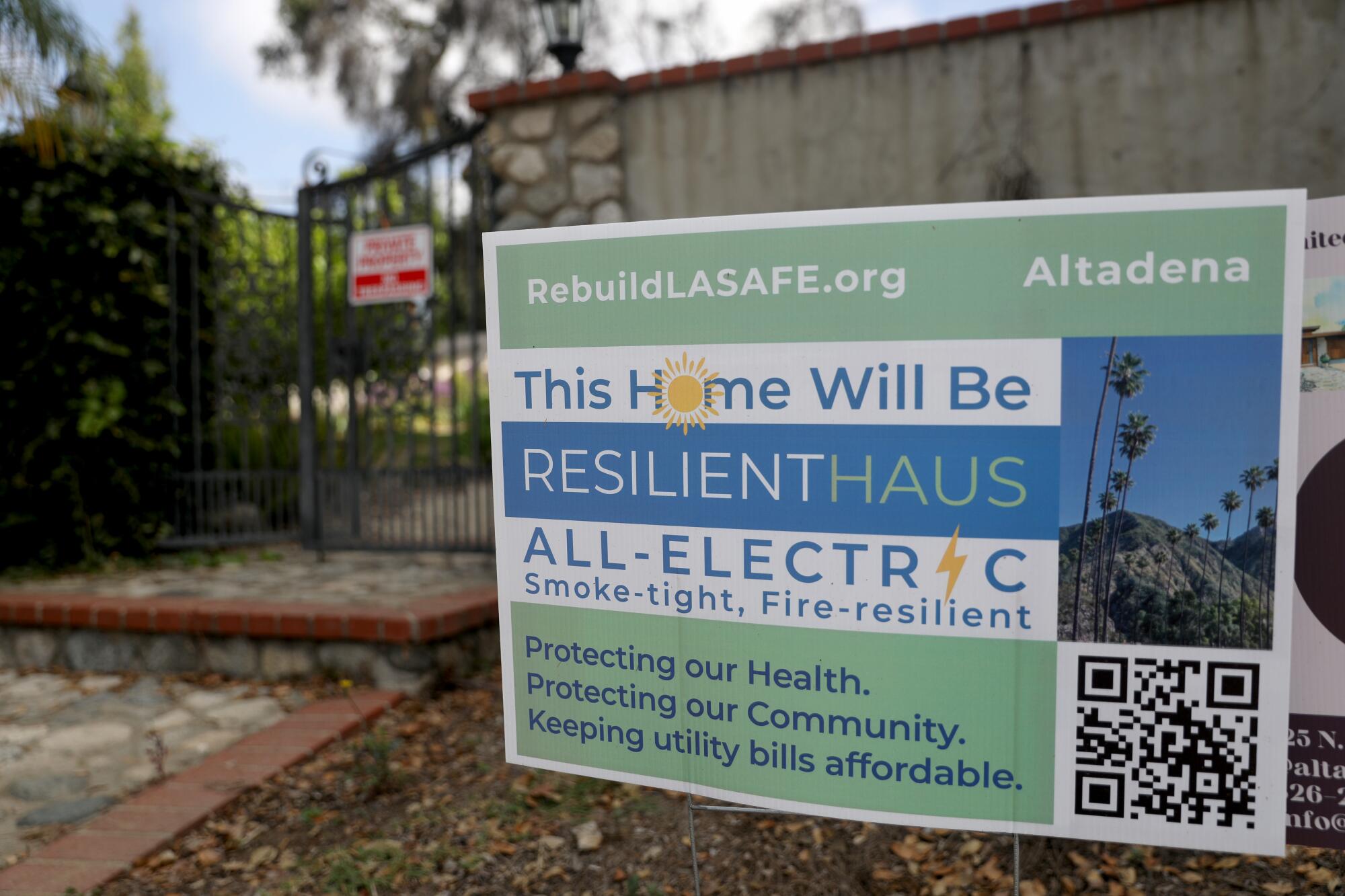
A sign in front of the home of Leo Cheng announcing that an all-electric home will be built where his home burned down during the Eaton fire.
(Gary Coronado / For The Times)
According to the Building Decarbonization Coalition, an electrification advocacy group, all-electric homes cost $3,000 to $10,000 less to build than mixed fuel homes in Los Angeles. That savings helps when it comes to buying appliances like heat pumps, which are the most efficient but tend to be more expensive up front.
The heat pump will yield lower utility bills for summer cooling because they use far less electricity than traditional air conditioners. They create winter heat bill savings in L.A. too.
The biggest question Athenson gets from clients is about electric cooking, especially when they’re used to cooking with gas. But he said concerns usually fall away when they learn more about induction stoves. “If you ask most chefs, that’s the most dialed-in, precise way to cook,” he said.
Genesis Builders LA is also offering fixed-price, pre-approved catalog homes in Altadena, with models that can be all-electric or use gas. Builder Devang Shah said he’s working with about 30 fire survivors, half of whom opted for all-electric.
“Some people have preferences for gas cooking and the look of a gas-lit fireplace,” said Shah. But all his clients will use electric heat pumps for space and water heating. Although the state waived a requirement that all new homes have solar for the burn areas, they still must be solar-ready. Shah’s models all come with solar and that, he said, helps heat pumps pencil out every time.
An incentive program for all-electric rebuilds
After a long delay, a $22-million incentive program launched on April 6 to support residents rebuilding all-electric in California disaster areas served by investor-owned utilities like Southern California Edison. Customers can qualify for $7,000 to $10,000 in subsidies, with more available for low-income fire survivors and bonuses for batteries and passive homes.
In just the first 10 days, 116 people from Altadena applied.
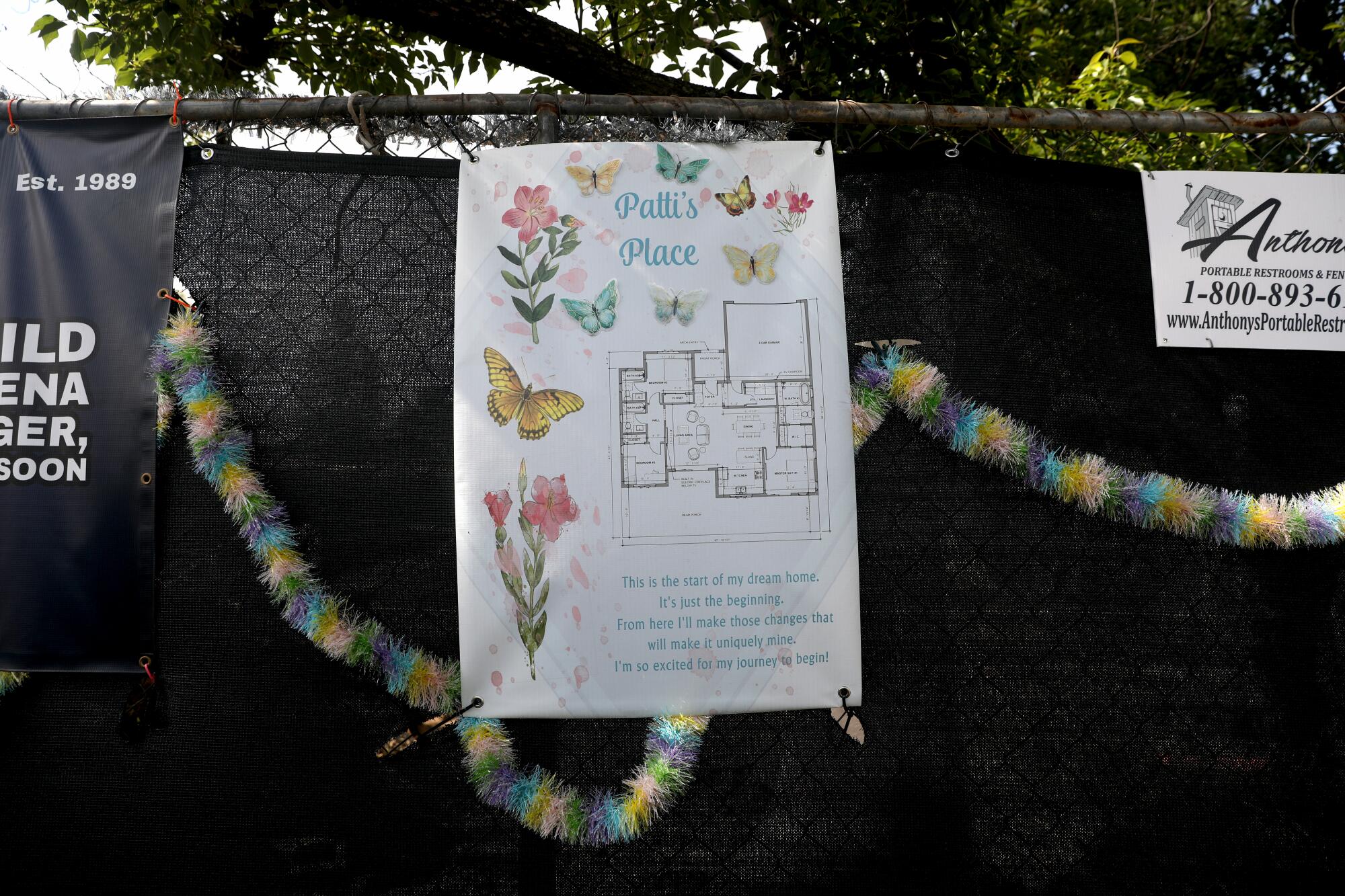
A plan for a new home along East Altadena Drive.
(Gary Coronado / For The Times)
Los Angeles Department of Water and Power, which serves most of the Palisades, also has a rebate program for electric wildfire rebuilds, with subsidies for all-electric homes or individual appliances.
Reza Akef, a builder in the Palisades and chair of the Pacific Palisades Community Council’s Infrastructure Committee, said people do consider these incentives in deciding what appliances to buy. On the other hand, SoCalGas offers wildfire rebates for more energy-efficient gas appliances. More than 1,100 households have enrolled.
About 90% of Akef’s 45 Palisades clients will keep gas. He said the fuel is faster for pool and spa heating, where electric heat pumps are more energy-efficient than gas but heat the water more slowly. Some of his clients feel a gas line will boost the resale value of their home, he said, and others have concerns about relying on one electric utility if the power goes out.
A spokesperson for Newsom said California is “aggressively pursuing widespread electrification” but would not burden survivors with “additional mandates and red tape.” Mayor Karen Bass’ office said she was giving Palisadians “options of how they want to rebuild,” with fire resiliency at the forefront.
Kari Weaver is an interior designer who lost her home in the Palisades fire and a member of Resilient Palisades, a group that’s advocating all-electric rebuilds. She plans to build an all-electric home with a solar and battery system in case of blackouts. But she’ll keep a gas line on the property and is still deciding if she’ll connect it to her pool. She’s looking into options like a cover that insulates the water, hybrid heaters and new electric heating models.
“These types of appliances are getting better all the time,” she said.

Lifestyle
L.A.’s unofficial Statue of Liberty is a Fashion Nova billboard off the 10 Freeway
This story is part of Image’s April’s Thresholds issue, a tour of L.A. architecture as it’s actually experienced.
A landmark is a landmark because it tells you that you’re home now — the piece of earth you’ve chosen to inhabit saying, “You’ve made it back, congratulations.” We identify our cities with their landmarks, and because we identify with our cities, we identify with the landmarks too. They are us and we are them, mirroring each other through eternity. A city like New York or Chicago, with the Chrysler Building, the Bean, etc., has landmarks that exist in the world’s popular consciousness. But L.A.’s most cherished landmarks belong to us and us alone, a secret you’re let in on if you live here long enough and pay attention.
The Fashion Nova baddie in horizontal sprawl off the Vertigo, for example, is an emblem for those in the know. Our twisted version of a capitalist guardian angel, patron saint of spandex in a cropped matching set. Welcome to El Pueblo de Nuestra Señora la Reina de los Ángeles de Fashion Nova. Merging on the 110 South from the 10 East while the sunset burns and traffic thickens is a miracle in more ways than one, and in the spirit of compulsively performing the sign of the cross when you pass a church on the freeway, this billboard is deserving of its own acknowledgment.
It may not be the landmark L.A. asked for, but in Sayre Gomez’s painting “Vertigo,” you begin to understand why it’s the one we deserve. At the opening for “Precious Moments,” Gomez’s solo show at David Kordansky, the room was vibrating. A game of energetic ping-pong unfolded underneath the gallery’s fluorescent light, beams of identification, recollections or stabs of grief bouncing off each piece in the exhibition. People were seeing hyperspecific parts of a city they love reflected in a hyperspecific way — for better and for worse. Recognition has two edges and they both happen to be sharp. Gomez twists the knife deeper for a good cause: He wants you not just to look but to really see.
In his work exist iconic signs of beloved local establishments — like the Playpen — the blinding glint reflecting off downtown’s skyline, telephone poles regarded as totems. The line to see Gomez’s replica of L.A.’s graffiti towers, “Oceanwide Plaza,” snaked through the gallery’s courtyard. Once inside, at least three graffiti writers whose names were blasted on the replica pointed it out proudly, even gave out stickers to take home. The truth can be beautiful and it can be ugly — in this case it’s both — on the flip side showing up in the form of smog, tattered flags and an abandoned graffiti tower that starkly represents the pitfalls of capitalism and greed, a neon arrow pointing to the homelessness crisis.
Because the Vertigo is something everybody who lives here recognizes as central to a sort of framework of Los Angeles. And I think the encampment has become that as well. It’s connecting these integral components — something that’s more revelatory and more fun with something that’s more grave.
— Sayre Gomez
In the main gallery, I was stuck on “Vertigo.” On the 12-foot canvas, my eye went to the place out of focus: the thin strip of billboard in the background featuring a young woman with sand-dune hips, patent knee-high boots and long black hair laid up on her side, wearing cat ears and a tiger bodysuit as flush as second skin. The model made the kind of eye contact that felt dangerous — might cause an accident if you’re not careful. “#1 Halloween Destination … FASHION NOVA,” it read. I knew her, anyone who has driven through the two main arteries of Los Angeles knows her. The black-and-white smiley motif of the Vertigo, an events space, sat right next to her face, just happy to be there, it seemed, above a painted sign that says “Ready to Party?”
The sky was the color of cotton candy, but the stale kind that’s been hardening in a plastic bag for days after the fair. Something rancid about it. In the foreground of the painting was a car encampment with a tattered floral sheet woven through the windows, cloth tarps and couch cushions creating a shield against the elements. Small plastic children’s toys lined at the top of the car — dinosaurs and dump trucks and sharks — creating their own shrunken skyline in front of the Vertigo, signaling that young kids likely lived there. It’s less juxtaposition for juxtaposition’s sake and more an accurate reflection of the breakneck duality of living in a place like L.A.
Even angels exist within the context of their environments. Our Fashion Nova baddie hangs off the Vertigo, a building that has used its ad space as physical clickbait and political posturing for over a decade. It’s promoting the kind of fast fashion brand that’s been regarded as a case study on the industry’s environmental impact. In the years the billboard has been up, it’s looked over dozens and dozens of car encampments like the one depicted in Gomez’s piece.
She feels dubious, yes. But no less like ours.
Julissa James: I’ve lived in L.A. for 13 years now. For me, the city and the architecture of the city is less the Frank Lloyd Wrights and Frank Gehrys — there’s that — but other landmarks that signal, “Oh, I’m home.” The Fashion Nova baddie above the Vertigo has always been that for me. Your piece is layered and there’s so much more to it than just that, but that’s the first thing I saw and was like, “Whoa. I need to talk to Sayre. We need to talk about ‘Vertigo.’”
Sayre Gomez: It’s like L.A.’s Statue of Liberty. It’s the city of anti-landmarks, you know what I mean? I mean, there’s the Hollywood sign, which I think is so telling, because it’s the remnants of a real estate venture. The city is built by real estate schemes and 100 years later we’re feeling the effects of it. You’ve got empty skyscrapers and a massive homeless catastrophe. L.A. doesn’t really have real landmarks. It has anti-landmarks.
JJ: When did the Fashion Nova billboard above the Vertigo click for you as something that felt representative of the city, or something that you wanted to depict?
SG: My studio is in Boyle Heights, so I pass that billboard multiple times a week. This is my 20th year in L.A. and that building’s always been a big mystery to me. It was empty when I moved here before this guy Shawn Farr bought it and turned it into Casa Vertigo. I think he probably makes more money on it with the ad space than anything. I know nobody who has ever been there. Very mysterious to me. So that’s what I was drawn to.
(Paul Salveson from David Kordansky Gallery)
The Vertigo has always been mysterious to me. And that whole fashion industry is mysterious to me — the kind of shmatta, American Apparel-adjacent, or maybe coming out of the wake of that. These kinds of businesses, or the representations of these businesses, how do they function and how do they flourish? Is it aboveboard? What more perfectly encapsulates that than that building? It’s this weird thing you can’t quite figure out but somehow it has a lot of money and then it’s an event space, supposedly billed as that. Clearly it’s this big ad thing, and I’m very interested in the changing dynamics of capital. The capital of yesteryear, which was based on the brick and mortar, where things are being made in a specific location, maybe on an assembly line or in a specific way, to a kind of capital that is based solely on advertising or on viewership. These beautiful buildings acting as pedestals for some kind of ad space, you know? It becomes an anti-landmark for me. Something where I’m like, “Oh, there’s that thing again.”
JJ: It’s this gorgeous Beaux Arts building …
SG: It’s a Freemason building!
JJ: When I’ve talked to some people about the Vertigo, they’re like, “the Fashion Nova building?”
SG: They always have the woman in the same pose — same pose, different clothes. If you remember before Fashion Nova, they would have these provocative ad campaigns or provocative slogans. “Twerk Miley” was up, remember that? They did a Trump one: “TRUMP NOW.” They did one for Kanye when he ran for president. The 10 and the 110 are literally the crossroads of the city, so it’s really poised to be a special building. It has a special designation because of the location.
JJ: Talk to me about the process of doing this piece. Where did it start and how did it evolve?
SG: I was cruising around that vicinity trying to see if I could get a good vantage point to take photos of Vertigo. And then I stumbled upon this car — the car that’s in the foreground of the painting. Anytime I see an encampment that has kids’ toys, things that reference back to the lives of children, it hits hard. But I like to lay it all out there. I like to make things confrontational. I want it to be difficult. The painting isn’t based on a one-to-one photo [Gomez paints from a composite rendering of images he’s taken around town], but I knew that I wanted to use that car, and I knew I wanted to get the Vertigo building, and so I started just messing around with different iterations. I could never find a good angle to take a good photo of the building, so I just went on Vertigo’s website and I was like, “I’m just using these.” I switched the sky and put a more moody, atmospheric sky in.
JJ: Which I loved, because we know that feeling — you’re merging onto the 110 and you see a beautiful sunset. The euphoria of like, “L.A. is the best city in the world.” But you know what? What I found so interesting about your piece is that it was revealing to me about myself, but also about so many of us that live in L.A. and have lived here for years and have developed a jadedness. When I saw your piece, immediately I was like, “Oh my God, the Vertigo! The Vertigo! The Vertigo!” And then I was like, “OK, wait, hold on, there’s so much more going on here.” But the fact that my eye went to that first instead of the car encampment, the kids’ toys, brought up a lot of questions about my own relationship to the city and the things that we choose to see, the things that maybe we’ve seen so much of that we subconsciously filter it out. Why was it important for you to put these two things up against each other in this way?
SG: Because the Vertigo is something everybody who lives here recognizes as central to a sort of framework of Los Angeles. And I think the encampment has become that as well. It’s connecting these integral components — something that’s more revelatory and more fun with something that’s more grave. That’s what I’m doing in my work at large. I use the sunsets and the beauty to create a dialogue, to entice people to sort of look a little bit at how things are contextualized, how things act, what’s actually happening. I don’t make things in a vacuum. I was working on this show and I was going to really push this agenda of incorporating more of my experience with my kids into the work. That’s also a double-edged sword. I wanted to interject some levity, because the work can get so dark. I wanted to bring in some iconography from their world and things that they get excited about. When you’re juxtaposing that with really stark things, it becomes darker. I want to thicken the stock a little bit. Make things a little more complex.
Lifestyle
‘Wait Wait’ for April 18. 2026: With Not My Job guest Phil Pritchard
Phil Pritchard of the Hockey Hall of Fame works the 2019 NHL Awards at the Mandalay Bay Events Center on June 19, 2019 in Las Vegas, Nevada. (Photo by Bruce Bennett/Getty Images)
Bruce Bennett/Getty Images
hide caption
toggle caption
Bruce Bennett/Getty Images
This week’s show was recorded in Chicago with host Peter Sagal, judge and guest scorekeeper Alzo Slade, Not My Job guest Phil Pritchard and panelists Alonzo Bodden, Adam Burke, and Dulcé Sloan. Click the audio link above to hear the whole show.
Who’s Alzo This Time
The Don Vs The Poppa; World’s Worst Doctor; Should We Eat That?
Panel Questions
Big Cheese News!
Bluff The Listener
Our panelists tell three stories about someone missing a huge opportunity in the news, only one of which is true.
Not My Job: Phil Pritchard, the NHL’s Keeper of the Stanley Cup, answers three questions about the other NHL, National Historic Landmarks
Peter talks to Phil Pritchard, the NHL’s Keeper of the Stanley Cup. Phil plays our game called, “Let’s Go Visit The NHL” Three questions about National Historic Landmarks.
Panel Questions
The Trump Dump and Air Traffic Control Becomes Animal Control
Limericks
Alzo Slade reads three news-related limericks: Spice Up Your Spring Cleaning; A Fizzy Meaty Drink; The Right Way to Eat Peeps.
Lightning Fill In The Blank
All the news we couldn’t fit anywhere else
Predictions
Our panelists predict the next big AirBnB story in the news
Lifestyle
How to have the best Sunday in L.A., according to Paul W. Downs
Paul W. Downs can’t help it that even on the weekends, his life intersects with “Hacks,” the HBO comedy he co-created and co-showruns with his wife, Lucia Aniello, and their friend Jen Statsky. (He also appears on the show as Jimmy LuSaque Jr., the besieged manager of its two stars, played by Emmy winners Jean Smart and Hannah Einbinder.) The fifth and final season of “Hacks” premiered last week, but on Downs’ days off, he often finds himself at its previous filming locations or hanging out with cast members who have become like family.
In Sunday Funday, L.A. people give us a play-by-play of their ideal Sunday around town. Find ideas and inspiration on where to go, what to eat and how to enjoy life on the weekends.
Downs moved to Los Angeles in 2011, but soon after, he and Aniello were hired to write (and for him to act) on the über-New York show “Broad City,” keeping them away from the West Coast for years. Now the couple live in Los Feliz, which they enjoy with their young son.
“I love Los Feliz because it’s a real neighborhood with restaurants and bars, but also feels close to nature with Griffith Park,” Downs says. “Also it’s very central to my Eastside friends and Westside agents.”
And if he had to live at a local mall, like the character Ava Daniels did in the third season of “Hacks,” which would he choose?
“It would be the Americana, obviously.”
Here’s how he’d spend a perfect day in L.A.
10 a.m.: A late rise and a li’l barista
I’m sleeping in if I can, which I can’t because I have a toddler, but let’s say I can sleep ’til 10. That would be insane.
Then I’m making coffee at home. I’m making it with my 4-year-old because he likes to make my coffee now. He always wanted to help, now he really wants to do it on his own. I’m still there to supervise, but he does do a lot of it.
I do batch brew. I’m doing Verve Coffee that I’m grinding there, and then I’m brewing four cups because I need my coffee. I had a Moccamaster for a long time, but I recently got a Simply Good Coffee. There’s no plastic — it’s all glass and metal.
11 a.m.: Chocolate croissants for everyone
We’re driving to Pasadena and we’re going to [Artisanal Goods by] CAR, which is the place to get the best chocolate croissant, I think, in the world. I don’t just think in L.A., I think they’re better than Paris. I’m going there with my wife and my kid and I’m having another coffee and some pastry. We’re ordering three [chocolate croissants]. We’re not doubling up.
11:45 a.m.: The family business
We’re driving to Fair Oaks in Pasadena. There’s a place called T.L. Gurley. We shot “Hacks” there, actually. Not only in Season 1, but also full circle in Season 5. We’re going to shmay around and look at antiques. My kid is going to want to play a vintage pinball machine. We’re going to find a little piece of art for the house or what have you. It’s not necessarily that I’m on the hunt. It’s to pass the time and to have some fun. If I could do anything and have a leisurely day and take my mind off work, that’s what I’m doing.
People love to interact with my kid when he’s there. We’re really training him to appraise things at a young age. My parents are part-time dealers of antiques. My grandmother bought and sold antiques. It’s kind of a family business.
1:30 pm.: Baguettes and books
We’re driving to Larchmont and we’re getting a sandwich at Larchmont Village Wine, Spirits & Cheese. I’m doing prosciutto-mozzarella-basil on a baguette.
Then we’re going to Chevalier’s Books. What’s sad is that I’m often not looking for leisure material. I’m looking for something that I’m interested in learning more about or writing about, or that they’re turning into a show I want to audition for. But we’re also doing Little Golden Books for my son. He’s obsessed. We’re not huge on screen time, so we really encourage the book-buying.
2:30 p.m.: Cast pool party
We’re having some family fun in the pool and we’re doing that until evening. We invite people over all the time. My sister-in-law is a New Yorker, but she actually wrote last season on “The Rooster” and she’s often writing on shows in L.A., so she’s often here and she’ll have a couple friends come over. I know this sounds like a piece of PR or something, but we’ll really literally have Hannah [Einbinder] and maybe Mark Indelicato from “Hacks” come over to swim. Jen, our co-creator of “Hacks,” will come over.
6:00 p.m.: Family dinner
Sometimes we’ll order Grá to the house, which is a pizza place in Echo Park — excellent sourdough crust pizza. But if we don’t do that, an ideal evening is an early dinner at All Time on Hillhurst in Los Feliz. We’re ordering the ceviche and my son is having all of it and not sharing with anybody at the table.
8:45 p.m.: A thrilling ending to the day
After putting my kid to bed, my wife and I, in an ideal world (full disclosure: we haven’t done this in two years), we’ll watch something together that we’ve been meaning to watch. We have a long list of movies and we either want to revisit or that we haven’t seen that we need to watch.
We don’t watch a lot of comedies. It’s a dream to watch a “Black Bag” or a little espionage thriller. We really like that because it’s so different than the stuff that we’re working on in the day.
Often the things we watch are things that we admire. We like deconstructing it as fans of film and television. We do like talking about the making of it, but it’s less of a critique and more of a listing of the things we appreciated about it.
10:30 p.m.: No work tomorrow
And then it’s lovemaking ’til morning on a perfect Sunday. If it’s a perfect Sunday, there’s also a Monday that’s off.
-
Entertainment3 minutes agoKarol G at Coachella was a global hit. Yet other foreign acts fear touring the U.S.
-
Lifestyle9 minutes agoL.A.’s unofficial Statue of Liberty is a Fashion Nova billboard off the 10 Freeway
-
Politics15 minutes agoOrdered free, still locked up: Judges fume as Trump administration holds ICE detainees
-
Science21 minutes agoA renewed threat to JPL as the Trump administration tries again to cut NASA
-
Sports27 minutes agoAfter 55 years as a broadcaster in L.A., Randy Rosenbloom is leaving town
-
World39 minutes agoBulgaria votes in eighth election in five years
-
News1 hour agoReal estate investors are buying up long-term care facilities. Residents can suffer
-
Detroit, MI3 hours agoFormer Piston shows Detroit what they’re missing as he dominates next to LeBron