Lifestyle
The real ping pong champion — and hustler — who inspired ‘Marty Supreme’


Marty Reisman practicing in New York in 1951.
Ed Ford/AP
hide caption
toggle caption
Ed Ford/AP
In the 1940s and ’50s, New York City table tennis was a gritty subculture full of misfits, gamblers, doctors, actors, students and more. They competed, bet on the game or both at all-night spots like Lawrence’s, a table tennis parlor in midtown Manhattan. A talented player could rake in hundreds in cash in one night. In this world, a handsome, bespectacled Jewish teenager named Marty Reisman was a star.
His game was electric. “Marty had a trigger in his thumb. He hit bullets. You could lose your eyebrows playing with him,” someone identified only as “the shirt king” told author Jerome Charyn for his book Sizzling Chops and Devilish Spins: Ping-Pong and the Art of Staying Alive.
The new movie Marty Supreme recreates this world. Timothée Chalamet’s character, table tennis whiz Marty Mauser, is loosely inspired by Reisman.
Nicknamed “The Needle” for his slender physique, Reisman represented the U.S. in tournaments around the world and won more than 20 major titles, including the 1949 English Open and two U.S. Opens.
Like Chalamet’s Marty Mauser, Reisman was obsessed with the game. In his 1974 memoir The Money Player: The Confessions of America’s Greatest Table Tennis Champion and Hustler, Reisman wrote that he was drawn to table tennis because it “involved anatomy and chemistry and physics.”
One of the game’s “bad boys”
Reisman was a daring, relentless showman, always dressed to the nines in elegant suits and hats. “His personality made him legendary,” said Khaleel Asgarali, a professional player who owns Washington, D.C. Table Tennis. Asgarali would often see Reisman at tournaments. “The way he carried himself, his charisma, his flair, the clothing, the style … Marty was a sharp dresser, man.”
He was also one of the game’s “bad boys,” just like the fictional Marty Mauser. In 1949 at the English Open, he and fellow American star Dick Miles moved from their modest London hotel into one that was much fancier. They ran up a tab on room service, dry cleaning and the like and then charged it all to the English Table Tennis Association. When the English officials refused to cover their costs, the players said they wouldn’t show up for exhibition matches they knew were already sold out. The officials capitulated — but later fined the players $200 and suspended them “indefinitely from sanctioned table tennis” worldwide for breaking the sport’s “courtesy code.”

Marty Reisman demonstrates an under-the-leg trick shot in 1955.
Jacobsen/Getty Images/Hulton Archive
hide caption
toggle caption
Jacobsen/Getty Images/Hulton Archive
Ping pong offered quick cash — and an outlet
Reisman grew up on Manhattan’s Lower East Side. His dad was a taxi driver and serious gambler. “It was feast or famine at our house, usually famine,” Reisman wrote. His parents split when he was 10. His mother, who had emigrated from the Soviet Union, worked as a waitress and then in a garment factory. When he was 14, Marty went to live with his father at the Broadway Central Hotel.
Hustling was “just baked into his DNA,” said Leo Leigh, director of a documentary about Reisman called Fact or Fiction: The Life and Times of a Ping Pong Hustler.
“I remember [Reisman] telling me that when he wanted to eat, he would wait until there was a wedding in the hotel, put on his best suit and just slip in and just sit and eat these massive, amazing meals,” said Leigh, “And then he’d be ready for the night to go and hustle table tennis.”
Reisman suffered panic attacks as early as nine years old. Playing ping pong helped with his anxiety. “The game so engrossed me, so filled my days, that I did not have time to worry,” he wrote.
“Finding this game of table tennis — and finding that he had this amazing ability — became almost like an escape, a meditation,” said Leigh.
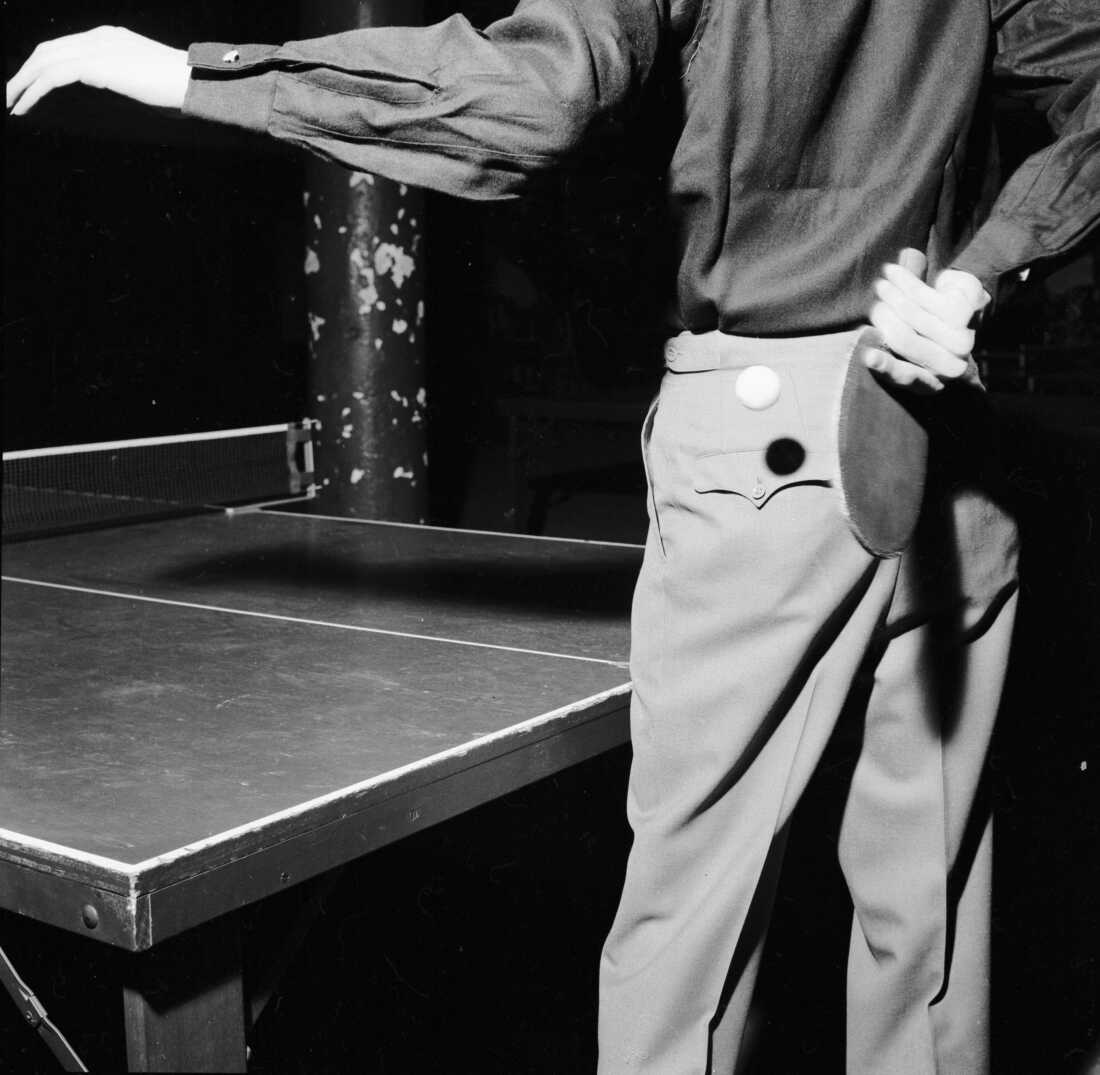
Marty Reisman shows a behind-the-back trick shot in 1955.
Jacobsen/Getty Images/Hulton Archive
hide caption
toggle caption
Jacobsen/Getty Images/Hulton Archive
“Einstein, Hemingway, and Louis wrapped into one”
Reisman wanted to be the best ping pong player in the world. “To be an Einstein in your field, or a Hemingway, or a Joe Louis — there could be nothing, I imagined, more noble,” Reisman wrote. “And table tennis champions were to me Einstein, Hemingway, and Louis wrapped into one.”
The game was respected throughout Europe and Asia, turning ping pong stars into big names: In Marty Supreme, one who was imprisoned at Auschwitz tells the story of being spared by Nazi guards who recognize him. (Reisman’s memoir tells a similar true story of the Polish table tennis champion Alojzy “Alex” Ehrlich.)
But in the U.S., ping pong was considered a pastime people played in their basements. New York City was an exception: “Large sums of money were bet on a sport that had no standing at all in this country,” wrote Reisman.
Reisman dazzled spectators with his flair on the table.
“If you look at footage of Marty in the ’50s and ’60s, you could almost compare it to the footage of Houdini,” said Leigh. “He would blow the ball into the air and then he would, you know, knock it under his leg or just do some acrobats. It was almost like putting on a show.”
One of his gimmick shots was breaking a cigarette in two with a slam.
YouTube

Marty Reisman after winning the final men’s singles game at the English Open in 1949.
AP
hide caption
toggle caption
AP
Chasing a dream “that no one respected”
Marty Supreme co-writer and director Josh Safdie grew up playing ping pong with his dad in New York City. “I had ADHD and found it to be quite helpful,” he told NPR. “It’s a sport that requires an intense amount of focus and an intense amount of precision.” Safdie said his great uncle played at Lawrence’s and used to tell him about the different characters he met there, including Reisman’s friend and competitor Dick Miles.
It was Safdie’s wife who found Reisman’s book in a thrift store and gave it to him. When he read it, Safdie was finishing a dream project that was years in the making, the 2019 movie Uncut Gems starring Adam Sandler. “Every step of the way, there was either a hurdle or a stop gap or a laugh in my face,” said Safdie, “And very few believers in that project.”
Safdie likened the experience to Reisman’s obsession with becoming a table tennis champion “who believed in this thing and had a dream that no one respected.”
YouTube
A new racket changes the game
In 1952, Japanese player Hiroji Satoh stunned the table tennis world by winning the Men’s Singles at the World Championships playing with a new type of racket that had thick foam rubber. Unlike the traditional hardbat, the sponge rubber silenced the pock of the ball hitting the racket. Reisman wrote that the new surface caused the ball “to take eerie flights … Sometimes it floated like a knuckleball, a dead ball with no spin whatsoever. On other occasions the spin was overpowering.”
“Marty really liked the sound of the old hardbat,” said Asgarali, “When the sponge racquet came out, Marty wasn’t competitive anymore. He totally fell out of the game.”
Leigh said Reisman would tell just about anyone who would listen how Hiroji Satoh destroyed his game.
He was “constantly analyzing and reanalyzing his personality, who he is, where he’s going,” said Leigh. He would “sit with all these academics and these writers and these almost philosophers and just talk for hours” about how the rubber bat “completely” ruined his game. “He was always searching for something.”
In 1958, Reisman bought the Riverside Table Tennis Club on Manhattan’s Upper West Side, a popular spot frequented by celebrities including Matthew Broderick and Dustin Hoffman. In 1997, at age 67, he won the United States Hardbat Championship.
Marty Reisman died in 2012 at age 82. A The New York Times profile of him less than a year prior started with the headline, “A Throwback Player, With a Wardrobe to Match.”



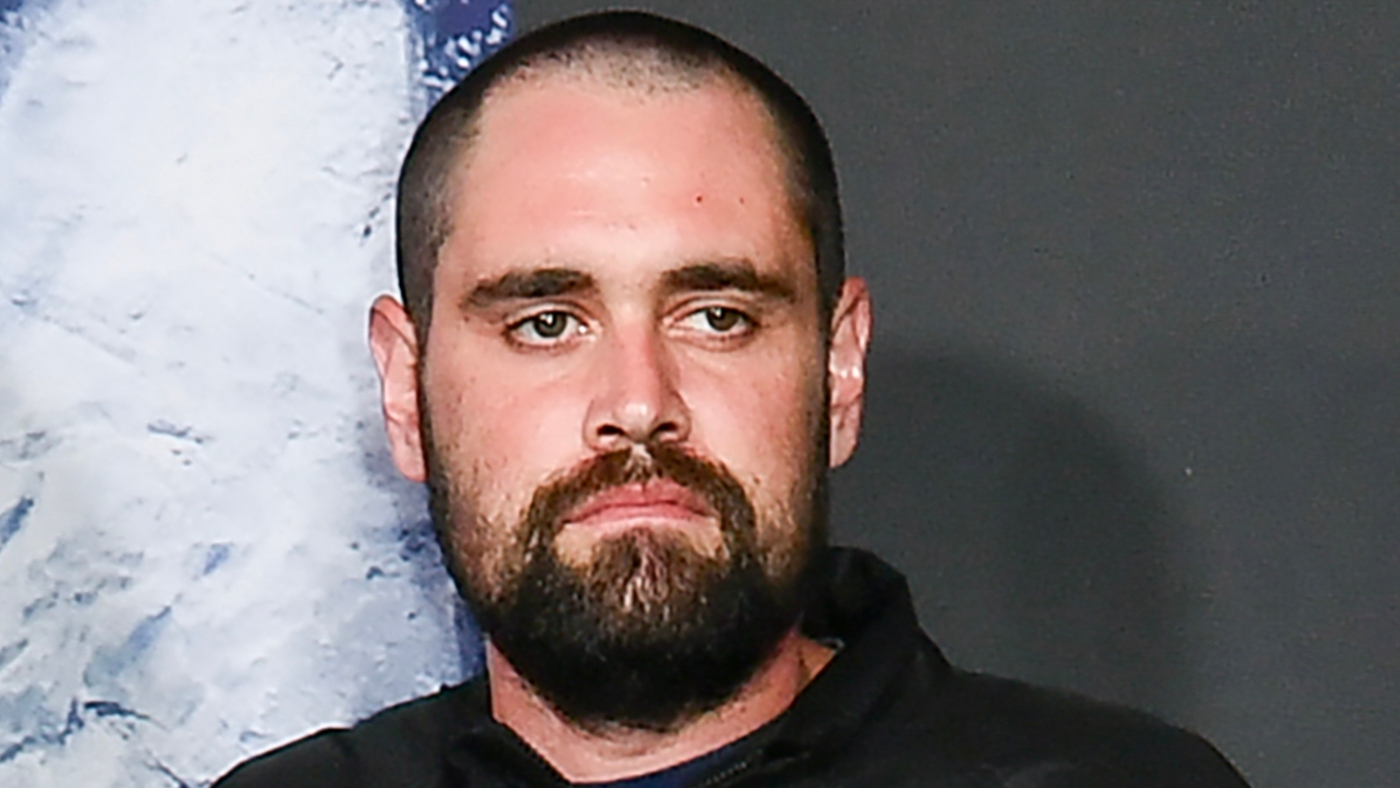
Nick Reiner arrives at the premiere of Spinal Tap II: The End Continues on Tuesday, Sept. 9, 2025, in Los Angeles.
Richard Shotwell/Invision/AP
hide caption
toggle caption
Richard Shotwell/Invision/AP
LOS ANGELES – Alan Jackson, the high-power attorney representing Nick Reiner in the stabbing death of his parents, producer-actor-director Rob Reiner and photographer Michele Singer Reiner, withdrew from the case Wednesday.
Reiner will now be represented by public defender Kimberly Greene.
Wearing a brown jumpsuit, Reiner, 32, didn’t enter a plea during the brief hearing. A judge has rescheduled his arraignment for Feb. 23.
Following the hearing, defense attorney Alan Jackson told a throng of reporters that Reiner is not guilty of murder.
“We’ve investigated this matter top to bottom, back to front. What we’ve learned and you can take this to the bank, is that pursuant to the law of this state, pursuant to the law in California, Nick Reiner is not guilty of murder,” he said.

Reiner is charged with first-degree murder, with special circumstances, in the stabbing deaths of his parents – father Rob, 78, and mother Michele, 70.
The Los Angeles coroner ruled that the two died from injuries inflicted by a knife.
The charges carry a maximum sentence of death. LA County District Attorney Nathan Hochman said he has not decided whether to seek the death penalty.
“We are fully confident that a jury will convict Nick Reiner beyond a reasonable doubt of the brutal murder of his parents — Rob Reiner and Michele Singer Reiner … and do so unanimously,” he said.

Last month, after Reiner’s initial court appearance, Jackson said, “There are very, very complex and serious issues that are associated with this case. These need to be thoroughly but very carefully dealt with and examined and looked at and analyzed. We ask that during this process, you allow the system to move forward – not with a rush to judgment, not with jumping to conclusions.”
The younger Reiner had a long history of substance abuse and attempts at rehabilitation.
His parents had become increasingly alarmed about his behavior in the weeks before the killings.
Legal experts say there is a possibility that Reiner’s legal team could attempt to use an insanity defense.
Defense attorney Dmitry Gorin, a former LA County prosecutor, said claiming insanity or mental impairment presents a major challenge for any defense team.

He told The Los Angeles Times, “The burden of proof is on the defense in an insanity case, and the jury may see the defense as an excuse for committing a serious crime.“
“The jury sets a very high bar on the defendant because it understands that it will release him from legal responsibility,” Gorin added.
The death of Rob Reiner, who first won fame as part of the legendary 1970s sitcom All in the Family, playing the role of Michael “Meathead” Stivic, was a beloved figure in Hollywood and his death sent shockwaves through the community.
After All in the Family, Reiner achieved even more fame as a director of films such as A Few Good Men, Stand By Me, The Princess Bride and When Harry Met Sally. He was nominated for four Golden Globe Awards in the best director category.
Rob Reiner came from a show business pedigree. His father, Carl Reiner, was a legendary pioneer in television who created the iconic 1960s comedy, The Dick Van Dyke Show.

Chiefs
Aware of Dom. Violence Claims
… Made By Rashee Rice’s Ex
Published
The Kansas City Chiefs are addressing the recent social media post made by Rashee Rice‘s ex … where she claimed she was abused during the course of an eight-year relationship, including when she was pregnant.
The shocking allegations were made as part of a lengthy statement shared to the Dacoda Jones’ Instagram account on Wednesday … when said she kept quiet for years to protect her former partner’s image — but can no longer stay silent.
She did not name Rice directly … but certain details about the relationship match up. Rice’s own grandmother even commented on the post … and in a phone conversation with TMZ Sports, she said Jones lied about the abuse after a dispute over paying for an apartment.

In the post, Jones said her relationship ended recently … and “since then it’s been nothing but hell.”
On top of the abuse allegations, Jones claims her ex locked her outside of their home in freezing temperatures after he was caught cheating, damaged her clothes and shoes and showed up at her new home and broke her door.
Jones also claims the man abandoned her and their kids in Kansas and she had to “beg” him for money so she could drive them to Texas.
Jones says he is now trying to force her and their kids out of their home “for no apparent reason.”
“I’ve known this man for YEARS,” Jones said. “He tries to put on this persona like he’s dad of the year. He does the bare minimum and I have to beg for that.”
“I’ve protected his image too long and I’m done doing that. It’s time to protect my peace, protect my children and stand up for myself.”
Jones included images of her alleged injuries from the domestic violence incidents … as well as damage to her home.
We reached out to Rice’s attorney, Royce West, who said his client has not been arrested or charged for domestic violence and hung up the phone.
The NFL declined to comment … but the Chiefs said they are “aware” of the claims made on social media and are in communication with the league.
Rice was suspended six games earlier this season for a 2024 hit-and-run crash in Texas … and teammates like Travis Kelce and Tyquan Thornton wore “Free 4” shirts in support of him during the ban.
He pleaded guilty to two felonies stemming from the incident — one count of racing on a highway causing bodily injury and one count of collision involving serious bodily injury … and was ordered to 30 days in jail and five years of probation.
We’ve reached out to Rice’s camp. No word back.

Timothée Chalamet plays a shoe salesman who dreams of becoming the greatest table tennis player in the world in Marty Supreme.
A24
hide caption
toggle caption
A24
Last year, while accepting a Screen Actors Guild award for A Complete Unknown, Timothée Chalamet told the audience, “I want to be one of the greats; I’m inspired by the greats.” Many criticized him for his immodesty, but I found it refreshing: After all, Chalamet has never made a secret of his ambition in his interviews or his choice of material.
In his best performances, you can see both the character and the actor pushing themselves to greatness, the way Chalamet did playing Bob Dylan in A Complete Unknown, which earned him the second of two Oscar nominations. He’s widely expected to receive a third for his performance in Josh Safdie’s thrilling new movie, Marty Supreme, in which Chalamet pushes himself even harder still.
Chalamet plays Marty Mauser, a 23-year-old shoe salesman in 1952 New York who dreams of being recognized as the greatest table-tennis player in the world. He’s a brilliant player, but for a poor Lower East Side Jewish kid like Marty, playing brilliantly isn’t enough: Simply getting to championship tournaments in London and Tokyo will require money he doesn’t have.

And so Marty, a scrappy, speedy dynamo with a silver tongue and inhuman levels of chutzpah, sets out to borrow, steal, cheat, sweet-talk and hustle his way to the top. He spends almost the entire movie on the run, shaking down friends and shaking off family members, hatching new scams and fleeing the folks he’s already scammed, and generally trying to extricate himself from disasters of his own making.
Marty is very loosely based on the real-life table-tennis pro Marty Reisman. But as a character, he’s cut from the same cloth as the unstoppable antiheroes of Uncut Gems and Good Time, both of which Josh Safdie directed with his brother Benny. Although Josh directed Marty Supreme solo, the ferocious energy of his filmmaking is in line with those earlier New York nail-biters, only this time with a period setting. Most of the story unfolds against a seedy, teeming postwar Manhattan, superbly rendered by the veteran production designer Jack Fisk as a world of shadowy game rooms and rundown apartments.
Early on, though, Marty does make his way to London, where he finagles a room at the same hotel as Kay Stone, a movie star past her 1930s prime. She’s played by Gwyneth Paltrow, in a luminous and long-overdue return to the big screen. Marty is soon having a hot fling with Kay, even as he tries to swindle her ruthless businessman husband, Milton Rockwell, played by the Canadian entrepreneur and Shark Tank regular Kevin O’Leary.
Marty Supreme is full of such ingenious, faintly meta bits of stunt casting. The rascally independent filmmaker Abel Ferrara turns up as a dog-loving mobster. The real-life table-tennis star Koto Kawaguchi plays a Japanese champ who beats Marty in London and leaves him spoiling for a rematch. And Géza Röhrig, from the Holocaust drama Son of Saul, pops up as Marty’s friend Bela Kletzki, a table tennis champ who survived Auschwitz. Bela tells his story in one of the film’s best and strangest scenes, a death-camp flashback that proves crucial to the movie’s meaning.
In one early scene, Marty brags to some journalists that he’s “Hitler’s worst nightmare.” It’s not a stretch to read Marty Supreme as a kind of geopolitical parable, culminating in an epic table-tennis match, pitting a Jewish player against a Japanese one, both sides seeking a hard-won triumph after the horrors of World War II.

The personal victory that Marty seeks would also be a symbolic one, striking a blow for Jewish survival and assimilation — and regeneration: I haven’t yet mentioned a crucial subplot involving Marty’s close friend Rachel, terrifically played by Odessa A’zion, who’s carrying his child and gets sucked into his web of lies.
Josh Safdie, who co-wrote and co-edited the film with Ronald Bronstein, doesn’t belabor his ideas. He’s so busy entertaining you, as Marty ping-pongs from one catastrophe to the next, that you’d be forgiven for missing what’s percolating beneath the movie’s hyperkinetic surface.
Marty himself, the most incorrigible movie protagonist in many a moon, has already stirred much debate; many find his company insufferable and his actions indefensible. But the movies can be a wonderfully amoral medium, and I found myself liking Marty Mauser — and not just liking him, but actually rooting for him to succeed. It takes more than a good actor to pull that off. It takes one of the greats.


Understanding New Mexico’s data center boom | Opinion

NC health officials urge vaccines amid measles and respiratory illness surge

Today in History, 1993: North Dakota-born astronaut leaves Fargo school kids starstruck

This rising sophomore has an important offseason ahead of him for Ohio State football

Oklahoma Sooners add transfer portal offensive lineman to the roster

Florida High School Football Rankings: Top 25 teams – Oct. 21

Cleary's 21 help Le Moyne down Central Connecticut State 69-64 in OT

How old is Bo Nix? What to know about Oregon quarterback ahead of 2024 NFL Draft

99th annual Pony Swim held in Virginia

Video: ‘It Didn’t Have to Happen This Way:’ U.Va. Faculty Call for Review of Police Response to Protests

Video: Minnesota Governor Condemns ICE Shooting

Trump greenlights Russian sanctions bill, paving way for 500% tariff on countries supporting Moscow: Graham

Saudi-led coalition says STC’s al-Zubaidi fled to UAE via Somaliland

U.S. to exit 66 international organizations in further retreat from global cooperation

San Diego sues to stop border barrier construction
-
 News1 week ago
For those who help the poor, 2025 goes down as a year of chaos
-

 Detroit, MI4 days ago
2 hospitalized after shooting on Lodge Freeway in Detroit
-

 Georgia1 week ago
Best in Georgia: 2025 AJC Varsity high school football all-state teams
-

 Dallas, TX3 days ago
Defensive coordinator candidates who could improve Cowboys’ brutal secondary in 2026
-

 Detroit, MI1 week ago
With 46k outages around Michigan, Metro Detroit prepares for power loss
-

 Southeast1 week ago
Murder in small-town America: The crimes that tore quiet communities apart in 2025
-

 Miami, FL1 week ago
Miami-Dade sheriff’s deputy opens fire on vehicle after altercation during traffic stop, officials say
-

 Midwest1 week ago
McDonald’s locks doors to keep out individuals who present ‘a risk’ in crime-ridden Minneapolis area