Lifestyle
The greatest trees of Los Angeles


There is a sycamore in the front yard of my grandparents’ house, the house where my father grew up. It is a giant, towering over the home, the yard, the whole neighborhood. Last spring, when my grandmother was fading and the tree was coming into leaf, I stood under the sycamore for a long while, listening to the wind rustling its new growth. It was a delicate sound that, every so often, turned into a tremendous roar as the breeze went gusty.
My grandmother died a few weeks later. She was 101. The tree must be at least as old. Several months after she died, once the house was ready to sell, we all fell into a minor panic about the future of our beloved sycamore. Surely, anyone buying this small, old house would be developing the lot, and would take down the tree.
A sycamore tree in Griffith Park.
(Devin Oktar Yalkin / For The Times)
But a day or two later, we learned that it is rather difficult — and also, illegal — to cut down a very old, still-alive sycamore, oak, California bay or black walnut in Los Angeles. It turns out the city has an entire department — its urban forestry division, and specifically its tree czar, Rachel Malarich — responsible for, among other things, saving such trees. All it took was alerting the office to the location and existence of our sycamore and the division would, if it hadn’t already, add it to its ever-growing list of trees it aims to protect.
I wrote “our sycamore” above, but great trees defy possessives. They are home to bees and birds and squirrels and ants and countless other critters. They are often older than all of us, older than the sidewalks, the streets, the parks. Older, sometimes, than the city itself.
These trees, belonging to no one, are for everyone.
The old sycamore was on my mind when, a few months ago, I got the idea to find and visit the greatest trees in all of Los Angeles. The idea wasn’t entirely my own — I was cribbing it from a tree of the year “contest” held in the United Kingdom, which, I came to learn, was itself part of a larger, European-wide tree of the year contest that includes at least 15 other nations, and began in the Czech Republic more than a decade ago.
Like the judges of these contests, I was interested in old, big trees — the sort of trees that tree pros and tree enthusiasts like to call specimens. I started my search for specimens by talking to many, many tree people: arborists, landscape architects, gardeners and garden nerds, historians and activists, tree-heads all. Like Jorge Ochoa, a horticulture professor at Long Beach City College, who suggested the tree he gets asked to identify most: a huge araucaria, also known as a bunya-bunya, that appears in the film “Blood In, Blood Out” and is an icon of East L.A. Or Jenny Jones, a landscape architect at Terremoto, who mentioned a “profoundly beautiful” mulberry in the Elysian Heights Elementary school garden. Leigh Jerrard, at Greywater Corps, said his favorite tree in L.A. was a valley oak on Chesebro Road in Agoura Hills, but then he caught himself. Had it survived the Woolsey fire a few years back? He wasn’t sure. He texted me a few days later. Nope. It was no longer alive.
A camphor tree, Cinnamomum camphora, at Evergreen Cemetery.
(Devin Oktar Yalkin / For The Times)
Giant avocado tree in Atwater, near the L.A. River. (Devin Oktar Yalkin / For The Times)
A floss silk tree towers over the Yamaguchi Bonsai Nursery. (Devin Oktar Yalkin / For The Times)
This was the case with a lot of legendarily great L.A. trees: They were now dead. A few different tree-heads mentioned the gigantic silk floss that was once at the Hotel Bel-Air, and many more suggested the Encino Oak, which by some estimates was already 500 years old when the first Spanish expedition through California camped under it. But Jeff Perry, who knows fallen trees, told me that the greatest L.A. tree of all once stood on what is now Commercial Street at the 101 Freeway, not a half-mile from Angel City Lumber, which Perry runs.
“This tree is so important,” he told me. “It was the centerpiece of the Tongva village here. It stood when the pueblo was established, when Mexican occupation took over, when American occupation took over.” A winemaker shaded his casks under its limbs, then German immigrants bought the winery and turned it into a brewery. Eventually the tree, which had long been known as El Aliso — Spanish for sycamore — was turned into firewood. “The point,” Perry said, “is that this was a tree that witnessed multiple layers of colonization.” Today, on the corner by the freeway onramp, there is a small plaque about El Aliso, the great tree that stood there for so long, and saw so much.
Another, more recently dead great tree that I kept hearing about was the Eagle Tree, another huge sycamore and an old Compton landmark. Its trunk has been saved, and there are now plans to distribute young clones of the Eagle Tree throughout the Southland, thanks in large part to the work of Kim Cooper and Richard Schave, preservationists who run the L.A. tour company Esotouric. There were many other trees Cooper and Schave mentioned — East L.A.’s El Pino, an old queen palm on Bunker Hill called Sunshine, some more very old bunya-bunyas at Rancho Los Amigos — and several other trees out there to save and celebrate before they expire. But before all that, they told me, I simply had to speak to Don Hodel.
This was not the first nor the last I would hear of Hodel. In fact, pretty much every other tree-head I spoke to mentioned him either right off or in closing, or followed up a day or two later with something along the lines of what Cooper and Schave had said: that if I was looking for great trees, the best trees, the trees worth celebrating, I really ought to be talking to Don.
The prickly surface of the floss silk tree near Yamaguchi Bonsai Nursery.
(Devin Oktar Yalkin / For The Times)
Ficus religiosa, Lafayette Park. Commonly called bo tree, it’s famous for being the same species that the Buddha meditated under when achieving enlightenment.
(Devin Oktar Yalkin / For The Times)
Donald R. Hodel is the emeritus environmental horticulturist for the University of California Cooperative Extension in Los Angeles. In 1988, Hodel authored a book, published by the California Arboretum Foundation, titled “Exceptional Trees of Los Angeles.” It is exactly what its title describes: a book of very good — or, I’m sorry, exceptional L.A. trees. It is long out of print, but I found a copy, and was thumbing through it when we spoke.
I told Hodel about my plan, which had, after several weeks among the tree-heads, plus some scouting missions, been refined a touch. I was after, I’d decided, only the most public of trees, which meant simply: the more accessible, the better. Sure, there was a California buckeye I adored at Descanso Gardens, but any place you had to pay to see a tree was out. As were trees in private backyards, or high-fenced front yards. The tree had to be highly visible, enjoyable and not a tree you had to hike too far to see. If it was in a public park, then at most it might require a minor walk, ideally not even uphill. If it was the sort of tree someone (someone who was not yet a tree-head) might drive by all the time and not really notice, or notice but think simply, “Huh, what a large tree!” — that was perfect.
Hodel thought first of the many streets in L.A. lined with great, glorious tree plantings: the coral trees along San Vicente, the Canary Island date palms lining the entrance to Dodger Stadium, the gum myrtles on Kenilworth Avenue in Pasadena and, of course, in Altadena, the deodar cedars along Christmas Tree Lane (“a spectacular planting,” Hodel said). But when I explained that it was specimens I was after, I heard Hodel go silent a moment. He had his book out too, and was flipping through it. “Some of these trees,” he said quietly, almost to himself, “I haven’t been back to them in 30 years, and they may not be there.”
Hodel then told me about a grapefruit tree in Little Tokyo that was planted about 150 years ago by Japanese American settlers as part of the first citrus grove in Los Angeles. For decades, the tree sat behind a building in a vacant lot, until the neighborhood rallied to save it, and replanted it in the courtyard of the Japanese American Cultural Center. It was by now very likely the oldest citrus in L.A., certainly the only one left from that original grove. “Ask if it’s still standing,” Hodel told me. And, later, I did. Reader, it is.
The 150-year-old grapefruit tree in the courtyard of the Japanese American Cultural Center.
(Devin Oktar Yalkin / For The Times)
There were also, of course — Hodel continued — the ficuses; the Moreton Bay figs in particular, which get absolutely gargantuan, and are never not notable, lining as they do La Mesa Drive in Santa Monica, or Vermont Avenue on its approach to Griffith Park, or spreading their branches out over the Pacific Ocean on Point Fermin in San Pedro, or beside the old library in South Pasadena. But one of his favorites — and mine, it turned out — was next to St. John’s Presbyterian Church, on National Boulevard, a few blocks from where the 10 Freeway crosses the 405 Freeway. This one tree takes up practically the whole block, was planted in 1875, and is the sort of specimen that can cause someone to gasp, and gawp, and long to pull over and stand beneath it for a while, just contemplating things like time and space and root systems.
Hodel had given me more than a few great trees but I was a greedy, half-tree-mad man by now. I wanted more: more trees, older trees, even better trees. He mentioned Orcutt Ranch, which, he said, had some of the oldest valley oaks around, and an even older coastal live oak, so old you could still see on it the scars from where its branches had been removed to fire the kilns that made the adobe brick that built the San Fernando Mission. “Lot of history tied up in those old oaks,” Hodel said.
About a week later, I visited the oak, which is a short walk from the parking lot to the back of the property, the last small parcel of a once-sprawling ranch that is now a public park. The tree has the look of an ancient thing — knobby and gnarled and thick, so thick and tall it appeared at times like several oaks stacked on top of one another. A tree like this is practically planetary; it creates its own ecosystem, and while we — photographer Devin Yalkin and I — stood in its silence and stillness for a spell, we also began to notice all the life within it and upon it: We counted at least two beehives, a half dozen squirrels, several California towhees and oak titmouses, many, many lesser goldfinches, huge networks of spiderwebs, plus dark holes and hollows throughout the oak that were certainly home to many more creatures we could not see. This tree, by some estimates, is at least 700 years old, which would make it a likely candidate for the oldest tree in all of L.A.
An excellent Moreton Bay fig tree at Mid-City’s Prescott School.
(Devin Oktar Yalkin / For The Times)
Among the oldest trees in Los Angeles, a coastal live oak at Orcutt Ranch.
(Devin Oktar Yalkin / For The Times)
But the day was young, and we still had many more trees to see, so after an hour or so, we drove across the San Fernando Valley, up and over the hills to the triangle where Cahuenga crosses Franklin, to an entirely different sort of specimen: a handsome jacaranda, not so incredibly old, not even especially big, just beloved, and beset on all sides by the city. I had heard about this tree from Nick Araya, an arborist who runs TreeCareLA. This tree, he told me, was managed by the surrounding neighborhood; they had a committee for it, even. Last year, Araya had been contacted by the neighborhood tree committee after the jacaranda in the triangle had been mysteriously vandalized. Someone, or something, had pruned a large portion of the tree. “They almost ruined it,” Araya said.
Araya sent his colleague Oscar Sanchez out to investigate, and Sanchez eventually figured out that someone, likely employed by some corporate entity (an advertising agency, perhaps), had illegally chopped the tree just to make a nearby billboard more visible. “Corporate vista pruning,” Sanchez called it. But people, Araya pointed out, obviously care more for trees than they do for billboard advertisements. And indeed, after a short time looking at the jacaranda, a man walking a small dog cautiously approached. His name was Louis Alfaro. The dog was his neighbor’s, and named Nacho. Alfaro was very worried about what we might be doing to the tree — did we work for the city? Was Devin photographing the site to take down the tree? It was one of the few patches of nice green shade, and there was already so much vandalism around it, he said. He’d lived in an apartment in the neighborhood for 11 years and visited the tree almost every day.
Wherever Araya goes in the city, tending trees, he encounters folks like Alfaro, who care deeply for specimens that are not on property they own, that are not their own trees, but they feel an ownership and responsibility for them all the same. Araya also catalogs champion trees — the largest specimens in the state or even the country — wherever his work takes him, which is all across L.A. One of his favorite specimens to send fellow arborists out to is the towering silk floss in back of Yamaguchi Bonsai Nursery on Sawtelle. He’s also particularly fond of a Moreton Bay fig that’s spilling over the muraled retaining wall of Mid-City’s Prescott School.
Among the other L.A. champions in the registry of California Big Trees is the state’s largest avocado tree, in Atwater, as well as the largest Canary Island pine, in Lawndale, and the largest deodar cedar, in Lafayette Square. These are all common trees that can be seen throughout the backyards and supermarket parking lots of Los Angeles. But these individuals have grown old and huge and worth celebrating, even if they happen to be unassuming and unexpected, situated as they are on quiet residential streets.
Dragon trees in downtown L.A.
(Devin Oktar Yalkin / For The Times)
The oldest plant in the world of known planting date is the Ficus religiosa Sri Maha Bodhi, which was planted in Anuradhapura, Sri Lanka, in 288 BC. Today, the bo tree is revered as a symbol for prosperity, happiness, good fortune and long life. (Devin Oktar Yalkin / For The Times)
The champion rose gum tree. (Devin Oktar Yalkin / For The Times)
Outside of the city’s parks department maintenance yards is another such champion, a rose gum, which is also known as a smooth-barked apple gum. Like many other very large trees in L.A. — the eucalyptuses, the bunya-bunyas, the Moreton Bay figs — it hails from Australia. As Devin and I were taking it in, Leon Boroditsky, the principal forester for the city’s parks department, walked out to meet us. His office is just across the street. What Boroditsky likes about this tree, beyond its pleasantly smooth bark and rosy shade, is that it’s an anonymous tree. That is, we do not know who planted it, or exactly when, or how. It is on a street corner that was once part of Griffith Park, and it’s possible that someone, long ago, simply acquired an interesting sapling of an exotic tree, had no yard in which to plant it, so planted it in what was, back then, the park. And now, here it is: a towering testament to one Angeleno’s long-ago hopes for the city’s future.
Trees are like that, existing as they do on a timescale so different from our own; they connect us to a distant past while also bearing witness to a future we will never live to see. After months spent searching for the greatest trees in L.A., I’ve come to realize that what I believe makes a tree great is not necessarily its size or its age but its ability to keep on living, especially if it has persisted despite prolonged neglect. That a tree, particularly a tree in a tree-poor part of town (of which there are, in L.A., far too many) endures is — well, it’s a very hopeful thing, isn’t it?
Aleppo pine, the tallest pine species that grows in L.A. This one is at the top of a hill overlooking the 5 Freeway and L.A. River in Elysian Park. Someone added a swing.
(Devin Oktar Yalkin / For The Times)
I suppose this is a roundabout way of explaining why it is that quite a few of what have become my favorite trees in L.A. are not the sort of trees that judges of any tree competitions may necessarily deem great. Many are still quite young, so really what I like about them is their potential, like some of the more than 400 trees planted in and around Skid Row by folks at Industrial District Green; or the still-young coastal live oaks and black walnuts, many planted by North East Trees, which as they grow and fill in will make up a dense microforest in Ascot Hills Park; or many young trees planted throughout city parks in Long Beach, Cerritos, Lakewood and Seal Beach, many rare and cultivated by Hodel for an organization called Southeast Trees.
The other sort of trees I love are the trees that have, despite our best efforts, endured, like a red river gum eucalyptus in West Carson. This tree sat alone for years and years in an old industrial brownfield, the site of a former synthetic rubber factory, putting down its roots in poisoned earth, surrounded by scrap yards. The tree is just about the tallest feature for a mile in any direction, a lighthouse for nature that draws people to it. And now, the eucalyptus is the heart of a soon-to-open park, developed by the Los Angeles Neighborhood Land Trust, named Wishing Tree Park. That’s what a great tree can be: a witness, a wish, a beacon — hope. A great tree is the park that got built around the tree, because it held on long enough for enough of us to finally take notice.
Do you have a favorite tree in L.A.? Tell us about it here.



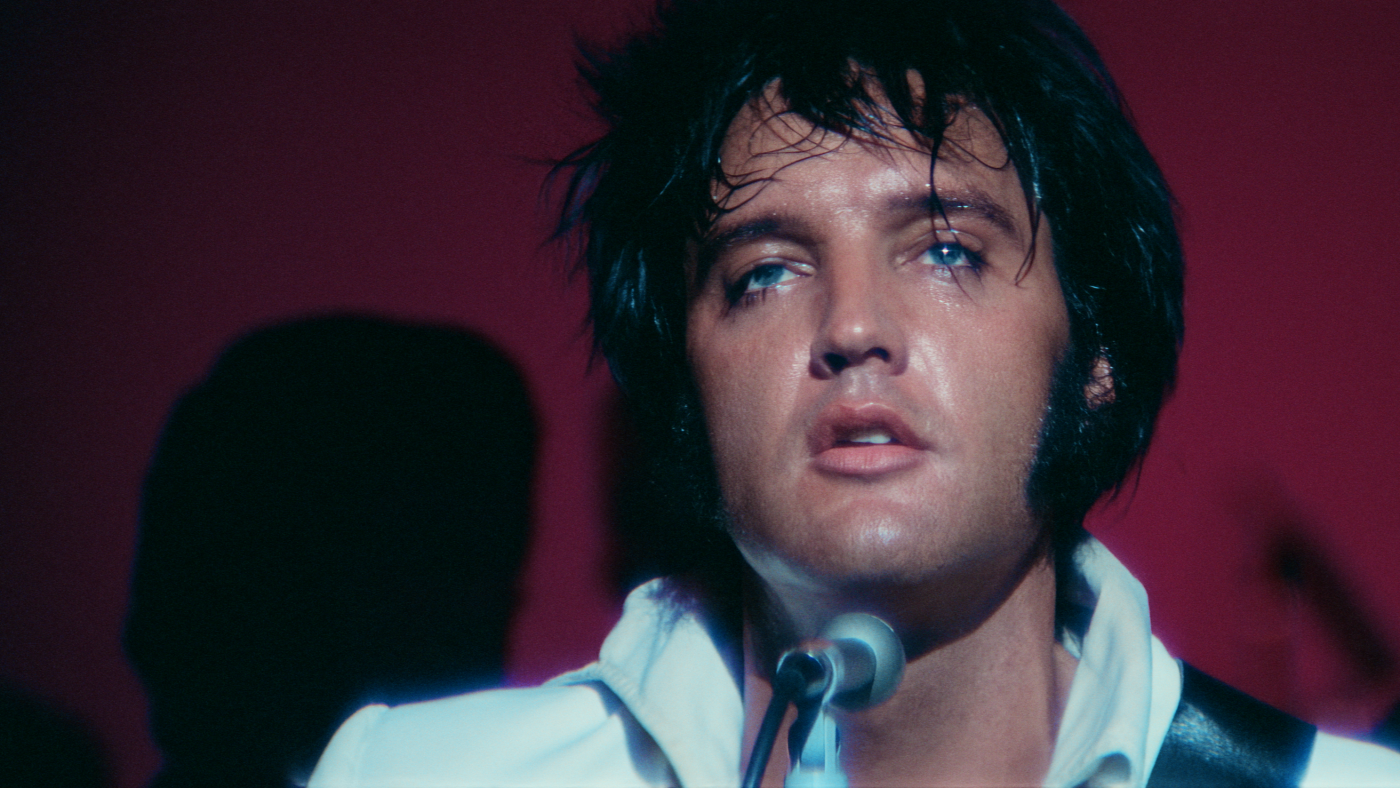
Elvis Presley in Las Vegas in Aug. 1970.
NEON
hide caption
toggle caption
NEON
“You are my favorite customer,” Baz Luhrmann tells me on a recent Zoom call from the sunny Chateau Marmont in Hollywood. The director is on a worldwide blitz to promote his new film, EPiC: Elvis Presley in Concert — which opens wide this week — and he says this, not to flatter me, but because I’ve just called his film a miracle.
See, I’ve never cared a lick about Elvis Presley, who would have turned 91 in January, had he not died in 1977 at the age of 42. Never had an inkling to listen to his music, never seen any of his films, never been interested in researching his life or work. For this millennial, Presley was a fossilized, mummified relic from prehistory — like a woolly mammoth stuck in the La Brea Tar Pits — and I was mostly indifferent about seeing 1970s concert footage when I sat down for an early IMAX screening of EPiC.
By the end of its rollicking, exhilarating 90 minutes, I turned to my wife and said, “I think I’m in love with Elvis Presley.”
“I’m not trying to sell Elvis,” Luhrmann clarifies. “But I do think that the most gratifying thing is when someone like you has the experience you’ve had.”
Elvis made much more of an imprint on a young Luhrmann; he watched the King’s movies while growing up in New South Wales, Australia in the 1960s, and he stepped to 1972’s “Burning Love” as a young ballroom dancer. But then, like so many others, he left Elvis behind. As a teenager, “I was more Bowie and, you know, new wave and Elton and all those kinds of musical icons,” he says. “I became a big opera buff.”
Luhrmann only returned to the King when he decided to make a movie that would take a sweeping look at America in the 1950s, ’60s, and ’70s — which became his 2022 dramatized feature, Elvis, starring Austin Butler. That film, told in the bedazzled, kaleidoscopic style that Luhrmann is famous for, cast Presley as a tragic figure; it was framed and narrated by Presley’s notorious manager, Colonel Tom Parker, portrayed by a conniving and heavily made-up Tom Hanks. The dark clouds of business exploitation, the perils of fame, and an early demise hang over the singer’s heady rise and fall.

It was a divisive movie. Some praised Butler’s transformative performance and the director’s ravishing style; others experienced it as a nauseating 2.5-hour trailer. Reviewing it for Fresh Air, Justin Chang said that “Luhrmann’s flair for spectacle tends to overwhelm his basic story sense,” and found the framing device around Col. Parker (and Hanks’ “uncharacteristically grating” acting) to be a fatal flaw.
Personally, I thought it was the greatest thing Luhrmann had ever made, a perfect match between subject and filmmaker. It reminded me of Oliver Stone’s breathless, Shakespearean tragedy about Richard Nixon (1995’s Nixon), itself an underrated masterpiece. Yet somehow, even for me, it failed to light a fire of interest in Presley himself — and by design, I now realize after seeing EPiC, it omitted at least one major aspect of Elvis’ appeal: the man was charmingly, endearingly funny.
As seen in Luhrmann’s new documentary, on stage, in the midst of a serious song, Elvis will pull a face, or ad lib a line about his suit being too tight to get on his knees, or sing for a while with a bra (which has been flung from the audience) draped over his head. He’s constantly laughing and ribbing and keeping his musicians, and himself, entertained. If Elvis was a tragedy, EPiC is a romantic comedy — and Presley’s seduction of us, the audience, is utterly irresistible.
Unearthing old concert footage
It was in the process of making Elvis that Luhrmann discovered dozens of long-rumored concert footage tapes in a Kansas salt mine, where Warner Bros. stores some of their film archives. Working with Peter Jackson’s team at the post-production facility Park Road Post, who did the miraculous restoration of Beatles rehearsal footage for Jackson’s 2021 Disney+ series, Get Back, they burnished 50-plus hours of 55-year-old celluloid into an eye-popping sheen with enough visual fidelity to fill an IMAX screen. In doing so, they resurrected a woolly mammoth. The film — which is a creative amalgamation of takes from rehearsals and concerts that span from 1970 to 1972 — places the viewer so close to the action that we can viscerally feel the thumping of the bass and almost sense that we’ll get flecked with the sweat dripping off Presley’s face.
This footage was originally shot for the 1970 concert film Elvis: That’s The Way It Is, and its 1972 sequel, Elvis on Tour, which explains why these concerts were shot like a Hollywood feature: wide shots on anamorphic 35mm and with giant, ultra-bright Klieg lights — which, Luhrmann explains, “are really disturbing. So [Elvis] was very apologetic to the audience, because the audience felt a bit more self conscious than they would have been at a normal show. They were actually making a movie, they weren’t just shooting a concert.”
Luhrmann chose to leave in many shots where camera operators can be seen running around with their 16mm cameras for close-ups, “like they’re in the Vietnam War trying to get the best angles,” because we live in an era where we’re used to seeing cameras everywhere and Luhrmann felt none of the original directors’ concern about breaking the illusion. Those extreme close-ups, which were achieved by operators doing math and manually pulling focus, allow us to see even the pores on Presley’s skin — now projected onto a screen the size of two buildings.
The sweat that comes out of those pores is practically a character in the film. Luhrmann marvels at how much Presley gave in every single rehearsal and every single concert performance. Beyond the fact that “he must have superhuman strength,” Luhrmann says, “He becomes the music. He doesn’t mark stuff. He just becomes the music, and then no one knows what he’s going to do. The band do not know what he’s going to do, so they have to keep their eyes on him all the time. They don’t know how many rounds he’s going to do in ‘Suspicious Minds.’ You know, he conducts them with his entire being — and that’s what makes him unique.”

Elvis Presley in Las Vegas in Aug. 1970.
NEON
hide caption
toggle caption
NEON
It’s not the only thing. The revivified concerts in EPiC are a potent argument that Elvis wasn’t just a superior live performer to the Beatles (who supplanted him as the kings of pop culture in the 1960s), but possibly the greatest live performer of all time. His sensual, magmatic charisma on stage, the way he conducts the large band and choir, the control he has over that godlike gospel voice, and the sorcerer’s power he has to hold an entire audience in the palm of his hands (and often to kiss many of its women on the lips) all come across with stunning, electrifying urgency.
Shaking off the rust and building a “dreamscape”
The fact that, on top of it all, he is effortlessly funny and goofy is, in Luhrmann’s mind, essential to the magic of Elvis. While researching for Elvis, he came to appreciate how insecure Presley was as a kid — growing up as the only white boy in a poor Black neighborhood, and seeing his father thrown into jail for passing a bad check. “Inside, he felt very less-than,” says Luhrmann, “but he grows up into a physical Greek god. I mean, we’ve forgotten how beautiful he was. You see it in the movie; he is a beautiful looking human being. And then he moves. And he doesn’t learn dance steps — he just manifests that movement. And then he’s got the voice of Orpheus, and he can take a song like ‘Bridge Over Troubled Water’ and make it into a gospel power ballad.
“So he’s like a spiritual being. And I think he’s imposing. So the goofiness, the humor is about disarming people, making them get past the image — like he says — and see the man. That’s my own theory.”
Elvis has often been second-classed in the annals of American music because he didn’t write his own songs, but Luhrmann insists that interpretation is its own invaluable art form. “Orpheus interpreted the music as well,” the director says.
In this way — as in their shared maximalist, cape-and-rhinestones style — Luhrmann and Elvis are a match made in Graceland. Whether he’s remixing Shakespeare as a ’90s punk music video in Romeo + Juliet or adding hip-hop beats to The Great Gatsby, Luhrmann is an artist who loves to take what was vibrantly, shockingly new in another century and make it so again.

Elvis Presley in Las Vegas in Aug. 1970.
NEON
hide caption
toggle caption
NEON
Luhrmann says he likes to take classic work and “shake off the rust and go, Well, when it was written, it wasn’t classical. When it was created, it was pop, it was modern, it was in the moment. That’s what I try and do.”
To that end, he conceived EPiC as “an imagined concert,” liberally building sequences from various nights, sometimes inserting rehearsal takes into a stage performance (ecstatically so in the song “Polk Salad Annie”), and adding new musical layers to some of the songs. Working with his music producer, Jamieson Shaw, he backed the King’s vocals on “Oh Happy Day” with a new recording of a Black gospel choir in Nashville. “So that’s an imaginative leap,” says Luhrmann. “It’s kind of a dreamscape.”
On some tracks, like “Burning Love,” new string arrangements give the live performances extra verve and cinematic depth. Luhrmann and his music team also radically remixed multiple Elvis songs into a new number, “A Change of Reality,” which has the King repeatedly asking “Do you miss me?” over a buzzing bass line and a syncopated beat.
I didn’t miss Elvis before I saw EPiC — but after seeing the film twice now, I truly do.

“You kinda have this Wednesday Addams vibe going on.”
I shrieked.
I was wearing my best armor: a black dress that accentuated my curves, a striped bolero to cover the arms I’ve resented for years and black platform sandals displaying ruby toes. My dark hair was in wild, voluminous curls and my sultry makeup was finished with an inviting Chanel rouge lip.
I would’ve preferred the gentleman at the speed dating event had likened my efforts to, at least, Morticia, a grown woman. But in this crowd of men and women ages ranging from roughly 21 to 40, I suppose my baby face gave me away.
My mind flitted back to a conversation I had with my physical therapist about modern love: Dating in L.A. has become monotonous.
The apps were oversaturated and underwhelming. And it seemed more difficult than ever to naturally meet someone in person.
She told me about her recent endeavor in speed dating: events sponsoring timed one-on-one “dates” with multiple candidates. I applauded her bravery, but the conversation had mostly slipped my mind.
Two years later, I had reached my boiling point with Jesse, a guy I met online (naturally) a few months prior who was good on paper but bad in practice.
Knowing my best friend was in a similar situationship, I found myself suggesting a curious social alternative.
Much of my knowledge of speed dating came from cinema. It usually involved a down-on-her-luck hopeless romantic or a mature workaholic attempting to be more spontaneous in her dating life, sitting across from a montage of caricatures: the socially-challenged geek stumbling through his special interests; the arrogant businessman diverting most of his attention to his Blackberry; the pseudo-suave ladies’ man whose every word comes across rehearsed and saccharine.
Nevertheless, I was desperate for a good distraction. So we purchased tickets to an event for straight singles happening a few hours later.
Walking into Oldfield’s Liquor Room, I noticed that it looked like a normal bar, all dark wood and dim lighting. Except its patrons flanked the perimeter of the space, speaking in hushed tones, sizing up the opposite sex.
Suddenly in need of some liquid courage, we rushed back to the car to indulge in the shooters we bought on our way to the venue — three for $6. I had already surrendered $30 for my ticket and I was not paying for Los Angeles-priced cocktails. Ten minutes later, we were ready to mingle.
The bar’s back patio was decked out with tea lights and potted palm plants. House-pop music put me in a groove as I perused the picnic tables covered with conversation starters like “What’s your favorite sexual position?” Half-amused and half-horrified, I decided to use my own material.
We found our seats as the host began introductions. Each date would last two minutes — a chime would alert the men when it was time to move clockwise to the next seat. I exchanged hopeful glances with the women around me.
The bell rang, and I felt my buzz subside in spades as my first date sat down. This was really happening.
Soft brown eyes greeted me. He was polite and responsive, giving adequate answers to my questions but rarely returning the inquiry. I sensed he was looking through me and not at me, as if he had decided I wasn’t his type and was biding his time until the bell rang. I didn’t take it personally.
Bachelor No. 2 stood well over six feet with caramel-brown hair and emerald eyes. He oozed confidence and warmth when he spoke about how healing from an accident a few years prior inspired him to become a physical therapist.
I tried not to focus on how his story was nearly word-perfect to the one I heard him give the woman before me. He offered to show me a large surgery scar, rolling up his right sleeve to reveal the pale pink flesh — and a well-trained bicep. Despite his obvious good looks and small-town charm, something suspicious gnawed at me. I would later learn he had left the same effect on most of the women.
My nose received Bachelor No. 3 before my eyes. His spiced cologne quickly engulfing my senses. He had a larger-than-life presence, seeming to be a character himself, so I asked for his favorite current watch.
“I love ‘The Summer I Turned Pretty,’” he actually said.
“Really?”
“Oh yeah, it’s my favorite. Oh, and ‘Wednesday.’ You kinda have this Wednesday Addams vibe going on.”
I was completely thrown to hear this 40-something man’s favorite programs centered around teenage girls, and by his standards, I resembled one of them. Where was the host with the damn bell?
Although a few conversations clearly left impressions, most of the dates morphed into remnants of information like fintech, middle sibling, allergic to cats, etc. Perhaps two minutes was too short to spark genuine chemistry.
After a quick lap around the post-date mingling, we practically raced to the car. A millisecond after the doors closed, my friend said, “I think I’m going to call him.” I knew she wasn’t referring to any of the men we met tonight. The last few hours were all in vain. “And you should call Jesse.”
I scoffed at her audacity.
When I arrived home and called him, it only rang once.
The following three hours of witty banter and cheeky innuendos were bliss until the call ended on a low note, and I remembered why I tried speed dating in the first place.
Jesse and I had great chemistry but were ultimately incompatible. He preferred living life within his comfort zone while I craved adventure and variety. He couldn’t see past right now, and I was too busy planning the future to live in the moment.
Still, in a three-hour call, long before the topic of commitment soured things, we laughed at the mundanity of our day, traded wildest dreams for embarrassing anecdotes, and voiced amorous intentions that would make Aphrodite’s cheeks heat.
Why couldn’t I have had a conversation like that with someone at the event?
It’s possible I was hoping to find the perfect replica of my relationship with Jesse. But when I had the opportunity to meet someone new, I reserved my humor and my empathy.
Also, despite knowing Jesse and I weren’t a good match, I thought we had a “chance connection” that I needed to protect. In reality, if I had shown up to speed dating as my complete self, that would have been more than enough to stir sparks with a new flame.
It would be several more weeks before I was ready to release my attachment to Jesse. But when I did, I had a better appreciation for myself and my capacity for love.
The author is a multidisciplinary writer and mother based in Encino.
L.A. Affairs chronicles the search for romantic love in all its glorious expressions in the L.A. area, and we want to hear your true story. We pay $400 for a published essay. Email LAAffairs@latimes.com. You can find submission guidelines here. You can find past columns here.
Editor’s note: On April 3, L.A. Affairs Live, our new storytelling competition show, will feature real dating stories from people living in the Greater Los Angeles area. Tickets for our first event will be on sale starting Tuesday.

Warner Bros. Discovery said Thursday that it prefers the latest offer from rival Hollywood studio Paramount over a bid it accepted from Netflix.
Bloomberg/Bloomberg via Getty Images/Bloomberg
hide caption
toggle caption
Bloomberg/Bloomberg via Getty Images/Bloomberg
The Warner Bros. Discovery board announced late Thursday afternoon that Paramount’s sweetened bid to buy the entire company is “superior” to an $83 billion deal it had struck with Netflix for the purchase of its streaming services, studios, and intellectual property.
Netflix says it is pulling out of the contest rather than try to top Paramount’s offer.
“We’ve always been disciplined, and at the price required to match Paramount Skydance’s latest offer, the deal is no longer financially attractive, so we are declining to match the Paramount Skydance bid,” the streaming giant said in a statement.
Warner had rejected so many offers from Paramount that it seemed as though it would be a fruitless endeavor. Speaking on the red carpet for the BAFTA film awards last weekend, Netflix CEO Ted Sarandos dared Paramount to stop making its case publicly and start ponying up cash.
‘If you wanna try and outbid our deal … just make a better deal. Just put a better deal on the table,” Sarandos told the trade publication Deadline Hollywood.
Netflix promised that Warner Bros. would operate as an independent studio and keep showing its movies in theaters.
But the political realities, combined with Paramount’s owners’ relentless drive to expand their entertainment holdings, seem to have prevailed.
Paramount previously bid for all of Warner — including its cable channels such as CNN, TBS, and Discovery — in a deal valued at $108 billion. Earlier this week, Paramount unveiled a fresh proposal increasing its bid by a dollar a share.
On Thursday, hours before the Warner announcement, Sarandos headed to the White House to meet Trump administration officials to make his case for the deal.

The meetings, leaked Wednesday to political and entertainment media outlets, were confirmed by a White House official who spoke on condition he not be named, as he was not authorized to speak about them publicly.
President Trump was not among those who met with Sarandos, the official said.
While Netflix’s courtship of Warner stirred antitrust concerns, the Paramount deal is likely to face a significant antitrust review from the U.S. Justice Department, given the combination of major entertainment assets. Paramount owns CBS and the streamer Paramount Plus, in addition to Comedy Central, Nickelodeon and other cable channels.
The offer from Paramount CEO David Ellison relies on the fortune of his father, Oracle co-founder Larry Ellison. And David Ellison has argued to shareholders that his company would have a smoother path to regulatory approval.
Not unnoticed: the Ellisons’ warm ties to Trump world.

Larry Ellison is a financial backer of the president.
David Ellison was photographed offering a MAGA-friendly thumbs-up before the State of the Union address with one of the president’s key Congressional allies: U.S. Senator Lindsey Graham of South Carolina, a Republican.
Trump has praised changes to CBS News made under David Ellison’s pick for editor in chief, Bari Weiss.
The chair of the Federal Communications Commission, Brendan Carr, told Semafor Wednesday that he was pleased by the news division’s direction under Weiss. She has criticized much of the mainstream media as being too reflexively liberal and anti-Trump.

“I think they’re doing a great job,” Carr said at a Semafor conference on trust and the media Wednesday. As Semafor noted, Carr previously lauded CBS by saying it “agreed to return to more fact-based, unbiased reporting.”
University of Denver to close Ricks Center for Gifted Children next year

Three trapped after car goes into ditch near Seattle’s Washington Park Arboretum

San Diego State moves back into NCAA Tournament field in latest ESPN Bracketology

Sheriff’s Office backpedals on controversial facial recognition deal

Soccer Frenzy: Cities, Fans, and What to Know | Futbol HQ

Florida High School Football Rankings: Top 25 teams – Oct. 21

Cleary's 21 help Le Moyne down Central Connecticut State 69-64 in OT

How old is Bo Nix? What to know about Oregon quarterback ahead of 2024 NFL Draft

99th annual Pony Swim held in Virginia

Indiana Members Credit Union announced as new anchor tenant at Bottleworks District

Where Iran’s ballistic missiles can reach — and how close they are to the US

Has India’s influence in Afghanistan grown under the Taliban?

Bill Clinton to testify before House committee investigating Epstein links

Read Judge Schiltz’s Order

Vulnerable House Dem lashes out at Trump’s ‘racist’ SOTU challenge: ‘That was uncomfortable’
-

 World2 days ago
Exclusive: DeepSeek withholds latest AI model from US chipmakers including Nvidia, sources say
-

 Massachusetts2 days ago
Mother and daughter injured in Taunton house explosion
-

 Montana1 week ago
2026 MHSA Montana Wrestling State Championship Brackets And Results – FloWrestling
-

 Oklahoma1 week ago
Wildfires rage in Oklahoma as thousands urged to evacuate a small city
-

 Louisiana5 days ago
Wildfire near Gum Swamp Road in Livingston Parish now under control; more than 200 acres burned
-

 Denver, CO2 days ago
10 acres charred, 5 injured in Thornton grass fire, evacuation orders lifted
-

 Technology6 days ago
YouTube TV billing scam emails are hitting inboxes
-

 Technology6 days ago
Stellantis is in a crisis of its own making