Lifestyle
Swan Gossip, Small Talk Studio, and the Slow Growth of Hand-Painted Clothes


One night in December 2019, Emma Louthan realized in a mild panic that she needed a gift for a child’s birthday party the next day. She grabbed acrylic paint and some of her daughter’s old clothes and began creating an aquatic scene: pink koi swimming beneath white and green water lilies.
The birthday boy wasn’t much impressed by the artful present, but it planted a seed in Ms. Louthan’s mind.
A few months later, she tried her hand at a collection of about a dozen hand-painted adult sweatshirts and found a more appreciative audience. It was the beginning of Covid lockdowns, and Ms. Louthan, an artist in Philadelphia who graduated from Temple University’s Tyler School of Art and Architecture, was working as a freelance textile designer while at home with her husband and 1-year-old daughter.
The sweatshirts, which she had painted in the kitchen of her brick duplex in Germantown, sold out online almost immediately.
“I feel like I just kind of accidentally hit it at the right time,” said Ms. Louthan, 35. Though divisive and terrifying, the pandemic also brought out people’s softer sides. Suddenly, comfort was king. Everyone was baking or crafting. Small-batch ceramics and upcycled quilted coats soared in popularity. There was a compulsory return to the home — and a wholehearted embrace of the homemade.
Noticing that people were drawn to “anything that could replicate a tie-dye look,” Ms. Louthan learned different dyeing techniques: botanical, ice, brush-applied. She traded her stiff acrylic paints for fabric versions, which she used to produce more sweatshirts and loungewear under her brand, Swan Gossip Shop.
As life slowed down during the pandemic, many other artists and independent designers also found success in the niche world of clothes with hand-drawn motifs — a trend spurred in part by Emily Adams Bode Aujla, who repopularized the senior cord tradition, which dates back to the 1900s, with her namesake brand.
Located across the country, these makers use a variety of methods, mediums and styles. In Los Angeles, Juliet Johnstone paints oversize, sherbet-colored flowers, butterflies and peace signs onto T-shirts and fitted work pants; in St. Louis, Lauren dela Roche and Curtis Campanelli of 69 Tearz use 19th-century farmer feed sacks as canvases for gothic hand lettering and rubber-hose-style cartoon characters; and in New York, Nick Williams and Phil Ayers of Small Talk Studio juxtapose imagery like American brand logos and botanical drawings on Japanese cotton.
In an era of mass-produced fast-fashion, these designers and others say they have experienced a growing demand for their meticulously rendered, one-of-a-kind garments.
Today, Ms. Louthan has a monthslong wait-list for her custom hand-painted clothes, which range in price from $250 (for T-shirts and sweatshirts) to $800 (for some pants). She’s partnered with local boutiques; the streetwear brand, Teddy Fresh; and national retailers including Anthropologie, Urban Outfitters and Free People on small batches of shirts, socks, bags and dresses.
“People say they can sense a certain energy in the hand-painted stuff,” Ms. Louthan said one afternoon this summer, while carefully adding green to a tendril on a pair of bluejeans.
Although her brand now has national reach, Ms. Louthan still paints her clothing at home, mostly on her kitchen table. Her process usually takes multiple days and consists of three stages: outlining forms, painting them and then heat-setting everything with an iron.
“I feel like with the rise of A.I., people are swinging the other way pretty intensely,” she said. “I think when everything feels so impersonal, people do gravitate toward art.”
Ms. Louthan’s work is fantastical, depicting off-kilter, edenic scenes of cherubs, rabbits, butterflies, devils, swans, moons and streams. She creates storybook worlds, where the sun smiles and jesters run wild.
She draws inspiration from illustrators of vintage children’s books (like Beatrix Potter and Roald Dahl); the Impressionist artist Mary Cassatt (known for her reverent paintings of domestic life); and ancient art.
Her daily walks to Awbury Arboretum, half a mile from her house, are also creative fodder. “There’s no roadblock,” she said, between what she sees blooming there and what she paints.
Before she had her first daughter, Rosie, in 2018, Ms. Louthan designed prints for mass market brands. Back then, she also painted by hand, but her designs would later be scanned, photoshopped and printed onto fabrics that would then be sold to companies like Gap, Old Navy and Alfred Dunner.
Ms. Louthan said her work today is “kind of the exact opposite of trying to design for thousands of people who want the same thing.”
Though Ms. Louthan occasionally orders plain white shirts or finds light-colored clothes in thrift stores, customers more frequently provide their own garments for her to paint (they have ranged from $800 Acne jeans to favorite old tees). It’s a way of giving clothes a second life, Ms. Louthan said, and making precious garments even more special.
The popularity of hand-drawn designs like hers can pose challenges. Producing a single garment is time consuming for artists and can also be physically taxing.
Ms. dela Roche of 69 Tearz used to joke that she was a “doodle machine.” But now, because of arthritis and bone spurs in her hand, she said, “I literally can’t hand-draw anything anymore.”
Last year, she and Mr. Campanelli, her business partner, began screen-printing outlines of her designs onto garments. Only about 25 items are screen-printed before Ms. dela Roche, 42, switches up the imagery. Mr. Campanelli, 33, still hand sews each garment and hand-paints certain portions, ensuring that each piece is distinct.
“Even if I try my absolute best, I cannot do the same thing twice,” he said.
In 2023, Mr. Williams and Mr. Ayers, the Small Talk Studio designers, expanded their then-three-year-old business to include seasonal, ready-to-wear collections.
“We had all these ideas we wanted to put into motion and we wanted the operation to support more than just these specific hand-drawn garments,” said Mr. Williams, 33. “The other part of it was also that there’s a ceiling to how much you can charge and how much you can put out if that’s all you’re doing.”
Of the current interest in such pieces, Mr. Ayers, 34, added, “We don’t know whether this is like a trend or not — you know, that people are into hand-drawn clothing.”
Ms. Louthan has had to make some adjustments, too. When she works with brands like Anthropologie and Free People, she is often tasked with fulfilling bulk orders of the same garment — 60 pairs of natural-dyed socks, for example, or 40 T-shirts emblazoned with kittens.
“They know that it won’t be all the same, but it’s as similar as possible,” she said. “I just work in batches, you know, kind of assembly-line style.”
Recently, Ms. Louthan has re-embraced the idea of licensing artwork to be scanned and printed on clothes. “I kind of hope to shift more into that in the future,” she said. “Honestly, just because hand-painting everything is physically — it’s just a lot.”
She’s striving to find a balance.
“There’s always at least one moment of, I would say, growth in every single thing I paint,” she said, pointing to a small area on a T-shirt where the red paint of a tomato bled into the blue paint of a stream. “I always make sure to have a few moments where I tell myself, even if no one else notices or no one else appreciates, I just think it’s really cool.”



Lisa Kudrow as Valerie Cherish in The Comeback.
Erin Simkin/HBO
hide caption
toggle caption
Erin Simkin/HBO
Consider Valerie Cherish, the perennially desperate-to-be-seen, desperate-to-be-loved Hollywood C-lister played by Lisa Kudrow. Valerie, bless her, reenters our collective lives once every decade, like the census.
And like the census, her return always assumes the form of an appraisal, a ruthless and clear-eyed taking of stock. In The Comeback‘s original 2005 season, Valerie donned a cupcake costume and pratfalled her way through the rise of reality television, starring in both a corny sitcom and its making-of documentary. In 2014, a second season found Valerie headlining a prestige HBO series about that sitcom, auguring the fusillade of high-end, self-satisfied streaming dramedies that were about to pummel an unsuspecting populace into submission.
In this third season, she’s still out here hustling. Sure, she’s got an Emmy under her belt, and she’s been booked and busy, but there are signs of trouble — she and her husband (Damian Young) have downsized from their Brentwood mansion to a West Hollywood apartment. Her publicist-turned-manager (Dan Bucatinsky) seems even more checked out than baseline. She’s hired a social media consultant (Ella Stiller) and has even started (ominous chord, shudder) … a podcast.
As we meet her, she’s older, wiser but still essentially Valerie: Blithely optimistic, hungrily opportunistic. She’s still desperate for attention — but the precise nature of the attention she’s craving these days has subtly but significantly shifted. It’s no longer enough for Valerie to be seen; now, she wants — expects, demands, even — to be heard.
She remains ridiculous, thank God. And Kudrow once again imbues her with the physicality that has come to define Valerie’s essential self: She’s still going through life nodding like a bobblehead, still punctuating just about every sentence with a “right?” or a “yeah?” or a “y’know?,” because it’s a learned response. If the world refuses to affirm her in any way — and somehow it continues to find endlessly novel ways to do just that — then she’ll just affirm her own darn self, yeah? Right?
But something happens in the first episode of the new season that efficiently signals how much has changed for Valerie. The setup is classic The Comeback: She’s agreed to star as Roxie in Chicago on Broadway (after receiving assurances that her choreo will be the “dumbed down, Real Housewives version”). Rehearsal isn’t going great — her director and fellow dancers are mean, catty and dismissive (apart from one gay guy, whose words of praise Valerie seeks out like a homing missile — which checks out).
What happens next is quietly remarkable, given the Valerie Cherish we’ve come to love/cringe-in-sympathy-with over The Comeback‘s previous seasons. She doesn’t chirpily ignore their insults and blithely soldier on. She doesn’t try to excuse and minimize their bad behavior so she can take advantage of the opportunity they’re affording her. No, she calls them out, and she quits. (More accurately: She finds a ready, contractually viable excuse to quit — same difference, I’d argue.)
This isn’t the Valerie we used to know. When an opportunity to star in an AI-written sitcom arises, she doesn’t knock over furniture to lunge at the chance, as she would have before. She refuses (at first), she seeks assurances that actual writers will be involved (they will, sort of), and she steps up as the show’s executive producer as soon as it becomes clear she’s the only one involved who cares about the cast, the crew and the quality of the show itself.
There remain plenty of opportunities for Kudrow to make us laugh at Valerie, but as the season progresses, we find ourselves rooting for her more than ever. That’s because Kudrow has altered Valerie’s fuel mixture a bit. She’s always been acutely self-aware, she’s always known when she’s being disrespected, but the Valerie of seasons one and two was perfectly content to swallow other people’s low opinions of her if it meant she got some time in the spotlight.
Now, that self-awareness is matched to something besides her default, pathologically sunny perseverance; it’s married to defiance, and to action.
She stands her ground against a costume designer (Benito Skinner) who sees her as camp and nothing more (yet another of The Comeback‘s knowing digs at its rabid gay fanbase). She agrees to play nice with a network executive (Andrew Scott) until she, very publicly, doesn’t. And when her dour husband starts flailing on his own reality show, Valerie draws on her vast reserves of experience on both sides of the camera to show him how it’s done.
But a self-actualized Valerie affects the show’s comedic chemistry, and there are times when the season can’t quite manage to sustain its satiric bite. On two occasions, the show’s pitched disdain for Hollywood phoniness and hollow ambition falters, and something akin to sincerity peeks out from behind the mask. In one, a beloved real-life Hollywood comedy legend delivers a short monologue to Valerie about why AI can never replace real comedy writers, because comedy needs broken people. In another, a cast member from The Comeback‘s first season returns simply to assure Valerie that she is a good person, a wonderful person, and that she is in no way in the wrong.
On both occasions, seasoned viewers will be patiently but eagerly awaiting the turn, the rug-pull, the reveal that such abject, wet-eyed earnestness will of course get swatted down, because this is The Comeback. But the turn never comes, the rug remains firmly in place and we are left to grapple with the knowledge that we’ve just been exposed to the creators’ true intent, delivered with a gravid plainness, without anything even resembling the gimlet-eyed take we’ve come to, well … cherish.
But you know what? Fine. Who knows if Valerie will return in ten years’ time to once again Cassandra us all about the state of the entertainment industry? Who knows, in point of fact, if there’ll be an entertainment industry for her to return to? I forgave those moments of uncharacteristic ingenuousness because I managed to convince myself they felt valedictory, triumphant — a few discordant bars within Valerie Cherish’s swan song.
Which, as viewers of The Comeback’s definitive, beloved, iconic Season 1 finale will remember, is “I Will Survive.” Because it could never be anything else. Y’know?
This piece also appeared in NPR’s Pop Culture Happy Hour newsletter. Sign up for the newsletter so you don’t miss the next one, plus get weekly recommendations about what’s making us happy.
Listen to Pop Culture Happy Hour on Apple Podcasts and Spotify.


Hear the name the Witch’s Cottage and you might conjure a mystical vision. And inside the new North Hollywood space, here there be witches, yes. But that’s just the start of it.
In one area of the two-story cafe, restaurant and bar, constellations beckon. A guide to crystals calls forth in another. An azure booth is flanked by an abstracted mermaid sculpture, and elsewhere howling wolves are engraved into the bar tops.
Witch’s Cottage co-founder Celina Lee Surniak, left, with investor/partner Ana Lovelis and co-founder Danielle Ozymandias. The three envisioned a welcoming space that views the world through a magical lens.
Hidden wonders are everywhere. Circle the cottage’s hand-constructed tree trunks, and maybe, if you’re lucky, you’ll spy a tiny door hiding a little witch. Sit at one of the tables, and don’t be surprised to hear the sounds of birds chirping from the man-made trees. Branches spring forth from paintings and every nook is a nod to something born of a fable.
A decade-long vision of the founders, the Witch’s Cottage has transformed the old Federal Bar into a colorful, whimsical fairy-tale-like forest of a gathering spot. A place where one can come for the fantasy, and stay for the chicken etouffee and the Hex Breaker, a tiki-style, rum-heavy drink for grown-up sorcerers.
“I wanted this to feel lived in,” says Danielle Ozymandias, who dreamed up the space with business partner Celina Lee Surniak, a fellow creative who like Ozymandias very much identifies as a witch. “I wanted this to be a visual feast because I think maximalism is just so interesting. That may be the ADHD talking, but I knew I wanted a lot.”

The dining room of the Witch’s Cottage aims for a fantasy forest-inspired look.


While they certainly designed the Witch’s Cottage to be family-friendly, Surniak and Ozymandias say part of their creative intent was to bring joy to adults.
“Everybody tries to shame you,” Surniak says. “Like, ‘You can’t buy that coffee. Save your money.’ No, let them have the coffee they really love. Let them get that annual pass to Disneyland. Let them have a weekly night at the movies, even if they go alone. The world is so weird right now. What we can do is find joy in tiny things.

A fairy at a media preview for North Hollywood’s new Witch’s Cottage.
“Being able to give adults the opportunity to say ‘I’m a fairy,’ is the best feeling ever,” Surniak continues. “And it’s not just at Renaissance fairs. Be a fairy here.”
Or be anyone. A sign near one of the restaurant’s restrooms makes it clear it doesn’t matter which one guests use. It asks that they simply wash their hands. “You can walk in as a witch, or a dragon, or just a FedEx worker,” Ozymandias says. “There’s no judgment.”
The Witch’s Cottage had its grand opening this weekend, and the community immediately responded with lines out the door. That wasn’t entirely surprising — the project was built by a collective. More than 200 volunteers donated more than 3,000 hours to bring the space to life, and the two founders attracted more than 100 investors via an online crowd-funding campaign that raised more than $167,000.
“We’re regular people,” Surniak says. “We don’t have a lot of money. We don’t have a nest egg. We don’t own property. If we were going to do anything, we would need help.”
Surniak says within three days of creating their campaign, they found an angel investor who offered them the funds to secure the building. Other investors followed, including Ana Lovelis and her husband Kenny Enea, known in the area for the elaborate haunted houses they have hosted at their home. The two joined as creative partners and helped with construction. Lovelis says she recognized in the Witch’s Cottage a similar outlook on life as hers. She recalled once years ago dating someone who had a skeptical and practical view of the world.
“And then there was me, being like, ‘That butterfly is a sign from my grandma,’” Lovelis says. The Witch’s Cottage, she says, is reflective of viewing the world through a magical lens. At a time of much stress for many, such a place may be needed. As Lovelis says, “What’s the harm?”

The Witch’s Cottage is a two-story space that serves as a cafe during the day and a restaurant at night. Dinner service begins at 5 p.m.
Surniak still has a day job, working as a stunt and intimacy coordinator on theatrical and Hollywood productions. Ozymandias, who previously worked in the local theater world, is focusing primarily on the Witch’s Cottage at the moment, helping to devise recipes and ensure the bakery can accommodate as many dietary restrictions as possible.
Beyond new menu items, there’s more in the works, including community events like sound baths, comedy nights and classes on composting, native plants and parenting. Or even some workshops that are more lighthearted, such as a hoped-for night on how to make a broom.
Hidden behind the upstairs bar is what’s called the Tempered Flask Tavern, and it’s an elaborate tabletop role-playing game room. Here, one will find a smoke-puffing dragon, but also digital windows that game masters can use to trigger various effects. A long table sits at its center, flanked by a knight, a digital fireplace and weaponry. Not open yet, the plan is for the room to be rented out by the hour.


The Tempered Flask Tavern is a hidden room dedicated to tabletop games inside the Witch’s Cottage. It will be available soon for guests to rent out.
Though Surniak and Ozymandias say they’ve been building vision boards for more than a decade of what the spot could look like, recent cultural shifts gave them the confidence that the timing was right. They point to “Stranger Things” and how it spawned a conversation around “Dungeons & Dragons,” or the success of Disney+ series “Agatha All Along.” More locally, they watched the rise of a game-focused bar such as the Roguelike Tavern, which is relocating to Studio City, as well as the news that experiential art firm Meow Wolf would be building an exposition in the city.
Taken as a whole, they felt bolstered that North Hollywood could support a heavily themed cafe, a home for those who have rolled a 20-sided die, once looked up the meaning of the Tower card or just enjoyed a viewing of “The Lord of the Rings.”
But one need not know the inner workings of RPGs, tarot or Middle-earth to feel at home in the Witch’s Cottage. This is a space, after all, for anyone who has ever been touched by a fairy tale, dreamed of the fantastical or wanted to believe in the power of wishing upon a star.


Views from inside North Hollywood’s the Witch’s Cottage.
So spend a little time in the Witch’s Cottage, and maybe you’ll start to imagine that cocktail is a potion, and those deviled eggs did in fact hatch from a dragon. Diners may debate between the “iron forged fondue melt” (a patty melt) or the “meze heartwich” (a white bean purée on sourdough), but childlike wonder is the specialty of the house.
“Everybody is somebody’s kid,” Ozymandias says. “And I just want a safe space for people’s kids. Even if you’re 50, or 80, you’re my kid. I want you to feel loved, and to have a cup of something warm or magical. I want you to know that whatever is outside those doors, when you’re in here, I got you.”
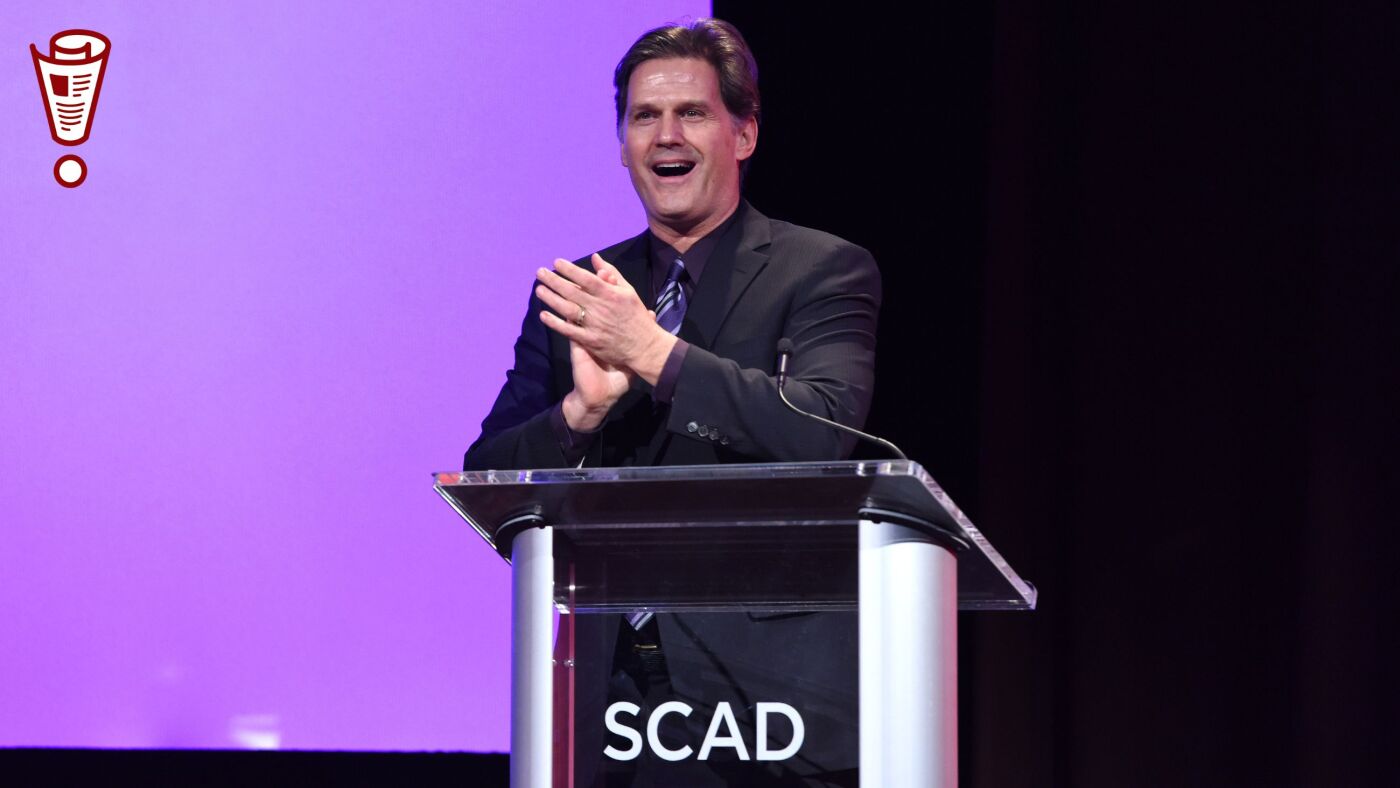
Actor, director, chair of film and television department, SCAD, D.W. Moffett speaks on stage during Rising Star Award presentation to “Star” on Day Three of aTVfest 2017 presented by SCAD at SCADshow on February 4, 2017 in Atlanta, Georgia. (Photo by Vivien Killilea/Getty Images for SCAD)
Vivien Killilea/Getty Images
hide caption
toggle caption
Vivien Killilea/Getty Images
This week’s show was recorded in Savannah with host Peter Sagal, judge and scorekeeper Alzo Slade, Not My Job guest D.W. Moffett and panelists Adam Burke, Shantira Jackson, and Joyelle Nicole Johnson. Click the audio link above to hear the whole show.
Who’s Alzo This Time
Flotus and Robotus, Ineligible Bachelorette, and a Change of Season
Panel Questions
Fold-out Coach
Bluff The Listener
Our panelists tell us three stories about a hot new dining destination, only one of which is true.
Not My Job: Actor, director, and chair of the film and television department at SCAD, D.W. Moffett, answers our questions about melees
Actor D.W. Moffett, part of the cast of One Battle After Another, plays a game called “Lots of Battles All At Once.”
Panel Questions
Hairless Whisper, Signing Off
Limericks
Alzo Slade reads three news-related limericks: Buns on the Runway, Constructive Play, Getting Work Done at Work.
Lightning Fill In The Blank
All the news we couldn’t fit anywhere else
Predictions
Our panelists predict, after the Bachelorette, what’ll be the next TV season to get cancelled at the last minute.

So you went to a No Kings protest. Now what?

The onlookers who stumble upon a No Kings Day protest in Michigan

Get out of the house with these SF events

Inside the Dallas furry convention drawing thousands and sparking culture battles

Jannik Sinner’s Girlfriend Laila Hasanovic Stuns in Skirt Before Miami Open Final

Florida High School Football Rankings: Top 25 teams – Oct. 21

How old is Bo Nix? What to know about Oregon quarterback ahead of 2024 NFL Draft

Cleary's 21 help Le Moyne down Central Connecticut State 69-64 in OT

99th annual Pony Swim held in Virginia

Indiana Members Credit Union announced as new anchor tenant at Bottleworks District
So you went to a No Kings protest. Now what?

JD Vance says he was ‘obsessed’ with UFOs, believes aliens are actually ‘demons’
The EU's recipe for trade deals : easy on beef, tough on wine

Photos: ‘No Kings’ protests across the country

Jeffries declines to break with indicted Democrat after ethics panel’s guilty verdict
-

 Sports1 week ago
IOC addresses execution of 19-year-old Iranian wrestler Saleh Mohammadi
-

 New Mexico7 days ago
Clovis shooting leaves one dead, four injured
-

 Miami, FL3 days ago
Jannik Sinner’s Girlfriend Laila Hasanovic Stuns in Ab-Revealing Post Amid Miami Open
-

 Tennessee6 days ago
Tennessee Police Investigating Alleged Assault Involving ‘Reacher’ Star Alan Ritchson
-

 Minneapolis, MN3 days ago
Boy who shielded classmate during school shooting receives Medal of Honor
-

 Technology1 week ago
YouTube job scam text: How to spot it fast
-

 Politics1 week ago
Schumer gambit fails as DHS shutdown hits 36 days and airport lines grow
-

 Science1 week ago
Record Heat Meets a Major Snow Drought Across the West