Lifestyle
Pat Sajak departs 'Wheel of Fortune' as TV's last old-school game show host


Pat Sajak on the Wheel of Fortune set.
Carol Kaelson/CBS Media Ventures
hide caption
toggle caption
Carol Kaelson/CBS Media Ventures
It was the game show answer that nearly broke the Internet: Tavaris Williams, eager to solve one of the word puzzles on Wheel of Fortune, gave an answer that wasn’t quite ready for prime time. The board looked like this: _ _ _ _ I _ T _ E B _ _ T!
His guess for the correct phrase? “Right in the butt.”
But while some in the audience gasped – and one of Williams’ competitors said, incredulously, “Whaaat!?” – host Pat Sajak simply answered “no,” smoothly moving on to the next contestant, who figured out the correct answer. (The solution was, for the record, “This is the best!”)
That incident aired on the show less than two weeks ago, going viral on social media and giving Williams enough visibility to land on Jimmy Kimmel Live, where he complimented Sajak for making him feel better and joking about it all, despite such an embarrassing flub.
But that’s been Sajak’s secret weapon over 41 seasons and more than 8,000 shows hosting the TV version of a Hangman-style wordgame. He leverages an easygoing, affable nature that helps move the show easily past any rough spots — whether it’s a contestant who loses thousands of dollars after mispronouncing an answer or a competitor who knows the show so well, he solves the puzzle and grabs his reward with no prompting from the host. (Sajak quipped, “There’s really no need for me at all.”)
On Friday, Sajak appears in his last new Wheel of Fortune episode, retiring from a job he began in 1981, as the longest-running host of a single game show in modern TV history. He told daughter Maggie in an interview also featured on Good Morning America that he could probably still keep hosting awhile, but “I’d rather leave a couple of years too early than a couple of years too late.”
While it’s true that Sajak’s departure is the end of an era for Wheel of Fortune, it’s also a pivotal moment for TV game shows in general.
Because Sajak is the last of TV’s old-school game show hosts.
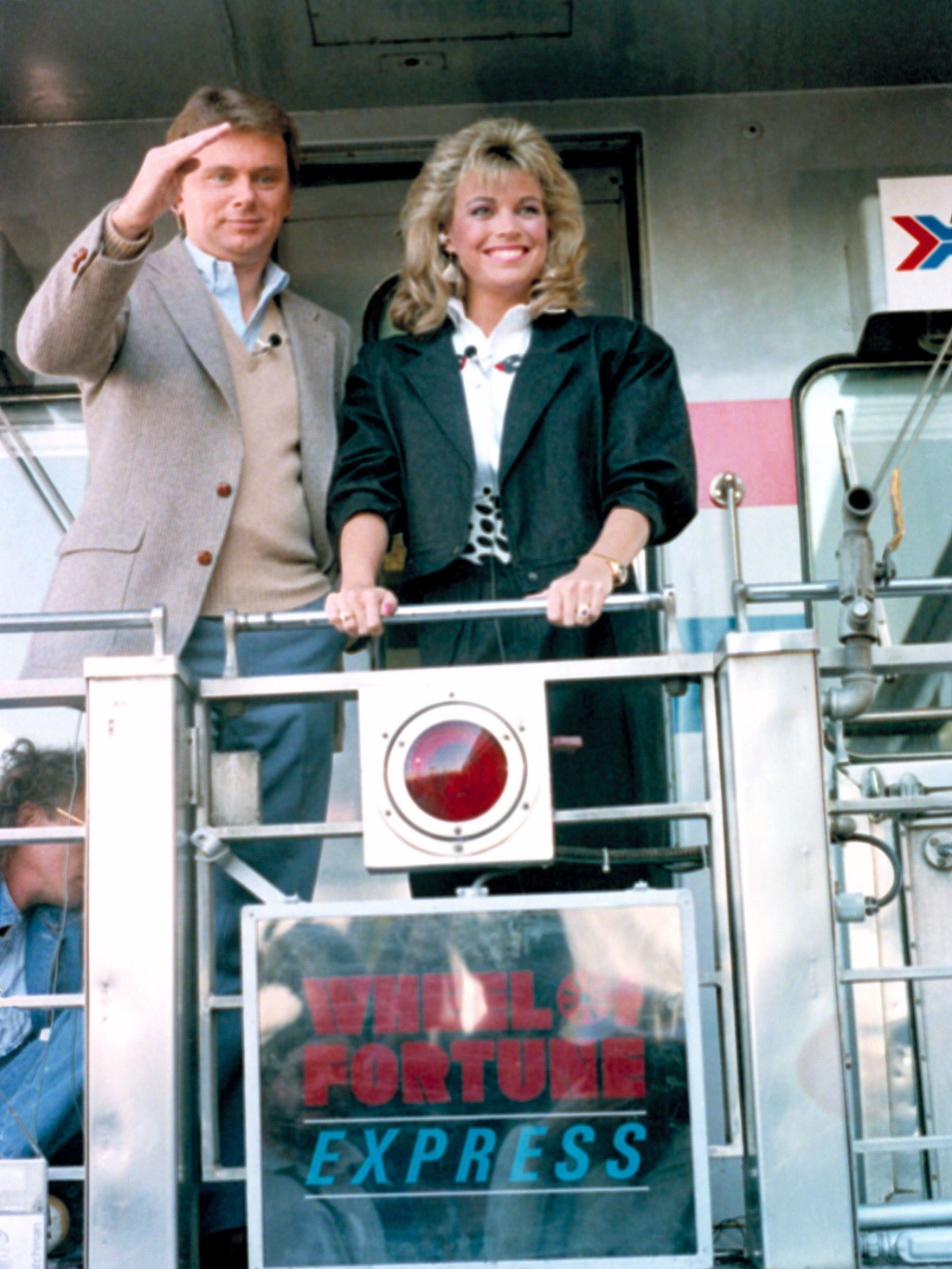
Pat Sajak and Vanna White prepare to tour cities across the country in 1987 aboard the Wheel of Fortune Express.
Judy Sloan/AP
hide caption
toggle caption
Judy Sloan/AP
The rise of the traditional game show host
Game show fans with short memories might not remember decades ago when hosts like Sajak filled the TV dial. Jeopardy‘s Alex Trebek. The Price is Right‘s Bob Barker. Let’s Make a Deal host and co-creator Monty Hall. Original Wheel of Fortune host Chuck Woolery. The Hollywood Squares‘ Peter Marshall. Tic-Tac-Dough’s Wink Martindale.
They were of a type. Generally middle-aged white men with the kind of telegenic, affable charisma found in local TV anchors – it’s no surprise Sajak was a weatherman at KNBC in Los Angeles before Wheel of Fortune creator Merv Griffin called – these hosts were studiously inoffensive and positioned for appeal to viewers in middle America.

Many of them were former radio hosts or fledgling actors. But their primary fame came from leading viewers through amusing contests on television.
“There was this sense of an almost lab-created broadcaster, whose job was to direct [the show’s] traffic in a sense,” says Robert Thompson, director of the Bleier Center for Television and Popular Culture at Syracuse University. “The contestants were really the show’s rotating cast … The hosts came from what I like to call the Wink Martindale School of Broadcasting.”
On paper, the job was simple. Introduce the contestants, explain the game, make a little small talk to turn the participants into characters viewers might invest in, and handle the occasional moment when an errant guest might say something bizarre or, um, explicit.
But watching the cavalcade of celebrities guest host Jeopardy in 2021 after Trebek’s death – names like quarterback Aaron Rodgers, talk show personality Mehmet Oz and broadcaster Joe Buck – it’s obvious there’s a secret sauce to leading such shows successfully.
Hosts must be knowledgeable without looking like know-it-alls; empathetic without looking too invested in any one player. They must explain the game in ways the players and the TV audience can follow, while also being fun and funny.
And they have to handle the reactions of average civilians under pressure – calming down the folks who get over-excited and pumping up people so intimidated they might shut down on camera.
For viewers of a certain age, old-style game show hosts like Sajak were comforting buddies – fun personalities to make you feel better while sitting at home sick from school or puttering around the house, watching daytime TV. Or, in the case of shows like Wheel and Jeopardy, which often air on TV stations after the network evening newscasts, their hosts are a relaxed presence easing you into the night.
Sajak channeled that inoffensive style well – even when news broke in 2019, amid the country’s increasing political polarization, that he was named chairman of the board of trustees for Hillsdale College, the private, conservative Christian school.
When he was paired with actress and model Vanna White in 1982, the two had chemistry like a charismatic couple leading a game among friends.
So, what are we losing, now that the last of the old school game show hosts is leaving the job?
New hosts with celebrity cachet
These days, thanks to network TV’s shrinking appetite for scripted TV series, there are more game shows than ever – from revivals of classic formats like Family Feud and Password to new inventions like Beat Shazam and The 1% Club. But the old school hosts have retired and/or died, like Trebek on Jeopardy, Barker from The Price is Right and Richard Dawson from Family Feud.
In their place are leaders who have already earned fame as performers elsewhere, bringing their fame, fanbase and persona to the screen. Consider Glee alum Jane Lynch on Weakest Link, actor/standup comic/musician Jamie Foxx on Beat Shazam or The West Wing alum Rob Lowe on The Floor. Even new Jeopardy host Ken Jennings was a champion on the program before he began hosting it.
Stand-up comics and improvisational performers accustomed to thinking on their feet have done well here, including Drew Carey, who succeeded Barker on The Price is Right, Let’s Make a Deal’s Wayne Brady and Family Feud’s Steve Harvey, who Syracuse University’s Thompson says is the king of game show hosts now – for his ability to inject personality and humor without derailing the game.
Old-school hosts were never expected to be an audience draw and even Wheel of Fortune‘s success has seemed a bit of a happy accident. Paired with Jeopardy in many TV markets, the two shows have become ratings juggernauts together, with the tough, intellectually challenging questions of Jeopardy balanced by the easy wordplay on Wheel of Fortune.
And who can resist solving a good word puzzle?
Given all that, it makes a certain kind of sense that Sajak’s replacement would be the closest modern equivalent of an old-school game show host: radio personality and American Idol host Ryan Seacrest, who has amassed his own endless list of hosting gigs.
Thompson expects the show’s popularity to keep chugging along when Seacrest takes over the show alongside Vanna White in September.
“If Barker and Trebek can be replaced… then Sajak can,” he adds. “I think the formats on these shows have become the star now. All the hosts have to do is stay out of the way and keep things moving along.”



Millie Bobby Brown in the final season of Stranger Things.
Netflix
hide caption
toggle caption
Netflix
After five seasons and almost ten years, the saga of Netflix’s Stranger Things has reached its end. In a two-hour finale, we found out what happened to our heroes (including Millie Bobby Brown and Finn Wolfhard) when they set out to battle the forces of evil. The final season had new faces and new revelations, along with moments of friendship and conflict among the folks we’ve known and loved since the night Will Byers (Noah Schnapp) first disappeared. But did it stick the landing?
To access bonus episodes and sponsor-free listening for Pop Culture Happy Hour, subscribe to Pop Culture Happy Hour+ at plus.npr.org/happy.

JasonMartin
Adin Ross Disrespecting Doechii …
Will Not Be Tolerated!!!
Published
TMZ.com
JasonMartin is putting his foot down after hearing Adin Ross call Doechii a “bitch” one too many times … the culture’s not going for it in 2026!!!
TMZ Hip Hop caught up with JM in L.A. this week, and he says Adin being aggressively addressed is vital to preventing outsiders of Black culture from toeing the line in the future.
Adin Ross is lying about Doechii and one of the biggest Twitter Accounts is behind it… pic.twitter.com/VoAwGJefyV
— Mike Tee (@ItsMikeTee) January 5, 2026
@ItsMikeTee
Adin maintains Doechii targeted him on her new track, “Girl, Get Up,” when she blasted people labeling her “an industry plant” … and blamed Complex magazine for helping fuel the fire.
Joe Budden, Glasses Malone, Wack 100, and Top Dawg Entertainment execs have all chimed in on Adin’s comments, and Jason says it’s bigger than internet tough talk … and won’t allow Adin to hide behind religion or freedom of speech to drag Black women.
Adin went on to collaborate with Tekashi 6ix9ine and Cuff Em on an anti-Lil Tjay and Doechii song, but has since said he’ll stay out of the beef; his chat doesn’t matter to him, and it’s not that deep to him.
TMZ.com
War mongering isn’t Jason’s only goal this year. He released 5 albums — “A Hit Dog Gon Holla,“ “I Told You So,“ “Mafia Cafe,“ “O.T.,“ and “A Lonely Winter” — to close out the 4th quarter and just may be in the “Snowfall” reboot with his buddy, Buddy!!!

A firefighter works as homes burn during the Eaton fire in the Altadena area of Los Angeles County, Calif., on Jan. 7, 2025.
Josh Edelson/AFP via Getty Images
hide caption
toggle caption
Josh Edelson/AFP via Getty Images
On New Year’s Eve 2024, journalist Jacob Soboroff was sitting around a campfire with a friend when he made an offhand comment that would come back to haunt him: The last thing he wanted to do in the new year, Soboroff said, was cover a story that would require donning a fire-safe yellow suit.
Just one week later, Soboroff was dressed in the yellow suit, reporting live from a street corner in Los Angeles as fire tore through the Pacific Palisades, the community where he was raised.
“This was a place that I could navigate with my eyes closed,” Soboroff says of the neighborhood. “Every hallmark of my childhood I was watching carbonize in front of me. … There were firefighters there and first responders and other journalists there, but it was an extremely lonely, isolating experience to be standing there as everything I knew burned down around me in real time.”

In his new book, Firestorm: The Great Los Angeles Fires and America’s New Age of Disaster, Soboroff offers a minute-by-minute account of the catastrophe, told through the voices of firefighters, evacuees, scientists and political leaders. He says covering the wildfires was the most important assignment he’s ever undertaken.
“The experience of doing this is something that I don’t wish on anybody, but in a way I wish everybody could experience,” he says. “It’s given me insane reverence for our colleagues in the local news community here, who, I think, definitionally were exercising a public service in the street-level journalism that they were doing and are still doing. … It was actually beautiful to watch because they are as much a first responder on a frontline as anybody else.”
Interview highlights

On the experience of reporting from the fires
You’re choking with the smoke. And I almost feel guilty describing it from my vantage point because the firefighters would say things to me like: “My eyeballs were burning. We were laying flat on our stomach in the middle of the concrete street because it was so hot, it was the only way that we could open the hoses full bore and try to save anything that we could.” …
I could feel the heat on the back of my neck as we stood in front of these houses that I remember as the houses that cars and people would line up in front of for the annual Fourth of July parade or the road race that we would run through town. Trees were on fire behind us — we were at risk of structures falling at any given minute. It was pretty surreal because this is a place I had spent so much time as a child and going back to as an adult. … I had no choice but to just open my mouth and say what I saw to the millions of people that were watching us around the country.
On undocumented immigrants being central to rebuilding the city

These types of massive both humanitarian and natural disasters give us X-ray vision for a time into sort of the fissures that are underneath the surface in our society. And Los Angeles, in addition to being one of the most unequal cities between the rich and the poor, has more undocumented people than virtually any other city in the United States of America. Governor Newsom knew that with the policies of the incoming administration, some of the very people that would be responsible for the cleanup and the rebuilding of Los Angeles may end up in the crosshairs of national immigration policy. And I think that that was an understatement. …
Pablo Alvarado in the National Day Laborer Organizing Network said to me that often the first people into a disaster — the second responders after the first — are the day laborers. They went to Florida after Hurricane Andrew, to New Orleans after Katrina, and they’d be ready to go in Los Angeles. And I went out and I cleaned up Altadena and Pasadena with some of them in real time.
And only months later did this wide-scale immigration enforcement campaign begin … on the streets of LA as sort of the Petri dish, the guinea pig for expanding this across the country. And it’s not an exaggeration to say that the parking lots of Home Depots, where workers [were] looking to get involved in the rebuilding of Los Angeles, has been ground zero for that enforcement campaign.
On efforts to rebuild
The pace is slow and it’s sort of a hopscotch of development. And I think for people who do come back, for people who can afford to come back, it’s going to be a long road ahead. You’re going to have half the houses on your street under construction for years to come. And for people that do inhabit those homes, it’s going to an isolating experience. But there’s an effort underway to rebuild. …
There’s also a lot of for-sale signs. And that’s the sad reality of this, is that there are people who, whether it’s that they can’t afford to come back … or that they just can’t stomach it, I think, sadly, a lot people are not going to be returning to their homes.
On what the Palisades and Altadena look like today

They both look like very big construction sites in a way. There are still some facades, some ruins of the more historic buildings in the Palisades. … But mostly it’s just empty lots. And in Altadena, the same thing. If you drive by the hardware store, the outside is still there. But it’s a patchwork of empty lots. Homes now under construction. And lots and lots of workers. … There are still a handful of people who are living in both the Palisades and in Altadena, but for the most part, these are communities where you’ve got workers going in during the day and coming out at night. …
We have designed this community to be one that’s in the crosshairs of a fire just like the one we experienced and that we will certainly, certainly experience again, because nobody’s packing it up and leaving Los Angeles. People may not return to their communities after they’ve lost their homes, but the ship has sailed on living in the wildland urban interface in the second largest city in the country.
On seeing this story, personally, as his “most important assignment”

Jacob Soboroff is a correspondent for MS NOW, formerly MSNBC.
Jason Frank Rothenberg/HarperCollins
hide caption
toggle caption
Jason Frank Rothenberg/HarperCollins
I don’t think I realized at the time how badly I needed the connections that I made in the wake of the fire, both with the people who have lost homes and the firefighters, first responders who were out there, but also honestly with my own family, my immediate family, my wife and my kids, my mom and my dad and my siblings and myself. I think that this was a really hard year in LA, and I think in the wake of the fire, I was experiencing some level of despair as well. Then the ICE raids happened here and sort of turned our city upside down. And this book for me was just this amazing cathartic blessing of an opportunity to find community with people I don’t think I ever would have otherwise spent time with, and to reconnect with people who I hadn’t seen or heard from in forever.
Anna Bauman and Nico Wisler produced and edited this interview for broadcast. Bridget Bentz, Molly Seavy-Nesper and Beth Novey adapted it for the web.


The first Detroit Lions OC candidate has emerged

San Francisco has a tax plan to save Muni

Dallas County eyes new multibillion-dollar jail to replace aging Lew Sterrett facility

Miami Heat-Minnesota Timberwolves Final Injury Update: Anthony Edwards’ status divulged

Ex-Yankees 1st-rounder among non-roster invitees to Red Sox spring training

Florida High School Football Rankings: Top 25 teams – Oct. 21

Cleary's 21 help Le Moyne down Central Connecticut State 69-64 in OT

How old is Bo Nix? What to know about Oregon quarterback ahead of 2024 NFL Draft

99th annual Pony Swim held in Virginia

Video: ‘It Didn’t Have to Happen This Way:’ U.Va. Faculty Call for Review of Police Response to Protests

Video: Nvidia Shows Off New A.I. Chip at CES

Pelosi heir-apparent calls Trump’s Venezuela move a ‘lawless coup,’ urges impeachment, slams Netanyahu

EU Commission examines childlike sexual images created by Musk’s AI

Lawmakers split over Maduro’s seizure. And, CDC cuts childhood vaccine schedule

Federal officials to halt more than $10B in funding to 5 states over non-citizen benefit concerns: report
-

 World1 week ago
Hamas builds new terror regime in Gaza, recruiting teens amid problematic election
-
 News1 week ago
For those who help the poor, 2025 goes down as a year of chaos
-
 Business1 week ago
Instacart ends AI pricing test that charged shoppers different prices for the same items
-

 World1 week ago
Podcast: The 2025 EU-US relationship explained simply
-
 Business1 week ago
Apple, Google and others tell some foreign employees to avoid traveling out of the country
-

 Technology1 week ago
ChatGPT’s GPT-5.2 is here, and it feels rushed
-

 Health1 week ago
Did holiday stress wreak havoc on your gut? Doctors say 6 simple tips can help
-

 Politics1 week ago
‘Unlucky’ Honduran woman arrested after allegedly running red light and crashing into ICE vehicle