Lifestyle
Opinion: This California millionaire is peddling eternal life. Why do so many people believe him?

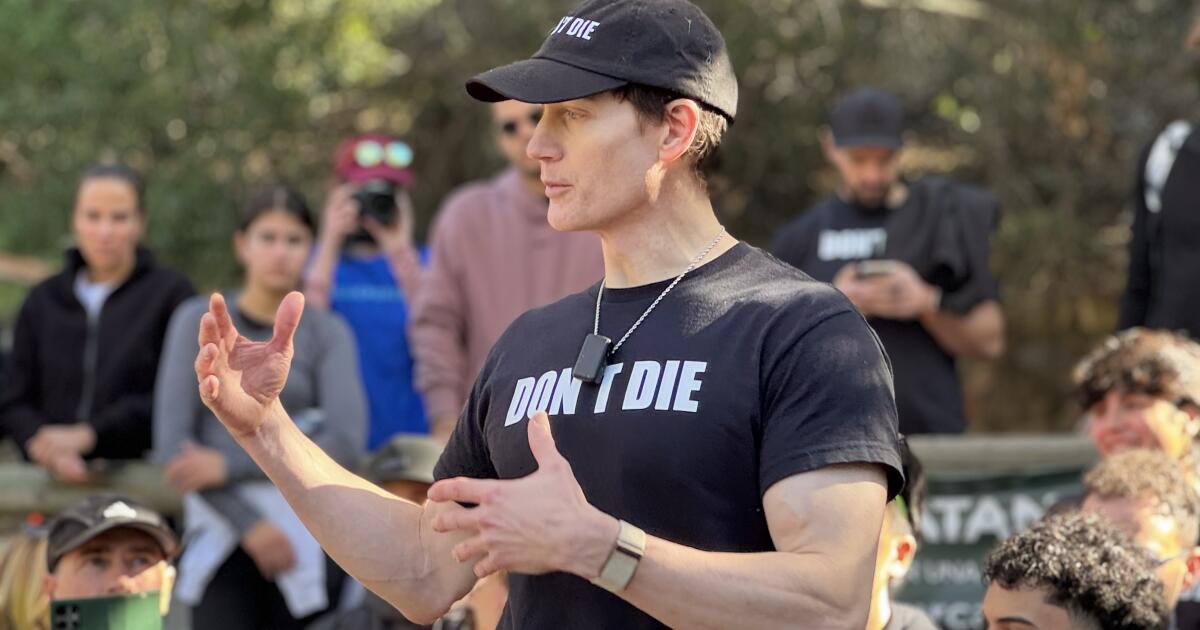
For a moment, I fell under the spell of Bryan Johnson.
Bathed in early-morning sunlight, the 46-year-old L.A.-based tech centimillionaire and longevity celebrity didn’t look much younger than his age, although he claims to have the wrinkles of a 10-year-old and organs that are several years younger than his lifespan.
We were standing at the Temescal Canyon trailhead in Pacific Palisades on Jan. 13, ahead of a Johnson-sponsored “Don’t Die” hike, one of many organized across the world that day and the only one hosted by him. Of the 500-plus people who had RSVP’d for the L.A. event, about 200 showed up. Some had slept in their cars to make it.
“The world is so full of things that take us away from what we truly want,” he told the crowd.
Opinion Columnist
Jean Guerrero
Jean Guerrero is the author, most recently, of “Hatemonger: Stephen Miller, Donald Trump and the White Nationalist Agenda.”
Johnson led us in a breathing exercise, swaying his pale and sinewy body to the electronic dance music song “Sundream” by Rüfüs Du Sol. Eyes closed, arms draped over neighbors, his fans inhaled and exhaled slowly. Restaurant servers and retail workers embraced corporate executives and real estate brokers. In their regular lives, many of these Gen Zers, millennials and baby boomers were worlds apart. Here, they were connected by a desire to live a long time — maybe forever.
Blueprint, Johnson’s wellness program, has gained a cult-like fan base in L.A. and beyond. Follow the regimen, he says, and decrease your biological age, although scientists and others criticize his approach. He’s just one subject, they say, and he tries many anti-aging methods at once, making it hard to determine cause and effect.
Johnson is undeterred.
“For the first time in the history of Homo sapiens, it’s possible to say with a straight face that death may no longer be inevitable,” he told me on the hike. It’s a statement he has made many times.
I had learned about Johnson at a party in L.A. months earlier, after noticing my first pesky eye wrinkles at age 35. Though I aspire to age fearlessly, I was feeling anxious about my waning youth in our image-obsessed city.
One of the party guests, a dermatologist, regaled me with bold and seductive claims about the pace of anti-aging research. He said a wealthy man in L.A. was spending millions on self-experimentation to uncover the secrets of eternal youth in our lifetimes.
When I Googled him, I was skeptical. A former Mormon from Utah who created a credit-card processing company that sold for $800 million, Johnson now brags about the frequency of his erections and posts photos of himself in which he looks as ghostly as the Roman statues at the Getty. He eats mostly seeds, vegetables and more than 100 daily supplements. He exercises rigorously and pays for red-light therapy, among other things.
He calls himself a “genetically enhanced human,” having undergone $25,000-a-dose gene therapy in Honduras that’s not approved by the Food and Drug Administration. It’s available only on the island of Roatan, where Hondurans say they fear displacement by U.S. billionaires who’ve bulldozed their land to create a regulation-free playground for the rich. The therapy uses follistatin, a morphogenetic hormone that is believed to boost muscle mass and fight inflammation. In one study, it extended the lifespan of mice.
But in person, Johnson looks human. Physically fit but mortal. Middle-aged.
In California, Johnson is not unique. Psychonauts and seekers here have long embarked on quixotic quests to transcend our common reality, employing everything from natural medicine and meditation to man-made chemicals and high-tech “transhumanism.” I’m wary of such trends, which can be escapist. I experimented with them as a teen; they made me self-destructive and dissociated.
But on the hike, Johnson’s fans seemed health-conscious and present. His videos across social media, where he has more than 1.6 million followers, encouraged them to prioritize self-care, they told me. They weren’t so sure about Johnson’s immortality claims, but they believed in his wellness aims.
I met a 54-year-old cancer survivor who said she reversed her Type 2 diabetes to pre-diabetes using Johnson’s advice.
Another hiker, David McGill-Soriano, a 26-year-old Long Beach resident and gang prevention counselor, had been hit by a car. He found Johnson on YouTube while bedridden with a fractured tibia and other injuries. Johnson’s faith in human perfectibility, he told me, inspired him to work to regain his strength.
“I’m so thankful for the Blueprint,” he said.
While some see Johnson’s Blueprint as a way to defy grind culture, others see it as a means to hustle harder.
“I’m always looking for ways to be a good robot and perform better,” said Diego Padilla, a 48-year-old aerospace executive who was carrying his Yorkshire terrier up the trail. He trusts Johnson because he’d made himself a guinea pig.
“I do not like animal testing whatsoever,” Padilla told me, cuddling his dog.
Johnson, who says he’s tried shock therapy on his penis and infusions of his teenage son’s blood plasma to reverse aging, measures numerous biomarkers in his body with a team of doctors and posts the data on his website.
“I think he is trying to democratize what he’s doing,” Padilla said. The Blueprint website links to devices such as a $150 erection tracker and a $599 epigenetic tracker, in case anyone wants to gather their own data.
When I found Johnson on the trail, I asked him how a single mom working three jobs could benefit from his program. He told me he was creating a healthy food service that would be cost-competitive with fast food.
“We’ve basically addressed the accessibility problem,” he said.
So far, he’s marketing $30 bottles of olive oil he may rebrand as Snake Oil, $39 cocoa powder, $25 macadamia bars and other products.
Some experts warn against the protocols Johnson promotes. Valter Longo, director of the USC Longevity Institute and professor of biological science, says some of Johnson’s treatment combinations, such as the 100-plus supplements, could be harmful.
“You can cause short-term benefits, but eventually that will probably turn into long-term problems,” he told me.
Before pivoting to wellness, Johnson invested in companies that endeavored to make the world programmable into zeros and ones. He spoke of humans as reducible to code, arguing that the future will be less about human or civil rights than about “evolution rights.” And he advocated for the merging of humans and machines.
“The relationship between human intelligence and artificial intelligence (HI + AI) will necessarily be one of symbiosis,” he wrote in 2016.
Johnson’s faith in AI is central to what he’s selling at Blueprint. On the website, he describes Blueprint not as a lifestyle brand but as “an algorithm that takes better care of me than I can myself.”
As we hiked, I told him I was wary of his argument that we should defer to AI for our decisions. I wanted to know why he would encourage people to renounce their free will at a time of rising authoritarianism and the erosion of our autonomy via Big Tech.
“Don’t you see a risk there?” I asked.
He replied that it was normal to be skeptical, as his idea was “on par with the biggest ideas that Homo sapiens have ever dealt with,” such as the fact that the Earth isn’t the center of the universe. “This idea that we may not be the best center of decision-making?” I asked. “Exactly right,” he said.
Johnson argues that humans are self-destructive and that we need AI to save us from ourselves.
“What I’m suggesting is every human and every system needs to be in check,” he told me, adding that technology will also save the Earth. “We have the same problem with the care of the Earth as we do with our body.”
As we reached the end of the trail, with its view of the ocean, Johnson announced a dance party. As Rüfüs Du Sol’s “On My Knees” played on a speaker, he bobbed up and down. Other hikers joined in.
Eventually, the group returned to the trailhead, where Johnson’s team had prepared “nutty pudding” and olive oil shots for everyone. Johnson stood on a picnic table and declared that he was plotting to negotiate discounts for his fans to get the unproved gene therapy in Honduras and other treatments. “We could become a bulk buying club for longevity therapies,” he said, to whoops and cheers.
“We are going from Homo sapiens to Homo evolutis,” Johnson said. “We are a different species.”
It was a new form of manifest destiny, 100% California and oblivious to its potential wreckage.


Milly Alcock in Supergirl.
Warner Bros. Pictures
hide caption
toggle caption
Warner Bros. Pictures
Hollywood’s newest Supergirl is kind of a dirtbag — in the good way. Fearless and grumpy, Supergirl (Milly Alcock) sets out on a quest to support a new pal’s revenge journey and to make a point that should be clear by now: Never mess with a lady’s dog. Also featuring David Corenswet and Jason Momoa, is Supergirl a worthy follow up to Superman?
If you want more DC superhero action, check out these episodes:
‘Superman’ takes off and nails the landing
‘The Batman’ puts the emo in emote
Connect with Pop Culture Happy Hour:
Letterboxd / Facebook
Our weekly newsletter
Support Pop Culture Happy Hour+
Lifestyle
L.A. Affairs: After decades of near-misses, I finally told him: ‘I’m not leaving here without you’

It didn’t take endless quarantining with my spouse during the COVID-19 pandemic to end my marriage of over two decades. By the summer of 2019, menopause — and the extra-added “bonus” of frontal fibrosing alopecia that it awakened — was pummeling me physically and mentally to the extent that I no longer had the capacity to function inside the dysfunction of my life.
The relief that came with the decision to finally let go was completely dwarfed by the immense pain of severing a family in two. I cried as I packed. I cried as I unpacked. I was rolling endlessly in a dark wave that would not stop; my feet could not tell sand from sky. Once I managed to break the surface, I reached out.
I called Tish, Diane and Michelle, three smart, strong, nurturing women who’d been through and survived divorce. I also called my brother, Dan, and my friends Doug and Steve, three kind, creative, funny men who always “got” me.
As for Steve, we met in the spring of 1984 when he auditioned to be the drummer for the Secrets, the band Dan, Doug and I had started the year before. In our small-town high school of fewer than 400 students, he had flown completely under my radar, as he was two years younger, and he joined marching band the year after I’d ditched my baritone horn for a microphone and Pat Benatar tights. Steve aced the audition, and the four of us clicked immediately over our shared love of the Pretenders and all things Monty Python. By mid-June, the Secrets were playing local bars and biker parties in the middle of nowhere, and I was head over heels in love with the drummer.
It wasn’t supposed to happen like that. I wasn’t supposed to fall in love with a boy from my hometown.
I had spent my whole life dying to get out of Middlebourne, W.Va., and had been champing at the bit to leave for college, but by late August, that no longer meant freedom; it meant that I’d have to leave Steve behind. I told myself we’d defy the odds and make it work. He was my soul mate. But we were just kids, and there was no internet, no cellphones with unlimited text and calling. By February 1985, the divide was too great. In a moment of loneliness, I cheated on him. It was over, and I was firmly told to take my place in the friend zone.
I spent the following year flailing and failing in college before making the bold, half-baked decision to drop out of the West Virginia University theater program and move to Los Angeles, a place I’d never been, to pursue a singing career. When Steve found out that I was moving across the country, he softened his friend-zone stance and told me he loved me. On July 13, 1986, he went with my parents to Pittsburgh International Airport to see me off.
For the next 33 years, we would come together and drift apart — sometimes as lovers but mostly as friends. During a visit to my Hollywood apartment in 1988, when he was still in college and the timing was still wrong, I told him, “Who knows. Maybe in 30 years, I’ll come back and get you.”
In November 2019, Steve came to visit me for a long weekend.
I picked him up at Los Angeles International Airport and took him straight to Zuma Beach for a picnic, where we watched dolphins jumping in the waves while the seagulls stole our potato chips. The following day, we cozied up for an afternoon of wine and cheese at Cornell Wine Co. in Old Agoura, then made our way over Topanga Canyon for dinner at Canyon Bistro & Wine Bar.
The night before he flew home, we watched the sun set from our table by the lake at Zin Bistro Americana in Westlake Village. I felt giddy, excited, seen, understood and appreciated in a way I hadn’t felt in a very long time. While it was tempting to jump right in with both feet, we decided to date long distance and take things slowly.
On March 26, 2020, while Steve was still recovering from being profoundly ill with COVID, I arrived at his doorstep at 6 a.m. and proclaimed, “I’m not leaving here without you.”
Two weeks later, after packing most of his belongings into U-Haul shipping crates, we left Parkersburg, W.Va., in Steve’s red Volkswagen Golf with two suitcases, one Treeing Walker Coonhound and one Aussie/Chow mix. I-40 West was practically empty; just us and the occasional car or Amazon truck.
We arrived in California on Easter Sunday and joined the rest of the world in quarantine, not knowing how it would affect our work and financial future. We took a lot of long walks to help deal with the stress of the not knowing, but the magic panacea for me came the day Steve’s Harley-Davidson arrived in one of the crates.
We cruised up and down PCH, and roared our way up and over Mulholland Highway, Stunt Road, Malibu Canyon and Decker Canyon, stopping along the way to stretch our legs, feel the sea spray on our faces and take in views from the valleys to the coastline. We were surrounded by so much beauty; it was almost impossible to let trepidation win.
On one particularly memorable ride on Mulholland Highway between Kanan Road and SR 23 near Saddle Rock, we came around a bend and — bam! — right in front of me was the greenest mountain range I’d ever seen in California, gleaming spectacularly in the sunlight. As I inhaled its gorgeousness and exhaled my stress, I thought, “I can’t believe I get to see this. I can’t believe I get to do this. I can’t believe I get to be with Steve.”
In September 2024, I got to marry Steve.
As my brother, Dan, said at the reception, “What a long, strange trip it’s been.”
The author lives in the suburbs of Los Angeles with her husband, Steve, and their dogs, Coco Puff and Kira.
L.A. Affairs chronicles the search for romantic love in all its glorious expressions in the L.A. area, and we want to hear your true story. We pay $400 for a published essay. Email LAAffairs@latimes.com. You can find submission guidelines here. You can find past columns here.

Sydney (Ayo Edebiri) and Carmy (Jeremy Allen White).
FX
hide caption
toggle caption
FX
There has always been a metaphorical parallel between The Bear, the television show, and The Bear, the fictional restaurant on the television show. Even as Carmy (Jeremy Allen White) and Sydney (Ayo Edebiri) transformed the Italian beef joint into the fancy restaurant of their dreams and wished for a Michelin star, there were undoubtedly locals who thought, “This is great and all, and I’m sure the food is good, but … I liked the beef sandwiches.” There’s still a window at The Bear to get them, but the focus is certainly elsewhere.
When it started, The Bear was mostly about the work that took place in the kitchen. The stresses of too many orders, territoriality from Richie (Ebon Moss-Bachrach), the arrival of Sydney, and the tightly wound but undeniably talented Carmy, making everybody both extremely stressed and significantly better. Over time, it shifted and grew, putting together beloved departure episodes like “Fishes” in Season 2, which introduced a boatload of guest stars for a flashback story of a disastrous family dinner before Mikey (Jon Bernthal) died. It spent time with Sydney’s family, it explored the way Tina (Liza Colón-Zayas) and Mikey originally met, it followed Marcus (Lionel Boyce) to Copenhagen, and it went with Richie to work for Andrea (Olivia Colman). All these episodes were excellent. And there was still a kitchen. But the focus seemed to be elsewhere.

At times, the show seemed to have disappeared up its own nose, to the point where you weren’t watching the show The Bear as much as you were watching the phenomenon The Bear. There were too many real-life chef cameos, until it seemed like those chefs were checking a box on a list of “things all the cool kids do.” There were too many other cameos, culminating in a rare miss from the reliably charismatic John Cena. The show placed a lot of narrative weight on Carmy’s love interest, Claire (Molly Gordon) — weight that the underwritten character couldn’t support. But even if every experiment and every diversion had worked, viewers couldn’t be blamed for missing the close focus on the kitchen and the camaraderie — for thinking, “This is all really special, but I do miss the beef sandwiches.”
The fifth and final season dispenses with the departure episodes, and it mostly dispenses with cameos. It all takes place on one day, just after Carmy tells Richie and Sydney that he wants to step back from the restaurant and give it to them and Sugar (Abby Elliott) to run, and it mostly takes place right there at The Bear. Now that the clock set by Jimmy (Oliver Platt) has run out, his money has run out as well, and a series of cascading disasters puts Sydney, Carmy and Richie behind the 8-ball from very early in the day, not least because of the tension hanging over all three of them as they prepare to tell the staff about Carmy’s decision to leave.

Tina (Liza Colón-Zayas).
FX
hide caption
toggle caption
FX
We spend this day mostly with the people we know best: our three leads, along with Sugar, Tina, Marcus, and the rest of the staff — including Luca (Will Poulter), who has stayed around to keep working with Marcus. Jimmy is running around with Computer (Brian Koppelman) and a young apprentice of his named Cheese (Elsie Fisher of Eighth Grade), trying to figure out what to do about his finances since it is Jimmy, and not just the restaurant, who’s out of money.
This day takes a while to get cooking, so to speak. The first three episodes of the season are slow, the first two in particular. It’s pouring rain outside, the lighting is dim, and the score maintains the same contemplative melancholy for a long, long time. For about two and a half episodes, it feels like one extended, low-energy scene.
But after that, there’s a shift in tone as the staff looks to get through service, and through seven episodes (FX did not make the finale available in advance for critics), the rest of the season is terrific. What you see is the core story of The Bear, which is people trying to serve food and overcome problems, but through the lens of everything that has happened over the show’s run: Carmy’s retreat from his obsessiveness, Richie’s expansive (and inspiring) discovery of his gift for hospitality; Sydney’s stepping forward from second-in-command to leader; Tina’s complex relationship with the restaurant and her grief over Mikey; Sugar and Carmy’s relationship with Donna (Jamie Lee Curtis); the arrival of Marcus as a high-end pastry chef.
The question the show asks over the last four episodes is: Given all those digressions and flashbacks, given all those visits with families and others, given everything we know about where all these people have been and what they’ve experienced, how does a high-pressure service — of the same kind we used to see in that first season — look now? How do they behave differently, and how does their behavior read differently? How are they the same people we have always known, but at a different juncture, in a different context? How do their wins mean more to them, and to the audience?
On the one hand, making a season this way, there are fewer surprising grace notes, like “Napkins,” the Tina/Mikey flashback episode in Season 3, or “Worms,” the episode in Season 4 where Sydney hung out with her cousin (Danielle Deadwyler) and her cousin’s kid. The Bear feels less daring and more conventional.
But oh, when they have victories under pressure? Victories, large or small? It is immensely, richly satisfying. There’s also more comedy other than just the goofy Faks family than we’ve had in a few seasons; Richie is perhaps the MVP of the season, and that’s partly because of how often he gets to be really funny. Ayo Edebiri continues to be the show’s best reactor, showing Syd eternally a little bit surprised (dismayed?) that she’s chosen to throw in her lot with these people.
There are a couple of questions yet to answer in the finale, both little plot items and broader character resolutions. Over these seven episodes, though, there is much to cheer.


-
 Sports2 minutes ago
Parents of ex-NFL player Doug Martin allege excessive force by Oakland police in wrongful death suit
-

 World12 minutes ago
Burkina Faso cuts diplomatic ties with former colonial ruler France
-
 News39 minutes ago
A day after Alito’s testy response to Sotomayor’s dissent, court says it was a ‘misunderstanding’
-

 Los Angeles, Ca2 hours ago
Watch Project Angel Food's 'Lead with Love' telethon on KTLA
-

 Detroit, MI2 hours ago
Metro Detroit weather forecast, June 26, 2026 — 4 p.m. Update
-

 San Francisco, CA2 hours ago
Newlyweds celebrate Pride-themed weddings inside SF City Hall as parade preparations underway
-

 Dallas, TX3 hours ago
All Dallas restaurants firing up specials for July 4th and America’s 250th
-

 Miami, FL3 hours ago
Helping Venezuela: State Department deploys Miami-Dade search-and-rescue team

