Lifestyle
‘No lines and big, wide-open runs’: This woodsy ski town is like Mammoth without the crowds


You are a beginning or intermediate skier, allergic to long lift lines, more interested in peace and quiet than après-ski action. Or you have young kids, ripe for introduction to skiing or snowboarding. Or you simply want a rustic mountain getaway, one where you can amble through a woodsy little village with zero Starbucks.
These traits make you a good candidate for June Lake, the eastern Sierra town that lives most of its life in the shadow of bigger, busier Mammoth Lakes.
“It’s way family-friendlier than Mammoth,” said Daniel Jones after a day of June Lake snowboarding with Lorena Alvarado and children Gabriela Gonzales, 7, and Amirah Jones, 2. They had come from Riverside, a first-time visit for the kids.
After a day of snowboarding at June Mountain, Daniel Jones and Lorena Alvarado of Riverside head for the parking lot with children Gabriela Gonzalez, 7, and Amirah Jones, 2.
(Christopher Reynolds / Los Angeles Times)
Like me, they’d arrived in time to savor the sight of the Sierra under all the snow that fell in late December. That storm knocked out power for several days, but led to the opening of all the trails on June Mountain, the town’s ski resort.
The main road to June Lake is the 14-mile June Lake Loop, a.k.a. State Route 158, which branches off from U.S. 395 about 10 miles north of the exit for Mammoth, roughly 320 miles north of Los Angeles.
Once you leave 395, things get rustic quickly. The two-lane loop threads its way among forests and A-frames and cabins, skirting the waters of June Lake and the lake’s village, which is only a few blocks long. Check out the three-foot icicles dripping from the eaves and keep an eye out for the big boulder by the fire station on the right.
After the village, you pass Gull Lake (the tiniest of the four lakes along the loop) and the June Mountain ski area. Then, if you’re driving in summer, the road loops back to 395 by way of Silver Lake and Grant Lake.
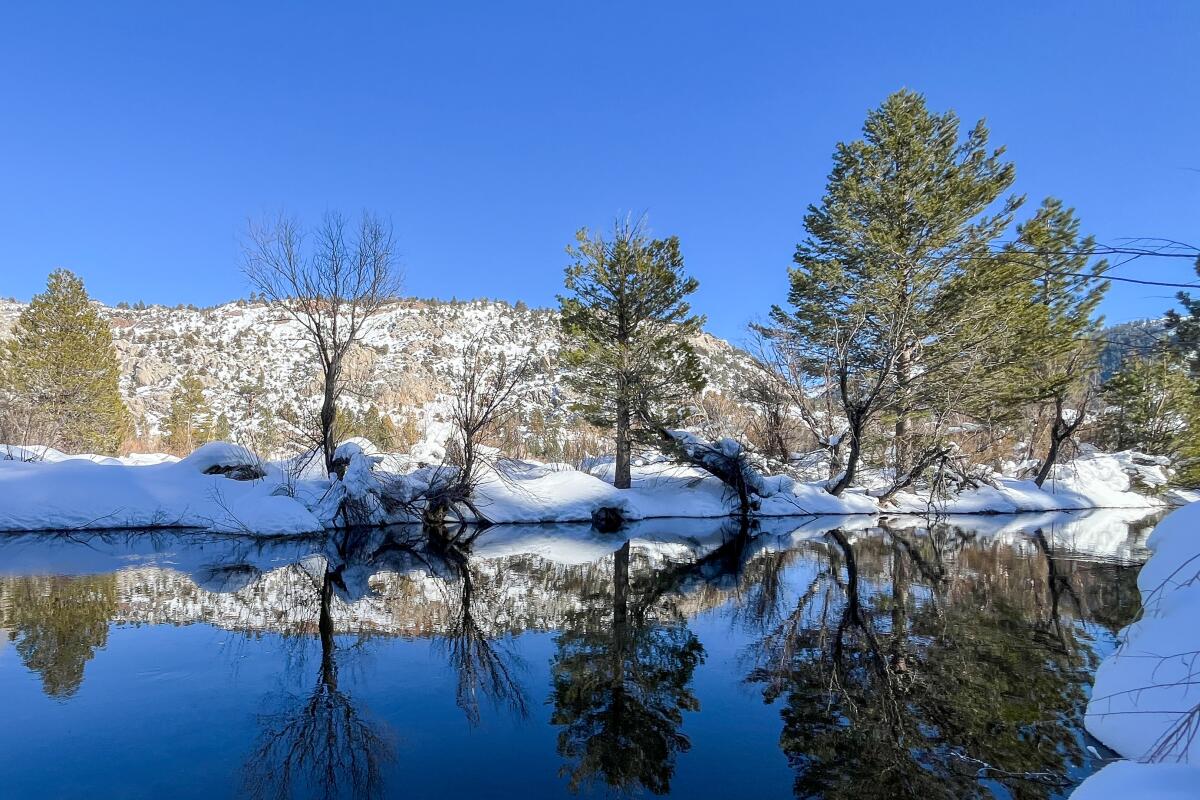
The June Lake area in the eastern Sierra includes several bodies of water. Rush Creek, seen here, feeds into Silver Lake a few miles from the village of June Lake.
(Christopher Reynolds / Los Angeles Times)
But in winter, the northern part of that loop is closed to cars, Maybe this is why the village, mountain and environs so often feel like a snowbound secret.
As for the June Mountain ski area, its 1,500 accessible acres make it much smaller than Mammoth Mountain (with whom it shares a corporate parent). And it has a larger share of beginner and intermediate runs — a drag for hotshots, maybe, but a boon for families.
By management’s estimate, June Mountain’s 41 named trails are 15% beginner level and 40% intermediate. (At Mammoth, 59% of 180 named trails are rated difficult, very difficult or extremely difficult.) Leaning into this difference, June Mountain offers free lift tickets to children 12 and under. (Adult lift tickets are typically $119-$179 per day.)

From the chairlifts at June Mountain ski resort, visitors get broad views.
(Christopher Reynolds / Los Angeles Times)
The ski area is served by six chairlifts, and just about everyone begins by riding chair J1 up to the June Meadows Chalet (8,695 feet above sea level). That’s where the cafeteria, rental equipment, lockers and shop are found and lessons begin.
That’s also where you begin to notice the view, especially the 10,908-foot Carson Peak.
“Usually, me and my family go to Big Bear every year, but we wanted to try something different. Less people. And a lot of snow,” said Valeriia Ivanchenko, a 20-year-old snowboarder who was taking a breather outside the chalet.
“No lines and lots of big, wide-open runs,” said Brian Roehl, who had come from Sacramento with his wife.
“The lake views are nice, too,” said Roxie Roehl.
June Lake is a 30-minute drive from Mammoth. Because both operations are owned by Denver-based Alterra Mountain Co., Mammoth lift tickets are generally applicable at June. So it’s easy to combine destinations.
Or you could just focus on June Lake, an unincorporated community with about 600 people, one K-8 public school and one gas station (the Shell station where 158 meets 395).
In summer, when it’s busiest, fishers and boaters head for the lakes and you can reach Yosemite National‘s eastern entrance with a 25-mile drive via the seasonal Tioga Road.

The Tiger Bar has anchored June Lake’s downtown since 1932.
(Christopher Reynolds / Los Angeles Times)
In winter and summer alike, the heart of June Lake‘s village is dominated by the 94-year-old Tiger Bar & Café (which was due to be taken over by new owners in January); Ernie’s Tackle & Ski Shop (which goes back to 1932 and has lower rental prices than those at June Mountain); the June Lake General Store and June Lake Brewing.
At the brewery — JLB to locals — I found Natalie and Chris Garcia of Santa Barbara and their daughter Winnie, 18 months old and eager to chase down a duck on the patio.
“This is her first snow,” Natalie Garcia said, adding that June Lake “just feels more down-home … less of a party scene.”
“We built a snowman,” said Chris Garcia.

Natalie and Chris Garcia of Santa Barbara play with their daughter, Winnie, and a duck at June Lake Brewing.
(Christopher Reynolds / Los Angeles Times)
It’s fun to imagine that rustic, semi-remote places like this never change, but of course they do, for better and worse. The Carson Peak Inn steakhouse, a longtime landmark, is closed indefinitely. Meanwhile, Pino Pies, which offers New Zealand-style meat pies, opened in the village last spring. (I recommend the $13 potato-top pie.)

Pino Pies, open since 2025 in June Lake, offers New Zealand-style meat pies.
(Christopher Reynolds / Los Angeles Times)
Next time I’m in town I hope to try the June Deli (which took over the former Epic Cafe space in the village last year) and the June Pie Pizza Co. (New York-style thin crusts) or the Balanced Rock Grill & Cantina. And I might make a day trip to Mono Lake (about 15 miles north).
I might also repeat the two hikes I did in the snow.
For one, I put crampons on my boots and headed about 3 miles south on U.S. 395 to the Obsidian Dome Trail, a mostly flat route of just under a mile — great for snowshoes or walking dogs.
For the other hike, I headed to the closed portion of June Lake Loop and parked just short of the barricade. Beyond it, a hiker or snowshoer finds several miles of carless, unplowed path, with mountains rising to your left and half-frozen Rush Creek and Silver Lake to the right.
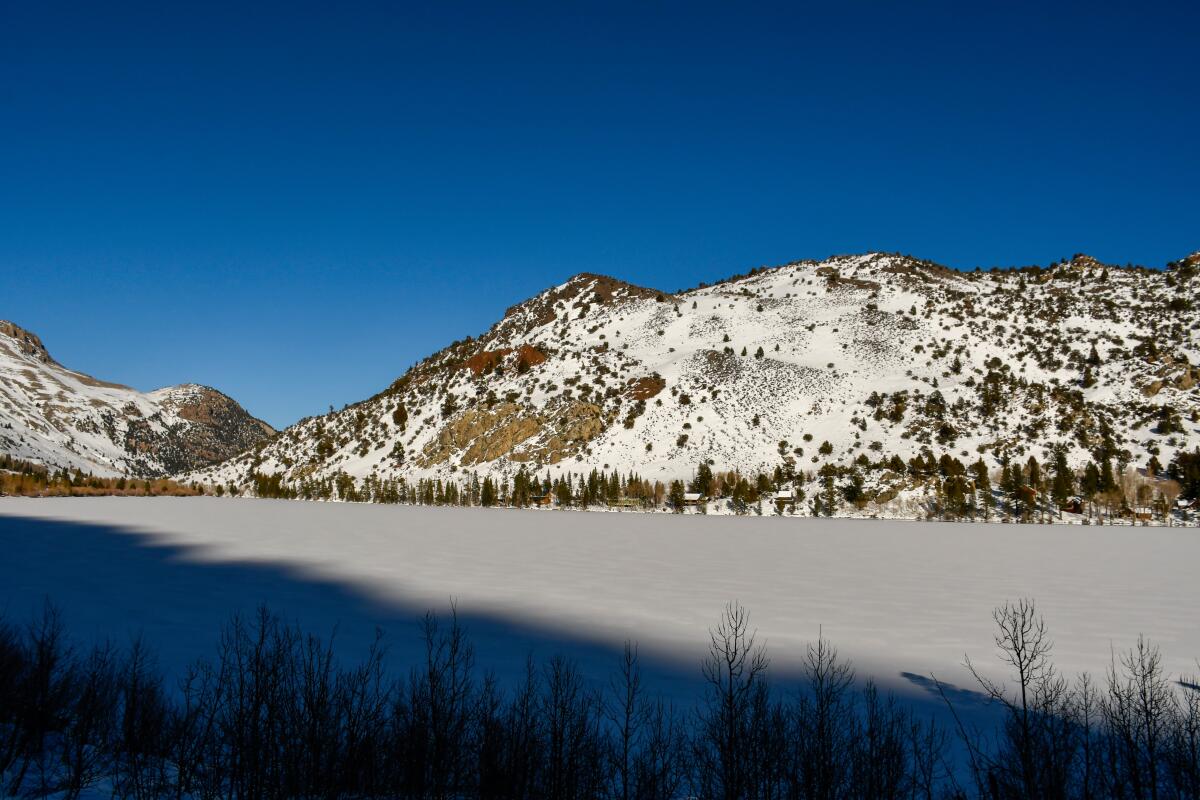
When part of Highway 158 closes to auto traffic in winter, hikers and snowshoers inherit a broad, mostly flat path with views of Silver Lake.
(Christopher Reynolds / Los Angeles Times)
“You get up to the lake and you hear the ice cracking. It’s wonderful,” said Mike Webb, 73, whom I met on the trail with his son, Randy, 46, and Randy’s 10-year-old and 12-year-old.
“This is serenity up here,” said Webb. “If you’re looking for a $102 pizza, go to Mammoth.”



There’s a three-story house in Baltimore that looks a bit imposing. You walk up the stone steps before even getting up to the porch, and then you enter the door and you’re greeted with a glass case of literary awards. It’s The Clifton House, formerly home of Lucille Clifton.
The National Book Award-winning poet lived there with her husband, Fred, starting in 1967 until the bank foreclosed on the house in 1980. Clifton’s daughter, Sidney Clifton, has since revived the house and turned it into a cultural hub, hosting artists, readings, workshops and more. But even during a February visit, in the mid-afternoon with no organized events on, the house feels full.

The corner of Lucille Clifton’s bedroom, where she would wake up and write in the mornings
Andrew Limbong/NPR
hide caption
toggle caption
Andrew Limbong/NPR
“There’s a presence here,” Clifton House Executive Director Joël Díaz told me. “There’s a presence here that sits at attention.”
Sometimes, rooms where famous writers worked can be places of ineffable magic. Other times, they can just be rooms.

Princeton University Press
Katie da Cunha Lewin is the author of the new book, The Writer’s Room: The Hidden Worlds That Shape the Books We Love, which explores the appeal of these rooms. Lewin is a big Virginia Woolf fan, and the very first place Lewin visited working on the book was Monk’s House — Woolf’s summer home in Sussex, England. On the way there, there were dreams of seeing Woolf’s desk, of retracing Woolf’s steps and imagining what her creative process would feel like. It turned out to be a bit of a disappointment for Lewin — everything interesting was behind glass, she said. Still, in the book Lewin writes about how she took a picture of the room and saved it on her phone, going back to check it and re-check it, “in the hope it would allow me some of its magic.”
Let’s be real, writing is a little boring. Unlike a band on fire in the recording studio, or a painter possessed in their studio, the visual image of a writer sitting at a desk click-clacking away at a keyboard or scribbling on a piece of paper isn’t particularly exciting. And yet, the myth of the writer’s room continues to enrapture us. You can head to Massachusetts to see where Louisa May Alcott wrote Little Women. Or go down to Florida to visit the home of Zora Neale Hurston. Or book a stay at the Scott & Zelda Fitzgerald Museum in Alabama, where the famous couple lived for a time. But what, exactly, is the draw?

Lewin said in an interview that whenever she was at a book event or an author reading, an audience question about the writer’s writing space came up. And yes, some of this is basic fan-driven curiosity. But also “it started to occur to me that it was a central mystery about writing, as if writing is a magic thing that just happens rather than actually labor,” she said.
In a lot of ways, the book is a debunking of the myths we’re presented about writers in their rooms. She writes about the types of writers who couldn’t lock themselves in an office for hours on end, and instead had to find moments in-between to work on their art. She covers the writers who make a big show of their rooms, as a way to seem more writerly. She writes about writers who have had their homes and rooms preserved, versus the ones whose rooms have been lost to time and new real estate developments. The central argument of the book is that there is no magic formula to writing — that there is no daily to-do list to follow, no just-right office chair to buy in order to become a writer. You just have to write.

Bruce Johnston
I’m Riding My Last Wave With The Beach Boys
Published
Bruce Johnston is riding off into the California sunset … at least for now.
The Beach Boys legend announced Wednesday he’s stepping away from touring after six decades with the iconic band. The 83-year-old revealed in a statement to Rolling Stone he’s hanging up his touring hat to focus on what he calls part three of his long music career.

“It’s time for Part Three of my lengthy musical career!” Johnston said. “I can write songs forever, and wait until you hear what’s coming!!! As my major talent beyond singing is songwriting, now is the time to get serious again.”
Johnston famously stepped in for co-founder Brian Wilson in 1965 for live performances, becoming a staple of the Beach Boys’ touring lineup ever since. Now, he says he’s shifting gears toward songwriting and even some speaking engagements … with occasional touring member John Stamos helping him craft what he’ll talk about onstage.
“I might even sing ‘Disney Girls’ & ‘I Write The Songs!!’” he teased.
But don’t call it a full-on farewell tour just yet. Johnston made it clear he’s not shutting the door completely, saying he’s excited to reunite with the band for special occasions, including their upcoming July 2-4 shows at the Hollywood Bowl as part of the Beach Boys’ 2026 tour. The run celebrates both the 60th anniversary of “Pet Sounds” and America’s 250th birthday.
“This isn’t goodbye, it’s see you soon,” he wrote. “I am forever grateful to be a part of the Beach Boys musical legacy.”
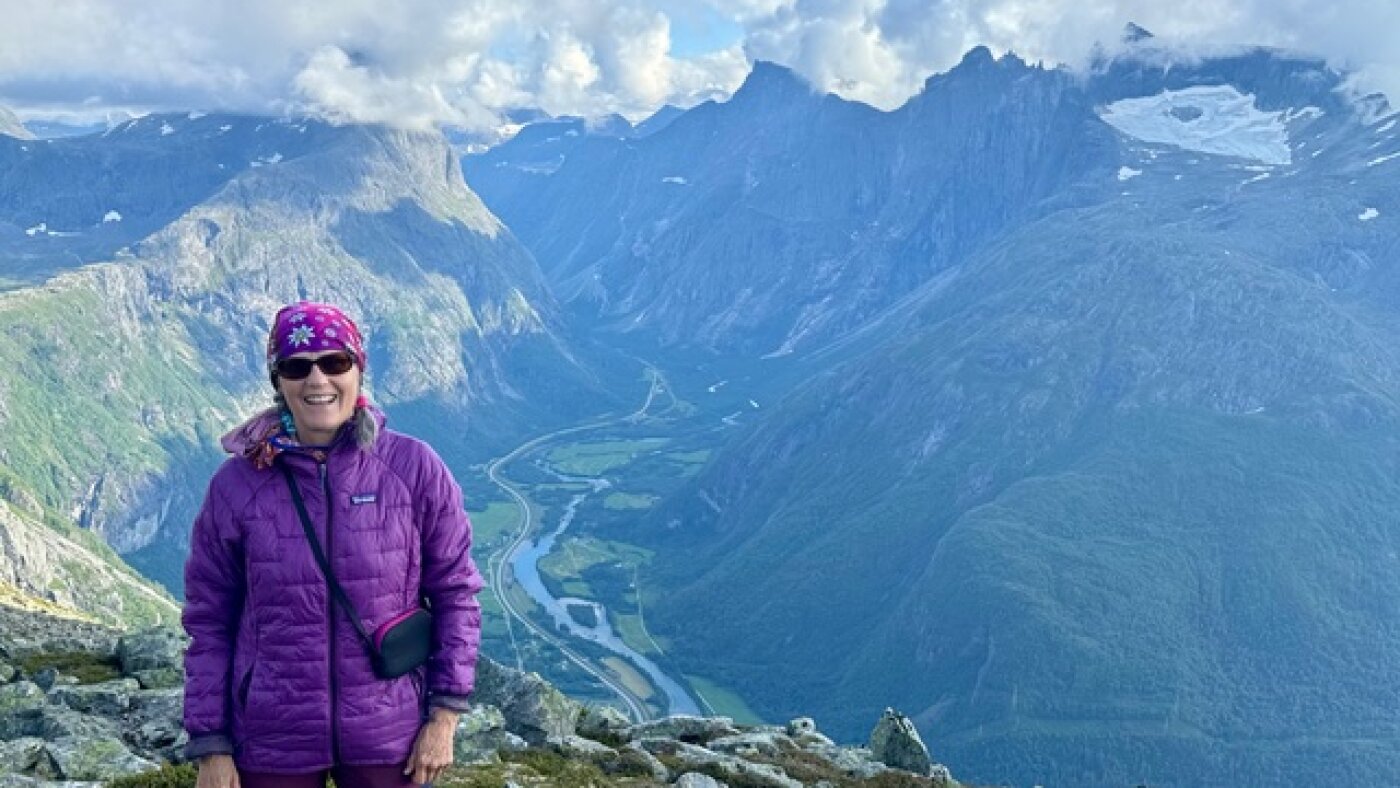
In 1982, Jean Muenchrath was injured in a mountaineering accident and on the brink of death when a stranger and his family went out of their way to save her life.
Jean Muenchrath
hide caption
toggle caption
Jean Muenchrath
In early May 1982, Jean Muenchrath and her boyfriend set out on a mountaineering trip in the Sierra Nevada, a mountain range in California. They had done many backcountry trips in the area before, so the terrain was somewhat familiar to both of them. But after they reached one of the summits, a violent storm swept in. It began to snow heavily, and soon the pair was engulfed in a blizzard, with thunder and lightning reverberating around them.
“Getting struck and killed by lightning was a real possibility since we were the highest thing around for miles and lightning was striking all around us,” Muenchrath said.
To reach safer ground, they decided to abandon their plan of taking a trail back. Instead, using their ice axes, they climbed down the face of the mountain through steep and icy snow chutes.
They were both skilled at this type of descent, but at one particularly difficult part of the route, Muenchrath slipped and tumbled over 100 feet down the rocky mountain face. She barely survived the fall and suffered life-threatening injuries.

This was before cellular or satellite phones, so calling for help wasn’t an option. The couple was forced to hike through deep snow back to the trailhead. Once they arrived, Muenchrath collapsed in the parking lot. It had been five days since she’d fallen.
”My clothes were bloody. I had multiple fractures in my spine and pelvis, a head injury and gangrene from a deep wound,” Muenchrath said.
Not long after they reached the trailhead parking lot, a car pulled in. A man was driving, with his wife in the passenger seat and their baby in the back. As soon as the man saw Muenchrath’s condition, he ran over to help.
”He gently stroked my head, and he held my face [and] reassured me by saying something like, ‘You’re going to be OK now. I’ll be right back to get you,’” Muenchrath remembered.
For the first time in days, her panic began to lift.
“My unsung hero gave me hope that I’d reach a hospital and I’d survive. He took away my fears.”
Within a few minutes, the man had unpacked his car. His wife agreed to stay back in the parking lot with their baby in order to make room for Muenchrath, her boyfriend and their backpacks.
The man drove them to a nearby town so that the couple could get medical treatment.
“I remember looking into the eyes of my unsung hero as he carried me into the emergency room in Lone Pine, California. I was so weak, I couldn’t find the words to express the gratitude I felt in my heart.”

The gratitude she felt that day only grew. Now, nearly 45 years later, she still thinks about the man and his family.
”He gave me the gift of allowing me to live my life and my dreams,” Muenchrath said.
At some point along the way, the man gave Muenchrath his contact information. But in the chaos of the day, she lost it and has never been able to find him.
”If I knew where my unsung hero was today, I would fly across the country to meet him again. I’d hug him, buy him a meal and tell him how much he continues to mean to me by saving my life. Wherever you are, I say thank you from the depths of my being.”
My Unsung Hero is also a podcast — new episodes are released every Tuesday. To share the story of your unsung hero with the Hidden Brain team, record a voice memo on your phone and send it to myunsunghero@hiddenbrain.org.

As his polarizing Pitt career winds down, a banged-up Cam Corhen has saved his best for last

Abercrombie’s Career-High 33 Lifts Augusta Past Middle Georgia in PBC Tournament Quarterfinals – Augusta University

Storm Team4 Forecast: Thick fog to clear before storms, rain Thursday night

Several Ohio schools placed under lockdown after threat

Texas Plans Second Execution of the Year

Florida High School Football Rankings: Top 25 teams – Oct. 21

Cleary's 21 help Le Moyne down Central Connecticut State 69-64 in OT

How old is Bo Nix? What to know about Oregon quarterback ahead of 2024 NFL Draft

99th annual Pony Swim held in Virginia

Indiana Members Credit Union announced as new anchor tenant at Bottleworks District

DHS defends McLaughlin against allegations husband’s company profited millions from ad contracts: ‘Baseless’

Sánchez defies Trump in political gamble as Madrid say no to war

Satellite images show Iran school strike hit more buildings than earlier reported

US submarine sinks Iranian warship by torpedo in a first since World War II

Which oil and gas facilities in the Gulf have been attacked?
-

 World1 week ago
Exclusive: DeepSeek withholds latest AI model from US chipmakers including Nvidia, sources say
-

 Massachusetts1 week ago
Mother and daughter injured in Taunton house explosion
-

 Wisconsin3 days ago
Setting sail on iceboats across a frozen lake in Wisconsin
-

 Maryland4 days ago
AM showers Sunday in Maryland
-

 Denver, CO1 week ago
10 acres charred, 5 injured in Thornton grass fire, evacuation orders lifted
-

 Florida4 days ago
Florida man rescued after being stuck in shoulder-deep mud for days
-

 Oregon6 days ago
2026 OSAA Oregon Wrestling State Championship Results And Brackets – FloWrestling
-

 Massachusetts2 days ago
Massachusetts man awaits word from family in Iran after attacks