Lifestyle
Needing a break from L.A., artists turn a cabin near Joshua Tree into a family escape
On a sunny spring afternoon in the high desert, Adam Miller and Devon Oder prepared to welcome guests — friends, neighbors, artists and family members — to a reception for artist B. Wurtz at their one-bedroom cabin in Yucca Valley.
Like many Los Angeles parents of young children who needed a break during the COVID-19 pandemic, the married artists and gallerists escaped to Yucca Valley with their two sons and three rescue dogs amid stay-at-home orders.
Oder, a Los Angeles native who first camped in Joshua Tree when she was a student at UC Santa Cruz, says they had long dreamed of buying a home in the desert. “Spending more time here during the pandemic reinvigorated our dream,” she says.
When a local real estate agent specializing in off-market listings showed them a tiny cabin on 2½ acres above downtown Yucca Valley, their dream of purchasing a home and living part-time in the desert became a reality.
The sunken living room features a colorful oil painting by Joani Tremblay, a ceramic owl by Myungjin Kim and a large ceramic vessel by Jennifer Rochlin.
(Lance Gerber)
“Once we opened a second gallery in Palm Springs, we wanted to be immersed in the community here,” says Miller. “We dreamed of buying land and building our own home, but once we found this cabin, we knew we wanted to start living here right away and make memories with our children.”
Today, the 1958 cabin is more than just a second home for the Pit art gallery owners who met while getting their MFAs at ArtCenter College of Design in Pasadena and later worked as studio assistants for Los Angeles artist Sterling Ruby. It’s also a place where they can connect with a thriving community of artists, such as their neighbor Heidi Schwegler of the Yucca Valley Material Lab and Ryan Schneider and Heather Day, whom they represent at the Pit.
“They made a decision to become a part of the community here,” says Schneider, an artist primarily focused on sculpture who lives in Joshua Tree full time. “They renovated the cabin in a beautiful way, filled it with art and started hosting gatherings. It has a super warm, family vibe.”
When Miller and Oder first saw the house on a scouting trip, Oder says she “immediately said yes.” Although the house was offered as is in a probate sale, they could tell that the previous owner, a musician who had died, had taken care of it. “The property just needed some love,” she says.

“The property just needed some love,” says Oder of the 1958 cabin, shown before it was remodeled.
(Devon Oder)
Miller wasn’t as certain.
“The house wasn’t a teardown, but it was gnarly,” he says of the dark wood-paneled walls and small, compartmentalized rooms.
Still, the simple kitchen and Home Depot bathroom were functional. A detached garage would help with storage since the cabin had no closets. The plumbing and the existing mini-split HVAC system were in good shape. But with the cabin measuring 988 square feet, the couple wondered where everyone would sleep.
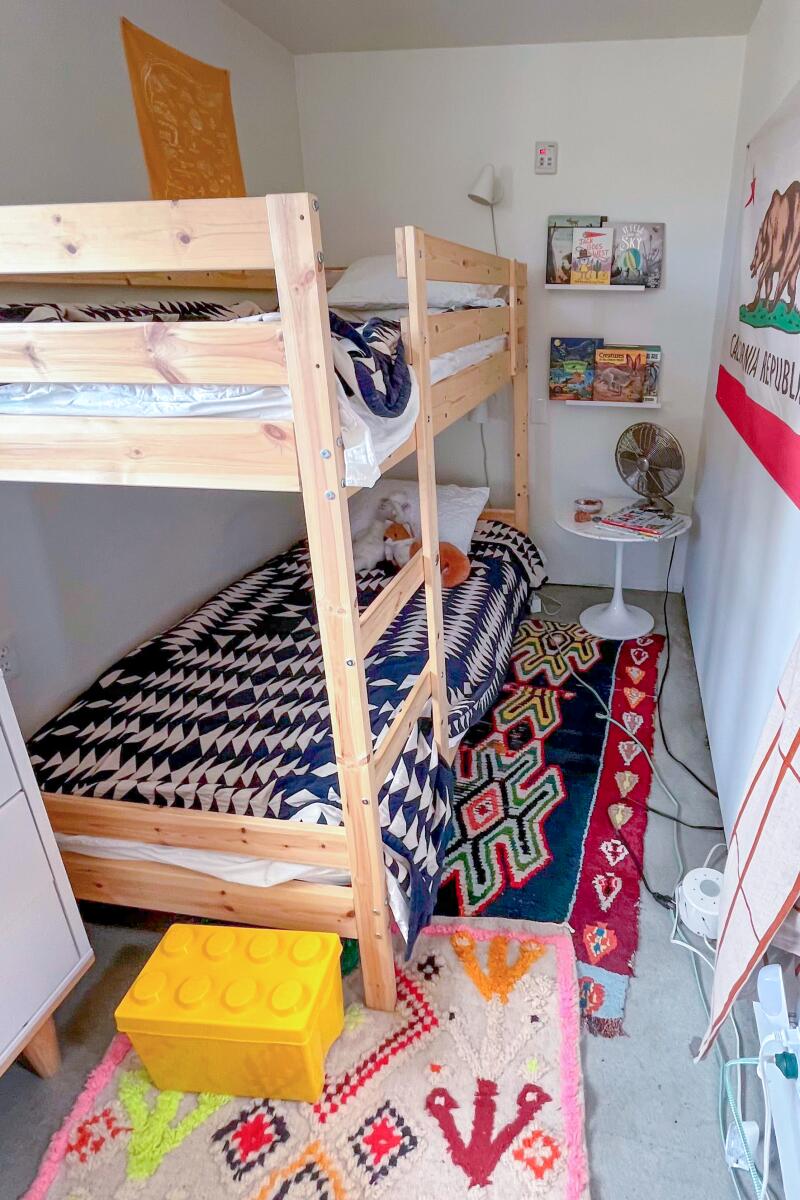
Uneven floor slabs hinted at minor additions over the years, including a supply room with shelving off the lone bedroom and bath. “I thought, ‘If we can fit a bunk bed in the pantry for the boys, then we should buy the house,’” Oder recalls with a laugh. Her optimism prevailed. Logan, 5, and River, 8, now sleep in bunk beds in the tiny space. They also added a pullout sofa in the living room and RV hookups in the backyard, hoping to accommodate more friends and family.
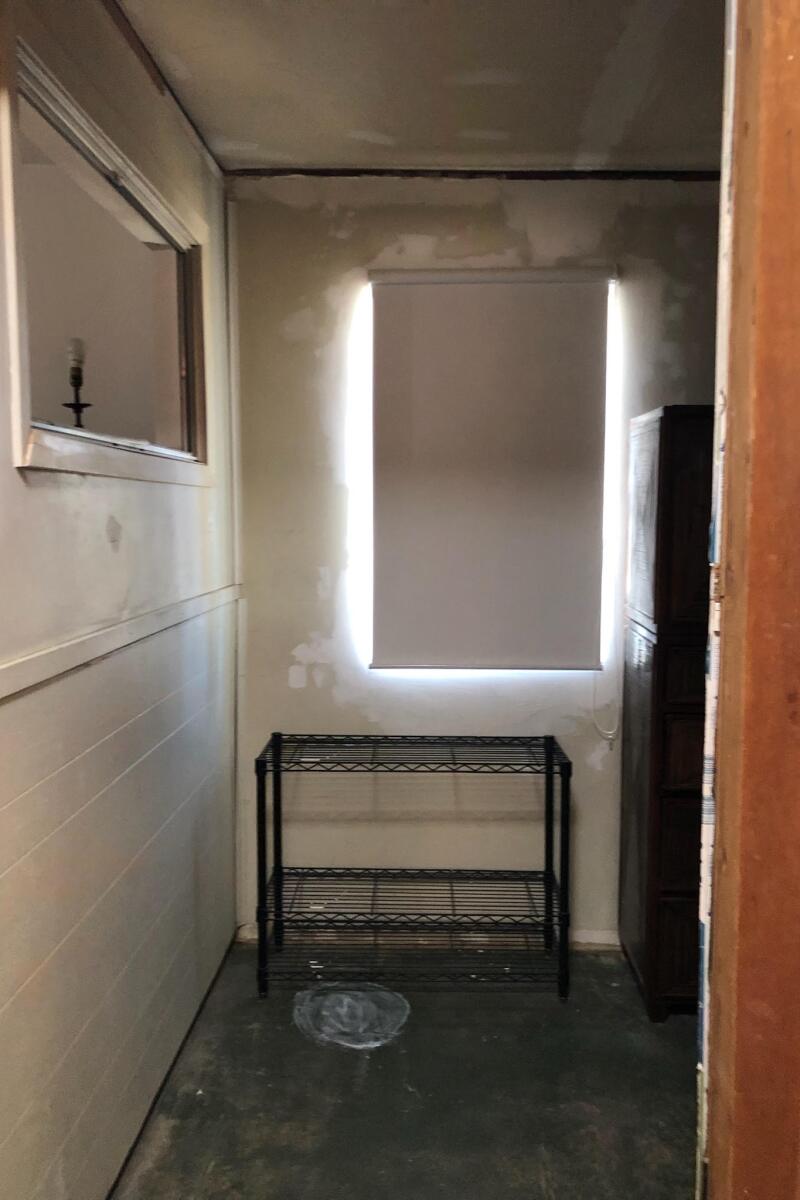
The pantry of the Yucca Valley cabin before it was turned into a room for the kids, shown right. (Devon Oder) The former pantry today. (Lisa Boone / Los Angeles Times)
In 2022, the desert contractors they approached were busy with remodeling projects, so the couple hired a gallery associate in Los Angeles who moved into the house and completed a cosmetic makeover in just a month and a half with the assistance of three others with remodeling experience .
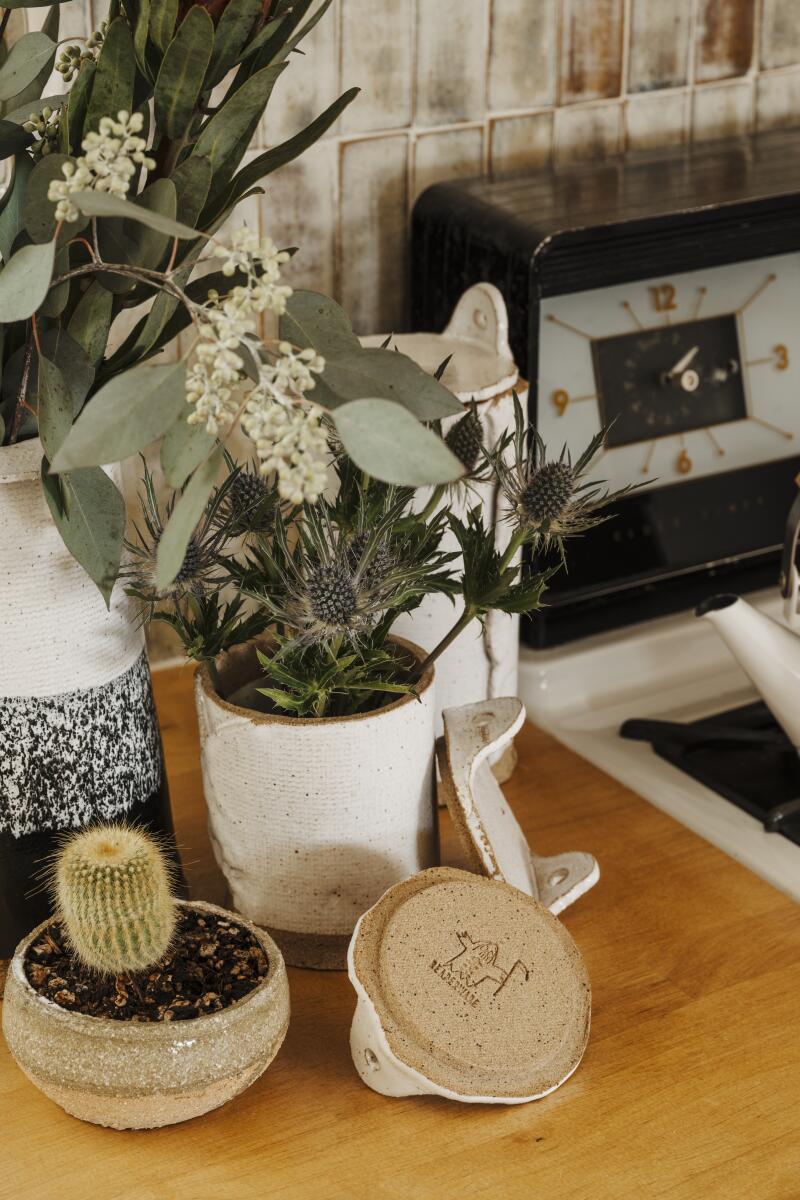
Rather than completely redoing the interiors, the couple kept as much of the cabin’s original charm as possible, including the 1960s oven and stove in the kitchen, windows, a wood-burning stove in a brick-backed corner of the dining room and some wood paneling. “We wanted it to feel like a cabin,” Miller says. “But we wanted it to feel homey too.”
The sunny transformation in the kitchen includes new butcher block countertops and open shelves filled with Miller’s Reaperware ceramic dishes. More handmade tiles by Miller, who is also a painter, brighten the backsplash behind the sink and stove. The couple also chose to preserve the funky kitchen island — a walnut dresser with drawers; they freshened it up with a new butcher block countertop to match the others.
(Lance Gerber)
The wall that once separated the living room from the kitchen and dining area was removed to open up the interiors, and the concrete floors, which had several layers of paint, were ground down and repolished — a no-nonsense move that suited the family’s indoor-outdoor lifestyle.
To add further warmth to the interiors, the couple — who are both 42 — combined colorful Moroccan rugs with cotton kilims and textiles, including double-sided handmade cotton and linen drapes that Miller’s mother sewed using Marimekko fabric.
And then there’s the art, which Miller says was chosen because it “felt appropriate for the desert environment,” including mixed-media pieces and ceramics by Miller and Oder, George Sherman, Joani Tremblay, Tony Marsh and Jonathan Cross.
After the couple updated the interiors, which cost around $45,000, not including furniture, fixtures and appliances, they focused on the outdoor area, which was mostly unkempt with bricks, trash, random planters and a run-down shed. A propane tank in the middle of the yard was relocated, and the couple hopes to turn a shipping container left behind into an art space.
Working together, they installed new cactuses, succulents, boulders, a hot tub and a galvanized steel cowboy tub for their boys.
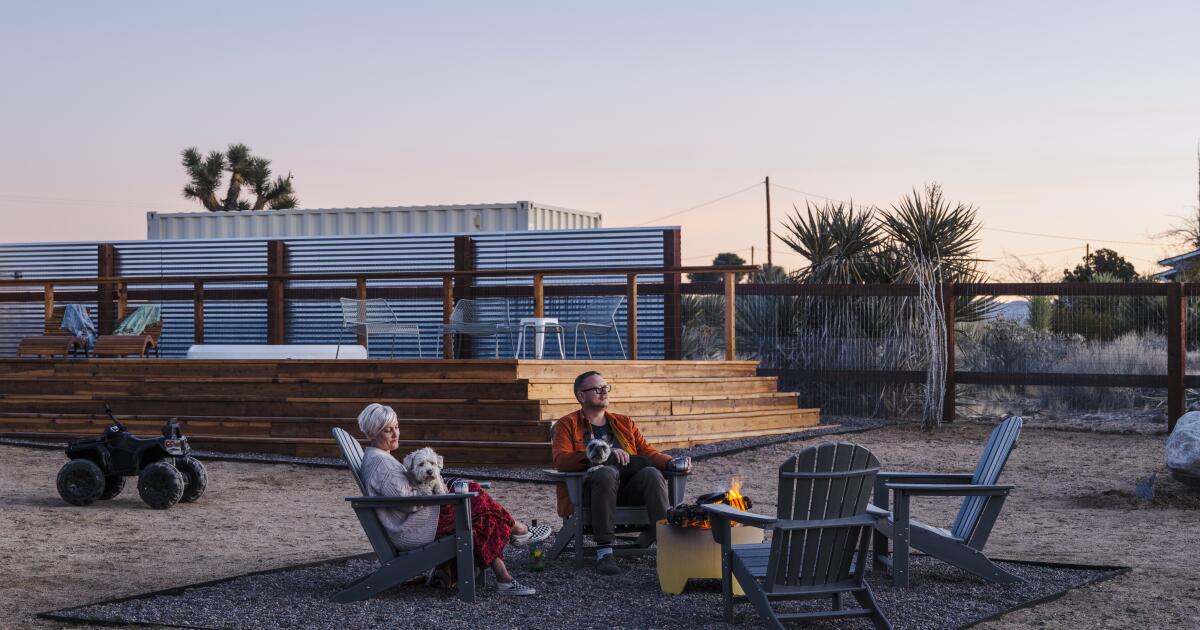
When they wanted to add a redwood deck, the artists drew it on a piece of white paper and asked Los Angeles-based contractor Finished by Design to build it. A firepit and a shady pergola create more places for the family and their guests to congregate outdoors when the weather’s right. Temperatures can reach triple digits in the summer, and it’s been known to snow in the winter.
Because they have dogs and kids, Oder and Miller had a three-foot-deep rattlesnake fence installed around the property’s perimeter. So far, they haven’t seen any snakes, but their neighbors warn them they are out there. According to Oder, the backyard, which features uninterrupted mesa views, is now “the best part” of their property.
After living in Joshua Tree for a decade, Schneider appreciates the couple’s landscape choices. “You are dealing with so many elements out here,” he says. “They did it right: practical but beautiful. You must do that when living in Joshua Tree, Yucca Valley and Twentynine Palms. It should be as simple as possible so that you can enjoy the mountains, hills and desert landscape.”
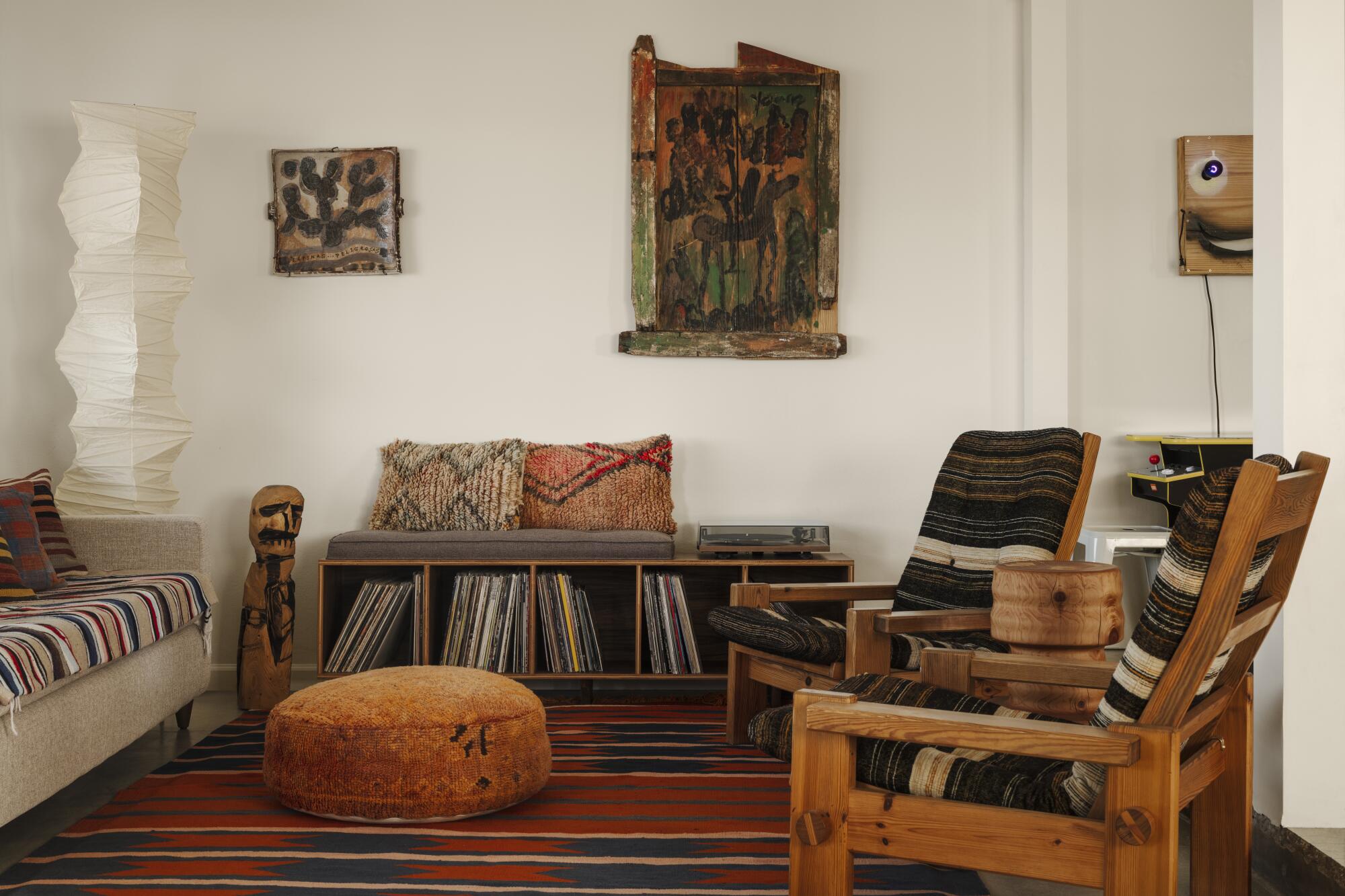
The living room includes a wooden skeleton sculpture by Ryan Schneider, left, a ceramic tray by George Sherman, above left and a painting on wood by Purvis Young.
(Lance Gerber)
It may be surprising that Miller and Oder, whose primary residence is a Spanish-style home in Eagle Rock, live in a modest cabin on a remote dirt road.
But sit with them on their outdoor deck, where you might catch a magnificent sunset, and you’ll find a couple deeply appreciative of their surroundings.
“It’s a wonderful place to unplug,” Miller says. “The environment is so tranquil that it feels like a mental shift. Our careers are so busy. We wanted a place to be in nature and focus on our family.”
When in town, the family enjoys visiting nearby Pioneertown, Joshua Tree National Park and Noah Purifoy’s outdoor sculpture. “The boys like seeing that you can make art with discarded toilets,” Oder says. But mostly, they love hanging out at the cabin, where they can soak, play, drive their battery-operated ATVs around the backyard and make s’mores at the outdoor firepit. “All the things we don’t let them do at home,” notes Oder.
Adds Miller: “It’s like a breath of fresh air here. It often takes a while to decompress, but after a couple of days, we don’t want to leave.”
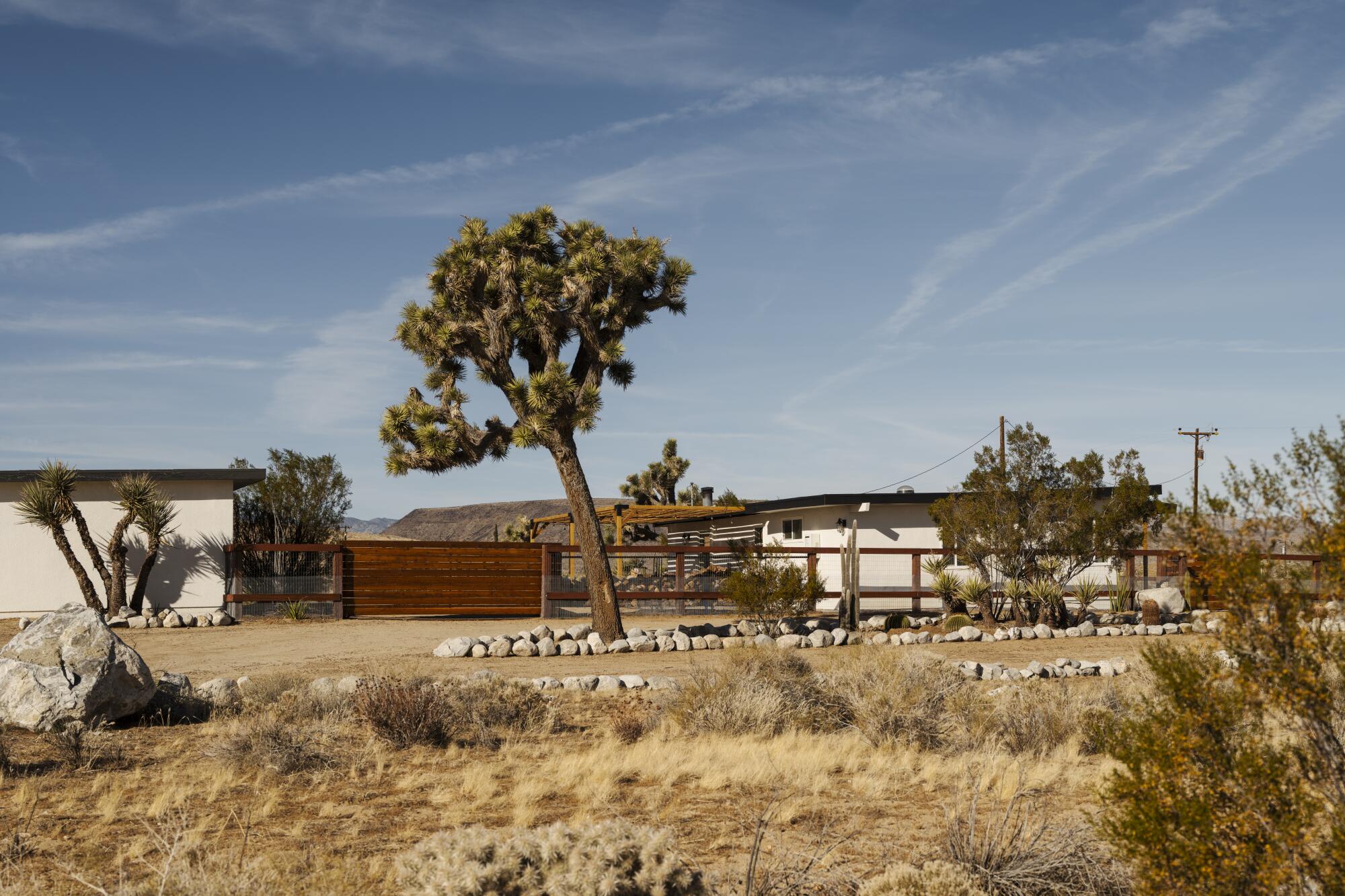
A view of the one-bedroom cabin off a dirt road in Yucca Valley.
(Lance Gerber)

Lifestyle
It Started with a Midnight Swim and a Kiss Under the Stars
When Marian Sherry Lurio and Jonathan Buffington Nguyen met at a mutual friend’s wedding at Higgins Lake, Mich., in July 2022, both felt an immediate chemistry. As the evening progressed, they sat on the shore of the lake in Adirondack chairs under the stars, where they had their first kiss before joining others for a midnight plunge.
The two learned that the following weekend Ms. Lurio planned to attend a wedding in Philadelphia, where Mr. Nguyen lives, and before they had even exchanged numbers, they already had a first date on the books.
“I have a vivid memory of after we first met,” Mr. Nguyen said, “just feeling like I really better not screw this up.”
Before long, they were commuting between Philadelphia and New York City, where Ms. Lurio lives, spending weekends and the odd remote work days in one another’s apartments in Philadelphia and Manhattan. Within the first six months of dating, Mr. Nguyen joined Ms. Lurio’s family for Thanksgiving in Villanova, Pa., and, the following month, she met his family in Beavercreek, Ohio, at a surprise birthday party for Mr. Nguyen’s mother.
Ms. Lurio, 32, who grew up in Merion Station outside Philadelphia, works in investor relations administration at Flexpoint Ford, a private equity firm. She graduated from Dartmouth College with a bachelor’s degree in history and psychology.
Mr. Nguyen, also 32, was born in Knoxville, Tenn., and raised in Beavercreek, Ohio, from the age of 7. He graduated from Haverford College with a bachelor’s degree in political science and is now a director at Doyle Real Estate Advisors in Philadelphia.
Their long-distance relationship continued for the next few years. There were dates in Manhattan, vacations and beach trips to the Jersey Shore. They attended sporting events and discovered their shared appreciation of the 2003 film, “Love Actually.”
One evening, Mr. Nguyen recalled looking around Ms. Lurio’s small New York studio — strewed with clothes and the takeout meal they had ordered — and feeling “so comfortable and safe.” “I knew that this was something different than just sort of a fling,” he said.
It was an open question when they would move in together. In 2024, Ms. Lurio began the process of moving into Mr. Nguyen’s home in Philadelphia — even bringing her cat, Scott — but her plans changed midway when an opportunity arose to expand her role with her current employer.
Mr. Nguyen was on board with her decision. “It almost feels like stolen valor to call it ‘long distance,’ because it’s so easy from Philadelphia to New York,” Mr. Nguyen said. “The joke is, it’s easier to get to Philly from New York than to get to some parts of Brooklyn from Manhattan, right?”
In January 2025, Mr. Nguyen visited Ms. Lurio in New York with more up his sleeve than spending the weekend. Together they had discussed marriage and bespoke rings, but when Mr. Nguyen left Ms. Lurio and an unfinished cheese plate at the bar of the Chelsea Hotel that Friday evening, she had no idea what was coming next.
“I remember texting Jonathan,” Ms. Lurio said, bewildered: “‘You didn’t go toward the bathroom!’” When a Lobby Bar server came and asked her to come outside, Ms. Lurio still didn’t realize what was happening until she was standing in the hallway, where Mr. Nguyen stood recreating a key moment from the film “Love Actually,” in which one character silently professes his love for another in writing by flashing a series of cue cards. There, in the storied Chelsea Hotel hallway still festooned with Christmas decorations, Mr. Nguyen shared his last card that said, “Will you marry me?”
They wed on April 11 in front of 200 guests at the Pump House, a covered space on the banks of Philadelphia’s Schuylkill River. Mr. Nguyen’s sister, the Rev. Elizabeth Nguyen, who is ordained through the Unitarian Universalist Association, officiated.
Although formal attire was suggested, Ms. Lurio said that the ceremony was “pretty casual.” She and Jonathan got ready together, and their families served as their wedding parties.
“I said I wanted a five-minute wedding,” Ms. Lurio recalled, though the ceremony ended up lasting a little longer than that. During the ceremony, Ms. Nguyen read a homily and jokingly added that guests should not ask the bride and groom about their living arrangements, which will remain separate for the foreseeable future.
While watching Ms. Lurio walk down the aisle, flanked by her parents, Mr. Nguyen said he remembered feeling at once grounded in the moment and also a sense of dazed joy: “Like, is this real? I felt very lucky in that moment — and also just excited for the party to start!”
Lifestyle
L.A. Affairs: I loved someone who felt he couldn’t be fully seen with me
He always texted when he was outside. No call, no knock. It was just a message and then the soft sound of my door opening. He moved like someone practiced in disappearing.
His name meant “complete” in Arabic, which is what I felt when we were together.
I met him the way you meet most things that matter in Los Angeles — without intending to. In our senior year at a college in eastern L.A. County, we were introduced through mutual friends, then thrown together by the particular gravity of people who recognized something in each other. He was a Muslim medical student, conservative and careful and funny in the dry, precise way of someone who has always had to choose his words. I was loud where he was quiet, messy where he was disciplined. I was out. He was not.
I understood, or thought I did. I thought that I couldn’t get hurt if I was completely conscious throughout the endeavor. Los Angeles has a way of making you feel like the whole world shares your freedoms — until you realize the city is enormous, and not all of it belongs to you in the same way.
For months, our world was confined to my apartment. He would slip in after dark, and we’d stay up late talking about his family in Iran, classical music and the particular pressure of being the son someone sacrificed everything to bring here. He told me things he said he’d never told anyone, and I believed him.
The orange glow from my Nesso lamp lit his face while the indigo sky pressed against the window behind him. In our small little world, we were safe. Outside was another matter.
On our first real date, I took him to the L.A. Phil’s “An Evening of Film & Music: From Mexico to Hollywood” program. I told him they were cheap seats even though they were the first row on the terrace. He was thrilled in the way only someone who doesn’t expect to be delighted actually gets delighted — fully, without guarding it. I put my arm around his shoulders. At some point, I shifted and moved it, and he nudged it back. He was OK with PDA here.
I remember thinking that wealth is a great barrier to harm and then feeling silly for extrapolating my own experience once again. Inside Walt Disney Concert Hall, we were just two people in love with the same music.
Outside was still another matter.
In February, on Valentine’s Day, he took me to a Yemeni restaurant in Anaheim. We hovered over saffron tea surrounded by other young Southern Californians, and we looked like friends. Before we went in, we sat in the parking lot of the strip mall — signs in Arabic advertising bread, coffee, halal meats, the Little Arabia District — hand in hand. I leaned over to kiss him.
“Not here,” he said. His eyes shifted furtively. “Someone might see.”
I understood, or told myself I did, but I was saddened. Later, after the kind of reflection that only arrives in the wreckage, I would understand something harder: I had been unconsciously asking him to choose, over and over, between the people he loved and the person he loved. I had a long pattern of choosing unavailable men, telling myself it was because I could handle the complexity. The truth was more embarrassing. I thought that if someone like him chose me anyway — chose me over the weight of societal expectations — it would mean I was worth choosing. It took me a long time to see how unfair that was to him and to me.
We went to the Norton Simon Museum together in November, on the kind of gray Pasadena day when the 210 Freeway roars in the background like white noise. He studied for the MCAT while I wrote a paper on Persian rugs. In between practice problems, he translated ancient Arabic scripts for me. I thought, “We make a good team.” Afterward, we walked through the galleries and he didn’t let go of my arm.
That was the version of us I kept returning to — when the ending came during Ramadan. It arrived as a spiritual reflection of my own. I texted: “Does this end at graduation — whatever we are doing?”
He thought I meant Ramadan. I did not mean Ramadan.
“I care about you,” he wrote, “but I don’t want you to think this could work out to anything more than just dating. I mean, of course, I’ve fantasized about marrying you. If I could live my life the way I wanted, of course I would continue. I’m just sad it’s not in this lifetime.”
I was in Mexico City when these texts were exchanged. That night I flew to Oaxaca to clear my head and then, after less than 24 hours, flew back to L.A. No amount of vacation would allow me to process what had just happened, so I threw myself back into work.
My therapist told me to use the conjunction “and” instead of “but.” It happened, and I am changed. The harm I caused and the love I felt. The beauty of what we made and the impossibility of where it could go. She gave me a knowing smile when I asked if it would stay with me forever. She didn’t answer, which was the answer.
I think about the freeways now, the way Joan Didion called them our only secular communion. When you’re on the ground in Los Angeles, the world narrows to the few blocks around you. Get on the freeway and you understand the whole body of the city at once: the arteries, the pulse, the scale of the thing.
You understand that you are a single cell in something enormous and moving. It is all out of your control. I am in a lane. The lane shaped how I drive. He was simply in a different lane, and his lane shaped him, and those two facts can coexist without either of us being the villain of the sad story.
He came like a secret in the night, and he left the same way. What we made in between was real and complicated and mine to hold forever, hoping we find each other in the next life.
The author lives in Los Angeles.
L.A. Affairs chronicles the search for romantic love in all its glorious expressions in the L.A. area, and we want to hear your true story. We pay $400 for a published essay. Email LAAffairs@latimes.com. You can find submission guidelines here. You can find past columns here.
Lifestyle
The Nerve Center of This Art Fair Isn’t Painting. It’s Couture.
The art industry is increasingly shaped by artists’ and art businesses’ shared realization that they are locked in a fierce struggle for sustained attention — against each other, and against the rest of the overstimulated, always-online world. A major New York art fair aims to win this competition next month by knocking down the increasingly shaky walls between contemporary art and fashion.
When visitors enter the Independent art fair on May 14, they will almost immediately encounter its open-plan centerpiece: an installation of recent couture looks from Comme des Garçons. It will be the first New York solo presentation of works by Rei Kawakubo, the brand’s founder and mastermind, since a lauded 2017 survey exhibition at the Metropolitan Museum of Art’s Costume Institute.
Art fairs have often been front and center in the industry’s 21st-century quest to capture mindshare. But too many displays have pierced the zeitgeist with six-figure spectacles, like Maurizio Cattelan’s duct-taped banana and Beeple’s robot dogs. Curating Independent around Comme des Garçons comes from the conviction that a different kind of iconoclasm can rise to the top of New York’s spring art scrum.
Elizabeth Dee, the founder and creative director of Independent, said that making Kawakubo’s work the “nerve center” of this year’s edition was a “statement of purpose” for the fair’s evolution. After several years at the compact Spring Studios in TriBeCa, Independent will more than double its square footage by moving to Pier 36 at South Street, on the East River. Dee has narrowed the fair’s exhibitor list, to 76, from 83 dealers in 2025, and reduced booth fees to encourage a focus on single artists making bold propositions.
“Rei’s work has been pivotal to thinking about how my work as a curator, gallerist and art fair can push boundaries, especially during this extraordinary move toward corporatization and monoculture in the art world in the last 20 years,” Dee said.
Kawakubo’s designs have been challenging norms since her brand’s first Paris runway show in 1981, but her work over the last 13 years on what she calls “objects for the body” has blurred borders between high fashion and wearable sculpture.
The Comme des Garçons presentation at Independent will feature 20 looks from autumn-winter 2020 to spring-summer 2025. Forgoing the runway, Kawakubo is installing her non-clothing inside structures made from rebar and colored plastic joinery.
Adrian Joffe, the president of both Comme des Garçons International and the curated retailer Dover Street Market International (and who is also Kawakubo’s husband), said in an interview that Kawakubo’s intention was to create a sculptural installation divorced from chronology and fashion — “a thing made new again.”
Every look at Independent was made in an edition of three or fewer, but only one of each will be for sale on-site. Prices will be about $9,000 to $30,000. Comme des Garçons will retain 100 percent of the sales.
Asked why she was interested in exhibiting at Independent, the famously elusive Kawakubo said via email, “The body of work has never been shown together, and this is the first presentation in New York in almost 10 years.” Joffe added a broader philosophical motivation. “We’ve never done it before; it was new,” he said. Also essential was the fair’s willingness to embrace Kawakubo’s vision for the installation rather than a standard fair booth.
Kawakubo began consistently engaging with fine art decades before such crossovers became commonplace. Since 1989, she has invited a steady stream of contemporary artists to create installations in Comme des Garçons’s Tokyo flagship store. The ’90s brought collaborations with the artist Cindy Sherman and performance pioneer Merce Cunningham, among others.
More cross-disciplinary projects followed, including limited-release direct mailers for Comme des Garçons. Kawakubo designs each from documentation of works provided by an artist or art collective.
The display at Independent reopens the debate about Kawakubo’s proper place on the continuum between artist and designer. But the issue is already settled for celebrated artists who have collaborated with her.
“I totally think of Rei as an artist in the truest sense,” Sherman said by email. “Her work questions what everyone else takes for granted as being flattering to a body, questions what female bodies are expected to look like and who they’re catering to.”
Ai Weiwei, the subject of a 2010 Comme des Garçons direct mailer, agreed that Kawakubo “is, in essence, an artist.” Unlike designers who “pursue a sense of form,” he added, “her design and creation are oriented toward attitude” — specifically, an attitude of “rebellion.”
Also taking this position is “Costume Art,” the spring exhibition at the Costume Institute. Opening May 10, the show pairs individual works from multiple designers — including Comme des Garçons — with artworks from the Met’s holdings to advance the argument made by the dress code for this year’s Met gala: “Fashion is art.”
True to form, Kawakubo sometimes opts for a third way.
“Rei has often said she’s not a designer, she’s not an artist,” Joffe said. “She is a storyteller.”
Now to find out whether an art fair sparks the drama, dialogue and attention its authors want.
-
Finance49 seconds ago
Michigan Capital One customers may get get money in lawsuit settlement
-
Fitness7 minutes agoFitness Experts Share The Best Exercises To Keep You Fit At Every Age
-
Movie Reviews19 minutes ago‘Michael’ Review: A Perfect Puzzle With Major Missing Pieces
-
World31 minutes agoMelissa McCarthy Hits on Mariska Hargitay as ‘Law & Order: SVU’ Guest Star: ‘I Know My Way Around a Pair of Handcuffs’
-
News37 minutes agoA New Worry for Republicans: Latino Catholics Offended by Trump
-
Politics43 minutes agoTariffs Raised Consumers’ Prices, but the Refunds Go Only to Businesses
-
Business49 minutes agoPolymarket Bets on Paris Temperature Prompt Investigation After Unusual Spikes
-
Science55 minutes agoCould an Earthly Fungus Contaminate Mars? NASA May Have Found One Hardy Enough.