Lifestyle
L.A. Crafted


(Textile sculpture of crafting materials and tools made by Los Angeles artist Mashanda Lazarus; photo by Robert Hanashiro / For The Times)

Los Angeles’ creative class extends far beyond Hollywood. In this series, we highlight local makers and artists, from woodworkers to ceramists, weavers to stained glass artists, who are forging their own path making innovative products in our city.

The home of ceramist Raina Lee includes a tree house featuring her pottery as well as a garage studio that houses her pottery wheel, kilns and her crackly volcanic glazes.
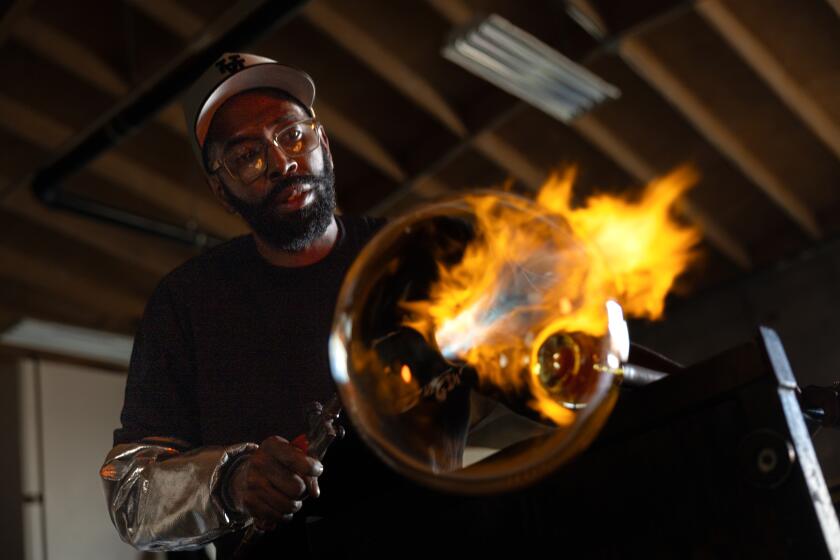
Los Angeles glassblower Cedric Mitchell relishes his role as a rulebreaker. “I wanted to break all the design rules similar to Ettore Sottsass,” he says, “and develop my own style.”

Vince Skelly, a Claremont designer, transforms raw timber into decorative and functional works of art. He starts with a chainsaw and transitions to other tools to add nuance.

Krysta Grasso’s vibrant crochet brand, Unlikely Fox, is dedicated to her late mother, who taught her to crochet when she was 5.

Daniel Dooreck’s fascination with motorcycles, flash tattoos and cowboys comes alive in the hand-thrown vessels he creates in his tiny Echo Park garage.

Julie Jackson’s use of reclaimed wood reinforces her commitment to creating sustainable home goods that tread lightly on the environment.

Soraya Yousefi’s art career started by accident, but she’s found her stride making whimsical bowls and cups in her Northridge home studio.

After managing grief, anxiety and depression, video game designer Ana Cho turned to pottery and woodworking to sustain her.

L.A. woodworker C.C. Boyce is reevaluating what happens when a person dies by turning ashes into planters.

Inspired by her career in automotive engineering, L.A. ceramist Becki Chernoff throws ceramic dinnerware that is clean-lined like the cars she loves.




How the Epstein files are upending U.K. politics

Nate Diaz
Ready to Throw Hands for America
… I Want In On White House Card!!!
Published
TMZSports.com
Nate Diaz has his sights set on kickin’ ass on one of the most unexpected stages possible: the White House.
The MMA star tells TMZ Sports he’s all-in if talk of a potential fight card tied to the nation’s capital ever becomes reality … making it clear the idea of scrapping under a red, white and blue spotlight has his full attention.
“Yeah, that’d be dope, too,” Diaz said. “America gang, baby. You already know what’s popping.”

While Diaz is hyped about the possibility of fighting on a patriotic mega-card, he says he’s not picky about who he faces — as long as it’s a legit, high-level fight.
And if he gets his way, the White House event could feature some familiar names from his past.
Diaz says he wants to run back his legendary rivalry with Conor McGregor for a trilogy bout — a fight that would instantly become one of the biggest attractions possible for a blockbuster event.
He also called out Dustin Poirier as another potential opponent, though Diaz didn’t exactly extend the olive branch … saying he’d be down to fight him “if he stops being such a p****.”
Diaz even floated Mike Perry as another name he’d gladly throw down with … making it clear he’s ready for whatever matchup gets him back into what he calls “real action.”
The 40-year-old last fought in the UFC in 2022, but his message now is loud and clear: he’s ready to return.

Saoirse Ronan and Timothée Chalamet in 2019’s Little Women, written and directed by Greta Gerwig.
Moviestore Collection Ltd/Alamy
hide caption
toggle caption
Moviestore Collection Ltd/Alamy
“Wuthering Heights” is in theaters, so we’re thinking about the best book to film adaptations of all time.
What’s your favorite movie that started life as a book — and what makes for a great book-to-film adaptation, anyway? Do you want filmmakers to stay as rigorously true to the book as possible? Or are you okay with bold departures, big swings, out-of-left-field choices that evoke the essence of the book, if not every last detail?
“Wuthering Heights,” for example, takes a middle road. Writer/director Emerald Fennell’s film keeps the familiar plot beats firmly in place, and casts actors who embody all the stuff that fans of the book need them to, but steeps them in the delirious hormones of a teenage fever-dream. Thus, Margot Robbie’s Cathy is headstrong, impetuous … and horny, while Jacob Elordi’s Heathcliff is broody, Byronic … and horny. The two spend most of the movie trading lusty looks in the soaking rain as peals of thunder roll over the moors. Every set, every costume is styled to the gods. It’s a breathlessly over-the-top take that’s divided critics and is about to do the same for audiences this weekend.
We’ve got four examples of other beloved books that made the transition to the big screen. Here’s why we think each of them works, and why we believe they’re the best of all time.
Little Women (2019)
YouTube
This movie version of Louisa May Alcott’s 1868 story about the March sisters is adapted and directed by Greta Gerwig. Gerwig does the impossible task of contemporizing the story while staying so faithful to the book. She does two things that haven’t worked in any other Little Women adaptations: She makes me tolerate the love story between Laurie and Amy. (I still have PTSD from the 1994 version.) And Gerwig allows for Jo — the protagonist, a liberated author who is writing her own story along the way — to have her cake and eat it too.
In the 19th century approach to this story, the woman has to have a man at the end. That’s just a given for these kinds of books and for these kinds of adaptations. But Gerwig made a decision that the writing of the book is essential to the plot line, and that within the book, Jo’s character ends up with a man — a scholar named Bhaer. But in reality, the book is the man — getting her first book published is the win — and that is her love. It’s so rich and smart. I just love it. — B.A. Parker, host of NPR’s Code Switch podcast
Nickel Boys (2024)
YouTube
Nickel Boys was originally Colson Whitehead’s book about a boy wrongly sent to an abusive boys school in Florida during the Jim Crow era. It becomes a story about his friendship with another boy there. Within five minutes of watching the movie, I was hooked and felt like I was seeing something really new. Not just new in that it was different from the book, which I really respect. But because the whole thing is told from this immersive camera point of view — and because you are in the head, really in the head of the person experiencing it, it is somehow more immersive even than the book. Sometimes, watching narratives that have descriptions of truly awful things — like Boys Don’t Cry and 12 Years a Slave — I find myself covering my eyes. But because of the point of view in Nickel Boys, I couldn’t. It not only showed me what it was, it showed me what it felt.

Director RaMell Ross is saying something about the experience of reading about these two boys being so badly abused in Jim Crow-era Florida. He’s also saying something about the way that we view it. He is saying something about how anyone who wants to see these things on screen should really think about how we have them in our heads, how they are portrayed to us, and how we react to that portrayal. It’s stunning, and I was absolutely jaw dropped about it. — Barrie Hardymon, editor, NPR investigations
Blade Runner (1982)
YouTube
Philip K. Dick’s 1968 novel Do Androids Dream of Electric Sheep? became the 1982 film Blade Runner. Both the movie and the book are set in a future where androids are used as slave labor. Six androids escape, and a cop named Rick Deckard — how’s that for a perfect, hard-nosed, noirish name? — has to hunt them down.
Look, there are book people and there are movie people. I’ve visited the Reddit threads; I know that a lot of book people/Philip K. Dick fans hate this movie. But I would argue that the book does what books do well, and the film does what films do well. When you read a book, you live inside it — you’re intellectually and emotionally invested, because you create its world in your mind. And in this book, the author dutifully outfits you with absolutely everything you need to know, and somehow more: You learn about the nuclear war that left big areas of the planet uninhabitable. You learn about this fallout called dust. You learn a lot about how class and status works, and why people are headed to off-world colonies. There is also a tremendous lot about a religion called Mercerism, which is founded on the notion of empathy as the highest human attribute.
The movie carves out the thinnest possible slice of the book — the action, the hunting androids part. And while it pays deference to some of the book’s big ideas, it doesn’t concern itself with all that weighty lore and backstory. It doesn’t need to, that’s not what it’s for. After all, you’re not living in this dystopian future, as you are when you read the book. You’re just visiting it for a couple hours. Androids builds the world, but Blade Runner trots you nimbly through it, doing what films do: Swapping out all those blocks of prose for the fluid visual language of cinematic mood, action and performance. — Glen Weldon, critic and host of NPR’s Pop Culture Happy Hour podcast
Starship Troopers (1997)
YouTube
My pick is a movie in which the director, Paul Verhoeven, straight up hates the source material, detests it and makes fun of it: 1997’s Starship Troopers. The 1959 book by Robert Heinlein is about space cadets and a guy named Johnny Rico going through cadet school and learning the philosophies of being in the military, and why it’s cool to live in a society in which only people who fight in the military can vote. The movie takes that premise and says — this idea: kind of fascist, right? It’s a hilarious parody of Heinlein’s book.
And yet, if you are a mouth breather, not fully understanding how it’s working on a metatextual level, the movie itself kind of rocks as propaganda, as a piece of action filmmaking. It feels like I’m watching Top Gun. Everybody’s extraordinarily good looking. It came out in the late nineties, but I first watched it on TV, and have always thought of it as a post-9/11 movie, in the context of being in school where people were trying to recruit us to join the military. It feels like an extension of Verhoeven’s RoboCop in a lot of ways, how everybody is acting not quite stiff, but extra. Everybody’s got a little asterisks on all of their lines. — Andrew Limbong, culture reporter and host of NPR’s Book of the Day podcast
This piece also appeared in NPR’s Pop Culture Happy Hour newsletter. Sign up for the newsletter so you don’t miss the next one, plus get weekly recommendations about what’s making us happy.
Listen to Pop Culture Happy Hour on Apple Podcasts and Spotify.


Preview: Tennessee Turns Sights to Postseason with SEC Championships – University of Tennessee Athletics

Walk for Peace monks return to Texas, reflection event planned

Utah owns US Magnesium site. Now it has a mess to clean up

Chester Man Killed In Snowmobile Crash In Vermont, ID Released

1 dead, 2 injured in head-on collision near Sequim

Florida High School Football Rankings: Top 25 teams – Oct. 21

Cleary's 21 help Le Moyne down Central Connecticut State 69-64 in OT

How old is Bo Nix? What to know about Oregon quarterback ahead of 2024 NFL Draft

99th annual Pony Swim held in Virginia

Indiana Members Credit Union announced as new anchor tenant at Bottleworks District

Video: We Tracked All the Lawsuits Against the Second Trump Administration

Nancy Mace proposes bill to make aliens deportable, inadmissible for animal cruelty

Ukraine team heads for Geneva talks as Moscow, Kyiv build military pressure

Europeans push back at US over claim they face ‘civilizational erasure’

Department of War transports next-generation reactor in nuclear energy milestone
-

 Alabama1 week ago
Geneva’s Kiera Howell, 16, auditions for ‘American Idol’ season 24
-

 Illinois7 days ago
2026 IHSA Illinois Wrestling State Finals Schedule And Brackets – FloWrestling
-

 Technology1 week ago
Apple might let you use ChatGPT from CarPlay
-

 World1 week ago
‘Regime change in Iran should come from within,’ former Israel PM says
-

 Culture7 days ago
Try This Quiz on Passionate Lines From Popular Literature
-
 News1 week ago
Hate them or not, Patriots fans want the glory back in Super Bowl LX
-

 Politics1 week ago
Virginia Dems take tax hikes into overtime, target fantasy football leagues
-

 Technology1 week ago
We found 20 Verge-approved gifts on sale ahead of Valentine’s Day