Connect with us

Lifestyle

L.A. Affairs: I told my husband that something had to change. I just didn’t know what would come next

Published

on

L.A. Affairs: I told my husband that something had to change. I just didn’t know what would come next

As he rolled up in front of my Van Nuys duplex, his teal Ford Tempo shimmering in the speckled fall sun, a wave of first-date excitement flooded my system.

Leaning across the center console, he flung open the passenger door.

“Sorry,” he said brightly, “I threw up in that seat on the 405 yesterday, but I think I mostly cleaned it up.”

I paused, looked at the seat and then back at his hopeful, earnest face.

Advertisement

“I ate vitamins on an empty stomach then sat in traffic,” he said with a shrug.

Well, I thought, at least it was just partially digested vitamins and not a carne asada burrito. It could be worse.

Deciding to be the cool girl, I slid into the not-quite-clean seat and took a deep breath.

Brian was 6 feet 4 and a moppy-haired brunette musician with magnetic stage presence. We’d met through a mutual friend from his band, a guy who made me laugh by drawing inappropriate images on my spiral notebooks in my theater classes at Cal State Northridge.

The week before, I’d watched them play a show in Calabasas and felt something shift. Onstage, Brian closed his eyes when he sang, swaying slightly offbeat as his wild waves caught the light. I was smitten.

Advertisement

Our first date unfolded on a stylish vintage couch in a cafe rumored to have once belonged to someone from punk-rock band NOFX. We sipped tea. This man had never had a sip of alcohol in his life, by choice, which felt both bizarre and wildly exotic to me at the time. I worried the absence of cocktails might make the night awkward. Instead, we talked for hours, our words tumbling over each other like we’d been rehearsing for years.

Within six months, he’d moved into my apartment. From there, we leapfrogged to Venice, then Marina del Rey and finally to Mar Vista, where we bought our second home and planted ourselves like people who understood picket fences. Two extraordinary children later, we had built something that looked, from the outside, like a Hallmark movie with much better music. I would stand in our kitchen at dusk, the marine layer settling in, peaceful as I loaded the dishwasher in a life I hadn’t necessarily seen for myself.

Then life, because it always does, began to press.

In 2019, my mother-in-law suffered a stroke and moved into our home while she recovered. I love her deeply and was grateful we could care for her. However. Caregiving inside a tiny West L.A. “bungalow” (as my MIL kindly referred to it) magnified everything from love to exhaustion. We survived it, yet hadn’t fully exhaled when the COVID-19 pandemic arrived like a cosmic reminder of how life loves a dramatic arc.

Suddenly, we were always home. Always in each other’s line of sight, always negotiating space that didn’t exist. I would often escape to our tiny yard for another DIY project, clutching coffee or whiskey like a flotation device and internally screaming in his direction: “Why are you always here?”

Advertisement

My chronic illness flared, and fear hovered over me like smog. Both sets of our parents were aging rapidly and reminding us of our own mortality. Grief layered itself over everything, but we kept the children steady and the house functioning. We kept showing up as best we could.

Yet somewhere along the way, large pieces of ourselves went missing.

In 2023, I fled to Mexico City with a friend. In photographs from that week, I barely recognize the woman staring back at me. She was heavy, pale; her eyes dulled and vacant. I realized I had become a highly efficient machine for other people’s needs and had lost track of my own.

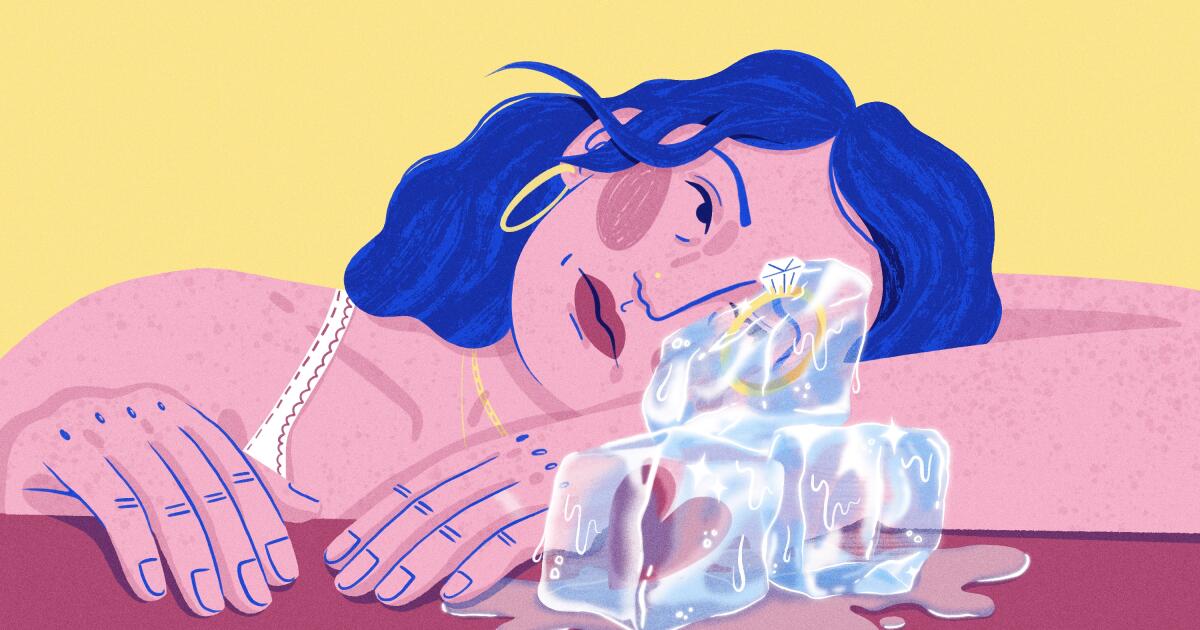
Months later, on a routine mental health walk near the Mar Vista park, I heard a podcast clip that stopped me in my tracks. “Life is a melting ice cube,” Mel Robbins said casually.

I physically froze on the sidewalk.

Advertisement

A melting ice cube.

Every time I passed that corner I thought about it, how this life was dripping away whether we were awake inside it or not.

That night I told Brian something had to change. I didn’t know what it meant. I just knew I could not continue living a version of life that felt like survival instead of participation.

As the friend he has always been, he listened.

Over the next year, we experimented. We tried reshaping our marriage into something more expansive. We tried an open relationship. We tried to rediscover the spark that had once felt effortless. What we discovered instead was that the truest thing between us had always been friendship.

Advertisement

So we separated.

Here’s the part people don’t expect to hear: It didn’t destroy us.

Somehow, without the pressure of being everything to each other, we became better. We are kinder and more honest. We parent as a team who spends holidays together and we will head to Coachella soon to complain about the bus lines amid total exhaustion yet again.

I turned 50 in the middle of the unraveling, sandwiched somewhere in the chaos of a second painful surgery and my mother’s death. To mark the end of a massive season in my life, I went to Spain for two months. I walked unfamiliar streets with music carrying me on its wings, ate dinner at 10 p.m. and remembered who I was when no one needed me to be anything in particular.

I came home a different person.

Advertisement

Now, Brian and I date other people. We talk on the phone most days about the kids, life and whatever absurd situation the world has thrown at us. We take it day by day, week by week, like adults who have finally accepted that certainty is an illusion.

Someone recently called our story “so L.A.”

I smiled.

Los Angeles has always been a city of reinvention, of artists and dreamers, and of people brave enough to admit when something needs to evolve. This city taught me how to chase a musician in a teal Ford Tempo. It also taught me how to build a family and how to let go without burning everything down.

Love does not always look the way we expect. Sometimes it transforms and sometimes it softens into something steadier and less cinematic.

Advertisement

Evolution is not failure; it is movement, and movement (even when it hurts) is proof you are still alive inside your life.

In Los Angeles of all places, I know how to begin again.

The author is a Los Angeles–based novelist and essayist. She writes about love, reinvention and modern relationships. Find her on Instagram: @marykathrynholmes.

L.A. Affairs chronicles the search for romantic love in all its glorious expressions in the L.A. area, and we want to hear your true story. We pay $400 for a published essay. Email LAAffairs@latimes.com. You can find submission guidelines here. You can find past columns here.

Advertisement

Lifestyle

Questions to help you get ‘financially naked’ with your partner

Published

on

Questions to help you get ‘financially naked’ with your partner

The first time Vivian Tu got “financially naked” in front of her partner — a term she uses to describe “brutally honest conversations” about money — it was out of desperation.

She was just starting her career on Wall Street and living in a roach-infested apartment in New York City. She had to use her savings to break the lease and move out. So she asked her new boyfriend whether she could temporarily stay at his place.

It was an opportunity to get real with him about her financial situation. She told him: “I have no money. I am broke. I have nothing.” That openness ended up strengthening their relationship, she says. Eventually, they got married.

Advertisement

Tu is now an entrepreneur who runs Your Rich BFF, a media company that teaches people about their finances. She says it’s critical for couples to talk about money as soon as they can.

It’s one of the topics of her latest book, published in February, Well Endowed, which offers advice to young people about making big financial decisions, like getting married or starting a family.

“People think love is enough. It’s not. You need to actually know you can build with this person,” she says.

To do that, couples need to be vulnerable with each other about money, she says, just as they are in other aspects of their relationship. In a conversation with Life Kit, Tu share financial questions to ask your partner at every stage. This interview has been edited for length and clarity.

The image on the left shows the cover of the book "Well Endowed." The photo on the right is a portrait of the book's author, Vivian Tu.

Financial educator Vivian Tu is the author of Well Endowed.

Left: HarperCollins. Right: Jenny Anderson

Advertisement


hide caption

toggle caption

Left: HarperCollins. Right: Jenny Anderson

Advertisement

What sort of money conversations can you have when you’re first dating? 

You can start talking about money on the very first date.

Do it from a place of fun. Ask: “If I gave you $100,000 to plan a perfect two-week vacation, what would that look like?”

Somebody who wants to climb Mount Everest and someone who wants to go to the Maldives and lay on a beach for two weeks — these are two very different people.

Having those fun money conversations early on makes it easier to be, like, “How much do you make?” Because if we’re planning on moving in together, I need to know what the rent can be.

Advertisement

What might you talk about before you become exclusive with a partner? 

What are your dreams for your career? Do you want to buy a home? Do you want to live here forever? Are you planning on moving back to your hometown?

These are money conversations that’ll help guide the trajectory of your relationship just to make sure that you’re on the same financial page.

How do they spend their money? If you know they are in a job where they don’t make that much money, but every weekend they’re out blowing money on designer stuff — where is that money coming from? Do they just have crazy credit card debt?

This data-collection period is really when you can be smart and learn something about this person and decide if they’re going to fit into your life. And are there changes you’re willing to make so that you can fit into theirs?

Advertisement

It can be awkward to talk about debt. What’s the best way to bring up the topic with your partner? 

Instead of asking, “How much debt do you have?” — which feels like an interrogation — it’s easier to offer something up.

You might say: Oh, by the way, I may be on a little bit of a tighter budget next month because I’m making a large payment to my student loan or on my credit card.

At that point you can ask, because you’ve now offered something: “By the way, do you have any credit card debt? Are there any months coming up that you might be feeling tighter financially that we should keep in mind together?”

What should you talk about if you are thinking about moving in together? 

Advertisement

If you haven’t had any money conversations yet, this is a good moment. This is now a point where you can no longer lie.

When you submit your information for a rental application, you have to show bank statements, proof of employment and proof of income. So it’s a really good time to talk about what you make, what you have, what you owe in terms of debt and then what your expenses are every month.

If you can talk about those four categories before moving in together, you should be in a good spot and, frankly, it’ll make other conversations a lot easier.

What about when getting married? What do you absolutely need to talk about before you even plan a wedding?

Avoid financial infidelity. That’s when you make purchases and deliberately hide them. We shouldn’t be hiding bank accounts. We shouldn’t be hiding credit cards. It should all be out in the open, and everybody should be OK with it. If they’re not, that’s a conversation you need to have.

Advertisement

A lot of couples don’t know where to begin when it comes to combining finances. What do you recommend?

I like a “yours, mine and ours” strategy and getting those numbers out in the open. You have your money, I have my money, and then we agree to put a percentage into a joint account consistently to fund our expenses together.

What ongoing questions should you have for your spouse or long-term partner? 

Constantly just goal setting. How big do we want our family to be? What’s that going to cost? Where would we like to live long term?

If you want two kids but end up only having one, that changes the calculus. Or if you’re considering moving to where your aging parents live ahead of their retirement, that changes the calculus.

Advertisement

A money conversation is not a one and done. You don’t get to do it and just be done with it. It’s something you have to have throughout life. At the end of the day, this is just a conversation asking: Are you a good partner? Is your partner a good partner? And do you make a good pair?

Continue Reading

Lifestyle

How to have the best Sunday in L.A., according to Betye Saar

Published

on

How to have the best Sunday in L.A., according to Betye Saar

Not only is Betye Saar a living legend, but the prolific L.A. artist continues to add to her impressive oeuvre day by day.

She’s been creating powerful, thought-provoking artwork since the ’60s and her pieces have been shown at the Smithsonian, the Museum of Modern Art, the Art Institute of Chicago and LACMA, as well as museums and galleries around the world.

Sunday Funday infobox logo with colorful spot illustrations

In Sunday Funday, L.A. people give us a play-by-play of their ideal Sunday around town. Find ideas and inspiration on where to go, what to eat and how to enjoy life on the weekends.

Advertisement

As her centennial birthday approaches this July, Saar shows no signs of slowing down. She still routinely creates art and continues to garner headlines and accolades. Last year, she was honored with the distinction of “Icon Artist” at the Art Basel Awards. During the upcoming Frieze Los Angeles art festival, which opens Feb. 26, she will be the subject of the photography installation “Betye Saar Altered Polaroids.” And this May, “Let’s Get It On: The Wearable Art of Betye Saar” will debut at Roberts Projects, the gallery that represents her. The exhibition will feature pieces from her early career as a costume and jewelry designer.

Though she’s skilled at painting and photography, she’s most widely known for assemblage, the art of juxtaposing miscellaneous items to form a single cohesive work. Her dioramas, sculptures and large-scale multimedia installations explore the legacy of American slavery, confront racial injustice and celebrate the strength and resiliency of African American women.

“I work with found objects that had another purpose before they came to my hands,” Saar says while seated at a patio table in her succulent-filled tiered garden. “The hardest part of it is going to a flea market, secondhand stores, an estate sale or even just going behind a store to see what people throw away.”

Over the years, she’s traveled by plane, train and automobile in search of usable materials. Meanwhile, admirers, colleagues and gallery workers have sent her curios from New Mexico, Tennessee, New England and beyond. Her daughters — artists Alison and Lezley, and writer Tracye, their mother’s studio director — also stay on the lookout for objects that might catch her eye.

“I’ve been doing this for a long time, so I have quite a collection,” she says.

Advertisement

Indeed, Saar’s multi-level home studio in Laurel Canyon is bursting with dozens of old empty picture frames, discarded window panes, wooden chests, antique chairs and vintage clocks. But there’s always room for more.

Her idea of a perfect Sunday includes foraging for new items (or old ones, as the case may be) to use in her daily art practice. And she’d return to her roots to do it.

“Pasadena is my hometown and I still have a few relatives that live there,” she says.

While visiting her old stomping grounds, she’d embark on a multi-stop shopping spree and wander through a longtime favorite San Gabriel Valley attraction (where her work just so happens to be on display).

This interview has been lightly edited and condensed for length and clarity.

Advertisement

10 a.m.: Search for hidden treasures

Pasadena Community College Flea Market is something that’s part of “the hunt.” Alison usually drives, sometimes Tracye. Some people are there early to get the deals; we’re not like that anymore. I like to look around and sometimes I find interesting fabrics, scarves to wear and strange-shaped succulents for my garden. I hardly ever find really good antiquing things there, because those are at antique stores and they’re usually pretty pricey. But I bought an old, rusty metal birdcage the seller said was from France. I like rusty stuff for my art. I also found an indigo blue kimono to wear at an art event later this year.

1 p.m.: Replenish with Thai food

I’d go down Fair Oaks Avenue — there’s some secondhand stores. Usually, it’s nothing I can use, but I still can’t say no. I have to go see for myself. Then, lunch at Saladang Garden. I always order chicken sate and the green papaya salad. Last time I went, we tried the Thai corn fritter which was really good and crispy. If food is too spicy, I can’t eat it. But somebody in my party would always have something spicy and I can have a spoonful to add to mine.

2:30 p.m.: More shopping

Advertisement

I am attracted to all the odd things at Gold Bug. Notepads and trinkets, curious vintage-y things with animals or interesting patterns, strange candles. Sometimes I surprise myself by buying something. They have a mixture of things that — whether it’s for the color, or the texture — I feel that I can recycle and fit into an art object that I’m making.

3:30 p.m.: Visit a childhood haunt (with a side of more shopping)

I really like the Huntington’s gardens. I remember the first time I went there was with my mother and a friend of hers, and we walked around. All the paths were dirt, you know, they hadn’t even gotten around to paving it yet. But I just fell in love with it. And I really like their gift shop.

6 p.m.: Head west for a culinary classic

If I go someplace to eat for lunch, I usually have leftovers to warm up. Nothing wrong with leftovers — if you liked it the first time, you’ll like it again! But if I had to go out to dinner, the Apple Pan. I would go there in the ’80s with my daughters. I like their sandwiches, or the hickory burger with cheese, and there’s good French fries.

Advertisement

8 p.m.: Tuck into some wind-down watching

Before bed, I like to watch the news because, otherwise, I don’t know what’s going on. I also like a lot of shows on PBS. “Finding Your Roots,” or dramas like “Sister Boniface Mysteries” and “Call the Midwife,” which has been going on forever!

Continue Reading

Lifestyle

Natural disasters and political instability hampered U.S. museum attendance in 2025

Published

on

Natural disasters and political instability hampered U.S. museum attendance in 2025

Flames from the Palisades Fire reach the grounds of the Getty Villa Museum on the Pacific Coast Highway amid a powerful windstorm on January 8, 2025 in Los Angeles, California. The museum was forced to close for around six months, causing a major drop in annual visitorship numbers for 2025.

Apu Gomes/Getty Images


hide caption

toggle caption

Advertisement

Apu Gomes/Getty Images

U.S. museum attendance was beset by natural disasters and political instability in 2025, according to The Art Newspaper‘s annual survey of “the world’s 100 most visited art museums.”

The January 2025 wildfires in Los Angeles hit the Getty Villa particularly hard. Attendance dropped nearly 60% due to the institution being closed for around half the year in response to damage caused by The Palisades fire. (Reached by email, The Getty noted the low attendance in 2025 was the result of the fire-related closure and not reflective of a drop in overall attendance since the museum reopened last June. Villa attendance numbers remain steady.)

Meanwhile, the federal government shutdown last fall crippled D.C. museums. The National Gallery of Art lost more than a quarter of its audience compared to the previous year. The National Museum of African American History and Culture’s and the National Museum of the American Indian’s numbers both dropped by nearly 15%. The National Portrait Gallery and Smithsonian American Art Museum saw audiences reduced to close to half of their pre-COVID size.

Advertisement

“The two museums had a particularly volatile year—with prolonged political battles with the Trump administration over programming, artists pulling out of exhibitions amid accusations of institutional censorship and high-level resignations,” The Art Newspaper said.

Stability despite volatility 

Despite unsteadiness across the museum industry, the country’s most-visited institutions remained relatively stable.

Visitorship at New York’s Metropolitan Museum of Art — the world’s fifth most-visited art museum — was up by nearly 5%. Bolstered by the reopening of the Michael C. Rockefeller Wing, it attracted nearly 6 million visitors in 2025. Despite its shutdown troubles, the National Gallery of Art still ranked second in the U.S. in terms of visitor numbers last year. The Museum of Modern Art in New York saw a modest increase compared to 2024. And the Art Institute of Chicago experienced close to a 15% rise in attendance.

The power of prestige 

The report attributes some of these gains to the power of blockbuster shows and big-name artists to draw crowds.

In New York, “Superfine: Tailoring Black Style” at The Met and the Jack Whitten retrospective at the Museum of Modern Art were top draws. “The Power of Names: Van Gogh” and Impressionist shows were major successes in D.C., LA and Boston. At the Museum of Fine Arts, Boston, a single Vincent Van Gogh exhibition accounted for more than a quarter of the museum’s annual attendance, which was up overall by 7% compared with 2024.

Advertisement

Big regional gains

Some regional museums also saw big gains.

The San Diego Museum of Contemporary Art nearly doubled its attendance. The Cleveland Museum of Art and Toledo Museum of Art also experienced significant jumps of more than 20%. Several museums even managed to best their pre-COVID benchmarks from 2019, including the Virginia Museum of Fine Arts and Frederik Meijer Gardens and Sculpture Park in Grand Rapids, Mich.

NPR has reached out to these museums for comment.

“In 2025, the museum welcomed more than 800,000 visitors, which was the highest attendance in the CMA’s nearly 110 year history,” said Todd Mesek, the Cleveland Museum of Art’s chief marketing officer in an email to NPR. “We believe that momentum is the result of sustained investment in exhibitions, public programs, and a commitment to free access, which ensures that our collection remains open and meaningful to all.” Mesek added that the ticketed special exhibition “Takashi Murakami: Stepping on the Tail of a Rainbow” generated the museum’s highest attendance in more than 25 years. The museum does not charge entry — and mostly never has — except for special exhibitions.

Global trends

The U.S. findings appear generally modest compared to other parts of the world covered in The Art Newspaper‘s report.

Advertisement

Notwithstanding a difficult year marked by a high-profile jewelry theft among other crises, the Louvre Museum in Paris — the world’s most-visited museum — still experienced a close to 5% gain in visitorship. It attracted more than 9 million people in 2025. And attendance at museums in East Asia — where, according to the report, “demand seems almost unlimited” — was particularly robust. The world’s third most-visited institution, the National Museum of Korea, Seoul, saw a whopping 72% jump on the previous year — “one of the largest rises in absolute numbers we have ever seen,” the report said.

However, political unrest derailed attendance at some institutions, especially in the Middle East. The Israel Museum lost 40% of its visitors compared with 2024, owing to Israel’s war in Gaza. The Tel Aviv Museum of Art faced cancellations of international exhibitions, and was shut for well over half the year owing to security concerns.

More than 200 million visits were made to the top 100 museums on The Art Newspaper‘s list, the report said. While this figure is still under the 230 million recorded in 2019, it is a vast improvement on the 54 million recorded in 2020.

“Our data for 2025 shows that, on the whole, art museums are as popular as they have ever been, with many of the biggest museums continuing to welcome millions every year,” the report said.

Advertisement
Continue Reading

Trending