Lifestyle
L.A. Affairs: He’s a Bruin. I’m a Trojan. Could I fight on in the name of love?


My mother, a UCLA graduate, switched her allegiance on a dime the day I enrolled at USC. She and my father attended every Trojans home game from that day forward. Familial blood may be thicker than alumni water but not so, it seems, when it comes to spousal relations.
And I know about it all too well. My husband, Brad, and I, both divorced and not in the market for anyone who didn’t ooze quality, had engaged in a keyboard courtship. He was avid, while I was reluctant at best. I refused to meet him for months, having been single for six years and not the least bit interested in sharing anything with anyone ever again. But he said he was willing to wait however long it took for me to muster up the courage, and he would even manage to overlook the fact that my diploma was from USC because he (unfortunately) was a devoted Bruin.
Letters soared back and forth between us, and because we were both 50 and counting, once I caved and we came face to face we wasted no time before announcing the nuptials, even though we both knew football season could be an impediment to forever after.
We shopped for rings before our first cross-town rivalry contest, the battle that former UCLA football coach Red Sanders once stated is not a matter of life and death: “It’s more important than that!” he insisted.
We set our wedding date for April, long before we truly realized what would happen in the fall at kickoff. Whereas I pictured us reveling in teasing trash talk, curled up on the sofa, popcorn at the ready — maybe even buying tickets to the big game someday — I was soon to learn that the Los Angeles gridiron civil war was more than we’d bargained for and, in fact, would permeate the walls of our love nest.
Brad started it. The first year, I scurried to Trader Joe’s like a nurturing newlywed bride to gather fun football food for what promised to be the fulfillment of my dream: our enjoying the light banter of frivolous competition in front of the television on a sunny Southern California Saturday afternoon.
When I emerged from the market, shopping bags in hand, I realized the man I’d promised to honor (Had I remembered to tell the priest to omit the word “obey”?) had switched out my striking cardinal and gold USC license plate frames for the ones decorated in the pale baby blue of his alma mater — ugh, UCLA Bruins!
Two could play at this game. I plopped the bags on the back seat, hopped on the 405 Freeway and beelined to SC Trojan Town at South Coast Plaza — yes, Virginia, there really is a retail Santa Claus for the University of Spoiled Children.
I whipped out my husband’s Visa card and promptly placed every fanatical fan item I could carry on it. I toted two suitcase-size handled bags filled with cocktail napkins, plates, cups, a king-size blanket, T-shirts, sweatpants, pajamas, signs, streamers, pennants, socks, hats, jerseys and my personal favorite, because he pretends to have symptoms of a stroke every time he hears it, a refrigerator magnet that plays the Trojan fight song.
Fight on! In no time, I had racked up an unconscionable dollar amount of paraphernalia that was sure to bring the house down. Then there was the year when USC was favored by a margin wider than the Pacific Ocean, the year the man I thought I’d be sharing my life with chose to clean out the garage and not even watch one quarterback toss. That was the year I ate all the cardinal and gold M&Ms myself.
Shortly after standing at the altar before family and friends, when we attended a UCLA-USC basketball game outfitted in our respective school sweatshirts, we were observed by a group of boorish Bruins. “Aw man,” one of them said to my husband. “Couldn’t you have done better?”
Clearly, you can’t major in manners on the west side of town. To this day, whenever the big day arrives for the football game more crucial than the Super Bowl, I find myself sometimes rising above it all in the company of Brad’s fraternity bro and his wife, an ex-UCLA song girl.
Although outnumbered and having to sit next to a song girl, I handle it gracefully despite some tiresome enemy tirades on the topic of campus controversy, á la parents paying to get their progeny into USC.
I point out that it’s a feather in one’s cap to be able to graduate from such a prestigious university, while our Bruin guests argue that those parents threw away their money.
Twenty years into sacramental union, we’d like to think we have for the most part let it go, especially since neither team provides the stellar spectacle that they did in our glory days from 1969 to 1973.
But every time November rolls around, unfurled is the flag flying our schools’ colors: half cardinal and gold, half just boring blue and yellow. “A House Divided,” it proclaims for all the neighbors to see. So perhaps to gain the truly proper perspective, it’s time for us to arrange a ceremony during which we renew our sacred vows adding just one more to the list: For better or for worse, for richer or for poorer … and no matter who wins the game.
The author is a second-generation Los Angeles native who lives in Fallbrook, Calif. A graduate of USC, she is the author of essays and stories that have appeared in newspapers and magazines including the Los Angeles Times, Orange Coast Magazine and Newsweek for over two decades.
L.A. Affairs chronicles the search for romantic love in all its glorious expressions in the L.A. area, and we want to hear your true story. We pay $400 for a published essay. Email LAAffairs@latimes.com. You can find submission guidelines here. You can find past columns here.


Can you say no to a friend’s wedding?
Getty Images/Getty images
hide caption
toggle caption
Getty Images/Getty images
Are we spending too much on other people’s weddings?
Going to a friend’s weddings can be so fun and meaningful… but it can also really hurt your wallet. A survey by LendingTree found that 31% of people who had been to a wedding in the past five years had accrued debt to attend. So what’s driving up the cost of weddings for guests? And what makes it so hard to say no to these expenses?
Brittany breaks it down with Allyson Rees, senior analyst at trend forecasting firm WGSN, and Annie Joy Williams, assistant editor at The Atlantic.
This episode was produced by Liam McBain, with additional support from Corey Antonio Rose. It was edited by Neena Pathak. Our Supervising Producer is Cher Vincent. Our Executive Producer is Barton Girdwood. Our VP of Programming is Yolanda Sangweni.
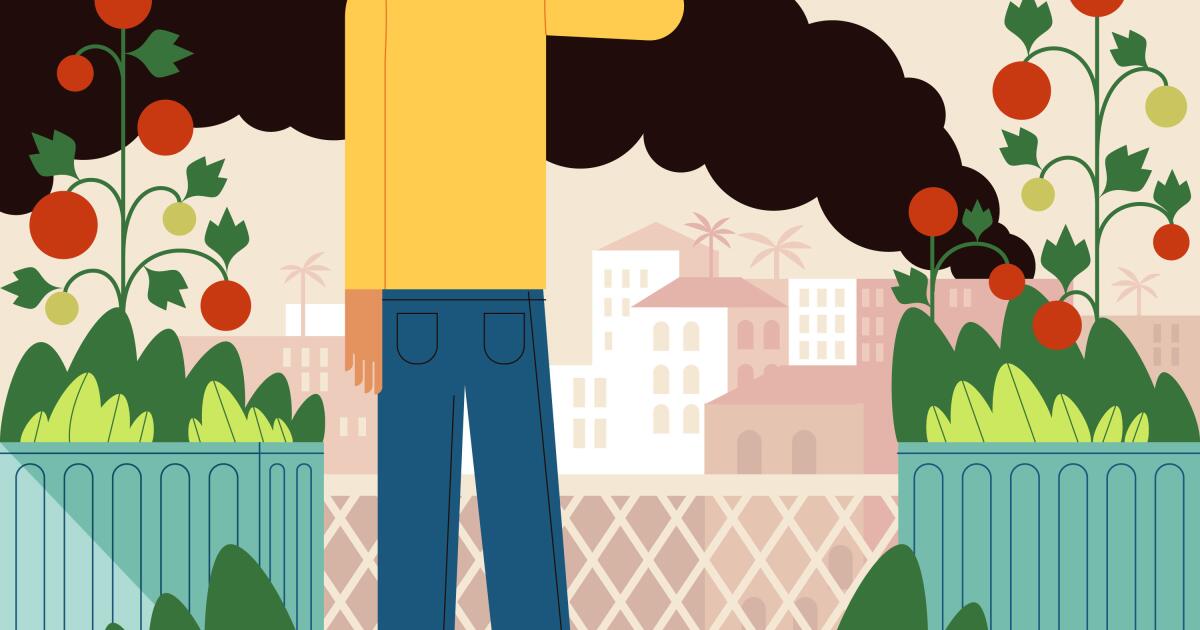
After the eight-day-long fire in a 500,000-square-foot Boyle Heights warehouse, eastern Los Angeles residents are contending with putrid smells, soot and potentially hazardous airborne chemicals after heavy plumes of smoke spread throughout the city. But those who grow food in nearby neighborhoods may also be wondering: How will the fires affect the plants and produce in my garden?
The Boyle Heights warehouse, owned by Lineage — a global temperature-controlled storage facility operator — housed 85 million pounds of frozen food and other products. In the days since the fire, local emergency visits for smoke inhalation and throat pain spiked while agencies still scramble to measure the amount of PM 2.5 — harmful fine particles — and heavy metals, like lead and arsenic, in the air.
According to researchers, any toxic airborne chemicals would likely stem from the charred foam insulation, metal exterior, burned solar panels and any lithium batteries that might have been present inside the warehouse.
After a fire, heavy metal particles can spread through ash and smoke over gardens and inhibit growth, said Olukayode Jegede, an agricultural toxicologist and assistant professor at UC Davis. Since the warehouse fire is so recent and cleanup has just begun, Jegede said the precise impact on gardens can’t be measured until comprehensive soil tests are conducted in the area.
While the L.A. city government hasn’t announced plans for soil testing, the Contaminant Level Evaluation and Analysis for Neighborhoods project at USC is offering free contaminant testing for Boyle Heights and East L.A. residents. Residents can collect soil samples and deliver them to Boyle Heights City Hall and other locations for an evaluation of lead, arsenic, chromium and mercury levels.
The good news is produce, plants and roots can still be preserved. According to Jegede, many of the soil tests conducted last year in the Altadena area after the Eaton fire showed that gardens and poultry were not as contaminated as one might expect.
“Quite a number of the soils we tested [in Altadena] were not really contaminated,” Jegede said. “We weren’t seeing many soils with concerning elevated levels of metal, so gardeners should not be too alarmed when these things happen.”
Nevertheless, there are several measures that gardeners can take to keep themselves, their children, plants and produce safe from potentially harmful contaminants stemming from the fire. Researchers, gardening experts and horticulturists offered some guidance on the handling, recultivation and cleanup that can keep you and your garden in good health.
How do I remove ash and contaminants from my garden?
Altadena horticulturist Leigh Adams said Boyle Heights plants and produce already live in a difficult environment, surrounded by industrial warehouses that spread contaminants daily.
“That area has been used industrially for 100 years, and the soil is impacted by many, many, many things,” Adams said. “Low-income neighborhoods and gardens usually don’t have a lot of resistance against dominant manufacturing.”
This means that the contamination of gardens in eastern L.A. won’t be as catastrophic as compared with those in Altadena, a more suburban environment, Adams said. But fallen ash still poses major health risks if ingested or inhaled.
An advisory from University of California Agricultural and Natural Resources last year recommended suiting up in an N95/KN95 mask, long sleeves, pants, close-toed shoes and gloves before attempting to deal with ash in the garden to limit exposure to potentially toxic contaminants. The advisory added that individuals should make sure all of this gear is cleaned thoroughly before bringing it back inside.
Once in the proper gear, Adams recommends removing the top two inches of topsoil from gardens, where the highest concentration of contaminants will settle after a fire. Using a plastic bag to collect the soil and disposing of it in the garbage — not green yard waste bins — will help to reduce the spread of airborne chemicals.
Gardeners with raised beds are advised to remove approximately six inches of soil, because excess ash can raise the pH level and prevent nutrients from soaking into the soil bed.
After this, watering the garden gently but plentifully will help to promote soil health and get rid of most of the ash present on plant leaves and stems. Adams said replacing the top two inches of soil with store-bought mulch or straw will help to contain any remaining ash and prevent it from spreading any further.
Experts say to avoid using leaf blowers if ash is present in the garden because they can send particles airborne. Doing so will increase the likelihood of heavy metal particles, which can carry lung irritants and carcinogens, being spread and inhaled.
A Boyle Heights resident keep a watchful eye on the fire at the 5,000-square-foot commercial building, which stores 85 million pounds of frozen food.
(Genaro Molina / Los Angeles Times)
Is it safe for me to eat produce from my garden?
Several studies, including one from the UC Cooperative Extension of Sonoma County, have shown that consuming produce in a fire-affected area poses minimal health risks.
Jegede said most root vegetables like potatoes and carrots, along with any fruit that has an outer layer, can be washed to remove potential contaminants, even if they were covered in ash. Peeling the outer layer of your produce can also help to reduce potential risks, he said.
Lettuce and other leafy foods with multiple layers pose a higher risk of contamination, but with a vigorous wash and peeling the outer layers, even the greens can be saved. The County of Los Angeles Department of Public Health recommends soaking leafy produce and fuzzy fruits like peaches in a 10% white vinegar and 90% water mixture.
Jegede said if the leaves or fruit are too delicate to wash or ash is still visible, it would be best to dispose of the produce.
How can I tell if my soil is contaminated?
After ridding your garden of visible ash, you might wonder how to tell if your plants will still thrive in the soil.
At-home soil tests that measure for alkaline, fertility and pH levels are widely available and can be purchased for $15 to $100 (for more detailed results) online. But Jegede said these tests can’t tell the full story of soil health.
Comprehensive soil testing is “something you can’t do properly at home,” Jegede said. “In labs, we are testing for metals like lithium and zinc, stuff that an at-home test will not show … If it comes to the point that you’re worried about your soil, I would just send it out to a lab.”
Wallace Laboratories in El Segundo, Babcock Laboratories in Riverside, Waypoint Analytical in Anaheim and other labs offer more detailed soil tests that measure heavy metal particles in addition to other fertility factors. Prices at Wallace Laboratories can range from $115 to $295 for a complete compost test.
The soil below two inches should be unharmed, Adams said, so long as new compost is set and plants are watered plentifully, which will promote natural biological cycles.
“What you’re doing is capping the soil, so that moisture stays in there, and instead of being dirt, it’s a living system called soil,” Adams said. “The more carbon we can get into our soil, the better.”
What can I do to help my soil recover?
For the last 12 years, Adams has been working with Metabolic Studio, a Los Angeles-based art and research hub focused on environmentalism, on methods for bioremediation, the practice of using additional fungi, plants and compost to decontaminate ash and break down contaminants.
Adams said straw, mushrooms, corn, rye and sunflowers are great bioremediators that can help to repair damage to soils. She said certain samples she’s worked on with Metabolic Studio have gone from testing at high heavy metal levels to nearly contaminant-free.
But for a more immediate fix, wash your produce, water your plants and have a little patience during ash cleanups. Your garden should look better in no time, Adams and Jegede said.

Inde Navarrette and Michael Johnston in Obsession.
Focus Features
hide caption
toggle caption
Focus Features
Two big horror films, Obsession and Backrooms, just smashed all box office expectations. So much of their success has been driven by Gen Z, which is now the biggest moviegoing demographic. But what makes a movie a Gen Z movie? Today we’re bringing you an episode of NPR’s It’s Been a Minute. Host Brittany Luse talks about this trend with Sam Adams and Reanna Cruz.
If you want to hear more about these movies, check out these episodes:
In ‘Obsession,’ love hurts. It really, really, really hurts.
‘Backrooms’ brings YouTube horror to the big screen
Zendaya brings ‘The Drama,’ we bring the spoilers
Connect with Pop Culture Happy Hour:
Letterboxd / Facebook
Our weekly newsletter
Support Pop Culture Happy Hour+
-

 Wyoming37 seconds ago
Wyoming coal company wins federal money to extract critical minerals from Powder River Basin – WyoFile
-

 Crypto8 minutes ago
Residents question proposed crypto mining center
-

 Finance10 minutes ago
How Natura &Co Is Transforming Finance with Generative AI on SAP S/4HANA
-

 Fitness15 minutes ago
This 30-second walking habit can make every walk more effective and boost your fitness in less time
-

 Movie Reviews26 minutes ago
Film Review: ‘Gail Daughtry and the Celebrity Sex Pass’ Throws a Ton of Jokes at the Wall (and Enough Stick) – Awards Radar
-

 World41 minutes ago
‘The Kitchen’ Director Alonso Ruizpalacios at BAM: ‘We Need More Trojan Horses’
-

 News46 minutes ago
Manhattan Building’s Columns Buckled Beneath New Addition, Images Show
-
Lifestyle1 hour ago
Can you say no to a friend’s wedding? : It’s Been a Minute

