Lifestyle
In 'Brats,' '80s stars grapple with a label that defined their early careers


St. Elmo’s Fire cast members Rob Lowe, Ally Sheedy, Demi Moore, Emilio Estevez, Mare Winningham, Judd Nelson and Andrew McCarthy.
Silver Screen Collection/Getty Images
hide caption
toggle caption
Silver Screen Collection/Getty Images
How you feel about Andrew McCarthy’s searching, earnest, frequently self-important and occasionally clueless documentary about Hollywood’s so-called “brat pack” of actors — titled, somewhat self-consciously, Brats – may depend on what you think about the whole phenomenon in the first place.
Brats does a great job reminding us why we should care about the subject at all. It notes that the success of teen-focused films in the 1980s — specifically John Hughes films like The Breakfast Club and Pretty in Pink, along with Joel Schumacher’s St. Elmo’s Fire – represented a turning point where the film industry began to feature coming-of-age movies, often with the same group of young actors.
McCarthy, who was in both Pretty in Pink and St. Elmo’s Fire, joined a group of burgeoning talents who would become major stars, including Emilio Estevez, Judd Nelson, Demi Moore, Ally Sheedy, Molly Ringwald and Rob Lowe. The films they starred in — often featuring high school-age kids in various circumstances struggling to find love or acceptance — channeled the struggles of youth across the globe, turning them into Beatles–level stars in the process.
“Hollywood discovered the box office potential of a young audience,” McCarthy says in somber narration over clips from films as disparate as Risky Business, Dirty Dancing, Back to the Future, Footloose and Weird Science. “It seemed that every weekend, there was another movie and another movie and another movie about and starring young people. In the history of Hollywood, it had never been like this.”
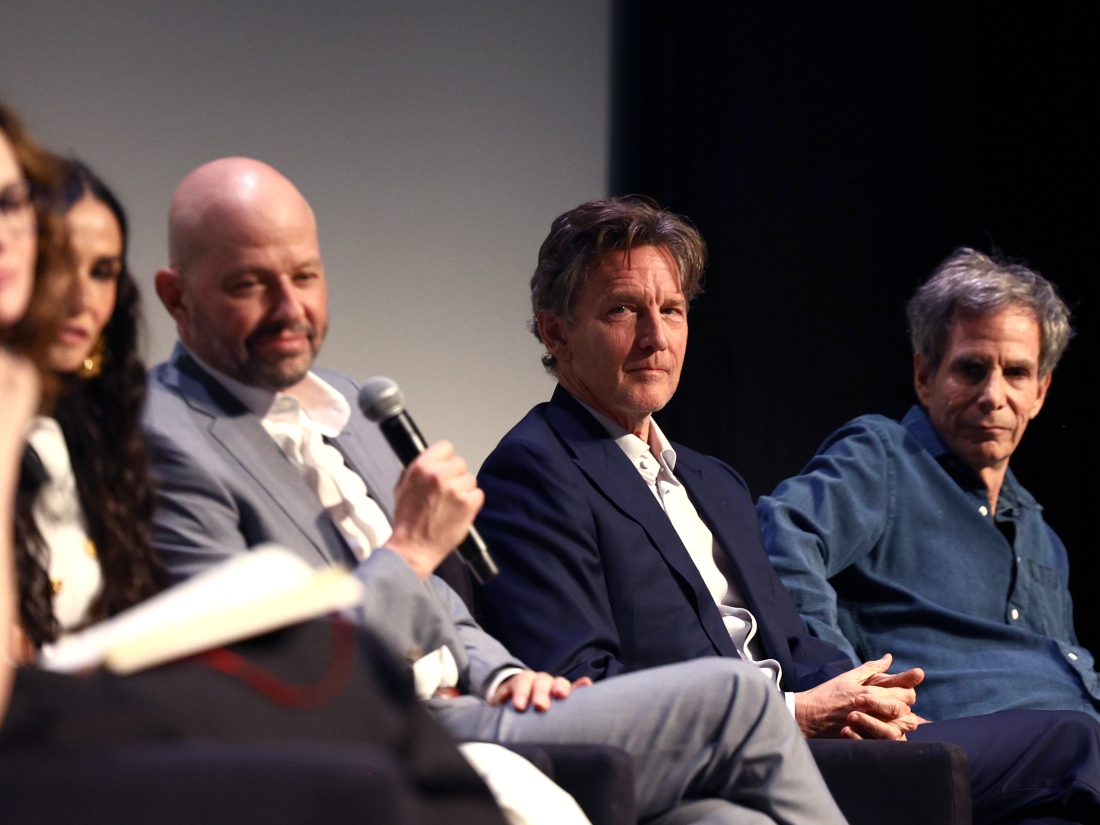
Ally Sheedy, Demi Moore, Jon Cryer, Andrew McCarthy, and David Blum at the Tribeca Film Festival.
Michael J. Le Brecht II/ABC
hide caption
toggle caption
Michael J. Le Brecht II/ABC
Defining the Brat Pack
But then journalist David Blum wrote a story in 1985 for New York magazine titled “Hollywood’s Brat Pack,” centered on time spent partying with Estevez, Lowe and Nelson, that cast shade on the group — lumping them together as unprofessional and over-privileged, while sticking them with a moniker which would follow them all around for decades. (One line described them as “a roving band of famous young stars on the prowl for parties, women, and a good time,” shortly before noting none of them had graduated from college.)
McCarthy, who admits he aspired to be a particularly serious actor back then, really bristled at the term, refusing to talk about it publicly very much. In another delicious irony the film fails to explore, Blum’s original article refers to McCarthy in a way that implies the author may not have even seen him as a bona fide member of the Brat Pack back then — despite the actor’s insistence that the term affected how he was perceived in Hollywood.

Which why it is surprising to see footage of him at the start of Brats, calling up actors he was never very close to but has been professionally linked with for nearly 40 years — suggesting they get together in front of cameras for a documentary he is directing and will star in — to actually talk about this Brat Pack thing.
Estevez, who the article called “the unofficial president of the Brat Pack,” seems wary even in talking for the documentary, while eager to get some things off his chest. Relatively quickly, he apologizes for refusing to star in a movie with McCarthy shortly after the article was published, for fear of feeding the narrative.
“It was naïve of me to think this journalist would be my friend,” Estevez admits, while noting he had never participated in a major magazine profile before Blum’s story. “I had already seen a different path for myself. And I felt derailed.”
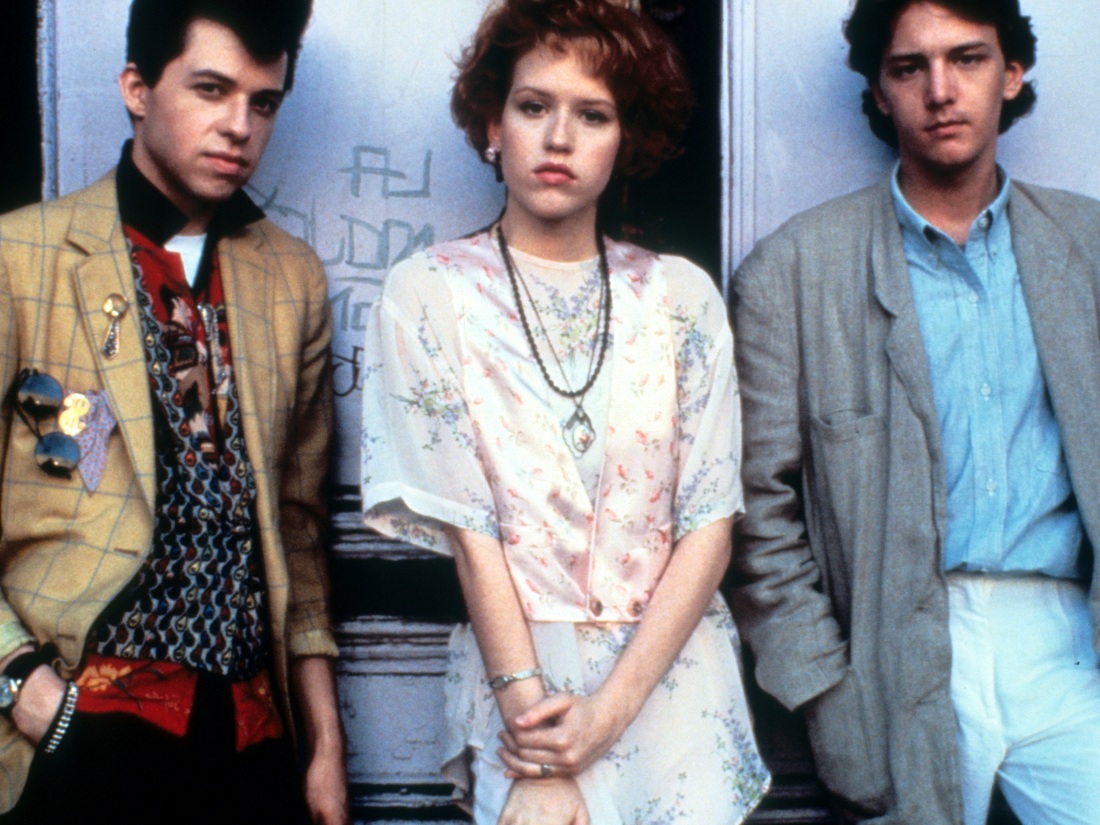
Jon Cryer, Molly Ringwald and Andrew McCarthy on the set of Pretty In Pink in 1986. Molly Ringwald was not involved in the Brats documentary.
Paramount/Getty Images
hide caption
toggle caption
Paramount/Getty Images
A movie with two messages
Scenes like this allow Brats to work on a few different levels at once. Through McCarthy’s own words and his catch ups with other Brat Packers like Estevez, Sheedy, Moore and Lowe, we get a sense of the people at the heart of a massive pop culture phenomenon.
This is a burgeoning genre in the documentary world: films and docuseries looking back at gigantic pop culture moments from decades ago, to reveal the unexplored cost for those at the center of things (think recent documentaries on Britney Spears and child stars on Nickelodeon). And there is value in hearing these performers, held up as legends for so long, grappling with the very understandable feeling they were stereotyped just as their careers were taking off.
“Why did we take [the term Brat Pack] as an offense?” Moore tells McCarthy earnestly in one moment. “I felt a sense of it being unjust. I just felt like it didn’t represent us…But I don’t know if I took it as personal over time as you did.”
Sheedy, Pretty in Pink co-star Jon Cryer and others talk about seeing the enthusiasm around these emerging stars suddenly curdle into insulting assumptions that dismissed their talents. And one of the elements which fueled their success — appearing together as a pack of friends in films — suddenly disappeared, as they all fled the stigma of the term.
But the other, perhaps unintentional effect of watching Brats, is revelation of how the sometimes clueless privilege these so-called Brat Packers enjoyed back then has stuck around, barely examined, decades later.
‘BRATS’ | Official Trailer | June 13 on Hulu
YouTube
Balancing regret with gratitude
Making an impact in Hollywood is difficult. Starring in big movies, even more so. But starring in massive movies that are considered the voice of a generation? That is a once-in-a-lifetime opportunity.
But, instead of feeling gratitude for landing in the right place at the absolutely best time to land parts in films like Class, Less Than Zero, Weekend at Bernie’s and other hits, McCarthy seems to have spent way too much time fretting over whether the Brat Pack label kept him from larger stardom or more serious work. And it doesn’t seem a coincidence that the most successful Brat Packers McCarthy could get on camera — Moore and Lowe — long ago made their peace with a term that has evolved into a more endearing label, softened by nostalgia and filled with respect.
McCarthy asks a lot of good questions, including one that should be simple but really isn’t: Who is in the Brat Pack? Is it just the people Blum cites in his story — including Tom Cruise and Matt Dillon — or should it also include performers who worked with them around the same time, like Jon Cryer? (In Brats, Cryer tells the camera emphatically, “I am not in the Brat Pack.” It’s tough to tell if he’s joking.)
This film also breezes past something that was always a big sticking point for me when it came to Brat Pack movies — the decided lack of racial and ethnic diversity.
McCarthy talks to several fans, critics and experts about the Brat Pack phenomenon. But there is just one Black person who speaks briefly and very soothingly about these films’ lack of diversity, before author Malcolm Gladwell — who is biracial — pops up to assure the director that it made perfect sense for Hughes to center so many of his hit movies on angsty white kids in suburban Chicago.
For fans of color like me, there was always a double edge to the success of Brat Pack-style films. Many themes were universal, but there was a nose-pressed-to-glass element of watching celebrated characters in an environment light years removed from my own experience.
Characters of color, when they did surface, could be the butt of jokes. It would take the rise of Black directors like Spike Lee, Matty Rich and John Singleton to bring the Brat Pack’s youth revolution to Black-centered stories in much smaller films.
Bottom line: actors considered part of the Brat Park were packaged together in big budget films by producers and directors looking to tell certain stories and reach certain audiences. As several people tell McCarthy in the film, even after the article was published, lots of people thought the Brat Pack were still the cool kids in Hollywood – and wanted to be part of that club.
Many other talented performers got left out of that process. And complaining about what you didn’t get — when you did receive massive fame, wealth and career opportunities at an early age — feels a little uncharitable, especially so many years later.
Quizzing the guy who started it all
But then McCarthy actually sits down with the author of the New York piece, David Blum. And your sympathy for the actor and all the other Brat Packers rises again.
That’s because Blum mostly refuses to admit that his article was intentionally negative or sought to take down stars like Estevez and Lowe. He takes pride in creating the phrase, noting that he perhaps should have gotten credit for building the wave of publicity which helped make movies like St. Elmo’s Fire a hit.
But Blum takes little responsibility for how the piece’s negative tone might have impacted his sources — or the implications of writing, without any real warning, a story that seemed quite different from the original feature he had told Estevez he was assembling.
It’s obvious that the actors featured in Blum’s original piece have mostly done well for themselves, crafting careers that outpaced the label he gave them. But even as he’s ending the interview, McCarthy can’t help pushing for an apology — asking the writer, almost plaintively, “Do you think you could have been nicer?”
Nearly 40 years later, it still seems tough for McCarthy to admit that accepting the label and living well — both because of and in spite of it — is likely the best possible response. (He seems to handle it all much better in a recent guest essay for The New York Times.)
It’s also obvious that watching him inexorably led to that conclusion while making this film — a journey brimming with nostalgia, pop culture potency and a bittersweet look back at youthful times — makes for one seriously compelling documentary.



new video loaded: Prada Peels Back the Layers at Milan Fashion Week
By Chevaz Clarke and Daniel Fetherston
February 27, 2026

Bill Cosby
Rape Accuser Says Cosby Won’t Take Stand At Trial
Published
Bill Cosby‘s rape accuser Donna Motsinger says the TV star can’t be bothered to show up to court for a trial in a lawsuit she filed against him.
According to new legal docs, obtained by TMZ. Motsinger says Bill will not testify in court … she claims it’s “because he does not care to appear.”
Motsinger says Bill won’t show his face at the trial either … and the only time the jury will hear from him will be a previously taped deposition.
As we previously reported, Motsinger claims Bill drugged and raped her in 1972. In the case, Bill admitted during a deposition that he obtained a recreational prescription for Quaaludes that he secured from a gynecologist at a poker game.
TMZ.com
Bill also said he planned to use the pills to give to women in the hopes of having sex with them.
Motsinger alleged Bill gave her a pill that she thought was aspirin. She claimed she felt off after taking it and said she woke up the next day in her bed with only her underwear on.
Here, it sounds like Motsinger wants to play the deposition for the jury.
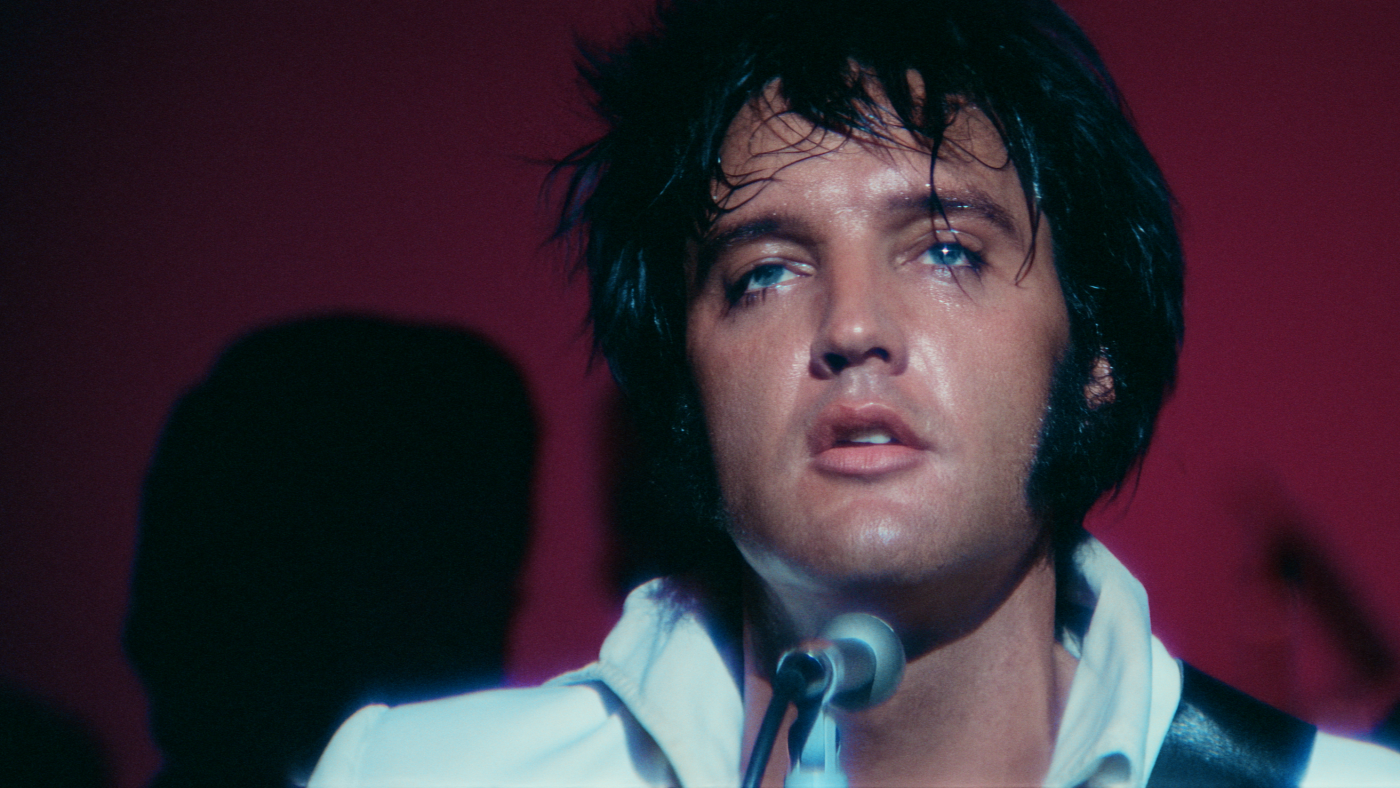
Elvis Presley in Las Vegas in Aug. 1970.
NEON
hide caption
toggle caption
NEON
“You are my favorite customer,” Baz Luhrmann tells me on a recent Zoom call from the sunny Chateau Marmont in Hollywood. The director is on a worldwide blitz to promote his new film, EPiC: Elvis Presley in Concert — which opens wide this week — and he says this, not to flatter me, but because I’ve just called his film a miracle.
See, I’ve never cared a lick about Elvis Presley, who would have turned 91 in January, had he not died in 1977 at the age of 42. Never had an inkling to listen to his music, never seen any of his films, never been interested in researching his life or work. For this millennial, Presley was a fossilized, mummified relic from prehistory — like a woolly mammoth stuck in the La Brea Tar Pits — and I was mostly indifferent about seeing 1970s concert footage when I sat down for an early IMAX screening of EPiC.
By the end of its rollicking, exhilarating 90 minutes, I turned to my wife and said, “I think I’m in love with Elvis Presley.”
“I’m not trying to sell Elvis,” Luhrmann clarifies. “But I do think that the most gratifying thing is when someone like you has the experience you’ve had.”
Elvis made much more of an imprint on a young Luhrmann; he watched the King’s movies while growing up in New South Wales, Australia in the 1960s, and he stepped to 1972’s “Burning Love” as a young ballroom dancer. But then, like so many others, he left Elvis behind. As a teenager, “I was more Bowie and, you know, new wave and Elton and all those kinds of musical icons,” he says. “I became a big opera buff.”
Luhrmann only returned to the King when he decided to make a movie that would take a sweeping look at America in the 1950s, ’60s, and ’70s — which became his 2022 dramatized feature, Elvis, starring Austin Butler. That film, told in the bedazzled, kaleidoscopic style that Luhrmann is famous for, cast Presley as a tragic figure; it was framed and narrated by Presley’s notorious manager, Colonel Tom Parker, portrayed by a conniving and heavily made-up Tom Hanks. The dark clouds of business exploitation, the perils of fame, and an early demise hang over the singer’s heady rise and fall.
It was a divisive movie. Some praised Butler’s transformative performance and the director’s ravishing style; others experienced it as a nauseating 2.5-hour trailer. Reviewing it for Fresh Air, Justin Chang said that “Luhrmann’s flair for spectacle tends to overwhelm his basic story sense,” and found the framing device around Col. Parker (and Hanks’ “uncharacteristically grating” acting) to be a fatal flaw.
Personally, I thought it was the greatest thing Luhrmann had ever made, a perfect match between subject and filmmaker. It reminded me of Oliver Stone’s breathless, Shakespearean tragedy about Richard Nixon (1995’s Nixon), itself an underrated masterpiece. Yet somehow, even for me, it failed to light a fire of interest in Presley himself — and by design, I now realize after seeing EPiC, it omitted at least one major aspect of Elvis’ appeal: the man was charmingly, endearingly funny.
As seen in Luhrmann’s new documentary, on stage, in the midst of a serious song, Elvis will pull a face, or ad lib a line about his suit being too tight to get on his knees, or sing for a while with a bra (which has been flung from the audience) draped over his head. He’s constantly laughing and ribbing and keeping his musicians, and himself, entertained. If Elvis was a tragedy, EPiC is a romantic comedy — and Presley’s seduction of us, the audience, is utterly irresistible.
Unearthing old concert footage
It was in the process of making Elvis that Luhrmann discovered dozens of long-rumored concert footage tapes in a Kansas salt mine, where Warner Bros. stores some of their film archives. Working with Peter Jackson’s team at the post-production facility Park Road Post, who did the miraculous restoration of Beatles rehearsal footage for Jackson’s 2021 Disney+ series, Get Back, they burnished 50-plus hours of 55-year-old celluloid into an eye-popping sheen with enough visual fidelity to fill an IMAX screen. In doing so, they resurrected a woolly mammoth. The film — which is a creative amalgamation of takes from rehearsals and concerts that span from 1970 to 1972 — places the viewer so close to the action that we can viscerally feel the thumping of the bass and almost sense that we’ll get flecked with the sweat dripping off Presley’s face.
This footage was originally shot for the 1970 concert film Elvis: That’s The Way It Is, and its 1972 sequel, Elvis on Tour, which explains why these concerts were shot like a Hollywood feature: wide shots on anamorphic 35mm and with giant, ultra-bright Klieg lights — which, Luhrmann explains, “are really disturbing. So [Elvis] was very apologetic to the audience, because the audience felt a bit more self conscious than they would have been at a normal show. They were actually making a movie, they weren’t just shooting a concert.”
Luhrmann chose to leave in many shots where camera operators can be seen running around with their 16mm cameras for close-ups, “like they’re in the Vietnam War trying to get the best angles,” because we live in an era where we’re used to seeing cameras everywhere and Luhrmann felt none of the original directors’ concern about breaking the illusion. Those extreme close-ups, which were achieved by operators doing math and manually pulling focus, allow us to see even the pores on Presley’s skin — now projected onto a screen the size of two buildings.
The sweat that comes out of those pores is practically a character in the film. Luhrmann marvels at how much Presley gave in every single rehearsal and every single concert performance. Beyond the fact that “he must have superhuman strength,” Luhrmann says, “He becomes the music. He doesn’t mark stuff. He just becomes the music, and then no one knows what he’s going to do. The band do not know what he’s going to do, so they have to keep their eyes on him all the time. They don’t know how many rounds he’s going to do in ‘Suspicious Minds.’ You know, he conducts them with his entire being — and that’s what makes him unique.”

Elvis Presley in Las Vegas in Aug. 1970.
NEON
hide caption
toggle caption
NEON
It’s not the only thing. The revivified concerts in EPiC are a potent argument that Elvis wasn’t just a superior live performer to the Beatles (who supplanted him as the kings of pop culture in the 1960s), but possibly the greatest live performer of all time. His sensual, magmatic charisma on stage, the way he conducts the large band and choir, the control he has over that godlike gospel voice, and the sorcerer’s power he has to hold an entire audience in the palm of his hands (and often to kiss many of its women on the lips) all come across with stunning, electrifying urgency.
Shaking off the rust and building a “dreamscape”
The fact that, on top of it all, he is effortlessly funny and goofy is, in Luhrmann’s mind, essential to the magic of Elvis. While researching for Elvis, he came to appreciate how insecure Presley was as a kid — growing up as the only white boy in a poor Black neighborhood, and seeing his father thrown into jail for passing a bad check. “Inside, he felt very less-than,” says Luhrmann, “but he grows up into a physical Greek god. I mean, we’ve forgotten how beautiful he was. You see it in the movie; he is a beautiful looking human being. And then he moves. And he doesn’t learn dance steps — he just manifests that movement. And then he’s got the voice of Orpheus, and he can take a song like ‘Bridge Over Troubled Water’ and make it into a gospel power ballad.
“So he’s like a spiritual being. And I think he’s imposing. So the goofiness, the humor is about disarming people, making them get past the image — like he says — and see the man. That’s my own theory.”
Elvis has often been second-classed in the annals of American music because he didn’t write his own songs, but Luhrmann insists that interpretation is its own invaluable art form. “Orpheus interpreted the music as well,” the director says.
In this way — as in their shared maximalist, cape-and-rhinestones style — Luhrmann and Elvis are a match made in Graceland. Whether he’s remixing Shakespeare as a ’90s punk music video in Romeo + Juliet or adding hip-hop beats to The Great Gatsby, Luhrmann is an artist who loves to take what was vibrantly, shockingly new in another century and make it so again.

Elvis Presley in Las Vegas in Aug. 1970.
NEON
hide caption
toggle caption
NEON
Luhrmann says he likes to take classic work and “shake off the rust and go, Well, when it was written, it wasn’t classical. When it was created, it was pop, it was modern, it was in the moment. That’s what I try and do.”
To that end, he conceived EPiC as “an imagined concert,” liberally building sequences from various nights, sometimes inserting rehearsal takes into a stage performance (ecstatically so in the song “Polk Salad Annie”), and adding new musical layers to some of the songs. Working with his music producer, Jamieson Shaw, he backed the King’s vocals on “Oh Happy Day” with a new recording of a Black gospel choir in Nashville. “So that’s an imaginative leap,” says Luhrmann. “It’s kind of a dreamscape.”
On some tracks, like “Burning Love,” new string arrangements give the live performances extra verve and cinematic depth. Luhrmann and his music team also radically remixed multiple Elvis songs into a new number, “A Change of Reality,” which has the King repeatedly asking “Do you miss me?” over a buzzing bass line and a syncopated beat.
I didn’t miss Elvis before I saw EPiC — but after seeing the film twice now, I truly do.

Utah Mammoth take down Minnesota 5-2 to end the Wild’s winning streak at 6

Couple sentenced for selling faulty fire extinguishers to Mississippi daycares, businesses – SuperTalk Mississippi
Missouri Lottery Mega Millions, Pick 3 winning numbers for Feb. 27, 2026

Montana cowboys help build trauma ranch for Israeli soldiers

How to Watch No. 12 Nebraska Basketball at USC with Preview, Breakdown, TV Channel

Florida High School Football Rankings: Top 25 teams – Oct. 21

Cleary's 21 help Le Moyne down Central Connecticut State 69-64 in OT

How old is Bo Nix? What to know about Oregon quarterback ahead of 2024 NFL Draft

99th annual Pony Swim held in Virginia

Indiana Members Credit Union announced as new anchor tenant at Bottleworks District

ICE blasts Washington mayor over directive restricting immigration enforcement

Did the EU bypass Hungary’s veto on Ukraine’s €90 billion loan?

How the federal government is painting immigrants as criminals on social media

Where Iran’s ballistic missiles can reach — and how close they are to the US

Has India’s influence in Afghanistan grown under the Taliban?
-

 World2 days ago
Exclusive: DeepSeek withholds latest AI model from US chipmakers including Nvidia, sources say
-

 Massachusetts3 days ago
Mother and daughter injured in Taunton house explosion
-

 Montana1 week ago
2026 MHSA Montana Wrestling State Championship Brackets And Results – FloWrestling
-

 Louisiana5 days ago
Wildfire near Gum Swamp Road in Livingston Parish now under control; more than 200 acres burned
-

 Denver, CO2 days ago
10 acres charred, 5 injured in Thornton grass fire, evacuation orders lifted
-

 Technology7 days ago
YouTube TV billing scam emails are hitting inboxes
-

 Technology7 days ago
Stellantis is in a crisis of its own making
-

 Politics7 days ago
OpenAI didn’t contact police despite employees flagging mass shooter’s concerning chatbot interactions: REPORT