Lifestyle
In a collection of 40+ interviews, author Adam Moss tries to find the key to creation


Adam Moss allowed NPR into a space only two other people have seen: his painting studio.
Adam Moss
hide caption
toggle caption
Adam Moss

Adam Moss allowed NPR into a space only two other people have seen: his painting studio.
Adam Moss
In a small brick building in the Lower East Side of Manhattan, you can find Adam Moss’s “den of torture.”
Prior to this interview, almost no one has been allowed in.
“Just my husband and my teacher. That’s it.” Moss said. “Two people in my entire life and I’ve had this thing for five years. So welcome.”
This space is less menacing than most dens of torture; there aren’t any medieval instruments of pain after all. Instead, the small, light-filled room overflows with brushes and palettes, and paintings of various sizes and stages of completion rest on every surface.
Adam Moss’ so-called “den of torture.” Instead of Medieval instruments of torture, he has paintbrushes and palettes.
Adam Moss
hide caption
toggle caption
Adam Moss
When Adam Moss gave up his job as editor-in-chief of New York Magazine five years ago, he started painting. He loved it, but it was agonizing.
“I really wanted to be good, and it made the act of making art so frustrating for me,” said Moss. “This [studio] is where I come many days and wrestle with trying to make something.”
Trying to make something is exactly the subject of Adam Moss’s new book, The Work of Art: How Something Comes from Nothing.
“The book is called The Work of Art,” says Moss. “And that is kind of what it’s about.”
It’s about the work.
Adam Moss’ The Work of Art: How Something Comes from Nothing features interviews with more than 40 creatives about their process, from blank page to final product.
Penguin Press
hide caption
toggle caption
Penguin Press
The book has 43 chapters, each one dedicated to a single artist, and their process of creating a single work. They come from a wide range of disciplines. There are poets, painters, chefs, sand castle sculptors and crossword puzzle makers.
And through this collection of interviews, the book tries to answer the questions: How does a sketch become a painting? How does a scribbled lyric become a song? How does an inspiration become a masterpiece?
The book is a visual feast, full of drafts, sketches, and scribbled notebook pages.
A sample of pages from chapter 9 of the book, which profiles poet and essayist Louise Glück.
Penguin Press
hide caption
toggle caption
Penguin Press
A sample of pages from chapter 9 of the book, which profiles poet and essayist Louise Glück.
Penguin Press
Every page shows how an idea becomes a finished design.
In one chapter, Moss speaks with Amy Sillman, an abstract painter who Moss admires for her unique use of color and shape.
“Amy was also a dream subject for this project,” Moss writes. “Because to reach the finish line of most of her paintings, she paints dozens of paintings, or even more, each usually pretty wonderful.”
Amy Sillman’s artistic process
-
Amy Stillman/Penguin Press
-
Amy Stillman/Penguin Press
-
Amy Stillman/Penguin Press
-
Amy Stillman/Penguin Press
-
Amy Stillman/Penguin Press
-
Amy Stillman/Penguin Press
-
Amy Stillman/Penguin Press
-
Amy Stillman/Penguin Press
-
Amy Stillman/Penguin Press
The chapter contains 39 images, demonstrating the full evolution from first draft to finished product of her work, Miss Gleason.
Each image is accompanied by a quote from Sillman, explaining what step that particular draft represented in her process.
In another chapter, Moss speaks with the musician Rostam, who describes the process of writing the song “In a River.”
Musician Rostam Batmanglij, pictured here performing in 2017, shared his songwriting process with Adam Moss.
Emma McIntyre/Getty Images
hide caption
toggle caption
Emma McIntyre/Getty Images
Musician Rostam Batmanglij, pictured here performing in 2017, shared his songwriting process with Adam Moss.
Emma McIntyre/Getty Images
For Rostam, the creative process occurred in large part on his iPhone, in a collection of draft lyrics written in the notes app, and melodies in recorded as voice memos.
Voice memo draft of Rostam’s “In a River”
Eventually, those notes and recording on his phone evolved into a completed song.
Rostam’s animation video for his song “In a River.”
YouTube
So, what is the key to creating a masterpiece? Moss did not find an answer. All of artists featured across the book are unique, and so are their creative processes.
However, Moss did point to some frequently shared traits.
One commonality Moss found was that many artists describe themselves as having ADHD.
“Whether they have ADHD or not, [they have] the elements that we associate with ADHD,” Moss said, describing a balance of distractedness and focus.
“You need to be distracted enough for your mind, for your imagination to go fishing, and you need to be focused enough to know what to do with it.”
Moss also found that his subjects consistently found ways not to let the fear of failure or mistakes prevent them from starting.
“They tried to get through that as quickly as possible and with as little thought as possible,” Moss said. “Many of them write in longhand, giving themselves explicit permission to fail.”
However, there was one trait between Moss’s subjects that was truly ubiquitous.
“They all have a compulsion, an obsession to make something. It gets into their system and they can’t let go of it,” Moss said, explaining that the vision or the final product is secondary to the process.
“The end product is not the point,” Moss said. “what they were consumed by, why they did what they did is because they were consumed by the work. “


Kars4Kids advertisements, like this TV commercial on a hot-pink set, feature children turning the charity’s phone number into a catchy jingle. But they do not disclose that most of the proceeds go to a Jewish nonprofit that supports programming for young adults.
Kars4Kids/Screenshot by NPR
hide caption
toggle caption
Kars4Kids/Screenshot by NPR
The “Kars4Kids” jingle — with its chipper melody and high-pitched, pre-tween singers — has been wedged firmly in many Americans’ heads for two decades. But it may soon go off the air in California after a judge banned it for being “deceptive.”
Judge Gassia Apkarian of the Orange County Superior Court ruled earlier this month that the ad violates California’s laws against unfair competition and false advertising because it does not disclose Kars4Kids’ religious affiliation.
The case has put the jingle — and the charity behind it — in the headlines. And it inspired us to check in on some other nostalgic favorites (more on that below).
The Kars4Kids case, explained
Kars4Kids says it gives most of its proceeds from used-car donations to Oorah, an Orthodox Jewish nonprofit based in New Jersey that provides opportunities like summer camps, adult matchmaking services and trips to Israel.
Kars4Kids makes the connection to its “sister nonprofit” clear on its website, though not in its infamous jingle: “1-877-Kars4Kids / K-A-R-S Kars for Kids / 1-877-Kars4Kids / Donate your car today.”
That omission prompted California resident Bruce Puterbaugh to sue Oorah in 2021.
According to the judge’s order, Puterbaugh testified that he donated a 2001 Volvo station wagon after hearing the Kars4Kids advertisement “over and over,” believing the money would benefit California kids in need. Puterbaugh, a self-described “not a computer person” in his 70s, said he never visited the charity’s website and only learned the truth from a casual conversation with his Lake County neighbor after the car was picked up.
“He testified that he felt ‘taken advantage of’ upon discovering — only after the donation — that the funds did not stay in California but supported a specific religious mission in the Northeast,” Apkarian wrote.
The neighbor, Neal Roberts, is a lawyer who went on to represent him in the case. Roberts told NPR that the ad — which has aired on the radio since the turn of the millennium and on TV since 2014 — is ubiquitous in California. But he said Apkarian, the judge in the case, doesn’t watch TV and hadn’t heard the jingle until it was played at the four-day trial in November.
“She heard it the first time, and then she heard it the second time, and then the rule in the court was, ‘Do not play that jingle again,’” he said with a laugh. “So I thought that gave us some idea that we might have a chance.”
According to the judge’s order, Kars4Kids’ Chief Operating Officer Esti Landau confirmed at trial that the charity’s primary function is not helping economically disadvantaged children but “Jewish kids and families throughout their lives.” She said the charity has “no functional programs in California beyond a ‘backpack giveaway’ characterized as a branding exercise,” the judge wrote.
Landau confirmed on the stand that in 2022 — among other expenditures — Oorah transferred $16,500,000 to North Africa and the Middle East, and spent $16.5 million to purchase a building in Israel. She testified that while the Kars4Kids ad features kids ages 8 to 10, the programs Oorah funds “often target young adults (17-18) and matchmaking as well as Jewish families.” And she conceded that a donor would “have to go to the website” for that information.
Neither Kars4Kids nor Oorah responded to NPR’s requests for comment. But in a lengthy statement on its website, Kars4Kids said the judge mischaracterized its work and its testimony at trial.
“Kars4Kids’ ads have one purpose: to remind listeners that Kars4Kids offers a quick and easy way to dispose of an unused vehicle,” it wrote. “The ads are targeted to vehicle owners, not specifically to people considering donating to charity.”
The charity said “helping children often means engaging parents and families as well,” and stressed that its mission and religious affiliation are prominently stated on its website.
But the judge ultimately sided with Puterbaugh, writing that “a reasonable consumer is not required to be ‘computer savvy.’” She gave the charity 30 days to stop airing the ad in California unless it is updated to include an “audible disclosure of its religious affiliation and the geographic location of its primary beneficiaries and the age of the beneficiaries.”
The judge also ordered the charity to pay Puterbaugh $250, the value of the car he donated, though acknowledged that “money cannot ‘un-donate’ a car or restore the donor’s belief that they were helping a local, needy child.”
Kars4Kids says on its website that it plans to appeal the ruling, which it said is “deeply flawed, ignores and misrepresents the facts that were presented at trial, and misapplies the law.”
The charity also called the case as “a lawyer-driven attempt to siphon off charitable funds for their own gain.” Roberts dismissed that accusation, saying the only money his client stands to gain is the $250 for the car and lawyers’ fees. The bigger win, he said, is putting Kar4Kids — and potentially other charities nationwide — on notice about the consequences of false advertising.
“I think anyone who knows the facts would think that there was wool being pulled over people’s eyes,” Roberts said.
Where are they now?
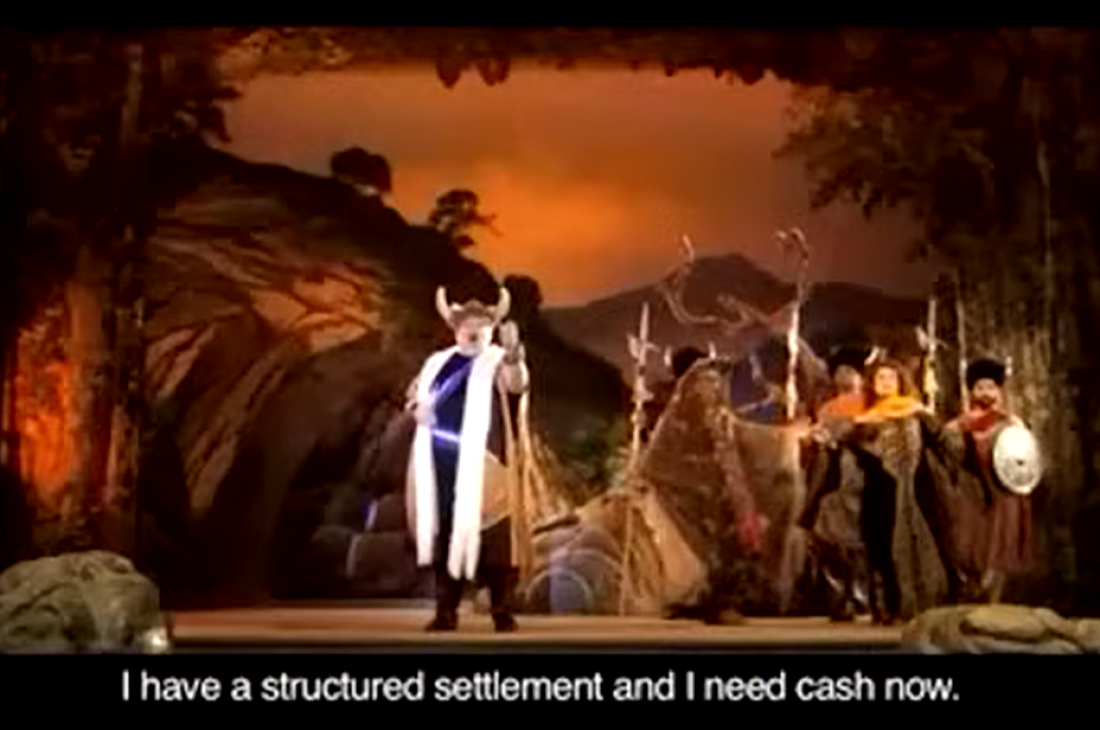
J.G. Wentworth’s catchy “Viking Opera” commercial, featuring elaborately costumed, structured settlement-winning opera singers in need of cash, has been airing on and off since 2008.
J.G. Wentworth/Screenshot by NPR
hide caption
toggle caption
J.G. Wentworth/Screenshot by NPR
This story sent us down a head-bopping rabbit hole of nostalgic jingles, confirming they never truly leave the depths of your brain. And it turns out, some of them are — in a sense — new again.
Remember Zoo Pals, the early-aughts, dipping sauce-friendly paper plates shaped like animals (pig, bee, frog, duck) that, per their peppy theme song, “make eating fun!”? Hefty discontinued the onetime birthday-party staple in 2014, but brought the plates back in 2023 — and has also introduced disposable cups and plastic bags in the years since. No word yet on whether the commercial might make a comeback too.
Folgers, the coffee brand, has had people humming “The best part of wakin’ up / is Folgers in your cup” since the cozy jingle first aired in 1984. Its various iterations have managed to hold viewers’ attention in the years since (the 2009 sibling version inspired a slew of parodies and fan fiction). In 2021, public performance royalties for the song — which is actually titled “Real Snowy Morning” — were auctioned off online. The winning bidder, identified as “Josh C.,” paid $90,500.
And earlier this year, the brand released remixed versions of the ad, fusing the original jingle with several popular wake-up songs spanning genres and generations (including the Everly Brothers’ “Wake Up Little Susie” and “Bring Me to Life” by Evanescence).
Just this week, comedian John Oliver parodied JG Wentworth’s Viking opera (“877-cash-now”) jingle for an episode examining the structured settlement factoring industry. Oliver’s version, warning people to be skeptical of such companies, features stars like singer Megan Hilty, actor Victor Garber and Larry David, in a nod to the original earworm’s prominent cameo in the final season of Curb Your Enthusiasm.
Sometimes a jingle outlives the very thing it’s advertising. Consider: “I’m a Toys R Us Kid,” the toy store ditty belted enthusiastically by generations of trike-riding kiddos since the 1980s. The franchise shuttered due to bankruptcy in 2018, though it has since been partially revived through a partnership with Macy’s. The jingle has staying power — much to the delight of prolific thriller author James Patterson, who helped write the lyrics in his early career in advertising.
“That’s a big moment in my life,” Patterson said when asked about it in a 2024 appearance on Live with Kelly and Mark. “That’s a fun one, and kids obviously loved it. And we do remember it, which is great.”

The Bob Baker Marionette Theater was about to debut its first new production in 45 years, and it was uncertain whether one of the show’s signature new puppets would even work. A pelican, with an oversized bucket-like beak, was in need of last-minute maintenance.
This gangly bird, designed to hop, skip, soar and sing to Clarence Henry’s mid-’50s rhythm and blues hit “Ain’t Got No Home,” was supposed to surprise the audience, as its elongated bill is actually hiding a frog. Getting the pelican-frog duo to perform in unison was a feat of mechanical artistry for the team, not to mention the choreography needed by the puppeteer.
-
Share via
And in the minutes before showtime, director Alex Evans was trying to stay calm. In such moments, he would say later, he only need remind himself of an old adage in the puppet arts.
“Puppets,” he says, “break all the time.”
With that, he was ready to embrace the unknown.
“I always say I love the chaos of live theater,” Evans says. “We got to believe in this thing.”
“Choo Choo Revue,” the latest in a long line of song-and-dance productions, is arriving at a momentous time for the Bob Baker Marionette Theater. Just last month the troupe announced its intent to purchase its venue on Highland Park’s York Boulevard for $5 million, doing so as it was gearing up for performances at the Coachella Valley Music and Arts Festival. The latter went viral, a fact Evans attributes to many of the first week shows of “Choo Choo Revue” selling out.

An organist plays while people file into the premiere of “Choo Choo Revue” at the Bob Baker Marionette Theater.
In many ways, “Choo Choo Revue” is a statement piece. Evans, who also serves as co-executive director with Mary Fagot, wants to place the spotlight on the theater’s current crop of artists, fabricators and collaborators. While the show pays tribute in many ways to the theater’s legendary namesake founder, perhaps most notably in its use of his vintage record collection, it’s time, Evans says, for the Bob Baker Marionette Theater’s next generation to shine.
Evans was instrumental in the decision to shift the team away from the previously announced production of “Arabian Nights,” a project once spearheaded by Baker, who died in 2014. Just ahead of the arrival of the 2020 COVID-19 pandemic, the theater had gone so far as to print an “Arabian Nights” program, and had finished sets and puppets ready to go.

“Choo Choo Revue” is the first new Bob Baker Marionette show since 1981’s “Hooray LA!”
During the forced closure, however, the team began to rethink its future. “It was a deep-breath time to do some internal thinking about who we are and what we want to prioritize,” says Evans, who joined the company in 2007 as a volunteer and became a staffer in 2009.
“The first new show in 40 years — us finishing one of Bob’s shows would have been deeply personal and meaningful, but it would have kept the narrative, internally and externally, that this was one person’s vision,” Evans says. “‘Choo Choo’ is the culmination of so many different ideas and people. It was purposefully about opening the floodgates, that Bob Baker could be more than just the person of Bob Baker.”
It wasn’t a sure thing the Bob Baker Marionette Theater would even reach this milestone. For much of the past decade — since about the death of the theater’s patriarch — the narrative surrounding the theater was one of survival.
In 2019, the Bob Baker Marionette Theater needed a lifeline. Forced out of its edge-of-downtown home of more than 55 years, the beloved troupe with its thousands of handcrafted puppets — a saucy black cat in heels, a fish out of water that can’t help but wiggle — ultimately found a new location in a Highland Park theater, where it signed a 10-year lease.
Then came the pandemic, when the theater relied heavily on community fundraising to cover its rent. California, and Hollywood in particular, has a rich puppetry tradition. Bob Baker Marionette Theater likes to refer to itself as the largest ongoing puppet theater in the U.S. The oldest puppet space in the country resides up north in Oakland at amusement park Children’s Fairyland. And in 2020, Bob Baker found it had many fans, asking at one point to raise $365,000 over the course of a year. It did so in four weeks.

2

3

1. L Castro twirls a marionette. 2. The audience gives a round of applause after the premiere of “Choo Choo Revue.” 3. People stand in line for the premiere of “Choo Choo Revue” at the Bob Baker Marionette Theatre. (Carlin Stiehl/For The Times)

Old favorites, including the theater’s famed black cat marionette, make appearances in “Choo Choo Revue.”
But it was the long process of buying its home, namely the belief that it would be in Highland Park to stay, that gave the company the confidence that it could go forward with a new show. The obvious question, of course, is why it took 40 years for a completely fresh Bob Baker experience. Evans gives a long answer, pointing to numerous hurdles, be it the shift in locations, the cost of preserving its historic puppets and collection, as well as just managing priorities.
“It’s not necessarily a financial hurdle,” Evans says, noting “Choo Choo Revue” cost $300,000, with about half of that sum dedicated to the creation of new puppets and scenery.
“I think it was more about priorities,” Evans says. “Like, do we get the staff healthcare first, or do we do a new show first? So we got the staff healthcare. Or do we give the stage better lighting.”
As for how and why the team settled on “Choo Choo Revue” as its first production since 1981’s “Hooray LA!,” Evans says not to overthink it.
“It made me giggle,” he says. “It was a jumping off point to imagination. ‘Choo Choo Revue,’ by name itself, I thought to giggle.”
The show is a fantastical representation of a cross-country train trip, filled with adorable puppet trains.
A meticulously detailed log with windows, for instance, or a car that seems to balance natural, mountainous wonders on its back. They’re colorful playthings, at least until the background scenery starts depicting various locomotive styles. Puppeteers will whisk train cars out into the open, each often housing a fantastical creature — a moose, for instance, who takes a break from knitting to prance around to a rendition of the on-theme traditional blues ditty “Midnight Special.”
Behind it all are tens of thousands of hours of handcrafted proficiency. Each new puppet is a work of art. Take, for instance, a swarm of bats that seemed to glow in the dark (the creatures, created for “Choo Choo Revue,” made their debut during last year’s Halloween season).

The Bob Baker Marionette Theater created more than 100 new puppets for “Choo Choo Revue,” including a pelican hiding a frog in its beak.
Or an intricately detailed cicada band. They’re each playing tiny instruments — one a half-open sardine can, another a stringed matchbook. Their wings deserve a close inspection, as the translucent curved fixtures are inspired by stained glass windows. There are trees that ski, and train whistles with big lips and high heels, modeled after harmony group the Andrews Sisters. Wait till the latter toot off their tops, as each of the 100 new puppets is full of surprises.
“We get a bunch of different artists together, and we all brainstorm,” Evans says of the creation process. “Like, ‘Let’s all think for a second about anthropomorphizing trains.’ We did a series of sketches and showed them to each other. I honestly probably have a thousand different fascinating ideas for train movement.”
On opening night, the crowd claps along to the numbers, cheering with delight at each new piece of whimsy that rolls or soars onto the floor-level stage. And as for the showstopping pelican, the frog erupts out of its beak right on cue, a moment that indeed inspires a round of laughter and childlike awe.
As the imaginary train whisks the puppets around the country, the show manages to build anticipation just by making the crowd wonder what comes next. Say, for instance, a fluffy Sasquatch, or a crooner of a moon in pajamas singing an old-timey lullaby to all the little ones seated cross-legged on the floor.

Puppeteer Ginger Duncan twirls a marionette named Comedy.
Much of “Choo Choo Revue,” like the yawning, serenading moon, is rooted in the music of the past. That was a decision made to ensure the show feels in line with earlier Bob Baker works. Yet Evans says the team is emboldend after Coachella to start tackling more contemporary songs at its Highland Park headquarters. The crowd at the Indio festival, for instance, went wild for the puppets swooning to Ben Platt’s cover of Addison Rae’s hit tune “Diet Pepsi.”
“Honestly, if we had done Coachella last year, it would have pushed ‘Choo Choo’ further,” he says, noting he initially feared pop music could distract. “I didn’t think it could work in a way that wouldn’t throw you out of the show.”
And yet Evans doesn’t want to get ahead of himself. He nearly teared up at the end of the “Choo Choo Revue” premiere, saying the following afternoon that seeing this show come together after multiple years was second only to his 2025 wedding in terms of creating an “overwhelming feeling of pride, love and care.”
“Choo Choo Revue” culminates in a look toward the future. That’s when a sleek, silver, oversized high-speed bullet train arrives on the scene.
It can be read as a metaphor.
While the nonprofit is still seeking donor help — at the premiere, Fagot said the company now has secured $4.7 million toward its $5 million goal of buying the theater and it also hopes to raise an additional $2 million for building upgrades — its future is more secure than it has been at any time over the past decade.
At long last, the Bob Baker Marionette Theater can relax and look toward new horizons.
Evans, for instance, can’t help himself excitedly tease a potential next Bob Baker show. He says twice in the interview that the Olympics are on the troupe’s mind.
“We’ve got two years,” he says. And now the permanent home to house it.

Are psychedelics the next big thing?
Psychedelics include the drugs LSD, magic mushrooms, peyote, and often ketamine and MDMA too, among others. And some of these drugs have a history of spiritual practice spanning millennia. Then many of these drugs became synonymous with hippies and 60s and 70s counterculture. But now, psychedelics have new cheerleaders: tech bros and CEOs. So why the rebrand?
To get into it all, Brittany is joined by Maxim Tvorun-Dunn, PhD candidate at the University of Tokyo, and Emma Goldberg, business reporter at the New York Times, to discuss what it means that these drugs are getting championed – and sometimes financially backed – by the tech elite, and how might that affect our culture’s relationship with psychedelics.
This episode originally aired on March 24, 2025.
Interested in hearing more of Brittany’s series “Losing My Religion?” Check out these episodes:
Goodbye, church… Hello, Wellness Industrial Complex!
Am I a god?! Why “manifesting” your reality is easier than ever
Support Public Media. Join NPR Plus.
Follow Brittany on Instagram: @bmluse
For handpicked podcast recommendations every week, subscribe to NPR’s Pod Club newsletter at npr.org/podclub.
This episode was produced by Liam McBain. It was edited by Neena Pathak. Our Supervising Producer is Cher Vincent. Our Executive Producer is Barton Girdwood. Our VP of Programming is Yolanda Sangweni.
-

 News12 minutes ago
Colorado Democratic Party censures Gov. Jared Polis after he commutes Tina Peters’ sentence
-

 Los Angeles, Ca2 hours ago
Southern California jeweler accused of stealing $1.5 million from customers through Rolex watch scam
-

 Detroit, MI2 hours ago
Air France flight bound for Detroit diverted to Canada over passenger from Congo, officials say
-

 San Francisco, CA2 hours ago
Caltrans considering 140 mph bus that would take passengers from San Francisco to Los Angeles
-

 Dallas, TX2 hours ago
Dallas police seek two people of interest seen leaving Deep Ellum shooting that injured five
-

 Miami, FL3 hours ago
Inter Miami nearing deal to bring in Brazilian star Casemiro to pair with Lionel Messi
-

 Boston, MA3 hours ago
Boston City Council deadlocks on push to reject Mayor Wu’s $4.9B budget
-

 Denver, CO3 hours ago
Denver weather: More rain to end the week

