San Francisco, CA
Caltrans considering 140 mph bus that would take passengers from San Francisco to Los Angeles


SAN FRANCISCO (KGO) — The California Department of Transportation is exploring the idea of a high-speed bus system that could travel between San Francisco and Los Angeles, offering an alternative form of transportation for travelers who frequently move between the two regions.
The concept, which remains in its early stages, envisions buses traveling at speeds of up to 140 miles per hour on state freeways. Caltrans officials describe the proposal as part of a broader effort to examine what it calls high-speed buses.
“I think it would be great. We need to build more infrastructure in the state of California,” said Jeff Fisher, a San Francisco resident.
In a recent presentation, Caltrans outlined potential routes and corridors that could support the system. Officials pointed to freeways such as the Harbor Freeway and the San Bernardino Freeway as possible starting points.
“Freeways with some infrastructure may be candidates to start such as the Harbor Freeway and the San Bernardino freeway. Or perhaps it would be best to start with the interregional service that can connect Los Angeles with San Diego and San Francisco Bay Area and Sacramento. That would favor I-5 and I-10 as the first freeways,” said Ryan Snyder, Caltrans feasibility studies manager.
MORE: California drops lawsuit seeking to reinstate federal funding for the state’s bullet train
The idea is already drawing interest from some travelers who regularly fly within the state.
“I think it would be a different form of transportation, and I think it might be more accessible,” said Katie Kim, a San Francisco resident who said she flies to Southern California three to four times a year.
“That would be a good idea maybe its faster,” said Arlette Contreras, a tourist.
MORE: Trump administration wants to hand out $2.4 billion it took from California’s high-speed railroad
However, transportation experts say the proposal would face some challenges, particularly in already congested corridors.
“Given the highly congested nature of that corridor on the interstate highways and really some of the secondary roadways, it would be critical that bus lanes would need to be additional lanes. They could not be in place of the existing lanes that people are already traveling on that are already highly congested,” said Rocky Moretti, director of policy and research with TRIP, a national transportation research nonprofit.
The proposal also comes as California spent more than $14 billion on a high-speed rail project intended to connect San Francisco and Los Angeles, according to the California High-Speed Rail Authority, something residents say remains top of mind as new transportation ideas are considered.
“Would love not to have to go through the airport. I’m just sort of skeptical that it will be able to work,” said Bradley Powles, a Hercules resident.
MORE: California Gov. Gavin Newsom signs bill requiring funding plan for state’s high-speed rail project
Caltrans has not provided cost estimates for the high-speed bus concept. A preliminary report noted that if the 140-mile-per-hour target proves infeasible due to cost, infrastructure or safety limitations, a slower speed of 80 to 100 miles per hour could serve as a practical alternative.
“Something that would be quicker and easier would be wonderful I hope it can be achieved,” Powles said.
Copyright © 2026 KGO-TV. All Rights Reserved.

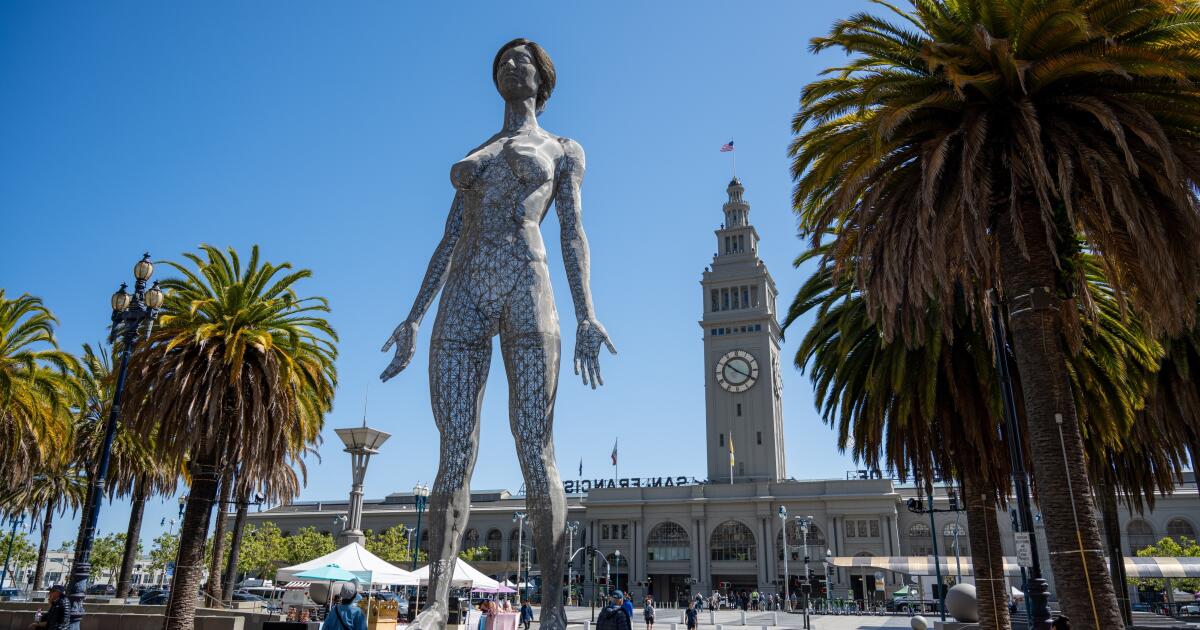
For sale in San Francisco: A 45-foot-tall metal sculpture of a naked woman.
Her name is R-Evolution. Her hair is pulled back and her facial expression is serene. Her mechanized chest expands and contracts, as if she’s breathing. And she tips the scales at 13,000 pounds (not that it’s anyone’s business what a lady weighs).
She will stand in Embarcadero Plaza across from the historic Ferry Building until October. Then she goes on sale. The artist says “she can go anywhere in the world,” but whoever buys or leases her will need a crane and a 60- to 80-foot bucket lift to resurrect her.
Since she was first unveiled as a temporary installation in April 2025, the giant statue, created by artist Marco Cochrane and modeled after California dancer and singer Deja Solis, has spurred debate about whether privately funded works are really public art. It also questions whether R-Evolution is a celebration of femininity in a free-spirited city that has long embraced public nudity or a hypersexualized shock piece from a male artist.
But debate, per the public and private entities who brought her to the plaza, is kind of the point. Art, they say, is supposed to be controversial.
An attempt to revitalize public space
R-Evolution is part of Big Art Loop, a privately funded initiative that aims to bring up to 100 temporarily installed large-scale sculptures — a minimum of 10 feet high or wide preferred — to public spaces along a 34-mile walking and biking trail over the next few years.
R-Evolution in Embarcadero Plaza in April 2025.
(Christopher Reynolds / Los Angeles Times)
Big Art Loop is funded by the Sijbrandij Foundation, a nonprofit established by billionaire Sid Sijbrandij, co-founder of the software company GitLab. It is curated by the art production agency Building 180, in partnership with the city’s Recreation and Parks Department and other public agencies.
“We’re going to continue to lean in to our arts and culture because that is driving our comeback here in San Francisco,” Mayor Daniel Lurie said in a September video promoting the Big Art Loop.
A city news release last year said R-Evolution’s arrival “aligns with San Francisco’s broader efforts to revitalize downtown” by increasing foot traffic to the battered business district, where office vacancy rates soared to record-high rates of more than 30% amid the pandemic-era pivot to remote work.
Controversial lady and Burning Man
Like a few of the Big Art Loop pieces, R-Evolution originally debuted at Burning Man, towering above the sweaty and stoned desert masses in 2015.
Critics of R-Evolution say the statue and other massive pieces along the billionaire-backed Big Art Loop did not get as much community input and were not subject to the same intense scrutiny by the San Francisco Arts Commission as other public artworks.
“I think what a lot of people, myself included, are frustrated by is the fact that these private entities are able to remake the public landscape in their own image,” Max Blue, a San Francisco Examiner art critic, told Gazetteer San Francisco in October, adding: “I don’t like these sculptures. I think a lot of them are just left over from Burning Man.”
Visual artist DJ Meisner told the Gazetteer: “It’s just so clear when you see the art that it’s like, ‘Oh, I’m supposed to be unbelievably wealthy and high looking at this.’ I’m neither of those things, so I’m just annoyed to be looking at it.”
Female representation or inappropriate?
Before R-Evolution was installed, an art vendor with a booth in Embarcadero Plaza wrote in a letter to the Arts Commission, saying she thought the statue, whose bare butt faces the Ferry Building, “might be very inappropriate for children.”
Another vendor wrote: “A naked woman statue designed by a man feels out of step with the times.”
The creator of the piece, Cochrane, said in a statement: “Women’s presence in public art is rare. When they are depicted, it is often through outdated or passive narratives. R-Evolution challenges that. She stands strong, aware, and grounded — calling for a world where all people can walk freely and without fear.”
Love her or hate her, she gets eyeballs
Julie Richter, a spokeswoman for Big Art Loop, told me in an email Thursday that R-Evolution, which had been slated for removal in April, got “very positive” feedback that led to her Arts Commission-approved extended stay through October. That feedback included positive reviews from most tourists, art vendors and nearby local businesses, according to a pitch to extend the statue’s stay by Big Art Loop and Building 180.
Near R-Evolution’s current perch, Vaillancourt Fountain — a colossal, crumbling Brutalist concrete sculpture that was unveiled in Embarcadero Plaza in 1971 and became a skateboarding mecca — was equally reviled and revered. Despite fans’ efforts to save it, the city removed it this spring.
Today’s top stories

The Visalia sign seen from Highway 99.
(Tomas Ovalle / For The Times)
These are California’s most affordable and least affordable cities
What we know about the boat accident near Alcatraz
- A memorial cruise turned tragic when a boat sank near Alcatraz Island, leaving one passenger dead, three missing and 17 rescued.
- The search for the missing was challenged not only by high winds and rough seas, but because the incident took place in a particularly deep channel of the bay dredged for cargo ships.
Scientists fear when the San Andreas fault finally snaps
- Scientists warn the region’s long earthquake drought is building dangerous strain on the San Andreas and San Jacinto faults, raising the odds of a devastating multi-county “Big One” in coming decades.
- With scenarios forecasting violent shaking from downtown L.A. to the Inland Empire, experts say the fault’s growing stress is a stark reminder to strengthen preparedness before nature resets the clock.
What else is going on
Commentary and opinions
This morning’s must-read
Other must-reads
For your downtime

The dining room at Baldi in Beverly Hills.
(Myung J. Chun / Los Angeles Times)
Going out
Staying in
A question for you: As temperatures rise in SoCal, how do you stay cool?
Email us at essentialcalifornia@latimes.com, and your response might appear in the newsletter this week.
And finally … your photo of the day

The trunk of a flooded car is seen in an underground garage along Palm Avenue in West Hollywood after a water main break sent thousands of gallons of water rushing down Sunset Boulevard and the surrounding area on Thursday morning.
(Allen J. Schaben / Los Angeles Times)
Today’s photo is from Times photographer Allen J. Schaben in West Hollywood, after a water main break sent thousands of gallons of water rushing down Sunset Boulevard and the surrounding area on Thursday morning.
Have a great day, from the Essential California team
Hailey Branson-Potts, staff writer
Hugo Martín, assistant editor, fast break desk
Kevinisha Walker, multiplatform editor
Andrew Campa, weekend writer
Karim Doumar, head of newsletters
How can we make this newsletter more useful? Send comments to essentialcalifornia@latimes.com. Check our top stories, topics and the latest articles on latimes.com.

The owner and operator of the boat that capsized earlier this week near Alcatraz Island said Thursday that his brother was killed and his sister, sister-in-law and a family friend remained missing after what began as a family trip to spread a relative’s ashes.
“It’s been horrible,” John Boisa said in a brief interview.
His comments came as San Francisco police used sonar to search for the 49-foot Volare and recovered a body floating west of Treasure Island. Authorities had not identified the person as of early Thursday evening.
Police were alerted to the body shortly after 1 p.m. by a passing vessel. The agency said it was using “multiple boat-mounted sonar platforms” to search for the Volare, which sank in water roughly 130 feet deep between Alcatraz Island and San Francisco.
The search has been complicated by “strong tidal currents along with wind and weather challenges,” police said in a statement.
Twenty people were aboard the boat when a wave struck it shortly after 3:30 p.m. Tuesday, causing the vessel to list before rolling over and sending everyone into the water.
Clifford Boisa, the operator’s brother, was pulled from the water and later declared dead despite receiving CPR. Sixteen others were rescued by a flotilla of first responders and nearby boaters.
Still missing Thursday were Clifford Boisa’s wife, Jackie Boisa; John Boisa’s sister, Carol Boisa; and a family friend whom he identified only as “Tonda.”
In a text message to this news organization, John Boisa recalled Jackie Boisa as possessing “a rare combination of easy acceptance of others with a kind of elegant sophistication.”
“She was simply a Lady and conducted herself in accordance with the highest meaning of that term,” he wrote.
He remembered his sister as bringing “her own special flavor to family gatherings and the earthy, natural joy she brought was ineffable.”
“I was especially pleased to see her enjoy our boating in recent years, and her smiles in photographs were genuine and without affectation,” he added. “I wanted for her and her children happiness and ease, and now, peace.”
Boisa, a Stockton-based consultant, said he had known Tonda only a short time but recalled her as “a generous, welcoming and gracious person.”
“I wish I knew her better, and I pray for peace and healing for her family,” he wrote.
Boisa described himself as the “vessel operator” and said Tuesday’s outing was “a family gathering” that included spreading the ashes of a relative who had died “a long time ago.”
Two days after the disaster, more details emerged about the boat, its weeklong stay in San Francisco and its final hours on the water.
The Volare, a 1981 Marine Trader Pilot built in Taiwan with a fiberglass hull, was based at Village West Marina & Resort, according to Tamara Barak Aparton of the San Francisco Recreation and Parks Department.
John Boisa received a guest permit to berth the boat at the city’s Marina Yacht Harbor from July 11 through Thursday, Aparton said. He had previously stayed at the harbor, though details about those visits were not available Thursday.
The vessel left the harbor around 10:15 a.m. Tuesday and traveled beneath the Golden Gate Bridge into the Pacific Ocean, according to the tracking website VesselFinder. It turned around about an hour later off Lands End and the Sutro Baths before returning to the bay at a slower speed.
The boat appeared to stop at Ayala Cove on the northwest side of Angel Island, leaving shortly after 3 p.m. and heading back toward the harbor, tracking data showed.
The Coast Guard’s search for survivors covered 950 square nautical miles before ending Wednesday evening. As police continued the recovery effort Thursday, maritime experts said they expected a lengthy investigation into how a vessel such as the Volare could capsize.

The Volare — a monohull recreation craft complete with two walled-off cabin levels and a deck top — was intended to handle waters such as San Francisco Bay, said Eric C. Jones, a retired Coast Guard rear admiral and superintendent of the Cal Poly Maritime Academy in Vallejo. Still, he said it was “unusual” for such a vessel to flip over in the bay.
Investigators are likely to examine whether the boat was properly maintained and operating correctly, and whether it could safely carry 20 people, Jones said. They also are expected to scrutinize the weather and water conditions that day and how the boat was operated in that environment.
The area where the Volare sank can be among the most challenging to navigate in the bay because of its distinctive winds and currents, said John Arndt, who has sailed the bay for more than 40 years and spent the past decade as publisher of the Northern California sailing magazine Latitude 38.
Arndt called the area “the playground of sailing” and compared portions of the bay to a ski hill, with some areas better suited to beginner and intermediate boaters. The area where the Volare sank could be compared to a black diamond ski run, he said: a more “challenging” section but one that is navigable for people experienced with those waters and conditions.
July and August are generally the windiest months on the bay, a result of hot air rising over the Central Valley and pulling cooler air from the Pacific Ocean through the bay’s narrow entrance. While winds can remain manageable in some areas, the central channel between Angel Island and San Francisco can experience strong sustained winds and gusts.
The water can become particularly choppy when westerly winds collide with an outgoing tide. Water flowing from the Sacramento and San Joaquin river valleys toward the Pacific further complicates the currents in that area.
Arndt called a disaster of this magnitude involving this type of boat “exceptionally rare.” He said Tuesday’s conditions were not outside the normal range for summer boating on the bay.
“When people analyze accidents and disasters, it’s not one thing — it’s sort of these things that tend to be a spiral of events,” Arndt said.

Jakob Rodgers is a senior breaking news reporter. Call, text or send him an encrypted message via Signal at 510-390-2351, or email him at jrodgers@bayareanewsgroup.com.
San Francisco, CA
‘It was a scene from the Titanic’: Fishermen recall rescuing passengers from sinking boat in SF Bay

SAN FRANCISCO (KGO) — Two commercial fishermen described the desperate rescue efforts they undertook after a three-level vessel sank in San Francisco Bay with 20 people on board, leaving several people trapped and others struggling in the water.
Mike Montoya and Justin Marceline said they had not planned to be on the water Tuesday but made a last-minute decision to go fishing.
While out on the bay, they noticed what they described as smoke or steam about two miles away and headed toward it. When they arrived, they found a vessel rapidly sinking and passengers fighting to survive.
“Moments of chaos” unfolded as people jumped into the freezing water, clung to the side of the boat and yelled for help, according to the fishermen.
“She didn’t have a lifejacket, and she was flailing, and I grabbed her by the arm and pulled her up. The imagine is etched in my mind. She had bright blue eyes and she looked up at me and said help, and I was like, ‘You look like my mom. I’m not going to let you go. I promise you.’ She told me she didn’t want to die, and I told her ‘I’m not going to let you die,’” Marceline said.
Crews will suspend search for 3 missing in deadly SF Bay boat sinking Wednesday evening
Montoya and Marceline said they were the first to arrive at the scene and rescued eight or nine people from the water before first responders reached the area.
“The boat was already sinking. It was about halfway in the water. I say they were on their knees in the second deck in the gally. Within a minute they were up to their shoulders,” Marceline said.
Montoya said getting close enough to rescue victims was difficult because of the debris scattered across the water.
“Yes, there was so much debris on the water and people and stuff everywhere. I couldn’t tell what was a person and what wasn’t, and I was maneuvering the boat in and out, and we would grab a person and back up and see who the next person to grab was,” Montoya said.
Within minutes, they said, first responders from across the Bay Area arrived with divers and rescue crews, joining the effort to save those on board. But both men said the most haunting images were of people they could not reach in time.
“There was one window open and when we pulled on the scene, Mike said, ‘There are people in there banging. The window — break the window!’ and like I said, there were mostly older people, and they couldn’t break the window. It was a helpless feeling,” Marceline said.
“Can’t even imagine. We were throwing weights at the window and handed a guy a weight here break the window or kick the window and he looked at us like, ‘I’m exhausted. Can’t do anything,’” Montoya said.
Marceline compared the scene to a maritime disaster.
“It was a scene from the Titanic in real life. Like people banging on the window trying to get out. It’s probably something I will never forget,” he said.
Sudden immersion in water under 60 degrees Fahrenheit (15 degrees Celsius) can lead to cold water shock, a condition where people lose dexterity in minutes. That can be dangerous or deadly when trying to escape a sinking watercraft.
As of Wednesday, dive teams continued searching for three people who remained missing following the sinking.
U.S. Coast Guard crews combed cold, choppy waters in and around San Francisco Bay on Wednesday for the three people missing nearly a day after the boat capsized with 20 family members and friends aboard to scatter the ashes of a loved one.
Ralph Boisa said his extended family and a few close friends were on his younger brother’s boat Tuesday afternoon to celebrate the life of his daughter who died at age 33 in 2016 and loved to surf.
His older brother, Clifford, died shortly after being pulled out of the water. Sixteen others were rescued as the cabin cruiser took on water, listed heavily to one side and rolled over before sinking. Clifford’s dog also died.
The three people missing are his sister Carol, Clifford’s wife Jackie, and his daughter’s friend, he said.
“We’ve gone through a lot of tragedy over the years,” said Boisa, who lost his other daughter in 1995. He lives in Washington and couldn’t make it for the excursion.
The Associated Press contributed to this report.
Copyright © 2026 KGO-TV. All Rights Reserved.
-

 Movie Reviews8 minutes ago
‘3 Weeks After’ Review: A High-School Field Trip Goes Off the Rails in a Skillful but Sadistic Serbian Shocker
-

 World20 minutes ago
Sitges Film Festival’s Monica Garcia at the Costa Rica Media Market: ‘We’re Waiting for the Next Issa Lopez’
-
News26 minutes ago
How ICE’s Traffic Stops Led to Fatal Confrontations
-

 Science44 minutes ago
The Latest Texas Floods Tested Warning Systems. This Time, They Passed.
-
 Lifestyle1 hour ago
‘I Want You to Be Happy’ takes on modern-day dating
-

 Technology1 hour ago
Apple’s plot to crush OpenAI
-

 World1 hour ago
Leaked Iran report finds record public anger as regime focuses on holding power
-

 Politics2 hours ago
White House dishes out new election security jab over Olive Garden’s pasta pass ID policy

