Lifestyle
“I want to show that we exist in Paris.” Claudia Rivera makes space for Latino designers in French capital

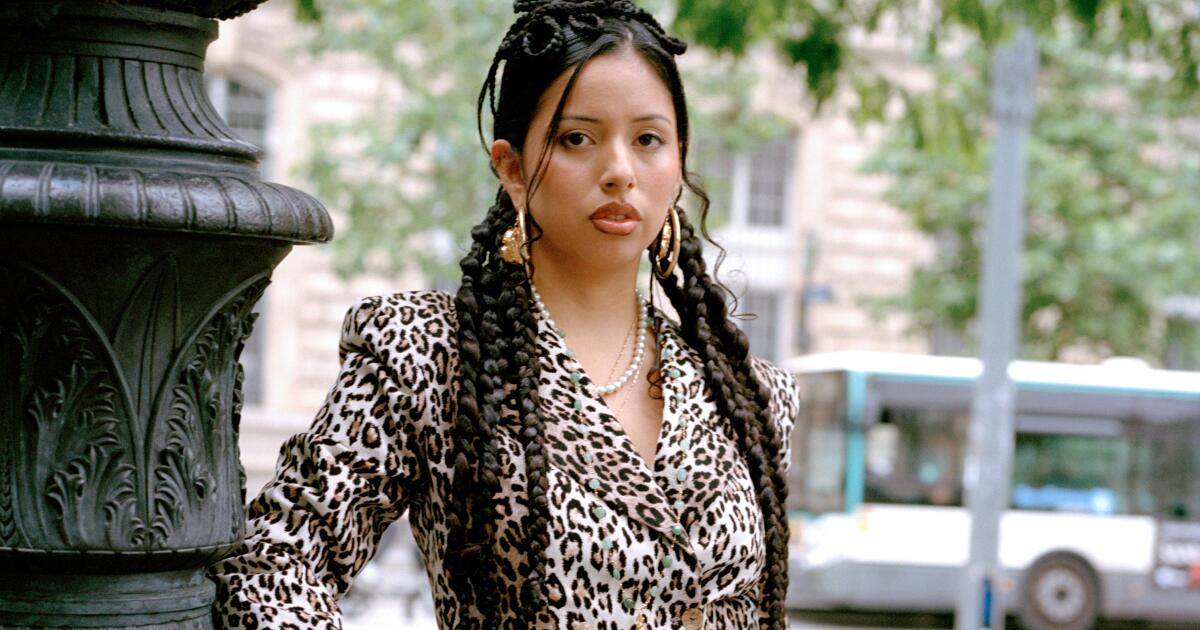

Claudia Rivera, a Peruvian-Parisian creative director and photographer, is known for building worlds in Paris that are colorful and communal, events that feel like a home away from home for the Latino community there. Rivera pulls up to Holy Grounds Coffee & Tea in El Sereno for our interview between L.A. meetings. She is wearing jorts, a subversive basic tank and fresh, jewel-encrusted nails done by @leslydidthem with rings on every finger. Her thick waist-length hair, an emblematic feature of her Peruvian identity, flows freely. Rivera’s projects and photography are also an intersection of her cultures, with details inspired by her family or community, who are often her greatest subjects and audience, infused with the energy and street style of her hometown, Paris.
Rivera organized the first monthlong Latino festival in Paris, Sabor Latino Month, by crowdfunding thousands of euros via other young Latinos in the city who were craving something like this, and eventually getting it sponsored by Adidas Paris. Her annual event, Ñañaykuna, which started in 2021, celebrates the community of Latina women in Paris by highlighting their work with music, dancing and food. One year, Rivera took portraits of all the participants in her signature warm style. Now, Rivera, who just launched her new creative agency Amaru, is working on a pop-up inspired by a mercado you’d find in a Latin American country, bringing a collection of Latino brands from around the world — including L.A.’s Amor Prohibido, Kids of Immigrants and Equihua — to Paris on Sept. 14-15, right before Fashion Week. “As a Franco-Peruvian girl, I grew up without clothes that represented me,” says Rivera. “Clothing is something that can help you represent yourself. It’s part of your personality.” The idea with the event, called Lo Nuestro, is to show the diversity among Latino-owned fashion brands.
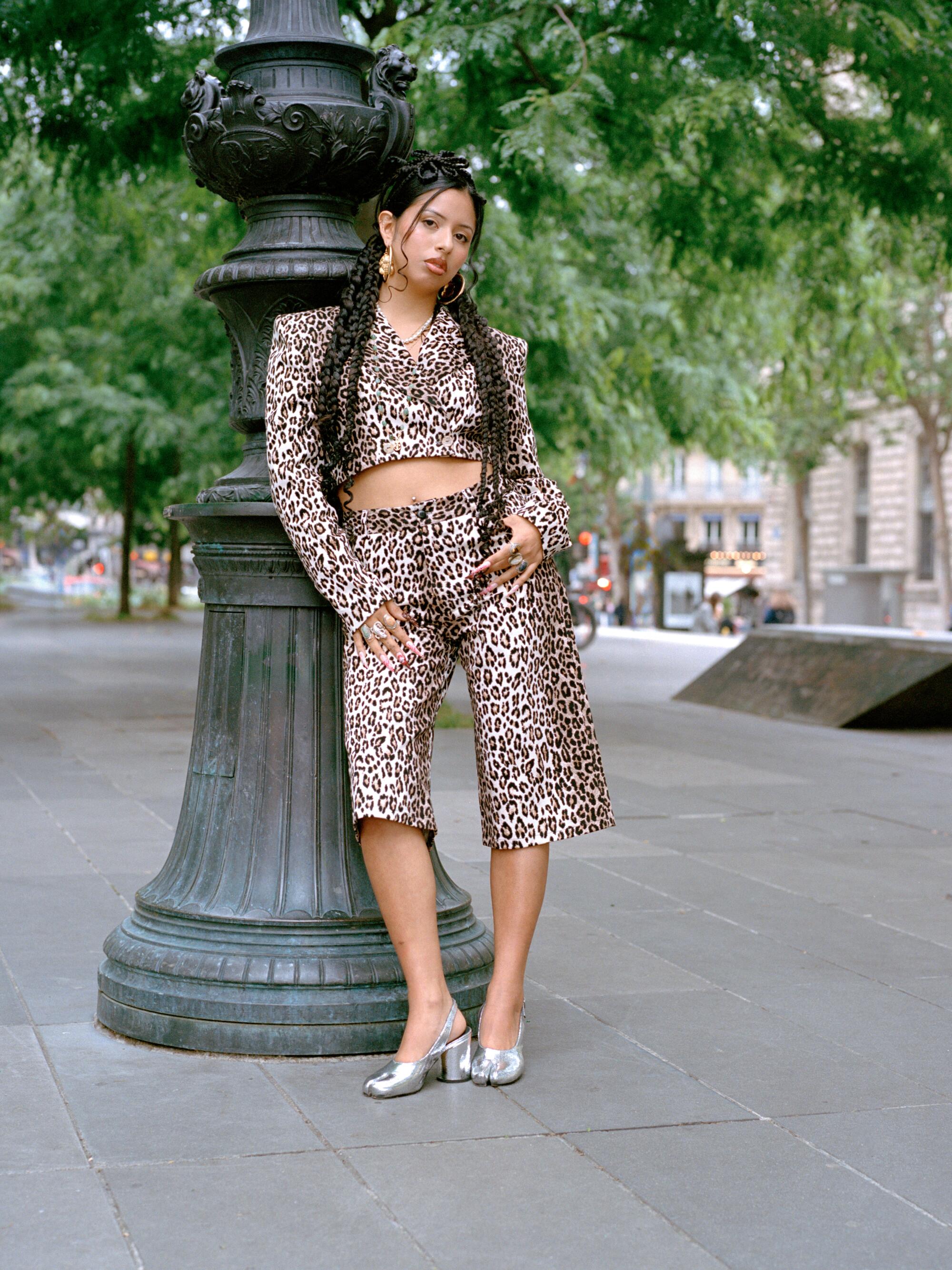
Claudia wears Roberto Sanchez animal print suit, Maison Margiela Tabi shoes, Shilita Créations jewelry.
“I was always checking the events in Los Angeles and it was my dream to be there and to see [that],” says Rivera. “I think being Latino here is very complicated because of everything. But there is also the privilege that you can live in a country where you exist, where your community is present. That’s what I want to do in my life: I want to create the space that I dreamed for when I was a kid. And I want this for the next generation. I want to show that we exist in Paris. To share our culture with the other communities.”
This is what Image Making means to me: Ever since I was a little, I’ve understood the power and importance of images. My parents were one of the first Peruvians to have papers in France. They came to France in the ’90s. In 2003, my dad went back to Peru for the first time in 10 years after he left for France. My dad went to visit the families of all of our Peruvian friends in France to film their homes, greetings from their families. When he came back, my mom cooked a big meal and everyone came over to our house. In 2005 I went to Peru for the first time — I was 5 years old. I started as a kid to take the camera y empezaba yo tambien a querer filmar. It’s not just the images but the process. To make the images, you also need to connect, to take time. Es un momento de care también. Las imágenes te ayudan a conectar el mundo, conectar tu comunidad, tu familia. I know that my family, to see me always taking pictures of our culture, they started to say, “OK, maybe this is something beautiful.” By taking the photos, I helped them to value their daily life. I feel that los archivos son muy importantes.
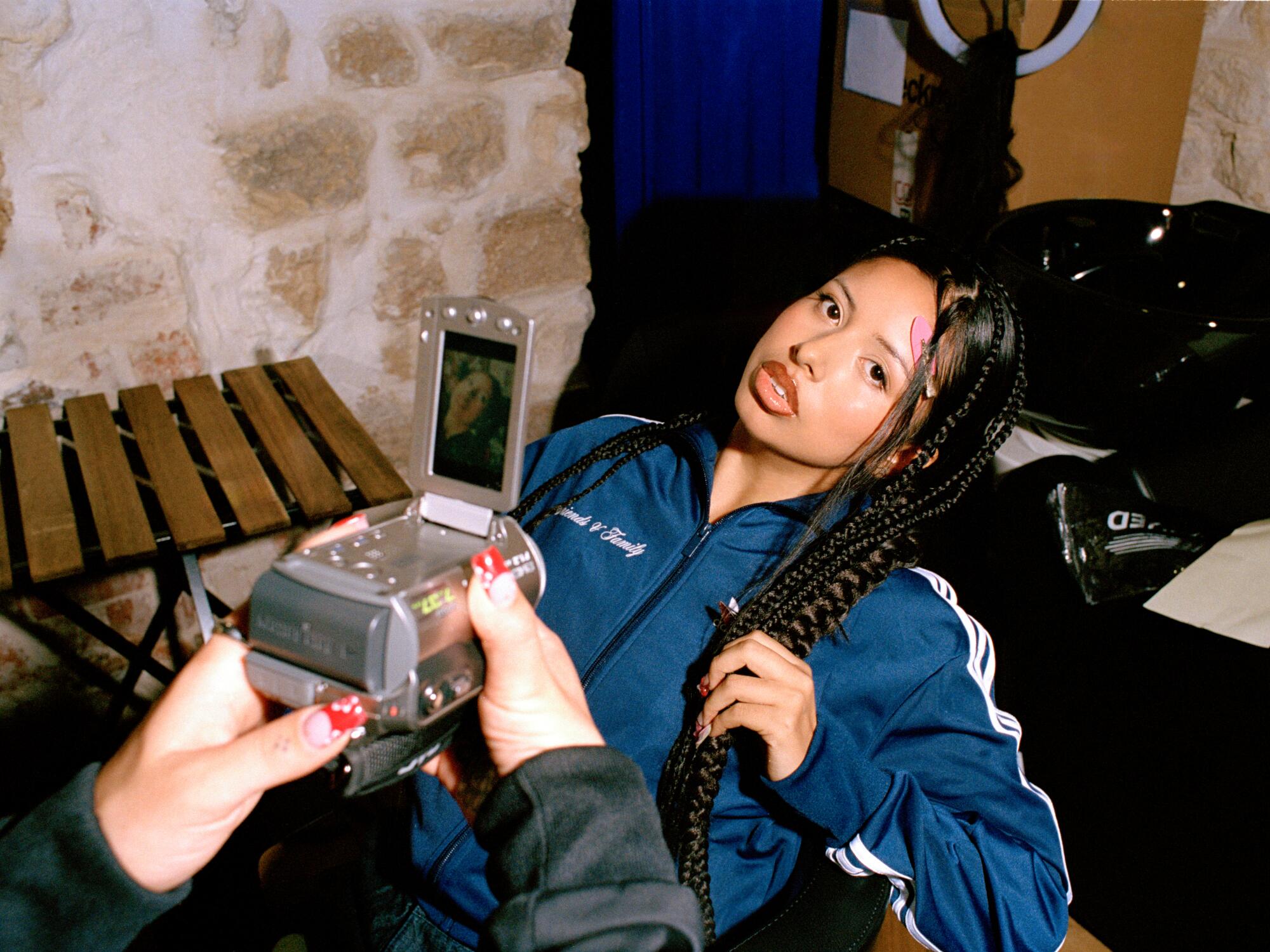
Claudia wears her own Adidas jacket.
What is the common thing or feeling that all of my work shares: El punto común es mostrar América Latina y highlight Latin American cultures. To tell our stories from our point of view.
My approach to personal style looks and feels like: I get very inspired by the culture of my family, but in the details. I started photography doing very colorful photos, with a lot of pink, a lot of orange, yellow, because these are the colors that are very present in traditional skirts in Peru. I include flowers in my work because flowers are present in the culture of my family. Hair is also very important for us.
What does my Paris feel like: I love Paris because it’s a city where there is a lot of diversity. It asks us to mix from all cultures. I feel very rich to have friends from all over the world. Growing up in Paris helped me understand Islam, other religions, other cultures from North African, South Africa, from Bangladesh. I have friends que vienen de todas partes del mundo. Compartimos mucho.
My work reveals about the city: It reveals that the Latino community exists [in Paris]. My projects don’t only interest people of the community — though of course they also like it porque es una expresión que we’ve always wanted to have — but there are also people from other communities that want to understand. And I think that’s a beautiful part of it: todos queremos abrirnos y entender las otras culturas.
Makeup Jade Benaim
Hair Santa Mari Juanna
Nails Alicia Faucher
Special thanks Cecile Armand, Hélène Tchen, Manon Guerby, Santa Mari Juanna Lab
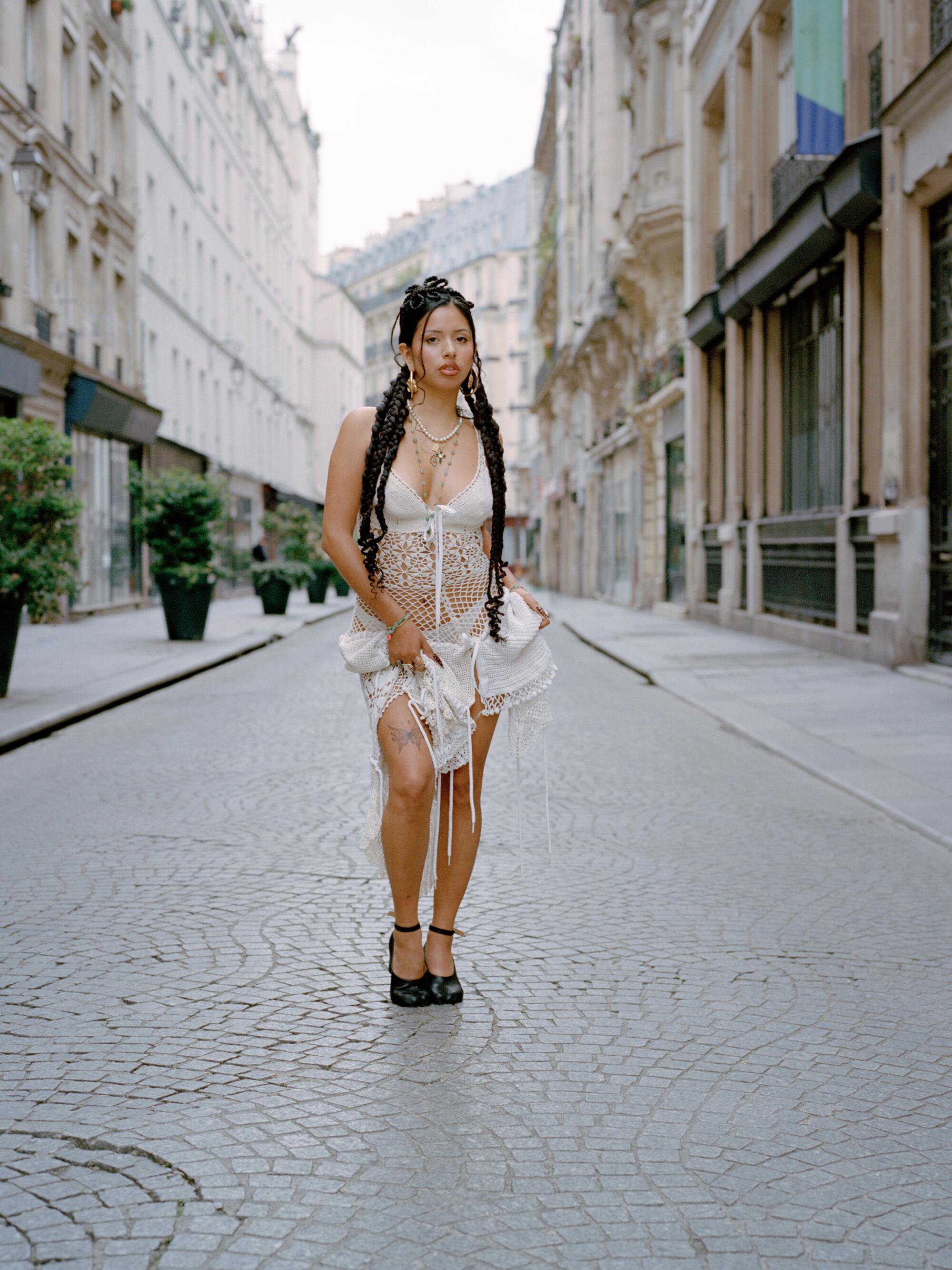
Claudia wears Gypsy Sport crochet dress, Maison Margiela Tabi shoes, Shilita Créations jewelry.




Under the glow of fluorescent lights at Seafood City market in North Hills, packages of pre-made adobo, salted shrimp fry and and dried anchovies glisten in meat coolers.
A DJ, dressed in a traditional barong, blasts a dance remix of Whitney Houston’s “I Wanna Dance with Somebody” as a crowd gathers to take a shot of fish sauce together.
“That was disgusting!” a man shouts into the mic, flashing a grimacing expression.

At Seafood City, DJs 1OAK, left, EVER ED-E and AYMO spin in barongs, the Philippines’ national formal shirt.
The smells of lechon and lumpia float through the air. Smiling children munch on halo-halo (a Philippine dessert made with ube ice cream, leche flan and shaved ice). Flags of the Philippines wave in the air as a man in UCLA Health scrubs hops into the center of an energetic dance circle. Employees shoot store coupons out of a money gun and toss bags of Leslie’s Clover Chips into the crowd. Fathers hold their children on their shoulders as a group of college students perform a Tinikling routine, a traditional Philippine dance in which performers step and hop over and between bamboo poles.
“This is so Filipino,” a woman says, in awe of the scene.

Sabria Joaquin, 26, of Los Angeles, left, and Kayla Covington, 19, of Rancho Cucamonga hit the dance floor at “Late Night Madness” in North Hills.
“I came here for groceries,” explains an elderly man, adding that he decided to stay for the party.
Seafood City, the largest Philippine grocery store chain in North America, typically closes at 9 p.m. But on certain Friday and Saturday nights, its produce or seafood aisle turns into a lively dance floor for “Late Night Madness.” On social media, where the gathering has exploded, it looks like a multigenerational nightclub that could use dimmer lighting. But for attendees who frequent the store, it’s more than that. It’s a space for them to celebrate their Filipino heritage through food, music and dance in a familiar setting.
“This is something that you would never expect to happen — it’s a grocery store,” says Renson Blanco, one of five DJs spinning that night. He grew up going to the store with his family. “My mom would [put] us all in the minivan and come here, and she’d let us run free,” he adds. “It’s comfortable here. It’s safe here.”
1

2

3

1. Rhianne Alimboyoguen, 23, of Los Angeles follows an employee through the produce section. 2. Allison Dove, 29, left, and Andrea Edoria, 33, both of Pasadena, enjoy Philippine street food. 3. Katie Nacino, 20, left, Daniel Adrayan, 21, and Sean Espiritu, 21, of the Filipino American Student Assn. at Cal State Northridge, practice tinikling, a traditional Philippine folk dance, in an aisle.
The first Seafood City location opened in 1989 in National City, a suburb of San Diego, which has a nearly 20% Asian population including a rich Filipino community. For its founders, the Go family, the mission was simple: to provide a market where Filipinos and people within the diaspora could comfortably speak their native language and buy familiar products. It’s since become a community anchor. Of the nearly 40 locations in Northern America, at least half of them are based in California, which has the highest population of Asian Americans in the United States.

-
Share via
The first “Late Night Madness” event happened in September in Daly City, Seafood City’s newest location. The company wanted to launch a street food program at the store’s food hall in a fun and creative way.
The DJ played a selection of hip-hop, pop, soul and classic Pinoy records like VST & Company’s “Awitin Mo, Isasayaw Ko.” Hundreds of people showed up, and videos of people of all ages turning up in the popular supermarket spread like wildfire. So the company decided to continue hosting the event in October during Filipino American History Month and for the rest of the year. It’s since expanded to more locations around the country and in L.A., including Eagle Rock.
By 10 p.m. at the Seafood City in North Hills, at least 500 people are dancing in the produce section, next to rows of saba bananas, fresh taro leaves and bok choy. The lively crowd forms dance circles throughout the night, taking turns jumping in the center to show off their moves to songs like Earth, Wind & Fire’s “Let’s Groove,” “Nokia” by Drake and Justin Bieber’s “I Just Need Somebody to Love.” At one point, TikToker and artist Adamn Killa hops on the mic and says “If you a Filipino baddie, this is for you,” before doing his viral dance.

Among the Philippine street food offerings were pandesal sliders, lumpia-style nachos, lobster balls and various skewers.
A group of employees dance behind the counter as they serve hungry patrons who fill their trays with various Filipino street food including pandesal sliders (soft Philippine bread filled with adobo, lechon or longganisa) and Lumpia Overload (think nachos, but a bed of lumpia instead of tortilla chips), lobster balls and barbecue chicken skewers. (No alcohol is served.) Meanwhile, a few lone shoppers sprinkle into the store to get their weekly groceries as music blasts through the speakers.
First-generation Filipino American Andrea Edoria of Pasadena says “Late Night Madness” reminded her of the family parties she attended as a child in L.A. and in Manila, where her parents are from.
“Growing up as a child of immigrants, I was kind of self conscious about displaying too much of my culture,” she says between bites of spiral fried potato. She went to the Eagle Rock event with her mother last month as well. “So it kind of fed my inner child to see so many people celebrating this shared culture and experience that we each grew up [with].”

A multi-generational crowd is drawn to the dance floor. At center is Jade Cavan, 44, of Chatsworth.

Members of the Filipino American Student Assn. at Cal State Northridge perform a tinikling performance.
She adds, “I think it’s so important especially now at a time where our country is so divisive and culture is kind of being weaponized, I think it’s a beautiful reminder that we can come together and find something that unites us.”
About 10 minutes before midnight, the grocery store is still bustling with activity. A dance battle breaks out and people begin hyping up the young women. The DJ transitions into slower tracks like Beyoncé’s “Love on Top” and Mariah Carey’s “All I Want for Christmas is You.” The remaining folks sing along loudly as they walk toward the exit, smiles imprinted on their faces. Staff rush to clean up, then huddle together for group photos to memorialize the evening.

After the final song is played, employees rush to clean up the supermarket.
Patrick Bernardo, 34, of Van Nuys looks at the counter, where a man had been chopping lechon, before stepping outside.
“There’s barely anything left on that pig,” he says, pointing to it as proof that the night was a success.

Trump admin sues Illinois Gov. Pritzker over laws shielding migrants from courthouse arrests

New Wegovy pill offers needle-free weight loss — but may not work for everyone

NFL reporter responds to fake death rumor in hilarious fashion: ‘Glitch in the matrix’

Android Sound Notifications help you catch key alerts
Kevin Costner’s western ‘Horizon’ faces more claims of unpaid fees

Florida High School Football Rankings: Top 25 teams – Oct. 21

Cleary's 21 help Le Moyne down Central Connecticut State 69-64 in OT

How old is Bo Nix? What to know about Oregon quarterback ahead of 2024 NFL Draft

99th annual Pony Swim held in Virginia

Video: ‘It Didn’t Have to Happen This Way:’ U.Va. Faculty Call for Review of Police Response to Protests
Trump admin sues Illinois Gov. Pritzker over laws shielding migrants from courthouse arrests

Europeans show solidarity with Denmark after Trump’s Greenland threat

Explosion at a Pennsylvania nursing home kills at least 2, governor says

What does Christmas look like for Ukraine? | Global News Podcast
404 | Fox News
-

 Iowa1 week ago
Addy Brown motivated to step up in Audi Crooks’ absence vs. UNI
-

 Maine1 week ago
Elementary-aged student killed in school bus crash in southern Maine
-

 Maryland1 week ago
Frigid temperatures to start the week in Maryland
-

 New Mexico7 days ago
Family clarifies why they believe missing New Mexico man is dead
-

 South Dakota1 week ago
Nature: Snow in South Dakota
-

 Detroit, MI1 week ago
‘Love being a pedo’: Metro Detroit doctor, attorney, therapist accused in web of child porn chats
-

 Health1 week ago
‘Aggressive’ new flu variant sweeps globe as doctors warn of severe symptoms
-

 Maine7 days ago
Family in Maine host food pantry for deer | Hand Off