Science
Martin Karplus, Chemist Who Made Early Computers a Tool, Dies at 94


Martin Karplus, a Nobel Prize-winning theoretical chemist who used computers to model how complex systems change during chemical reactions, a process that has led to advances in the understanding of biological processes, died on Dec. 28 at his home in Cambridge, Mass. He was 94.
His wife, Marci Karplus, said he died while recovering from a fall in which he broke a femur.
Over his long career, Dr. Karplus had crossed paths with some of the most important scientists of the 20th century, including Linus Pauling and J. Robert Oppenheimer.
Scientists can control the chemicals in a reaction, and they can measure and evaluate the results, but what happens in between is a mystery.
As Sven Lidin, chairman of the Nobel selection committee explained when announcing the 2013 winners in chemistry: “It’s like seeing all the actors before Hamlet and all the dead bodies after, and then you wonder what happened in the middle. And actually, there is some interesting action there, and this is what theoretical chemistry provides us with — the whole drama.”
Beginning in the 1960s, when computers were only a fraction as powerful as today’s smartphones, Dr. Karplus and his fellow Nobel laureates — Michael Levitt, originally from South Africa, and Arieh Warshel, who was born in Israel — began to build virtual models of molecules to understand what happens to them during complex reactions like photosynthesis and combustion.
The models used classical Newtonian physics to predict how multitudes of atoms and molecules move during reactions, and they used quantum physics to describe how chemical bonds are broken and formed during those reactions. This type of analysis proved particularly useful in understanding biological reactions involving enzymes, the proteins that govern chemical responses in living organisms.
There was initial resistance to the scientists’ work because it was difficult for others to accept that computer models could be accurate enough or could sufficiently account for the many variables in some reactions. But by the time the Nobel Prize was awarded in 2013, that skepticism was gone.
“Today, the computer is just as important a tool for chemists as the test tube,” the academy wrote in its announcement. “Simulations are so realistic that they predict the outcome of traditional experiments.”
At Harvard University, where Dr. Karplus spent most of his career, he and his research team in 1983 created a program for simulating molecular interaction, calling it Chemistry at Harvard Macromolecular Mechanics (CHARMM). The program is available to researchers worldwide.
In the late 1950s, Dr. Karplus made another important contribution to chemistry: He developed what is known as the Karplus equation. It makes it possible to calculate the magnitude and orientation of protons in organic compounds involved in nuclear magnetic resonance spectroscopy, allowing chemists to study the arrangements of atoms in molecules. It is now a basic part of chemistry education.
Martin Karplus was born on March 15, 1930, in Vienna into a well-off and intellectually accomplished Jewish family. He was the second son of Johann Karplus, a banker, and Isabella (Goldstern) Karplus, a hospital dietitian.
His paternal grandfather, Johann Paul Karplus, was a neurologist who discovered the functions of the hypothalamus, the crucial brain region that controls body temperature, hunger, heart rate and other vital activities. An uncle, Eduard Karplus, was an engineer and inventor. And Martin’s older brother, Robert, became a theoretical physicist at the University of California at Berkeley.
In the face of rising antisemitism in the 1930s and a few days after Nazi Germany annexed Austria in the Anschluss of March 1938, Martin, his brother, and his mother fled to Zurich and then to France, eventually arriving in Le Havre.
Martin’s father was initially imprisoned in Vienna, but he was able to join the family before they set sail for New York. They arrived on Oct. 8, 1938, and soon after moved to Newton, Mass.
At Newton High School, Martin discovered that his older brother had made such a mark there that many teachers doubted Martin’s ability to do as well, he recalled in a Nobel biography. One teacher, who was in charge of the Westinghouse Science competition, the nation’s top talent search in the sciences, told Martin that it would be a waste of his time to enter.
But he found another teacher who was willing to proctor his test for the competition. He went on to qualify as one of the country’s 40 finalists. Martin’s project on alcids, an aquatic bird, was chosen as the co-winner of the competition, after which he met President Harry S. Truman in Washington.
Accepted to Harvard University, he concentrated on chemistry and physics. As he was finishing his undergraduate degree in 1950, both the University of California at Berkeley and the California Institute of Technology, known as Caltech, accepted him for graduate studies.
Unsure where to go, he visited his brother, Robert, who by then was working at the Institute for Advanced Study in Princeton, N.J. Robert showed him around, introducing him to Albert Einstein and J. Robert Oppenheimer, who had led the Manhattan Project that developed the atomic bomb and who had become the institute’s director. Dr. Oppenheimer recommended Caltech, where he had been a professor, calling it “a shining light in a sea of darkness,” according to Dr. Karplus’s biography. Decision made.
At Caltech he focused on biophysics, joining a graduate group led by Max Delbrück, who, along with Salvador E. Luria, had proved that Darwin’s theory of evolution also applied to bacteria. They, along with Alfred D. Hersey, would be awarded the Nobel Prize in Physiology or Medicine in 1969 for their work.
As Dr. Karplus wrote in his Nobel biography, a turning point in his life came two months after he started at Caltech. Dr. Delbrück suggested that Dr. Karplus present a seminar on his intended area of research: how vision works.
He began his presentation, but after 10 minutes Dr. Delbrück interrupted him to say that he did not understand what Dr. Karplus was saying. Dr. Karplus began anew, and Dr. Delbrück interrupted again, saying he still did not understand. Dr. Karplus began again, and Dr. Delbrück interrupted a third time.
At this point, Dr. Richard Feynman, who was awarded the Nobel Prize in Physics in 1965 and who was sitting in the audience, turned around and said to Dr. Delbrück: “I can understand, Max. It is perfectly clear to me.” Dr. Delbrück turned red and stormed out. Later that day, he called Dr. Karplus to his office and told him that he could no longer work with him.
Dr. Karplus switched to chemistry.
In the chemistry department, Dr. Karplus initially worked with Prof. John Kirkwood, but then Dr. Kirkwood left for Yale University. His graduate students were given the chance to switch to working with Linus Pauling. Only Dr. Karplus accepted.
Dr. Pauling was on the short list of the greatest scientists of the 20th century. He was one of only five people to receive two Nobel Prizes: the first in 1954 for chemistry, for determining how atoms are chemically bound in molecules; and the second, the Nobel Peace Prize, in 1962, for promoting nuclear disarmament. His scientific work led to the founding of quantum chemistry and molecular biology.
Dr. Karplus’s time with Dr. Pauling proved fruitful: He finished his doctoral dissertation just before Dr. Pauling departed on a trip in late 1953. Dr. Karplus, who had received a National Science Foundation postdoctoral fellowship, then left to spend two years at Oxford University.
In 1955, he was hired by the University of Illinois, which was doing advanced work on nuclear magnetic resonance (NMR) spectroscopy. It was during his five years in Illinois that he put together his Karplus equation.
In 1960, Dr. Karplus was hired to be a researcher at the IBM Watson Scientific Laboratory and to teach at Columbia University. With access to state-of-the-art computing power, he continued his research on NMR and also began to investigate creating models to explain chemical reactions.
Dr. Karplus changed jobs again in 1966, returning to Harvard. There he started to concentrate on biological reactions, which are the most complex. The work would lead to the creation of CHARMM and to his Nobel Prize.
In the 1990s, Dr. Karplus was appointed a professor at Louis Pasteur University, later renamed the University of Strasbourg, in France. He spent the next 20 years going back and forth between there and Harvard.
Dr. Karplus met Marci Hazard at Harvard, where she has worked for 51 years. They married in 1981. His first wife was Susan Karplus; their marriage ended in divorce.
In addition to his wife, he is survived by two children from the earlier marriage, Reba and Tammy; one child from his second marriage, Mischa; and one grandchild. (Susan Karplus died in 1982. His brother, Robert, died in 1990.)
In 2020, Dr. Karplus published his autobiography, “Spinach on the Ceiling: The Multifaceted Life of a Theoretical Chemist.” The title referred to the landing spot of a launched spoonful of spinach that he had been ordered to eat as a boy.
Over his career, Dr. Karplus supervised close to 250 graduate and doctoral students, most of whom have gone on to successful academic careers. They are collectively known as Karplusians.



Few substances are as deeply woven into everyday life as alcohol. It is a fixture at holiday celebrations, work-related social gatherings, sporting events, airports, and brunch or dinner tables. All demonstrate how deeply alcohol has become embedded in social customs and cultural traditions.
Yet alcohol contributes to millions of deaths globally each year and is linked to cancer, liver disease, unintentional accidents, violence and, importantly, dependence and addiction. Despite this, the disconnect between alcohol’s cultural role and its serious health burden is striking. An estimated 2.3 billion people worldwide consume alcohol.
As a physician working in addiction medicine, I regularly care for patients whose alcohol use affects nearly every organ system. It is often not until these patients end up admitted to the hospital that they learn the effects of alcohol on various parts of their body besides their liver.
Newer evidence challenges assumptions about what was long considered “safe drinking.” Even moderate drinking carries risk and is not as harmless as people, including experts, once thought.
Many people associate alcohol risk primarily with addiction or dangerous behaviors such as driving while intoxicated. However, its effects extend far beyond this, into nearly every aspect of a person’s well-being.
While alcohol may transiently improve mood and ease social anxiety, long-term alcohol use can lead to a worsening of mood, cognition and sleep, which can further compound use.
A 2021 literature review found that consuming approximately two standard drinks roughly doubles the odds of sustaining injuries — with or without a vehicle involved. The review also found that heavy episodic (binge) drinking can increase the risk of injury by 50-fold, depending on the amount of alcohol consumed and the type of injury. While alcohol’s effects on the liver are well known, it can also lead to gastrointestinal complications and heart disease
The World Health Organization estimates that 2.6 million deaths each year are attributable to alcohol, accounting for nearly 1 in every 20 deaths worldwide.
While many people recognize the risks of alcohol addiction, people are generally much less aware of the links between alcohol use and cancer risk.
The World Health Organization classifies alcohol as a Group 1 carcinogen — the same category as tobacco and asbestos. In 2025, the U.S. surgeon general emphasized that alcohol increases the risk of at least seven cancers, including cancers of the breast, colorectal, liver, oral, esophagus and larynx. An advisory called for updated warning labels.
Yet fewer than half of Americans recognize alcohol as a risk factor for cancer, particularly for cancers such as breast cancer that are not commonly associated with alcohol use.
Throughout the 1990s and early 2000s, observational studies suggested that moderate alcohol consumption might offer cardiovascular benefits. Over the past decade, however, higher-quality studies have challenged these findings, suggesting that much of the apparent benefit may have reflected differences in the health and lifestyles of moderate drinkers rather than a protective effect of alcohol itself.
Current evidence increasingly suggests that even low levels of alcohol may increase cancer risk.
Federal guidelines acknowledge that adults should “consume less alcohol for better overall health.” However, the most recent version of the “Dietary Guidelines for Americans,” updated in January, removed the previous recommendation to limit intake to no more than one drink per day for women and two for men. It also omitted explicit discussion of alcohol’s links to cancer.
These changes have drawn criticism from public health experts, who argue that the revised language plays down the growing evidence of alcohol-related harms and provides less specific guidance to consumers. The current administrator of the Centers for Medicare & Medicaid Services characterized alcohol as a “social lubricant” that brings people together, rather than emphasizing its well-established health risks.
This may be true physiologically, at least temporarily, but obscures the fact that relying on it as a social lubricant can lead to chemical and psychological dependency. In my view, statements to that effect are shortsighted, prioritizing short-term social effects over more insidious and long-term issues, including addiction.
While many dangerous mind-altering substances are hidden from public perception, alcohol is often placed at the center of it – a trend that shows no sign of changing imminently.
Further, large companies often profit from ads that appeal to young people.
Looking back at the history of tobacco smoking provides some helpful insights. In 1965, 42.4% of the U.S. population smoked. By 2022, that figure had dropped to 11.6%.
This steep decline did not happen because of a single intervention, but through decades of accumulating scientific evidence, public education campaigns, warning labels, restrictions on advertising, smoke-free policies, higher tobacco taxes and shifts in social norms. Together, these efforts transformed smoking from a widely accepted social behavior into one broadly recognized as a major health risk and correspondingly, less socially accepted.
Although alcohol consumption has modestly declined in recent years, it remains deeply embedded in social life in ways cigarette smoking no longer is.
People often assume that if a substance is legal, common and widely socially accepted — even encouraged — it must also be safe. But public health history suggests those assumptions can and should change.
Emma Fenske is an addiction medicine fellow and internal medicine physician at Oregon Health & Science University. This article was produced in partnership with the Conversation.
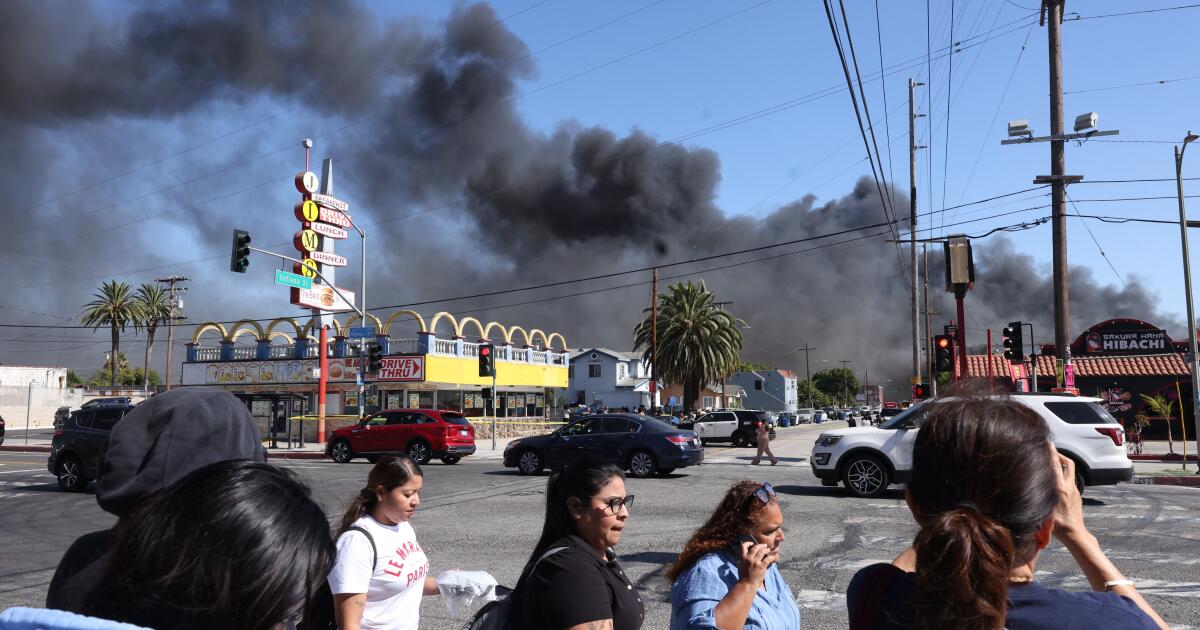
The air near the Lineage refrigerated warehouse fire in Boyle Heights carried astronomically high levels of smoke and soot, surpassing some of the worst air pollution during the Los Angeles County fires in January 2025, according to preliminary data from air officials.
The fire spewed thick black smoke for days. From downtown Los Angeles to the San Gabriel Valley, tens of thousands were enveloped in unhealthful levels of smoke, even as some local officials told residents that the air posed no danger.
As the days wore on, worst off were communities nearest the blaze. On June 19, three days after the facility ignited, a temporary air quality monitoring station at Eastman Elementary in unincorporated East Los Angeles measured an extremely hazardous 755 micrograms per cubic meter of fine particles for more than an hour, according to the South Coast Air Quality Management District.
For comparison, a Caltech air monitor in Pasadena recorded about 650 micrograms per cubic meter during the Eaton fire.
These high levels of fine particles, known as PM 2.5, probably resulted in the surge of residents into local emergency rooms during the fire, according to local health officials. But even now with the smoke gone, people still have not been told what chemicals they were breathing in during the weeklong ordeal.
Michael Jerrett, an environmental health professor at the UCLA Fielding School of Public Health, said his concern is the composition of materials emitted when the building burned.
“These contain many particularly toxic components,” Jerrett said, “and we know little about how these mixtures affect health.”
There is no completely safe level of fine particulate pollution, he noted, meaning higher concentrations are always worse.
During the 2025 L.A. County fires, local air officials announced that several monitors downwind had detected elevated levels of brain-damaging lead and cancer-causing arsenic from toxic paint and construction materials used in older homes.
The Lineage warehouse, built in 2018, is likely to contain different materials of concern. Thick insulation foam required for a massive refrigeration operation, solar panels and refrigerants were burned, leaving many residents on edge.
Even though three public agencies conducted air monitoring, the picture is still murky.
“[Public officials] are speaking with a lot of confidence but not a lot of information,” said mark! Lopez, a community organizer with East Yard Communities for Environmental Justice. “We’ve gotten in the room with folks to discuss where the gaps lie and where assumptions are being made. And I think they are realizing these agencies supposed to protect our air and our health aren’t as reliable as they thought they were.”
In response to the Boyle Heights fire, the South Coast air district deployed a mobile monitoring vehicle to screen for toxic substances in the community near the fire, according to Nahal Mogharabi, a spokesperson for the air district. It found increased levels of bromine, a chemical commonly found in fire retardant, and chlorine, often released from burning plastic. Both were below short-term health-based exposure thresholds.
Toxic metals, including lead and arsenic, were not elevated, according to air district data.
“That was the reassuring piece, that they were not picking up any of the metals,” said Dr. Nichole Quick, chief medical advisor for the Los Angeles County Department of Public Health. “But … that smoke is unhealthy. “You don’t want to be breathing it, regardless.”
The U.S. Environmental Protection Agency set up air monitors around the perimeter of the facility to test for toxic air contaminants, has the results and has not made them public. Julia Giarmoleo, an EPA spokesperson, said the monitors did not detect elevated metals, but would not provide a copy of the data without a federal records request.
The Los Angeles Fire Department’s hazardous material team also tested for ammonia, which is used in refrigeration, and hydrogen fluoride, a toxic chemical that could be released by burning lithium-ion batteries and solar panels.
Fire officials previously said they measured low levels of hydrogen fluoride on the second day of the fire. But the department would not answer questions about its air monitoring. It also told a reporter to submit a public records request.
It remains unclear whether any agency has tested for hydrogen cyanide or isocyanates, highly toxic gases that could be released from burning chemical-laden insulating foam inside the building.
“The real issue is what monitoring has not been done to protect the fence-line community from the air toxics,” said Jane Williams, executive director of California Communities Against Toxics.
Without the EPA or LAFD data, what is known of the smoke’s toxicity rests on the air district’s mobile monitoring.
Jerrett, the UCLA researcher, said that is not ideal for understanding the kind of plume released by the Boyle Heights fire, which rapidly changed direction with the wind.
“This can in some instances lead to levels that look low, but they are resulting from a mismatch between the location of the vehicle and the plume,” he said.
The Boyle Heights blaze, similar to the Eaton and Palisades fires, has revealed the region’s air monitoring can’t always tell people what they’ve been exposed to in a disaster.
“We do need a better monitoring system in place,” he said.
Local officials are now shifting their focus to the rancid odors from millions of pounds of rotting food in the ruined wing of the warehouse. Decomposing food can release hydrogen sulfide, a toxic gas synonymous with landfills and garbage. Lineage hired contractors who are measuring this noxious gas and other pollution. Their data indicate they have not detected hydrogen sulfide.
As Lineage workers haul the rotting food to local landfills, they are using deodorizing mist and have discussed using shrink wrapping to suppress the stench and minimize issues for nearby homes.
At this point, the odors are believed to be an inconvenience rather than a public health threat, according to Quick, the county medical advisor. She said running air purifiers may help to reduce odors indoors.
“It’s very important for folks to understand that the odors themselves do not indicate any dangerous levels of toxins, mold, bacteria, and so forth,” Quick said. “But the odors are a public nuisance.”
The air district is still encouraging residents to report odors to its online complaint system or by calling (800) 288-7664.

Federal employees who were axed during waves of cuts by the Trump administration have fought back against the dismantling of a key climate science website, Climate.gov, and put up a new site, Climate.us, that can now do everything the original did.
The site, with millions of users each year, was known for colorful charts that anyone could freely download and that simplified giant sets of data, such as temperature readings. Now it refers to another page and is no longer being updated.
Daniel Swain, a UC Agriculture & Natural Resources climate scientist, called the resources available at Climate.gov “the most efficacious dollars spent by NOAA on public-facing science, possibly ever.” He has used graphics from the former website on his popular weather blog.
“I am a terrible artist or illustrator. It would be very bad if I had to create those on my own.” Swain said. The website didn’t just make graphics that were beautiful, he said, they were accurate and reliable because of the network of researchers who fact-checked them.
Rebecca Lindsey was the editorial lead and program manager for Climate.gov until February 2025, when her position at the National Oceanic and Atmospheric Administration was eliminated by the Elon Musk-led Department of Government Efficiency, or DOGE. She explained that the online resource was “a bridge between scientists, data and the public.”
Lindsey and her team have now rebuilt the bridge piece by piece, if just a bit further downstream.
The team is made of the same editorial and technical staff that ran Climate.gov. It’s paid for through a crowdfunding campaign and one large, anonymous donation.
The group has raised some $380,000, about $100,000 of which came in the last week. They also have recruited 80 scientists who are willing to volunteer as subject matter experts and fact checkers. It’s enough to keep the work going through February while they seek more long-term funding.
The first iteration of Climate.us went online in 2025 to keep the last 15 years of work from the government website available. The newest version restores the full function of the previous website.
For Californians, the timing could be important.
“We’re headed for a very strong El Niño event that will have significant implications for Southern California,” Swain said. “Climate.gov and the scientists behind it did a great job walking people through the last one, and I would expect that’s the case this time as well.”
Climate.gov excelled at tapping into a pool of academic experts to explain what was happening in nearly real time. This allowed the public to see how events such as wildfire, drought or large weather patterns such as El Niño were shaping their lives when they needed the information most. Research from academic institutions, by contrast, can take years to publish results from major natural disasters.
Swain emphasized that cuts to resources that give context to hard-to-interpret data is not just a loss for the research community.
“It’s getting more and more difficult for the American public to access the science and the scientists that their tax dollars have supported for over half a century,” he said.
With the revival of Climate.us, Swain said he plans to directly use the site and its graphics to keep Californians connected to the world of climate science.
-

 Virginia4 minutes ago
Virginia nonprofit Urban Baby Beginnings to receive $5K grant for Nexstar’s ’30 Days of Giving’
-
 Washington11 minutes ago
Review: Our critic cannot tell a lie: ‘Young Washington’ is the dullest of history lessons
-

 Wisconsin14 minutes ago
Swatting call caused temporary lockdown at Rice Lake, Wisconsin health clinic
-

 West Virginia26 minutes ago
‘We cannot wait’: West Virginia Dems call for special session to address school funding
-

 Wyoming29 minutes ago
Election Q&A: Scott Smith for Wyoming state treasurer
-

 Crypto34 minutes ago
Senate Urged to Vote on CLARITY Act Before August Recess as Lawmakers Return July 13
-

 Finance41 minutes ago
New questions about Trump’s taxes after financial disclosure release
-

 Fitness44 minutes ago
Our Editors Found the Best Fitness Deals—Save Nearly 50% on Home Gym Equipment

