Lifestyle
I stopped driving on L.A.'s chaotic freeways. How do I get over this painful anxiety?

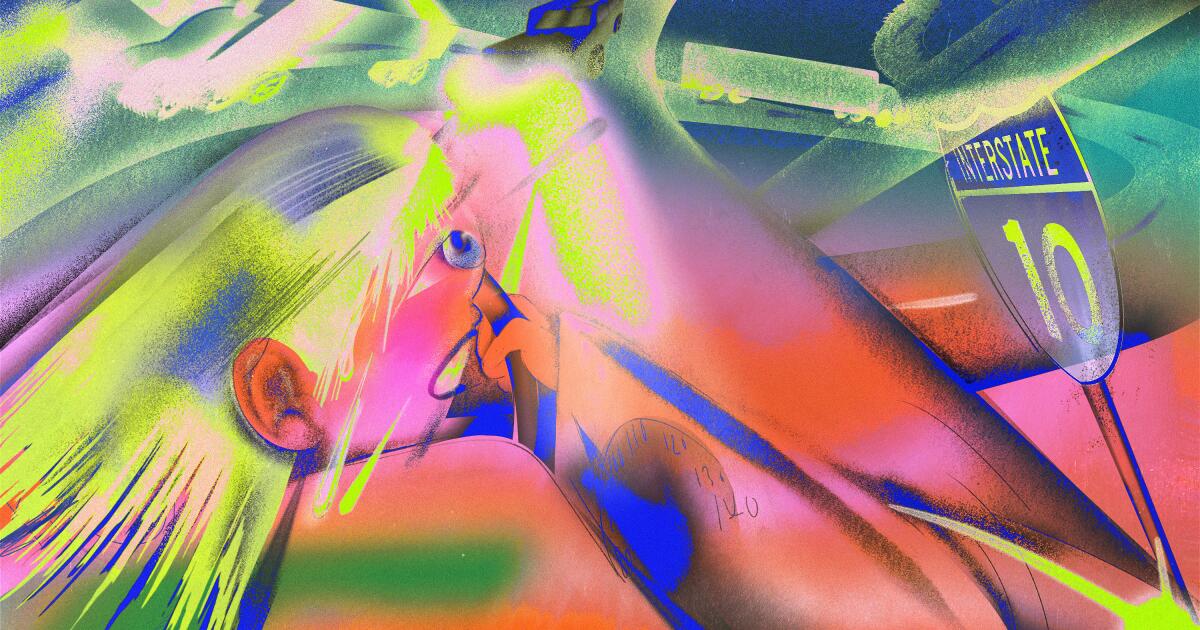
My New Year’s resolution this year is simple. This weekend — my first back in L.A. after visiting family for the holidays — I will drive to the 101 freeway entrance by my house and I will … get on it.
Simple as that. But far easier said than done.
I haven’t driven on the freeway in more than two years — I’ve been too afraid. I’ve rarely even ridden as a passenger on the freeway, with someone else behind the wheel, and when I do, I sit on my hands so my fingers won’t tremble.
Fear of driving on the freeway is hardly uncommon — and for good reason. Headlines reporting fatal accidents and police pursuits ending in deadly crashes are more commonplace than ever in L.A.
But here’s the thing: It’s an entirely new phenomenon for me. Living in Los Angeles as a journalist, I’ve fearlessly traversed the city’s vast thicket of freeways for decades. My work took me from the mountains to the desert to the sea. Years ago, I dated someone in San Diego and endured the three-hour drive on the 5 south every other Friday for about a year. And all with relative ease.
So what changed? My brain, basically.
The pandemic was rough, in infinitely varied ways, for everyone. For me, on top of the stresses of the public health crisis and its myriad economic and social repercussions, I experienced a series of losses in succession, sometimes with just weeks between them. And it didn’t let up for about two years. My grief manifested on the freeway, where I’d have small, then more pronounced, panic attacks — something totally new to me.
Here’s what happened: In early 2020, a sibling of mine tragically died. Later that year, my partner and I broke up. We’d been together for several years and it was a significant loss. This was in the early days of the pandemic, when many of us were wiping down our groceries and staying inside for days on end. I was doing that too, but now alone in my apartment.
I don’t have children but my cats provided comfort during that period. (For some of us, our pets are our kids.) Then they both died too, one after the other — unexpectedly. The first, only 8 years old, suffered a violent and painful death. My second cat, much older and more fragile, witnessed it and became so anxious afterward that she got sick and passed away only months later.
The silence in my home, after that, was unsettling: no scritch-scratching of claws on hardwood floors or chomping of kibble in the background as I pecked away at my keyboard writing articles. I’d sip coffee in the mornings, taking some comfort in the lush view of the greenery on my deck. Until nearly all the plants died in a heatwave.
Then my parked car was smashed during a hit-and-run. Insurance paid to fix it. But then the car was targeted by catalytic converter thieves. Again, insurance covered the repairs. But when, several months later, the thieves struck again, my insurance company declared the 14-year-old Honda a total loss.
When the tow truck came to haul my car away, I fell into the driver’s burly arms and cried. I’d had that trusty, beat-up Honda longer than any romantic relationship, and at that moment, it felt like all I had left.
Given this sustained succession of emotional gut punches, my central nervous system was on high alert. A car door would slam outside and I’d jump, my body bracing tensely: “What next?”
That feeling manifested — exaggeratedly so — driving on the freeway. I held it together in all areas of my life, but the freeway became a release valve for my pent-up grief. Instead of seeing the big picture while driving, getting into the flow of traffic, I saw too much detail. The freeway was a dangerous, kinetic collage of spinning wheels and whirling, sparking hubcaps and rectangular hunks of metal flying forward, any piece of which, at any instant, could crash into me. It was like at the start of a billiard game, when the cue breaks the racked balls with a fiery crack, sending the multicolored striped and solid orbs flying in all directions. That’s how I saw traffic. Panic.
The freeway was a dangerous, kinetic collage of spinning wheels and whirling, sparking hubcaps.
The lane I was driving in felt constricting and narrow; trucks on either side of me felt hulking and ominous. My jaw clenched, my breath quickened, my teeth chattered. And my heart pounded in my chest.
It wasn’t a choice so much as survival — I could not drive, safely, on the freeway anymore. I made adjustments, slipping like water around rocks. I changed my Waze settings to “avoid freeways” and took surface streets everywhere instead. I took Ubers or carpooled with friends if the drive was too long on surface streets. If headed especially far, I took a train.
I should add that I don’t particularly like to drive. Nor would anyone close to me say I’m good at it. Before L.A., I’d only lived in walkable cities with active public transportation systems: Philadelphia, San Francisco, Tokyo, Boston. But I certainly never feared driving.
And for those who have always feared freeway driving, it’s understandable. Traffic-related deaths in Los Angeles have been on the rise in recent years, at their highest point in two decades. In 2022, 312 people died in traffic accidents, according to the Los Angeles Police Department’s most recent data. That’s a 5% jump from 2021 and a 29% jump from 2020.
Perhaps the most disconcerting part was that my newfound freeway phobia sparked something of an identity crisis: I am not a fragile or fearful person. I take risks, I speak up for myself, I have a sense of agency. I don’t recognize this new, tentative version of myself. I’m confused by her, ashamed. Who is she? How do I get back to the self I identify with? Does she even still exist?
I’ve since healed from those aforementioned losses and am feeling infinitely revived in my personal life. New cats, new boyfriend, new car. But, oddly, the freeway fear has stuck.
“It’s such a normal human impulse when you’ve gone through tragedy and loss,” says L.A. author and psychotherapist Claire Bidwell Smith. “You’re seeing the world through a lens where the unexpected looms around every corner and something catastrophic can happen at any moment. Your life was going along and then: Bam! Bam! Bam! You’re scrambling to hold onto something, so you hold onto ‘How can I predict this, control it in some way?’ But we can’t control the world in the way we would like to, so we get stuck in this catastrophic place.”
Panic attacks in cars are especially common, Bidwell Smith adds. Her theory? “The car is a space where you’re often alone, a quiet private space, and all these thoughts, some of the stuff we’ve been pushing away, start to gurgle up.”
I haven’t talked openly about my freeway phobia much, not even to family. Until recently — and nearly everyone I’ve spoken to about it had experienced something similar or knew someone who had. I was at dinner recently with two journalist friends. One of them said she developed flying anxiety after her father died, something that dissipated over time. The other said her sister in Toronto developed a fear of driving on the freeway after their father died — she still hasn’t gotten over it.
Bidwell Smith says that after her own parents died, she developed a fear of flying and became fixated on her health. A client developed a fear of riding on elevators after his wife died.
How many more people are there like us in L.A.?
“It’s very common,” says Sarah Caliboso-Soto, director of the Telebehavioral Health Clinic at USC’s School of Social Work, which provides counseling for driving anxiety among other mental health issues. “Grief itself can be a very traumatic experience, and when people are driving, in particular, their senses are more heightened. And you can experience anxieties as a result.”
My period of avoiding freeways wasn’t all bad. I traversed neighborhoods I’d never otherwise pass through in L.A., gaining a better understanding of how the city connects. I got lost plenty, on zigzaggy Waze routes, but that had its upsides too. I stumbled on a collection of street murals, on remote side streets, in the downtown L.A. warehouse district. I found an available apartment for rent, for a friend, in Jefferson Park, a gem of a neighborhood filled with old Craftsman homes. I stopped several times for roadside fruit at different points around the city, wolfing down chili-spiked mango, drenched in lime juice, from behind the wheel.
But I long for my freedom again, to be unhindered by an emotional impediment. I miss the person I once was and ache to embody her again. It may not happen all at once; likely it will be a slow process, one freeway ramp at a time.

Lifestyle
DLTA’s former Ace Hotel is reborn as a ‘creative hub’ — and yes, you can still sleep there
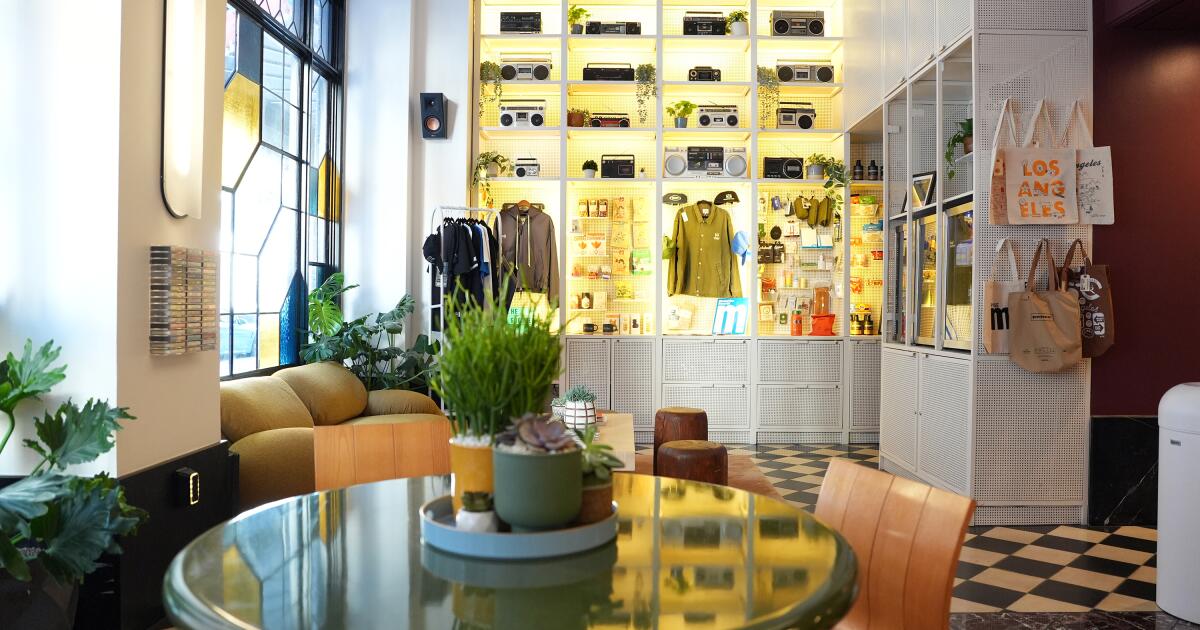
The historic 1920s tower that once housed the beloved Ace Hotel is entering a new era just in time for the summer.
Two years after opening in the iconic Spanish Gothic building on South Broadway, Stile Downtown Los Angeles has unveiled its multimillion-dollar renovation and its expansion from a limited-service hotel to a full “creative hub.” The makeover adds a 24/7 membership-based creative lab with state-of-the-art music studios, co-working lounges, an updated rooftop bar called Somewhere Special, a restored theater and a curated retail shop for the community.
“We don’t really want to call it just a hotel — it’s more of a hub,” says Jaisun Ihm, CEO of AJU Continuum, the investment company that purchased the historic space.
Throughout the space are throwback touches — for instance, hotel guests can borrow a Walkman and browse the curated cassette library with titles like Sade’s “Promise,” Paula Abdul’s “Forever Your Girl” and the Isley Brothers’ “Between the Sheets.”
Behind the massive overhaul is South Korea-based AJU Continuum, which purchased the property in 2019 but didn’t change the name until 2024. The project marks the investment company’s first U.S. expansion.
“We don’t really want to call it just a hotel — it’s more of a hub,” says Jaisun Ihm, CEO of AJU Continuum, which is best known for its culture-forward Ryse Hotel in Seoul. With Stile, Ihm says their mission was to “connect L.A. to Seoul.”
Ryse, Ihm says, encapsulates today’s eclectic lifestyle hotel: “It’s grounded in street culture. We say it’s iconoclastic. It’s youthful in nature.”
AJU Continuum teamed up with L.A. architecture and interior design studio Design, Bitches — the group behind the chic Checker Hall in Highland Park and Verve Coffee Roasters in the Arts District. Ihm didn’t care that it was Design, Bitches’ first hotel venture. After working with several firms over the years, he was tired of seeing the same aesthetic everywhere and wanted to work with a team that would bring a “bold” perspective, he says.
When the creatives at Design, Bitches got the invitation, they were all in. “I’ve always wanted to do a hotel,” says RA Rudolph, the studio’s co-founder. “I love hotels and I have opinions,” she adds laughing.
For Angelenos who frequented the Ace Hotel, a maverick venue that helped revitalize downtown L.A. for a decade beginning in 2014, walking through Stile will feel both familiar and new. While the building’s bones remain intact — a requirement of its historic-cultural monument designation — the space has an industrial-modern twist inspired by L.A.’s creative spirit.
For example, the United Theater on Broadway, which was once the 1927 flagship movie palace for the influential United Artists collective (Mary Pickford, Charlie Chaplin, Douglas Fairbanks and D.W. Griffith), now features fresh carpet, modernized sound and stage equipment and roughly 125 new light fixtures inspired by the lobby’s original Spanish Revival-style chandelier. As a nod to the building’s legacy, where Hollywood’s earliest icons broke away from major studios to control their own work, AJU Continuum has launched its own in-house booking team for the live entertainment venue. Also, the giant neon “Jesus Saves” sign that has sat atop the building since its days as a church is still there — and the owners have no plans to remove it.
1

2

3

4

5

1. A clawfoot tub inside the Loft King Suite. 2. Lounge chairs inside the Loft King Suite. 3. Hotel guests lounge in the rooftop pool. 4. Adriana Castellanos and friends hanging out in the lobby bar. 5. Photos taken in the photo booth at the Somewhere Special rooftop bar.
Some of the most significant changes can be found in the hotel lobby, which features a curated convenience store called the Goodie Shop, which is adorned with throwback boomboxes. Located next to the front desk, which was significantly condensed, the store is filled with a selection of California-sourced snacks and beverages, lifestyle goods, Stile-branded merch and travel essentials (phone chargers, toothpaste, hair care, etc.).
On the opposite side of the lobby is SparkHouse, a private members club and creative hub for up-and-coming musicians and creatives. The two-story space features professional recording studios, podcast and video suites, co-working lounges and meeting spaces, which are slated to open by early next year once permits are approved, Ihm says. SparkHouse’s cafe and bar is open to the public and sells tea, coffee (try the honey matcha latte), wine, beer cocktails and small bites. Ihm says programming at SparkHouse will include listening sessions, live showcases and even a mentorship program for rising artists.

“I’ve always wanted to do a hotel,” says RA Rudolph, the co-founder of Design, Bitches.
The rooftop bar, which offers stunning skyline views of the city and a pool, is now called Somewhere Special. The design team removed about 90% of the plants that used to pack the area to maximize space for dancing and mingling. Also, the pool area, now painted in a playful shade called Carrot Orange, has more seating and a photo booth nearby.
All 182 guest rooms were given a fresh coat of dusty rose paint, new custom carpet, furniture and upgraded bathrooms. In each room, you’ll find Korean amenities like face masks, a custom robe by a local brand called Room Service Los Angeles and books from the former Los Angeles University Cathedral that occupied the space from 1991 to 2011. With the hotel motto being “stay by your own rules,” Rudolph says it was important for them to make the rooms adaptable to each guest’s needs and to prioritize comfort. The result is uncommon room layouts like the tri-suite king room equipped with two twin-sized beds and a king bed split by a privacy divider that doubles as a playful art installation. Rudolph, who used to travel often with her now-adult children, says that’s the type of room she always wished had existed.
Stile’s arrival comes at a precarious moment for downtown L.A. In recent years, the neighborhood’s once buzzy hospitality and nightlife scene has experienced dwindling foot traffic, slow pandemic recovery and increased vacancies. Some business owners say crime and neglect are driving away customers. Nearly 1,000 businesses left downtown in 2024. Launching a high-concept lifestyle hotel is a bold gamble.

The Goodie Shop, a new curated convenience store, is filled with a selection of California-sourced snacks and beverages, lifestyle goods and travel essentials.
But Ihm says he hopes that Stile will help rejuvenate the area and create an ecosystem that will support neighboring businesses as well. Rudolph says she’s already starting to see that change.
“It’s been nice to see that in the last year that I’ve been coming here to work on the project, it’s livened back up again,” she says. “Especially this block, it feels better.”

Inside the World Cup Cultural Exchange
Getty Images/Getty Images
hide caption
toggle caption
Getty Images/Getty Images
What does America look like to visitors?
We’re finding out in real time as fans and athletes from all over the world visit the United States for World Cup matches across the country. From Ranch dressing, to the wonders of all-you-can-eat buffets, tourists are getting a taste of all the USA has to offer, but how do we square the warm welcome for the World Cup with the United States’ recent stances on immigration? Brittany is joined by immigration reporter Jasmine Garsd, and NPR reporter Juliana Kim to find out.
Want more global perspectives on culture? Check out these episodes:
How often do you think about the American Empire?
Make life harder (and better): Learn another language.
Support Public Media. Join NPR Plus.
Follow Brittany on Instagram: @bmluse
For handpicked podcast recommendations every week, subscribe to NPR’s Pod Club newsletter at npr.org/podclub.
This episode was produced by Liam McBain and Corey Antonio Rose. It was edited by Neena Pathak. Our Supervising Producer is Cher Vincent. Our Executive Producer is Barton Girdwood. Our VP of Programming is Yolanda Sangweni.

-
 Entertainment3 minutes ago
When, unlike our upcoming 250th anniversary, a bicentennial mattered to orchestras
-
Lifestyle10 minutes ago
DLTA’s former Ace Hotel is reborn as a ‘creative hub’ — and yes, you can still sleep there
-
 Politics13 minutes ago
Trump wants to show off D.C. for the Fourth. His construction is in the way
-
 Science18 minutes ago
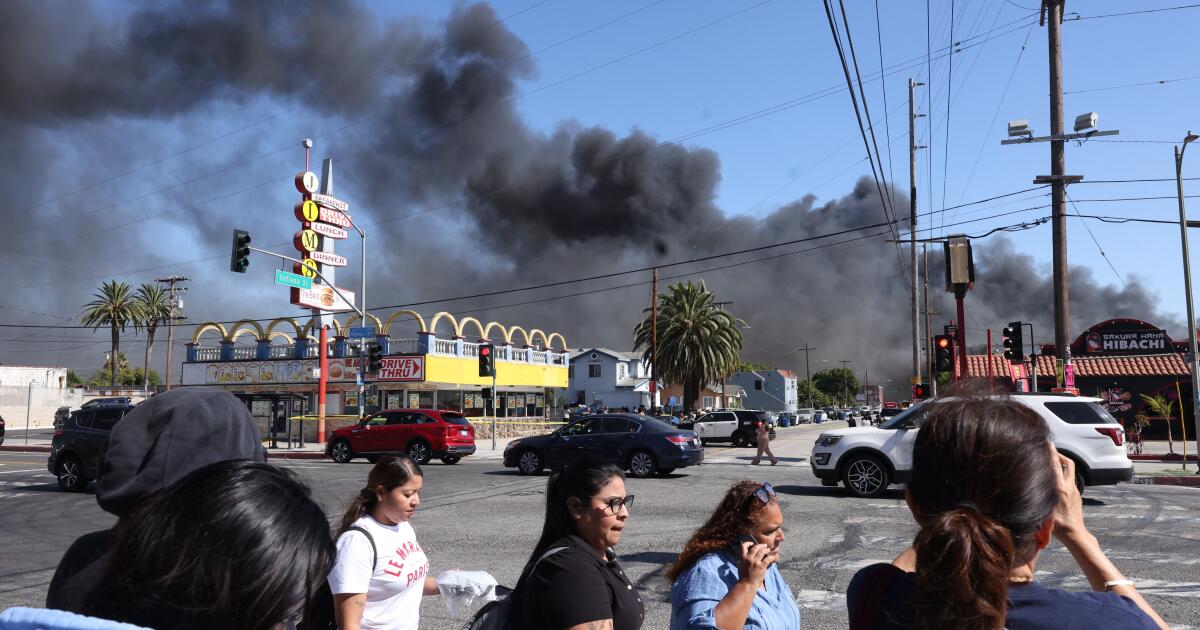
Boyle Heights blaze choked L.A. with astronomical soot pollution
-
 Sports25 minutes ago
Lakers announce summer league schedule, roster
-
World33 minutes ago
How the Entry-Exit System is becoming a nightmare for Europe's summer travellers
-

 News58 minutes ago
Newsom’s office responds to SCOTUS ruling on women’s sports as California faces ongoing trans athlete wave
-

 Los Angeles, Ca2 hours ago
Family of boy, 8, killed by falling tree branch at Calabasas park to get $14.6M

