Connect with us

Lifestyle

How to have the best Sunday in L.A., according to Drew Michael Scott (a.k.a. Lone Fox)

Published

on

How to have the best Sunday in L.A., according to Drew Michael Scott (a.k.a. Lone Fox)
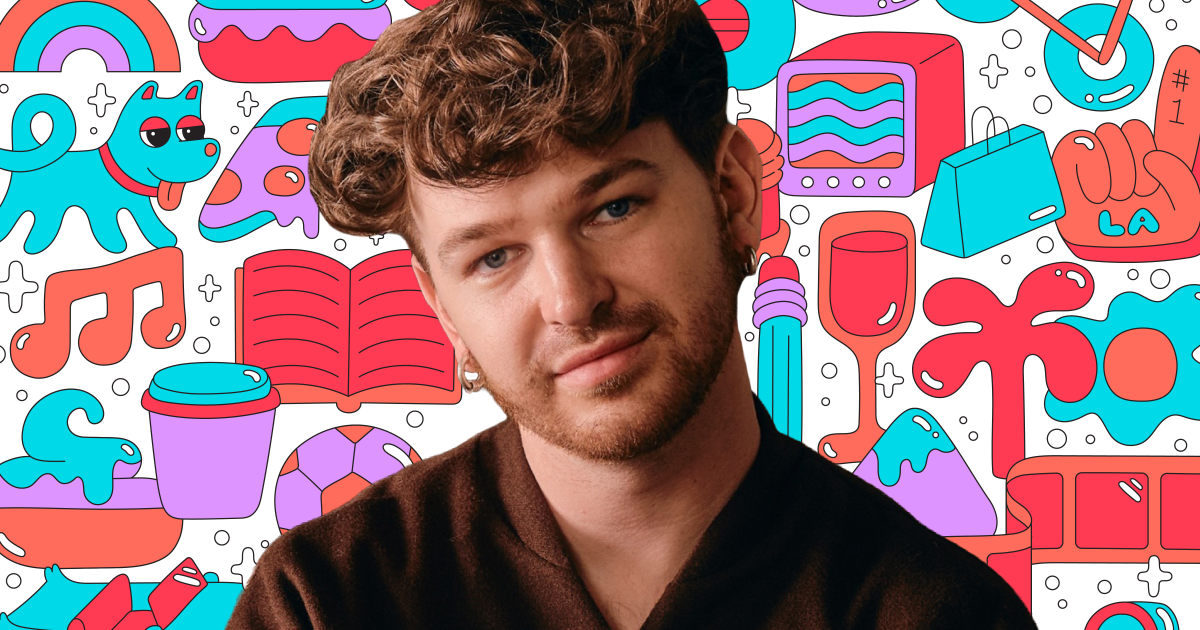
To his millions of YouTube, Instagram and TikTok followers, 30-year-old designer and content creator Drew Michael Scott (a.k.a Lone Fox) is best known for his easy-to-follow DIY transformations, from updating his 1929 Spanish duplex and offering rental tips to surprising his mom with a living room makeover.

Now, Scott has taken on a new project that isn’t online. This week, he opened Lone Fox Los Angeles, a 7,000-square-foot bricks-and-mortar home store on La Brea Avenue in Mid-City that will have about 2,500 square feet of retail space across two floors.
Sunday Funday infobox logo with colorful spot illustrations

In Sunday Funday, L.A. people give us a play-by-play of their ideal Sunday around town. Find ideas and inspiration on where to go, what to eat and how to enjoy life on the weekends.

Advertisement

“I source every single item,” Scott said, as he gave a tour of the elegant showroom filled with vintage furniture and modern accessories including glassware, pillows, lighting and small gifts.

Scott started selling vintage furniture online about 2½ years ago after his viewers kept asking him about the pieces he used. “I would always use thrifted finds and flea market things in my makeovers, and people would always ask me, ‘Can you sell what you’re using?’” he said.

Fans can now get a taste of his impeccable style in person. Curious about where he finds his vintage pieces? On a typical Sunday in L.A., Scott visits one or two flea markets. Want to know which ones? Keep reading.

This interview has been lightly edited and condensed for length and clarity.

8 a.m.: Avoid anxiety by posting content

Advertisement

I am a workaholic. But I do that to myself. In the past, I was an anxious person, and that stemmed from having too much free time. So I like filling my day. I have been doing social media for 15 years, and Sundays are my primary day for posting content. I wake up around 8 or 9 a.m. and am excited to post my content, which I always have ready to go. Over time, I noticed it felt like a nice day for people to look at social media because they had more free time, and I found that my views did better on Sunday.

9 a.m.: Coffee and croissants at a minimalist coffee shop

I love the coffee shop Laveta Coffee near downtown [L.A.] on Glendale Boulevard, which is only 16 minutes from my house. It’s a chill coffee shop where croissants are made to order. They also have cinnamon-sugar croissant doughnuts that are really good. I always get the Andante, a cold brew with maple syrup, salted sweet cream foam, cacao powder and pink salt. It is the best coffee I’ve ever had in my life. It’s my go-to, and I love that place.

10 a.m.: Flea market shopping in Long Beach or Pasadena

Sundays are for flea markets, and I take advantage of that. I personally source all my vintage pieces, so I try to visit flea markets every week. I bring a wagon to carry all my finds and really enjoy hunting for treasures. I try to go early and can always find art or furniture to rework and give new life. My favorite spot is the Long Beach Flea Market.

Advertisement

Another great option is the Pasadena City College Flea Market. It’s especially nice on hot days because about 70% of it is in a shaded parking garage. Sometimes I’ll find a large piece of furniture. When that happens, I use Lugg, which works like Uber. It’s perfect for things like sideboards and usually costs about $100.

Noon: Hunt for treasures at a sprawling antique mart

I also spend a lot of time at the Mart Collective in Venice, where I have a booth. I love finding new pieces there and checking out the different vendors. The selection is so interesting. It feels more like a museum than a typical antique mall, and I always discover something new. Two booths I really like are West End Vintage, which has unique furniture that looks like it’s from a mountain home, and a French booth near the checkout stand that has amazing French oil paintings.

1:30 p.m.: Stop by Lone Fox Los Angeles

After shopping, I’ll drop off my vintage finds from the flea market and check in at Lone Fox Los Angeles. I don’t plan to be there all the time, but I want to be around the first few weeks it’s open to spot any issues.

Advertisement

2 p.m.: Walk the dog over to Thai lunch

After visiting the shop, I’ll walk my dog over to Her Thai in Mid-City to pick up lunch. I love their pad Thai and Thai iced tea, and I usually get my order to go and bring it home. The Thai tea is especially good. Her Thai is run by the same people who own Met Her at a Bar and Met Him at a Bar, and they are all great.

4 p.m.: Indulge in an afternoon bath

I love taking a bath during the day, even though it feels a bit unusual. I only get the chance on Sundays. I don’t really use bath time to relax, but I do find it sparks my creativity. When I’m in the bath, I come up with ideas for scripts or plan out my work for the week. It might not be the typical way people use their bath time, but it’s something I’ve always enjoyed. My mind is usually focused on work, so that’s where my thoughts go. While I’m in the tub, I like using Cyklar products. Their vitamin C body oils smell great, and adding them to my bath makes me feel productive.

7 p.m.: Enjoy some homemade pasta at a cozy neighborhood cafe

Advertisement

Then I’d have dinner at Met Him at a Bar, my favorite spot. I really like the restaurant’s vibe. They offer both indoor and outdoor seating, and it reminds me of a New York street corner. The restaurant serves Italian food and makes its pasta from scratch. Their Brussels sprout appetizer with balsamic glaze is amazing. The cocktails are great too. Since it’s just a few blocks from my house, I can walk there if I want to have a drink.

10 p.m.: Content planning while watching true crime documentaries

I love watching TV from bed. On Sunday nights, I usually plan content for the week and check what’s trending. I try to relax and come up with new ideas. I’m really into crime documentaries, which are very different from the content I make at home. I like how real they are, even if they aren’t uplifting. I can work on my phone and look up when something interesting happens. I also enjoy YouTube videos about home content, Mr. Kate, how things are made and soothing ASMR reels. It’s my guilty pleasure and helps me unwind.

Advertisement

Lifestyle

Zendaya brings ‘The Drama,’ we bring the spoilers : Pop Culture Happy Hour

Published

on

Zendaya brings ‘The Drama,’ we bring the spoilers : Pop Culture Happy Hour

Zendaya in The Drama.

A24


hide caption

toggle caption

Advertisement

A24

The Drama is a dark and twisty comedy starring Zendaya and Robert Pattinson as a storybook couple preparing for their upcoming wedding. But just days before the big day, she reveals a horrifying truth about her past self that threatens to undo their nuptials, and their bond. In this spoiler-packed episode, we’re getting into that reveal, and all the surprising drama of the movie.

Follow Pop Culture Happy Hour on Letterboxd at letterboxd.com/nprpopculture

Advertisement
Continue Reading

Lifestyle

At Catch One, a funk concert transports you to 1974 — and it’s immersive theater at its finest

Published

on

At Catch One, a funk concert transports you to 1974 — and it’s immersive theater at its finest

The man I’m talking to tells me he has no name.

“Hey” is what he responds to, and he says he can be best described as a “travel agent,” a designation said with a sly smile to clearly indicate it’s code for something more illicit.

About eight of us are crammed with him into a tiny area tucked in the corner of a nightclub. Normally, perhaps, this is a make-up room, but tonight it’s a hideaway where he’ll feed us psychedelics (they’re just mints) to escape the brutalities of the world. It’s also loud, as the sounds of a rambunctious funk band next door work to penetrate the space.

Celeste Butler Clayton as Ursa Major and Ari Herstand as Copper Jones lead a group of theater attendees in a pre-show ritual.

(Gabriella Angotti-Jones / For The Times)

Advertisement

”Close your eyes,” I’m told. I let the mint begin to melt while trying to pretend it’s a gateway to a dream state. The more that mint peddler talks, the more it becomes clear he’s suffering from PTSD from his days in Vietnam. But the mood isn’t somber. We don’t need any make-believe substances to catch his drift, particularly his belief that, even if music may not change the world, at least it can provide some much-needed comfort from it.

“Brassroots District: LA ’74” is part concert, part participatory theater and part experiment, attempting to intermix an evening of dancing and jubilation with high-stakes drama. How it plays out is up to each audience member. Follow the cast, and uncover war tales and visions of how the underground music scene became a refuge for the LGBTQ+ community. Watch the band, and witness a concert almost torn apart as a group on the verge of releasing its debut album weighs community versus cold commerce. Or ignore it all to play dress-up and get a groove on to the music that never stops.

A soul train style dance exhibition.

Audience members are encouraged to partake in a “Soul Train”-style dance exhibition.

(Gabriella Angotti-Jones / For The Times)

Advertisement

Now running at Catch One, “Brassroots District” aims to concoct a fantasy vision of 1974, but creators Ari Herstand and Andrew Leib aren’t after pure nostalgia. The fictional band at the heart of the show, for instance, is clearly a nod to Sly and the Family Stone, a group whose musical vision of unity and perseverance through social upheaval still feels ahead of its time. “Brassroots District” also directly taps into the history of Catch One, with a character modeled after the club’s pioneering founder Jewel Thais-Williams, a vital figure on the L.A. music scene who envisioned a sanctuary for Black queer women and men as well as trans, gay and musically adventurous revelers.

“This is the era of Watergate and Nixon and a corrupt president,” Herstand says, noting that the year of 1974 was chosen intentionally. “There’s very clear political parallels from the early ‘70s to 2026. We don’t want to smack anyone in the face over it, but we want to ask the questions about where we’ve come from.”

This isn’t the first time a version of “Brassroots District” has been staged. Herstand, a musician and author, and Leib, an artist manager, have been honing the concept for a decade. It began as an idea that came to Herstand while he spent time staying with extended family in New Orleans to work on his book, “How to Make it in the New Music Business.” And it initially started as just a band, and perhaps a way to create an excitement around a new group.

A huddled group

Ari Herstand as musician Copper Jones in an intimate moment with the audience.

(Gabriella Angotti-Jones / For The Times)

Advertisement
A scene during Brassroots.

Celeste Butler Clayton (Ursa Major), from left, Ari Herstand (Copper Jones), Bryan Daniel Porter (Donny) and Marqell Edward Clayton (Gil) in a tense moment.

(Gabriella Angotti-Jones/For The Times)

Yet as the pair became smitten with immersive theater — a term that typically implies some form of active involvement on the part of the audience, most often via interacting and improvising with actors — Brassroots District the band gradually became “Brassroots District” the show. Like many in the space, Herstand credits the long-running New York production “Sleep No More” with hipping him to the scene.

“It’s really about an alternative experience to a traditional proscenium show, giving the audience autonomy to explore,” Herstand says.

Eleven actors perform in the show, directed by DeMone Seraphin and written with input from L.A. immersive veterans Chris Porter (the Speakeasy Society) and Lauren Ludwig (Capital W). I interacted with only a handful of them, but “Brassroots District” builds to a participatory finale that aims to get the whole audience moving when the band jumps into the crowd for a group dance. The night is one of wish fulfillment for music fans, offering the promise of behind-the-stage action as well as an idealized vision of funk’s communal power.

Advertisement

Working in the favor of “Brassroots District” is that, ultimately, it is a concert. Brassroots District, the group, released its debut “Welcome to the Brassroots District” at the top of this year, and audience members who may not want to hunt down or chase actors can lean back and watch the show, likely still picking up on its broad storyline of a band weighing a new recording contract with a potentially sleazy record executive. Yet Herstand and Leib estimate that about half of those in attendance want to dig a little deeper.

At the show’s opening weekend this past Saturday, I may even wager it was higher than that. When a mid-concert split happens that forces the band’s two co-leaders — Herstand as Copper Jones and Celeste Butler Clayton as Ursa Major — to bolt from the stage, the audience immediately knew to follow them into the other room, even as the backing band played on. Leib, borrowing a term from the video game world, describes these as “side quests,” moments in which the audience can better get to know the performers, the club owner and the act’s manager.

A woman interacts with audience members.

“Brassroots District: LA ‘74” is wish fulfillment for music fans, providing, for instance, backstage-like access to artists. Here, Celeste Butler Clayton performs as musician Ursa Major and is surrounded by ticket-goers.

(Gabriella Angotti-Jones / For The Times)

An audience member's costume.

An audience member’s costume.

(Gabriella Angotti-Jones / For The Times)

Advertisement

Yet those who stay in the main stage will still get some show moments, as here is where a journalist will confront a record executive. Both will linger around the floor and chat with willing guests, perhaps even offering them a business card with a number to call after the show to further the storyline beyond the confines of the club. If all goes according to plan, the audience will start to feel like performers. In fact, the central drama of “Brassroots District” is often kicked off by an attendee finding some purposely left-behind props that allude to the group’s record label drama. Actors, say Herstand, will “loosely guide” players to the right spot, if need be.

“The point is,” says Leib, “that you as an audience member are also kind of putting on a character. You can stir the spot.” And with much of the crowd in their ‘70s best and smartphones strictly forbidden — they are placed in bags prior to the show beginning — you may need a moment to figure out who the actors are, but a microphone usually gives it away.

“They’re a heightened version of themselves,” Herstand says of the audience’s penchant to come in costumes to “Brassroots District,” although it is not necessary.

“Brassroots District,” which is about two hours in length, is currently slated to run through the end of March, but Herstand and Leib hope it becomes a long-running performance. Previous iterations with different storylines ran outdoors, as it was first staged in the months following the worst days of the pandemic. Inside, at places such as Catch One, was always the goal, the pair say, and the two leaned into the venue’s history.

Advertisement

“Brassroots District: LA ’74”

“It’s in the bones of the building that this was a respite for queer men and the Black community,” Leib says. “There’s a bit of like, this is a safe space to be yourself. We’re baking in some of these themes in the show. It’s resistance through art and music.”

Such a message comes through in song. One of the band’s central tunes is “Together,” an allusion to Sly and the Family Stone’s “Everyday People.” It’s a light-stepping number built around finger snaps and the vision of a better world.

Advertisement

“We are stronger when we unite,” Herstand says. “That is the hook of the song, and what we’re really trying to do is bring people together. That is how we feel we actually can change society.”

And on this night, that’s exactly what progress looks like — an exuberant party that extends a hand for everyone to dance with a neighbor.

Continue Reading

Lifestyle

Hollywood studios reach a tentative agreement with writers union

Published

on

Hollywood studios reach a tentative agreement with writers union

The Writers Guild of America West building in Los Angeles on May 2, 2023.

Valerie Macon/AFP via Getty Images


hide caption

toggle caption

Advertisement

Valerie Macon/AFP via Getty Images

After less than a month of negotiations, the Writers Guild of America and the Alliance of Motion Picture and Television Producers announced their first steps toward a deal on Saturday.

“Today the WGA Negotiating Committee unanimously approved a four-year tentative agreement with the AMPTP for the 2026 Minimum Basic Agreement (MBA),” the union posted on its website. “Crucially, it protects our health plan and puts it on a sustainable path, with increased company contributions across many areas and long-needed increases to health contribution caps. The new contract also builds on gains from 2023 and helps address free work challenges.”

In 2023, the WGA went on a strike that lasted an entire summer and cramped production schedules for months.

Advertisement

The AMPTP said in its announcement that it looks forward to “building on this progress as we continue working toward agreements that support long-term industry stability.”

Word of the agreement arrived a few weeks before the expiration of the union’s current contract on May 1.

It also comes amid an ongoing dispute between the Writers Guild of America West and its own staff union. The staff union includes workers in fields such as legal and communications. Dozens of them in Los Angeles went on an independent strike in mid-February. The employees allege WGA West management was engaging in unfair labor practices, union-busting activities and bad faith bargaining. In a social media post last week, the staff union said striking members had lost health insurance coverage. NPR has reached out to the WGA for comment on the internal strike. The WGA canceled its annual West Coast award show in March as a result of the staff union strike.

The new four year contract between the WGA and Hollywood studios is expected to contain new rules around the use of artificial intelligence, such as licensing for AI training. According to a social media post from entertainment industry journalist Matthew Belloni, it will also include pension increases and extra compensation for streaming video on demand. The proposed deal, which is a year longer than the usual agreements between the union and studios, was greeted with relief online by a number of writers, performers and producers.

The AMPTP is currently hashing out a new set of agreements with unions that represent screen actors and directors.

Advertisement

The new writers’ contract still requires ratification by union members, which could come later this month, the WGA said.

Continue Reading

Trending