Lifestyle
Every ceremony at India's star-studded Ambani wedding, explained


Nita Ambani, wife of Asia’s richest man, Mukesh Ambani, arrives holding a lamp with an image of elephant-headed Hindu god Ganesha, for the wedding of their youngest son, Anant Ambani in Mumbai on Friday.
Rafiq Maqbool/AP
hide caption
toggle caption
Rafiq Maqbool/AP
What are reality TV star Kim Kardashian, former British Prime Minister Tony Blair and famous Indian cricketer Jasprit Bumrah all doing in the same room together?
Attending a wedding, of course.
Anati Ambani, the youngest son of Mukesh Ambani, the richest man in Asia, married Radhika Merchant in a three-day wedding ceremony in Mumbai this weekend.
The event, which has been criticized for being a display of extreme privilege in an impoverished country, has been capturing headlines for most of the year, as pre-wedding ceremonies and celebrations have featured appearances by some of the most famous names in the world.
The wedding is estimated to cost around $132 million to $156 million, but the exact figure is unknown.

Anant Ambani and his fiancée Radhika Merchant pose for a picture during their Sangeet ceremony in Mumbai, on July 5.
Sujit Jaiswal/AFP via Getty Images
hide caption
toggle caption
Sujit Jaiswal/AFP via Getty Images
This isn’t the first time the Ambanis have made headlines for their lavish weddings: In 2018, Beyoncé performed a concert at a pre-wedding celebration of Isha Ambani, the daughter of Mukesh Ambani.
Mukesh Ambani is the owner of Reliance Industries, a multinational conglomerate that sells everything from petrochemicals to cheap phones.
Indian weddings are known to be lavish, opulent affairs, with multiple religious ceremonies and parties to celebrate the groom and bride. It’s a multibillion-dollar industry, making it the second-largest wedding market in the world, behind the United States.
Indian weddings stand out because they go on for multiple days, with different events and celebrations that each have their own cultural significance.
The Ambani wedding is no exception. Celebrations started four months before the wedding on Friday.
Indian weddings differ greatly depending on which region of India families are from, and can be much smaller in some cases. The Ambanis are from Gujarat, a state in Northern India, and they have followed many of the typical customs of that region.
The wedding itself

Billionaire Mukesh Ambani (center) takes his son Anant Ambani by the hand as they walk with Nita Ambani (right) at the wedding in Mumbai on Friday.
Rajanish Kakade/AP
hide caption
toggle caption
Rajanish Kakade/AP
On Monday, the week’s wedding celebrations started with a private haldi ceremony. In a haldi ceremony, a turmeric paste is spread on the bride and groom’s face or bodies by their friends and family. Haldi, which means turmeric in Hindi, is well known for its anti-inflammatory and healing properties. Some consider haldi to have a purifying effect on the bride and groom. The ceremony is usually private and attended by only the closest friends and families, a tradition the Ambanis followed.
The wedding itself began on Friday and lasted well into the next day. The main ceremony took place in Mumbai’s Jio World Convention Center, which has a capacity of 16,000 people. A red carpet was rolled out for the guests, who included wrestler and actor John Cena, singer Nick Jonas and reality TV stars Kim and Khole Kardashian.

American actor and professional wrestler John Cena gestures as he arrives at the wedding in Mumbai on Friday.
Rajanish Kakade/AP
hide caption
toggle caption
Rajanish Kakade/AP
A traditional Hindu wedding usually has the bride and groom tied together with a piece of cloth as the groom leads the bride around a pit of fire seven times. These are called the pheras, or the marriage vows. A pundit, or Hindu priest, usually chants the vows in Sanskrit as the couple circle the flames.
Each round around the fire symbolizes a different commitment the bride and groom are making to each other and to God. Once the vows are over, the couple is officially married. The ceremony can take anywhere from 45 minutes to three hours depending on the exact traditions the couple is following.
The crowd at the Ambani wedding was so large that police had to divert traffic around the venue It’s monsoon season in India, and heavy rains have been disrupting flights into Mumbai all week.

Reliance Industries Chairman Mukesh Ambani (left) waves to photographers as he poses with his family members on the occasion of engagement of his son Anant Ambani (third from left), with Radhika Merchant (second from left) during a ceremony in Mumbai, on Jan. 19, 2023.
Rajanish Kakade/AP
hide caption
toggle caption
Rajanish Kakade/AP
The (multiple) engagement ceremonies
After a quiet proposal at a temple in December, Radhika Merchant took part in her first engagement celebration in January: a traditional Indian mehndi ceremony. The ceremony, also known as a henna ceremony, is typically held the night before a wedding. The bride has henna, a type of dye that leaves a red-orange stain, applied to her hands and feet. Mehndi ceremonies are usually organized by the bride’s side of the family, and are meant as a way to give the bride a chance to relax, as henna takes a few hours to develop after applying.

After that ceremony, the pair held a gol dhana ceremony, a Gurjati engagement event in which sweets made of coriander seeds are exchanged by the bride and groom. Typically, the bride arrives at the groom’s house with these sweets and other gifts, which are exchanged between families to symbolize their engagement.
Ambani’s gol dhana ceremony drew in some of the biggest names in Bollywood, including actors Salman Khan, Shah Rukh Khan and Aamir Khan, who are household names in India.
The pre-wedding celebrations, cruises and performances
The wedding first made headlines when singer Rihanna performed at a pre-wedding celebration in the family’s hometown in March. The 1,200-guest list included Mark Zuckerberg, Bill Gates and Ivanka Trump and Jared Kushner.
Shortly after their star-studded event, the family set off on a four-dayEuropean cruise on a luxury ship. There was a strict no-phones policy, but leaked footage showed singers including Pitbull and the Backstreet Boys performing on the yacht. Katy Perryalso performed for the familyat one of their stops on their cruise.
The Ambanis didn’t just settle for one ultra-rare performance at their pre-wedding festivities: just last week, Justin Bieber performed at yet another pre-wedding celebration at an arts center in Mumbai founded by Anant Merchant’s mother.
Although the Bieber performance was what was officially given the title, all of these parties, spanning multiple continents and months, might be considered part of a sangeet. Usually, the sangeet is a day-long celebration of dancing and music before the wedding. Family members will usually perform a choreographed dance to a Bollywood song, leading up to a final dance between the bride and groom, symbolizing the two families becoming one. The word sangeet is Sanskrit literally means “sung together”

People walk past the Antilia mansion, house of billionaire Mukesh Ambani, while it is lit up ahead of his son Anant Ambani and Radhika Merchant’s wedding in Mumbai on Wednesday.
Rajanish Kakade/AP
hide caption
toggle caption
Rajanish Kakade/AP
What happens after the wedding?
Once the wedding was over, the couple engaged in the last part of a traditional Hindu ceremony, shubh ashirwad, known as the divine blessing ceremony. Here, the couple seeks blessings from community elders. Usually, the couple is showered with rose petals and rice as they walk down the aisle once again, concluding the wedding ceremonies for the bride and groom.
Up next, the Mangal Ustav, or the reception: much like an American wedding, this is a party that takes place right after the marriage ceremonies are over. Here, the now husband and wife have their first chance to dance and celebrate their new life as a married couple.
The Ambani wedding reception is expected to take place at the Ambani family’s $2 billion residence in Mumbai, and is sure to be as star-studded and extravagant as the last four months of festivities.



The Kennedy Center on June 28, with its facade signage still covered by a tarp and scaffolding.
Alex Wroblewski/AFP via Getty Images
hide caption
toggle caption
Alex Wroblewski/AFP via Getty Images
On Wednesday, a federal appeals court denied President Trump’s request to stop the removal of his name from Washington, D.C.’s Kennedy Center. The signage on the building has been covered with tarp and scaffolding since June 13, but in a court filing last month, the center’s current executive director said that Trump’s name has been removed.
In their decision, three judges from the U.S. District Court of Appeals for the District of Columbia Circuit said that the president had failed to prove that the arts center would be “irreparably injured” without Trump’s name attached to it.

NPR requested comment from the Kennedy Center, but did not receive an immediate reply.
This latest round of court decisions is part of the ongoing litigation filed by Rep. Joyce Beatty, D-Ohio, against President Trump and the board of the Kennedy Center. In a statement emailed Wednesday to NPR, Beatty said: “Today’s ruling again affirms that this administration’s efforts to rename the Kennedy Center were unlawful. His name no longer desecrates this sacred memorial, which belongs to the American people. Now it is time for the Trump administration to accept this, comply with the law, and take the tarps down.”
In previous court filings, Trump’s legal team had asserted that removing the president’s name from the arts complex, both on the physical building and in its digital materials, would inflict irreparable harm in both time and money already spent. In the denial, the three judges — Patricia Millett, Robert Wilkins and Gregory Katsas — wrote that since Trump’s name has already been removed, “a stay would not avert those harms.”
Furthermore, Trump had claimed that without his name attached, future fundraising would be threatened “and [will] contribute to the financial decline of the Center.” In response, the appeals judges wrote: “Appellants, however, have failed to support this assertion with any specific facts or evidence. They offer only the conclusory assertions of the Kennedy Center’s Executive Director that were made in a factually unsupported declaration.” The center’s current executive director, Matt Floca, specializes in physical plant management.
The presiding judge in the case, Christopher R. Cooper, has ordered that the center provide him a status report on the center’s operation and programming before the end of this month. As of Wednesday, the center’s calendar lists a small roster of programs, including outdoor free movie screenings, workshops for children, and five free live performances in July on its Millennium Stage. In the past, the Kennedy Center presented over 2,000 arts and education events each year, including free daily Millennium Stage performances.

Lifestyle
A meal with an animated Mona Lisa? Immersive dining goes high tech — but will L.A. eat it up?
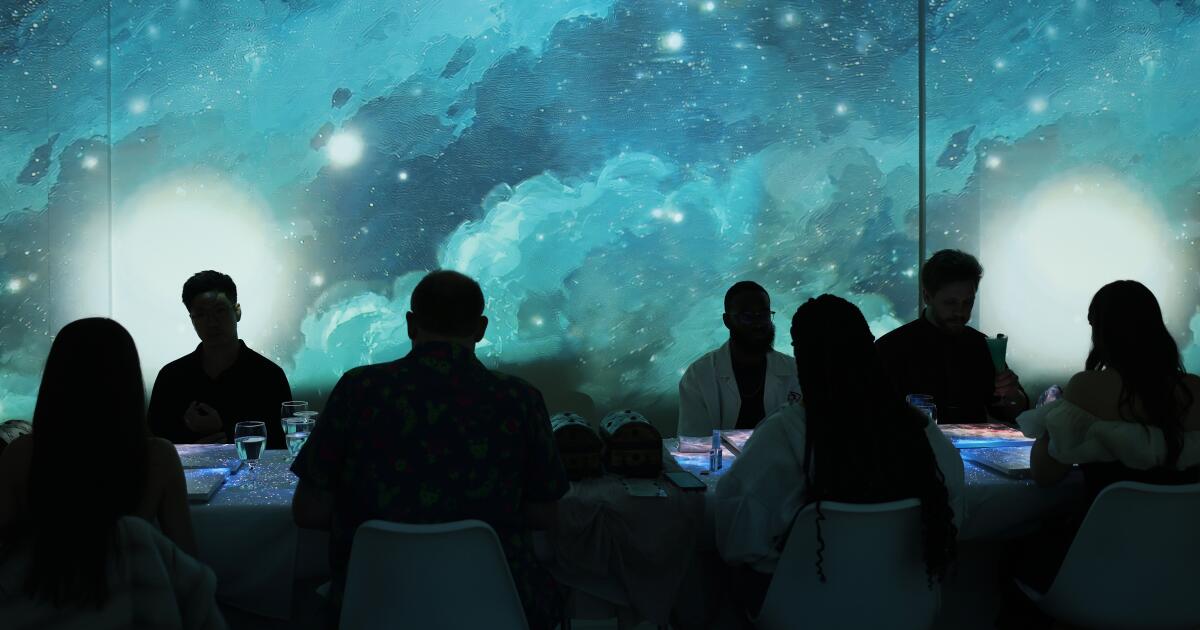
My dinner course is served. It is a Campbell’s-inspired soup can, lightly angled so strands of broccoli are peeking out. I lift the can to uncover a slow-braised short rib and mashed potatoes. An American dish to represent an American artist, here Andy Warhol.
The room is overtaken with projections, scenes of bustling New York traffic paired with bachelor-pad-like guitar riffs. Shown on a wall above a dinner table is a selection of Warhol silkscreens. It’s a Friday night in West Hollywood, and I’m surrounded by a mix of out-of-towners and those celebrating an anniversary. And while this is a special occasion, we’re urged to get a little messy with our food — to use our hands, to paint with a salad, to draw on a cookie.
The main course: A tomato soup can? “7 Paintings” is an immersive event that occasionally hides dishes in artist-inspired presentations.
(Christina House / Los Angeles Times)
Play is the primary side dish at “7 Paintings,” a tech-infused dinner theater that aims to be a crash course in fine art. That selection of veggies paired with multiple mini cups of colorful dressings? Guests are encouraged to mix and match the vinaigrettes into a mess of hues, a nod to abstractionist Jackson Pollock. And yellowfin tuna with dashes of avocado and taro chips? That’s an edible tribute to Banksy, of course. What does raw fish have to do with stenciled street art? It’s bold, heavily angled and has a short shelf life? Maybe? Perhaps don’t overthink it.

Even the paper is edible.
(Christina House / Los Angeles Times)
“Have you ever eaten a painting before?” says Nadine Beshir, the Dubai-based creator of “7 Paintings.” “We try to get people out of their comfort zones and eating paper. I want to bring out the child in them.”
“7 Paintings,” held at Sunset House L.A. through the end of August, is the latest example of immersive dining to arrive in this city. These experiences often involve guest participation and are accentuated with advanced multimedia technology and sometimes theatrical elements.
Worldwide, there have been standouts. For instance, Eatrenalin at Germany’s Europa-Park, a dining room-meets-ride where participants are whisked around the space on trackless “floating chairs,” has just received a coveted Michelin star. Ibiza’s Sublimotion has similar haute ambitions, pairing 12 diners together in a room that will come alive with otherworldly projections and performers. At times, diners will win don virtual reality headgear.
But tech-driven immersive dining experiences have never quite taken off in Los Angeles as a trend. Last year, the Gallery, where fantastical cityscapes and projections surrounded downtown L.A. diners, stood just a couple months before the concept was abandoned.

“7 Paintings” pairs food with art and music. It’s “fun dining, not fine dining,” says its founder.
(Christina House / Los Angeles Times)

Bartender Luca Famulari shakes a cocktail at the immersive dining event.
(Christina House / Los Angeles Times)
“The economics of a restaurant are not the same as the economics of theater and the challenge of combining the two lies in thinking outside the box with respect to pricing and cost structure, such that the customer perceives high value from both the food and the experience,” says the Gallery co-founder Daren Ulmer.
Entrepreneurs keep aiming for that careful balance. “Le Petit Chef and Friends” is currently running at Tangier at downtown’s Hotel Figueroa, an event in which a fully animated film is projected on our plates and tables. Long-running pop-up event Fork N’ Film leans more dinner and movie, pairing dishes directly inspired by what is happening on screen. Upcoming films include “Ratatouille” and “Lilo and Stitch.”
The field comes with challenges. “The costs are very high,” says Joanna Garner, an immersive designer and former creative director with experiential art firm Meow Wolf. Garner has been experimenting herself with communal, immersive dinner events, and her next, the flirtatious “Please Open Your Mouth,” is set for July 11. (No tech there, as Garner is after a more sensual, adult-focused gathering.) Tickets for her event are $150 and a spot in the “7 Paintings” dining room runs $175, priced on par with a number of city’s most acclaimed restaurants.
There is also the reality that all public dining is in some fashion immersive, usually requiring varying combinations of engagement, communication and presentation. And then, are all these added elements distracting?

An animated Mona Lisa sits on the wall as guests enjoy their meals. Throughout the dinner, the painting provides factoids on various artists.
(Christina House / Los Angeles Times)
Throughout “7 Paintings,” for instance, an animated Mona Lisa, situated on the wall next to the main dinner table, will provide brief biographical details of each artist represented.
“Being able to nail the food, and nail the story, those are two very difficult threads to weave,” Garner says. “I do think, ultimately, people come to a dinner table to talk to the people at the table and to have intimate experiences. To have an experience where you’re constantly being taken away from the food, I’m not so sure if that’s what people are looking for.”
Food is framed as a star of “7 Paintings” but tasting it is just one component. At one point, we must uncover a cheese course in a tiny treasure chest, the code for the lock hidden in the projections (don’t stress, it’s not a hard puzzle). Beshir highlights the Pollock-inspired salad course, which is accentuated with a jazz soundtrack, as the thesis of the evening.
1

2

1. A guest uses a silicon brush to apply sauces onto an entree, a nod to abstractionist Jackson Pollock. 2. Projections fill up the dining table during meals.
“This course is really about getting people to free their minds from preconceived ideas,” Beshir says. “Like, you have to eat with a fork and knife, or the salad comes and then the dressing. No, the dressing comes and then the salad, and it’s trying with big brushes to paint the way he did. A lot of people do not understand Abstract Expressionism, and they think it’s people just splashing colors around. But when you understand the link between the rhythm of the music and painting, you live it. We give you time to paint with your salad dressing.”
In L.A., Beshir has partnered with nightlife impresario Kim Kelly, who is plotting a “Sleep No More”-inspired walk-around theatrical show for the Sunset House venue later this year. “7 Paintings,” however, is fully seated, and purposefully a little silly. Beshir and Kelly have been evolving it during its L.A. run, recently adding a stronger painting component by giving guests their own canvas to work on throughout the evening. Each night crowns a winner.
“Everyone comes over to look at their art,” Kelly says. “It just kind of changed the whole thing, to be honest. People are now being creative throughout the entire evening. Instead of just watching and occasionally painting, you’re now painting the whole time.”
As for what, perhaps, soba noodles with edamame and mushrooms have to do with Pablo Picasso, or why Salvador Dali gets an unexpected dessert course of a white chocolate potato souffle, Beshir clarifies the goal of the evening. While the animated Mona Lisa will provide backstories on each painter, this isn’t an educational night. “It’s fun dining, not fine dining,” Beshir says.
And by the end of my night, strangers were socializing, showing off their painted cookie creations, sharing Banksy tidbits and asking for recommendations on various vinaigrette combinations. Ultimately, it’s an evening of discovery, packed with surprises like finding an entire course hidden under a canvas.

Darryl Mayes of Charlotte, N.C., left, and Taylor Smith of North Hollywood, right, uncover their course.
(Christina House / Los Angeles Times)
“We try not to have too much sophistication, like fried ants or something. I’m personally very adventurous in how I eat, but if I want to have this in 100 cities around the world, I cannot be too meticulous.”
And Beshir has big goals.
“I want this be your movie and dinner thing,” Beshir says. “I want people to be waiting for our next show, and to be able to afford to come every couple months.”
And to come home not with leftovers, but perhaps a painting of their own.

Matthew Rhys was nominated for his role in Widow’s Bay.
Apple TV
hide caption
toggle caption
Apple TV
The 2026 Emmy nominations are here. We’re unpacking the record-breaking nominations for Hacks, plus a big day for Widow’s Bay, The Pitt, and The Bear. We’ll also talk about the snubs and make some early predictions of who will win.
Connect with Pop Culture Happy Hour:
Letterboxd / Facebook
Our weekly newsletter
Support Pop Culture Happy Hour+
-

 Los Angeles, Ca1 minute ago
Heat advisory, beach hazards in effect as Southern California sizzles
-

 Detroit, MI21 minutes ago
Teen on moped hit by car after cruising through stop sign in Detroit
-

 San Francisco, CA30 minutes ago
Flight of fancy: San Francisco moves to build private luxury airport terminal
-

 Dallas, TX36 minutes ago
Dallas’ digital creator economy is booming. Burnout is too.
-
Miami, FL43 minutes ago
I went to 2 famous Miami restaurants, a flashy steakhouse and a Cuban hot spot. Here’s how they compared.
-

 Boston, MA46 minutes ago
Pedestrian struck and killed in Roxbury – Boston News, Weather, Sports | WHDH 7News
-

 Denver, CO51 minutes ago
Santa Fe Drive in Denver closed this weekend for pedestrian bridge construction
-

 Seattle, WA58 minutes ago
Police video shows West Seattle Bridge copper wire theft suspect’s arrest

