Lifestyle
Bucks County, Pa., Is Now a Celebrity Hot Spot


It’s hard to pinpoint when things began to change around here but you might start with the arrival of Yolanda Hadid in 2017.
Ms. Hadid, a onetime regular on “The Real Housewives of Beverly Hills,” bought a farm just outside New Hope, Pa., to be closer to her daughters, the models Gigi and Bella Hadid, who were then living in New York City.
The 32-acre property, with its stone farmhouse, horse barn and formal garden, became a family retreat, and the Hadids’ social media feeds filled with pastoral images: Gigi in a two-piece bathing suit, posing with a bowl of newly picked vegetables beside a patch of basil; Yolanda in black boots, bluejeans and a puffer vest, showing off a heap of fresh-cut lavender.
“We ride horses, we have a vegetable garden,” Yolanda told The Toronto Star in 2018, describing her life in the countryside with her famous daughters, who between them have 140 million followers on Instagram.
The presence of the Hadids attracted other famous people to Bucks County, a woodsy area known for its rolling hills and 12 covered bridges. In 2018, Zayn Malik, the British pop singer who was in a relationship with Gigi, bought a farm there. “It is quiet,” he said in an interview with British Vogue. “There are no human beings.” People magazine shared the news that Gigi gave birth to the couple’s daughter at home in Bucks County in 2020.
Tranquil Bucks County was back in the media spotlight the next year, when TMZ and Billboard reported on an altercation involving Mr. Malik, Gigi and Yolanda that took place at one of their country homes. Facing four charges of harassment, Mr. Malik pleaded no contest and was sentenced to 360 days of probation; he and Gigi broke up after the incident.
In 2023, the actor-writer-director Bradley Cooper, widely reported to have succeeded Mr. Malik as Gigi’s love interest, paid $6.5 million for a 33-acre gentleman’s farm close to Yolanda’s property. Then came local sightings of Leonardo DiCaprio and Justin and Hailey Bieber. Just across the Delaware River from New Hope, in Lambertville, N.J., Julianne Moore and Sydney Sweeney were filming a movie.
Suddenly, New Hope and the quaint neighboring towns were becoming a celebrity enclave. While a census might reveal fewer famous people per acre than in the Hamptons, Malibu, or Aspen, the area’s glamour quotient was on the rise.
Located between Philadelphia and Manhattan, New Hope has long been a haven for wealthy part-time residents. The surrounding countryside has been compared to that of the Cotswolds in England, and the artists and artisans living in the area add a touch of bohemia to the rusticity. But in past decades the weekenders tended to be lawyers and executives from Philadelphia, not supermodels, Hollywood actors and pop stars.
Michael Arenella, a musician and the founder of the annual Jazz Age Lawn Party on Governors Island, bought a weekend house in Bucks County in 2014, when he was living in Brooklyn. He started living there full-time two years later in the belief that he had chosen a place well off the cool map.
“Beacon is like Brooklyn 2.0,” Mr. Arenella, 46, said, referring to the Hudson Valley town that has been nicknamed “Bro No,” an abbreviation of Brooklyn North, because of the many former Brooklynites residing there. “I wanted to get away from New Yorkers. Bucks County is not quite as pretentious.”
Lately, though, Mr. Arenella has been seeing plenty of New York license plates in and around New Hope. Beyond sightings of Gigi Hadid or Jakob Dylan, another famous transplant, there are other signs of change in the area.
Humble inns have been refurbished to attract a new clientele, and several luxury hotels have sprung up, including River House at Odette’s, where the average nightly rate for a Saturday in November was $560 and the private rooftop club charges members $1,250 a year.
Philadelphia magazine cited the hotel and its in-house restaurant as the most glaring example of “the new New Hope.” Opened in 2020 by a group of investors that includes Ed Breen, the executive chairman of DuPont, it was built on the former site of Chez Odette’s, a restaurant and cabaret presided over by an eccentric French actress and poet, Odette Myrtil.
Along with Bucks County Playhouse, which opened in 1939 and drew such stars as Grace Kelly and Robert Redford, Odette’s came to symbolize New Hope’s bohemian culture. It closed in 2007, after three consecutive floods struck the town, and the stone building that housed it was painstakingly relocated to another lot, where it now sits empty.
Just up the Delaware, in Stockton, N.J., population 494, the historic Stockton Inn recently reopened after a two-year renovation. Its owners hired a James Beard Award winner to manage the property and its two restaurants. They also opened Stockton Market, a gourmet café that sells Frankies 457 olive oil and matcha tea made on site. Nearby, another high-end dining establishment, the Northridge Restaurant, opened last month after a three-year transformation of a weathered barn on the property of the Woolverton Inn.
Real estate values have soared in the area as the ultrarich supersize musty, low-ceilinged 19th-century abodes. “The old Bucks County farmhouse is now being blown out and expanded into true estates,” said Michael J. Strickland, a real estate agent with Kurfiss Sotheby’s International Realty who moved from Manhattan to Bucks County full-time in 2000.
Part of the appeal, he added, is that “property values are still accessible here, versus the Hamptons.”
‘Everyone Is From Brooklyn’
Mira Nakashima has seen the changes up close. She moved to New Hope as a child, in 1943. Her father, George Nakashima, was a woodworker and designer whose sculptural tables and chairs were displayed at the Museum of Modern Art and today fetch thousands of dollars at auction.
Mira took over George Nakashima Woodworkers after his death in 1990 and still runs the complex of workshops he built on a tree-lined property above the town. Sitting at a walnut table made by her father, Mira, 82, recalled the old New Hope as low-key and artsy.
“A lot of landscape painters came because the landscape was so beautiful,” she said. “There was fishing on the river. And there were canals running both sides of the river. And it was quiet and peaceful.”
For years, Nakashima Woodworkers held an open house on Saturdays. Recently, Mira said, the grounds became so overcrowded that she now offers guided tours by appointment only.
“Everyone is from Brooklyn. I can smell Brooklyn on them when they arrive here,” added Soomi Hahn Amagasu, Mira’s daughter-in-law and the studio’s sales manager. “So many young people are coming here.”
They won’t find Williamsburg-on-the-Delaware, however. New Hope’s commercial drag still has a hippie vibe distinct from the increasingly refined retail atmosphere of that Brooklyn neighborhood, with its Hermès and Chanel stores.
Mainstays include Witch Shop Gypsy Heaven, MagiKava teahouse and Love Saves the Day, a vintage bric-a-brac emporium formerly located in New York’s East Village. Another store sells tie-dye rock T-shirts. Those places, along with the homey bars and reasonably priced restaurants, bring in the suburban teens, twentysomethings and other day-trippers who clog the streets on weekends.
The lack of luxury stores of the kind you might find in East Hampton is by design, said Larry Keller, New Hope’s mayor for the last 27 years and an antique dealer in town. The town is also not so hot on national chains: After Starbucks and Dunkin’ moved in, the council revised zoning laws to favor local businesses.
“You don’t have the square-footage,” Mr. Keller said, referring to the tiny storefronts. “Where is Ralph Lauren going to have a store and sell enough gear to make sense? These are boutiques.”
One of New Hope’s shops made the grade for Gigi Hadid: Ditto Vintage, on Brick Street. Last winter Ms. Hadid stopped in and bought a Nahui Ollin handbag, a leather jacket and a necklace.
There are some upscale shops in nearby Lambertville: Albucker Gallery sells contemporary art and an assortment of found objects; Ten Church offers vintage clothing; and Rago Arts and Auction Center sells works by Nakashima and other design goods. Lambertville is also on the foodie map: Canal House Station, which serves American fare in a converted 1870s train station, earned a Michelin star.
Back on the Pennsylvania side of the iron bridge, there are signs that New Hope is in the early stages of a makeover. The building that houses Farley’s Bookshop, which opened in 1967, was recently renovated into a bright, modern space. A few doors down, a scruffy indoor mini mall was turned into a Ferry Market, a food hall. A high-end eyeglass store, Kitto Optical, opened on the same block.
“The French fries the restaurants serve are now truffle fries,” joked Katsutoshi Amagasu, 21, a Nakashima family member who grew up in New Hope.
Some of the town’s structures date to the colonial era, like the circa.-1727 Logan Inn. But on the residential north end, beyond the protected historic district, a Victorian house overlooking the river was bulldozed and replaced with a modernist compound befitting Bel Air. On an adjacent empty lot, a builder promises four luxury condominiums, each with a terrace, elevator and private dock. The asking price for one unit is $3.5 million.
Lorraine Eastman, a real estate agent at Berkshire Hathaway, said the riverfront has been built up to the point that portions of the Delaware are no longer visible to passers-by. Ms. Eastman lived in New Hope back in the ’80s, before moving to Los Angeles and eventually returning seven years ago.
“I bartended with Big Sue, who was 6-foot-1, wore size 13 motorcycle boots and smoked a cigar and sang jazz,” she recalled of her time working at John and Peter’s, a bar and rock club on South Main Street that’s still in business. “I lived in a loft on Ferry Street, which is now the Nurture Spa. New Hope was very artsy, gritty, very bohemian. It still has a little bit of all those qualities, but it is changing.”
Eat, Pray, Spend
Like many picturesque small towns, New Hope seems to have been discovered during the pandemic by urbanites who gobbled up property and drove up real estate prices.
“People are always looking for a place to go that’s a hidden little storybook town,” said Ms. Eastman, who recently listed a renovated 1769 farmhouse with a pool and “party” barn on 37 acres for $4.5 million.
Celebrity residents aren’t exactly new, either: Paul Simon had a weekend house in Bucks County in the early ’70s; more recently, the “Eat, Pray, Love” author Elizabeth Gilbert lived in Frenchtown, N.J., 16 miles north.
But the presence of the Hadids and Mr. Cooper, who grew up in suburban Philadelphia, has lent glamour to the area and whetted the appetites of developers and entrepreneurs.
A few miles from Yolanda Hadid’s estate, in the hamlet of Carversville, Pa., another hospitality project is nearly complete.
Milan Lint and his husband, Mitch Berlin, each of whom have had finance careers in New York, are renovating the Carversville Inn, a circa.-1813 stone building that the couple bought in 2020.
Standing amid the construction one morning last month, Mr. Lint, who has owned a weekend home with Mr. Berlin in Bucks County for 20 years, described the plans for the space, which is slated to open soon.
The new Carversville Inn will be a European-style boutique hotel with six rooms priced around $500 a night, Mr. Lint said. Its 65-seat restaurant will have “a French brasserie menu, in the Pastis or Balthazar style,” Mr. Lint added, name-checking a pair of Manhattan stalwarts.
Asked why he and Mr. Berlin had chosen Bucks County as the place for their venture, rather than, say, the Hudson Valley, Mr. Lint shared a memory of a boring, rainy summer spent in the area.
“The Hudson Valley is very pocket, and weather-dependent,” he said. “Here, the towns dot up and down the river. You can have a full weekend four seasons a year.”



Lifestyle
L.A. Times Concierge: ‘It’s hard to make friends as an adult in L.A. What are some groups I can join?’
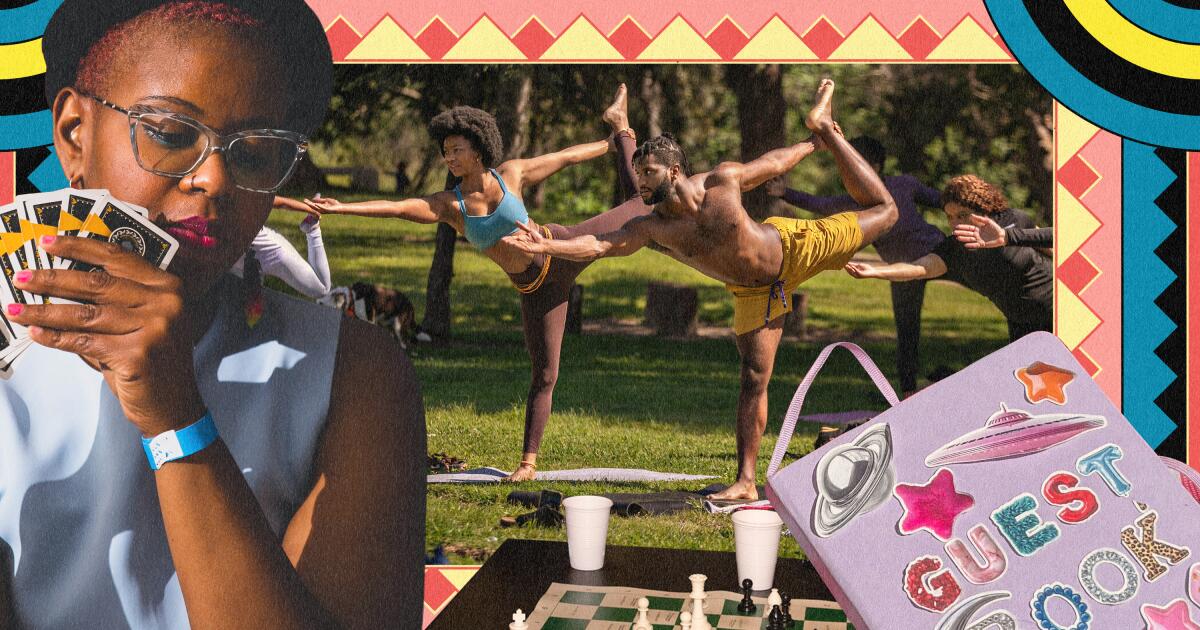
Keeping and maintaining friends as an adult is hard, especially with the demands of life, travel and work. In volunteering, I encounter more people like myself, which is nice, but sometimes it’s difficult to participate without a lot of commitment to the organizations. I’m wanting to explore smaller, intimate groups to build community with people who I share similar values with. I’m interested in self-growth, psychology, games, mindfulness and yoga. I loved the L.A. Times story “Awaken your inner child at this welcoming collage club for adults” and I would love to know about similar activities. Thanks! —Marlen I.
Looking for things to do in L.A.? Ask us your questions and our expert guides will share highly specific recommendations.
Here’s what we suggest:
Marlen, I couldn’t agree more. As we get older, it can feel more and more difficult to sustain friendships, especially in Los Angeles, where people live so far apart and have busy lives. This struggle is exactly why so many social clubs have been sprouting up in L.A. over the last few years. From board game clubs to junk journaling meetups, there’s so many different ways to connect and maybe try something new. I’ve compiled a list of social clubs and community spaces that I think you’ll enjoy.
Since you’re already familiar with Art+Mind Studios, you should definitely check out Junk Journal Club. Junk journaling is essentially a craft practice that combines elements of collaging, journaling and scrapbooking. With the rise of junk journaling content on social media, the once solo pastime has turned into a lively social scene. Junk Journal Club, dubbed “the original junk journal club,” hosts monthly meetups, which can be found on its Instagram page. When my colleague Malia Mendez went to an event recently, people told her that attending Junk Journal Club “has made befriending strangers easy,” and many of them stay in touch.
Another craft-centered event that’s worth exploring is the Crafters Clubhouse, which founder Victoria Ansah calls “a creative third space for adult makers.” She hosts monthly arts and crafts workshops including activities like scrapbooking, punch needle embroidery and clay art.
Given that you’re interested in yoga and mindfulness, you may like WalkGood LA, a community-centered wellness organization that hosts a variety of activities including a run club and accessible yoga classes. During the pandemic, I found solace in attending their weekly yoga classes called BreatheGood. The outdoor sessions take place every first Sunday at Kenneth Hahn State Recreation Area and feature free chiropractic adjustments and healthy food vendors. The vibe of the intergenerational event feels warm and welcoming. All you have to do is show up with your yoga mat. The organization also hosts various classes including yoga, breath work, mindful meditation, mat Pilates and step aerobics at their studio, the WalkGood Yard, in Arlington Heights.
Another social club I recommend is Love, Peace & Spades, which my friend Kevin Clark started in 2022, to create a space where people could play the card game with others. With music provided by a live DJ, the monthly game night feels like being at a family cookout. Spades can be extremely intimidating to start as a beginner playing with pros. But don’t worry. Love, Peace & Spades has instructors who can teach you how to play.
If you’re interested in chess, L.A. Chess Club is “an event with the laid-back ease of a chill game night and all the social and romantic possibility of a night out on the town,” according to Times contributor Martine Thompson, who wrote a story about the event. At the weekly gathering, which features a food vendor, cocktails, tattoo artists and DJs, you can “competitively play chess, learn the game, meet new friends or mingle as a single person,” Thompson shares. Another fun event is RummiKlub, a monthly Rummikub game night that takes place in elevated, design-forward spaces across the city.
L.A. also has several fun creative venues that regularly bring people together, such as Junior High, a nonprofit art gallery and inclusive gathering space that hosts artist showcases, comedy nights, pottery workshops and more. There’s also Nina in Atwater, which holds a variety of gatherings including a monthly series that focuses on mindfulness called “Be Here Now: Simple Tools for an Everyday Nervous System Reset.”
I hope that these suggestions are a good starting point for finding the group, or several groups, that are an ideal fit for you. Just by putting yourself out there and being open, you are bound to build and find community. Best of luck on your journey!

Ryan Gosling stars as Ryland Grace, a former science teacher-turned-humanity’s last hope.
Jonathan Olley/Amazon MGM Studios
hide caption
toggle caption
Jonathan Olley/Amazon MGM Studios
Perhaps the reason Project Hail Mary hits the spot in the spring of 2026 is that novelist Andy Weir, who wrote the 2021 novel and also the book The Martian, is fundamentally an optimist. Both stories concern men who are alone, facing impossible odds, far from Earth. And both stories posit that for anyone stranded under these conditions, the most important assets are accumulated knowledge, patience, curiosity, and the understanding that you need collaborators. Not magic, not muscle, not weapons, not even bravery, really. Just this: Know your stuff. Stay calm. Solve one problem at a time. Get help.
Problems of the natural world can be addressed through, and only through, mastery and cooperation might seem like a truism, but in Weir’s stories, it emerges as an expansively hopeful thesis.

In the new film Project Hail Mary, directed by Phil Lord and Christopher Miller, Ryan Gosling plays Ryland Grace, a middle school science teacher whose background is in molecular biology. He wakes up in a berth, bedraggled and weak, unable to remember why he is floating through space on a ship in which he is the only living crew member. With time, he’s able to put together that a woman named Eva Stratt (Sandra Hüller) recruited him to a team she was assembling to solve the gravest of problems: The sun is dying. The rest of the mission details are filled in through flashbacks, but the short version is that Grace was sent into space to figure out how to stop a sort of celestial infection that’s wiping out star after star — not just our sun.
Because there are other suns involved, it’s not surprising that there turns out to be other life involved, too. Other beings are trying to save themselves from the same menace that’s threatening Earth, and eventually, Grace makes contact with one: another scientist in another ship, whom he decides to call “Rocky,” because the guy looks a little rock-like. Also a little dog-like.
It is one of the greatest threats to making a good film out of Project Hail Mary that Rocky is very cute. In fact, he is adorable. He is also a skilled engineer dealing with his own isolation and his own losses. But Grace finds a way to communicate with him and eventually to outfit him with a human voice (provided by James Ortiz, who’s also Rocky’s puppeteer), and at that point, there is a lot of buddy comedy in the mix. It would have been easy to turn this into a nonstop series of gags where Ryan Gosling — who, after all, is also often adorable — cracks jokes with his alien pal. There are parts of the film that are that, and they are terrific.
But Weir is a really thoughtful writer (as is screenplay writer Drew Goddard), and Gosling can be an exceptionally quiet and sympathetic actor (as he was when he played Neil Armstrong in the underappreciated First Man). And in this story, they also find a lot of opportunities to explore questions about how to carry on in almost impossible circumstances.
Grace’s story is a lot of fun, but, like The Martian, which became a movie in 2015, it’s also an examination of how to get by and avoid despair. It’s about what Grace needs in order to persevere: a plan, a sense of purpose, and some company. It posits that people (and maybe beings other than people) need friends. They need allies. Grace needs Rocky, for help with the science but also because for him, alone is bad, and not-alone is better.
This piece also appeared in NPR’s Pop Culture Happy Hour newsletter. Sign up for the newsletter so you don’t miss the next one, plus get weekly recommendations about what’s making us happy.
Listen to Pop Culture Happy Hour on Apple Podcasts and Spotify.

Animated Australian sensation “Bluey” has arrived in Disneyland, and the titular anthropomorphic pastel-coated canine has come ready to play. And dance. And to race some “barky boats.”
The Walt Disney Co. first teased that the Blue Heeler puppy and her younger sister Bingo would be coming to the Anaheim theme park in 2024. Bluey is now the star of a performance-focused takeover of the park’s Fantasyland Theatre, which officially opened Sunday.
Two shows, games and spontaneous dance parties are hallmarks of the experience, as Disneyland’s live entertainment team sought to translate the show’s particular broadcast-based appeal to the real world.
“Bluey” works because it’s charmed children and grown-ups alike, emphasizing imaginative parenting skills as much as it does Bluey’s playful spirit. Though only about seven minutes, each core “Bluey” episode unfolds patiently, often centered on make-believe, wonder and childlike ingenuity. Subtle life lessons, such as cooperation, understanding one’s self-worth, overcoming a fear of the unknown and much more, dot seemingly simple scenarios.
In many episodes, Bluey’s mom (Chilli) and dad (Bandit) indulge in their daughters’ penchant to play pretend, so much so that a friend of mine with a young girl joked that she needed to watch the show to learn how to be a better mom.
-
Share via
I arrived at “Bluey’s Best Day Ever!” as a childless columnist, and yet I came away enchanted by what Disneyland’s live entertainment team, led by Susana Tubert, had concocted. It’s a little silly and corny, yes, but manages to vary the tempo and can even tug at one’s heartstrings by showing the bond between siblings.
Theme park fare, especially when aimed at a preschool set, tends to fall back on high-energy, photo-op-based treatments, and while there’s plenty of amped-up goofiness here, “Bluey’s Best Day Ever!” understands that’s not why the series was the most-streamed program in 2025, according to data from research firm Nielsen.
Two core shows are featured in the experience, and some “Bluey” regulars make an appearance. The overbearing, bratty hand-puppet Unicorse, for instance, plays key roles in launching each performance. Set to play continuously throughout the day, with breaks for Bluey and Bingo to appear on stage and dance or play with youngsters, each has a slightly different tone and feel.
One emphasizes an adventure story, its themes encouraging Bluey to flash some bravery and dispel stereotypes. The other takes a lighter touch, with some of the softer, almost ballad-like songs from the show, such as “Rain (Boldly in the Pretend),” highlighted, seeking to emphasize the bond between Bluey and Bingo. Here, I thought of Bluey’s more tender moments — those, for instance, that emphasize becoming comfortable with growing older and letting go.

“Bluey’s Best Day Ever!” features live music, puppets and dance breakouts.
(Mark Potts / Los Angeles Times)
“We try to hit the humor, the play — shared play — and some of the more profound experiences that these characters go through,” Tubert says. “At the end of the second show, you’ll see a moment that is really quite beautiful. It’s a tribute to sisterhood, and how these two characters of Bluey and Bingo connect with one another.”
While one can certainly sit in the Fantasyland Theatre’s stands and simply take in the two shows, there are plenty of moments geared at getting audiences moving. Dances, for instance, may mimic animal behaviors, or reference popular moments from the series, such as getting grannies to floss.
A nod to the attention-seeking fairies — here, less Tinker Bell and more a metaphor for being noticed — inspires a “Riverdance”-like breakout. The five-piece, brass-heavy band gets a workout when Bluey’s impossible-to-control toy Chattermax has a cameo. The squawking plaything can test even Bluey’s patience.
Throughout, performers walk a line between teaching the maneuvers to the crowd and getting lost in the moment themselves. The challenge for Disney choreographer Taylor Worden was to create dance moves that also doubled as audience encouragement.
Spin, for instance, like a flower in the wind, or lightly snap your fingers to recall the sound of rain. Bounce with your hands in front of you as if you’re driving a car down a rocky street, or put your hand above your head and try for an elegant, ballerina-inspired twirl.
“It actually was letting go of all of those technical things that I’ve learned and letting that inner child come out,” Worden says. “As imaginative as Bluey and Bingo are, I wanted to hone in on that. I want everybody to enjoy, have fun and play. Play is at the forefront of everything. It’s so easy to get set in our ways, and even as an adult, it’s so hard to actually play nowadays. This has been such an experience to get to a childlike state.”

“Bluey’s Best Day Ever!” references many show moments from the series, including one with nods to the fairies.
(Mark Potts / Los Angeles Times)
There’s more, however, to “Bluey’s Best Day Ever!” than the two performances. The Fantasyland Theatre has been outfitted with pop-up installations. Some are purely photo ops, such as an opportunity for little ones to take a class photo with Bluey and her pals, while others aim to inspire exploration, such as a mini gnome village or fairy garden.
Taken as a whole, the feel is something of a fair, like hanging out with Bluey and Bingo at a backyard barbecue. The theater’s walk-up food window is serving pizza-inspired baked potatoes, a colored chocolate pretzel meant to mimic an asparagus pretzel wand, and more.
There’s also a place to race some “barky boats.” In the show, barky boats is a game that takes place on a tiny stream with tree bark, but there’s no water here. Instead, look for a track in a nook above the seating area, where one can race wooden blocks affixed with wheels — think Pinewood Derby — down a track painted to mimic a waterway. Throughout the theater, the colors are springlike and muted, pastels that are lightly bright and storybook-inspired. Even the dance costumes adopt this soft, crayon-like color palette.

“Bluey’s Best Day Ever!” at the Disneyland Resort invites audience participation.
(Mark Potts / Los Angeles Times)
“The color palette works perfectly with the set,” says Trevor Rush, a manager with costume design and development. “Lots of pastel colors. ‘Bluey,’ that world, focuses very much in that primary world. You won’t see a lot of black represented.”
“Bluey’s Best Day Ever!” does not currently have an end date, but is expected to be a Disneyland staple throughout the spring and summer seasons, with showtimes currently set for the late morning and early afternoons. For Tubert, who has an extensive background in theater, “Bluey’s Best Day Ever!” is meant to highlight the theme park as a place of play, where one can be a bit silly, and maybe even a little vulnerable.
“There’s a nonjudgmental safe space that we’ve created in ‘Bluey’s Best Day Ever!’ that invites everyone to feel uninhibited and the joy of playfulness,” Tubert says.
L.A. Times Concierge: ‘It’s hard to make friends as an adult in L.A. What are some groups I can join?’

Californians may need to mail ballots early as Supreme Court signals support for new election day deadline

Ohtani. Yamamoto. Sasaki. A 12-story ‘cultural bridge’ between L.A. and Japan to debut in Torrance

How the Iran war is about to hit your wallet

Suspect in slaying of Loyola University student was in the country illegally, officials say

Florida High School Football Rankings: Top 25 teams – Oct. 21

How old is Bo Nix? What to know about Oregon quarterback ahead of 2024 NFL Draft

Cleary's 21 help Le Moyne down Central Connecticut State 69-64 in OT

99th annual Pony Swim held in Virginia

Indiana Members Credit Union announced as new anchor tenant at Bottleworks District
How the Iran war is about to hit your wallet
Suspect in slaying of Loyola University student was in the country illegally, officials say

Video: Plane Collides With Vehicle at LaGuardia Airport

As cattle herds shrink and beef prices rise, investors back AI cow collars

French elections: Paris stays left as far right makes mixed gains
-

 Detroit, MI5 days ago
Drummer Brian Pastoria, longtime Detroit music advocate, dies at 68
-

 Oklahoma1 week ago
Family rallies around Oklahoma father after head-on crash
-

 Georgia1 week ago
How ICE plans for a detention warehouse pushed a Georgia town to fight back | CNN Politics
-
 Science1 week ago
Federal EPA moves to roll back recent limits on ethylene oxide, a carcinogen
-

 Alaska1 week ago
Police looking for man considered ‘armed and dangerous’
-

 Movie Reviews4 days ago
‘Youth’ Twitter review: Ken Karunaas impresses audiences; Suraj Venjaramoodu adds charm; music wins praise | – The Times of India
-
 Science1 week ago
Long COVID leaves thousands of L.A. county residents sick, broke and ignored
-

 Education1 week ago
Video: Turning Point USA Clubs Expand to High Schools Across America