Lifestyle
At Jazz at Lincoln Center, Dave Chappelle Rallies to Keep ‘Tradition Alive’


Outside the Rose Theater at Jazz at Lincoln Center on Wednesday night, hundreds of people in shimmering gowns and velvet tuxes waited for the program to begin. They snacked on popcorn from gold pinstriped bags and sipped cocktails in front of a wall lined with giant black-and-white photos of the jazz pianist and composer Duke Ellington.
“I love coming here,” said Alec Baldwin, as he posed with his wife, Hilaria Baldwin, who was wearing a plunging lilac gown and a cross necklace, on the red carpet at Jazz at Lincoln Center’s annual fund-raising gala, which celebrated Ellington’s 125th birthday.
The couple, who married in 2012, star in a TLC reality TV show, “The Baldwins.” Filmed as Mr. Baldwin faced trial for involuntary manslaughter, it focuses on their hectic family life with seven children, all age 11 and under, and eight pets. A judge dismissed the case in July.
“The kids aren’t necessarily into the music I appreciate,” said Mr. Baldwin, 67, who wore a navy suit and a burgundy button-down. “I like a lot of classical. I love Japanese jazz, too.” (Ms. Baldwin, 41, a fitness expert and podcast host, said she played a lot of Billie Eilish.)
Another jazz fan in the crowd was Michael Imperioli, the “Sopranos” star who recently played Dom Di Grasso, a smooth Hollywood producer, in the second season of “The White Lotus.”
He has not seen the new season yet, he said, but he plans to soon.
“I’m going to sit down and watch the whole thing in two days or something,” he said. “I’ve been binging British detective shows.”
The Baldwins and Mr. Imperioli were among a smattering of celebrities from the film, music and media worlds, including the journalist Joy Reid and Ellington’s granddaughter, Mercedes Ellington. The evening, which was hosted by the actor and comedian Dave Chappelle, honored the philanthropist H.E. Huda Alkhamis-Kanoo and the jazz pianist and composer Toshiko Akiyoshi.
Around 6:45 p.m., attendees began funneling into the theater. In front of the stage were two rows of table seating, topped with bags of popcorn and bottles of wine. The Baldwins shared a table with Chloe Breyer, the executive director of the Interfaith Center of New York, and Greg Scholl, the executive director of Jazz at Lincoln Center.
As they waited for the concert to begin, which featured the Jazz at Lincoln Center Orchestra with Wynton Marsalis, Ms. Baldwin sipped a glass of red wine, while Mr. Baldwin munched on a bag of popcorn and scrolled through his phone.
Around 7:15 p.m., Mr. Chappelle took the stage.
“Man, you would’ve never thought you’d see me at an event like this, would you?” said Mr. Chappelle, the famously firebrand comedian.
“Don’t worry, no bad words,” he joked. “Just here to help out.”
He then shared a lesser-known part of his biography: Before he was in the stand-up comedy scene, he attended Duke Ellington School of the Arts in Washington, D.C., a public high school with a focus on arts education.
“That school profoundly, profoundly, profoundly changed my life,” said Mr. Chappelle, who is an amateur jazz pianist. “Duke Ellington was a guy who traveled all around the world just based off his talent. And as kids, we knew that it was possible, just because his energy was in the air.”
Though he mostly stuck to the teleprompter, Mr. Chappelle did throw in a few ad-libs. (“You can’t get one of the greatest comedians in the world to just read a teleprompter,” he said.)
He took light aim at President Trump.
“It’s up to us. We got to keep this tradition alive. This is one of the best things we got going in America,” he said. “You see what Trump did at the Kennedy Center? You’re next. He’ll come here, ‘I got to make jazz great again.’ Oh, no! Oh, no!”
Around 9:15 p.m., the members of the orchestra led a second-line procession that snaked through the atrium, as a dozen trumpeters, drummers and saxophonists played “When the Saints Go Marching In.” Afterward, a few hundred dinner guests tucked into plates of roasted branzino, chatting at tables with views of Columbus Circle.
Around 10 p.m., they began filtering down a hallway lined with a metallic gold curtain into Dizzy’s Club, an intimate space with bamboo walls and windows overlooking Central Park.
They danced until after midnight, as the Norman Edwards Jr. Excitement Band played swing standards like “Take the ‘A’ Train,” and the lights of Manhattan twinkled behind them.
“It’s heartening to see so many different generations here,” Ms. Ellington said. “Music is the only thing that’s going to really keep us going. We need it now more than ever.”



Phil Pritchard of the Hockey Hall of Fame works the 2019 NHL Awards at the Mandalay Bay Events Center on June 19, 2019 in Las Vegas, Nevada. (Photo by Bruce Bennett/Getty Images)
Bruce Bennett/Getty Images
hide caption
toggle caption
Bruce Bennett/Getty Images
This week’s show was recorded in Chicago with host Peter Sagal, judge and guest scorekeeper Alzo Slade, Not My Job guest Phil Pritchard and panelists Alonzo Bodden, Adam Burke, and Dulcé Sloan. Click the audio link above to hear the whole show.
Who’s Alzo This Time
The Don Vs The Poppa; World’s Worst Doctor; Should We Eat That?
Panel Questions
Big Cheese News!
Bluff The Listener
Our panelists tell three stories about someone missing a huge opportunity in the news, only one of which is true.
Not My Job: Phil Pritchard, the NHL’s Keeper of the Stanley Cup, answers three questions about the other NHL, National Historic Landmarks
Peter talks to Phil Pritchard, the NHL’s Keeper of the Stanley Cup. Phil plays our game called, “Let’s Go Visit The NHL” Three questions about National Historic Landmarks.
Panel Questions
The Trump Dump and Air Traffic Control Becomes Animal Control
Limericks
Alzo Slade reads three news-related limericks: Spice Up Your Spring Cleaning; A Fizzy Meaty Drink; The Right Way to Eat Peeps.
Lightning Fill In The Blank
All the news we couldn’t fit anywhere else
Predictions
Our panelists predict the next big AirBnB story in the news
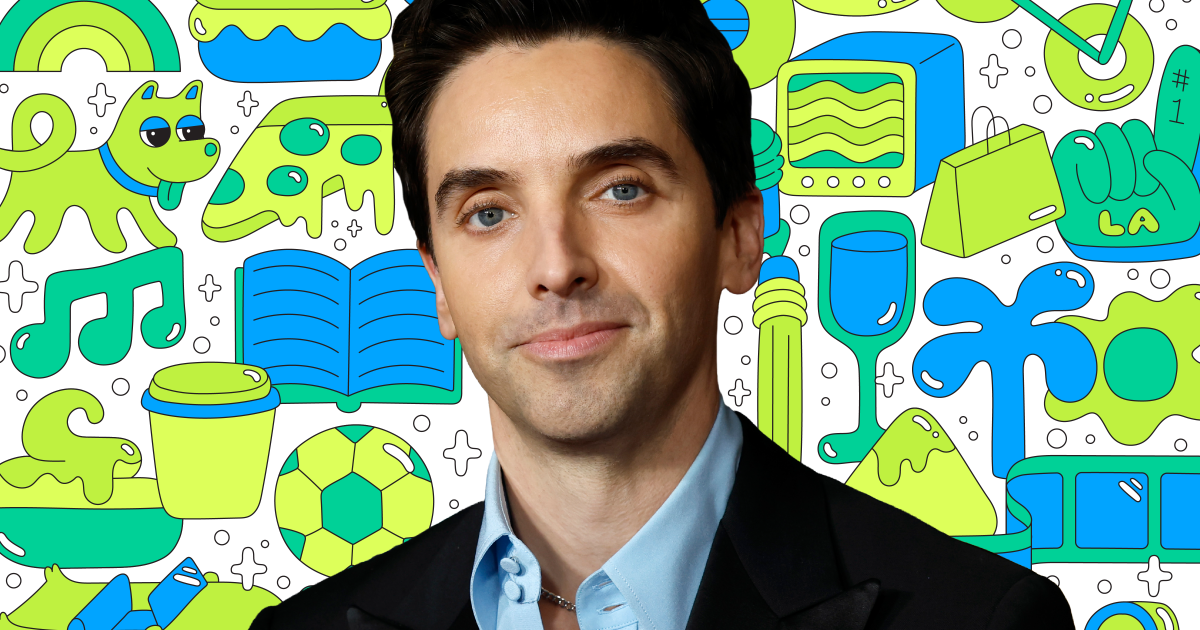
Paul W. Downs can’t help it that even on the weekends, his life intersects with “Hacks,” the HBO comedy he co-created and co-showruns with his wife, Lucia Aniello, and their friend Jen Statsky. (He also appears on the show as Jimmy LuSaque Jr., the besieged manager of its two stars, played by Emmy winners Jean Smart and Hannah Einbinder.) The fifth and final season of “Hacks” premiered last week, but on Downs’ days off, he often finds himself at its previous filming locations or hanging out with cast members who have become like family.

In Sunday Funday, L.A. people give us a play-by-play of their ideal Sunday around town. Find ideas and inspiration on where to go, what to eat and how to enjoy life on the weekends.
Downs moved to Los Angeles in 2011, but soon after, he and Aniello were hired to write (and for him to act) on the über-New York show “Broad City,” keeping them away from the West Coast for years. Now the couple live in Los Feliz, which they enjoy with their young son.
“I love Los Feliz because it’s a real neighborhood with restaurants and bars, but also feels close to nature with Griffith Park,” Downs says. “Also it’s very central to my Eastside friends and Westside agents.”
And if he had to live at a local mall, like the character Ava Daniels did in the third season of “Hacks,” which would he choose?
“It would be the Americana, obviously.”
Here’s how he’d spend a perfect day in L.A.

10 a.m.: A late rise and a li’l barista
I’m sleeping in if I can, which I can’t because I have a toddler, but let’s say I can sleep ’til 10. That would be insane.
Then I’m making coffee at home. I’m making it with my 4-year-old because he likes to make my coffee now. He always wanted to help, now he really wants to do it on his own. I’m still there to supervise, but he does do a lot of it.
I do batch brew. I’m doing Verve Coffee that I’m grinding there, and then I’m brewing four cups because I need my coffee. I had a Moccamaster for a long time, but I recently got a Simply Good Coffee. There’s no plastic — it’s all glass and metal.
11 a.m.: Chocolate croissants for everyone
We’re driving to Pasadena and we’re going to [Artisanal Goods by] CAR, which is the place to get the best chocolate croissant, I think, in the world. I don’t just think in L.A., I think they’re better than Paris. I’m going there with my wife and my kid and I’m having another coffee and some pastry. We’re ordering three [chocolate croissants]. We’re not doubling up.

11:45 a.m.: The family business
We’re driving to Fair Oaks in Pasadena. There’s a place called T.L. Gurley. We shot “Hacks” there, actually. Not only in Season 1, but also full circle in Season 5. We’re going to shmay around and look at antiques. My kid is going to want to play a vintage pinball machine. We’re going to find a little piece of art for the house or what have you. It’s not necessarily that I’m on the hunt. It’s to pass the time and to have some fun. If I could do anything and have a leisurely day and take my mind off work, that’s what I’m doing.
People love to interact with my kid when he’s there. We’re really training him to appraise things at a young age. My parents are part-time dealers of antiques. My grandmother bought and sold antiques. It’s kind of a family business.

1:30 pm.: Baguettes and books
We’re driving to Larchmont and we’re getting a sandwich at Larchmont Village Wine, Spirits & Cheese. I’m doing prosciutto-mozzarella-basil on a baguette.
Then we’re going to Chevalier’s Books. What’s sad is that I’m often not looking for leisure material. I’m looking for something that I’m interested in learning more about or writing about, or that they’re turning into a show I want to audition for. But we’re also doing Little Golden Books for my son. He’s obsessed. We’re not huge on screen time, so we really encourage the book-buying.

2:30 p.m.: Cast pool party
We’re having some family fun in the pool and we’re doing that until evening. We invite people over all the time. My sister-in-law is a New Yorker, but she actually wrote last season on “The Rooster” and she’s often writing on shows in L.A., so she’s often here and she’ll have a couple friends come over. I know this sounds like a piece of PR or something, but we’ll really literally have Hannah [Einbinder] and maybe Mark Indelicato from “Hacks” come over to swim. Jen, our co-creator of “Hacks,” will come over.
6:00 p.m.: Family dinner
Sometimes we’ll order Grá to the house, which is a pizza place in Echo Park — excellent sourdough crust pizza. But if we don’t do that, an ideal evening is an early dinner at All Time on Hillhurst in Los Feliz. We’re ordering the ceviche and my son is having all of it and not sharing with anybody at the table.

8:45 p.m.: A thrilling ending to the day
After putting my kid to bed, my wife and I, in an ideal world (full disclosure: we haven’t done this in two years), we’ll watch something together that we’ve been meaning to watch. We have a long list of movies and we either want to revisit or that we haven’t seen that we need to watch.
We don’t watch a lot of comedies. It’s a dream to watch a “Black Bag” or a little espionage thriller. We really like that because it’s so different than the stuff that we’re working on in the day.
Often the things we watch are things that we admire. We like deconstructing it as fans of film and television. We do like talking about the making of it, but it’s less of a critique and more of a listing of the things we appreciated about it.

10:30 p.m.: No work tomorrow
And then it’s lovemaking ’til morning on a perfect Sunday. If it’s a perfect Sunday, there’s also a Monday that’s off.

Jay (not pictured) found himself alone and hopeless in a jail cell when a fellow inmate’s unexpected words of comfort changed his life.
Irkham Khalid/Getty Images
hide caption
toggle caption
Irkham Khalid/Getty Images
When Jay was 22 years old, he was a self-described loner. In this story, he is being identified by his nickname to allow himself to speak candidly about the following experience and his mental health. He says the few people he did hang out with at the time had questionable morals.
”I chose my friends poorly, and your friends have a tendency to rub off on you. And so I started making poor decisions,” Jay said.
One evening, when he and his friends were out drinking, someone suggested they should try to break into the chemistry building on his college campus. Most of the group shrugged the suggestion off, deeming it impossible, but Jay was convinced he could pull it off.
“The next night I made a plan of how to do it, and I did it,” Jay remembered. “And I didn’t get caught doing it, [but] I got caught afterwards.”
At around 1 that morning, Jay was placed in the county detention center. Sitting alone in his cell, reality began to sink in.

“I pretty much thought that my life as I knew it was going to be over, and I had decided that the world would be better off without me in it.”
Jay made a plan to end his life. As he prepared himself, he began to cry.
“But just in that moment when I was ready to do it, I heard a voice coming from the top left corner of my cell, from a little vent. And someone called out to me and said, ‘Hey, is this your first time?’”
The man who called out was an inmate in the cell next door.
“I collected myself a little bit, and I said, ‘Yeah.’ And he said, ‘Can I pray for you?’”
Jay had grown up religious, but had stopped going to church years before. In that moment, though, he knew he needed support. He said yes, and listened as the man began to pray.

“I wish I could tell you that I remember the [exact] words that he said to me, but what I remember is that his words landed with me, and instead of wanting my life to be over, suddenly I saw hope,” Jay said.
The interaction happened nearly ten years ago, but it was a pivotal moment in Jay’s life, and one he thinks about all the time.
“[Now], I have a good job. I have a girlfriend who loves me. I have a life. But I have a life because somebody who was in the same situation I was in had the courage to talk to a fellow inmate and be kind.”
Jay says that he wishes he could meet that man again and express his appreciation.
“[I would] shake that guy’s hand, give him a hug, and tell him what his small gesture meant for me, how he changed the course of my life.”
My Unsung Hero is also a podcast — new episodes are released every Tuesday. To share the story of your unsung hero with the Hidden Brain team, record a voice memo on your phone and send it to myunsunghero@hiddenbrain.org.
-
 Sports5 minutes ago
After 55 years as a broadcaster in L.A., Randy Rosenbloom is leaving town
-

 World17 minutes ago
Bulgaria votes in eighth election in five years
-
 News47 minutes ago
Real estate investors are buying up long-term care facilities. Residents can suffer
-

 Detroit, MI3 hours ago
Former Piston shows Detroit what they’re missing as he dominates next to LeBron
-

 San Francisco, CA3 hours ago
Eastbound I-80 closure in San Francisco snarls traffic, slows business
-

 Videos3 hours ago
Can Keir Starmer survive the latest Mandelson revelations? | BBC News
-

 Dallas, TX3 hours ago
Petar Musa’s Brace Not Enough as FC Dallas Draws LA Galaxy 2-2
-

 Miami, FL3 hours ago
MLS: Messi double helps Inter Miami slay Rapids in front of huge crowd