Lifestyle
Artists priced out of Los Angeles head to this creative hub in the high desert

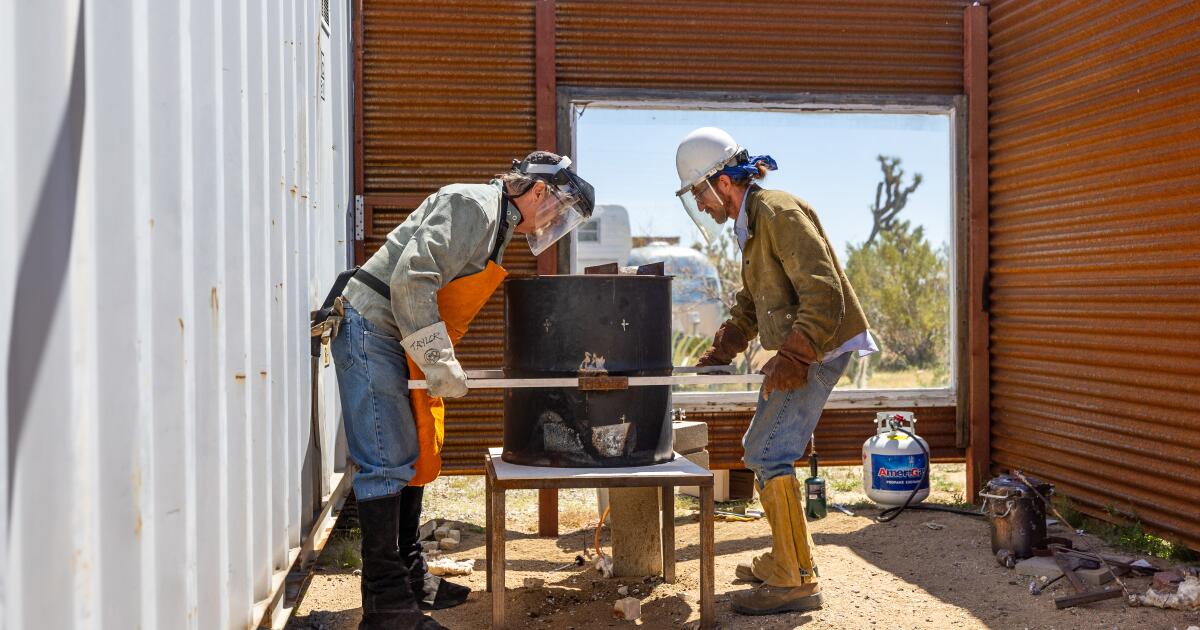
At high noon on a Saturday, the last aluminum pour of the day is about to commence at the Yucca Valley Material Lab.
Heidi Schwegler, founder of the Lab, has crawled up to the roof to get the best vantage point for a video. Schwegler has a hard stance on safety while still allowing for wild experimentation — it’s this attitude that makes the compound, with its art and recording studios, gallery, retrofitted campers and workshops like foundry and glass casting — a place of inspiration and community that pulls in people from all over the nation, but especially Angelenos looking for a reprieve from city life.
Owner Heidi Schwegler at Yucca Valley Material Lab in Yucca Valley.
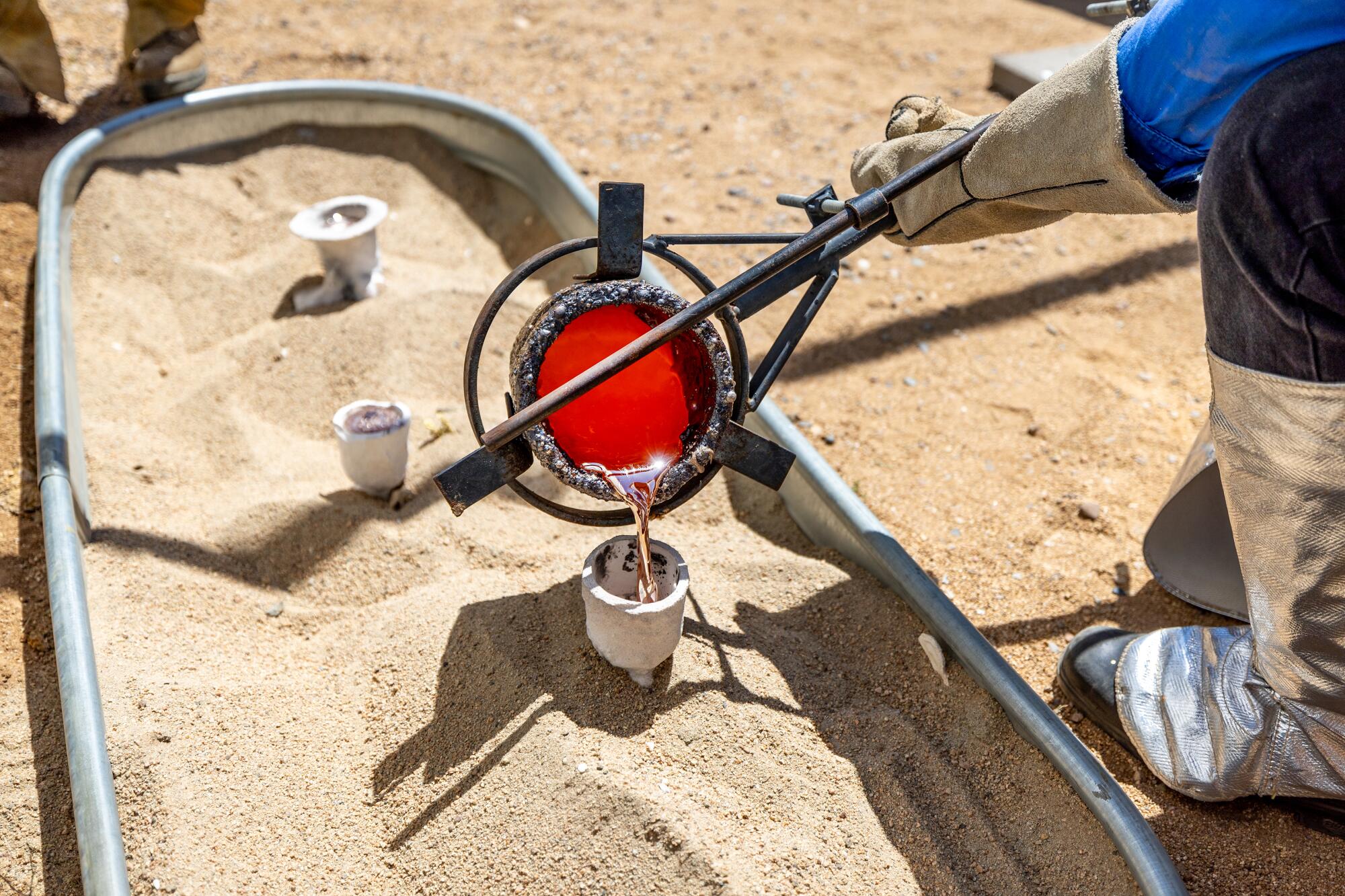
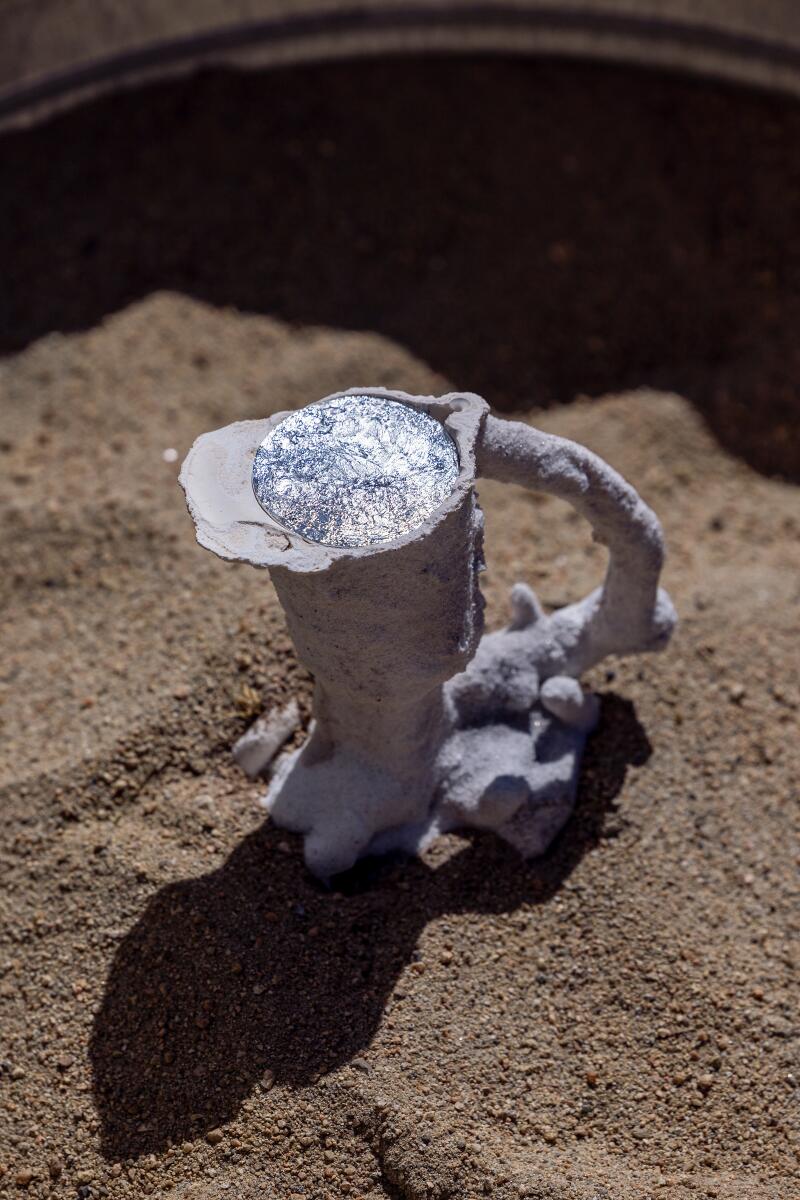
Jodie Cavalier, an interdisciplinary artist, pours molten aluminum into molds made earlier in the week.
(Allen J. Schaben / Los Angeles Times)
“This is the closest Derek and I could get to L.A. and afford it,” said Schwegler, referring to her partner, Derek Monypeny, who works with musicians. “And I think if you ask a lot of artists out here, they’ll say the same thing. It’s as close as you can get and be a really decent place to live and have a huge studio and still be within driving distance of an art center.”
It’s this passion and energy that pull artists east. Every workshop sells out, attracting hot-shot artists and retired high school teachers alike. “It’s really amazing to see my art and pedagogical practice come together outside of myself — in the form of a curved metal building plopped in the Mojave Desert,” Schwegler said. “Never would I have imagined this when we bought this property in 2018.”
The Lab has become a landing place for out-of-town artists and people looking for a way to plug into the desert scene. Many artists in Yucca Valley moved there on a whim after visiting for a weekend, much like Schwegler.
“I built this program because I was really afraid I would become a total recluse out here, because I didn’t think anybody was out here,” Schwegler said. “Come to find out, it’s just like that saying: ‘If you build it, they will come.’”
An artist and self-proclaimed materials junkie, Schwegler has pulled together funding from various sources, including AHA Projects, a nonprofit organization that supports creators, to cover residency and workshop costs, including airfare for teachers and housing for artists. Schwegler also often works with artists from the desert and Los Angeles for trade.
The Lab’s growing community has been cited as a reason why L.A. artists stay in the high desert — being able to see familiar faces at one or two cultural events a weekend is a balm after the smorgasbord and sprawl of the Southland.
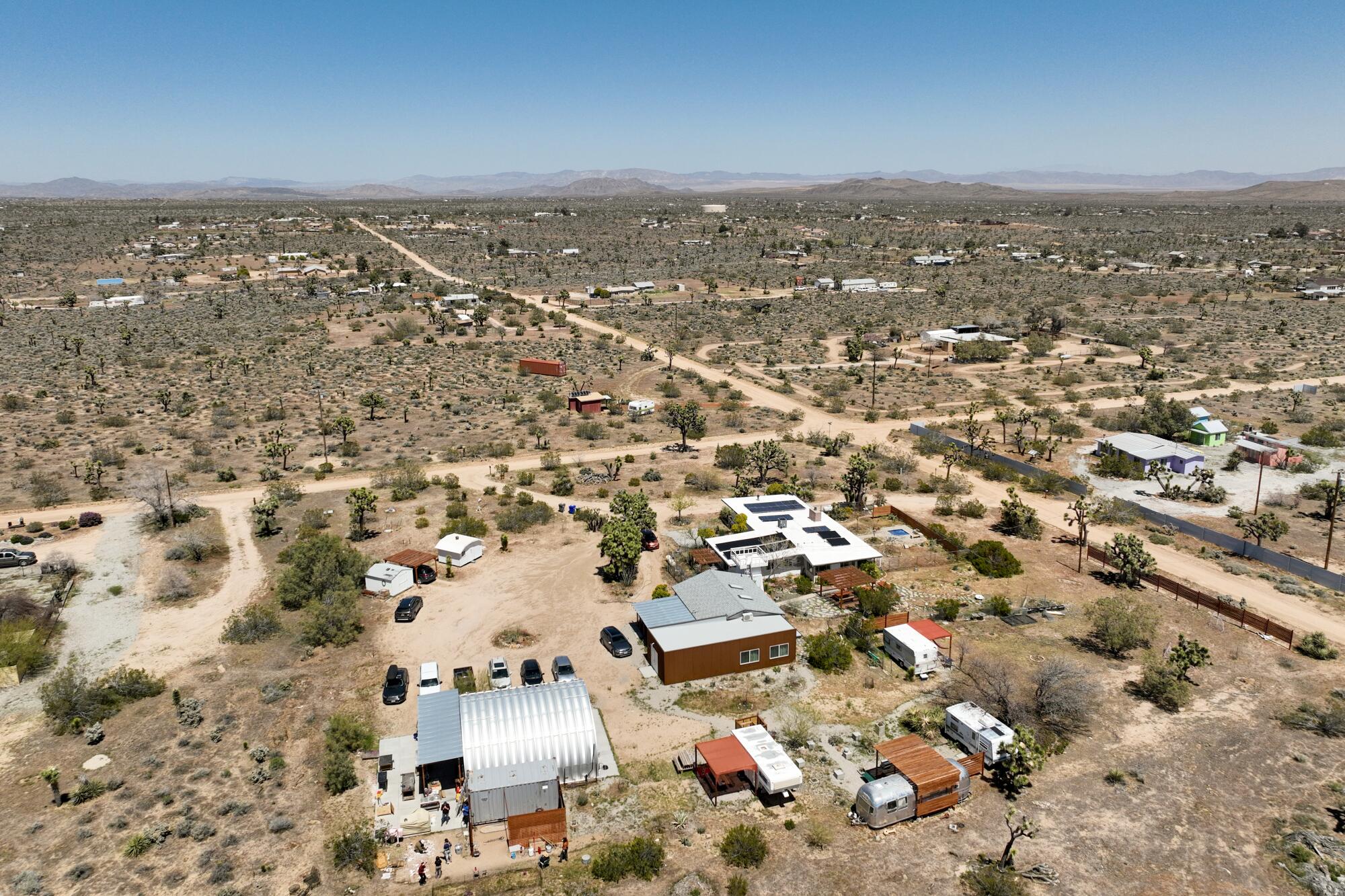
The Yucca Valley Material Lab, as seen from above.
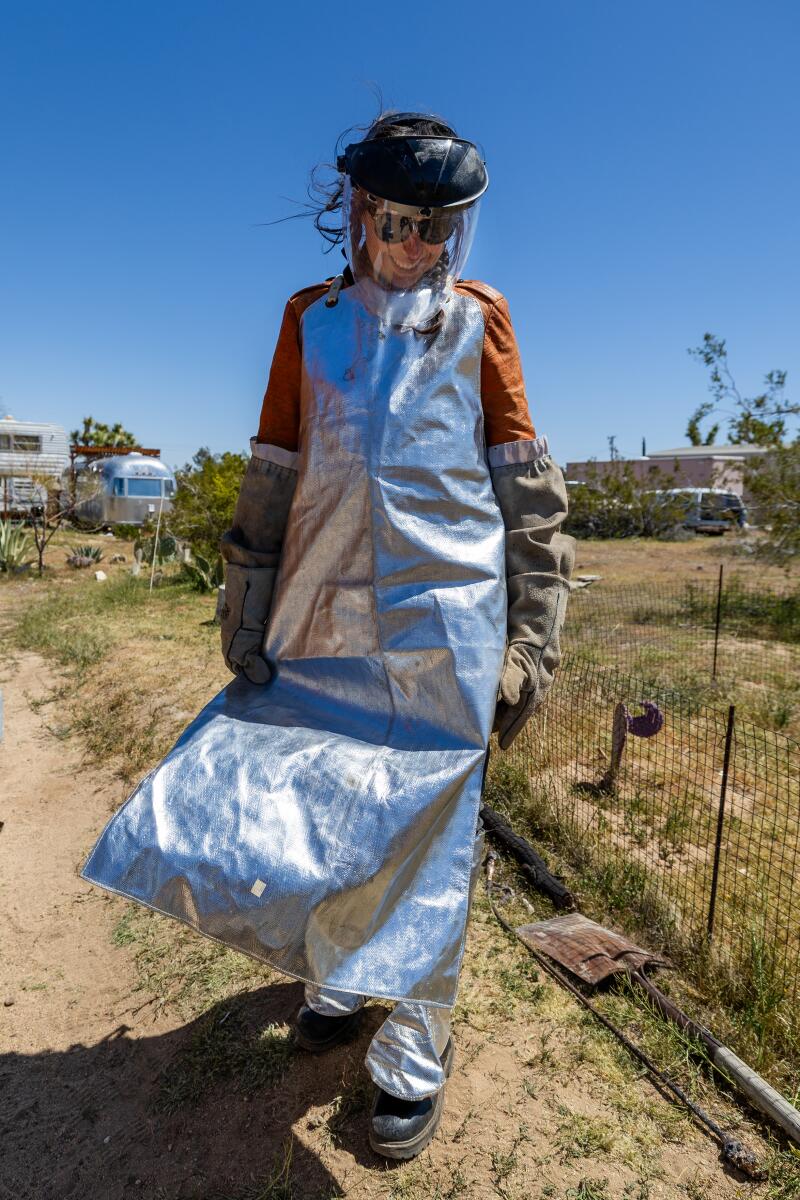
Haydeé Jiménez, an artist in residence at Yucca Valley Material Lab, wears a protective Kevlar apron during a bronze and aluminum workshop.
Students in the foundry casting in bronze and aluminum workshop pour molten aluminum into molds that were made earlier in the week.
In 2016, artists Ry Rocklen and Carolyn Pennypacker Riggs realized that a mortgage in the desert would be cheaper than a storage unit in Los Angeles. “I had a bunch of my ‘Trophy Modern’ furniture in storage and realized we could decorate our house with it and have a place to visit on the weekends,” said Rocklen, of a series of sculptures he made for an exhibit.
After having a child in 2020 and spending more time in nearby Joshua Tree, they moved full-time and converted their garage into studio space. “It was such a strange time, with so many different things going on, adjusting was not really on my mind. It was kind of a blur between our new baby, the pandemic and the move,” said Rocklen, who runs the gallery space Quality Coins in Yucca Valley. “The landscape, however, was our saving grace, as we were able to go on walks through the beautiful rocky hills.”
Back at the metal workshop, the roaring sound of the kiln — which is used in the process of turning molten bronze and aluminum into objects — fills the quiet desert mesa with an ambient soundtrack.
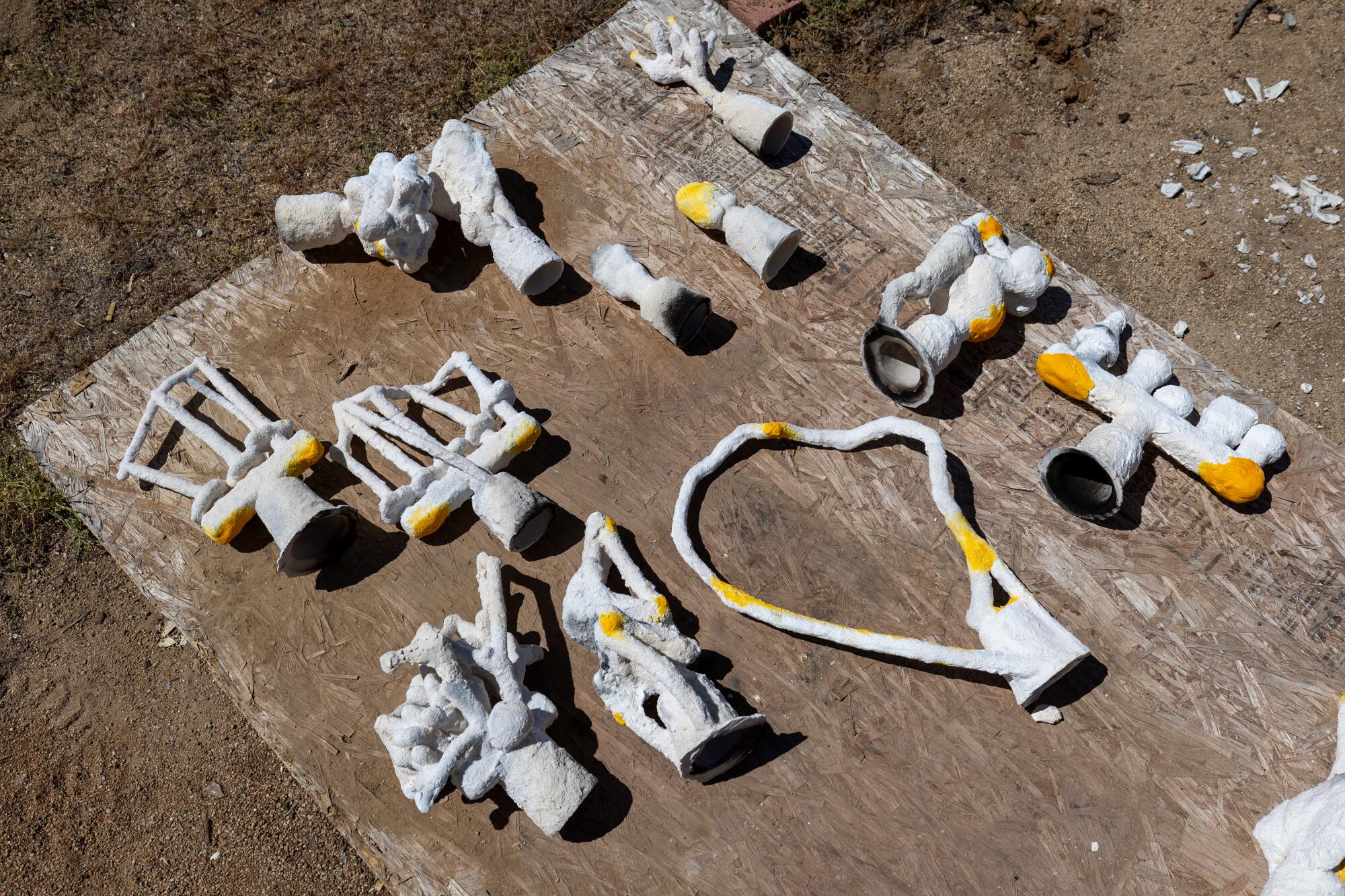
During a metals workshop, students made molds and learned to pour bronze and aluminum at the foundry.
Haydeé Jiménez, a recent artist in residence who splits her time between Los Angeles and Tijuana, crouched outside the metals workshop observation window wearing headphones and sunglasses, with her microphone wind-screened by a cardboard box. Amid the Joshua trees and creosote bushes, she recorded the sounds of the makeshift foundry.
Jiménez, who describes her art practice as revolving around “sound, music and vibrational sound healing,” said she was excited to work with new materials.
“When I first got the invitation to join [the Lab] for a residency, I hoped to work with glass and create little resonant objects for the development of a sort of acoustic ASMR experience,” said Jiménez, referring to Autonomous Sensory Meridian Response, which is when one is soothed by sounds like whispers and taps. Later in the weekend, she’d layer the foundry recording over sounds made using bronze objects from the workshop in a performance with gong-master Tatsuya Nakatani at the Firehouse, a Joshua Tree venue.
Any given weekend at the compound can be action-packed; that Saturday, Lazy Eye Gallery opened Michelle Ross’ “Before Pictures,” a show of sculptural paintings inside the nave of a water tower converted into a small funnel of a gallery space with a ladder to the roof that affords a view of the mesa.
But as the artists’ community grows, so has interest in real estate in Yucca Valley, Joshua Tree and Twentynine Palms, once considered more affordable areas. Housing prices in Yucca Valley have grown 80% since 2019, according to Zillow, although the steep pandemic rush has since cooled.
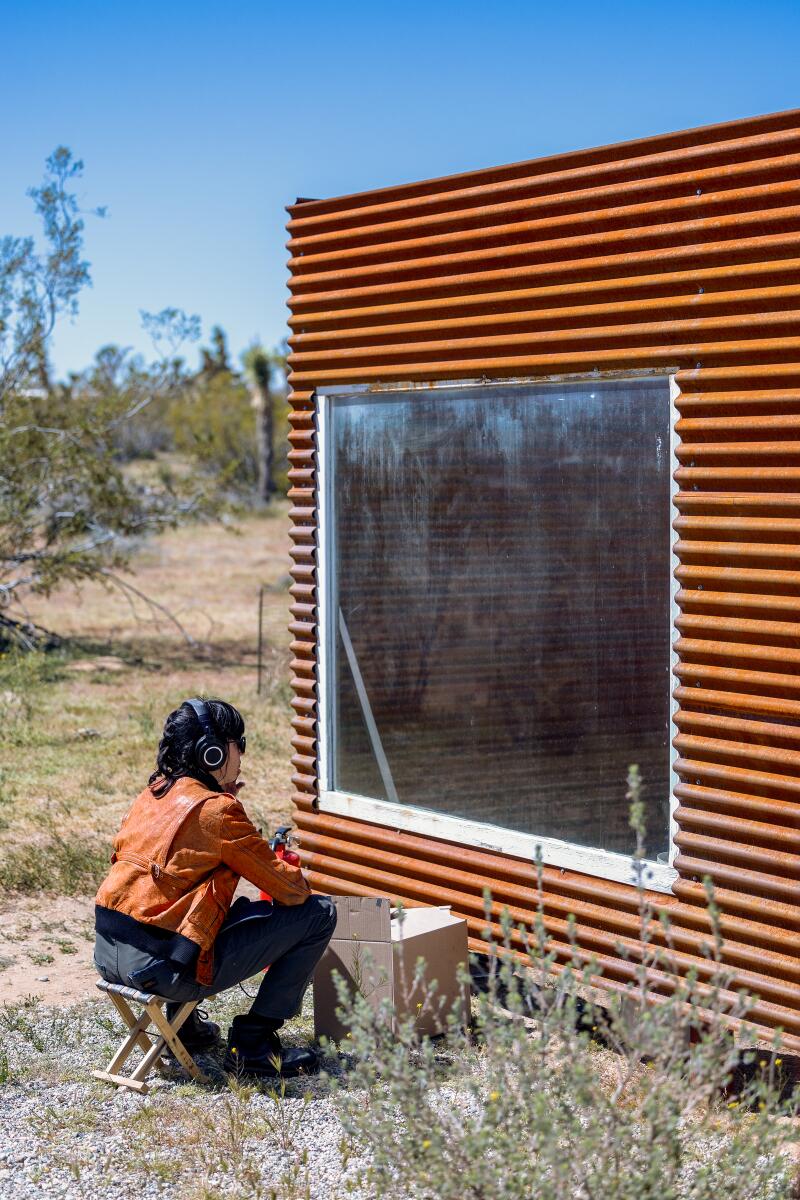
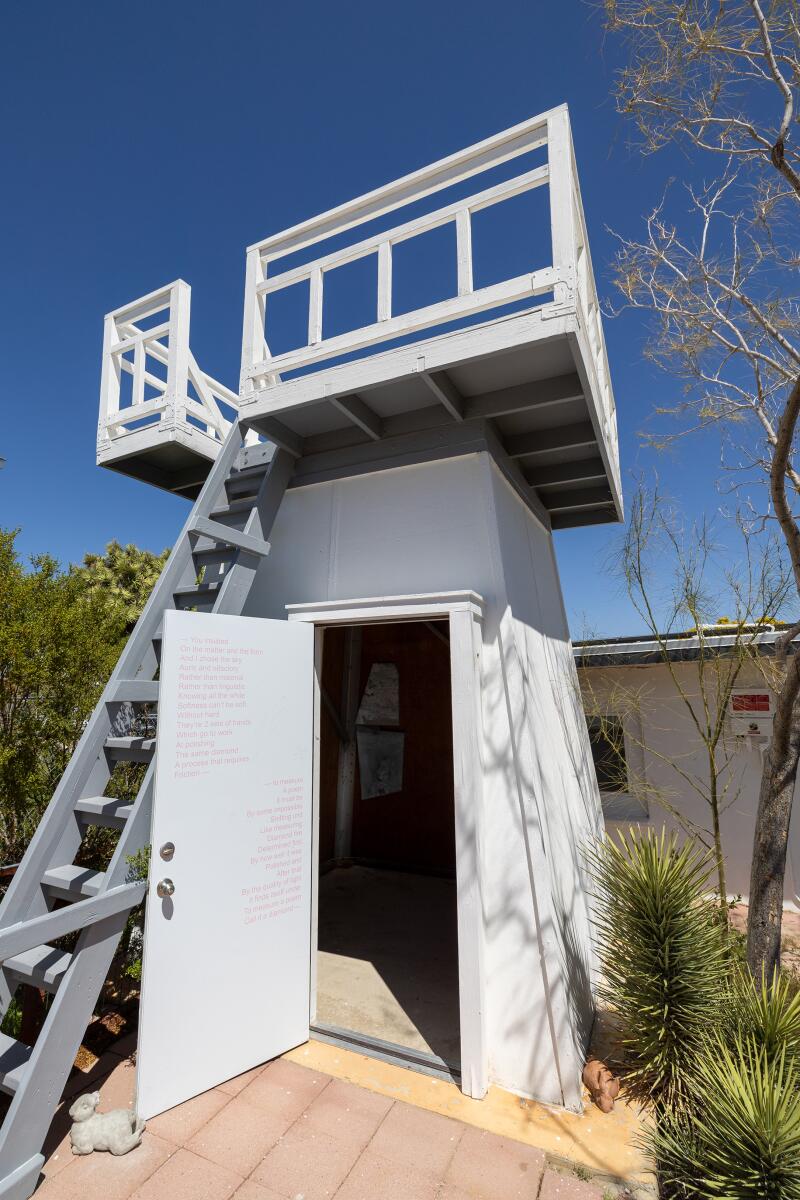
Haydeé Jiménez, an artist in residence at Yucca Valley Material Lab, records sounds of students in the foundry pouring molten aluminum into molds. A view of the Lazy Eye gallery at the Yucca Valley Material Lab.
“The presence of Airbnbs is corrosive,” said Riggs, observing that interested buyers have grown beyond “Silver Lake hipsters with a getaway cabin.” Last year, Yucca Valley capped short-term rentals at 10% of its housing stock. According to Redfin, most people searching to buy Yucca Valley homes today are in San Francisco.
Between the expansive landscape, cheaper-than-L.A. studio space and the small-town feel, the desert offers the experience of slow time — which can help some artists tap into a flow state without the day-to-day distraction of city living. But all that free time and space can be intimidating.
Ceramic artist and designer Mansi Shah left Los Angeles in 2020 after another artist friend told her about a house for rent in Yucca Valley; she packed up and headed to the desert within a few weeks. “There was 500 feet of open desert between me and my nearest neighbor. I remember those first few months, I was terrified of everything. The wind, the quiet, the desert critters,” said Shah.
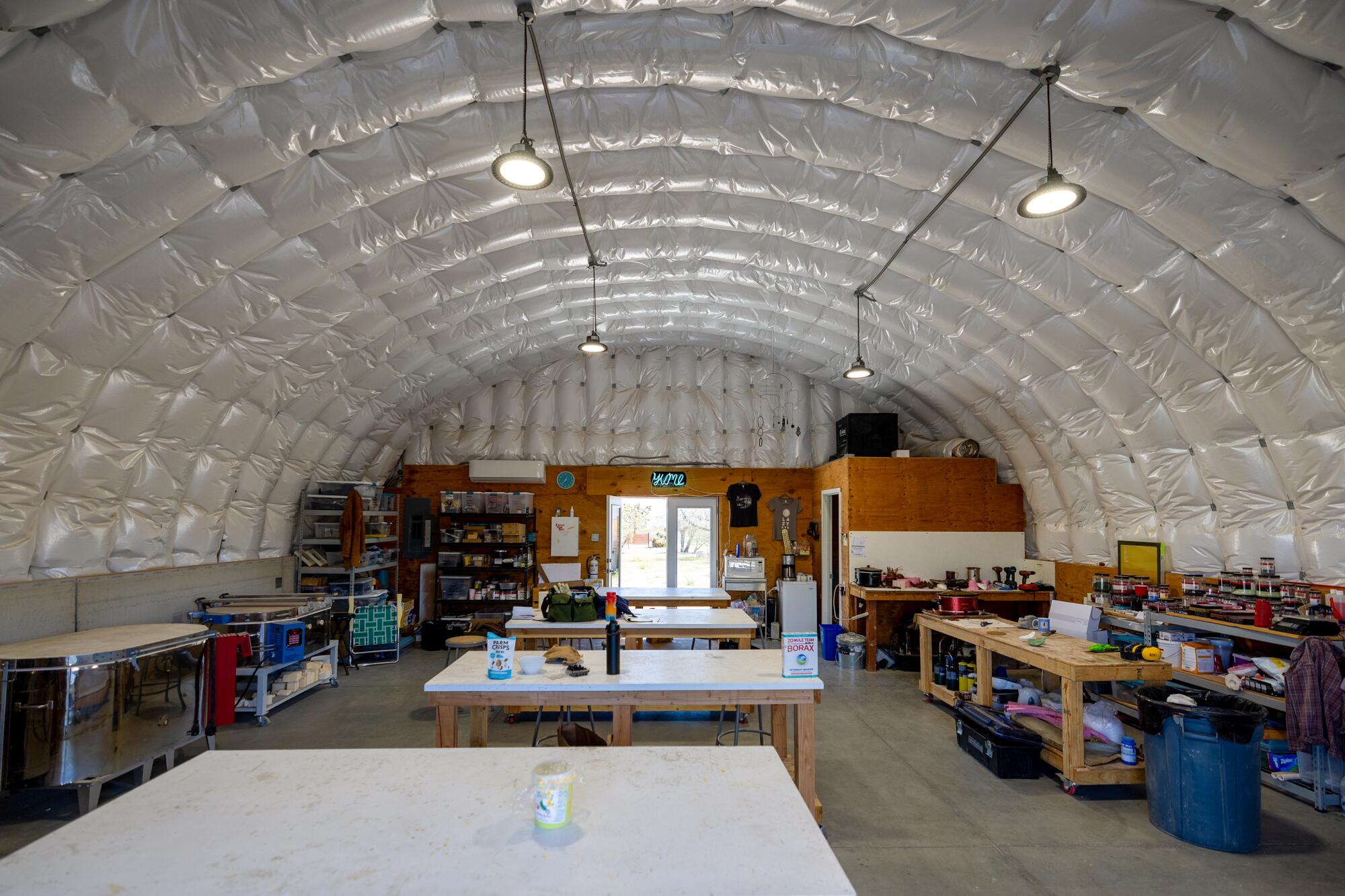
A view of the work lab in a Quonset structure built by a student at the Yucca Valley Material Lab.
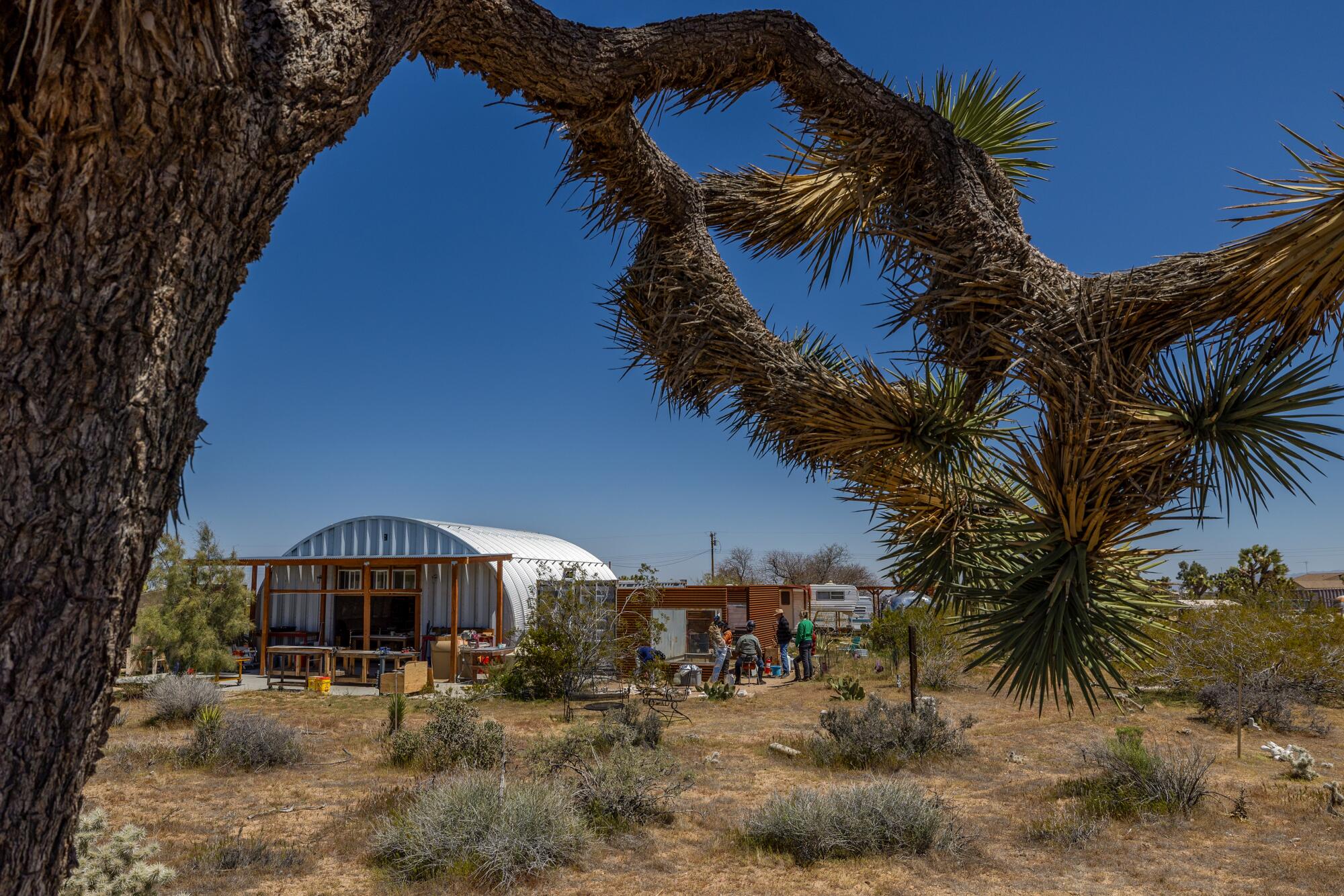
A Joshua tree frames students in the foundry.
“My introduction to life in America was the desert,” said Shah. She grew up in Palm Springs with her hotel manager father after her family emigrated from India. But later, she’d lived in Los Angeles, then New York and then returned to Los Angeles. “Now moving back here to the high desert, setting up my home and studio, it feels I’ve come back full circle.”
When she moved to L.A. in 2017, she realized that it had radically changed — most noticeably, the rent prices.
“But every exploding colorful sunset, every jackrabbit, every coyote sighting changed my brain chemistry,” said Shah. “I began to soften and ease into the different pace of life here. There’s a reverence for nature here that I hadn’t experienced before.”
In the summer months, the average temperature is 95 degrees Fahrenheit. “My studio schedule revolves around outside temperatures,” said Shah. “I tend to work early mornings and nights in the summer and run the kiln overnight.”
Workshops at the Lab are about to wind down for the summer, making the last bronze pour of the day bittersweet.
After pouring hot aluminum into one of her stick-shaped molds and letting it cool in a pile of dirt, a participant took a ball-peen hammer and cracked open the rough silicate mold, like a geode.
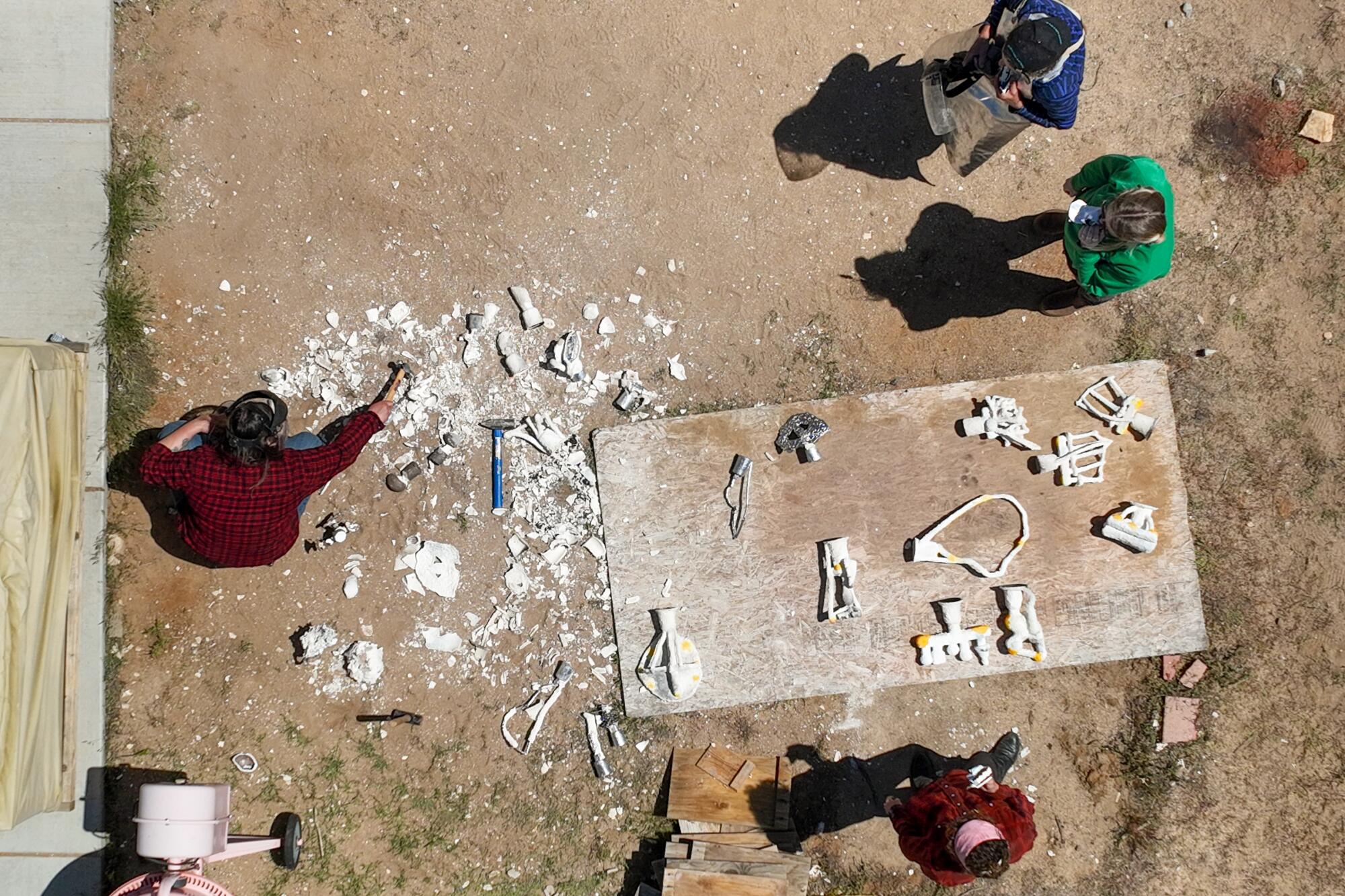
An aerial view of students in the foundry knocking plaster off molds with a ball-peen hammer.
The next day, participants buffed their objects and applied chemical solvents to create patinas and finishes before heading back to the city. After the last pour finished, the crucible was set aside to cool.
“That’s a wrap,” said Schwegler, while everyone clapped.


In central London’s Waterloo Place, a life-size statue that emerged overnight in late April has been creating a stir. When I visited a few weeks after it was erected, local authorities had already set up protective barriers around it.
The installation — signed by the famed street artist Banksy — depicts a man in a suit hoisting a flag as he strides over a precipice. As he marches on, the flag blows backward to cover his face, leaving him unaware he’s only a step away from a perilous fall.
Set among grand monuments celebrating Britain’s past, the “flag man” takes on a particular visual irony at a time when the country — and much of the world — is debating its path forward.
Like many viewers there, I found myself wondering whether this statue is Banksy’s warning about the consequences of uncritical nationalism, or simply a reflection on human shortsightedness. Or, perhaps, it is just prompting us to ponder a broader question: What happens when devotion to a symbol prevents us from seeing what lies ahead?
Whatever the message, the work feels remarkably attuned to the current moment.
For more Far-Flung Postcards, click here.
Lifestyle
Wait, it’s a candle? Her beeswax fruit and veggie ones look so real, you’ll want to take a bite
Jessica Gonzalez hustles behind her booth at the recent Renegade Craft Fair, frantically ringing up sales, answering questions and packaging her beeswax candles.
It’s hot on the grounds of the Los Angeles State Historic Park in April, but 35-year-old Gonzalez and her fiancé, Jordan Colindres, keep their cool as a crowd gathers to admire her Happy Organics candle collection, a homage to her family’s produce company in the Central Valley that looks like real fruits and vegetables.
“I love doing in-person events because it’s so fun to see people’s reactions,” she said a few months later. “It makes me feel good to see other people finding joy in my candles. They often say, ‘Oh, that’s really funny.’ And it is funny to have a cherry candle on top of your birthday cake.”

3

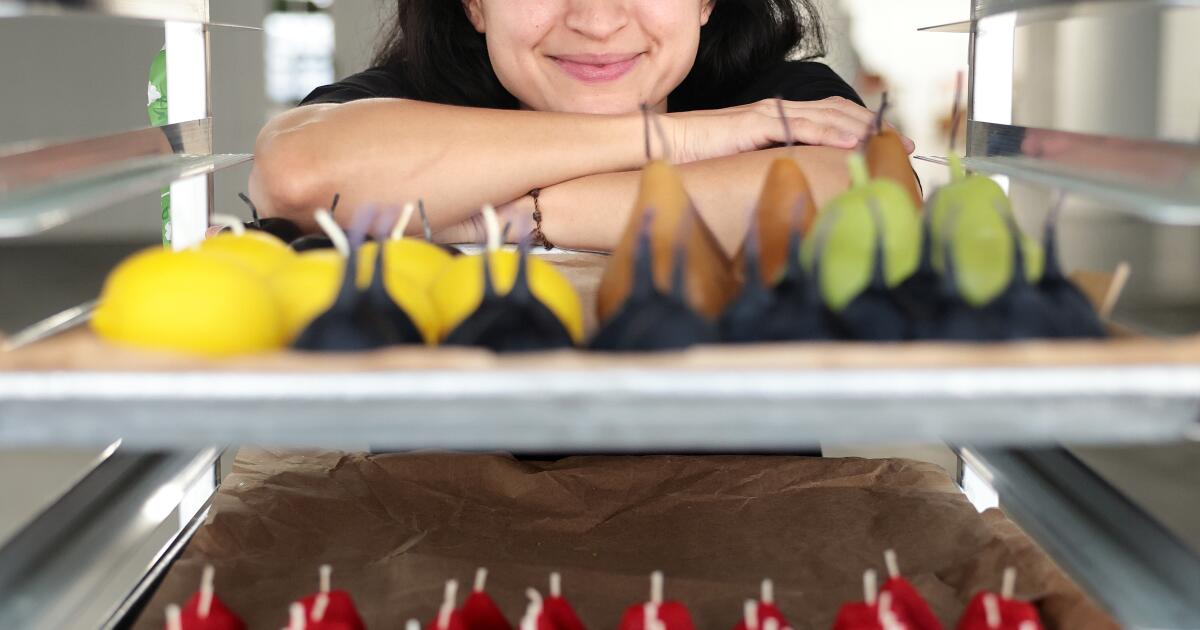
1. A staff member pulls a beeswax corn candle, $26, out of its mold at Happy Organics’ studio in downtown Los Angeles. 2. Each Beeswax Mixed Berry Birthday Candles set is cast from real mixed berries — strawberries, raspberries, blackberries, blueberries and cherries. A set of 10 is $30. 3. Bartlett green pears and heirloom tomatoes, $24 to $40.
Judging by the smiles and charmed looks on shoppers’ faces, her produce-inspired candles are less about illuminating rooms and more about sharing the joy she sought when she first started the company in 2018.
In this series, we highlight independent makers and artists, from glassblowers to fiber artists, who are creating original products in and around Los Angeles.
But then, it’s hard not to smile at the playfully elegant Bosc pears, puckered mandarins and green-and-purple asparagus taper candles which range in price from $12 to $40. Some are molded into corn on the cob, celery and rhubarb shapes. Others are made to look like mushrooms, figs, tomatoes and snap peas. The most popular are the small birthday candles shaped like raspberries, cherries and blackberries, packed in molded-pulp baskets just like you’d find at the grocery store or farmers market.

-
Share via
Gonzalez didn’t start out as a designer. The youngest of nine children, she was born in 1991 in Salinas and later moved to Merced, where she grew up on a 10-acre farm. She studied computer science at Mills College, then worked in tech consulting in the Bay Area and eventually became the CTO of an ag-tech company. When her mother, Angela, became ill in 2016, she returned to Merced to be with her family.
When her mom died suddenly soon after she moved home, Gonzalez left the tech industry. “I wasn’t connected with what I was doing,” she said. “I wanted to find something more meaningful; something I loved. I didn’t want my ego to keep me stuck in what I studied in college. I decided to let myself try new hobbies and passions and look for joy again.”
After her mother’s death, she began working with her father, Salvador, and her uncles at the family’s apiary, where they managed more than 30 hives. (Her grandfather was also a beekeeper in Michoacán, Mexico.) Soon, she began selling their raw honey at local farmers markets. In a heartbreaking turn, her father was diagnosed with cancer a year later, so she started making cannabis-infused honey, balms and chocolates to help ease his pain.
When she saw that the beeswax candles, which last significantly longer than paraffin candles, were selling faster than the honey, she decided to focus on making candles from the leftovers from her uncles’ hives.
She was only 25, but it was a turning point. “It was one of those moments where I felt like I needed to change my path,” she said. “I needed to change everything in my life.”

Jessica Gonzalez and her father Salvador on their family farm in Merced. (Gonzalez family)

Gonzalez at Happy Organics’ studio in downtown Los Angeles. (Christina House / Los Angeles Times)
When her father died in 2018, she inherited his bees and started Happy Organics, although she hadn’t planned on starting a business. After experiencing so much loss, making candles became a kind of therapy. “It felt great to work with my hands again, something I thought I’d never have time for,” she said.
Her oldest sister, Sonia Gonzalez, said Gonzalez reminds her a lot of their father, who reinvented himself many times over the years.


The nopal cactus is cast from a real nopal and hand-poured in 100% pure beeswax in the Los Angeles studio.
“He grew up as a village boy in the rural mountains of Michoacán, Mexico, and went on to work in restaurants, cut down Christmas trees and pick strawberries and broccoli in the fields of Salinas,” she wrote in an email. “From there, he started selling produce door-to-door, then at flea markets and eventually built his own produce distribution business from the ground up. As the youngest of nine kids from a working-class family, Jessica’s always been incredibly resourceful, responsible, and amazing at reinventing herself.”
Like a lot of millennials, Gonzalez taught herself how to make candles by watching YouTube videos. She started with hand-dipped tapers, working in the garage on the farm that helped her feel safe and connected to her parents. “It was a really nice environment to try something new and creative,” she said.
Inspired by her family’s produce, she cast real corn, strawberries and cherries in plaster, then made a silicone mold to create copies. Even when using the same mold, color can vary from batch to batch, and how it cools also affects the result. “That’s just how handmade things are,” she said. “There’s always some variation.”

Cherry molds make cherry candles at Happy Organics’ studio in downtown Los Angeles.

A variety of fruit and veggie candles.
When she moved to Los Angeles in 2023 to be with Colindres, her business took off. “L.A. is a great place to grow,” she said. “There’s so much opportunity here. When I go to a farmers market, I never know who I’ll meet.”
She sold her candles in person at craft shows, the Hollywood Farmers’ Market and most recently, during a residency at the P.F. Candle Co. showroom in Echo Park.

2

3

1. A staff member trims the wicks on a pair of carrot birthday candles, $22. 2. Gonzalez passes by shelves of candles at Happy Organics’ studio in downtown Los Angeles. 3. Asparagus taper candles, $30.
“I have a lot of respect for her as a fellow candle maker (making molds is not easy), but getting to know her story more and how her choice of foods and wax is reflective of her family’s history gave it so much meaning,” P.F. Candle Co. founder and creative director Kristen Pumphrey said in an email. “It’s been a tough couple of years for L.A. businesses, so we gotta stick together — there’s this wonderful sense of community hosting a local brand that’s so passionate about their work.”
As her business has expanded, her products are now available at Terrain, Joan’s on Third and the MoMA Design Store in addition to her website. She has also had to source beeswax from other vendors across the country to keep up with demand.
Kimberly Curtis, owner of Hide & Seek Vintage in Studio City, said Gonzalez’s strawberry and cherry birthday candles “flew off the shelves last year” during the holidays. “Our customers love them,” she added.

Gonzalez holds a cabbage candle.
Still, Gonzalez stays connected to her Central Valley roots. Everything she and her small team make in downtown Los Angeles is handmade and “takes time,” she said, describing the steps involved in crafting quality candles. Right now, her favorite is the Nopal Cactus candle, which she made using a clipping from an employee’s yard. While others help her with production, wholesale management and packaging, she focuses on sales, content and all-new product development.
When asked if she has advice for others who want to start their own business, Gonzalez admits she sometimes feels overwhelmed.

In 2013, Gonzalez and her family gathered at their Merced ranch to celebrate her parents’ anniversary.
(Gonzalez family)
“The biggest thing that has gotten me through the toughest spots is my why or my reason for starting,” she said. “I think that has to be really strong. That’s what brought me a lot of comfort when I felt like quitting: going back to the beginning and remembering why I started this.”
For Gonzalez, her reason is always close to her heart. “I wanted to feel connected to my parents in some way,” she said. “This was a good representation of my upbringing.”

The Kennedy Center, the facade of which remains covered with a tarp, is seen in Washington, DC, on June 28, 2026. A US federal judge asked on June 24 for an explanation for why a tarpaulin continues to cover the facade of the Kennedy Center where President Donald Trump’s name was recently removed. District Judge Christopher Cooper gave the board of trustees of the performing arts venue until the end of July to explain “the purpose for and status of the tarp and scaffolding that Defendants have erected on the front portico of the Center.”
ALEX WROBLEWSKI/AFP via Getty Images
hide caption
toggle caption
ALEX WROBLEWSKI/AFP via Getty Images
More than two weeks ago, President Trump’s name was removed from the Kennedy Center facade though it is still covered by a tarp and the legal battle continues.
On Monday, a U.S. Department of Justice filing on behalf of the Kennedy Center included some surprises. The document was submitted in response to issues raised by lawyers for ex-officio board member Rep. Joyce Beatty of Ohio who is suing to remove President Trump’s name from the center and stop its closure for renovations.
Among the revelations, the Kennedy Center admitted that, during a board meeting on December 18, 2025, Beatty had been “muted and prevented from speaking.” It was at that meeting that the board voted to add President Trump’s name to the center. The filing later acknowledges the congresswoman was “prevented from voicing her opposition.”
The John F. Kennedy Center for the Performing Arts is a living memorial to its namesake. The guidelines for how the theatre complex spends federal dollars are very specific. Among other rules, it states that “no additional memorials or plaques shall be designated or installed.” Beatty argues adding Trump’s name runs afoul of those rules and that any change requires approval from Congress.
According to one of Beatty’s filings, “There was no advance notice in the agenda that the Board would be considering a name change,” a statement the Kennedy Center now does not deny. The center admits that, prior to voting, there was “no discussion about potential risks or downsides of the vote to adopt a secondary name for the Center.” Nor was there a board discussion “about any potential conflict of interest that might result from the vote.”
The center’s lawyers previously contended that if Trump’s name were to be removed, it would “lose money from donors who support” him and “impede the Center’s fundraising efforts.”
Closing for renovations
Earlier this year, Trump announced on social media that the Kennedy Center would close for two years for renovations. He wrote that he made the decision after “a one year review” with “Contractors, Musical Experts, Art Institutions, and other Advisors and Consultants.”
But, according to the center’s lawyers, Trump’s announcement “was made without presenting any plans, analyses, timelines, or funding information to his cotrustees and without any Board vote.”
The Kennedy Center has long denied reporting by The Washington Post that ticket sales plummeted after President Trump became the Center’s board chair. In Monday’s legal filing, the Center admits that, by October 2025, “nearly half of the Center’s tickets were going unsold.”
-

 Science18 minutes ago
This Cell Feeds, Grows and Reproduces. And It’s Manmade.
-
Lifestyle40 minutes ago
Greetings from London, where Banksy’s flag man is a warning cry
-
Education43 minutes ago
This Little Robot Cleans Windows
-

 Technology48 minutes ago
Comcast’s split could make or break Peacock
-

 World55 minutes ago
State Department congratulates Keiko Fujimori as Peru’s president-elect following razor-thin vote count
-

 Politics58 minutes ago
Mamdani ripped for claiming victory over capitalism after NYC’s multi-billion dollar taxpayer funded bailout
-

 Health1 hour ago
American vaccines that transformed public health over 250 years: ‘Outweighs harm’
-

 Sports1 hour ago
Ex-NFL reporter Dianna Russini interaction with police officer to dodge traffic ticket comes to light

