Lifestyle
Artists priced out of Los Angeles head to this creative hub in the high desert

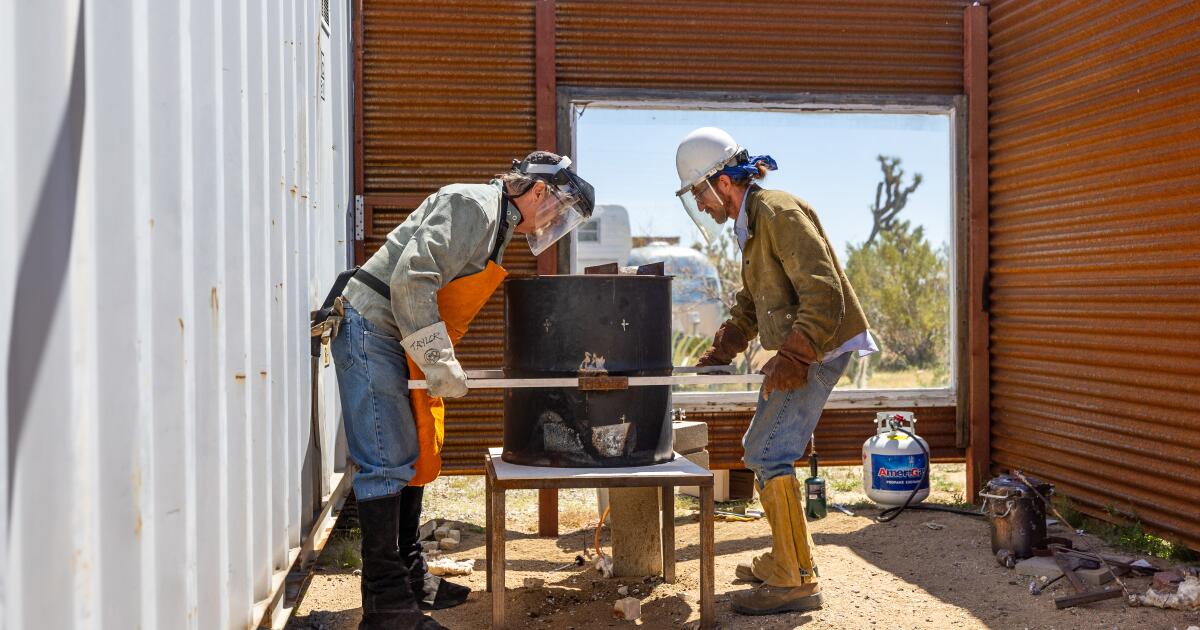
At high noon on a Saturday, the last aluminum pour of the day is about to commence at the Yucca Valley Material Lab.
Heidi Schwegler, founder of the Lab, has crawled up to the roof to get the best vantage point for a video. Schwegler has a hard stance on safety while still allowing for wild experimentation — it’s this attitude that makes the compound, with its art and recording studios, gallery, retrofitted campers and workshops like foundry and glass casting — a place of inspiration and community that pulls in people from all over the nation, but especially Angelenos looking for a reprieve from city life.
Owner Heidi Schwegler at Yucca Valley Material Lab in Yucca Valley.
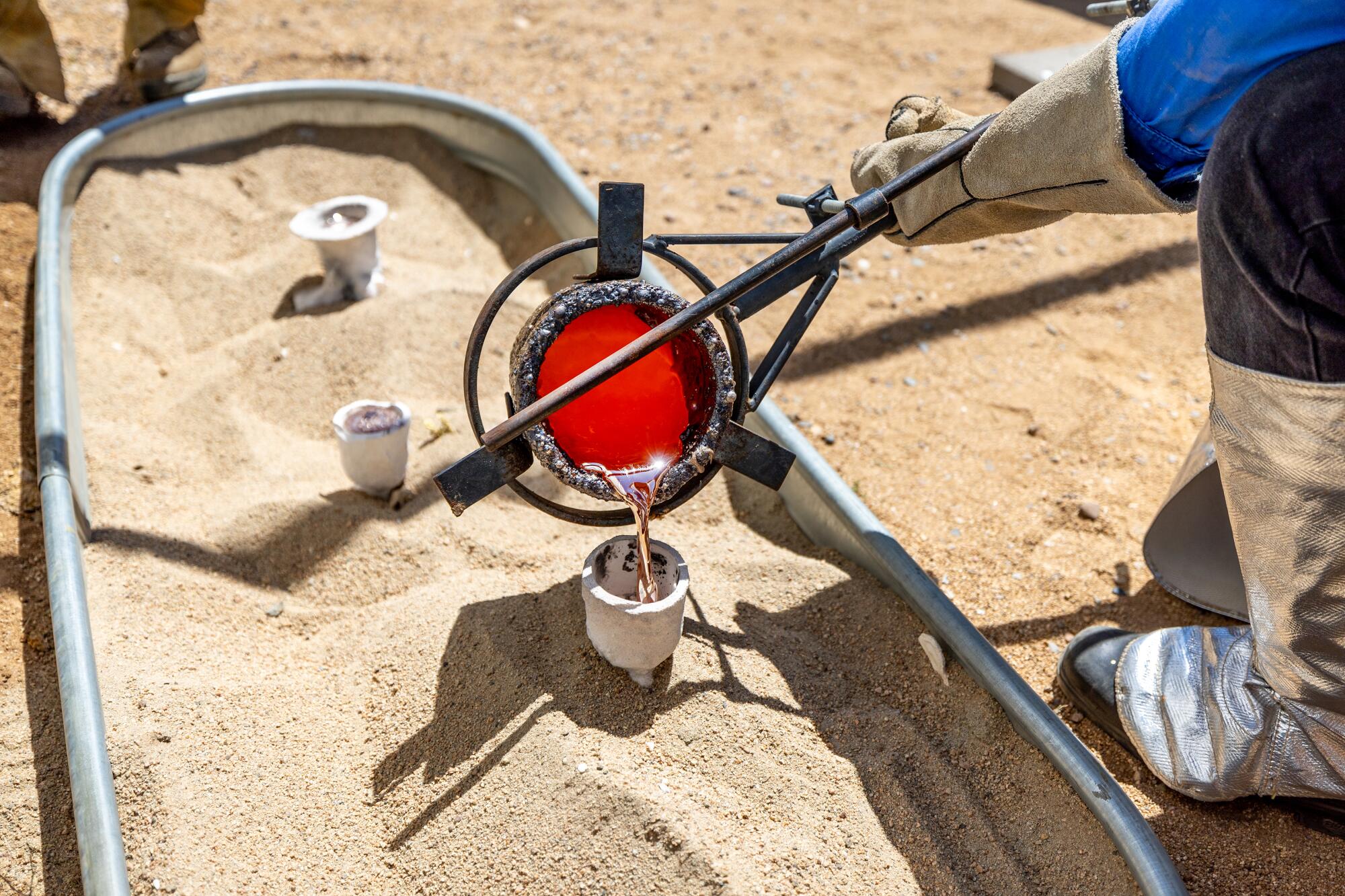
Jodie Cavalier, an interdisciplinary artist, pours molten aluminum into molds made earlier in the week.
(Allen J. Schaben / Los Angeles Times)
“This is the closest Derek and I could get to L.A. and afford it,” said Schwegler, referring to her partner, Derek Monypeny, who works with musicians. “And I think if you ask a lot of artists out here, they’ll say the same thing. It’s as close as you can get and be a really decent place to live and have a huge studio and still be within driving distance of an art center.”
It’s this passion and energy that pull artists east. Every workshop sells out, attracting hot-shot artists and retired high school teachers alike. “It’s really amazing to see my art and pedagogical practice come together outside of myself — in the form of a curved metal building plopped in the Mojave Desert,” Schwegler said. “Never would I have imagined this when we bought this property in 2018.”
The Lab has become a landing place for out-of-town artists and people looking for a way to plug into the desert scene. Many artists in Yucca Valley moved there on a whim after visiting for a weekend, much like Schwegler.
“I built this program because I was really afraid I would become a total recluse out here, because I didn’t think anybody was out here,” Schwegler said. “Come to find out, it’s just like that saying: ‘If you build it, they will come.’”
An artist and self-proclaimed materials junkie, Schwegler has pulled together funding from various sources, including AHA Projects, a nonprofit organization that supports creators, to cover residency and workshop costs, including airfare for teachers and housing for artists. Schwegler also often works with artists from the desert and Los Angeles for trade.
The Lab’s growing community has been cited as a reason why L.A. artists stay in the high desert — being able to see familiar faces at one or two cultural events a weekend is a balm after the smorgasbord and sprawl of the Southland.
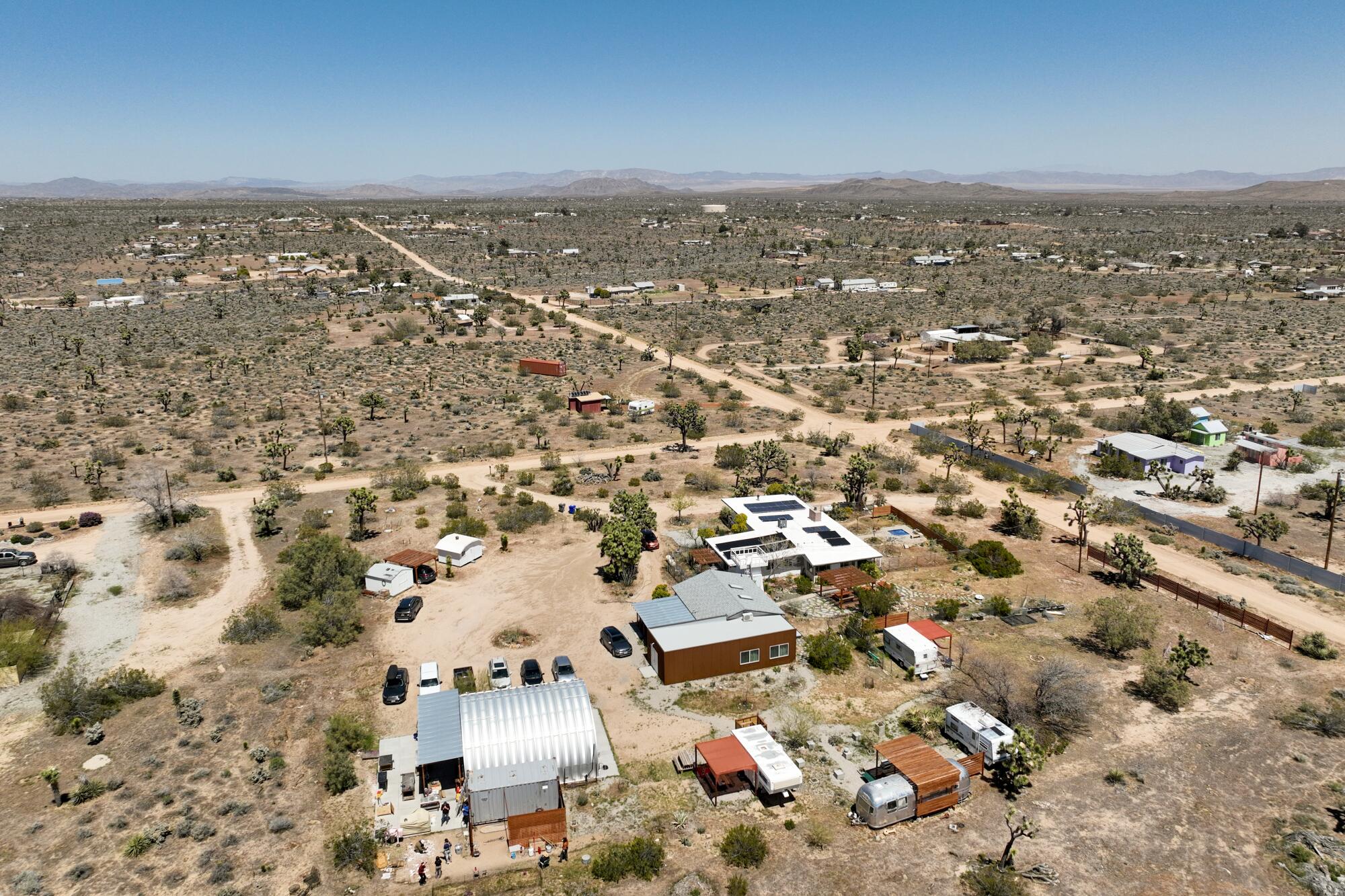
The Yucca Valley Material Lab, as seen from above.
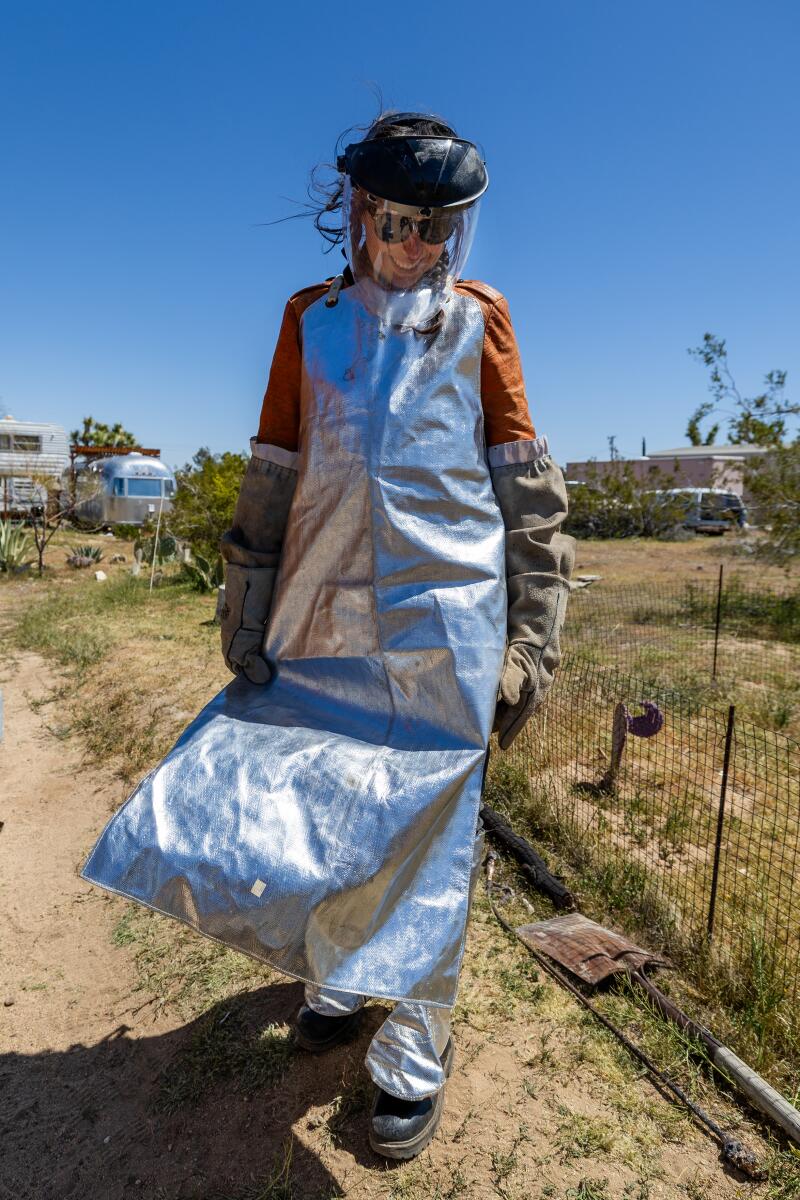
Haydeé Jiménez, an artist in residence at Yucca Valley Material Lab, wears a protective Kevlar apron during a bronze and aluminum workshop.
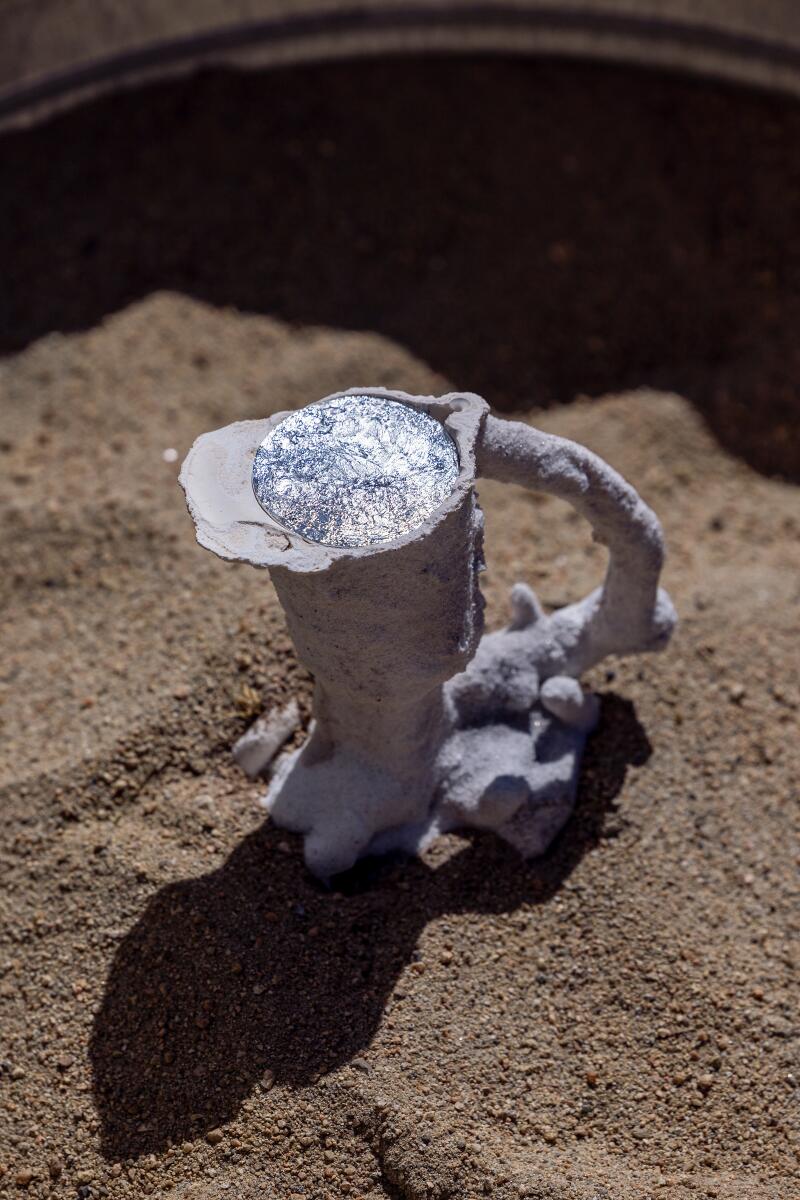
Students in the foundry casting in bronze and aluminum workshop pour molten aluminum into molds that were made earlier in the week.
In 2016, artists Ry Rocklen and Carolyn Pennypacker Riggs realized that a mortgage in the desert would be cheaper than a storage unit in Los Angeles. “I had a bunch of my ‘Trophy Modern’ furniture in storage and realized we could decorate our house with it and have a place to visit on the weekends,” said Rocklen, of a series of sculptures he made for an exhibit.
After having a child in 2020 and spending more time in nearby Joshua Tree, they moved full-time and converted their garage into studio space. “It was such a strange time, with so many different things going on, adjusting was not really on my mind. It was kind of a blur between our new baby, the pandemic and the move,” said Rocklen, who runs the gallery space Quality Coins in Yucca Valley. “The landscape, however, was our saving grace, as we were able to go on walks through the beautiful rocky hills.”
Back at the metal workshop, the roaring sound of the kiln — which is used in the process of turning molten bronze and aluminum into objects — fills the quiet desert mesa with an ambient soundtrack.
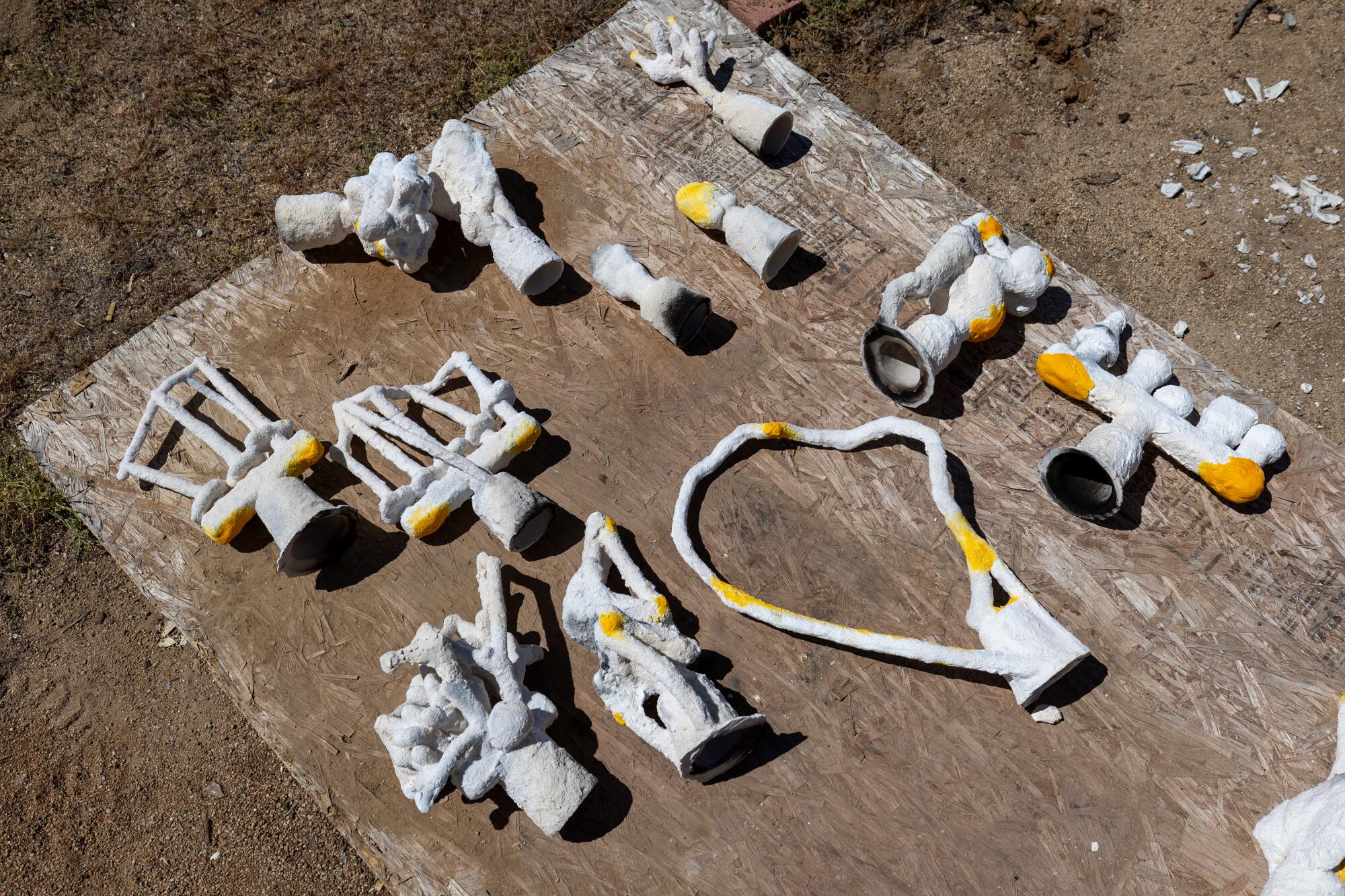
During a metals workshop, students made molds and learned to pour bronze and aluminum at the foundry.
Haydeé Jiménez, a recent artist in residence who splits her time between Los Angeles and Tijuana, crouched outside the metals workshop observation window wearing headphones and sunglasses, with her microphone wind-screened by a cardboard box. Amid the Joshua trees and creosote bushes, she recorded the sounds of the makeshift foundry.
Jiménez, who describes her art practice as revolving around “sound, music and vibrational sound healing,” said she was excited to work with new materials.
“When I first got the invitation to join [the Lab] for a residency, I hoped to work with glass and create little resonant objects for the development of a sort of acoustic ASMR experience,” said Jiménez, referring to Autonomous Sensory Meridian Response, which is when one is soothed by sounds like whispers and taps. Later in the weekend, she’d layer the foundry recording over sounds made using bronze objects from the workshop in a performance with gong-master Tatsuya Nakatani at the Firehouse, a Joshua Tree venue.
Any given weekend at the compound can be action-packed; that Saturday, Lazy Eye Gallery opened Michelle Ross’ “Before Pictures,” a show of sculptural paintings inside the nave of a water tower converted into a small funnel of a gallery space with a ladder to the roof that affords a view of the mesa.
But as the artists’ community grows, so has interest in real estate in Yucca Valley, Joshua Tree and Twentynine Palms, once considered more affordable areas. Housing prices in Yucca Valley have grown 80% since 2019, according to Zillow, although the steep pandemic rush has since cooled.
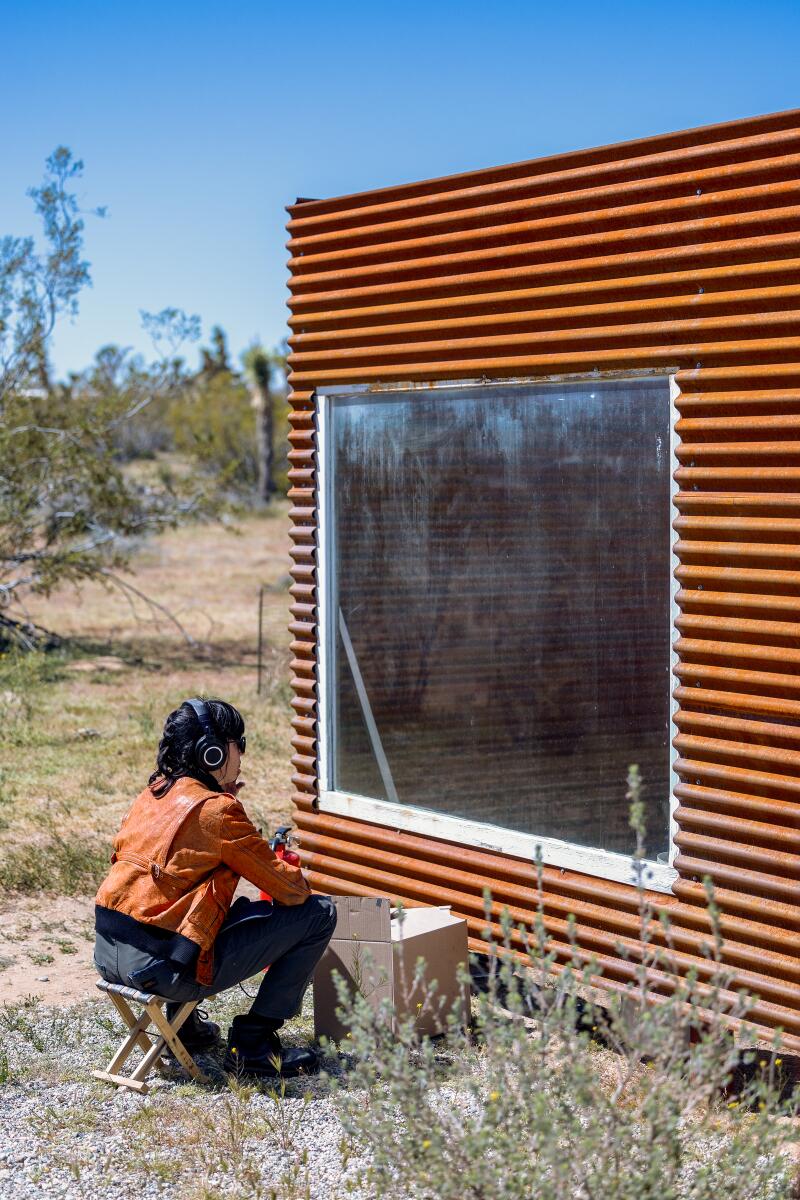
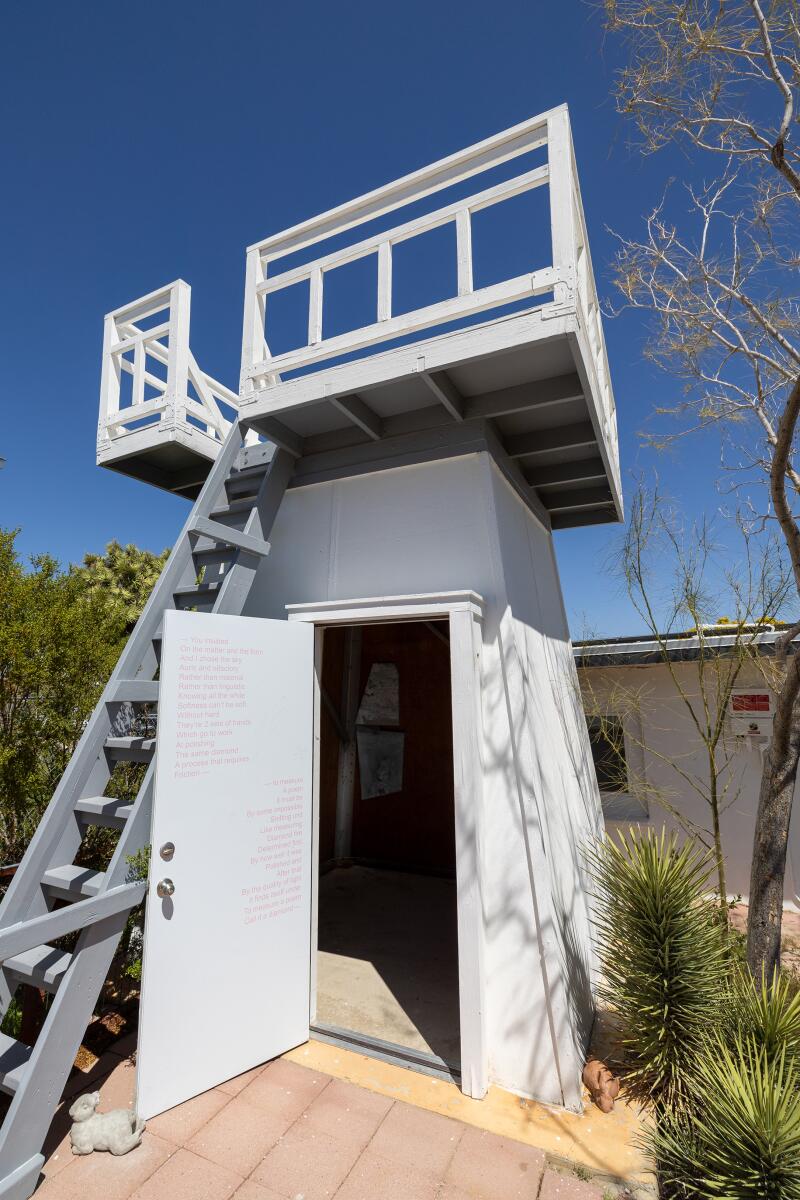
Haydeé Jiménez, an artist in residence at Yucca Valley Material Lab, records sounds of students in the foundry pouring molten aluminum into molds. A view of the Lazy Eye gallery at the Yucca Valley Material Lab.
“The presence of Airbnbs is corrosive,” said Riggs, observing that interested buyers have grown beyond “Silver Lake hipsters with a getaway cabin.” Last year, Yucca Valley capped short-term rentals at 10% of its housing stock. According to Redfin, most people searching to buy Yucca Valley homes today are in San Francisco.
Between the expansive landscape, cheaper-than-L.A. studio space and the small-town feel, the desert offers the experience of slow time — which can help some artists tap into a flow state without the day-to-day distraction of city living. But all that free time and space can be intimidating.
Ceramic artist and designer Mansi Shah left Los Angeles in 2020 after another artist friend told her about a house for rent in Yucca Valley; she packed up and headed to the desert within a few weeks. “There was 500 feet of open desert between me and my nearest neighbor. I remember those first few months, I was terrified of everything. The wind, the quiet, the desert critters,” said Shah.
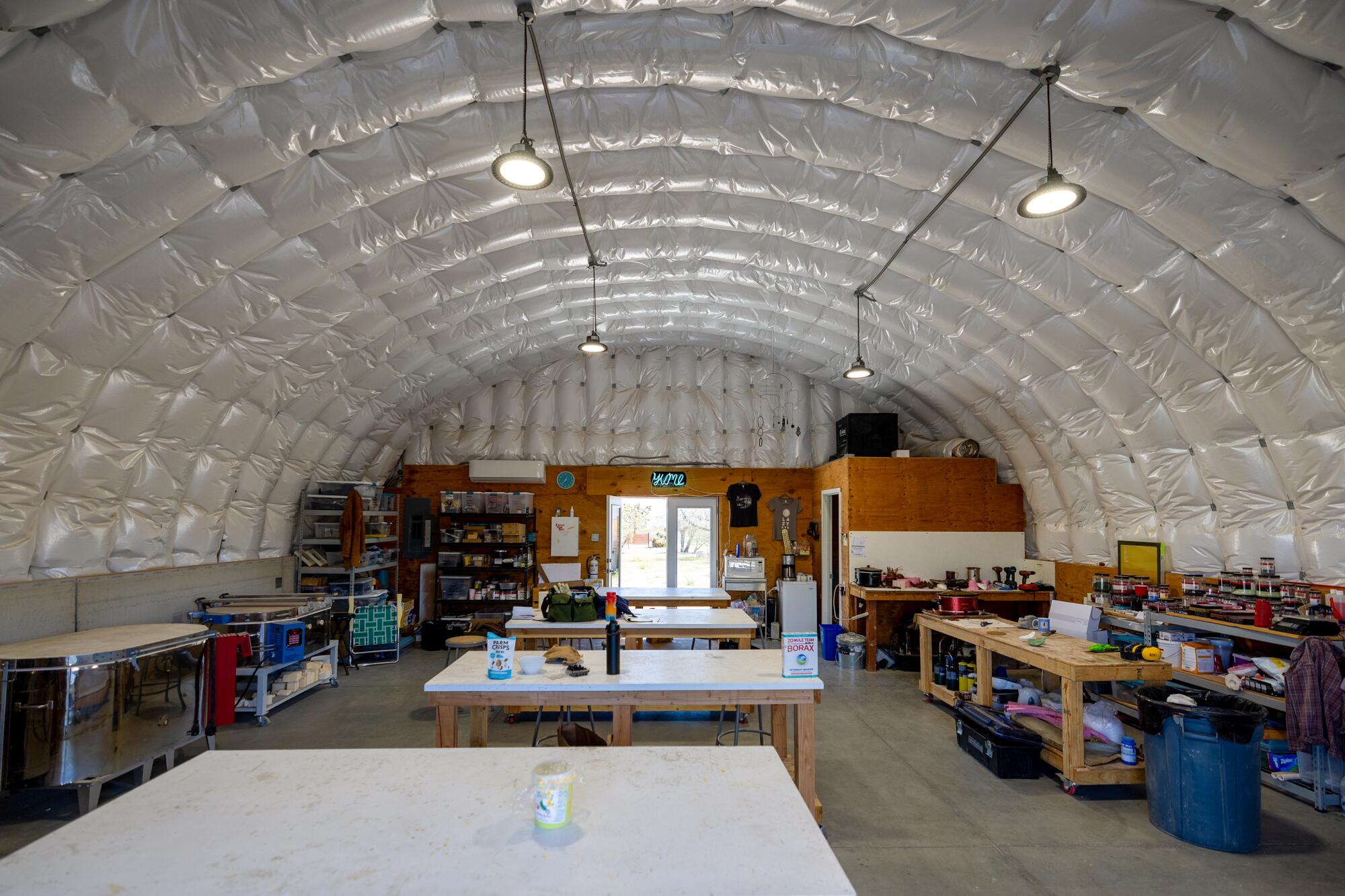
A view of the work lab in a Quonset structure built by a student at the Yucca Valley Material Lab.
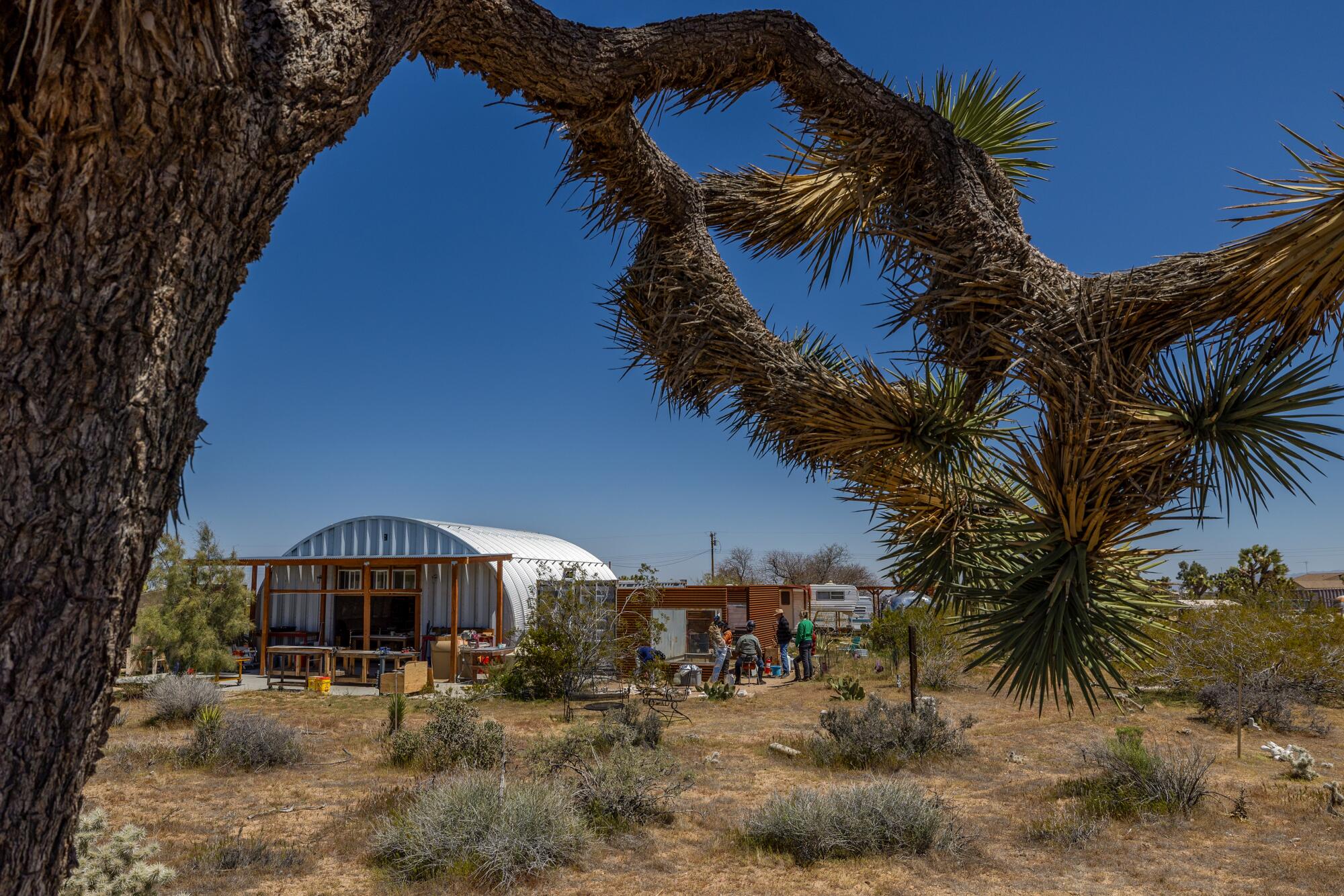
A Joshua tree frames students in the foundry.
“My introduction to life in America was the desert,” said Shah. She grew up in Palm Springs with her hotel manager father after her family emigrated from India. But later, she’d lived in Los Angeles, then New York and then returned to Los Angeles. “Now moving back here to the high desert, setting up my home and studio, it feels I’ve come back full circle.”
When she moved to L.A. in 2017, she realized that it had radically changed — most noticeably, the rent prices.
“But every exploding colorful sunset, every jackrabbit, every coyote sighting changed my brain chemistry,” said Shah. “I began to soften and ease into the different pace of life here. There’s a reverence for nature here that I hadn’t experienced before.”
In the summer months, the average temperature is 95 degrees Fahrenheit. “My studio schedule revolves around outside temperatures,” said Shah. “I tend to work early mornings and nights in the summer and run the kiln overnight.”
Workshops at the Lab are about to wind down for the summer, making the last bronze pour of the day bittersweet.
After pouring hot aluminum into one of her stick-shaped molds and letting it cool in a pile of dirt, a participant took a ball-peen hammer and cracked open the rough silicate mold, like a geode.
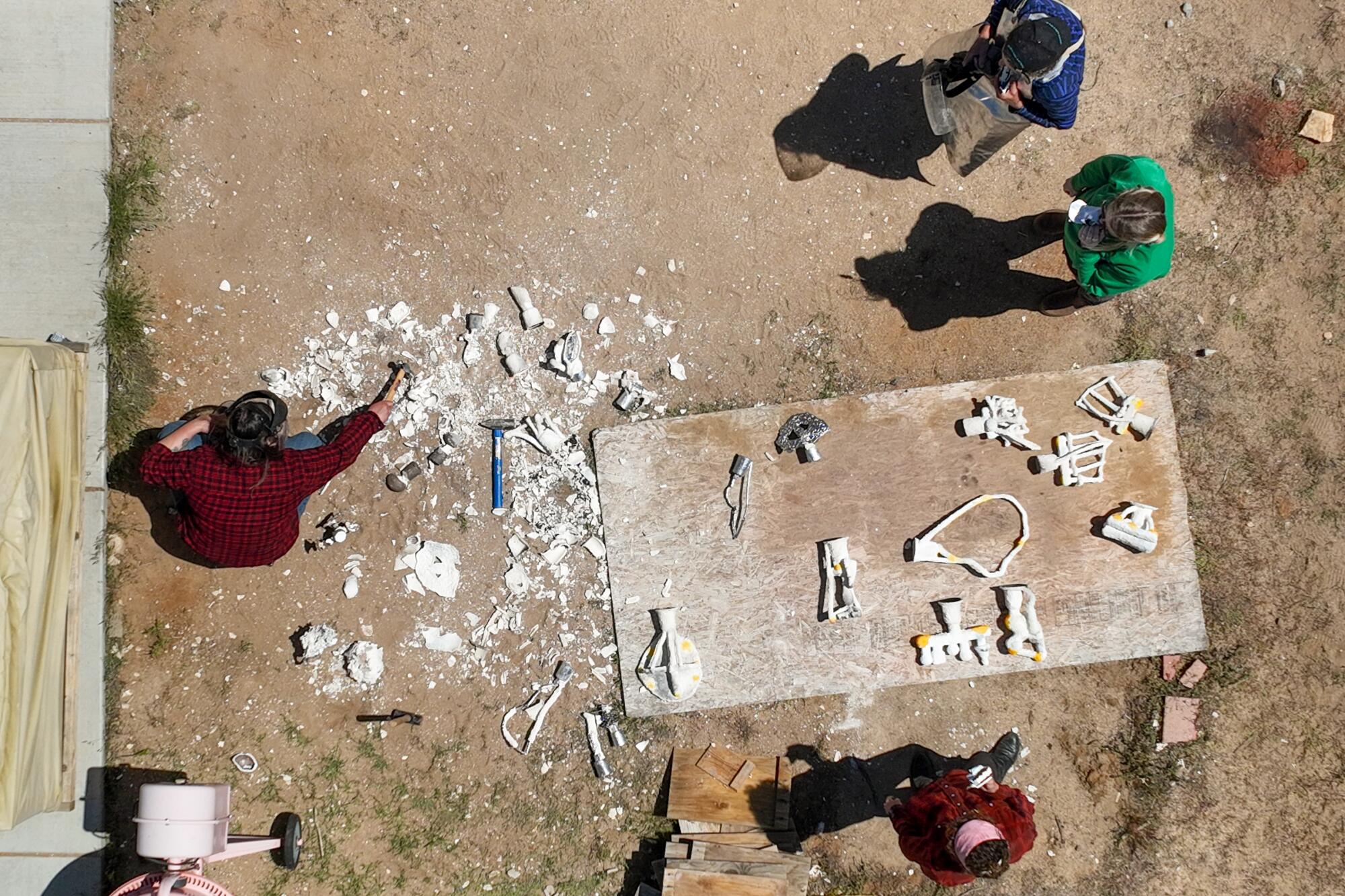
An aerial view of students in the foundry knocking plaster off molds with a ball-peen hammer.
The next day, participants buffed their objects and applied chemical solvents to create patinas and finishes before heading back to the city. After the last pour finished, the crucible was set aside to cool.
“That’s a wrap,” said Schwegler, while everyone clapped.



Britney Spears
Open to Treatment Plan After DUI Arrest, Source Says
Published
Britney Spears‘ team is hoping the judge mandates treatment for the pop star over jail time following her Wednesday DUI arrest … and Britney isn’t fighting them on that, TMZ has learned.
Sources familiar with the situation tell TMZ … Britney is willing to comply with a treatment and support plan.
We’re told her team is in the early stages of developing a plan and they’re exploring multiple options, including mental health services, detox, and dual-diagnosis programs.
It’s unclear whether she would do inpatient or outpatient treatment, and it’s also unclear whether she would enter treatment before her May 4 court date.
Broadcastify.com

We broke the story … Britney was pulled over by California Highway Patrol officers around 9:30 PM Wednesday in Westlake Village, CA, not far from her home. She was later taken to a hospital — not for any injuries, because we’re told she didn’t sustain any — but to draw her blood to determine her blood alcohol content.
According to CHP, she was arrested for “driving under the influence of a combination of drugs and alcohol.”
Sources familiar with the investigation told us an unknown substance was found in Britney’s car, which was sent to be tested.
Britney’s manager, Cade Hudson, previously told TMZ … “This was an unfortunate and inexcusable incident. Britney will take the right steps, comply with the law, and we hope this marks the start of long-overdue change in her life. She needs help and support during this difficult time. Her boys will be spending time with her, and her loved ones are putting a plan in place to set her up for success and well-being.”

Michael B. Jordan plays twin brothers Smoke and Stack in Sinners.
Warner Bros. Pictures
hide caption
toggle caption
Warner Bros. Pictures
Ryan Coogler’s supernatural horror stars Michael B. Jordan playing twin brothers who open a 1930s juke joint in Mississippi. Opening night does not go as planned when vampires appear outside. “In a straightforward metaphor for all the ways Black culture has been co-opted by whiteness, the raucous pleasures and sonic beauty of the juke joint attract the interest of a trio of demons … they wish to literally leech off of the talents and energy of Black folks,” writes critic Aisha Harris. The film made history with a record 16 Academy Award nominations.


We asked our NPR audience: What movie would you recommend to someone who loved Sinners? Here’s what you told us:
Near Dark (1987)
Directed by Kathryn Bigelow; starring Adrian Pasdar, Jenny Wright, Lance Henriksen
If you want another cool vampire movie with Western kind of vibes, check out Kathryn Bigelow’s Near Dark — super underseen and kind of hard to find, but really gritty and sexy and another very different take on what you might think is a genre that had been wrung dry. – Maggie Grossman, Chicago, Ill.
30 Days of Night (2007)
Directed by David Slade; starring Josh Hartnett, Melissa George, Danny Huston
It follows a group of people in a small Alaskan town as they struggle to survive an invasion of vampires who have taken advantage of the month-long absence of the sun. Both this and Sinners revolve around a vampire takeover and the people’s fight to outlast the “night.” – Nathan Strzelewicz, DeWitt, Mich.
The Wailing (2016)
Directed by Na Hong-jin; starring Kwak Do-won, Hwang Jung-min, Chun Woo-hee, Jun Kunimura
In this South Korean supernatural horror film, a mysterious illness causes people in a quiet rural village to become violent and murderous. A local police officer investigates while trying to save his daughter, who begins showing the same disturbing symptoms. The film blends folk horror, religion, and psychological dread, exploring themes of faith, evil, and moral weakness. Like Sinners, it centers on a supernatural force corrupting a close-knit community, builds slow-burning tension, and examines spiritual conflict and human frailty. – Amy Merke, Bronx, N.Y.
Fréwaka (2024)
Directed by Aislinn Clarke; starring Bríd Ní Neachtain, Clare Monnelly, Aleksandra Bystrzhitskaya
In this Irish folk horror film, a home care worker, Shoo, is assigned to stay with an elderly woman who’s convinced she’s under siege by malevolent fairies. Like Sinners, Fréwaka blends folk traditions and social commentary with horror. The social failures Shoo copes with (untreated mental health issues, religious abuse) are just as frightening as the supernatural forces. – Kerrin Smith, Baltimore, Md.
And a bonus pick from our critic:
Ma Rainey’s Black Bottom (2020)
Directed by George C. Wolfe; starring Viola Davis, Chadwick Boseman, Glynn Turman
This is an adaptation of August Wilson’s play about a legendary blues singer (Viola Davis) muscling through a recording session with white producers who want to control her music. Chadwick Boseman’s blistering in his final role. – Bob Mondello, NPR movie critic
Carly Rubin and Ivy Buck contributed to this project. It was edited by Clare Lombardo.

The tiny town of West Goshen, Calif., was exactly the kind of place that community solar was designed for.
Near Visalia, most of its 500 residents live in mobile homes, where companies won’t install rooftop panels without a solid foundation. And until recently, they used propane for heating and cooking, with price fluctuations in the winter posing hardships for low-income families.
Community solar, in which residents get a discount on their bills for subscribing as a group to small solar arrays nearby, was designed to help low-income residents, apartment dwellers, renters and others who can’t put panels on their own roofs.
Over the last 11 years, New York, Maine, Minnesota, Massachusetts and other states have built thriving community solar programs. But California has built, at most, only 34 projects since 2015, and experts say that’s a generous accounting.
“We’ve had community solar for a dozen years, and it simply has not produced anything of scale and anything of note,” said Derek Chernow, director of Californians for Local, Affordable Solar and Storage, a developer trade group that’s pushing to get a more robust program off the ground. “Projects don’t pencil out.”
The West Goshen residents were among the lucky few, becoming part of a community solar project in 2024.
“It has kind of allowed us to kind of breathe a little bit,” said resident and community organizer Melinda Metheney. Her bill has dropped by about $300 in the summer months, thanks to the 20% community solar discount, stacked with other low-income discounts and clean energy incentives, she said.
West Goshen’s panels sit about 10 miles out of town, in a field surrounded by farms. Energy and climate experts agree California must add much more clean energy to its grid, some 6 gigawatts by 2032, the California Public Utilities Commission said in a new plan last week.
Assemblymember Christopher M. Ward (D-San Diego), who in 2022 authored a bill to create a more effective community solar program, said the state needs to double its annual solar installation rate to reach that goal and is not on track to do that using only large utility-scale solar farms and individual rooftop arrays.
“We need mid-scale community solar,” he said.

Energy and climate experts agree California must add much more clean energy to its grid, some 6 gigawatts by 2032, the California Public Utilities Commission said in a new plan last week. Above, solar panels at Extra Space Storage in Pico Rivera.
(Kayla Bartkowski / Los Angeles Times)
He and a coalition of environmental groups, solar developers and the Utility Reform Network, a ratepayer advocacy group, worked to put his 2022 law into effect. They coalesced around requiring utilities to pay community solar developers and customers for the electricity they feed to the grid using the same formula they use for people who install rooftop solar.
But in May 2024, the California Public Utilities Commission decided to go with a late-in-the-game proposal backed by the state’s investor-owned utilities to pay community solar at a lower rate.
The agency, along with its public advocate’s office, argued that crediting solar developers at the higher rate would raise bills for customers who don’t have solar, who would still have to shoulder the cost of grid maintenance. It’s similar to the argument they’ve made to cut incentives for rooftop solar.
The new program relied on federal money, including the Biden administration’s Solar for All, to sweeten the deal for developers. But the utilities commission spent very little of the $250 million available under that grant before the Trump administration tried to claw it back last summer, and now it is held up in litigation.
At a legislative oversight hearing last week, Kerry Fleisher, the commission’s director of distributed energy resources, blamed the loss for the new program’s failure to launch.
“There’s been a tremendous amount of uncertainty in terms of the Solar for All funding that was intended to supplement this program,” Fleisher said. “That’s part of the reason why this has taken longer than normal.” She said the commission still plans to release a program in the next several months.
Ward, the San Diego lawmaker who wrote the community solar bill, called the program “fatally flawed” in an interview.
He’s now considering a bill to bring the community solar program more in line with what he initially envisioned — higher incentives, requirements for battery storage, and compliance with state law that mandates new houses be built with solar.
A study last year funded by a solar trade group found that could save California’s electric system $6.5 billion over 20 years. But Ward’s effort to revive his program last year failed to pass the Assembly appropriations committee.
“All the other states in our country that have adopted similar community solar program models, they are working,” said Ward, adding that 22 states have programs comparable to the one solar advocates want in California. “The writing on the wall suggests that, exactly as we feared years ago, this was not the way to go.”
California Public Utilities Commission spokesperson Terrie Prosper called California “a leader in cost-effective, least-cost solar deployment overall compared to any other state,” in an emailed statement.
Under the commission’s definition, the state has brought on 34 projects, representing 235 megawatts of community solar. But studies from groups such as the Institute for Local Self-Reliance and Wood Mackenzie use different definitions for community solar, and they show California far behind at least 10 other states.
Meanwhile, advocates and developers involved in successful community solar projects in California say they were difficult to get off the ground.

Homes in the Avocado Heights area of Los Angeles County are part of a community solar project.
(Kayla Bartkowski / Los Angeles Times)
One that came online in May in the unincorporated communities of Bassett and Avocado Heights in the San Gabriel Valley provides solar electricity to about 400 low-income residents. They get 20% discounts on their electric bills for subscribing to panels installed on two Extra Space Storage building rooftops in Pico Rivera.
Organizers said it took nearly five years to find the right location and comply with utility requirements. They also got a grant in addition to funding provided by the state utilities commission’s solar program.
It “would not have happened if it hadn’t been for the grant,” said Genaro Bugarin, a director at the Energy Coalition nonprofit that proposed and coordinated the project.
Brandon Smithwood, vice president of policy at Dimension Energy, the developer for the project in West Goshen, said he still hopes to see a community solar program in California that compensates projects for the way they help out the grid.
“We’ve seen it can work, and we know what we have won’t work,” Smithwood said at the hearing.

Ozempic-style drugs could slash complication risks after heart attacks, research suggests

Russell Wilson escalates feud with Sean Payton, labels Broncos coach ‘classless’

$163K in fake medical bill charges; AI uncovers it for you

After Warner Bros. merger, changes are coming to the historic Paramount lot. Here’s what to expect
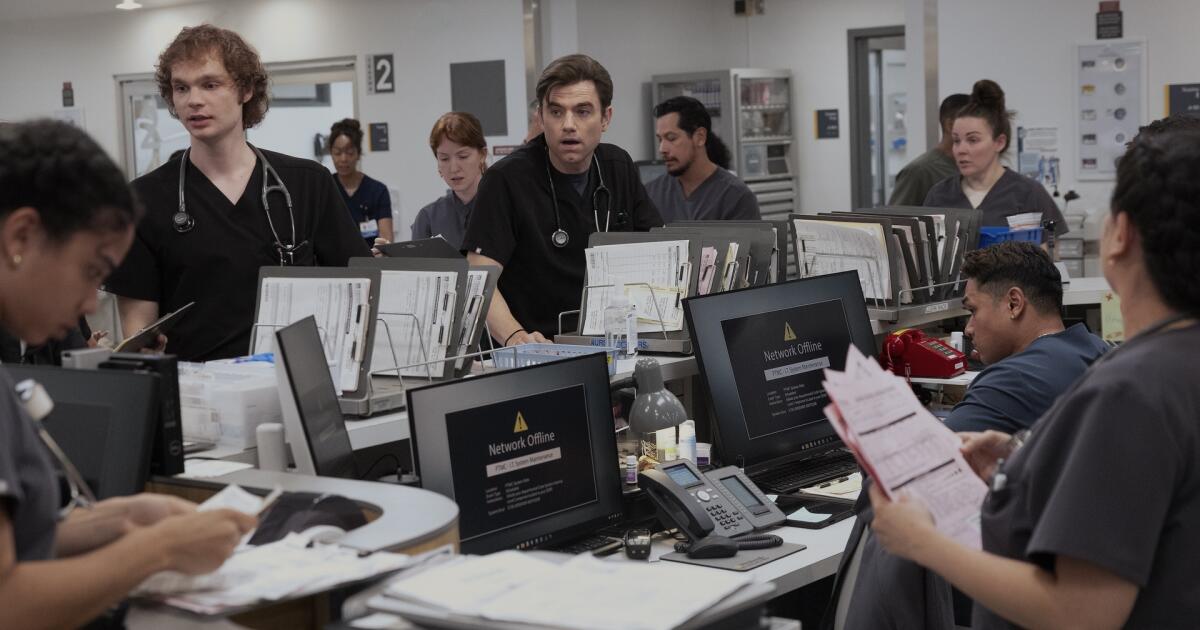
Commentary: As ‘The Pitt’ suffers a digital meltdown, a human with analog experience saves the day

Florida High School Football Rankings: Top 25 teams – Oct. 21

Cleary's 21 help Le Moyne down Central Connecticut State 69-64 in OT

How old is Bo Nix? What to know about Oregon quarterback ahead of 2024 NFL Draft

99th annual Pony Swim held in Virginia

Indiana Members Credit Union announced as new anchor tenant at Bottleworks District
Fact check: Did French border guards mock influencers returning from Dubai amid Iran war?

Iran’s fight for survival / The widening war / Trump’s nebulous goals : Sources & Methods

Map: 4.9-Magnitude Earthquake Shakes Louisiana

Paxton vows he’s ‘staying in this race’ even if Trump backs Cornyn in Texas GOP clash

Which Kurdish groups is the US rallying to fight Iran?
-

 World1 week ago
Exclusive: DeepSeek withholds latest AI model from US chipmakers including Nvidia, sources say
-

 Wisconsin4 days ago
Setting sail on iceboats across a frozen lake in Wisconsin
-

 Massachusetts1 week ago
Mother and daughter injured in Taunton house explosion
-

 Maryland5 days ago
AM showers Sunday in Maryland
-

 Massachusetts3 days ago
Massachusetts man awaits word from family in Iran after attacks
-

 Florida5 days ago
Florida man rescued after being stuck in shoulder-deep mud for days
-

 Denver, CO1 week ago
10 acres charred, 5 injured in Thornton grass fire, evacuation orders lifted
-

 Oregon6 days ago
2026 OSAA Oregon Wrestling State Championship Results And Brackets – FloWrestling