Lifestyle
Alec Baldwin is indicted in fatal shooting of cinematographer after new gun analysis


A grand jury indicted Alec Baldwin on Friday on an involuntary manslaughter charge in a 2021 fatal shooting during a rehearsal on a movie set in New Mexico, reviving a dormant case against the A-list actor.
Andy Kropa/AP
hide caption
toggle caption
Andy Kropa/AP

A grand jury indicted Alec Baldwin on Friday on an involuntary manslaughter charge in a 2021 fatal shooting during a rehearsal on a movie set in New Mexico, reviving a dormant case against the A-list actor.
Andy Kropa/AP
SANTA FE, N.M. — A grand jury indicted Alec Baldwin on Friday on an involuntary manslaughter charge in a 2021 fatal shooting during a rehearsal on a movie set in New Mexico, reviving a dormant case against the actor.
Special prosecutors brought the case before a grand jury in Santa Fe this week, months after receiving a new analysis of the gun that was used. They declined to answer questions after spending about a day and a half presenting their case to the grand jury.
Defense attorneys for Baldwin indicated they’ll fight the charge.
“We look forward to our day in court,” said Luke Nikas and Alex Spiro, defense attorneys for Baldwin, in an email.
While the proceeding is shrouded in secrecy, two of the witnesses seen at the courthouse included crew members — one who was present when the fatal shot was fired and another who had walked off the set the day before due to safety concerns.
Baldwin, the lead actor and a co-producer on the Western movie “Rust,” was pointing a gun at cinematographer Halyna Hutchins during a rehearsal on a movie set outside Santa Fe in October 2021 when the gun went off, killing her and wounding director Joel Souza.
Baldwin has said he pulled back the hammer, but not the trigger, and the gun fired.
The charge has again put Baldwin in legal trouble and created the possibility of prison time for an actor who has been a TV and movie mainstay for nearly 40 years, with roles in the early blockbuster “The Hunt for Red October,” Martin Scorsese’s “The Departed” and the sitcom “30 Rock.”
The indictment provides prosecutors with two alternative standards for pursuing an involuntary manslaughter charge against Baldwin in the death of Hutchins. One would be based on negligent use of a firearm, and the other alleges felony misconduct “with the total disregard or indifference for the safety of others.”
Judges recently agreed to put on hold several civil lawsuits seeking compensation from Baldwin and producers of “Rust” after prosecutors said they would present their case to a grand jury. Plaintiffs in those suits include members of the film crew.
Los Angeles-based attorney Gloria Allred, who is representing the slain cinematographer’s parents and younger sister in a civil case, said Friday that her clients have been seeking the truth about what happened the day Hutchins was killed and will be looking forward to Baldwin’s trial.
Neama Rahmani, a former federal prosecutor and president of the West Coast Trial Lawyers firm in Los Angeles, pointed to previous missteps by prosecutors, saying they will need to do more than present ballistics evidence to make a case that Baldwin had a broader responsibility and legal duty when it came to handling the gun on the set.
Special prosecutors dismissed an involuntary manslaughter charge against Baldwin in April, saying they were informed the gun might have been modified before the shooting and malfunctioned. They later pivoted and began weighing whether to refile a charge against Baldwin after receiving a new analysis of the gun.
The analysis from experts in ballistics and forensic testing relied on replacement parts to reassemble the gun fired by Baldwin, after parts of the pistol were broken during testing by the FBI. The report examined the gun and markings it left on a spent cartridge to conclude that the trigger had to have been pulled or depressed.
The analysis led by Lucien Haag of Forensic Science Services in Arizona stated that although Baldwin repeatedly denied pulling the trigger, “given the tests, findings and observations reported here, the trigger had to be pulled or depressed sufficiently to release the fully cocked or retracted hammer of the evidence revolver.”
The weapons supervisor on the movie set, Hannah Gutierrez-Reed, has pleaded not guilty to involuntary manslaughter and evidence tampering in the case. Her trial is scheduled to begin in February.
“Rust” assistant director and safety coordinator David Halls pleaded no contest to unsafe handling of a firearm last March and received a suspended sentence of six months of probation. He agreed to cooperate in the investigation of the shooting.
An earlier FBI report on the agency’s analysis of the gun found that, as is common with firearms of that design, it could go off without pulling the trigger if force was applied to an uncocked hammer, such as by dropping the weapon.
The only way the testers could get it to fire was by striking the gun with a mallet while the hammer was down and resting on the cartridge, or by pulling the trigger while it was fully cocked. The gun eventually broke during testing.
The 2021 shooting resulted in a series of civil lawsuits, including wrongful death claims filed by members of Hutchins’ family, centered on accusations that the defendants were lax with safety standards. Baldwin and other defendants have disputed those allegations.
The Rust Movie Productions company has paid a $100,000 fine to state workplace safety regulators after a scathing narrative of failures in violation of standard industry protocols, including testimony that production managers took limited or no action to address two misfires on set before the fatal shooting.
The filming of “Rust” resumed last year in Montana, under an agreement with the cinematographer’s widower, Matthew Hutchins, that made him an executive producer.


Comedian Richard Pryor performs on stage at the Los Angeles Hollywood Bowl on Sept. 19, 1977.
Lennox McLendon/Associated Press
hide caption
toggle caption
Lennox McLendon/Associated Press
Historian Elizabeth Stordeur Pryor has spent much of her career tracing the N-word through slavery, Jim Crow, the civil rights movement and hip-hop. But what she didn’t tell her audiences was that her father, Richard Pryor, was the comedian who put the word at the center of American comedy in the 1970s.
“I was a scholar of the N-word — and so was he,” Pryor says of her father.
As the child of a white mother and a Black father, Pryor describes her own relationship to the N-word as a “super complicated” one. She remembers teaching a college class in which one of her white students used the word while quoting Blazing Saddles — a film her father co-wrote. Pryor froze: She had vowed never to use the word in her classroom, but suddenly there it was.

“I [was] just kind of like like a deer in the headlights,” Pryor says. “I was really worried about the Black students. … Something I had never considered when I thought about teaching is what happens when the racism that we study and we teach comes in? … How do I work through that in the moment?”
Pryor’s new book, Something We Said: Richard Pryor, A Notorious Word, and Me, is part memoir and part history of one of the most divisive words in the English language. Late in his career, after spending time in Kenya, Richard Pryor vowed never to use the word again.
“One of the things I admire about that moment when he disavows the word is he said, ‘This is for me. I’m not telling you what to do,’” she says. “There is a piece [of him] where he understood that the word had a function in Black culture. He does talk about, though, as an artist, losing control of what the word was doing.”
Interview highlights
On her father’s use of the N-word
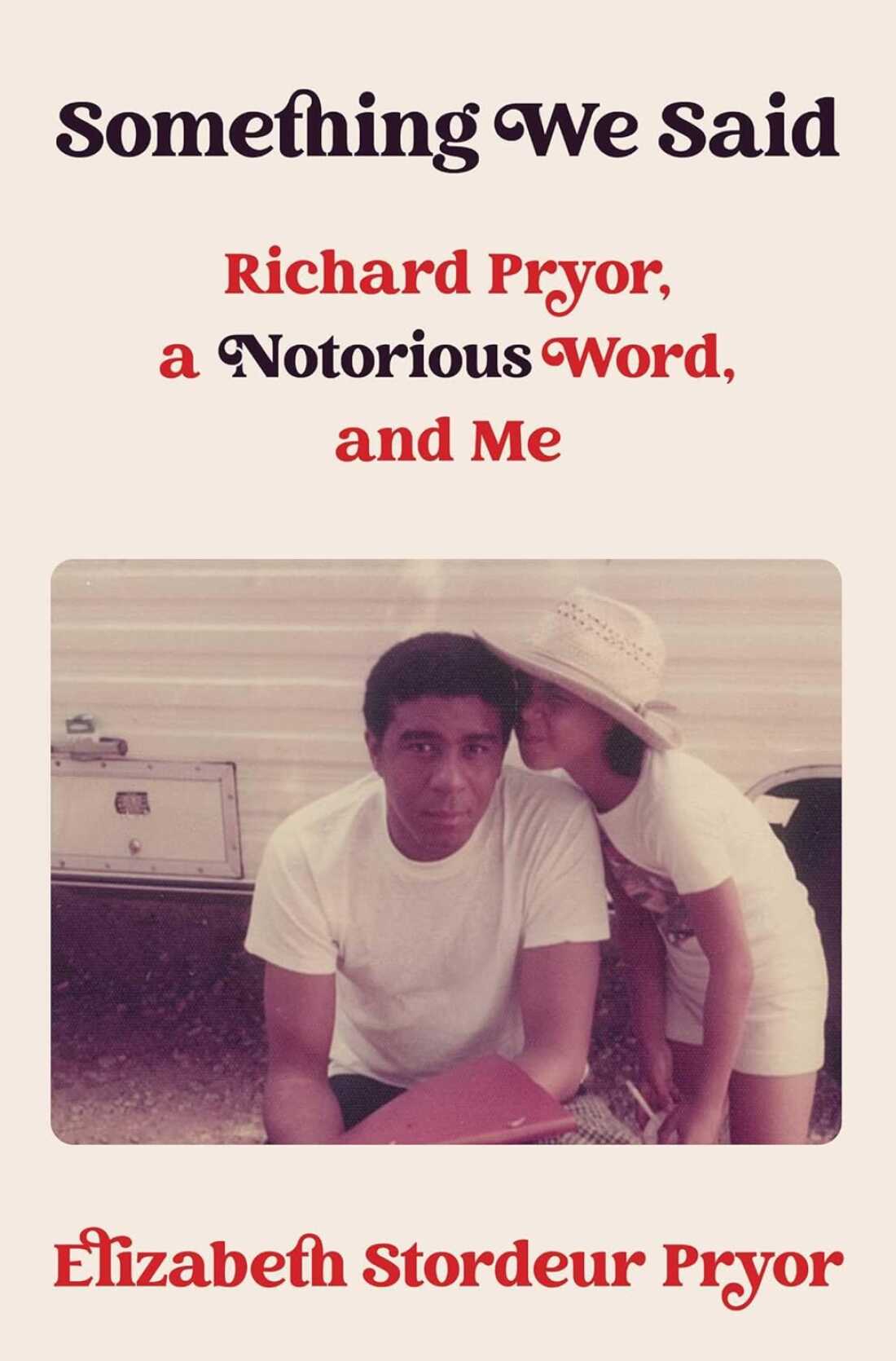
[In] one of the first meaningful conversations I ever had with [my dad] as a little girl, he told me, “Don’t let nobody ever call you that.” And then he used it, and then his friends used it. …
I think it’s really important to emphasize that when I’m saying that he used the word that it was in the subversive way, that it was the language of protest, and that he was building on a Black tradition of protest, that Black people had used this word kind of as a slap in the face to white racism. You know, “We know how to take our punches and our knocks, and we’re not afraid of this thing that you’re trying to demean us as.” And so bringing that use, the way that Black people perceived of the N-word, onto stage was really powerful in the 1970s.
On talking about the N-word with her college students
Teaching the word is still incredibly difficult. I have to say, the conversations are always hard, but I feel like it’s important because my students walk away knowing that this is not a conversation, like I said, about free speech. It’s really about how how we interact, how we want to bring as many people as we can to the table. And if we do that, that means that we’re going to be thinking about who we’re sitting at the table with and how things will impact them.
On meeting her dad for the first time when she was 6
We were in Newark, New Jersey, … and my mom is acting kind of … nervous. And we knocked on the door of a hotel room, and he opened in a towel. And I was like, this is my father. Like, not only do I get a father, but I get this guy. What? I just felt like I won. I loved him immediately. Instantly. His eyes were so warm, and he was so handsome. And I just fell head over heels. … I saw my face [in his face]. … He created a bridge immediately between us and invited me to cross over.
On vying for her father’s attention as a kid

I wanted to be smart enough and creative enough, and I would try to show off. I did theater. I did improv. He would come to my plays and come to my performances. [I] tried to get intellectual with him, like when I was in college. And I had a Black awakening and he basically, like, sent me some stuff so I could awake Blackly, I guess. … He sent me the documentary on Malcolm X that had been filmed, I think, in 1972. And then he sent me The Last Poets’ [song] … “N-words are Scared of Revolution,” to listen to. And I did. I felt like he was inviting me into a secret world, and I wanted to go there. …
At the end of his life, when he couldn’t speak anymore, I would go over and read from the narrative of Frederick Douglass to him, and I could see that he was feeling proud … of being read Frederick Douglass by me.
On Richard Pryor’s upbringing with a sex worker mother and the first laugh that changed everything.
Oh, my dad. He told me a story about being 5 years old and, I don’t know why, but he’s wearing a little cowboy suit, and he was in front of the house and all the people were there, his grandmother, all the sex workers, and his father and his uncle. And he slipped in dog poop and they just start cracking up. And so he got up and he made himself slip in it again, and they couldn’t stop laughing. And so he did it again and again. And it’s pretty painful to think of the lengths that he felt that he needed to go to get their adoration and attention.
Anna Bauman and Thea Chaloner produced and edited this interview for broadcast. Bridget Bentz, Molly Seavy-Nesper and Meghan Sullivan adapted it for the web.

Nope, it’s not AI. It’s just a really big flag with bright lights, draped on Hoover Dam for the next several weeks.
As a display to mark the 250th anniversary of U.S. independence, the states of Nevada and Arizona and the federal Bureau of Reclamation teamed up to hang and illuminate an enormous American flag on the dam on Memorial Day.
The display, scheduled to be in place through July 4, is visible to anyone crossing between Arizona and Nevada on U.S. Route 93, which goes across the top of the dam. The flag is 150 feet tall and 300 feet long, spread on the south-facing side of the dam and lit by 550 LED lights (powered by dam-generated electricity).
A wider view of the illuminated U.S. flag at Hoover Dam.
(Michael Bittle)
It’s a spectacle that comes at a challenging moment for Hoover Dam, as experts warn that Lake Mead’s dwindling water levels could threaten the dam’s ability to generate hydropower. “Slap a flag on it, that’ll fix it,” suggested one of several Reddit commenters who were moved to snarkiness by the flag image.
The dam, a frequent day-trip destination from Las Vegas, stands 35 miles east of the Las Vegas Strip, about 295 miles northeast of Los Angeles. The site features a visitor center and overlook, and guided and self-guided tours.
Installation of the display involved dozens of riggers and two cranes. The flag, which is roughly the dimensions of a football field, has been previously used for celebrations at Indianapolis Colts and Las Vegas Raiders football games.
Within two days after it was hung, gusts of wind up to 50 mph prompted organizers to lower the flag last Wednesday as the National Weather Service declared a wind advisory for the area. Organizers raised the flag again late Friday.
Strong winds are not uncommon in the area. Organizers said weather “may periodically require the flag to be temporarily lowered.” Updates on the flag’s status can be found on the Hoover Dam Facebook page.
The Las Vegas Convention and Visitors Authority paid for the display. A spokeswoman said the cost, including flag, production, installation costs and six weeks of lighting, will be between $750,000 and $1 million.
The dam, a five-year construction job that was completed in 1936 during the depths of the Great Depression, is often hailed as one of the nation’s most impressive works of infrastructure. Though this is not the first time a flag has been draped on it, organizers have called the display “the most ambitious long-duration installation ever attempted at Hoover Dam.”

Is dog poop a scourge in your area?
borisz/simplehappyart/Getty Images/Photo Illustration by NPR
hide caption
toggle caption
borisz/simplehappyart/Getty Images/Photo Illustration by NPR
Left-behind dog poop is annoying. But it’s also a sign of anti-sociality.
Spotting unidentified poop outside is an unfortunate and unavoidable part of being alive, but in some cities, there’s a scourge being left behind by some people’s four-legged friends. Manuela López-Restrepo, writer and producer at All Things Considered, couldn’t stop noticing it – and she wondered if it might be a sign of something deeper going on. Paired with dogs popping up in places they maybe shouldn’t be – she wondered: can dogs be a vector for anti-social behavior? And what would it look like for people – and their pets – to share space more harmoniously?
Manuela shares her reporting with Brittany and they get deeper into the story of the dookie.
For more episodes about culture and how we share public space, check out:
The Coldplay kiss cam & moral surveillance
Crime is down. Why don’t people feel safe?
In search of a safe place to cry…
Support Public Media. Join NPR Plus.
Follow Brittany on Instagram: @bmluse
For handpicked podcast recommendations every week, subscribe to NPR’s Pod Club newsletter at npr.org/podclub.
This episode was concepted and reported by Manuela López-Restrepo. It was produced by Liam McBain. It was edited by Neena Pathak. We had engineering support from David Greenburg. Our Supervising Producer is Cher Vincent. Our Executive Producer is Barton Girdwood. Our VP of Programming is Yolanda Sangweni.
-

 Los Angeles, Ca31 minutes ago
Jurors to decide who's financially responsible for Iskander boys' deaths
-
 Detroit, MI49 minutes ago
Teen injured after shooting in Detroit, police looking for suspect
-

 San Francisco, CA1 hour ago
San Francisco ‘adult supremacy’ workshop brands teachers as oppressors — as fringe trend spreads in California schools
-

 Dallas, TX1 hour ago
Here’s To You: Class of 2026 grads
-

 Miami, FL1 hour ago
Family displaced after car crashes into southwest Miami-Dade home, leaving structure unlivable
-

 Boston, MA1 hour ago
Red Sox, Craig Breslow Under Fire From Ex-Boston Pitcher’s Dad
-

 Denver, CO1 hour ago
Broncos’ Salary Cap Picture Just Got a Lot Better
-
Seattle, WA1 hour ago
Melinda French Gates, ex-wife of Bill Gates, to join Seattle Kraken as minority investor


