Lifestyle
12 beautiful plants and flowers to enjoy in Southern California in 2025


Clearly, there’s no shortage of flowers in Southern California. As I write this near the end of 2024, roses, iris and California fuchsia are still blooming in my Ventura garden, and hummingbirds are darting among tall orange whorls of lion’s tail (Leonotis leonurus) and fat magenta stalks of hummingbird sage.

New adventures are calling, one for every month of the year.
That’s likely why it’s easy to take our blooms for granted in SoCal. So this year, let me help you make a plan. I’ve compiled a list of 12 lovely buds and their optimum bloom times in Southern California.
Please note, this is a limited and highly subjective list not intended to encompass the vast number of spectacular flowers in our region. Also note that these listed bloom times are meant as guides, not absolutes, so before you plan an outing, always check ahead to ensure your favorites are actually in flower.
For floral joy throughout the year, set reminders now to take some time in the coming months to literally stop and smell the roses … or lilacs.

January: Camellias
Camellia shrubs, with their glossy dark green leaves, soared in popularity in the mid-1900s, which is why they’re ubiquitous in established SoCal landscapes, and the leaves of some varieties — Camellia sinensis, for instance — give us black tea. But it’s the flowers, with their variety of shapes, colors and fragrance, that really inspire anyone with an eye for beauty.
One of the world’s premier collections is at Descanso Gardens in La Cañada Flintridge. Descanso’s extraordinary camellia forest was created by former Los Angeles Daily News publisher and camellia collector E. Manchester Boddy under unhappy circumstances. According to the history on Descanso’s website, Boddy amassed many exquisite varieties from at least three Japanese American nurseries whose camellia breeding owners were forced to sell their inventory at a fraction of its value before they were incarcerated during World War II because of their Japanese heritage.
The legacy of camellia growers such as F.M. Uyematsu lives on at the gardens, but Southern California still has one other internationally famous nursery devoted to camellias and azaleas in Altadena. Nuccio’s Nurseries offers more than 500 varieties of camellias, many created by cross-pollinating bees and then nurtured by the owners. Visit in January and February to delight in the many choices, and take one home — they grow in pots too. And visit this year, because family members are trying to sell the property, so this opportunity won’t last forever.

February: Bulbs (daffodils, tulips, etc.)
Bulbs are defiant harbingers of spring in colder climes, sometimes pushing up through the snow in their zeal to greet the sun and spread a little color on a bleak landscape of slushy grays. We don’t face that problem much in SoCal, of course, but our last two winters were so damp and gray that I nearly wept with joy last February when the first daffodils burst forth in my soggy garden.
Twin Peaks, a tiny town near Lake Arrowhead, has planted thousands of daffodil bulbs as part of the Julie Greer Daffodil Project. Greer, a resident of Twin Peaks’ Strawberry Flat neighborhood, loved daffodils and began planting hundreds of the bulbs around her community in 1999 with the help of her husband, Tom, and close friend Julie Hale. After Greer died from breast cancer in 2001, residents planted thousands more bulbs in her honor in their yards and along State Highway 189, creating a beautiful spring display.
Tulips usually start blooming a few weeks later in SoCal. Several botanic gardens, such as South Coast Botanic Gardens in Rolling Hills Estates and the Huntington Library, Art Museum, and Botanical Gardens in San Marino, have tulip and bulb gardens — the Huntington plants them in its famous rose garden to create filler color after the roses are pruned. But for an awe-inspring display, visit Descanso Gardens in La Cañada Flintridge, which plants 30,000 tulip bulbs every January for early spring blooms. (This is weather-dependent — check out the handy “What’s in Bloom” guide for more information.)

March: California poppies and wildflowers
Fields full of wildflowers are breathtaking. They seem to create a kind of joyful delirium, which is why every spring experts get the same exasperating question: Will there be a superbloom? The query is especially important to SoCal residents, as we live relatively close to big bloom areas like Walker Canyon in Lake Elsinore, Carrizo Plain National Monument near Santa Margarita and numerous state parks such as Antelope Valley California Poppy Reserve, Anza-Borrego Desert State Park and Chino Hills State Park.
Please note that “superblooms,” when hillsides are blanketed with color like bright quilts lying against the ground, are relatively rare. But we usually get some lovely wildflower displays every year, easy to spot on hikes in the desert or nearby mountains, or even along the hills that line our freeways. Rule of thumb: Wildflower blooms are triggered by warming temperatures, so desert areas will see blooms earlier than higher elevations. Check the Theodore Payne Foundation’s Wild Flower Hotline, which provides updates every Friday about the best viewing spots for wildflowers from March through June. Note: It’s always a bad idea to park your car on a freeway shoulder so you can dash up a hill and trample some wildflowers in your quest for a colorful selfie. Admire carefully, without destroying or picking.

April: Roses
Almost every SoCal botanic garden worth its salt has some space devoted to the genus Rosa, along with a few public parks and ranchos, such as Dominguez Rancho Adobe Museum in Rancho Dominguez, Rancho Los Alamitos in Long Beach and Exposition Park in South L.A. But probably the most extraordinary is the rose garden at the Huntington Library, Art Museum, and Botanical Gardens. Lucky for us, Arabella Huntington loved roses, because the botanic garden she and her husband left behind features more than 1,300 varieties, tended by famed rose breeder Tom Carruth, who left his job creating new rose varieties at Weeks Roses to become the Huntington’s rose garden curator.
Roses are tougher than you’d think — during the drought I spied many residential yards with dead lawns and an old rose bush still valiantly blooming despite neglect and lack of water. April is the month most varieties enter full bloom, but these plants like Southern California, so expect to see roses blooming well into late fall.

May: Lilacs
I see your eyebrows arching … lilacs? In Southern California? Well, yes, and I don’t just mean the native ceanothus shrubs, a.k.a. California lilacs, that start coloring (and perfuming) our wild hills and many native habitat gardens as early as March. Varieties such as Joyce Coulter (Ceanothus ‘Joyce Coulter’) look very much like the traditional lilacs (i.e., Syringa vulgaris) that require freezing winter temperatures to profusely bloom.
Descanso Gardens has developed heat-tolerant hybrids for its garden, and there’s also a low-chill variety known as Beach Party. Or you can grow them in mountain areas, such as Idyllwild, where Gary Parton, a retired college art teacher, has nurtured 165 varieties in his Idyllwild Lilac Gardens.
For 20 years, Parton has opened his lilac garden to the public for free every spring, but 2025 will be the last time. You can visit every Friday, Saturday and Sunday from the last weekend of April through May from 9 a.m. to 4 p.m. After that, Parton, 86, is putting his home and near acre of land up for sale to move to warmer climes.

June: Lavender
What is it about lavender that makes people want to don gauzy clothes and wander the fields, fingers trailing through the fragrant flowers? (There must be a Hallmark movie in here somewhere.) These Mediterranean native flowers have a scent that keeps giving, even if you strip all the little buds off the upright stalks and put them in a container.
Southern California has several lavender fields near L.A. to satisfy your day-trip, lavender-field cravings. If you do an online search for “lavender farms Southern California,” you’ll get a good-sized list for farms north of Los Angeles, such as Frog Creek Farm in Ojai, Foxen Canyon Farms in Solvang, Lavender Fields Forever in Buellton and Clairmont Farms in Los Olivos. To the east, you’ll find 123 Farm in Cherry Valley, the Fork & Plow Lavender Farm in Aguanga (19 miles east of Temecula) and Ross Lake Lavender Farm in Fallbrook.

July: Sunflowers
If you have even a scrap of sunny ground for planting, definitely push a sunflower seed into the ground this winter and stand back — it’s not exactly like Jack and the Beanstalk, but the way sunflowers grow is truly miraculous. In just a few months, that little seed can grow twice as tall as the average American male (5-foot-9), with a stalk as thick as his arm and flowers far bigger than a human head.
Sunflowers come in all sizes, shapes and colors, from gigantic to knee-highs designed to fill a vase with happy flowers. We even have the California native sunflower (Helianthus annuus) decorating our wild hills, an annual reseeder that Bruce Schwartz of the L.A. Native Plant Source calls “a living bird feeder” because of the safe perches and food the plant provides.
A few farms in Southern California grow fields of sunflowers for wandering and picking, with flowers blooming from summer into fall, including Tanaka Farms’ Hana Field in Costa Mesa, the Pumpkin Station in Rancho Bernardo (near Escondido — call ahead to see when flowers are ready for picking) and Carlsbad Strawberry Co. in Carlsbad, which typically has a sunflower maze for photos (no picking) in the fall.

August: California buckwheat
Come midsummer, it’s easy to spot native California buckwheat (Eriogonum fasciculatum) shrubs growing in the wild areas of central and Southern California, especially in Los Angeles, Orange and San Diego counties. The large spreading shrubs are covered with flowers that grow in thick bunches, like cream-colored bouquets dotted with pink in the spring. Late in the year, the flowers turn a handsome copper color, but in August, they are mid-change, so from a distance, the shrubs look speckled with cream and rust.
Up close, you immediately understand why these shrubs are considered a keystone species — one of SoCal’s most important habitat plants — because the flowers are alive with bees, butterflies and a multitude of other nectar-loving bugs, not to mention the birds who happily dine at this insect buffet.
You can see buckwheats at the California Botanic Garden in Claremont, the state’s largest garden devoted to California native plants, as well as at the Theodore Payne Foundation in Sun Valley and Tree of Life Nursery in San Juan Capistrano.

September: Crape myrtle
Hear that rumbling? That’s the sound of shade tree advocates unhappy that I’m mentioning crape myrtles in this list. But my mom loved these showy trees with the colorful crepe-papery flowers, as did my grandmother, and about a billion-jillion other SoCal residents who have planted them in yards, around businesses and along many city streets. These trees are a triple threat, said Los Angeles County Arboretum arborist Frank McDonough: beautiful bloomers in late summer with clouds of frilly flowers in purples, pinks, fuchsia and white; dramatic red and gold leaves in the fall; and sculptural bark that makes the bare tree lovely in winter.
So why the grumbling? Crape myrtles are so popular they’ve become the prominent trees in some cities, which means those cities could lose much of their urban forest if the trees were attacked by a disease or insect. And while crape myrtles are lovely to behold and require little water once they’re established, they don’t provide much in the way of shade, a problem when you’re trying to reduce urban heat levels.
Despite these concerns, these eastern Asian natives are still lovely when they’re blooming in the late summer and early fall, and unlike the much loved and much despised jacaranda, their magnificent flowers don’t leave a slippery purple mess on cars and sidewalks. The Arboretum has one of the largest collections outside of city streets, McDonough said, but you can also see them at the San Diego Zoo, Descanso Gardens and the Japanese Garden at the Huntington Library, Art Museum, and Botanical Gardens. But for the sake of diversity and our increasing need for shade, consider planting something else around your business or home.

October: Chrysanthemums
Come October, it’s impossible to walk into a supermarket or hardware store without seeing an army of potted chrysanthemums in many sizes and colors. But those retail displays, mostly meant for decorating front porches and patios, are just the tip of the iceberg.
One of the country’s premier chrysanthemum growers, Sunnyslope Gardens, operated in San Gabriel for some 70 years, but the nursery closed more than a decade ago. Now ardent chrysanthemum growers in Southern California trade with each other, said George MacDonald, outgoing president of the San Gabriel Valley Chrysanthemum Society, or buy online from King’s Mums in Oklahoma, which offers 130 cultivars as well as publications for people who want to grow their own.
The Earl Burns Miller Japanese Garden at California State University Long Beach hosts a Chrysanthemum Festival (scheduled for Nov. 8 in 2025), but probably the best way to see this flower’s many faces is at the two annual shows sponsored by the San Gabriel Valley Chrysanthemum Society, usually the first weekend of November at the Los Angeles County Arboretum in Arcadia, and the Orange County Chrysanthemum Society, usually the last weekend in October, at Sherman Library & Gardens at Corona del Mar.

November: Poinsettias
By November, poinsettias start crowding mums out of retail displays, and yes, I know the plant’s showy red “petals” aren’t actually flowers but leaves — the plant’s flowers are actually the small yellow centers — and these days, cultivars come in many other colors, including cream, pink, white, pale green, orange and speckled.
It was SoCal nurseryman Paul Ecke Sr. who took a little-known, spindly outdoor plant from Central America in the early 1920s and bred it into a hardy potted plant “whose tapering red leaves have been synonymous with the Yuletide season for more than 70 years,” according to his obituary in 1991. Ecke started growing and selling his poinsettias in a field on Sunset Boulevard but moved to Encinitas around 1923, where Ecke Ranch became the largest poinsettia producer in the world.
The family business was sold in 2012, and the company’s poinsettias are primarily grown in Guatemala now. But it’s still possible to see greenhouses filled with poinsettias in Encinitas. Weidner’s Gardens, a locally owned, 50-year-old nursery, grows 30 varieties, according to co-owner Kalim Owens, and offers free tours of the greenhouses every year at 10 a.m. and 2 p.m. on the Friday and Saturday before Thanksgiving.

December: Toyon berries
OK, toyon berries are not flowers, but they are so bright and festive, and native to Southern California, so they seemed a fitting end to this floral calendar. This time of year, you can see these tall, bushy shrubs covered with berries throughout Southern California, from the native plant trail at Rio de Los Angeles State Park in Glassell Park to Walnut Canyon Road leading to the Oak Canyon Nature Center in Anaheim Hills, to Griffith Park and many of the other wild areas that frame our SoCal cities.
Or, visit the Natural History Museum of Los Angeles County, which has a grove of about 25 tall toyon in its native plant garden. This time of year, its toyon are ablaze with berries, until they’re picked clean by hungry birds, reports museum educator Lila Higgins in a delightful article titled “California Holly: How Hollywood Didn’t Get its Name,” in which she debunks the romantic and oft-repeated myth that Hollywood got its name from the toyon plant, which resembles English holly.
Instead, Higgins writes, the name came from Daeida Wilcox, wife of Harvey Henderson Wilcox, a rich businessman from Kansas who, in 1886, bought 120 acres of fig and apricot groves near Cahuenga Pass for about $18,000 and discovered he could make good money subdividing the land and selling lots for $1,000 each. Initially it was called the Wilcox subdivision, until Daeida met a wealthy traveler on a train “who owned a fine estate in Illinois” named Hollywood. Daeida so loved the name that on Feb. 1, 1887, her husband filed a subdivision map in the Los Angeles County Recorder’s office with the name “Hollywood.” And thus, a star was born, thanks to a chance encounter on a train, which is a pretty romantic Hollywood ending in itself.


Lifestyle
L.A. Affairs: It’s hot when a man drives to me. But would this new guy make the trek from the Valley?
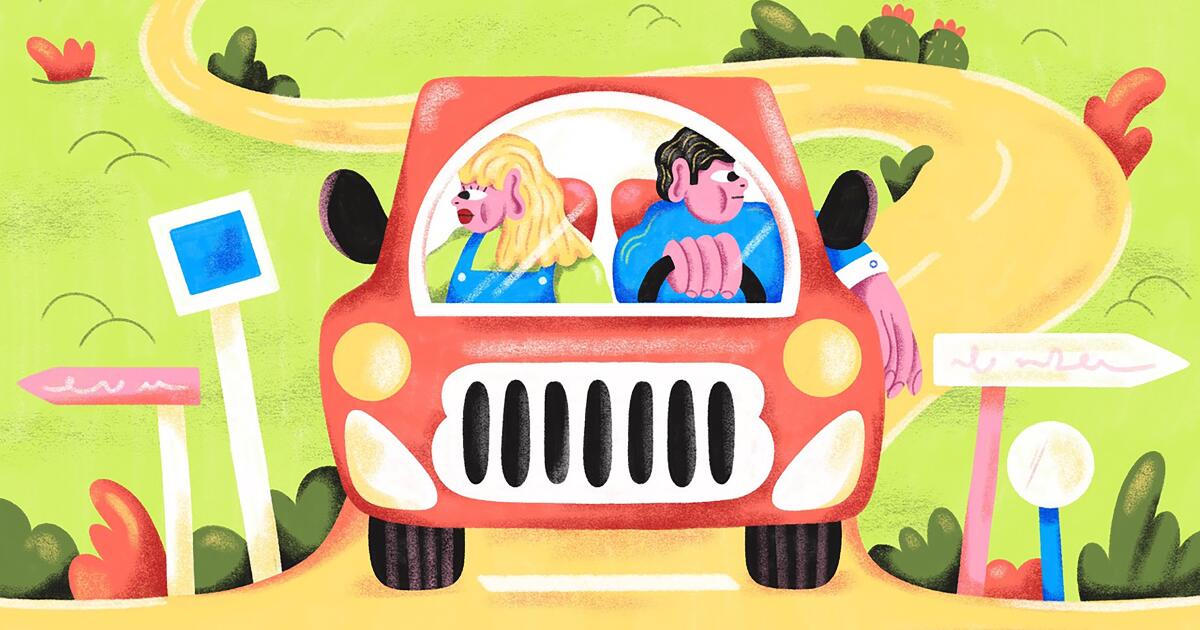
I met Dan on Hinge.
He lives in Woodland Hills, and I live in Venice. In Los Angeles, this is considered a long-distance relationship. In another city it might be nothing. Here, it’s a factor.
But I believe that with the right person, you can make anything work, so I stay open. I’m a native New Yorker, and if I were living in Brooklyn and a guy lived on the Upper West Side, that would be a 45-minute subway ride, which is truly nothing in New York. So with that same logic, I try to have flexibility with men in L.A.
When we started planning our first date, Dan suggested three options: a hike on mushrooms, a wine tasting or a walk on the beach.
A hike on mushrooms is something I’d only do with someone I already trust, not someone I just met online. I don’t do first-date hikes because I don’t like feeling trapped if the guy’s a dud. So I chose the wine tasting.
Then I learned the wine tasting was in West Hills.
On a Friday night, driving there from Venice would be insane. So I said I didn’t want to meet there because of the traffic. He suggested Malibu. That was also not ideal on a Friday.
I was getting annoyed — this was a pink flag because in my dating world, the guy is supposed to come to the woman’s neighborhood in the early days. I’ve gone out with plenty of men from the Valley who effortlessly suggested they come to me. It’s not rare or impossible.
I suggested he come to the Westside. I didn’t specifically say Venice, and in hindsight, I probably should have. He landed on Brentwood, which was manageable for both of us. On our first date, we met at an Irish pub on Wilshire Boulevard. He was cuter and more interesting than I had expected, and with the Guinness flowing, we had fun.
When I got home, he texted me: “Well, I like you 🙂 Less the tik tok and the lack of rock music in your life, but it’s not a deal breaker — there are other qualities 🙂 What are your thoughts?”
I noticed the slight negativity but was mostly dazzled that a man texted immediately after the date to say he liked me. In the modern dating economy, this felt rare.
The next day, both of our evening plans fell through, so we made a last-minute date. The wine tasting he originally suggested still sounded like fun, and although it meant me driving to the Valley, I was up for it now that we’d met.
We sipped flights at Malibu Wines & Beer Garden in its airy, romantic courtyard and played a flirty version of Truth or Dare. Halfway through, he dared me to kiss him.
We ended with sushi on Ventura Boulevard and a short make-out session in his car. He invited me to Thanksgiving at his uncle’s, which felt too soon, but also sweet.
After the second date, he texted and said he had his kids that week and was also hosting an event on Thursday, so his only day to meet was Wednesday. I said great.
On Tuesday night, he checked if we were still on, and I said yes.
Then he texted: “I’m flexible on time but not on location. I have a big event on Thursday, hopefully you can come to me again.”
My stomach tightened. This again?
So I texted back: “I drove to you last time, which was a bit of an exception for me especially in the early days, but the wine tasting location sounded special. Usually guys come to my area. How about we switch it up this time?”
He replied: “I appreciate the effort! Because of my event, I’d rather be close to a computer just if needed … Here is what i offer:
— I’ll come to your area anytime next week/end
— Lunch/dinner on me
I want to continue where we stopped last time 😉 No pressure of course, but let’s snuggle”
I responded: “Ok let’s meet next week. Snuggles sound nice … let’s see what happens …”
Then he wrote: “So I won’t see you tomorrow?”
I replied: “Unless you wanna come to me and bring your laptop along, let’s rain check until you have more flexibility.”
He said: “Dang, you are hard. I’ll let you know tomorrow around midday if it’s ok.”
And then — surprise — he decided to come.
He drove to Venice for a 5 p.m. date. He said his ETA was 5 p.m., and it ended up being 5:25 p.m., typical 405 Freeway.
When he showed up, he was in a cranky mood. On our way to KazuNori in Marina del Rey, I thanked him for picking me up and told him I think it’s hot when the guy comes to the girl.
“You’re just saying that because you want me to come to you more,” he said, not playfully, but aggressively.
That was basically the end for me. But there I was, in his car, heading to dinner. So I stayed pleasant and tried to make the best of it.
I shared that in the early stages of dating, I find it’s good etiquette for the guy to come to the woman’s neighborhood. He immediately disagreed and started ranting about how dating rules are ridiculous and how they swing in women’s favor. He resented paying for dates and declared he wasn’t looking to “sponsor a woman’s life.”
“If women want equality and equal rights,” he said, “then it should apply all across the board, including dating, and the man shouldn’t have to pay.”
I said women don’t actually have equal rights because we get paid less than men and often receive lower salaries than men in the same position.
I tried to change the subject and reset the mood, but he insisted we keep hashing it out.
I tried to explain masculine/feminine dynamics: providing and protecting, giving and receiving.
“What does the man get out of this arrangement?” he asked.
It was like watching someone’s personality warp into Mr. Hyde. Then he brought up another point: He’s a single dad of two kids, so he gets tired; and because I don’t have kids, that should factor into who drives where.
At this point, I was barely engaging and focused on eating my hand rolls, and I couldn’t wait to get home.
The check came, and I happily split it, wanting nothing further from him.
In the car back to my place, he remarked: “It’s obvious we’re never gonna see each other again.”
Obvious, but did it need to be stated?
Then he showed me a Spotify playlist he’d made for me of his favorite electronic music, because he knows I like EDM.
“Oh, that’s sweet,” I said.
“Yeah, that’s how I show interest. Through things like this, not who drives to who,” he replied.
When I got out of the car, we wished each other luck, and I headed inside and shut the door.
Two hours later, he sent me the playlist. I’ve yet to listen to it.
It wasn’t the distance that ruined it. It was the resentment. I’m not looking for a man who feels burdened by the effort. I’m looking for a man who sees the value of courting a woman in the first place.
The author is a writer, comedian and former psychologist who lives in Venice. She is the creator of the new vertical series “Manfari.” She’s on Instagram: @solange_neue and @manfari.show.
L.A. Affairs chronicles the search for romantic love in all its glorious expressions in the L.A. area, and we want to hear your true story. We pay $400 for a published essay. Email LAAffairs@latimes.com. You can find submission guidelines here. You can find past columns here.

Lonnie Bunch III is the 14th Secretary of the Smithsonian. He’s pictured above in September 2017.
J. Scott Applewhite/AP
hide caption
toggle caption
J. Scott Applewhite/AP
In a memo addressed to staffers sent Tuesday, the secretary of the Smithsonian, Lonnie G. Bunch III, defended the institution after the White House issued a 162-page report that characterizes the National Museum of American History as a place which has become “subject to institutional capture by a radical, activist ideology that is fundamentally opposed to telling the noble, honest story of the great country we know and love.”
In his email, which NPR has obtained, Bunch wrote in part: “While there will always be room for improvement, this report is not a fair characterization of the work and totality of the National Museum of American History. At the Smithsonian, our work is driven by scholarship, accuracy and an uncompromising commitment to tell the fullness of America’s story. As public servants and the keepers of this institution, we are charged with helping a nation find understanding, hope and clarity and as part of that duty, we are dedicated to excellence, reflection and growth.”

He continued: “We remain focused on what grounds us: a steadfast commitment to scholarship, nonpartisanship, independence, accuracy and integrity. For nearly 180 years, the Smithsonian has worked alongside partners across government — from the White House to Congress to our governing Board of Regents — guided by our enduring mission to increase and diffuse knowledge. That purpose remains: to pursue knowledge with rigor and to serve the American public with clarity and care.”
The White House report was issued on July 4 by the Domestic Policy Council under the title “Saving America’s Story: How Ideological Capture at the Smithsonian Institution’s National Museum of American History Erases Our Heritage.”

The council faults the National Museum of American History on a multitude of fronts, saying it underemphasized the Founding Fathers and early colonial and Revolutionary history; was not sufficiently celebratory of the country’s 250th anniversary; and that it engaged in “anti-white,” “illegal alien” and transgender activism.
It also accuses the museum of trying to “indoctrinate” teachers and students through its exhibitions, programming and teaching resources.
In the report, the council also specifically criticizes museum director Anthea Hartig, who has led the National Museum of American History since 2019 and is concurrently the president of the Organization of American Historians, calling her “an activist advancing an ideological agenda contradictory to the museum’s founding purpose of fostering patriotism.”

The Trump administration has made the Smithsonian museums one of its primary targets in its efforts to reshape cultural narratives to align with its viewpoints. In August 2025, the White House requested a “comprehensive internal review” of eight Smithsonian museums, including the National Museum of American History, following an executive order issued by President Trump in March 2025 in which he called for the removal of “improper ideology” from the Smithsonian’s offerings.
According to the Smithsonian’s charter, all of its 21 museums, 14 education and research centers, and the National Zoo are meant to be run independently of the federal government. The Smithsonian is overseen by Bunch and a board of regents, which includes Vice President Vance, Supreme Court Chief Justice John Roberts and other members appointed by Congress.
In an interview with NBC’s Meet the Press on Sunday, Bunch spoke about the Smithsonian’s 250th anniversary special exhibition at the Smithsonian Castle, which is called “American Aspirations.”
He told NBC: “It’s really important for people to understand that America is much an ideal as it is a place, that it’s a series of aspirations that have really shaped who this country is. And so for me, what is so powerful is to say, ‘Let us honor the words of Thomas Jefferson and the founders, but let us use those to challenge us to be better.’”
Jennifer Vanasco edited this story.

-

 Austin, TX5 minutes ago
Texas Has One Trait Almost Every National Champion Shares
-

 Alabama12 minutes ago
Final 2026 MLB mock draft projections for Alabama’s Justin Lebron
-
 Alaska15 minutes ago
Watch My Buddy Matt Not Get Eaten by Bears in Alaska
-

 Arizona20 minutes ago
Roller derby still has a home in Arizona despite myriad obstacles
-

 Arkansas27 minutes ago
Freshman OL Tucker Young never wavered through Arkansas football coaching changes | Whole Hog Sports
-

 California30 minutes ago
Northern California high school graduation shooting suspect arrested in Texas
-

 Colorado35 minutes ago
Colorado to weigh daily hunting limits, ban on fur sales for wildlife hunted for fur
-

 Connecticut42 minutes ago
Woman arrested, accused of murdering man in Farmington in March

