Lifestyle
His portrait of MLK in a hoodie went viral. Now he shares a message in his Downtown Disney art

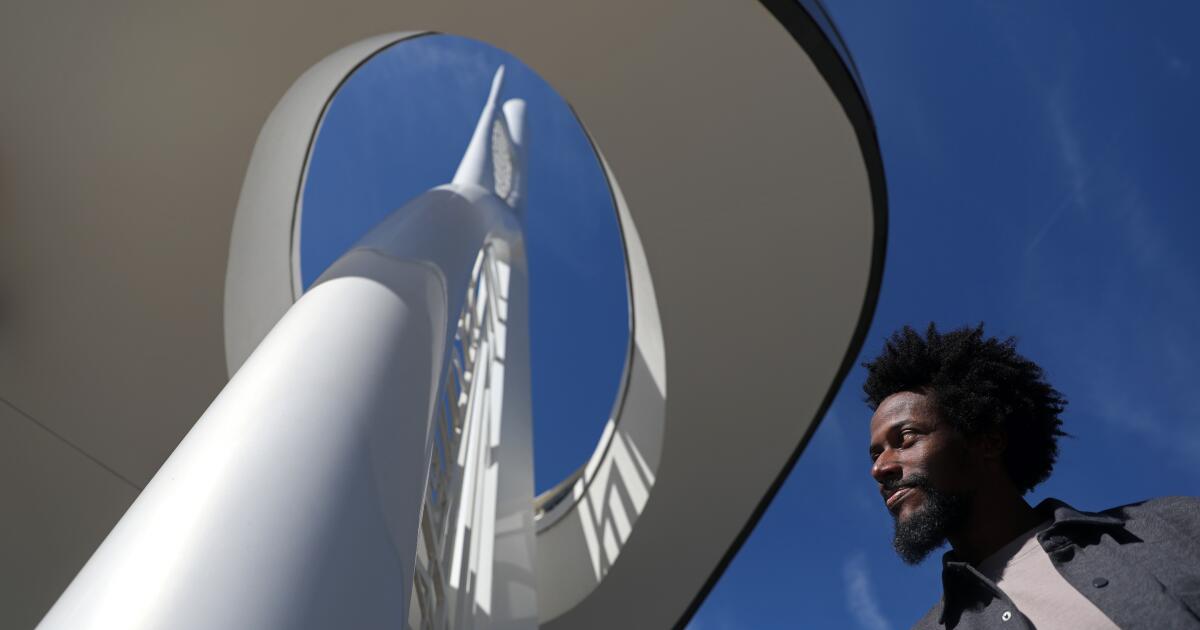
There’s a hidden door in Downtown Disney. Only this one isn’t meant to be walked through.
Flanking a stage near the monorail station, you’ll find a glistening white tower, the work of artist and activist Nikkolas Smith, who has adopted the term “artivist.” At first glance, the tower — one of Downtown Disney’s most striking works — appears to be a nod to Disneyland’s Midcentury art, for its curved lines and space-age optimism wouldn’t be out of place in Tomorrowland.
That’s there, says Smith, but there are also a number of more subtle inspirations.
The tower is a nod to five Black architects, trailblazers whose creations sometimes went unnoticed or overlooked. And that’s why at the base of the structure is a looping opening meant to signify a half-open doorway.
Downtown Disney’s Legacy Tower touches on the styles of different Black architects as it rises into the sky.
(Gary Coronado / For The Times)
Smith shares a distressing anecdote. “They had to learn how to read drawings upside down, because they weren’t allowed to sit next to the white clients,” Smith says, adding they also had to endure unequal pay. “So I was incorporating things like the half doorway to symbolize their struggle.”
Officially designated as the Legacy Tower, Smith himself fixates on that word — “legacy.” The term, he says, represents a thematic constant across his work. A regular collaborator on a number of Walt Disney Co. projects and a former architect with Walt Disney Imagineering, the division of the company focused on theme park experiences, Smith is something of a connector. His canvas art, full of fast-moving brush work, is often rooted in the past while urgently seeking to draw links to the present.

Artist Nikkolas Smith went viral for his portrait of Martin Luther King Jr. in a hoodie, a tribute to slain teenager Trayvon Martin.
(Nikkolas Smith)
His 2025 children’s book, “The History of We,” tells the story of how humanity can trace its roots to Africa. And one of his best-known pieces is of Martin Luther King Jr. in a hoodie, meant to evoke the image of Trayvon Martin, the slain 17-year-old whose death inspired a social justice movement. The work went viral in 2013 while Smith was still working for Imagineering. It altered his career trajectory.
“It was like, ‘I cannot just make art about churros and rides right now,’” Smith says. “There’s a time for that, and there’s also a time to talk about this.” He references his portraits related to the killings of Black men, many at the hands of police officers, such as Philando Castile and Michael Brown.
“At the end of the day, Disney understood that,” Smith adds. “They understood that I needed to make art that was extremely important at the moment, about justice or the lack of justice.”
Smith left Disney in 2019 after 11 years but has maintained a close relationship with the company, so much so that Imagineering called upon Smith to design the tower, which opened in 2023.

Artist Nikkolas Smith, left, chats with guests Ricky Yost and Martina Yost of Aubrey, Texas, who recognized Smith from a recent Disney cruise excursion.
(Gary Coronado / For The Times)
As the Legacy Tower spirals toward the sky, its patterns and and lattice work nod to the likes of James H. Garrott, Robert A. Kennard, Roy A. Sealey, Ralph A. Vaughn and Paul Revere Williams. All were active in Los Angeles — Williams, for instance, was a pivotal designer on the LAX Theme Building — and Smith interlaces decorative flourishes in varying styles that twist around one another to work up the Legacy Tower’s pointed spheres.
The door of the Legacy Tower symbolizes perseverance, Smith says. “They made it through, despite all of the obstacles they had to go through.”
Smith had studied the architects while a student at Hampton University, and has documented on his Instagram their various stylings, which range from restrained to whimsical to ornate. A section referencing Vaughn is modern minimalism, whereas an area dedicated to Sealey is full of jagged, pointed linework. All of it is held together via a coiling design that feels full of movement.

The patterns of the Legacy Tower are nods to the likes of James H. Garrott, Robert A. Kennard, Roy A. Sealey, Ralph A. Vaughn and Paul Revere Williams.
(Gary Coronado / For The Times)
“How can I show humanity’s interconnected future? That’s the idea,” Smith says. “There’s this African theme of Sankofa. If we look toward our future, we have to look at the past and value and appreciate the past. I thought it would be great if I could really commemorate some Black designers and architects as the foundation and backstory of the tower. And I was also thinking about these breezeway block patterns that you see in Leimert Park.”
And yet it also feels like something that belongs in the park. Smith says he looked at some Tomorrowland designs.
“A Midcentury Modern vibe was Walt,” Smith says, referring to park patriarch Walt Disney. “That was Walt’s thing. It all connects. I love that people can hopefully now connect both things. You can connect Tomorrowland and Walt with Paul Revere Williams.”
It’s clearly Smith’s favorite design of his for Disney, although it’s not the only space at the resort that features his artistry. During his decade-plus with Imagineering he regularly worked on teams that focused on projects at Disney California Adventure, which this year is celebrating its 25th anniversary. He was heavily involved, he says, in the evolution of Avengers Campus, contributed to a small promenade stage in Pixar Pier and helped envision the facade of Guardians of the Galaxy — Mission: Breakout!, which transformed the former Tower of Terror into a sci-fi structure.

Nikkolas Smith says elements of Downtown Disney’s Legacy Tower symbolize perseverance.
(Gary Coronado / For The Times)
Smith looks back fondly at his years at Imagineering, specifically calling out his time on the Guardians project. The former fake hotel is now full of glistening bronze pipes, a retro futurist look that former Imagineer Joe Rohde, who led the design, has said takes influence from the high-tech aesthetic of architect Renzo Piano, who worked on France’s Pompidou Centre.
“How much can we add to it? How much can we get away with gluing onto this thing?” Smith says of the Guardians facade. “What is the right amount of ‘Guardians of the Galaxy,’ without being too much? Without scaring people on the freeway?”
Today, Smith continues to focus on social justice work, and has also collaborated with filmmaker Ryan Coogler, such as completing concept designs for his Oscar-nominated film “Sinners.” Smith’s 2023 children’s book “The Artivist” documents the importance of creating art that’s in conversation with the world, believing it’s not only a source for education but for empathy. Smith’s weekly paintings speak out often against the current administration, and Smith has been particularly vocal on the ICE raids.

A selection from “The Artivist,” an illustrated book from Nikkolas Smith.
(Nikkolas Smith)
“Some people say that all art is activism, but I feel that some of the best art that is created is art that has a message,” Smith says. “And hopefully that message has to do with the humanity of all people, and for me, I like to focus on marginalized communities, and how we can value the humanity of everybody. That’s why I make picture books about the origins of humanity and the origins of this country.”
The Leimert Park resident says his wife and young son regularly visit the Disneyland Resort. And when he does, Smith says, he always takes a moment to stop by the Pixar Pier stage that he contributed to, which is often used for character meet and greets.
“They were team projects, and I do go up to them with so much pride,” he says. “I go up to the Pixar Pier promenade stage, and I just go up to it and touch it. … The beautiful thing about Disney is these creations are usually around for a lifetime.”
It turns out you can take the artivist out of Disney, but you can’t fully take the Disney out of the artivist.



Milly Alcock in Supergirl.
Warner Bros. Pictures
hide caption
toggle caption
Warner Bros. Pictures
Hollywood’s newest Supergirl is kind of a dirtbag — in the good way. Fearless and grumpy, Supergirl (Milly Alcock) sets out on a quest to support a new pal’s revenge journey and to make a point that should be clear by now: Never mess with a lady’s dog. Also featuring David Corenswet and Jason Momoa, is Supergirl a worthy follow up to Superman?
If you want more DC superhero action, check out these episodes:
‘Superman’ takes off and nails the landing
‘The Batman’ puts the emo in emote
Connect with Pop Culture Happy Hour:
Letterboxd / Facebook
Our weekly newsletter
Support Pop Culture Happy Hour+
Lifestyle
L.A. Affairs: After decades of near-misses, I finally told him: ‘I’m not leaving here without you’

It didn’t take endless quarantining with my spouse during the COVID-19 pandemic to end my marriage of over two decades. By the summer of 2019, menopause — and the extra-added “bonus” of frontal fibrosing alopecia that it awakened — was pummeling me physically and mentally to the extent that I no longer had the capacity to function inside the dysfunction of my life.
The relief that came with the decision to finally let go was completely dwarfed by the immense pain of severing a family in two. I cried as I packed. I cried as I unpacked. I was rolling endlessly in a dark wave that would not stop; my feet could not tell sand from sky. Once I managed to break the surface, I reached out.
I called Tish, Diane and Michelle, three smart, strong, nurturing women who’d been through and survived divorce. I also called my brother, Dan, and my friends Doug and Steve, three kind, creative, funny men who always “got” me.
As for Steve, we met in the spring of 1984 when he auditioned to be the drummer for the Secrets, the band Dan, Doug and I had started the year before. In our small-town high school of fewer than 400 students, he had flown completely under my radar, as he was two years younger, and he joined marching band the year after I’d ditched my baritone horn for a microphone and Pat Benatar tights. Steve aced the audition, and the four of us clicked immediately over our shared love of the Pretenders and all things Monty Python. By mid-June, the Secrets were playing local bars and biker parties in the middle of nowhere, and I was head over heels in love with the drummer.
It wasn’t supposed to happen like that. I wasn’t supposed to fall in love with a boy from my hometown.
I had spent my whole life dying to get out of Middlebourne, W.Va., and had been champing at the bit to leave for college, but by late August, that no longer meant freedom; it meant that I’d have to leave Steve behind. I told myself we’d defy the odds and make it work. He was my soul mate. But we were just kids, and there was no internet, no cellphones with unlimited text and calling. By February 1985, the divide was too great. In a moment of loneliness, I cheated on him. It was over, and I was firmly told to take my place in the friend zone.
I spent the following year flailing and failing in college before making the bold, half-baked decision to drop out of the West Virginia University theater program and move to Los Angeles, a place I’d never been, to pursue a singing career. When Steve found out that I was moving across the country, he softened his friend-zone stance and told me he loved me. On July 13, 1986, he went with my parents to Pittsburgh International Airport to see me off.
For the next 33 years, we would come together and drift apart — sometimes as lovers but mostly as friends. During a visit to my Hollywood apartment in 1988, when he was still in college and the timing was still wrong, I told him, “Who knows. Maybe in 30 years, I’ll come back and get you.”
In November 2019, Steve came to visit me for a long weekend.
I picked him up at Los Angeles International Airport and took him straight to Zuma Beach for a picnic, where we watched dolphins jumping in the waves while the seagulls stole our potato chips. The following day, we cozied up for an afternoon of wine and cheese at Cornell Wine Co. in Old Agoura, then made our way over Topanga Canyon for dinner at Canyon Bistro & Wine Bar.
The night before he flew home, we watched the sun set from our table by the lake at Zin Bistro Americana in Westlake Village. I felt giddy, excited, seen, understood and appreciated in a way I hadn’t felt in a very long time. While it was tempting to jump right in with both feet, we decided to date long distance and take things slowly.
On March 26, 2020, while Steve was still recovering from being profoundly ill with COVID, I arrived at his doorstep at 6 a.m. and proclaimed, “I’m not leaving here without you.”
Two weeks later, after packing most of his belongings into U-Haul shipping crates, we left Parkersburg, W.Va., in Steve’s red Volkswagen Golf with two suitcases, one Treeing Walker Coonhound and one Aussie/Chow mix. I-40 West was practically empty; just us and the occasional car or Amazon truck.
We arrived in California on Easter Sunday and joined the rest of the world in quarantine, not knowing how it would affect our work and financial future. We took a lot of long walks to help deal with the stress of the not knowing, but the magic panacea for me came the day Steve’s Harley-Davidson arrived in one of the crates.
We cruised up and down PCH, and roared our way up and over Mulholland Highway, Stunt Road, Malibu Canyon and Decker Canyon, stopping along the way to stretch our legs, feel the sea spray on our faces and take in views from the valleys to the coastline. We were surrounded by so much beauty; it was almost impossible to let trepidation win.
On one particularly memorable ride on Mulholland Highway between Kanan Road and SR 23 near Saddle Rock, we came around a bend and — bam! — right in front of me was the greenest mountain range I’d ever seen in California, gleaming spectacularly in the sunlight. As I inhaled its gorgeousness and exhaled my stress, I thought, “I can’t believe I get to see this. I can’t believe I get to do this. I can’t believe I get to be with Steve.”
In September 2024, I got to marry Steve.
As my brother, Dan, said at the reception, “What a long, strange trip it’s been.”
The author lives in the suburbs of Los Angeles with her husband, Steve, and their dogs, Coco Puff and Kira.
L.A. Affairs chronicles the search for romantic love in all its glorious expressions in the L.A. area, and we want to hear your true story. We pay $400 for a published essay. Email LAAffairs@latimes.com. You can find submission guidelines here. You can find past columns here.
-
Business2 seconds ago
Cisco to lay off more than 400 workers in California
-
 Entertainment3 minutes ago
Tom Sandoval’s girlfriend Victoria Robinson arrested after patio fire pit altercation
-

 Lifestyle8 minutes ago
Swatch Seeks Damages From Samsung Over Trademark Infringement, Ft Reports
-
 Politics15 minutes ago
MS NOW anchor Alex Witt to exit as network reduces live weekend programming
-
 Sports23 minutes ago
Parents of ex-NFL player Doug Martin allege excessive force by Oakland police in wrongful death suit
-

 World33 minutes ago
Burkina Faso cuts diplomatic ties with former colonial ruler France
-
 News1 hour ago
A day after Alito’s testy response to Sotomayor’s dissent, court says it was a ‘misunderstanding’
-

 Los Angeles, Ca2 hours ago
Watch Project Angel Food's 'Lead with Love' telethon on KTLA

