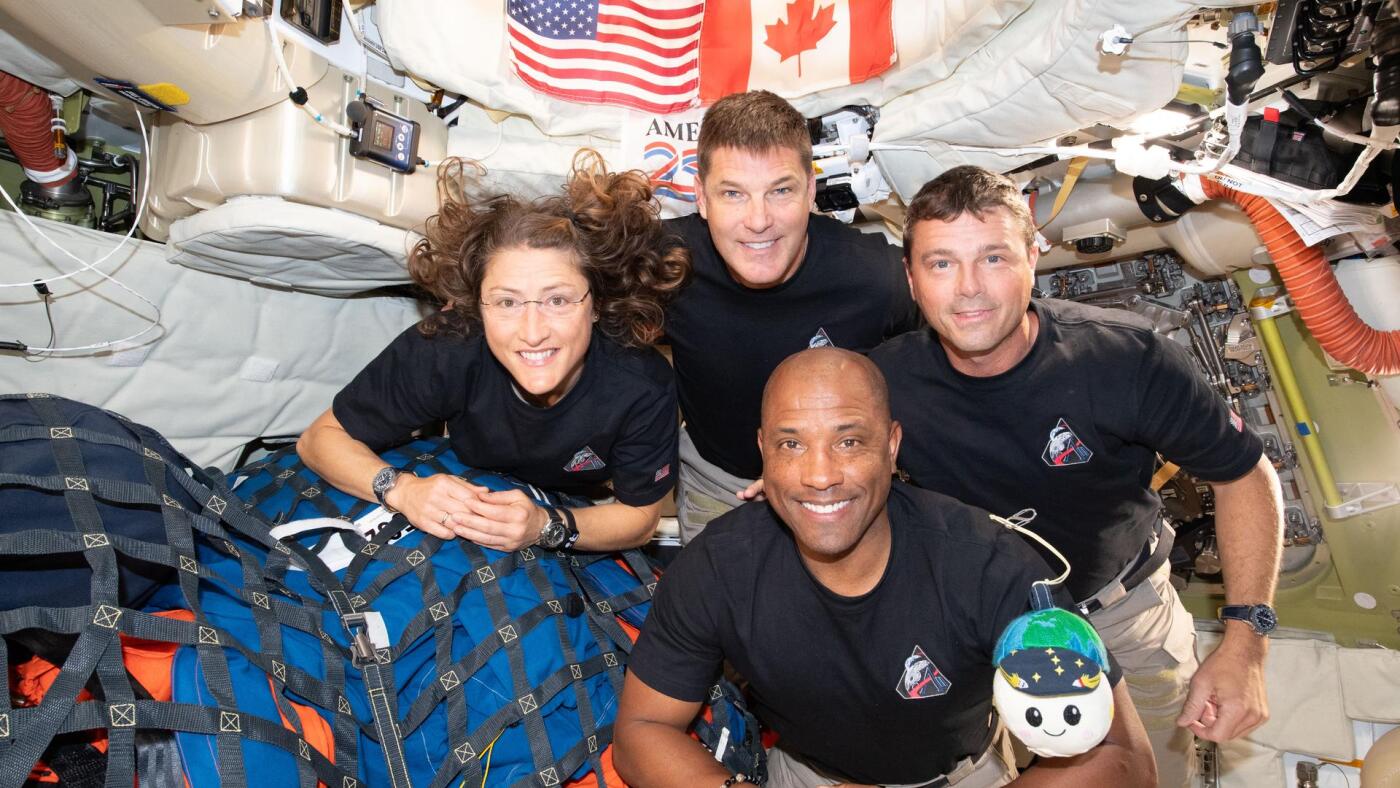
The Artemis II crew — Christina Koch (left), Jeremy Hansen, Victor Glover and Reid Wiseman — have to share tight quarters aboard the Orion spacecraft on their way home. But even with limited space, they can still get a solid workout in — thanks to a very special piece of equipment.
NASA
hide caption
toggle caption
Advertisement
NASA
Even a few days away from Earth can significantly alter the human body. Without the constant pull of gravity on the skeleton, muscle and bone can quickly atrophy. To combat this immediate physical decline, the four astronauts aboard Orion on the Artemis II mission are using a specially designed machine known as the flywheel.
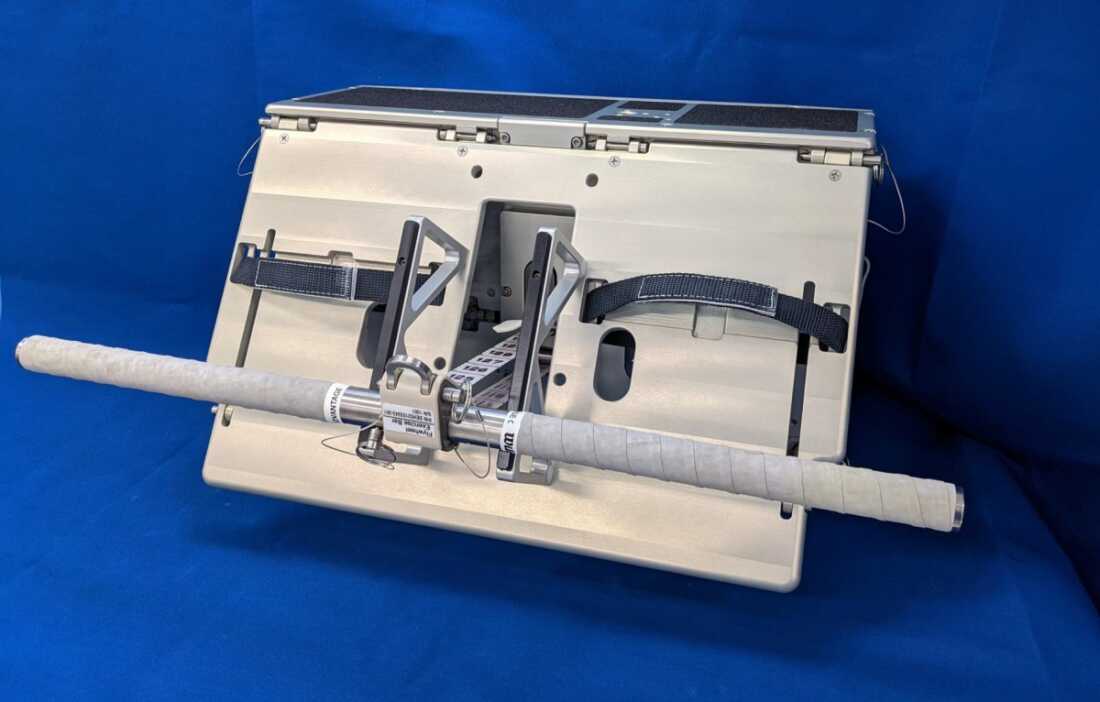
In a video blog posted before the crew launched, Canadian astronaut Jeremy Hansen compares the flywheel to a rowing machine. “Like a cardiovascular workout where you row at a lower resistance and a fast pace,” Hansen explains as he demonstrates the flywheel’s functionality. Astronauts strap their feet onto a small platform and pull on a handle connected to a cable. Pulling spins a flywheel. It works like a yo-yo, according to NASA — astronauts get as much resistance as they put into it.
The Artemis II crew exercises on Orion using a flywheel, a simple cable-based device for aerobic and resistance workouts. hide caption
Advertisement
toggle caption
The flywheel is small, not unlike an extra large shoebox. Working in Orion’s tight quarters — only 316 cubic feet , about the size of a smallish bedroom — engineers had to design this device to perform with utmost efficiency, so that it can both provide a cardiovascular workout and resistance exercises up to 400 pounds. Astronauts can use it to do weightlifting moves like squats, deadlifts and curls.
Before the astronauts, there were the pillownauts
The flywheel has been years in the making. Jessica Scott, an exercise physiologist at Memorial Sloan Kettering Cancer Center, worked on early prototypes for NASA, anticipating that astronauts would be vulnerable to rapid muscle atrophy without physical exertion.
Scott compares ten days in space to ten days in bed. Atrophying for that amount of time, says Scott, “You would feel very weak and your muscles start to lose size very quickly.” The heart, she stresses, is especially vulnerable with this decline in strength.
When recruiting people to study these early flywheel prototypes, says Scott, researchers looked for 30 subjects willing to lie in bed for 70 days. She and her colleagues weren’t sure they would be easy to recruit.
Turns out, people were eager to spend hours a day reclining in the name of science.
Advertisement
“We had over 10,000 people apply for 30 positions,” says Scott.
They called themselves the “pillownauts.”
Researchers divided these participants into different groups. Some stayed in bed all day. Some of them broke their bed rest in order to work out on a more traditional suite of exercise equipment, and some of them used the flywheel. The goal was not to improve fitness, but to prevent declines.
The flywheel, says Scott, delivered the results researchers were hoping.
“What was really exciting was that the small device could prevent the declines, the same amount that a full gym could do,” she says.
Advertisement
Other missions — like those aboard the International Space Station — have full suites of exercise equipment. The flywheel has not yet been tested for longer durations, but Scott says she’s hopeful it could also provide fitness for astronauts in longer periods of gravity deprivation.
Not everyone’s an astronaut, but everyone ages
Even for people who are not planning on orbiting the moon — this research has important implications, says Thomas Lang, a radiologist who studies bone and muscle loss and has worked with NASA on exercise science for previous missions.
“You start childhood and then as you grow your bone density and mass reach a peak,” says Lang, “in your late twenties or early thirties.”
Those who are lucky to live to old age, he says, will experience hormonal changes that lead to bone loss over time. For women, that escalates sharply in menopause. “That’s a big whopping decline,” says Lang.
Men’s decline may not be as dramatic, says Lang, but they are also vulnerable, especially as they live into their 70s and 80s.
Advertisement
NASA researcher Jessica Scott is also hopeful this work could have broader applications for the general public. Few of us will travel to space, but many of us can relate to dealing with time and space constraints when it comes to exercise, says Scott.
“One day we could all be having our own flywheel,” she says — something small enough to fit under a desk at work, or in the corner of an office.
After his first 30-minute aerobic session with the device, astronaut Reid Wiseman said he was happy to report that in addition to providing a good workout, he was pleased the flywheel didn’t drive his roommates too crazy. No one had to wear ear plugs to block out the sound.
“ It is a really good piece of gear and we can actually get a nice workout,” says Wiseman. “I look forward to the next time I get to try a resistance workout.”
Health and fitness expert Joe Wicks has said it was growing up in a “challenging home” which first sparked his passion for exercise.
Best known as the “nation’s PE teacher” after hosting daily YouTube workouts during the pandemic, raising more than £1million for charity and earning an MBE, Wicks has been building an online fitness following since 2014 and now has more than 4.7 million followers on Instagram alone.
However, speaking to the Irish News, the Epsom-born fitness coach said physical activity has served as a form of therapy since he was six years old.
“As a young child I lived in quite a challenging home,” he said.
“My parents both had mental health issues. My dad was a heroin addict and my mum suffered from anxiety, eating disorders and extreme OCD so I had these two very difficult people to live with.
“It was quite chaotic but I realised when I exercised, played sport, ran or did any kind of movement I could soothe and calm myself and take away some of that stress.
Advertisement
“And that’s really where my love for physical exercise and movement comes from. It’s been my therapy really since I was about six or seven years old.”
Joe Wicks was made an MBE in 2020 (Steve Parsons/PA)
In addition to his fitness programmes, Wicks has also authored numerous best-selling cookbooks, although he said his relationship with food was also affected by his upbringing.
“In terms of the food side of it, I was exposed to a very unhealthy diet. We were on benefits and any money that came through the house was really funding my dad’s addiction.
“So there wasn’t lots of fruit, veg or homemade meals – it was things like crispy pancakes, potato waffles, chicken nuggets, frozen chicken pies, and lots of sweets, chocolate and fizzy drinks.
“I had a very unhealthy diet and even now I sometimes struggle to eat junk food in moderation.”
A turning point came at the age of 13 when he was invited to visit St Mary’s University in Twickenham.
Advertisement
“It was an outreach between the school and the university.
“Lots of the children who went along were on the border of going down the wrong path or came from a difficult home life.
“I knew they were trying to inspire me and get me thinking more positively – that I could actually go to university one day.
“So I did a tour and spent a day there.
Read more: ‘It was an insane hormone disaster’: Newry fitness influencer on how health struggles inspired a thriving wellness platform
Advertisement
Joe Wicks leading a workout. (Ben Birchall/PA)
“When I got home, I said to my mum that I was going to do a degree in sports science and become a PE teacher.
“And I did actually end up going to that university.”
Although Wicks always had ambitions of becoming a PE teacher, he said he never expected the scale his career would reach.
“I’ve had an amazing career, but it’s been very unintentional.
“I’m not someone who had a big plan or strategy – everything has happened quite organically.
“It’s always been a natural progression and I couldn’t have imagined it going the way it has.
Advertisement
“I’m very grateful for all of it and I don’t ever take it for granted.”
Wicks holding two fitness sessions at Glastonbury last year (Ben Birchall/PA)
One of his most recent and unexpected highlights has been training children’s TV character Daddy Pig ahead of this year’s London Marathon.
“The PR for Hasbro, who own Peppa Pig, reached out and I actually really love Peppa Pig – we’ve always watched it with the kids.
“They said, ‘we’ve got this campaign with Daddy Pig’s son George, who’s now moderately deaf, so Daddy Pig is running the marathon for his son and for the National Deaf Children’s Society’.
“So I said I’d do it but I really wanted to run on the day with him. So they got me a spot and I’m running with him.
“And it’s obviously Daddy Pig in full character and I’m there coaching and motivating him. It’s been really fun and the kids have obviously seen the videos and think it’s hilarious.”
Advertisement
Read more: Joe Wicks: ‘Don’t convince yourself you haven’t got time to cook and that you can’t, because you can’Joe Wicks trains Daddy Pig for London marathon.
Wicks added that he is looking forward to bringing that same energy to Belfast where he will headline the inaugural Wellfest on September 12 and 13.
“There are talks, a nutrition and wellness area and discussions around mental health, as well as workouts from trainers across the board.
“It’s going to be really good fun.”
He will be joined by his wife, Rosie, for the session.
“Because I’ve done the workout so many times, they wanted something a little bit different.
Advertisement
“And it wasn’t like Rosie jumped at it – she’s quite shy. But I said it would be fun and we could make a weekend of it.
“We’re going to go on stage, do a 30-minute workout and it’s going to be great.
“It’s basically a high-energy session where we’ll be chatting and laughing and hopefully people will get involved and feel energised at the end.”
Joe and Rosie Wicks will host a workout session at this year’s Wellfest in Belfast.
It will be the first time the couple have worked out together on stage.
“I don’t know what to expect,” he laughed.
“We’ve never worked out on a stage together before. I’ve done my workouts and videos and the kids have joined in but they don’t really talk.
Advertisement
“So having Rosie there, mic’d up, we can have a bit of banter and I think it will be more engaging than just me on my own.
“I want it to feel relaxed. People aren’t there to be judged – they’re there to enjoy it. So I think it’s going to be good.”
He said a key part of Wellfest’s appeal is its accessibility, with an emphasis on inclusivity rather than elite fitness.
“The good thing about Wellfest is that you’ll have people of all ages and all different body types.
“You can have kids in the crowd and grandparents as well.
Advertisement
Read more: Joe Wicks to run London marathon alongside Daddy Pig for deaf charityPicture: Aviva Health UK/PA (Aviva Health UK/PA)
“It’s essentially a PE with Joe-style workout with music and if you miss something or need to stop, that’s fine.
“You’re not there to compete, just to take part and enjoy it.”
First established in 2015 in Herbert Park in Dublin, the event is designed to appeal to all levels, particularly those at the beginning of their fitness journey.
“Wellfest is an experience – you’re going there to learn something new and you’ll come away feeling energised and positive,” Wicks added.
“It might be a talk on nutrition, stress or mental health or a workout where you realise you can do something you didn’t think you could.
Advertisement
“It’s about taking part, enjoying it and then maybe continuing some of those habits at home.”
Tickets for WellFest NI, which will take place at Belfast’s Ormeau Park on September 12-13, are on sale now via WellFestNI.com.
Sheridan Smith does not mess about when it comes to overhauling her body for acting roles. Back in 2019, she revealed she had lost two stone while performing in West End production of Joseph and the Technicolor Dreamcoat and now, the 44-year-old is training for her part in ITV mystery thriller, Two Birds.
To help her achieve her goals, she recruited personal trainer and founder of 1st Class Bootcamp Tom Brown earlier this year. ‘The focus is on building her a strong, fit, healthy body that can perform under pressure,’ Tom tells Women’s Health UK. ‘It’s about improving strength, body composition (so, helping her burn fat and build muscle) and overall wellbeing – physically and mentally, rather than chasing extremes.’
Instagram
The pair strength train together four-five times a week, and there’s one key element to Sheridan’s programme: progressive overload. ‘Sheridan had trained before,’ Tom tells us. ‘But this approach to strength training is far more structured as we practice a clear, repeatable system which involves increasing the intensity week on week (a.k.a. progressive overload), usually by upping the weight she lifts in each exercise.
‘We also implement one strict rest day a week, as recovery is where your muscles have the time to grow back stronger and adapt, meaning she can lift heavier next time. It’s about doing the right exercises well – and doing them repeatedly. There are no quick fixes.’
Advertisement
While Sheridan’s programme involves a mix of strength training, cardio and mobility, strength is the priority. ‘This is how Sheridan can build muscle as the stress that weight training places on your muscles forces them to adapt and grow back stronger,’ Tom explains.
Below, Tom shares the exact 45-minute lower-body strength workout Sheridan does every Monday.
A quick caveat: transforming your body composition isn’t driven by exercise or nutrition alone. To build muscle and burn fat, Tom says Sheridan also follows a high-protein diet, drinks 2-3L water daily, prioritises sleep and recovery, and limits toxins through alcohol, sugar and highly processed food.
Sheridan Smith’s 45-minute lower-body workout
Warm-up and activation (8–10 minutes)
This is designed to activate the glutes and posterior chain (the muscles on the back of your body) before adding weight.
Do: 2-3 rounds with minimal rest between exercises and rounds
Advertisement
Glute bridges: 15 x reps
Single-leg glute bridges: 10 reps x each side
Dorsal raises: 12–15 x reps
Clamshells: 12–15 reps x each side
Main strength workout (40 minutes)
Barbell back squat: take 3 seconds to lower, pause for 1 second, then extend to stand in 1 second. Do: 3-4 sets of 10-12 reps, resting for 90 seconds between sets. Home workout alternative: dumbbell front-rack squats
Dumbbell Bulgarian split squat. Do: 3 sets of 12-14 reps per leg, resting for 75-90 seconds between sets
Dumbbell straight-leg deadlifts. Do: 3-4 sets of 10-12 reps per leg, resting for 90 seconds between sets
Hamstring curl machine. Do: 3 sets of 12-15 reps, resting for 45-75 seconds between sets. Home workout alternative: Stability ball hamstring curl/dumbbell glute bridge
Seated leg curl (single leg). Do: 3 sets of 12-15 reps, resting for 60 seconds between sets. Home workout alternative: Dumbbell glute bridge (heels close to glutes)
Dumbbell weighted step-ups. Do: 2-3 sets of 15-20 reps, resting for 60-90 seconds between sets. Home workout tip: Use a sturdy chair or stairs if no access to a bench
Cool down:
Forward fold into half lift: 4-5 breaths
Low lunge hip flexor stretch: 30 secs x each side
Transition to hamstring stretch: 30 secs x each side
Downward dog: 4-5 breaths, gently pedalling the heels
Pigeon pose: 30-45 secs x each side
Instagram
Sheridan Smith’s weekly workout routine
Monday: 45-60 mins strength training (lower-body focus)
Tuesday: 30-45 mins low-impact cardio + core work + mobility
Wednesday: 45-60 mins strength training (upper-body push/pull focus)
Thursday: Active recovery (walking, mobility, light movement)
Friday: 45-60 mins full-body strength + conditioning
Saturday: Outdoor movement (long walk, hike or steady cardio)
Sunday: Full rest and recovery
As Women’s Health UK’s fitness director and a qualified Pilates and yoga instructor, Bridie Wilkins has been passionately reporting on exercise, health and nutrition since the start of her decade-long career in journalism.
After earning a first-class degree in journalism and NCTJ accreditation, she secured her first role at Look Magazine, where she launched the magazine’s health and fitness column, Look Fit, before going on to become Health and Fitness writer at HELLO!
Since, she has written for Stylist, Glamour, Cosmopolitan, Marie Claire, Elle, The Metro, Runner’s World and Red. Today, she oversees all fitness content across Women’s Health online and in print, spearheading leading cross-platform franchises, such as ‘Fit At Any Age’, which showcases the women proving that age is no barrier to exercise.
She has also represented the brand on BBC Radio London, plus various podcasts and Substacks – all with the aim to encourage more women to exercise and show them how. Outside of work, find her trying the latest Pilates studio, testing her VO2 max for fun (TY, Oura), or posting workouts on Instagram.
Short, no-equipment workouts are racking up billions of views as consumers ditch traditional gym routines for fast, accessible fitness that fits into everyday life
Gym membership might be at an all-time high, but there’s a whole population of people going after their workout goals without a a traditional location or routine.
Just as people are drawn to short-form content on social media, they’re also gravitating toward short-form fitness — also known as “exercise snacks.”
Data from AI-powered analytics platform Virlo scoured more than 1,000 online videos with more than 2.2 billion views, finding that 5–15 minute routines on social media are outperforming traditional gym content, achieving higher engagement as they lower friction and make fitness feel immediately achievable.
Over three-quarters (76%) of trending fitness content across TikTok, Instagram and YouTube was no-equipment workouts that catered to audiences short on time, the report found.
Within that content, videos pushing specific body part targeting and transformation — especially abs, glutes and arms — had three to five times more engagement, while phrases like “no equipment,” “home workout” and “do anywhere” amplified shares. Videos that promised results within a certain number of days or expressed urgency (“lose fat fast” or “10 days to abs”) also saw higher views, especially repeat visits.
Advertisement
The trend reflects a broader shift online toward low-commitment, accessible and quick-results fitness that can seamlessly fit into the confines of everyday life. The videos are typically being posted by “micro-creators” without huge followings who post relatively simple routines.
These mini workouts appeal to the ubiquitous desire for instant gratification, while reducing the intimidation of structured gym routines, potentially increasing the chance of people who might not work out at all engaging in some form of exercise.
While the credibility of these creators’ claims to transform body composition in short windows with these movements is up unknown, there is science backing the effectiveness of exercise snacks.
A meta-analysis from last year found that short, structured bouts of movement — about five minutes of moderate-to-vigorous exercise — significantly improved cardiovascular fitness in adults, and slightly improved endurance among older adults, supporting the idea that any movement is better than none, especially if it lowers the barrier to entry to exercise.