Fitness
Forget about the gym! Chicken-sizing will keep you fit. Bonus: Fresh eggs


Andy Rementer / for NPR
In my 20s, I loved running. I called it “my Prozac.” Every week, I tried to run 25 miles. It kept my mood up and my heart healthy.
But when I reached my 30s, my relationship with running soured. My back started protesting the long runs. Then it protested the short runs. Eventually, one morning, I couldn’t walk. My back said, “Nope, no more running.”
For months, I felt pretty sad about this huge loss in my life. I tried other types of exercising, but my back protested it all — biking, yoga, pilates, zumba, you name it. Everything that our society calls “exercising” hurt my back for many days afterward. “Sorry. But we’re done with all of that,” my 33 vertebrae said in unison.
A different exercise mind-set
At the same time, I was reporting on global health for NPR, and I started to realize that exercising per se was a strange phenomenon. Around the world, people don’t necessarily go out and move their bodies with the intent to burn calories and tone their thighs (mmmm … chicken thighs). Instead, they embrace a revolutionary idea: They move — and move quite a bit — with a clear purpose in mind beyond the movement. They move to reach a destination. They move to hunt or forage. They move to take care of animals or tend crops. Or build a structure. Or gather firewood.
“Every day you’re doing something from dawn to dusk,” says Esther Ngumbi, who grew up in rural Kenya and is now an entomologist at the University of Illinois, Urbana. “In the morning, you have to go to the river to fetch water and come back. Then you go to the farm during the day and go fetch fire wood. Then at dusk, you have to go fetch water again.”
In other words, Ngumbi was weightlifting, not three times a week but at least twice a day. “I had to carry a 25-gallon bucket of water from the river,” she exclaims. “So yeah, I was weightlifting. I was exercising 24-7.”
Tying movement to purpose felt rewarding, Ngumbi says. And yet, here in the U.S. we’ve replaced almost all of this rewarding movement with machines. “The river exists in my home now. The fire stays at my home. And I can turn them both on and off when I need to,” she says laughing. “So now that I don’t have this purpose [to move] and all these things I need to do, I started gaining pounds. I’m just eating more and moving much less.” So Ngumbi started to exercise — at the gym.
But I started to wonder if I could go the opposite direction. If I could take inspiration from people all over the world and add more purpose and meaning to my exercising. “Hmm,” I thought, “maybe this type of movement could be my version of crossfit and barre.”
And so, after a decade of being a couch potato, I launched the most successful exercising program of my life. I bought 15 chicks, two coops and a book about how to raise a backyard flock. And I started chicken-sizing.
To be honest, chicken-sizing is harder than I thought it would be. Way harder. Taking care of flightless birds does tone your core and thighs. Because it requires bending, squatting and carrying heavy loads around your yard. One weekend, I tracked what chicken-sizing involved, and I counted about 20-30 squats each day, 1,500 extra steps each day (depending on how many chickens I have to chase back into the pen), and lots of lifting poultry water dispensers up, down and around the yard. They’re not 25 pounds but they’re at least 5.
The pluses of chicken-sizing
So I’ve gotten into way better shape than I expected. And I’ve come to realize there are some big advantages to chicken-sizing over regular exercising:
Failure is not an option: You cannot make up an excuse not to work out. You can’t put on your chicken-size clothes, sit around for 30 minutes and decide, “Oh, I’ll just do it tomorrow.” The ladies depend on you and need care every single morning and every single night. And if you don’t do it, they might die. They could be eaten by raccoons or skunks (who eat their heads, drink their blood and discard their bodies). Or they could dehydrate or freeze to death. The stakes are just too high.
And so you do it. Twice a day. Every. Single. Day. And it becomes so routine, so habitual that you don’t even realize you’re exercising. The task is part of your life, similar to going to the bathroom. You don’t put it on your calendar. You just do it. (Yes, some mornings early in this new regimen you curse the fact that you bought 15 chickens, but that sentiment passes after a few months).
You don’t have to change clothes: What a huge time saver! But also, cutting out that simple step makes it so much easier to actually get up and do the task. As all the habit experts say, “Make it easy!”
You always have a workout partner: In my case, I have 15. Sure, their brains are the size of two peanuts. But they are happy to see me — oh so happy. Every morning and evening, they cheer on my chicken-size routine with gusto! Squawk. Bah-Baaaahk!
And if I need a break, I can pick up a chicken and snuggle her soft feathers. Often it’s a white bird named Marshmallow. Talk about a feel-good, in-the-moment, five-senses experience. Sure, snuggling a hen isn’t quite the same as a dose of Lexapro, but twice a day, it comes pretty close. (
(One of my friends asked me the other day if I do “self-care,” and I said, “No.” And she responded in the funniest way. “Yes, you do. You raise chickens.”}
And there’s an added bonus that no gym workout will provide. Eggs! Holy moly, eggs! The best eggs you’ve ever eaten in your life. Some days I sit at the breakfast table and just marvel at how good these eggs taste. Or I’ll stare at our egg rack on the kitchen counter and appreciate the color of the beautiful shells.
Just this morning, I fried one egg for myself and one for my daughter. As we sliced into the golden-orange yolk, she said, “Whose is this one?”
“Oh, that’s Marshmallow’s,” I said. “She’s so amazing. Thank you, Marshmallow.” And thank you, chicken-sizing.
Given all these wonderful aspects of chicken-sizing, I wondered if Esther Ngumbi missed raising chickens or fetching water at the river.
“I do miss it,” she says with a sigh. “But some of it, I don’t miss,” she counters. “For example, sometimes I had to wake up early in the morning, and it was so cold.”
So maybe chicken-sizing is so great because it gives me purpose but I don’t actually have to do it. My family would still eat if I forget to close their cage one night and a skunk comes to decapitate them.
In other words, maybe chicken-sizing is a sweet spot between moving all day because your livelihood depends on it and moving only because your body sits down all day.
Ngumbi agrees. “Yes, maybe there is a sweet spot to exercising,” she says. “I actually really enjoyed going to fetch water at dusk. It was so refreshing with the cool evening breeze. It just all of a sudden relaxed you. So I felt like I was meditating while walking” — meditating, weightlifting and accomplishing a necessary task of life.
Science journalist MIchaeleen Doucleff is the author of Hunt, Gather, Parent: What Ancient Cultures Can Teach Us About the Lost Art of Raising Happy, Helpful Little Humans.
Copyright 2024 NPR


The World Health Organization says the average adult is supposed to get 60 minutes of moderate to vigorous activity five days a week, which sounds somewhat doable until it’s 9 p.m., your kids are finally in bed, and you just want to fall onto the couch and dissociate. But more and more people online are talking about “movement snacks” — little bite-sized amounts of exercise you can do throughout your day to meet your 60-minute goal without having to make special time for one big workout. Because yes, we all want to be our healthiest, but sometimes a HIIT class at the gym is just not in the schedule.
We asked personal trainers and fitness coaches for their favorite movement snacks you can do in the office, around the house, and on busy weekends when everyone’s home.
How much exercise is a person really supposed to get?
While the WHO recommends 60 minutes a day, the CDC is a little more lax, recommending at least 150 minutes of moderate-intensity physical activity a week, or about 30 minutes a day, five days a week. While it may feel like you’re the only one struggling to fit a workout into your daily routine, you’re far from alone. In fact, it’s always been hard for most Americans. So, while movement snacks may be a cute new term we’re all hearing for the first time, fitness pros have been promoting bite-sized exercise forever.
“I work with busy professionals, so I’ve been integrating micro workouts of two to 10 minutes into my clients’ lifestyles for almost 20 years,” says Andrea Marcellus, certified personal trainer and CEO of AND/life.
The most important thing for your health isn’t getting all your daily movement done in one big, perfectly curated workout — it’s about being consistent, Marcellus says. Movement snacks can help you stay consistent because you don’t have to budget a big chunk of time; instead, you can fit something simple into your day when you have three minutes to spare. Hell, you don’t even have to change clothes or go anywhere.
“Most people think movement only counts if it’s a workout. That mindset is what keeps people sedentary. In reality, your body doesn’t care if steps come from a hike, a gym session, or pacing when you’re on a call,” says Lindy Royer, physical therapist and balanced body educator. “This is where you win the game — by stacking movement into things you’re already doing.”
Movement Snacks To Try Throughout Your Day
- Set an alarm on your phone to chime every hour — that’s what women’s fitness coach Allison Kalsched tells her clients. When it goes off, stand up and do 10 bodyweight squats. Then go back to work. When you get tired of squats, mix in walking lunges, push-ups (it’s fine if they’re modified!), or dead bugs. Throw on 30 seconds of jumping jacks or high knees for bone-building benefits, which is important for women in menopause, she adds.
- Take a micro walk. “Five minutes or 500 steps is my absolute favorite,” says Dr. Milica McDowell, doctor of physical therapy, author of the forthcoming book Walk, and exercise physiologist at US Physical Therapy. “It changes mood, lowers blood pressure, boosts mental clarity, and can help you get your cumulative steps in.”
- Dance to your new favorite song with your kids or all by yourself. “Dance party was big with my kids after dinner,” Marcellus says. “It takes four to 10 mins and helps kids burn off dinner energy, while also giving parents a metabolic boost.”
- Stop and do 60 reps of any full-body exercise, like squats, lunges, or jumping jacks — this usually takes about two minutes, no matter which one you choose, Marcellus says. Or, hold a plank for one to two minutes.
- Pair walking with habits that already exist to get your steps in, like marching in place while brushing your teeth or doing a lap inside the house while your food is in the microwave. “This means you’re not adding time — you are upgrading your time,” says Royer.
- Count your housework. Sweeping, mopping, vacuuming, general domestic labor — these things totally contribute to your total exercise time each day, says Royer.
- If you go up or down the stairs at home, just… do it two or three times. That little extra here and there adds up, according to Royer.
The best advice is to focus not on “how can I move right now?” but “how can I do something that isn’t sitting right now?” Royer says. “The real truth that most people ignore is that sedentary time is the real enemy, not a lack of workouts. Focus on breaking up your sitting time. Build in frequent movement snacks. You’re not looking for perfection, just something more than nothing. You don’t need more time; you actually just need more conscious efforts to move.”
Fitness
At 66, Judy Murray swapped skipping for rebounding – here’s why it’s so effective for midlife women

A household name synonymous with tennis, Judy Murray has branched out in recent years when it comes to fitness. While the coach and former player still frequents the court – it’s integral to her day job, after all – she has incorporated several other activities into her routine, including one you might be unfamiliar with: rebounding.
Rebounding
In an interview with The Times, Judy explained that while skipping had been part of her tennis routine for years, she’d decided to replace it with rebounding – jumping on a trampoline – due to the impact skipping started to have on her joints and legs. And she’s onto something – a NASA study found rebounding to be up to 68% more effective at working the muscles and joints than treadmill running – something scientists call mechanical loading, which is crucial for bone, muscle and tendon health.
It doesn’t have to be expensive, either. Judy told The Times that she had bought a mini trampoline for £24.99 and that she used it in one-minute bursts.
‘Rebounding can be a smart swap for women in midlife, particularly if high-impact skipping or plyometric training has started to feel unforgiving on the joints,’ says personal trainer Michael Baah. ‘As oestrogen declines during perimenopause and menopause, we typically see reductions in bone mineral density, muscle mass and tendon elasticity,’ he explains. ‘High-impact ground reaction forces from traditional skipping can be effective for bone health, but they also place substantial load through the knees, hips and Achilles.’ Rebounding, on the other hand, ‘absorbs some of the ground reaction force, reducing peak stress through the joints, while still stimulating muscle activation in the calves, glutes and core.’
It shouldn’t replace strength training, adds Baah, which ‘remains the most effective intervention for combatting age-related sarcopenia and maintaining metabolic health,’ but it’s an incredibly valuable conditioning tool ‘for women who want to protect their joints while maintaining cardiovascular fitness.’
Below, we also look at the other workouts Judy has turned to in recent years to stay strong and active while protecting her joints – and why you should try them, too.
She swims
‘As I get older I have found a lot of things I enjoyed doing really impact my knees and hips, but a lot of things I can do in water…I also realise I have five grandchildren now. I want to be able to run after them and pick them up and put them down with relative ease,’ Judy told The Times. ‘I have a whole routine I do in the swimming pool and there is no impact in the water. It is a better way to do some of the things I used to do.’
Indeed, not only does swimming protect your joints, but it’s also effective for cardio fitness. ‘The biggest advantage of swimming is that it is low impact. The buoyancy of water significantly reduces joint loading, making it an excellent option for people with joint pain or who have a lower tolerance to impact,’ personal trainer and nutritionist Georgia Garlick previously told WH. ‘It is a true full-body exercise, involving the upper body, trunk, hips and legs simultaneously.’ On average, she added that moderate swimming burns 500-700 kcal per hour – typically more than moderate cycling.
She has started playing golf
Judy has also discussed how participating in Strictly Come Dancing back in 2014 instilled in her a desire to continue challenging herself and trying new things – no matter her age. In that vein, ahead of her 65th birthday, she told HELLO!, that she had taken up golf. ‘I’m addicted to it, it is so incredibly relaxing,’ she said. ‘It gets me out in the fresh air and away from my phone and because it’s not as physically demanding as running around a tennis court, it suits me now that my arms aren’t as strong as they once were.
‘As we get older it’s so important to keep trying to find things that stimulate you, make you think and keep you socially connected – and golf ticks all of those boxes.’
A review published in the British Journal of Sports Medicine linked golf to an increased life expectancy, reduced risk of chronic disease and improved mental health.
She plays pickleball
While padel has become hugely popular, it seems that its sibling pickleball – which combines tennis, badminton and table tennis – is more up Judy’s street. After trying the sport herself, she’s since campaigned to get more people involved. ‘It’s just fun and engaging, and it’s incredibly inclusive. And for Scotland, it’s a perfect fit for us. We have terrible weather, we have badminton courts everywhere – in every community centre and sports centre. Even church halls have badminton courts,’ she told The National. ‘In terms of setting up quickly, wherever you are, I think it’s a perfect fit for getting more people more active.’
Judy added that she sees it as a perfect transition from tennis to something that will let her play a similar game for longer.
She stretches regularly
The final touch to Judy’s fitness routine? A dedicated stretching routine. ‘Since I turned 60, I’ve realised how important it is to stretch to stay mobile and flexible if I want to stay active with my grandchildren,’ she told HELLO!.
While we don’t know the specifics of Judy’s stretching routine, even dedicating just a few minutes daily to mobility can supercharge longevity.
There is an ideal routine based on science, though. According to a panel of experts convened by the American College of Sports Medicine, who reviewed a range of studies, you should:
- Do flexibility exercises (stretches, yoga or tai chi) for all major muscle-tendon groups – neck, shoulders, chest, trunk, lower back, hips, legs and ankles – minimum two to three times per week.
- Spend 60 seconds on each exercise. If you can hold a specific stretch for 15 seconds, try repeating it three more times and if you can hold it for 20 seconds, two more repetitions would be ideal.
As Judy regularly says, though, it’s about finding forms of exercise that you enjoy, as you’ll be far more likely to find the time – even if it’s for five minutes – to get stuck in.
Hannah Bradfield is a Senior Health and Fitness Writer for Women’s Health UK. An NCTJ-accredited journalist, Hannah graduated from Loughborough University with a BA in English and Sport Science and an MA in Media and Cultural Analysis. She has been covering sports, health and fitness for the last five years and has created content for outlets including BBC Sport, BBC Sounds, Runner’s World and Stylist. She especially enjoys interviewing those working within the community to improve access to sport, exercise and wellness. Hannah is a 2024 John Schofield Trust Fellow and was also named a 2022 Rising Star in Journalism by The Printing Charity. A keen runner, Hannah was firmly a sprinter growing up (also dabbling in long jump) but has since transitioned to longer-distance running. While 10K is her favoured race distance, she loves running or volunteering at parkrun every Saturday, followed, of course, by pastries. She’s always looking for fun new runs and races to do and brunch spots to try.

In an era where ultramarathons, double training days and weekly Hyroxes have become the norm, the signs of exercise dependency are increasingly blurred. Movement is celebrated as medicine, after all – so how do you know when it’s become something more sinister?
At its core, exercise dependency is a pattern of compulsive exercise where working out stops being a flexible, health-enhancing habit and becomes something you feel driven to do – even when it’s harming your body, mood or life. But since it’s widely seen as a “healthy” habit, the signs are often missed.
In reality, depending on exercise (often to avoid painful or difficult emotions) carries significant physical and psychological consequences – and research shows that among people who regularly exercise, 14-42% of them suffer. Below, dietitian and expert in REDS Renee McGregor shares the signs to watch for, then scroll down for advice on how to restore a healthier relationship with exercise.
Signs of exercise dependency
- Using exercise to manage emotions: Relying on exercise to fix negative moods or feelings of worthlessness.
- Never feeling you’re doing “enough”: Feeling that no matter how much you train, it’s not sufficient.
- Hidden workouts: Hiding the amount of exercise done from others.
- Distorted priorities: Inflexible, obsessive, and compulsive thinking regarding fitness goals.
- Ignoring pain or injury: Continuing to train despite illness, exhaustion or injury.
- Withdrawal symptoms: Feeling anxious, depressed, irritable or restless if a session is missed.
- Compulsive scheduling: Structuring the entire day around workouts and feeling intense anxiety if the schedule is disrupted.
- Increasing intensity/volume: Needing more exercise to achieve the same high or emotional satisfaction.
- Prioritising exercise: Skipping work, school, social events or family obligations to exercise.
How to recover
1.Identify compulsive patterns
Studies show exercise dependence shares features with other addictive behaviours, like tolerance, withdrawal and compulsive use. And McGregor says around 60% of people with exercise dependency also show behaviours linked to a dysfunctional relationship with food. Aim to identify what makes you want to exercise: is it a desire to control your weight? Or to avoid guilt or anxiety? How do you feel when you’re not able to exercise?
2. Reduce wearable tech tracking
Constantly tracking your steps, workout data and fitness scores can inadvertently increase anxiety, guilt and comparison around metrics and goals, potentially reinforcing obsessive exercise behaviour – instead of healthy motivation. Indeed, studies show wearables can exacerbate harmful compulsive exercise behaviour and should be used with caution in people prone to dependence.
3. Find a non-body-based hobby
Language learning, pottery, chess, or volunteering can all help to reduce stress, build identity outside exercise and improve well‑being by activating new reward pathways and providing a sense of purpose. Research on these types of leisure activities shows that engaging in hobbies is linked to better mental health, reduced depression and anxiety and is also protective in recovery from addictive behaviour.
4. Seek professional psychological support
Other research shows various types of therapy can help explore motivations and past experiences that contribute to compulsive exercise, as well as helping to rebuild social functioning outside of exercise routines.
5. Broaden your coping strategies beyond exercise
Multiple studies show that exercise often serves as an emotional coping strategy for stress, anxiety or low mood – not just physical health. Experts say recognising and addressing this in therapy can help you to broaden your emotional toolbox beyond exercise – for example, studies show walking outdoors (without tracking your pace or steps) can help relieve stress and anxiety. Other research shows five-ten minutes of paced breathing, journalling and short guided meditations can also work. Gardening, long baths and reading fiction can also act as a stress release.
6. Structure balanced activity with rest
Establish a structured, weekly schedule focussing on moderate intensity exercise over high intensity, with rest and recovery also formally scheduled in, as per research. It’s not about completely cutting out all exercise, but making it a realistic, sustainable and healthy part of life.
7. Set training boundaries
Experts recommend built-in rest and setting a minimum duration per exercise session to avoid overexercising and to boost physiological recovery and psychological resilience. Aim for at least one rest day between workouts.
If you recognise these signs in yourself, it’s important to seek support from a GP or qualified mental health professional. Exercise dependency and exercise addiction are treatable, and getting help early can make recovery far easier and more sustainable. Contact your GP or use the NHS’ Mental Health Services, or contact BEAT.
As Women’s Health UK’s fitness director and a qualified Pilates and yoga instructor, Bridie Wilkins has been passionately reporting on exercise, health and nutrition since the start of her decade-long career in journalism. She secured her first role at Look Magazine, where her obsession with fitness began and she launched the magazine’s health and fitness column, Look Fit, before going on to become Health and Fitness writer at HELLO!. Since, she has written for Stylist, Glamour, Cosmopolitan, Marie Claire, Elle, The Metro, Runner’s World and Red.Now, she oversees all fitness content across womenshealthmag.com.uk and the print magazine, spearheading leading cross-platform franchises, such as ‘Fit At Any Age’, where we showcase the women proving that age is no barrier to exercise. She has also represented the brand on BBC Radio London, plus various podcasts and Substacks – all with the aim to encourage more women to exercise and show them how.Outside of work, find her trying the latest Pilates studio, testing her VO2 max for fun (TY, Oura), or posting workouts on Instagram.
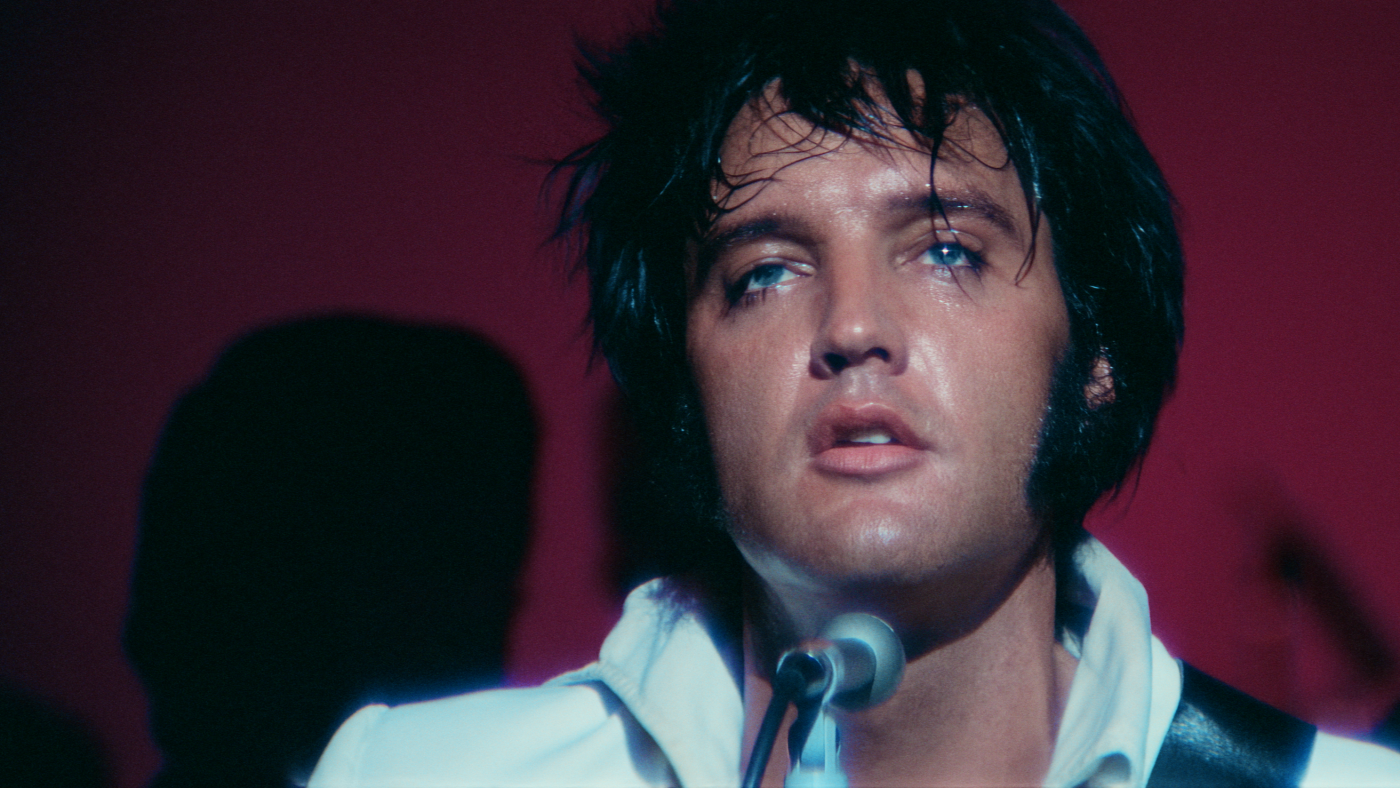
Baz Luhrmann will make you fall in love with Elvis Presley

Here’s your first look at Kratos in Amazon’s God of War show

State Dept authorizes non-essential US Embassy personnel in Jerusalem to depart ahead of possible Iran strikes

Where Iran’s ballistic missiles can reach — and how close they are to the US

Heart disease threat projected to climb sharply for key demographic

Florida High School Football Rankings: Top 25 teams – Oct. 21

Cleary's 21 help Le Moyne down Central Connecticut State 69-64 in OT

How old is Bo Nix? What to know about Oregon quarterback ahead of 2024 NFL Draft

99th annual Pony Swim held in Virginia

Indiana Members Credit Union announced as new anchor tenant at Bottleworks District
Where Iran’s ballistic missiles can reach — and how close they are to the US

Has India’s influence in Afghanistan grown under the Taliban?

Bill Clinton to testify before House committee investigating Epstein links

Read Judge Schiltz’s Order

Vulnerable House Dem lashes out at Trump’s ‘racist’ SOTU challenge: ‘That was uncomfortable’
-

 World1 day ago
Exclusive: DeepSeek withholds latest AI model from US chipmakers including Nvidia, sources say
-

 Massachusetts2 days ago
Mother and daughter injured in Taunton house explosion
-

 Montana1 week ago
2026 MHSA Montana Wrestling State Championship Brackets And Results – FloWrestling
-

 Oklahoma1 week ago
Wildfires rage in Oklahoma as thousands urged to evacuate a small city
-

 Louisiana4 days ago
Wildfire near Gum Swamp Road in Livingston Parish now under control; more than 200 acres burned
-

 Technology6 days ago
YouTube TV billing scam emails are hitting inboxes
-

 Denver, CO2 days ago
10 acres charred, 5 injured in Thornton grass fire, evacuation orders lifted
-

 Technology6 days ago
Stellantis is in a crisis of its own making