Sports
If anyone knows what Caitlin Clark is experiencing, it's Diana Taurasi … to an extent


PHOENIX — Caitlin Clark was on the bench, for once, clapping as the final seconds ticked here Sunday. The Indiana Fever rookie celebrated an 88-82 win over the Phoenix Mercury with teammates, and then she was surrounded by television cameras and photographers. As she spoke to an ESPN reporter, Diana Taurasi walked past 20 feet away, headed for the home locker room.
This contest was big for the Fever, its first victory over a winning team in 20 tries, but it also presented a before-and-after picture that was impossible to ignore. Clark, 22, is the hotshot rookie, the future of the WNBA. Phoenix’s Taurasi, 42, is the league’s career scoring leader, someone who has a street named after her outside the arena.
In front of a sold-out crowd at Footprint Center, Clark was steady over 39 minutes. Although she shot 4 of 14, she finished just shy of her first professional triple-double with 15 points, 9 rebounds and 12 assists. “My gosh … she’s just an incredible passer,” Indiana coach Christie Sides said. “She just finds the plays that need to happen.”
Taurasi posted 19 points, 3 assists and 3 rebounds in 32 minutes. Two nights earlier, in a home win over the Los Angeles Sparks, Taurasi had buried five 3-pointers. Against the Fever, she shot 2 of 10 from deep, never finding an offensive rhythm.
a near triple-double from Caitlin Clark in today’s win over Phoenix 😈 pic.twitter.com/KSJriLAb3l
— Indiana Fever (@IndianaFever) June 30, 2024
Aside from the courtside interview, during which she praised her team’s resilience, Clark didn’t talk to reporters after the game. Sides said the guard did not feel well and needed to meet with the trainer. It’s also a fair bet Clark didn’t want to be put into position to answer questions about beating Taurasi, the rising star toppling a legend. In some ways, this has been a challenge for the entire Indiana franchise.
This weekend Sides twice was asked to assess Clark’s performance. Twice she focused her answer more on the Fever’s youth and their collective growth. After Indiana’s loss to the Seattle Storm on Thursday, Clark met with reporters alongside teammate Aliyah Boston. After reporters directed a fifth straight question to Clark, Clark waved her hand and said, “Ask Aliyah a question.”
If anyone can relate, it’s probably Taurasi, but this comes with an asterisk. Twenty years ago, she was in a similar situation. Like Clark at Iowa, Taurasi had finished her college career at Connecticut as the best player in the sport. She was the No. 1 pick of the WNBA Draft and was expected to elevate the league. The difference was media attention. Since joining the league, Clark has been the focus of countless debates — some on basketball, others on race. She has learned that anything she says can become a national headline or conversation.
Perhaps that explains her reaction Saturday when asked about the WNBA All-Star Game, which takes place July 20 in Phoenix. Even though Clark ranked second in recent fan voting, she didn’t want any part of the conversation. “I don’t know if I’ll be there,’’ she said after practice at Arizona State University. “I’m not going to talk in hypotheticals. My focus is on playing basketball. All that takes care of itself.”
In the same media session, Clark was asked for her first memory of Taurasi, a difficult task considering she was only 2 when Taurasi first joined the WNBA. But after thinking a second, Clark said Taurasi was always someone she associated with women’s professional basketball. She appreciated the intensity and fire in which Taurasi played, and called Sunday’s game a chance to compete against the best, “a dream come true.”
“That’s somebody I grew up idolizing and looking up to and wanting to be like one day,’’ Clark said. “I don’t know if there’s going to be many people to be able to do it like her.”
As a Phoenix rookie in 2004, Taurasi instantly became the face of the franchise. Her first home game drew 10,493 fans, the most for an opener in three years. Before many road games that season, Taurasi met pregame and talked with a select group of 50 fans. Former Phoenix general manager Seth Sulka told reporters at the time that the attention was unlike anything he had seen in the WNBA.
“I loved it,” Taurasi said when asked about this Sunday. “I just loved to play basketball. I didn’t care too much about outside noise or what people thought of me. I enjoyed every minute. Being a rookie was cool, man. It was fun. You could do whatever you want, you didn’t know any better. Being in Sports Illustrated, Slam … ESPN the Magazine.”
Taurasi glanced at a young reporter in the room.
“You’re too young. You don’t know what I’m talking about,” she said.
Like Clark, Taurasi still had to deal with physical play, with veterans trying to put her in her place. Opponents respected her talent, but they made her earn their respect. On April 5, while providing TV commentary during the women’s Final Four, Taurasi recalled a “Welcome to the WNBA” moment and how an intimidating defender named DeLisha Milton-Jones twice elbowed her in the face. It set up a rivalry of sorts.
During a recent phone conversation, Milton-Jones, the coach of the women’s program at Old Dominion, laughed. She had seen Taurasi’s comments on social media. “I’m like, ‘Invite me on your show so I can tell them the other side,”’ she said.
Milton-Jones was aware of Taurasi’s skill. In the WNBA, she saw it up close. How Taurasi manipulated the game with her vision. How she understood spacing and timing. How she applied a point guard’s touch to multiple positions. But what impressed Milton-Jones most was how Taurasi arrived with tricks that took most rookies a season or two to learn.
Milton-Jones said that when she elevated for a jump shot, Taurasi would poke her in the stomach, just hard enough to make her flinch and throw off her shot. On offense, Taurasi would come off a pindown and try to jam Milton-Jones to try to create space.
“She would literally punch me in the stomach,’’ Milton-Jones said. “Then she would blast off wide open. My coach is yelling at me like, ‘You need to be guarding her!’ And I’m like, ‘She just punched me in the stomach!’ She was feisty and crafty and she had this vet savvy-esque play to her game.”
(Responded Taurasi outside the media room Sunday: “I think it was my upbringing. Italian Argentines, we’re sneaky. We’re always trying to find an advantage somehow. In the game of basketball, there’s games within the game. And when you’re not physically gifted as much as other people, you have to find little ways to get that edge.”)
Carrie Graf, who coached Taurasi her first two pro seasons, said Taurasi’s biggest flaw was with the referees. She was too harsh. Instead of yelling in their faces, she told Taurasi to use her charisma. To remember that officials are people. But there was no questioning her readiness.
“I can picture this shot like it’s a photograph,’’ Graf said on the phone from Australia. “She’d get in the lane and she’d be up against the tall timbers. She’s on the right side and she extended her right arm out like it was an elevated hook shot. And then with her left hand, the shot blocker is coming in, and while she’s in the air, she goes up and grabs the shot blocker’s arm to clear some space so she could put the ball on the rim. Women just weren’t doing that stuff back then.”
Diana Taurasi drives against Caitlin Clark in Sunday’s game. (Chris Coduto / Getty Images)
Clark has this quality as well, but instead of hanging in the air, it’s pulling up from the logo, a trademark move that has made her famous within the sport. She did this twice Sunday, igniting the crowd. Even in Phoenix, the “Clark” jerseys outnumbered Phoenix players’ in many sections of the arena.
Caitlin Clark showing off her deep range with another logo three 🎯 pic.twitter.com/IX8wnVb3g4
— Indiana Fever (@IndianaFever) June 30, 2024
Clark is still navigating this transition. Like she has all season, she forced too many passes Sunday, resulting in 6 turnovers. She tried a behind-the-back pass that had little chance. She misfired on a lead pass in transition. She lost the ball and fell to the court.
Before the game (Clark meets with reporters before every contest), she had said her biggest adjustment had simply been the pace of everything. After losing to South Carolina in the NCAA national championship, Clark returned to Iowa City for a day and “then my life kind of changed,” she said.
After the draft, Clark moved to Indianapolis. May 3, she played her first preseason game. She hasn’t slowed since, playing 20 games for the 8-12 Fever. The exciting part is she knows she has room to grow, mastering details that can elevate her game. The frustrating part is she hasn’t had much practice time to do so.
“I had to learn game to game,” Clark said. “That’s kind of been the biggest adjustment.”
Taurasi predicted as much. She didn’t mean it as a shot at Clark and the league’s talented rookies. Only that this transition often takes time. In a Phoenix radio interview, Taurasi compared it to a college quarterback adjusting to the NFL. After Sunday’s loss, she expressed how much she respects how Clark has handled it.
“It’s amazing what Caitlin has been able to do,” Taurasi said. “Her short career so far has been nothing short of remarkable. The one thing that I really love about her is she loves the game. You can tell she’s put the work in. And even throughout her short WNBA career, it’s been a lot of pressure, a lot of things thrown at her, she keeps showing up and keeps getting better every single game. Her future is super bright.”
(Top photo: Kate Frese / NBAE via Getty Images)



NEWYou can now listen to Fox News articles!
President Donald Trump will present the FIFA World Cup trophy to the winner of the match between Spain and Argentina on Sunday, a White House official confirmed to Fox News.
FIFA President Gianni Infantino said last month on “Fox & Friends” that he and Trump would deliver the trophy to the winning team’s captain on the field of New York/New Jersey Stadium.
WATCH ARGENTINA VS SPAIN LIVE
Reece James of Chelsea lifts the FIFA Club World Cup trophy on stage with President Donald Trump after Chelsea’s victory over Paris Saint-Germain in the 2025 final at MetLife Stadium in East Rutherford, N.J. (VCG/VCG via Getty Images)
Infantino also said at the time that Trump would attend the contest. White House press secretary Karoline Leavitt called the president’s attendance “a fitting conclusion to a tournament that showcased America’s ability to host the world on the grandest stage.”
Trump was on stage during the FIFA Club World Cup trophy presentation after Chelsea defeated Paris Saint-Germain last summer.
Earlier in the World Cup, Trump got involved in one of the World Cup’s biggest controversies, calling Infantino and requesting a review of Folarin Balogun’s red card. Balogun was suspended for Team USA’s Round of 16 match, but he was later ruled eligible for the game.
President of FIFA Gianni Infantino and President Donald Trump prepare to present the trophy to Chelsea FC following the World Cup final match between Chelsea FC and Paris Saint-Germain at MetLife Stadium in East Rutherford, N.J., on July 13, 2025. (VCG/VCG via Getty Images)
Trump has yet to attend a World Cup match, but Secretary of State Marco Rubio was spotted at the U.S. Men’s National Team’s opener against Paraguay, a 4-1 win on June 12.
The president was awarded the first FIFA Peace Prize at the Kennedy Center in Washington, D.C., during the World Cup final draw in December.
President Donald Trump speaks after receiving the FIFA Peace Prize from FIFA President Gianni Infantino during the World Cup 2026 Final Draw. (Amber Searls-Imagn Images)
CLICK HERE TO DOWNLOAD THE FOX NEWS APP
Trump recently attended Game 3 of the NBA Finals at Madison Square Garden, while the White House played host to UFC Freedom 250 last month. An IndyCar race will take place in Washington, D.C., next month.
Fox News’ Ryan Morik contributed to this report.
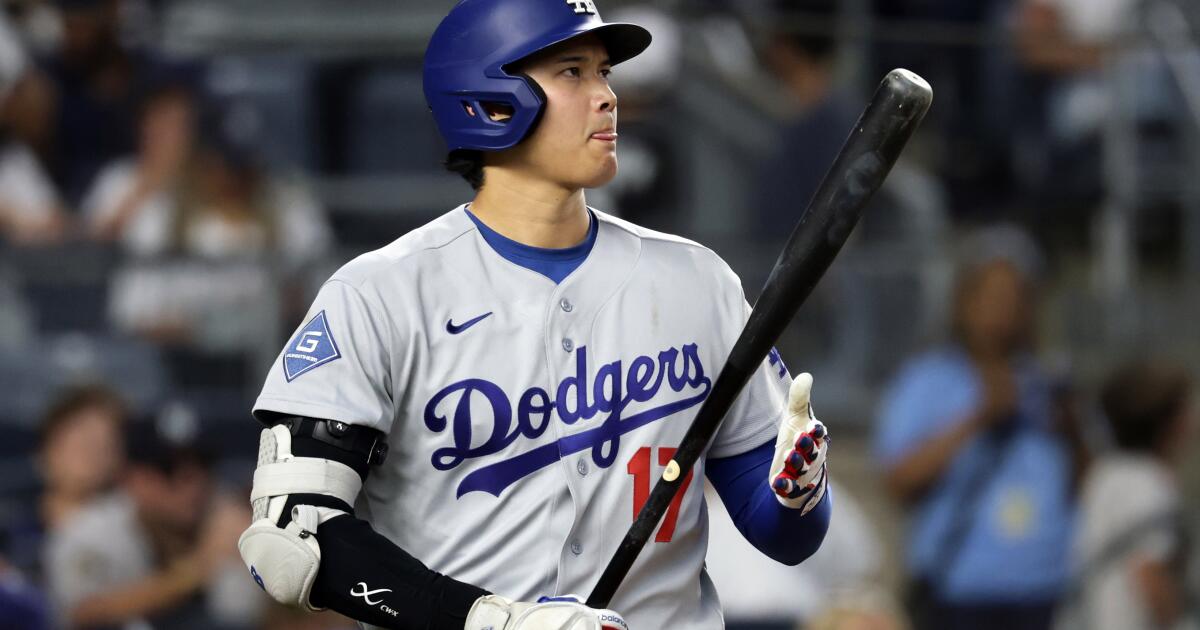
NEW YORK — The Dodgers don’t know when Shohei Ohtani will take the mound next.
He was tentatively scheduled to start Wednesday against the Phillies, after promising initial reports on his recovery from an injection in his left knee. But after seeing his knee’s response to playing catch, the team decided to give him more time.
“We just want to continue to give it the best chance to kind of get into a good spot,” manager Dave Roberts said. “And as he said, as we feel, it’s the pitching and the torque of landing on that leg that kind of gets it upset.”
It was clear enough from catch play that Ohtani’s start would have to be pushed back that Ohtani did not feel the need to test it by throwing off a mound, Roberts said.
“Where we’re at right now, how we’re proceeding, I would say that it’s going to be some time,” Roberts said. “It’s not going to be a day-to-day thing.”
That left a wide range of timeline possibilities, from days to weeks. Roberts did, however, rule out shutting Ohtani down from pitching for the rest of the season.
“I guess anything is possible, but I just don’t think that’s a possibility,” he said.
To fill Ohtani’s spot in the rotation this week, the Dodgers moved right-hander Emmet Sheehan’s start to Monday. Before the rainout bumped the second game of the series against the New York Yankees, Sheehan was scheduled to start Saturday.
For Sunday’s doubleheader, right-hander Yoshinobu Yamamoto will take the mound in the first game. The bullpen, and potentially multiple innings from the 27th man, will cover the nightcap.
“Honestly, a lot of it is where we’re at and how we’ve put ourselves in a good spot,” Roberts said of the MLB-leading Dodgers. “Could [Ohtani] probably do it? Sure. But right now, the benefits just don’t seem to outweigh the cost at this time of the season. So I think we still have plenty of time to get him to a good spot to then pitch.”
Ohtani, who went hitless in four at-bats as the designated hitter in Friday’s 2-1 win, was set to DH and hit leadoff in Sunday’s first game.

NEWYou can now listen to Fox News articles!
It’s the game that no one ever wants to play in, but there was still a lot on the line for both England and France in the third-place match at the 2026 FIFA World Cup on Saturday.
Both teams hit the pitch at Miami Stadium (also known as Hard Rock Stadium) after some tough semifinal losses: France to Spain, and England to reigning champs Argentina.
France was looking for redemption after coming up short in a tournament where they were widely viewed to be the favorite. Plus, this match presented an opportunity for French star Kylian Mbappe to overtake Argentina’s Lionel Messi in the Golden Boot race.
WATCH THE WORLD CUP FINAL ON FOX ONE
England’s Bukayo Saka scores during the FIFA World Cup 2026 Bronze Medal Match. (Photo by Jose Breton/Pics Action/NurPhoto via Getty Images)
However, they were up against an England team that had played well throughout the tournament and was 2-1 against them in World Cup matches. Their two most offensively potent players this tournament, Harry Kane and Jude Bellingham, both started the match on the bench.
Well, in the early going, it turns out that England had enough offensive firepower to get things started.
In just the 3rd minute, Declan Rice hit paydirt to open the scoring.
Only about ten minutes later, England put another one in the back of the net; however, it was deemed to have been offside.
But even with the big guns sitting on the bench, England was easily the more offensively productive team early, with Ezri Konsa adding another off of a corner in the 18th minute.
But why not make it three?
In the 37th minute, Bukayo Saka scored a goal that was certainly not how the Three Lions would’ve drawn it up, but it counts just the same.
And while you’re at it, Mr. Saka, just tack on another for good measure.
FOX ONE’S NEW WORLD CUP VIEWING EXPERIENCE
England took a 4-0 lead into halftime after one of the most lopsided first halves of the tournament, and few expected France to be on the receiving end, especially with Harry Kane and Jude Bellingham still on the bench.
And, honestly, it could’ve been worse.
France bounced back from a nightmare first half, and star Kylian Mbappe scored a pair to take the lead in the Golden Boot race and make history. (Photo by CHANDAN KHANNA / AFP)
Fortunately for France, they did exactly what they needed to and came out firing in the second half. Mbappe got them on the board in the 48th minute, and put himself ahead of Messi in the Golden Boot race, and even with him in career World Cup goals at 21.
Then, just minutes later, France’s Bradley Barcola added another to make it a 4-2 game.
So, while the first half was all England, the second was all about France, and in the 66th minute, Mbappe made it 4-3, while also extending his Golden Boot lead and taking over the top spot on the all-time World Cup goals list.
What. A. Match.
Who cares about third place, right?
England’s Jude Bellingham and Reece James celebrate Bukayo Saka’s (center) third goal of the Bronze Final match in Miami. (Photo by Luke Hales/Getty Images)
But after getting several opportunities to tie it up, England was awarded a penalty kick, and that went to Bukayo Saka, who buried it for the hat trick and to give England a little breathing room late in the match.
It’s hard to believe he didn’t play a single minute in the semifinal loss to Argentina, right?
And that breathing room was important, because France wasn’t going to go quietly.
But England answered back immediately with a beauty from Jude Bellingham, his seventh of the tournament, and that was all she wrote.
Unbelievable.
The final score was, incredibly, 6-4. That was the most goals scored in a World Cup third-place match ever, topping the one in 1958 between France and West Germany.
With that win, England may have come up short when it comes to bringing a World Cup title back home, but that was their best finish in a World Cup since they won it in 1966.
CLICK HERE TO DOWNLOAD THE FOX NEWS APP
It was an incredible match, and now there’s only one left and its for the World Cup title.
Spain and Argentina will meet on Sunday afternoon at New York-New Jersey Stadium, with the match scheduled to start at 3 pm ET.
-

 Detroit, MI18 minutes ago
Detroit nonprofit rebounds from theft of 400 pairs of shoes with help from the community
-

 San Francisco, CA30 minutes ago
Fans gather in San Francisco to watch Spain-Argentina World Cup final
-

 Dallas, TX36 minutes ago
Dallas Mavericks acquire former No. 1 pick Zaccharie Risacher in 3-team trade
-

 Boston, MA48 minutes ago
Boston Weather: Cooler temperatures, possible storms incoming
-

 Denver, CO54 minutes ago
Denver weather: Pinpoint Weather Alert Day continues through Monday evening for heat
-

 Seattle, WA60 minutes ago
West Seattle Grand Parade throwback: 1989’s ‘Save the Admiral’ float – and views of the route it traveled
-

 San Diego, CA1 hour ago
Hilarious moment superheroes paddle for their life as Comic Con 2026 kicks off in San Diego
-

 Milwaukee, WI1 hour ago
Brewers Make Powerful Statement As World Series Quest Enters Second Half

