Connect with us

Lifestyle

Move over, pickleball: In this wealthy L.A. neighborhood, another game reigns supreme

Published

on

Move over, pickleball: In this wealthy L.A. neighborhood, another game reigns supreme
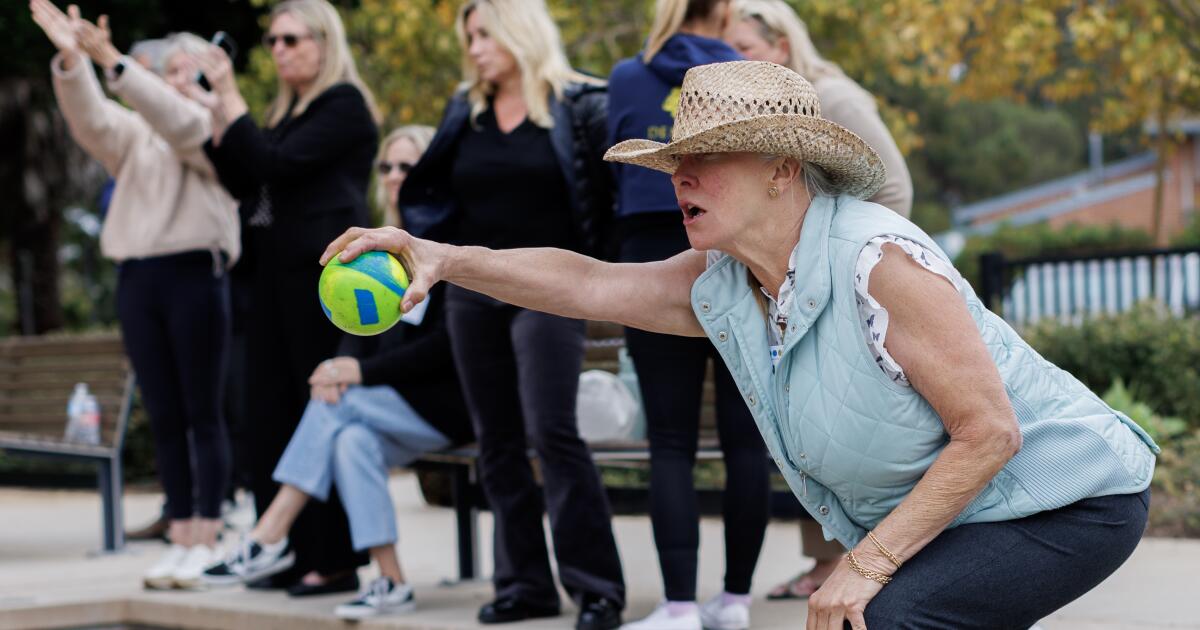
Jimmy Dunne hopped off his electric bike, hung his helmet on the handlebars and hurried over to the three bocce courts at Veterans Gardens just in time to offer his usual Tip of the Day.

“Think strategically,” the commissioner of the Palisades Bocce Club told the 50 amateur players who had gathered at the park on this chilly gray morning. At 68, he was a relative youngster compared with most of the assembled crowd. “If you’re playing against a master like Bill Skinner and you’re down in the last quarter, go hard.”

Everyone laughed. Skinner, who is 90 and plays for the OBG (Old But Great) Rollers, beamed. And the tournament began.

Player’s name tags are kept in individual team parcels in a bin for the Pacific Palisades Bocce League.

(Gina Ferazzi / Los Angeles Times)

Advertisement

Pickleball may have exploded in the wake of the pandemic, but in Pacific Palisades bocce is king. More than 900 people have joined the Palisades Bocce Club since it began in June 2021. In the spring season, which ended this month, 542 people played regular matches. Games take place three times a week, and while winning is nice, it has never been the point. The league prizes community over competition, bringing together neighbors of all generations to connect in the outdoors.

“None of this was ever about bocce,” said Dunne, a longtime Palisades resident and songwriter who has written for Whitney Houston and Kenny Rogers. “It’s about celebrating the wonder in our backyard and the simple pleasure of having friends in town.”

The stakes were high on this Tuesday in May — the winning team would head to the championships — but the vibe was decidedly relaxed. Roger Stewart, who’s in his 90s, rolled his ball while remaining seated on a bench. The ladies of La Bocce Vita, who wore matching black caps featuring their team name in sparkly pink letters, were more interested in planning a weekend getaway together than beating their opponents. And Skinner, a 40-year member of the local Optimist Club, wove through the crowd cracking jokes until someone told him it was his turn to roll.

Dunne, dressed in navy blue pants and a navy blue sweater, cheered them all on, his blue eyes twinkling beneath a pale pink baseball cap.

Advertisement

“Great shot! Just spectacular,” he called out. “Beautiful! Just a little long!”

Bocce dates back at least as far as the Roman Empire and has long been popular in Italy, but interest in the game appears to be surging in the United States.
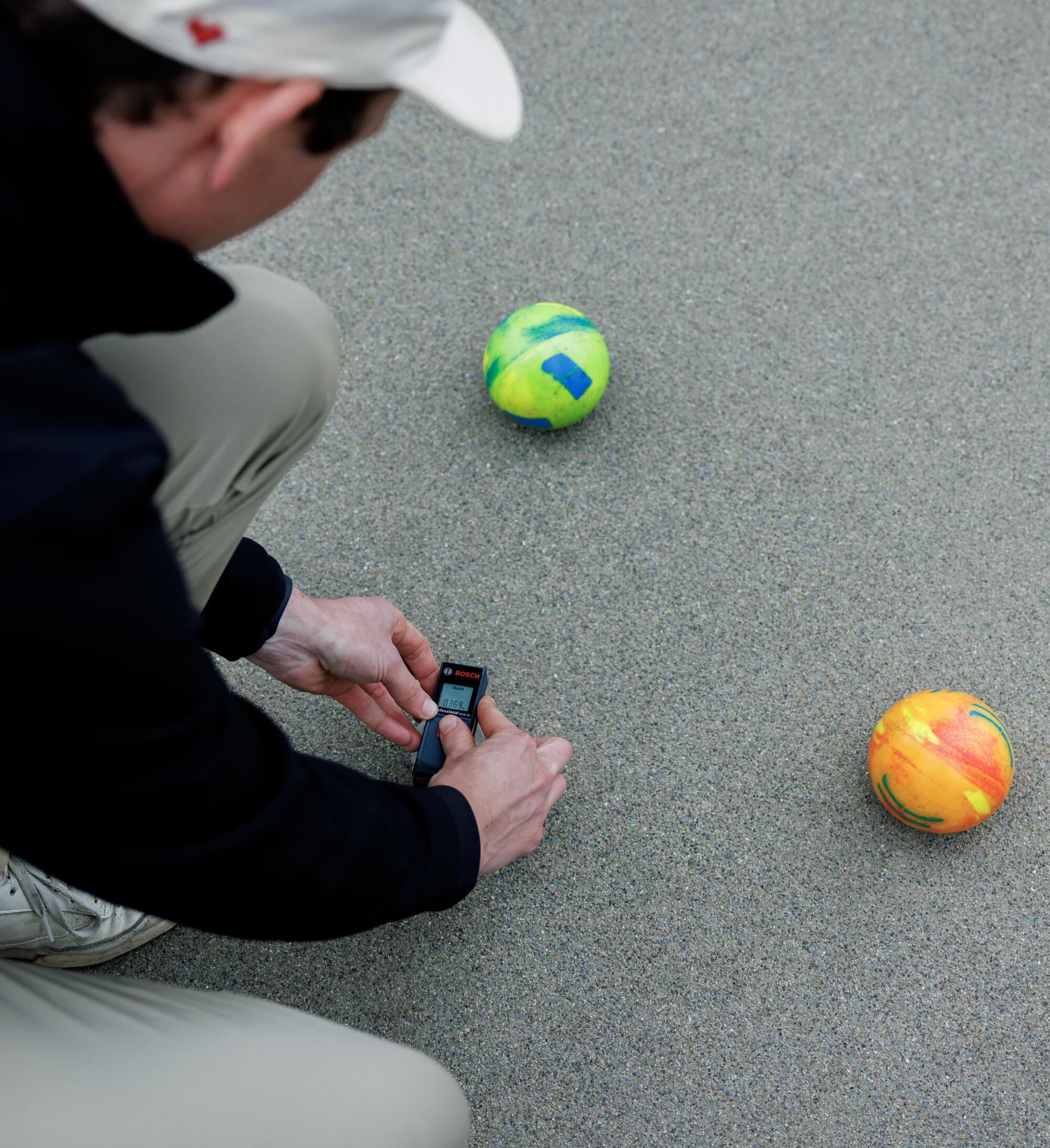
A man using a digital device to measure the distance between two bocce balls.

Scorekeeper Sean Barnett uses a digital measuring tool to figure out which team’s colored balls are closest to the smaller pallino.

(Gina Ferazzi / Los Angeles Times)
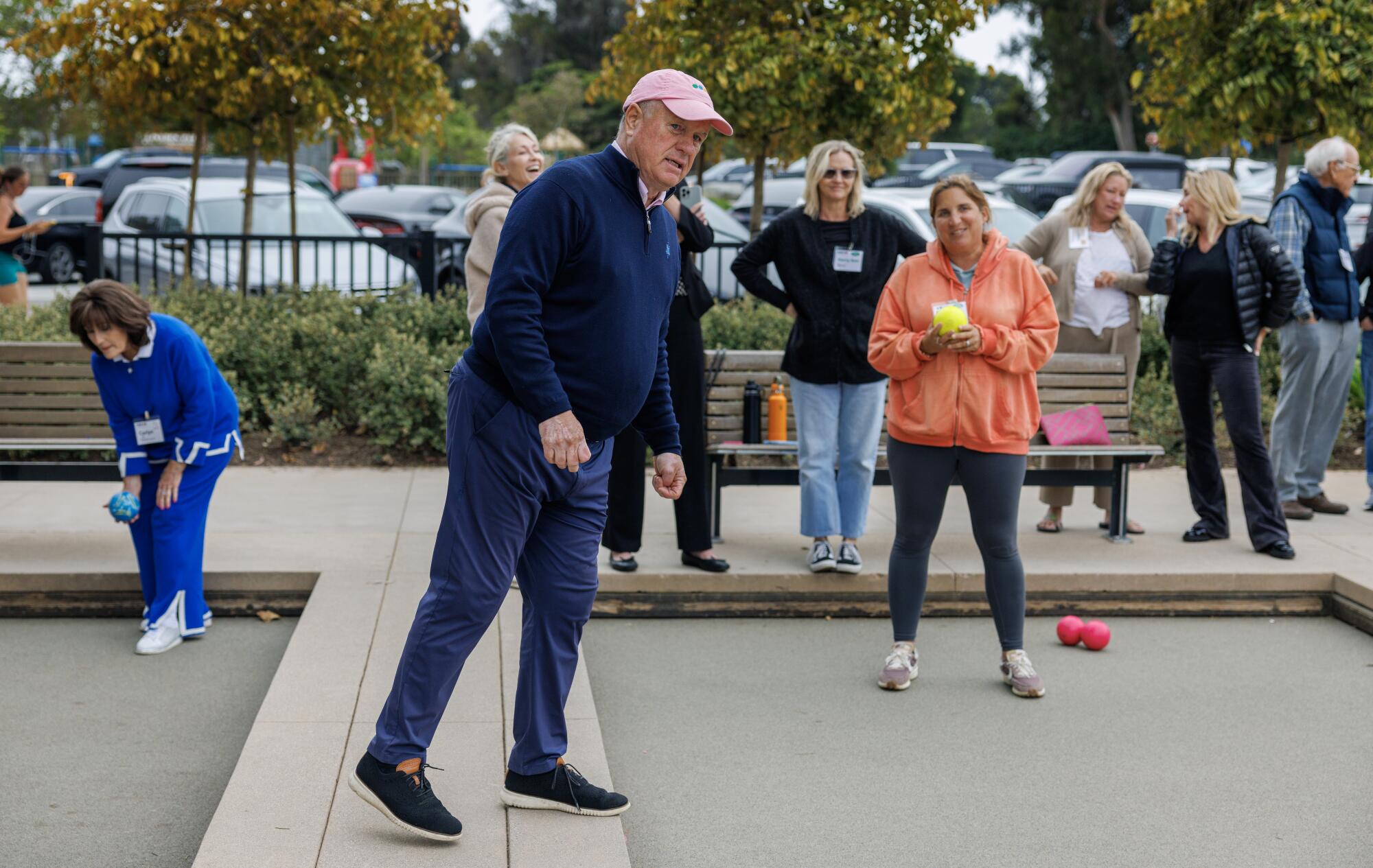
A man watching a game of bocce ball, surrounded by other bocce players.

League Commissioner Jimmy Dunne watches play in-between the bocce courts during Thursday league night at the Veterans Gardens bocce courts. The courts in the pubic park were put in two years ago and currently 545 people are signed up to play.

(Gina Ferazzi / Los Angeles Times)

Advertisement

“Our explosion is not quite to the pickleball level, but there has been a serious uptick since COVID,” said Alex Gara, co-founder of the American Bocce Company, which runs a league with 3,000 players in Chicago as well as national tournaments. “Often there’s this magical moment where things all come together and a sport grows exponentially very quickly. A lot of people feel like that’s happening for bocce right now.”

There are several reasons why bocce has become such a sensation in the wealthy seaside community of Pacific Palisades, according to Dunne. It’s less physically demanding than tennis or pickleball, making it an accessible social activity for the Palisades’ growing senior population. It’s easy to pick up, and because it relies more on skill and strategy than strength or speed, it’s one of the few sports where a 90-year-old might easily beat a 30-year-old.

“It’s time off from life, and God, do we need it.”

— Jimmy Dunne, Palisades Bocce Club commissioner

Advertisement

The neighborhood’s relatively temperate climate makes it possible for seniors to play outside year-round. It’s also an excuse for older players to get out of the house and for younger players to take a break from the relentless churn of parenting and work. It costs only $75 a person to join for a season.

“Nobody has a credit card in their pocket, and aside from taking pictures, nobody’s looking at their phones,” Dunne said. “It’s time off from life, and God, do we need it.”

Dunne’s love affair with bocce began in the summer of 2010, when he stumbled across a park in the French countryside where people of all ages were gathered around what looked like a bocce court. (This being France, they were likely playing a similar game, petanque). As he took in the scene, a wedding party streamed out of a local church and joined the game.

“I had never played bocce and I had no idea what it was, but what was magical about it was that it was drawing all these people in the community to come out at sunset,” he said. He vowed to create something similar in Los Angeles.

Advertisement

Dunne, who was a writer and producer on “Happy Days” and counts former L.A. mayoral candidate Rick Caruso among his closest friends, is the kind of guy who gets things done. Soon after returning from his trip he convinced the Bel-Air Bay Club in Pacific Palisades, where he’s a member, to put in two bocce courts. Within months, 250 people had joined its league. Word got out and Dunne helped the game spread to Hillcrest Country Club in Beverly Hills, the Griffin Club in Cheviot Hills and the California Club in downtown L.A.

“I took on this odd role of being the pied piper of bocce,” he said. “But my interest wasn’t in bocce, it was in whether this could create belonging.”
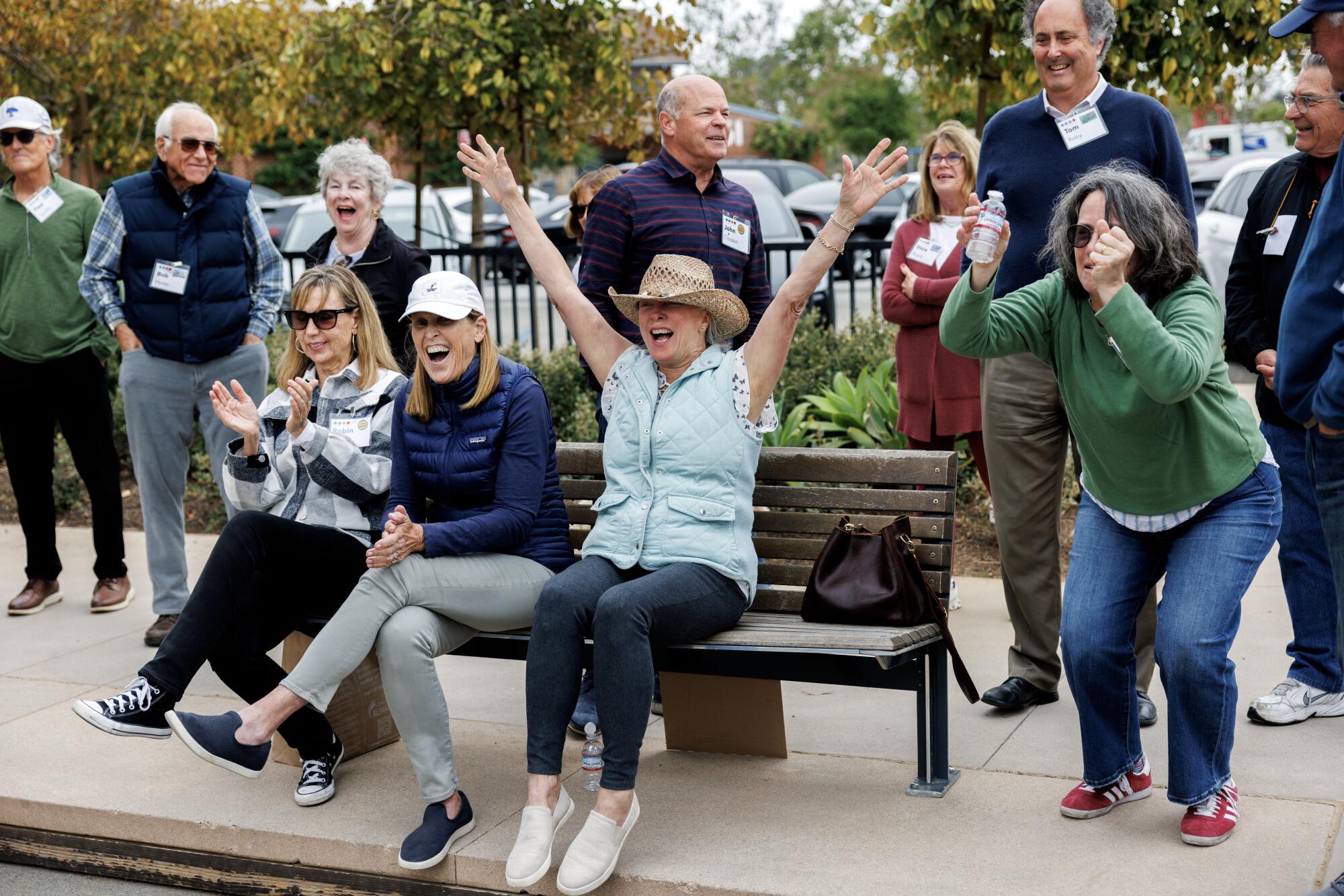
A group of women cheering while sitting on a bench.

Nancy Myers reacts with her “I Liff Bocce” teammates as they win during play for the Pacific Palisades Bocce League.

(Gina Ferazzi / Los Angeles Times)

After a string of successes with country clubs, Dunne decided to experiment with building a bocce community that was open to the public. In 2016 he and a group of friends began fundraising to build three courts on a patch of dirt near the Palisades Recreation Center. Bill McGregor, an old friend and an architect and real estate developer, drew up the plans for what became Veterans Gardens. Today it is a beautifully landscaped park with several picnic tables and barbecues in addition to the bocce courts — all of it paid for and maintained by private donations including from the local American Legion post. The park opened in 2021 at the height of the pandemic.

Advertisement

“I knew bocce was a thing, but this exceeded our expectations,” said McGregor, who oversaw the construction of the former Sony Music headquarters designed by I.M. Pei, among other local developments. “So many people have not used their public park since their kids were little. Now they’re using it again.”
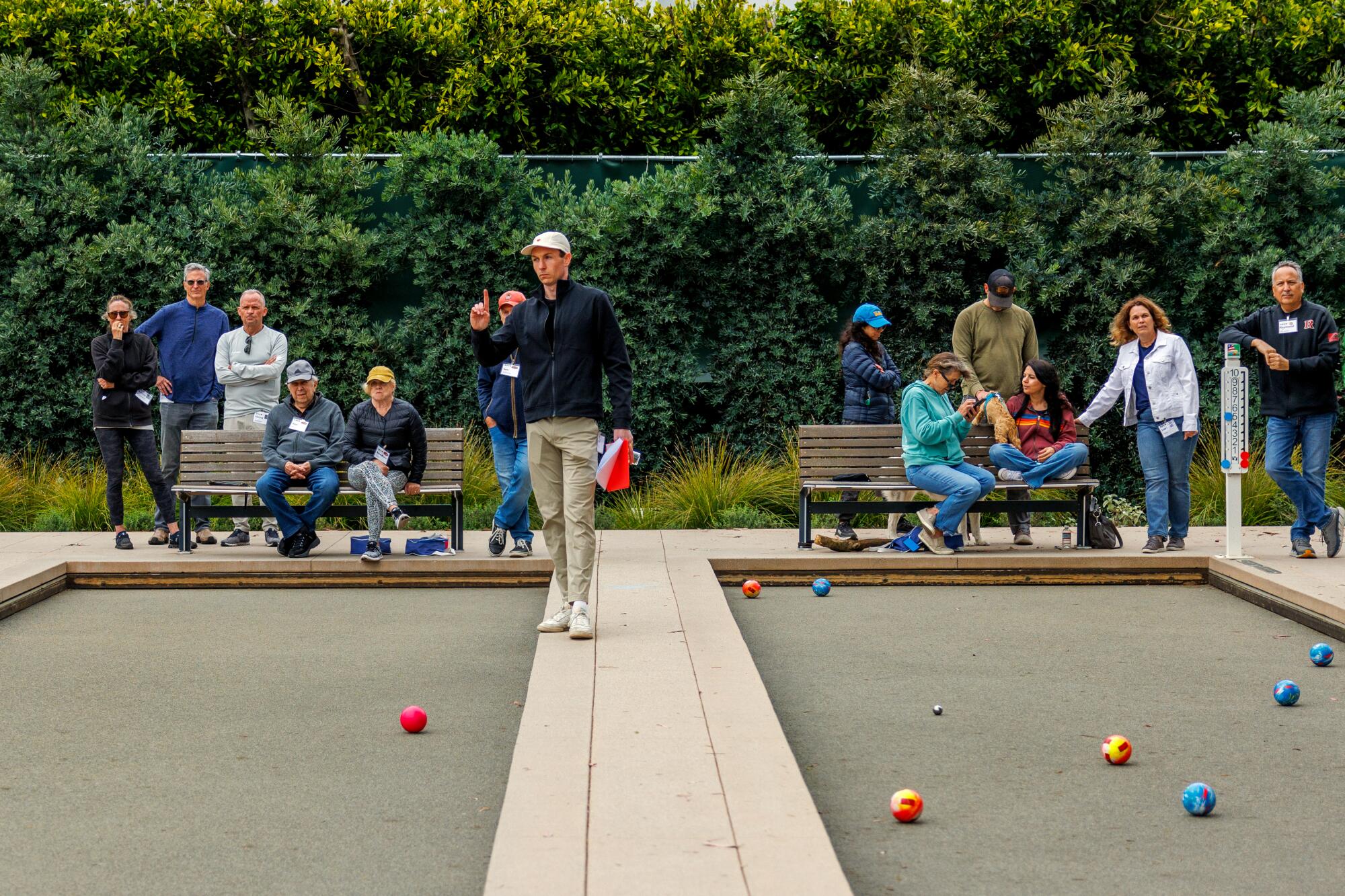
A man walking between bocce courts, counting scores as a crowd looks on.

Scorekeeper Sean Barnett walks in-between the bocce courts during Thursday league night at the Veterans Gardens bocce courts.

(Gina Ferazzi / Los Angeles Times)

Dunne is relentlessly optimistic, but even he was surprised by the league’s success. “In the country clubs people are eating and drinking the whole time,” he said. “What’s wild to me is here people come out with no cocktails and no food.”

Despite the Palisades Bocce Club’s folksy, all-American vibe, a lot of time, thought and energy has gone into making it the community hub it has become. To keep players engaged off the court, Dunne sends out a weekly newsletter with photos from recent games and announcements about who is celebrating the birth of a new grandchild or recovering from surgery.

Advertisement

He hired another friend, Carlyn Peterson, to manage the logistics of the league, placing people on teams, scheduling games and organizing the end-of-season dinners where awards like “The Snappies (Best Dressed in the World)” and “Happiest Campers (A Team So Full of Life)” are given out. A handful of certified bocce professionals are paid to referee the matches.

“It’s the one-two punch of providing the courts and professional programming that’s the secret sauce,” said Dunne, who volunteers most of his time but is compensated to run and manage the league. “That’s what makes it work really well.”
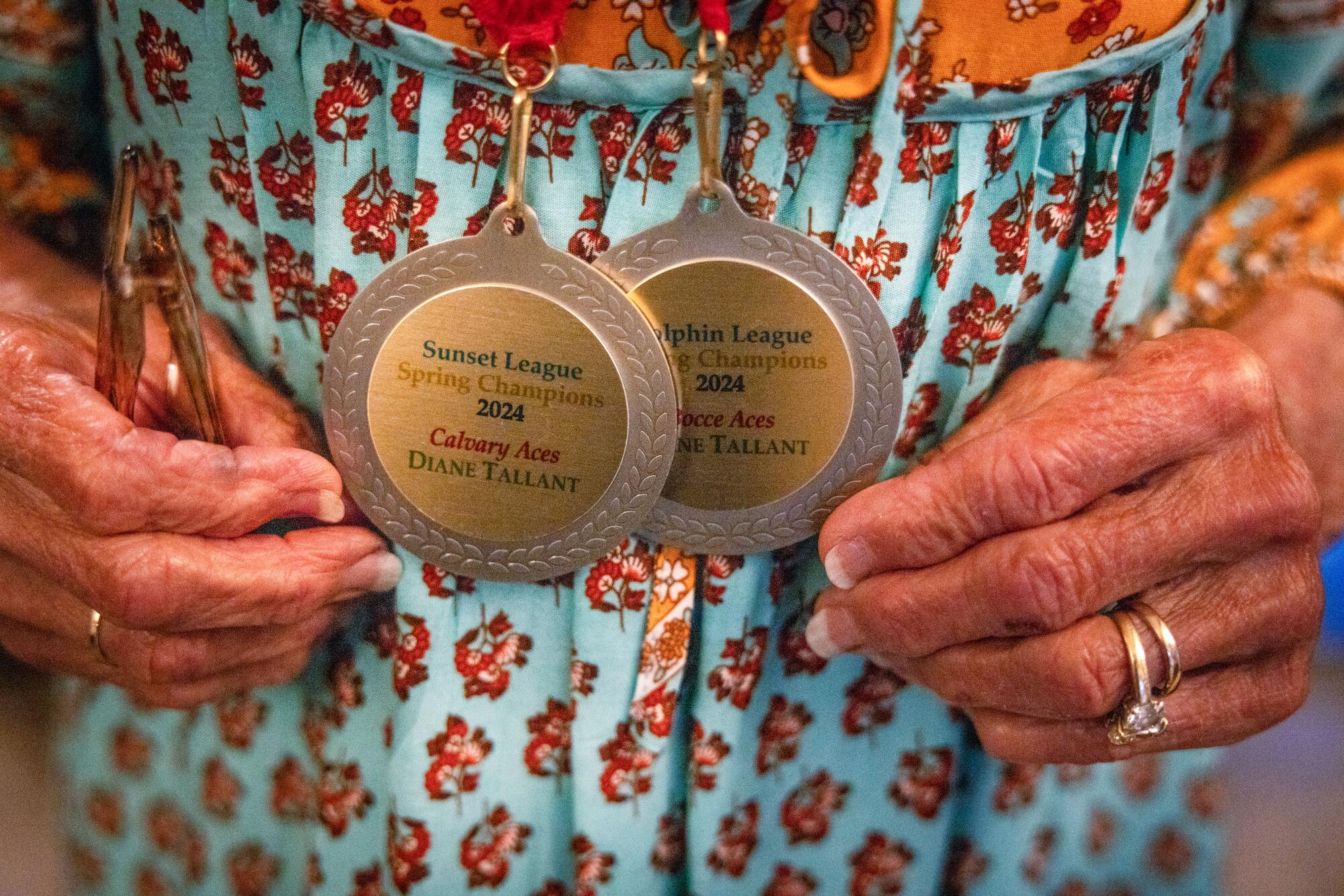
A close up of a woman's hands gripping two award medals.

Diane Gallant sports two awards at the Palisades Bocce League Awards Dinner.

(Jason Armond / Los Angeles Times)
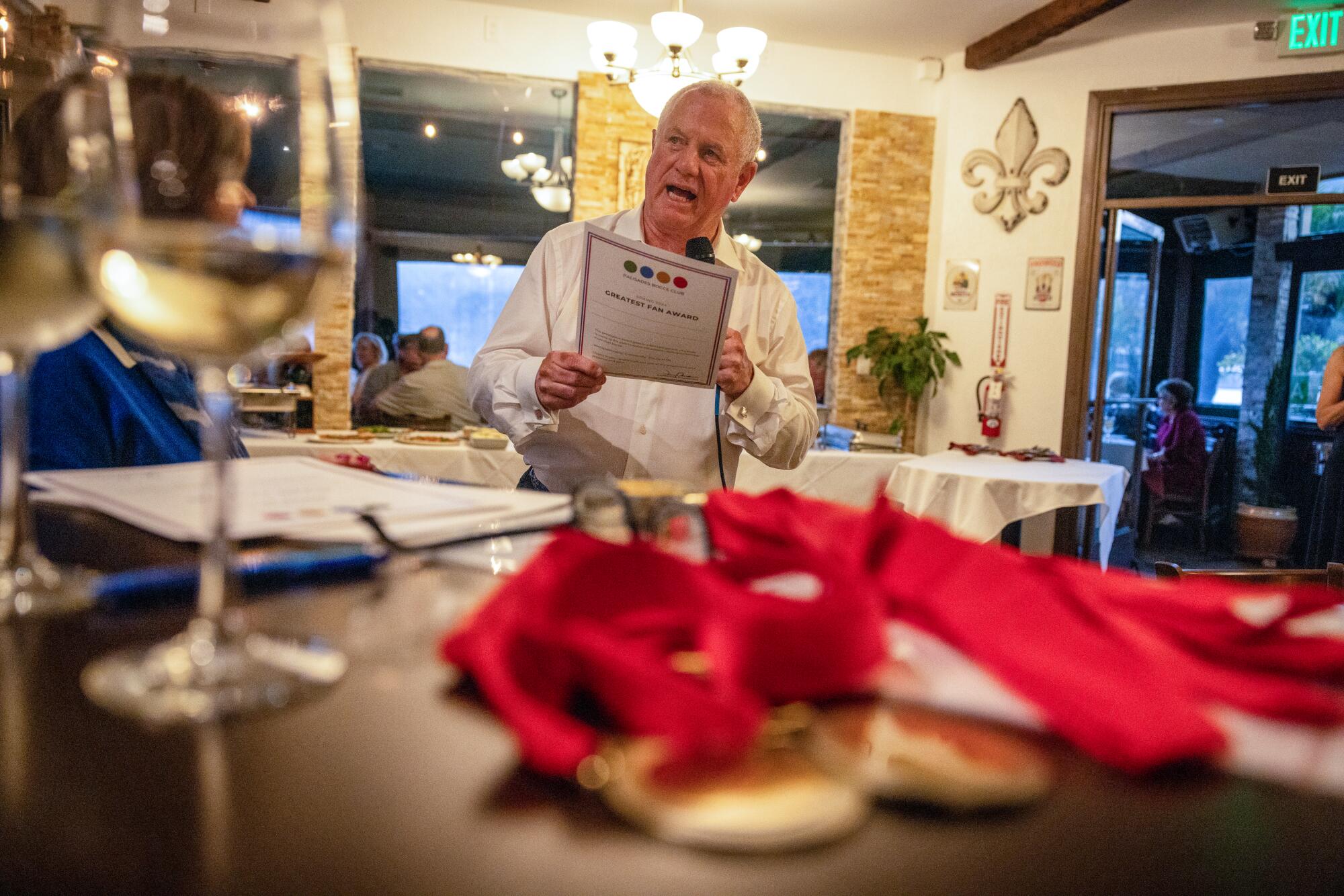
A man holding a microphone and reading from a piece of paper.

League founder Jimmy Dunne, presents awards at the Palisades Bocce League Awards Dinner.

(Jason Armond / Los Angeles Times)

Advertisement

Dunne would like to see the success of the Palisade Bocce Club replicated across Los Angeles, especially in neighborhoods with fewer resources than Pacific Palisades, where the average price of a house is over $3.5 million according to Zillow.

“To me there is a path to get those projects done, not by the city, but by donorship from folks who have the ability to fund it from other communities,” he said.

He’s already reached out to the City of Los Angeles Department of Recreation and Parks.

In the meantime the league is gearing up for the summer and fall seasons, and because there are more players and teams than ever before, there will be an extra spot for games on Sunday afternoons.

Advertisement

Skinner will be there. The ladies of La Bocce Vita have already signed up.

“When people crab about this and that and say everything is wrong in the world, I just want to say, ‘Come to the park and see,’” Dunne said. “There are some wonderful things going on.”

Lifestyle

Firings at CBS’ ’60 Minutes’ reflect the fight for media control in the age of Trump

Published

on

Firings at CBS’ ’60 Minutes’ reflect the fight for media control in the age of Trump

Correspondents of CBS’ 60 Minutes pose for a portrait in 2023. From left to right, they are Sharyn Alfonsi, L. Jon Wertheim, Bill Whitaker, Lesley Stahl, Scott Pelley, Cecilia Vega, and Anderson Cooper. Former Executive Producer Bill Owens sits on the far right. Only Wertheim, Whitaker and Stahl remain at the program.

CBS Photo Archive/CBS via Getty Images/CBS


hide caption

toggle caption

Advertisement

CBS Photo Archive/CBS via Getty Images/CBS

Stay up to date with our Up First newsletter sent every weekday morning.

When CBS fired Scott Pelley on Tuesday night, the new 60 Minutes executive producer, Nick Bilton, told Pelley it was for insubordination at a staff meeting the day before.

The veteran correspondent argues he was defending the DNA of 60 Minutes and the integrity of its journalism.

Advertisement

The battle royale over the network’s most prestigious and profitable news program is part of a broader fight over the direction of CBS News.

And given CBS’s acquisition by a billionaire family whose business interests have become intertwined with the political interests of President Trump, it reflects a larger war over control of the media in the current moment.

That father and son, Larry and David Ellison, bought CBS’ parent company, Paramount, last summer. In January, they became co-owners of TikTok’s U.S. operations. Now they’re seeking approval from Trump’s regulators to buy Warner Bros. Discovery, the parent company of CNN.

A glamorous show shorn, for now, of most its stars

CBS fired Cecilia Vega, a correspondent, and Tanya Simon, the executive producer, from 60 Minutes last week. They are shown in this photo at the 2026 White House Correspondents' Association Dinner on April 25, 2026 in Washington, D.C.

CBS fired Cecilia Vega, a correspondent, and Tanya Simon, the executive producer, from 60 Minutes last week. They are shown in this photo at the 2026 White House Correspondents’ Association Dinner on April 25, 2026 in Washington, D.C.

Kristina Bumphrey/Variety via Getty Images/Variety


hide caption

Advertisement

toggle caption

Kristina Bumphrey/Variety via Getty Images/Variety

But the specifics of this individual episode matter — for 60 Minutes, CBS, its audience of millions, and even the news business itself.

Advertisement

The program has been the most glamorous post in broadcast news. The correspondents are the stars of the show. And now, there are just three of them.

Anderson Cooper left last month, concerned over the direction of the network’s coverage. Last week was a virtual bloodbath: correspondents Cecilia Vega and Sharyn Alfonsi were fired. So were a producer and two show executives — including Tanya Simon, a longtime staffer who had stepped up as executive producer when her predecessor resigned in protest before the Ellisons’ takeover.

With Pelley’s ouster, only correspondents Lesley Stahl, Bill Whitaker, and Jon Wertheim remain. Now they are considering whether to resign, according to two associates with knowledge.

Their brand-new boss, Bilton, was previously a tech reporter for The New York Times and an investigative reporter for Vanity Fair. He executive-produced a documentary for Netflix about a couple accused of laundering Bitcoin and has been a producer on several other films.

Notably, he has no experience in television news.

Advertisement

Neither does Bari Weiss, whom David Ellison installed as the network’s editor in chief last October. The Ellisons also bought her center-right views-and-news site, The Free Press.

She has maintained that the network of Walter Cronkite needs a makeover for the digital moment. She has also contended for years that CBS, along with the rest of mainstream media, is too reflexively anti-Trump, anti-Israel, and too woke.

A rejection of CBS News executives’ overtures

The new executive producer of 60 Minutes, Nick Bilton, has been a tech journalist and documentary filmmaker, but lacks experience in broadcast news.

The new executive producer of 60 Minutes, Nick Bilton, has been a tech journalist and documentary filmmaker, but lacks experience in broadcast news.

Matt Winkelmeyer/Getty Images/Getty Images North America


hide caption

Advertisement

toggle caption

Matt Winkelmeyer/Getty Images/Getty Images North America

Bilton attempted to set a conciliatory tone at Monday’s meeting — his first with the show. Pelley, a formidable veteran correspondent and former CBS Evening News anchor, wasn’t having it.

Pelley called Bilton unwelcome and unqualified. And Pelley said that Weiss was attempting to “murder” the program.

Advertisement

In firing Pelley on Tuesday, Bilton said the journalist had hijacked the meeting and rejected overtures to work constructively through their differences. (NPR obtained a copy of the firing notice.) Bilton wrote that Pelley’s “antipathy to the future of the show came through loud and clear.”

In his own statement late Tuesday evening, shared with NPR, Pelley accused CBS’s new news leadership of killing 60 Minutes‘ DNA and pushing him “to inject falsehoods and bias into a politically sensitive story” and “to include assertions that are unverified.”

The accusations, to which CBS has not yet responded, echo those made by Alfonsi and Vega, the two correspondents fired last week.

Earlier this year, Alfonsi publicly complained after Weiss held one of her stories at the last minute, and kept it frozen for weeks, demanding an on-camera interview with a Trump White House official that never played out. It ran, unchanged from the intended version, with additional statements from the administration tacked on to the end.

After being fired, Vega said in a statement obtained by NPR that her team had “experienced efforts to insert political bias into our stories.”

Advertisement

“Let’s call this what it is: censorship, both censorship and self-driven” Vega continued. “It is dangerous for the show and dangerous for democracy.”

Weiss previously rejected Alfonsi’s and Vega’s allegations. (CBS said Vega’s claims, for example, were “not based in reality” while expressing appreciation for her work.)

Weiss and Bilton say digital threat requires a 60 Minutes overhaul now

In a meeting this morning, Weiss said that Pelley chose his own path — that is, to be fired rather than to find a way to work through his concerns, according to attendees. The network and Weiss have not yet publicly addressed Pelley’s accusations of interference. 

Bilton and Weiss say they respect the show’s traditions, its accomplishments and its legacy of enterprise reporting, extended interviews and visual storytelling. It rose in the ratings 9% over the past season under Simon.

The two news leaders say, however, 60 Minutes needs to be overhauled before it becomes increasingly irrelevant in the era of streamers and other sources of news, information and entertainment in the digital age.

Advertisement

Interviews with 12 current and former CBS News staffers, from producers to executives, suggest great reservations and suspicions remain about Weiss’ judgment and her ability to handle the prominent and even famous journalists on whom her division relies.

Weiss had initially sought to reinvent the CBS Evening News, dropping a two-anchor format that had sagged in the ratings. Cooper turned down Weiss’ overtures to anchor it and left the network altogether, concerned about her approach, according to associates. (They spoke on condition of anonymity because Cooper has not chosen to speak publicly on the matter.)

David Ellison became chairman and CEO of CBS' parent company, Paramount, after buying it last year.

David Ellison became chairman and CEO of CBS’ parent company, Paramount, after buying it last year.

Noam Galai/Getty Images for Paramount/Getty Images North America


hide caption

Advertisement

toggle caption

Noam Galai/Getty Images for Paramount/Getty Images North America

The ratings have continued to sag under new anchor Tony Dokoupil. And some CBS journalists, including producers who have left the Evening News, have publicly accused Weiss of making editorial decisions driven by politics. She has rejected those claims.

The decision to take on overhauling two key shows — one listing, one highly profitable, both high profile — carries significant risks for Weiss and the network, even apart from other considerations.

Advertisement

But the Ellisons’ presence cannot be ignored.

When Shari Redstone was negotiating the sale of CBS’s parent company, Paramount, to the Ellisons’ Skydance Media last year, the network announced the end of Stephen Colbert’s late night show. He had been one of the president’s most biting and acerbic critics.

David Ellison also made a series of concessions directly to Trump’s chief broadcast regulator, Federal Communications Commission Chair Brendan Carr, gutting CBS’s diversity, equity and inclusion initiatives and appointing a conservative ombudsman to field complaints of bias against its news reporting.

Carr and other regulators approved the Paramount deal last summer.

The accommodations echo those made by other media titans.

Advertisement

Amazon and Blue Origin founder Jeff Bezos remade the editorial pages of the Washington Post, which he owns, into a far more hospitable zone for Trump at the outset of his second term. So did Los Angeles Times owner Dr. Patrick Soon-Shiong, a noted medical device inventor. Amazon and Blue Origin have multi-billion dollar contracts with the federal government. Soon-Shiong’s medical research firm routinely has patent applications up for review with federal regulators. One was approved Tuesday.

The Ellisons are hoping to win approval from federal regulators next month for their purchase of Warner Bros. Discovery in a deal valued at more than $110 billion. It would include Warner Bros. Studio, HBO and CNN, among other properties.

As Weiss routs CBS News’ old guard, the question of what role she might play at CNN — and what changes that portends at CBS — hangs over journalists at the two networks. The fate of 60 Minutes serves as a high-stakes case study for both.

Continue Reading

Lifestyle

We’re having a main character summer. Are you? : It’s Been a Minute

Published

on

We’re having a main character summer. Are you? : It’s Been a Minute
Are you ready for a whirlwind summer romance?Making plans to capitalize on summer can get overwhelming – from finding the right spot to hang or feeling comfortable in your clothes in the sweltering summer heat. So what does it mean to approach summer with a romantic joie de vivre?  Brittany is joined by Carly Olson, freelance journalist covering architecture and business, and Garrett Schlichte, writer and chef, to walk us through how to have a rom-com summer where you’re the star.Want more on how to be the best version of yourself? Check out these episodes:How to make friends & get good gossipIt only takes 30 minutes to be a good momSupport Public Media. Join NPR Plus.Follow Brittany on Instagram: @bmluseFor handpicked podcast recommendations every week, subscribe to NPR’s Pod Club newsletter at npr.org/podclub.
Continue Reading

Lifestyle

Vintage-obsessed millennial parents are driving L.A.’s booming kids’ clothing resale market

Published

on

Vintage-obsessed millennial parents are driving L.A.’s booming kids’ clothing resale market

Kids’ vintage clothing sales are experiencing a remarkable boom at in-person markets and online, where prices for clothes for little ones have shot up on websites including Depop and Poshmark. Millennial parents are looking to outfit their kids in the clothes and TV and film characters they loved (or coveted) when they were kids.

The result? There’s a new generation of kiddos hitting the playground looking incredibly cool. Take Amari Case, a SoCal toddler who spent a Sunday afternoon this spring ambling around a vintage market in a West Hollywood warehouse clad in baggy jeans and a ’90s-era tee emblazoned with the “Dragon Ball Z” character Son Goku.

When she wasn’t scribbling on a Lorax coloring sheet, she’d been cruising around the market with her dad, Aaron Munoz Case, snapping up new pieces destined to make her the flyest kid at the preschool playground.

Neil Wright, from left, Kristine Nite Scalzo and Brandon Rosenblatt, co-founders of Elemeno Kids Vintage Market.

Advertisement

Showing off Amari’s new vintage satin L.A. Raiders jacket and tiny teal Grant Hill Detroit Pistons jersey, Munoz Case, who was also impeccably dressed, noted that while Amari went through a phase at about 18 months where she wanted to dress herself, eventually she gave up and went back to letting her dripped-out dad dictate her wardrobe.

Munoz Case found Amari’s first vintage piece at the Rose Bowl Flea Market and got the bug, going back every month to pick up something to add to his little’s wardrobe.

Trendspotters and researchers say Munoz Case isn’t alone in his quest. The market for kids’ vintage clothing has heated up precipitously over the last few years, perhaps hitting a boiling point in January when an Eeyore romper from the ’90s sold for over $3,000 on EBay. (It was new with tags, but one without tags still went for almost a grand about a month later.)

The thirst for tiny throwbacks is so popular that first-ever, all-kids market Elemeno — named after the “L-M-N-O” bit of “The Alphabet Song” and where Amari was toddling and shopping — drew 17 vendors and over 2,000 attendees over a single weekend in March. (There are plans for another Elemeno Kids Vintage Market pop-up later this year in New York, as well as plans to bring the event back to L.A. sometime next year.)

1

Advertisement
A child and mom seated.

2 A child wearing an Avirex jacket from the ’90s.

1. Cameron Scalzo, wearing a vintage McDonald’s T-shirt from the ‘90s, and mom Kristine Nite Scalzo. 2. Cameron Scalzo rocks an Avirex jacket from the ‘90s.

Eye Speak Vintage’s Kristine Nite Scalzo, who co-organized the event and is opening an all-kids vintage store in Pasadena this month, says she fell under the kids vintage spell in 2020 when she was pregnant with her son. She’d always been a vintage shopper for herself, so she knew she wanted to pass the passion down to the next generation. She started filling up her son’s closet, and soon enough, she found herself selling her other finds out of a bodega in her garage.

She has a by-appointment space in Pasadena now, where she draws everyone from Rihanna’s stylist to out-of-town moms who make a point to stop by on their way to Disneyland. “The community around kids vintage has really skyrocketed on Instagram over the past six years,” Scalzo says. “We want to know who we’re buying from. We want to know that we’re doing good with buying secondhand. And it’s a hobby for people that can turn into a possible business on the side. Because knowing there’s a big group that’s interested in vintage kids clothes, you can always pass an item [your kid outgrows] to someone else or resell it.”

Scalzo says some parents are out digging through bins at the Goodwill Outlet looking for the perfect piece, while others are content to pay up for, say, a ’90s Simpsons T-shirt or a mini-size Harley-Davidson jacket. Scouring the racks at the Elemeno market, most pieces cost $15 to $40, though there were special pieces pulled to the side in some booths with price tags that could make a parent’s eyes pop. (Think $275 for a set of well-worn Spider-Man overalls from the ’00s or $150 for a pair of Cross Colours denim shorts from the ’90s.)

Advertisement

In kids and adult vintage alike, mint condition is highly valued. No matter the era in which they were raised, kids tend to be messy. They get strawberry juice on their shirts or scuff up the knees on their Bugle Boy jeans. Vintage kids clothes that look pristine are more expensive, and while plain kids clothes do sell, items with characters on them or cool prints tend to draw more attention and dollars.

Brandon Rosenblatt, another of the Elemeno organizers, says he’s had his eye on a specific kids “Back to the Future” shirt for some time, but notes that it typically sells for about $1,000. He’s partial to McKids clothes for his daughter, from McDonald’s short-lived kids clothing brand, noting that he’s even snagged her a vintage official McDonald’s-themed aloha shirt from Hawaii, something he says he’s never seen anywhere else.

1 Siblings Amora and Milo Castilo wear vintage cowboy hats, jackets and chaps.

2 Thalia Castilo and her kids Amora and Milo.

1. Siblings Amora and Milo Castilo wear vintage cowboy hats, jackets and chaps. 2. Thalia Castilo and her kids Amora and Milo.

Advertisement

Other collectors, he says, might be a little less obscure, leaning into mainstream characters such as Strawberry Shortcake or from ’80s and ’90s properties including “The Land Before Time” and “Rugrats.”

“A lot of millennials are having kids — like everyone who’s in their 30s and 40s — and they all want to put their kids in the same IP they grew up in,” Rosenblatt says.

“It’s the thrill of the hunt that gets everyone so excited,” Scalzo says. “Once you find that perfect nostalgic piece, you’re like ‘Holy s—,’ and you just want to chase that feeling again and again.”

Mia De La Rosa, a reseller who was at the Elemeno market, says that like Scalzo, she started buying kids vintage clothes when she was pregnant with her daughter, Liv, who’s 6 now, very into everything on PBS Kids and has a closet full of thrifted vintage garb covered in characters such as D.W., the annoying little sister from the ’90s show “Arthur.”

Everything Liv wears is “completely her style,” De La Rosa says. “She dresses herself every day and she gets compliments on what she’s wearing at school all the time.”

Advertisement

Other vintage-wearing kids — and in particular younger ones — might simply be sporting what their parents like or might just like the look of the shirt even if they don’t know what it’s advertising. (An 8-year-old boy at the Elemeno market, for instance, chose to wear a pristine T-shirt highlighting the ’90s Jim Carrey movie “The Mask” because it featured his favorite color: green.)

Derrick Broaster, a vintage enthusiast turned full-time reseller, says that while he chooses to put himself in clothes from the ’60s and ’70s, he outfits his two sons in clothes from the 2000s. (“How Bow Wow used to dress when he was a kid,” he says.)

Although his younger son tends to rebel against Broaster’s vintage picks, opting for whatever Spider-Man shoes happen to be in his eyeline, his older son has leaned in, letting his dad advise him on what vintage pieces could work and what would be the most stylish.

1 Brothers pose for a portrait wearing vintage clothing.

2 A family poses for a portrait wearing vintage clothing.

1. Julian, left, and Javier Gutierrez show off their vintage clothing. Javier says his mom always tells him to keep his vintage outfits clean. 2. Mom Priscilla Guzman, clockwise, Dad Javier Gutierrez and sons Julian and Javier Gutierrez enjoy the vibe of vintage clothing. Guzman says she’s been buying and selling kids’ vintage since her oldest son was born eight years ago.

Advertisement

Rosenblatt says a good portion of what vintage finds he sees in the market now has returned to the U.S. from places in Central America and South America or Asia where those pieces were likely sent decades ago after they were donated or given away.

“There’s a real underbelly of this vintage game with rag houses getting access to bulk product overseas and letting people sort through it,” he says. “There are companies now that rip through 20, 30 or 40,000 pieces of vintage clothing a week. It’s a really interesting ecosystem.”

For many kids vintage sellers, finding their stock is just as fun and interesting as getting it back into consumers’ hands. “Anywhere we can find clothes, we’re there,” says Matthew Carlos, owner of Long Gone Youth. He started selling vintage clothes 11 years ago, when he was 15, switched to kids vintage at 20 and has spent the last six years scouring flea markets, websites and swap meets.

“The kids market is definitely growing,” he says, “but I still feel like we haven’t even gotten close to where we can go. It’s just getting popular now, but the more events [like Elemeno] we can do, the more it’ll go mainstream.” Even now, some major brands like Gap and OshKosh B’gosh have recognized the interest in some of their styles from the ’80s and ’90s, moving to re-release the looks in limited runs.

Advertisement
Jackie and Frank Oropeza with daughter Rumi Mae shop at Elemeno Kids Vintage Market.

Jackie and Frank Oropeza with daughter Rumi Mae shop at Elemeno Kids Vintage Market.

Kids resale is also leaning into streetwear culture. Rosenblatt, who worked in the streetwear industry, says that he’s noticed that a good portion of those interested in kids vintage — particularly, male shoppers — tend to be fans of streetwear brands like Supreme, Fear of God Essentials and Bape. At Elemeno, for instance, a good portion of the parents we saw pushing strollers were well-dressed dads seemingly on solo missions, something you don’t always see at kid-centric events.

“I just want my son to feel like I did as a kid,” said Justin Nguyen, while watching his toddler, Jayden, play with bubbles. “I want him to be happy, carefree and joyful, and I want to be able to spend time with him. My mom and dad were always working, even on the weekends. Now that I’m a dad, taking my son out on weekends to do stuff like this just seems like a blessing.”

Advertisement
Continue Reading
Advertisement

Trending
