Fitness
Army to expand holistic health and fitness program to all soldiers


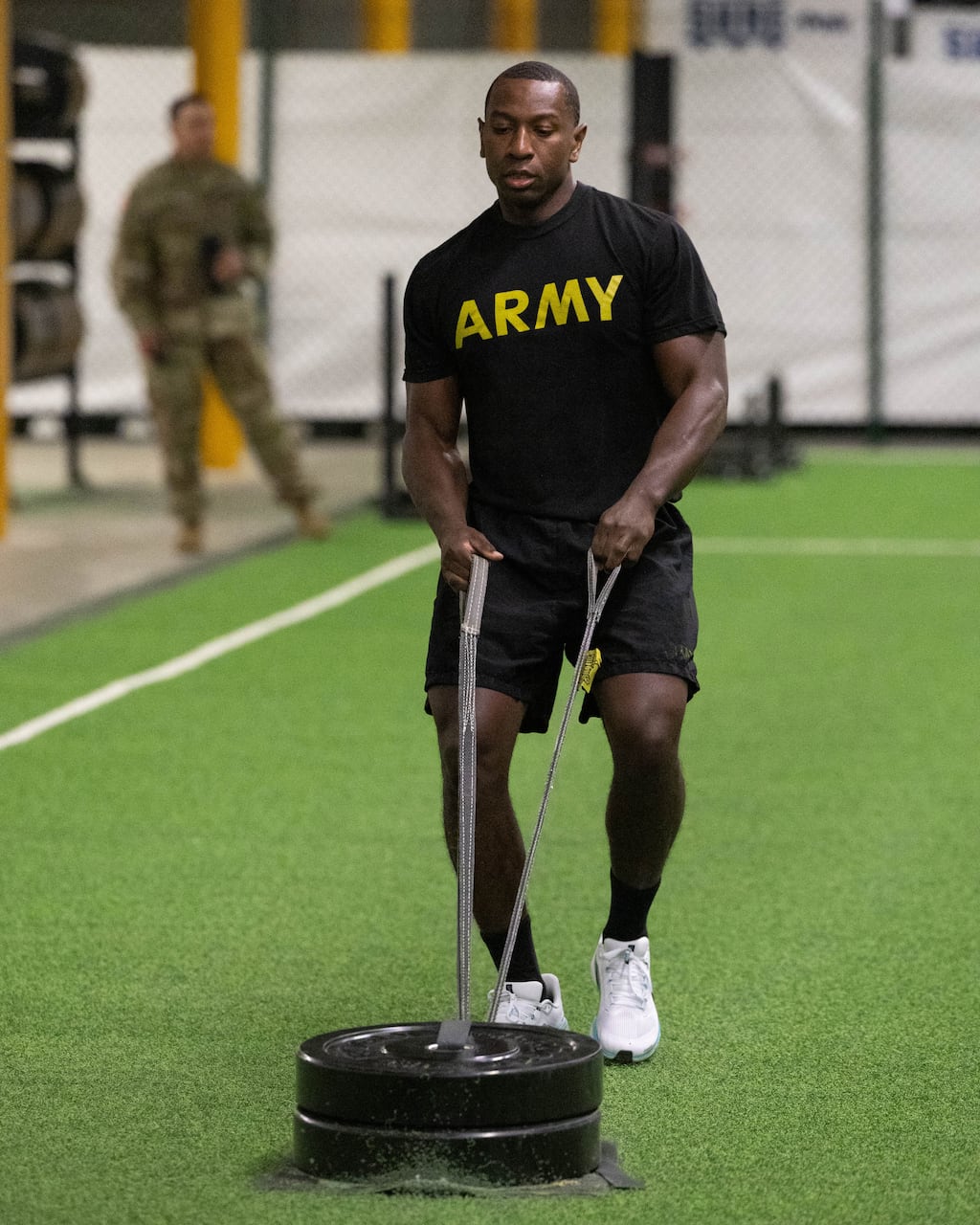
The Army is expanding its new all-around health and fitness program, which includes professional civilian staffing, workout gear and more, to all soldiers rather than only combat brigades.
Army Vice Chief of Staff James Mingus told soldiers at the Maneuver Warfighter Conference at Fort Moore, Georgia, on Wednesday that the Holistic Health and Fitness program, also called H2F, will roll out across the entire force.
The program was showing too much benefit to be used only by the combat arms brigades, according to the four-star.
“It is an Army program, and it is making a huge difference on how our soldiers are performing out there,” Mingus said.
The Army launched a pilot H2F program in late 2018 and began equipping combat arms brigades with full complements of gym equipment and H2F staff, including physical therapists, dietitians, occupational therapists, athletic trainers, strength and conditioning coaches and cognitive performance specialists, in 2020.
RELATED
The program’s holistic approach addresses five domains: physical, spiritual, mental, sleep and nutrition.
The original plan called for the service to outfit all 110 combat arms brigades by 2030. Chief of Staff Gen. Randy George announced last year that the Army would speed up fielding by increasing the annual number of brigades from 10 to 15. The fully resourced program had reached 50 brigades this year, including some military police, medical, engineer and sustainment brigades, according to Army data.
Mingus didn’t share specifics or timelines on the rollout, which will require more funding from Congress. But he advised leaders to begin work in their units now.
“A lot of our formations still don’t have it but there are things you can do,” Mingus said. “I would challenge you to study what is the essence of how you assess the program and execute functional fitness, nutrition, sleep.”
The Center for Initial Military Training, or CIMT, at Fort Eustis, Virginia, launched the Holistic Health and Fitness website in late August. The site contains information on all aspects of the program such as unit resources, the H2F Academy and the command’s annual H2F Symposium.
“We wanted to develop a website that provides tools for soldiers to help them take a hard look at themselves and really assess their personal health and fitness while also providing resources from subject matter experts so they can improve in all five readiness domains,” Lt. Gen. David Francis, CIMT commander, said in a statement.
Francis described the H2F program as the “largest human performance optimization project ever fielded.”
The program’s top priority since its inception has been reducing physical injuries among soldiers during deployment and training. Francis touted the results.
“The initial return on investment shows H2F will pay for itself as it decreases musculoskeletal injuries, reduces non-deployables, and helps soldiers who do get injured return to duty faster,” Francis said.
Early data released by CIMT in April showed H2F-resourced brigades saw a 23% higher increase in Army Combat Fitness Test (ACFT) passing rates, along with other performance and behavior improvements.
Behavior and performance data from H2F-resourced brigades compared with non-resourced brigades demonstrated:
- 14% lower increase* in musculoskeletal injuries = 6,489 fewer injured soldiers.
- 30% lower increase in musculoskeletal injuries lasting more than 90 days = 3,002 fewer injured soldiers on profile for more than 90 days.
- 22% lower increase in behavioral health reports = 2,962 fewer soldiers on behavioral health profiles.
- 20% lower increase in behavioral health reports lasting more than 90 days = 3,002 fewer soldiers on behavioral health profiles greater than 90 days.
- 502% lower increase in substance abuse profiles = 13,947 fewer soldiers on substance abuse profiles.
- 23% greater Army combat fitness test passing rate = 4,455 more soldiers passing the ACFT.
- 27% more soldiers reaching expert on rifle marksmanship qualification = 88,000 more soldiers receiving expert rifle marksmanship qualification.
*Brigades analyzed, both with and without H2F teams, saw increases in most areas from 2021–2023, but those units with H2F teams saw significantly lower increases in all categories.
Source: Center for Initial Military Training
As the Army implements the program across the force, the active-duty combat arms brigades remain a priority, with the Army National Guard and Army Reserve likely waiting longer for resources.
However, the new website can help fill those gaps in the meantime, Sgt. 1st Class Nicholas Rice, an Army Reserve H2F system developer, said in a statement.
“It’s a vital tool in our shared mission to ensure that every investment made in our Soldiers is an investment in a better, more capable version of themselves,” Rice said.
At Wednesday’s conference, the vice chief praised his experience with a precursor program that used similar principles when he served the 75th Ranger Regiment. That program, known as the Ranger Athlete Warrior Program, emerged in the early 2000s to decrease injuries in the notoriously demanding unit.
Mingus carried a version of that program with him when he assumed command of 4th Brigade Combat Team, 4th Infantry Division, at Fort Carson, Colorado, he said.
The program prepared his soldiers to perform in some of the roughest terrain during demanding missions during their 2012 deployment to Afghanistan, according to the general.
Todd South has written about crime, courts, government and the military for multiple publications since 2004 and was named a 2014 Pulitzer finalist for a co-written project on witness intimidation. Todd is a Marine veteran of the Iraq War.



New gym, same exercises
Photo: File photo
Vernon’s favourite senior’s personal trainer is on the move. For more than 25 years, Don MacLeod has been leading weight-resistance exercise classes for seniors.
Vernon’s favourite senior’s personal trainer is on the move.
For more than 25 years, Don MacLeod has been leading weight-resistance exercise classes for seniors.
And for the past eight years, MacLeod had taught classes five days a week at Snap Fitness in the Landing Plaza, but on March 31 that gym closed its doors, so MacLeod needed a new venue for his popular classes.
Enter Anytime Fitness in the Anderson Subdivision.
MacLeod said he is grateful to have reached a deal with the fitness club to carry on his morning exercise classes, and many seniors have already signed up.
While there are other gyms in Vernon that have seniors exercise classes, the certified personal trainer uses weight-resistance training to target all major muscle groups.
He will lead seven classes from Monday to Friday.
“It’s basic strength training,” MacLeod said of the exercises that geared towards the older crowd.
“We do everything that the bodybuilders and powerlifters do, but in a reasonable manner where we are just going to get our bones, our muscles, our tendons and ligaments stronger.”
MacLeod, 71, has also taken special courses geared specifically towards working with seniors.
Some seniors may feel too intimidated to go to a gym on their own, but MacLeod said seniors can find a common bond when they exercise in a group.
MacLeod said he has heard a few people say “what a waste of space” to hold senior’s classes.
“They really make life difficult for us. They think old people shouldn’t be in the gym, why are they lifting weights: to stay strong and to stay healthy,” MacLeod said. “One day, these guys are going to be old too.”
MacLeod said he started lifting weights in 1972 and continues to reap the benefits of regular exercise as he enters his 70s.
For more information, contact MacLeod at 250-260-1001.

HONOLULU (KHON2) — A local fitness center specializes in preventative training programs targeting a disease that impacts our kupuna.
Fitness Therapy Hawaii specializes in step-by-step preventative training programs targeting Parkinson’s symptoms.
In the program, patients get a clearance with doctors, work with physical therapists and prescribed medication.
“Science shows that once you get diagnosed as soon as possible, right? What exercise will do is help you keep those neurons firing, because Parkinson’s is a neurodegenerative disease. The longer you wait for these patterns of movement, you will die,” George Ma, Fitness Therapy Hawaii owner, said.
According to Yale Medicine, exercise is an essential component of Parkinson’s disease management, saying “high-intensity exercise induces brain-protective effects that have the potential to not just slow down but possibly reverse the neurodegeneration associated with Parkinson’s Disease.”
“When you get diagnosed with Parkinson’s, in the beginning, you have no hope. And then you come here, you do your tour, there’s hope. And then as they start moving through our exercise programs, they find purpose. And we have clients who have been with us for seven years at stage one,” Ma said.
Fighting the disease thats way might be intimidating to some… that’s why Fitness Therapy Hawaii lets caretakers work out with their loved ones.
Group classes are also available, which encourage socialization for what can be an isolating disease.
“In Hawaii, there is a stigma for Parkinson’s, and I think having a place and having that purpose and understanding that your fellow member has been fighting it with you,” Ma said.
Visit the Fitness Therapy Hawaii website for more information.

Anyone who has ever done a HIIT class walks in with a certain set of expectations: loud music, burpees and muscles that will hurt a little afterwards.
What people might not anticipate is being encouraged to make as much noise as they can while doing sets of squats or told it’s OK to cry. But these are just a couple of things someone may be invited to try during a somatic exercise class, in which each workout is designed to help you look inward and release any pent-up emotions. (And yes, your thighs will still burn afterwards.)
Haven’t heard of somatic movement? According to some of Australia’s most popular fitness influencers and entrepreneurs, you’re about to start seeing it everywhere.
What is somatic movement?
“Somative movement, in its broadest term, is movement that brings your attention and awareness towards the internal landscape,” says Imogen Sist, physiotherapist and head trainer at KICStudio, the first bricks and mortar space from Australian wellness brand KIC.
To explain the difference between internal and external outcomes in exercise, Sist uses running as an example. “Running can be very external, if you’re only looking at your pace or distance,” she says. “Or if we run as a somatic experience, we ask how it feels while we’re running, what sensations come up in our body, physical and emotional.”
By this definition, Sist says all exercise can incorporate somatic movement.
Actions such as rubbing your temples during moments of rest, paying attention to tension in your face and asking yourself how you feel while doing typical exercise moves, like star jumps and leg pulses, are what Sist believes make her classes unique.
“In a general Pilates class, you might disassociate and think, ‘Oh just get through this’, but this [somatic exercise] is very focused on how you feel while you’re doing each movement,” she says.
How it differs to somatic therapy
The term “somatic” comes from the ancient Greek word soma, which roughly translates to “the living body and its wholeness”, says Jennifer Lalor, Byron Bay-based psychotherapist, EMDR practitioner and somatic therapist.
According to Lalor, somatic therapy differs from traditional talk therapies because it takes a body and mind approach to healing.
“Whether it’s somatic exercise or somatic therapy, we’re trying to help people bring their attention to the life of their body in a way that can be self-healing and self-educating,” says Lalor, citing a theoretical example of someone who has been in a car accident and is now holding trauma in their mind but also in their body.
While somatic therapy is often associated with trauma recovery, in which a mind-body approach can be uniquely healing, Lalor says it can also be very effective for high-performance people, such as executives and athletes, who need to show up mentally and physically in high-stress environments.
And though somatic movement is not to be confused with somatic therapy, Sist says elements of the mental health practice are sprinkled into the classes she and other trainers lead. “We take learnings from those kinds of practices.”
The next big fitness trend
Few workout classes have a celebrity following quite like The Class, a “music-driven somatic exercise method” combining body weight movements with cardiovascular training founded in New York by Taryn Toomey in 2011.
In a 2020 interview with Toomey for Goop, Gwyneth Paltrow referred to the workout as “pretty incredible and pretty unique”, admitting she felt embarrassed the first time she did it, making so much noise. Emma Stone, Naomi Watts and Alicia Keys are also fans.
While not the first studio to offer somatic movement classes in Australia, the April 18 opening of KICStudio in Melbourne’s Cremorne signals the trend’s move into the mainstream.
KIC co-founders Steph Claire Smith and Laura Henshaw are known for their holistic and inclusive approach to fitness, and this ethos will be reflected in the studio’s offering of four class types – all grounded in somatic movement – including HIIT, strength, yoga and breathwork.
According to Henshaw, the opening is the start of a national rollout program for KICStudio.
Trying it yourself
For visitors to KICStudio, classes may include using vocals during exercises (being loud is encouraged in the studio, which is mirror-free to help remove any feelings of self-consciousness), self-touch, breathwork and shaking – a movement Sist compares to birds resetting their feathers.
Once someone is familiar with the practice, Sist says, it’s easy for people to introduce these additions into their regular exercise routine, whether it’s while doing weights at home or on a walk.
“We’re always told as women we’re too loud and take up too much space, so we wanted to create a space where people can come and take up as much space as they want, be as loud as they want,” says Henshaw. “To find a practice that enables you to unlock that within yourself is electric.”
The writer travelled to Melbourne as a guest of KIC.
Make the most of your health, relationships, fitness and nutrition with our Live Well newsletter. Get it in your inbox every Monday.
 Gyan Yankovich is lifestyle editor at the Sydney Morning Herald and The Age.Connect via X.
From our partners

‘Downtown Takeover’ in Detroit leads to several teens being detained, dozens in the streets

How to watch San Francisco Giants vs. New York Mets

Dallas Deputy Mayor Pro Tem defends City Manager Kim Tolbert after uproar over future of City Hall

Deputies respond to reports of bomb threat at Baptist Hospital in SW Miami-Dade – WSVN 7News | Miami News, Weather, Sports | Fort Lauderdale

‘Boston Blue’: Ernie Hudson Teases the Truth About Lena’s Father After Pivotal Episode

Florida High School Football Rankings: Top 25 teams – Oct. 21

How old is Bo Nix? What to know about Oregon quarterback ahead of 2024 NFL Draft

Cleary's 21 help Le Moyne down Central Connecticut State 69-64 in OT

99th annual Pony Swim held in Virginia

Indiana Members Credit Union announced as new anchor tenant at Bottleworks District

Video: Search and Rescue Underway After Iran Downs U.S. Fighter Jet

Nebraska Senate candidate restructures campaign after complaint over payments to family: report

Two dozen Democrat-led states sue Trump over mail-in ballot limits

Trump’s ballroom fight sheds new light on an underground White House bunker

Video: Trump Struck Iran. Now Farmers Are Paying the Price.
-

 Culture1 week ago
Wil Wheaton Discusses ‘Stand By Me’ and Narrating ‘The Body’ Audiobook
-

 South-Carolina6 days ago
South Carolina vs TCU predictions for Elite Eight game in March Madness
-

 Culture1 week ago
What Happens When We Die? This Wallace Stevens Poem Has Thoughts.
-

 Miami, FL1 week ago
Jannik Sinner’s Girlfriend Laila Hasanovic Stuns in Ab-Revealing Post Amid Miami Open
-

 Minneapolis, MN1 week ago
Boy who shielded classmate during school shooting receives Medal of Honor
-

 Education1 week ago
Video: Transgender Athletes Barred From Women’s Olympic Events
-

 Vermont6 days ago
Skier dies after fall at Sugarbush Resort
-

 Politics6 days ago
Trump’s Ballroom Design Has Barely Been Scrutinized